Chapter 12 – MRP and ERP
12-1
CHAPTER 12
MRP AND ERP
Teaching Notes
When covering the material the following points should be emphasized:
• Dependent demand item needs are generated from higher level item needs of which they are a part.
• The dependent demand needs tend to be lumpy and not dispersed uniformly.
• MRP inputs are:
a. Master Production Schedule
b. Bill of Materials
c. Inventory Records
• The MRP system uses backward scheduling. It uses low-level-coding and starts at the end item level
and explodes requirements level-by-level.
• MRP provides feedback about delayed or cancelled orders, changes in quantities and due dates of
open and future orders.
• ERP constitutes the most general level of planning, followed by MRP II and MRP, while shop floor
scheduling and control involves the most detailed planning.
I have found the following approach to work quite well in terms of developing student understanding
of MRP:
1. Emphasize the difference between independent and dependent demand, even though it repeats
material covered in the previous chapter.
Chapter 12 – MRP and ERP
12-2
3. Go back through in more detail, covering low-level coding, lot-for-lot ordering, and working
through a product-tree and developing a material requirements plan.
Answers to Discussion and Review Questions
1. Independent demand refers to demand for end items; dependent demand refers to usage of
2. MRP is appropriate when requirements planning must be accomplished for items with derived
3. a. A master schedule specifies the quantity and timing planned for finished goods.
b. A bill of materials indicates the components and their quantities needed to make and/or
assemble one unit of an end item.
4. Safety stock is not normally needed for dependent demand items below the end-item level
because the usage of these items are calculated from the quantities established for the end item in
5. The need for safety stock arises when variability exists in usage and/or lead time. With derived
demand, the causes of variability in lead time can be related to vendor deliveries or variabilities in

Chapter 12 – MRP and ERP
6. Because of the pyramid relationship that exists for components in an MRP system, it is not
realistic to attempt to provide safety stock at all levels because this would result in huge carrying
7. A net change system is one that is updated as changes occur, while a regenerative system is
updated periodically. The regenerative system is best suited to systems which are fairly stable. It
8. Successful MRP requires accurate inputs (master schedules, bills of materials, and inventory
records). It also requires a computer to process information and generate material requirements
plans.
9. Among the usually mentioned advantages of MRP are low levels of in-process inventories, the
ability to evaluate material requirements which a given master schedule will entail, and an ability
10. MRP can contribute to productivity by providing management with the kinds of information it
11. When MRP II systems include feedback loops, they are referred to as closed loop MRP. Closed
12. The term lot sizing refers to selecting a lot size to order. In the case of uniform demand, an EOQ
approach will yield an appropriate lot size. Under lumpy demand, it usually makes sense to time
13. Planned order receipts refers to a plan for future ordering; scheduled receipts indicates an actual
order has been made and when it is expected to arrive.
14. In the 1970s, manufacturers began to recognize the importance of the difference between
independent demand which is relatively stable and dependent demand which is rather “lumpy” by
Chapter 12 – MRP and ERP
12-4
15. MRP II (Manufacturing Resource Planning) involves an effort to expand the scope of production
resource planning to include other functional areas of the firm in the planning process such as
marketing, finance, and purchasing. The integration of these areas in the formulation of the
16. The unforeseen costs of MRP include the following:
a. Training: The workers have to be trained to learn and become proficient with a new system
and its processes.
b. Integration and testing: Integrating the computer systems associated with different areas of
the firm and testing the links between various corporate areas and systems.
Taking Stock
1. The cost of implementation: This includes the actual cost of the software, training and
implementation costs, cost of getting every department to cooperate, cost of integration and
testing, cost of data conversion, cost of data analysis, and cost of employee salaries.
The potential benefits of implementing ERP:
a. faster access to data
e. integration of financial data
f. standardization of manufacturing processes
g. standardization of human resources information

Chapter 12 – MRP and ERP
12-5
2. The executives of the organization with input from different functional departments (marketing,
operations, and finance) must be involved in designing and implementing an ERP system. The
3. a. The technology of ERP software allowed many companies to integrate their databases, which
in turn allowed easier tracking of orders, faster response to customers’ inquiries, integration of
financial data and standardization of the manufacturing processes.
b. The easier to use the system, the less the training costs, the fewer mistakes, the faster response
to customers’ needs. The complete integration of the system will enable the company to access
Critical Thinking Exercise
1. An end item such as this chair is considered to be an independent demand item with uniform
demand. It is appropriate to use EOQ/ROP for the independent demand items because the
assumption of continual (uniform) usage and continuous monitoring is met.
The components and parts that go into end items are considered to be dependent demand items.
Their demand is dependent on the demand for the respective end items. Demand for the parts and

Chapter 12 – MRP and ERP
12-6
2. Student answers will vary.
Memo Writing Exercises
1. It is possible that an intuitive scheduling approach without using MRP may function at an
inefficient level. However, the operational inefficiency may be ignored or may go unnoticed. It is
very important that Bill of Materials (BOM) and inventory records are accurate for MRP
Chapter 12 – MRP and ERP
12-7
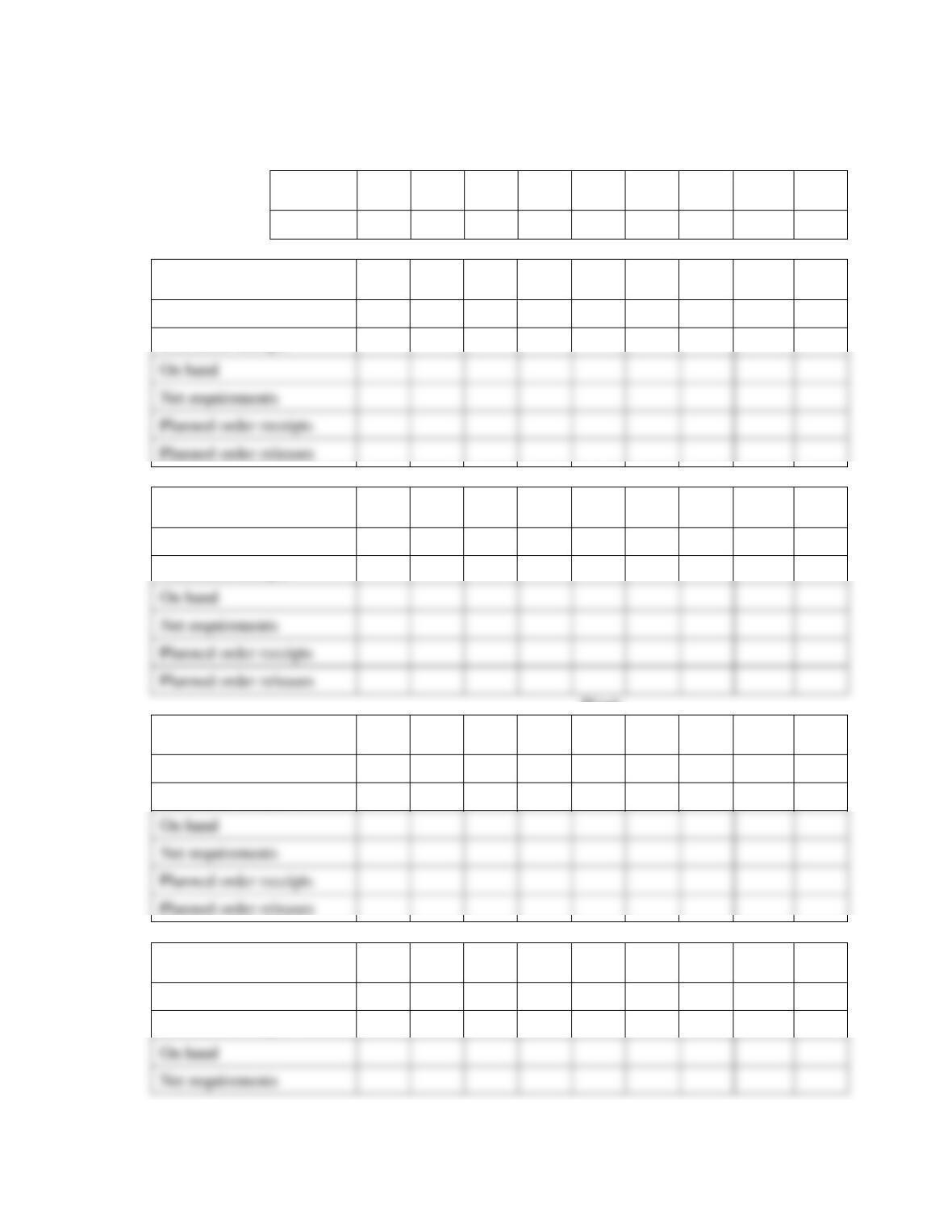
Master
Schedule for:
Week
Beg.
Inv.
1
2
3
4
5
6
7
8
Quantity
Week
Beg.
Inv.
1
2
3
4
5
6
7
8
Gross requirements
Scheduled receipts
Week
Beg.
Inv.
1
2
3
4
5
6
7
8
Gross requirements
Scheduled receipts
On hand
Net requirements
Planned order receipts
Planned order releases
Week
Beg.
Inv.
1
2
3
4
5
6
7
8
Gross requirements
Scheduled receipts
On hand
Net requirements
Planned order receipts
Planned order releases
Week
Beg.
Inv.
1
2
3
4
5
6
7
8
Gross requirements
Scheduled receipts
On hand
Net requirements
Net requirements
Planned order receipts
Planned order releases
Chapter 12 – MRP and ERP
12-8
Solutions
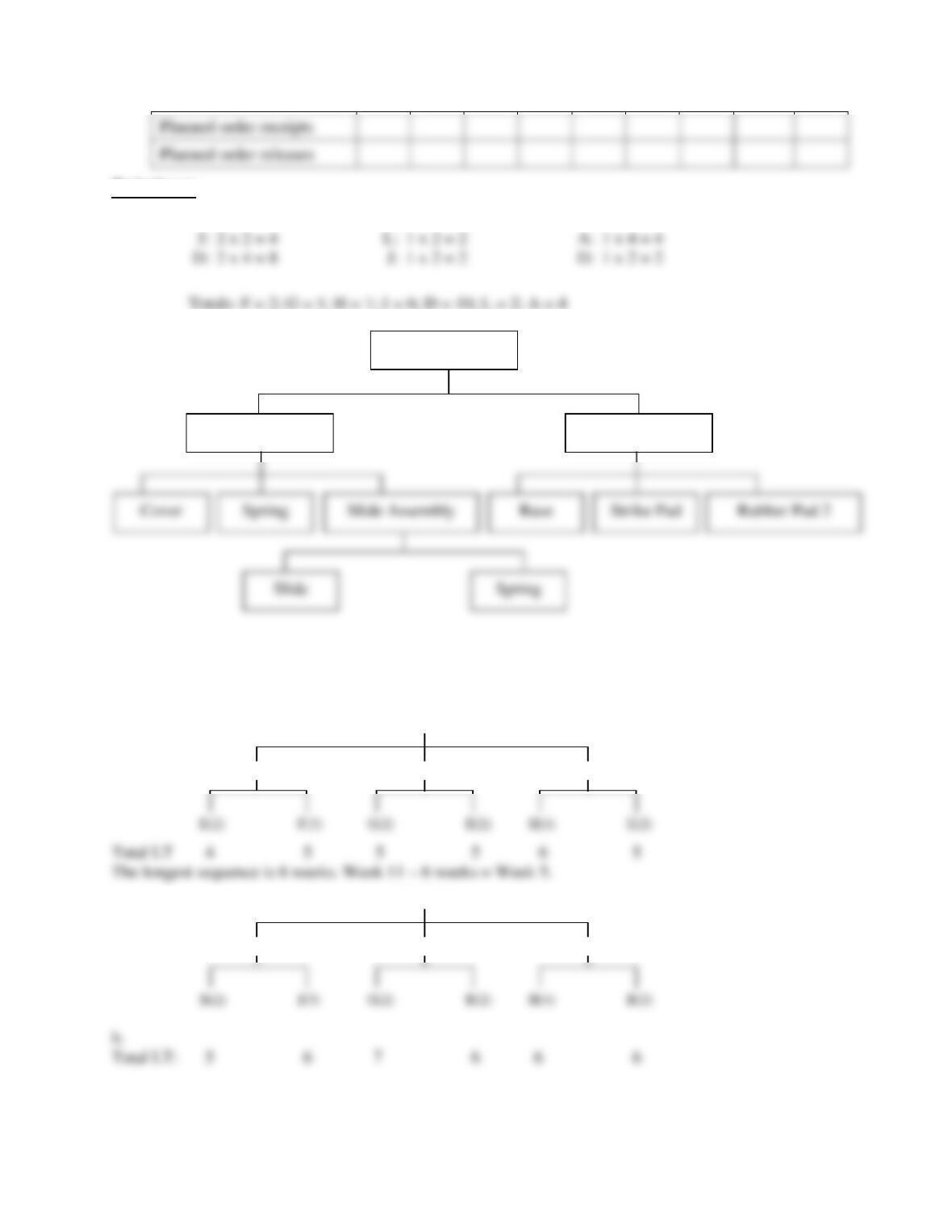
1. a.
F: 2
G: 1
H: 1
J: 2 x 2 = 4
L: 1 x 2 = 2
A: 1 x 4 = 4
D: 2 x 4 = 8
J: 1 x 2 = 2
D: 1 x 2 = 2
1. b.
Slide Assembly
2.
a.
B: 20 x 2 = 40 – 10 = 30
C: 20 x 1 = 20 – 10 = 10
D: 20 x 3 = 60 – 25 = 35
E: 30 x 2 = 60 – 12 = 48
E: 10 x 2 = 20
E: 35 x 2 = 70
Total: 48 + 20 + 70 = 138
b.
E(2) F(3) G(2) E(2) H(4) E(2)
3.
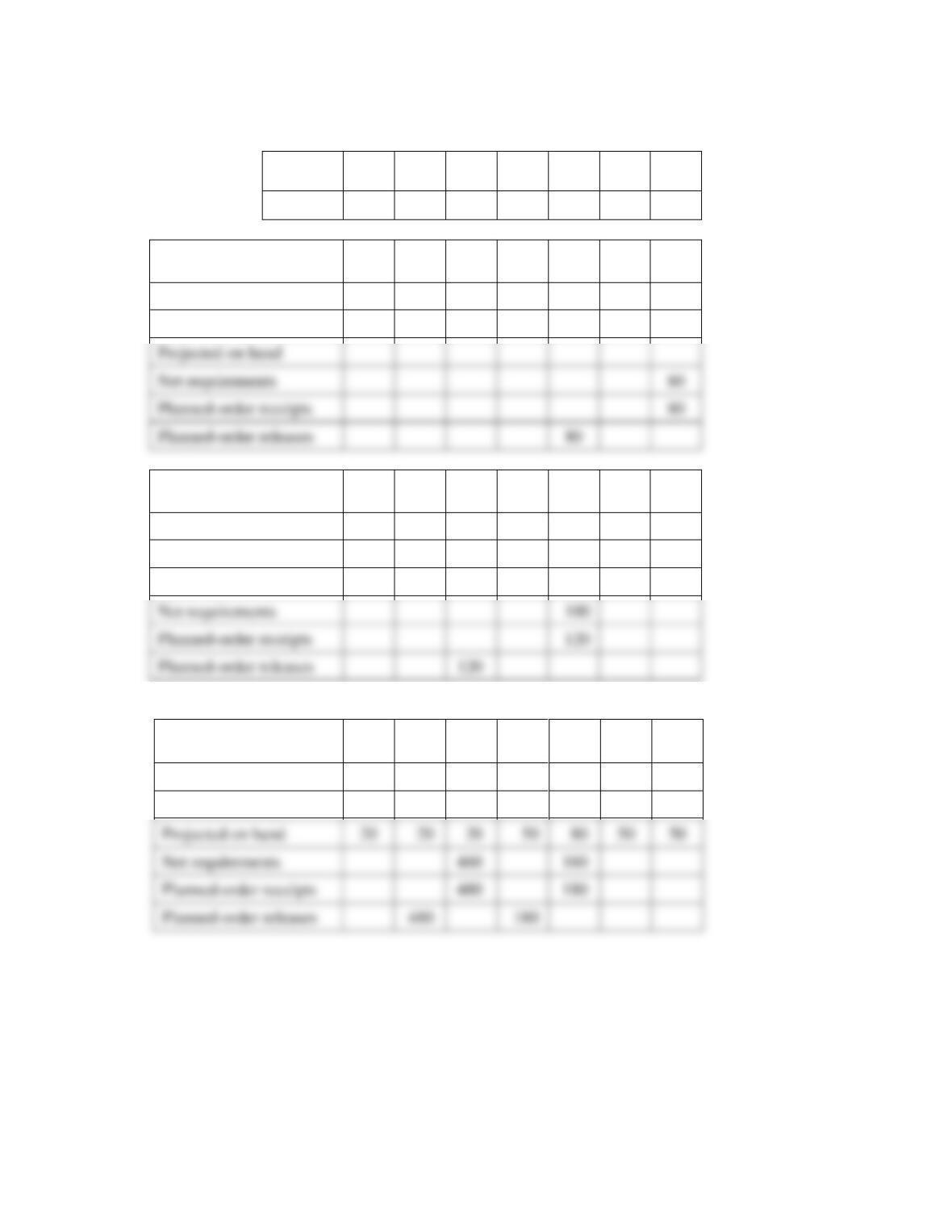
End Item
B(2)
C
D(3)
End Item
L(2)
C
K(3)
Stapler
Top Assembly
Base Assembly

Chapter 12 – MRP and ERP
12-9
The longest lead time is 7 weeks. Thus, 8 – 7 = 1, the beginning of week 1.
a.
L: 2 x 40 =
80
C: 1 x 40 =
40
K: 3 x 40 =
120
–10
–15
–20
70
25
100
B: 2 x 70 =
140
B: 2 x 25 = 50
B: 2 x 100 = 200
–30
110
Total: 110 + 50 + 200 = 360
Chapter 12 – MRP and ERP
12-10
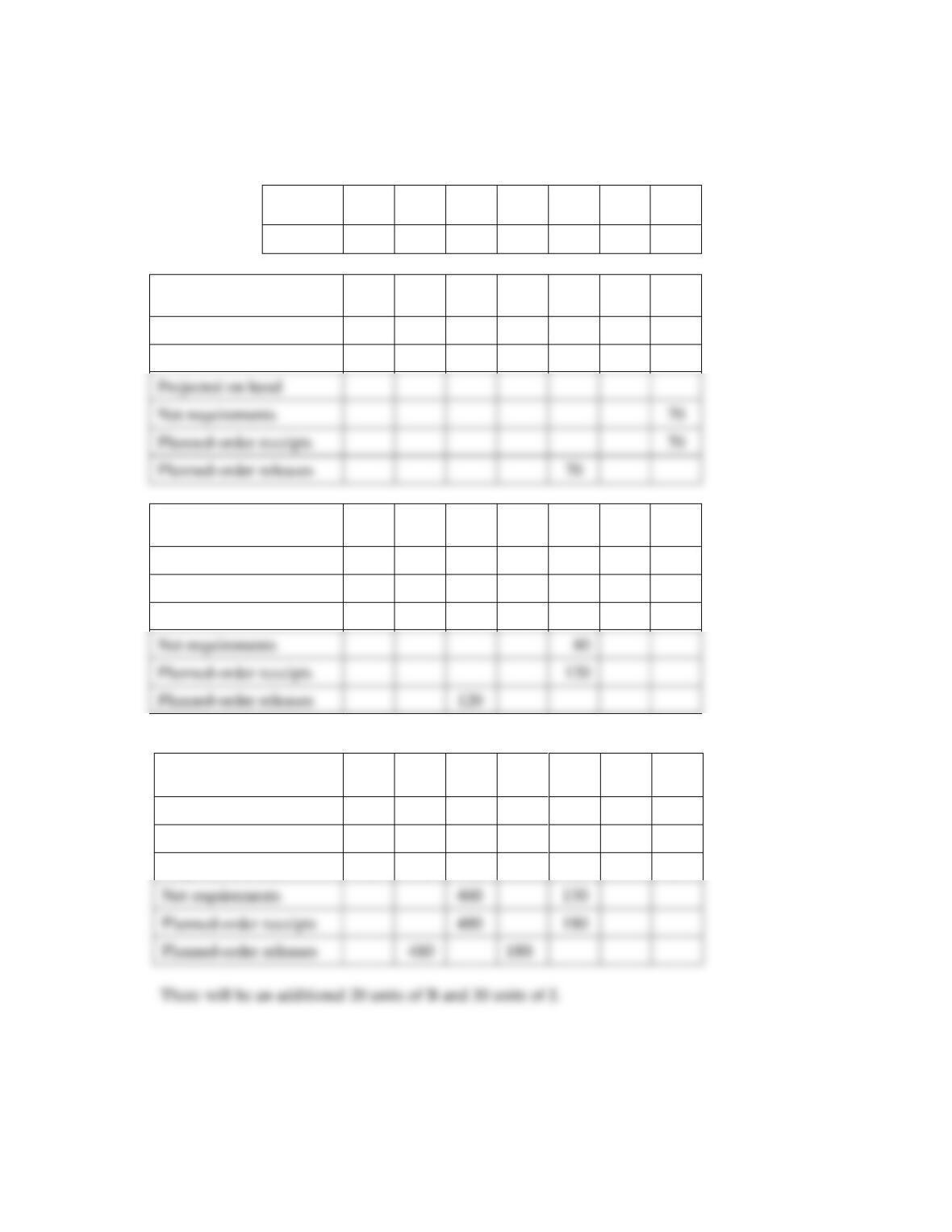
4. a.
Master
Schedule
Week
Beg.
Inv.
1
2
3
4
5
6
Quantity
80
E LT = 2 wks.
Beg.
Inv.
1
2
3
4
5
6
Gross requirements
80
Scheduled receipts
B(2) LT = 2 wks.
Beg.
Inv.
1
2
3
4
5
6
Gross requirements
160
Scheduled receipts
Projected on hand
60
60
60
60
60
20
20
Net requirements
100
Planned-order receipts
120
Planned-order releases
120
J(4) & J(3) LT = 1 wk.
Beg.
Inv.
1
2
3
4
5
6
Gross requirements
480
240
Scheduled receipts
30
30
30
Projected on hand
Net requirements
460
160
Planned-order receipts
480
180
Planned-order releases
480
Projected on hand
Net requirements
80
80
Planned-order releases
Chapter 12 – MRP and ERP
12-11
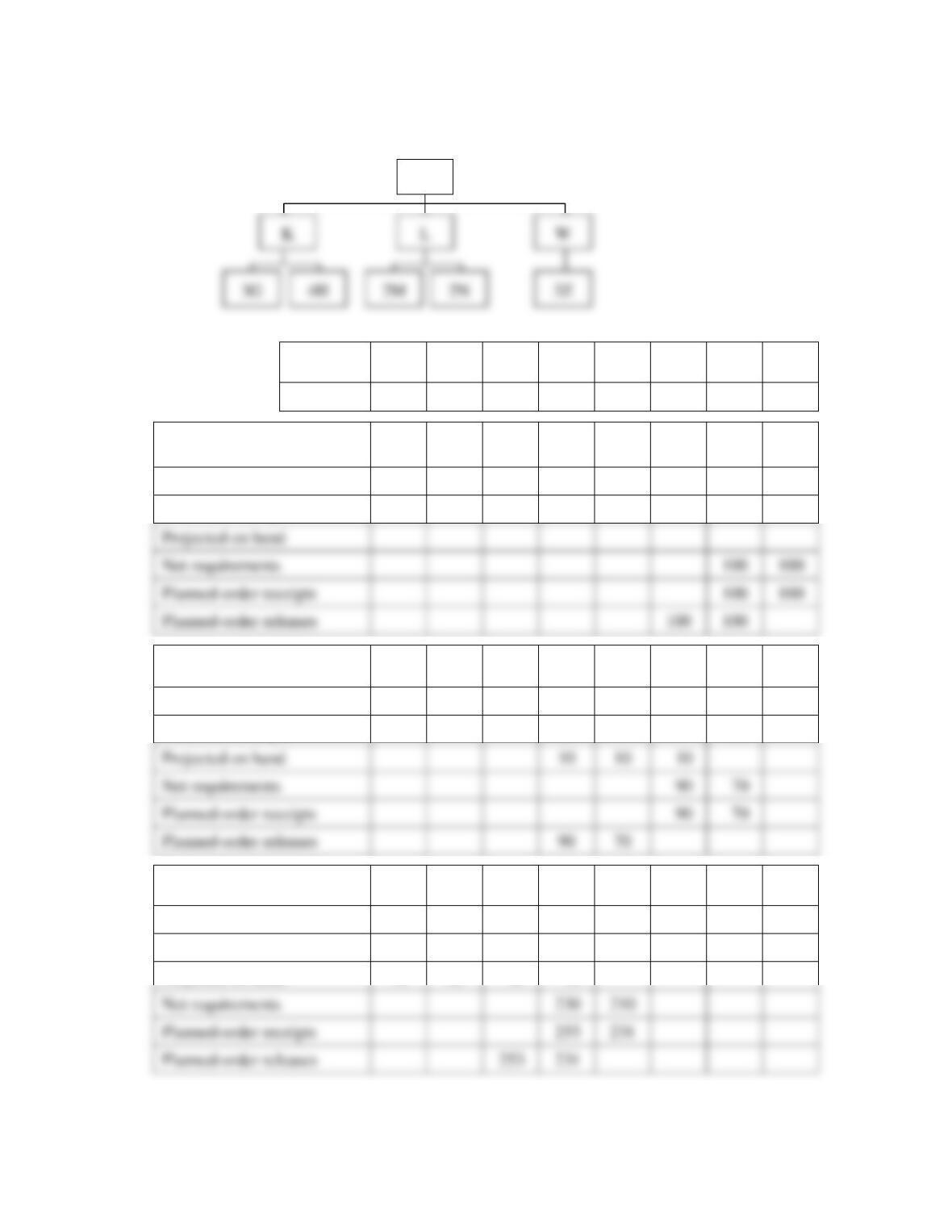
4. b.
Master
Schedule
Week
Beg.
Inv.
1
2
3
4
5
6
Quantity
70
E LT = 2 wks.
Beg.
Inv.
1
2
3
4
5
6
Gross requirements
70
Scheduled receipts
B(2) LT = 2 wks.
Beg.
Inv.
1
2
3
4
5
6
Gross requirements
140
Scheduled receipts
Projected on hand
60
60
60
60
60
40
40
Net requirements
80
J(4) & J(3) LT = 1 wk.
Beg.
Inv.
1
2
3
4
5
6
Gross requirements
480
210
Scheduled receipts
30
30
30
Projected on hand
20
20
20
50
80
80
80
Planned-order receipts
480
180
Projected on hand
Planned-order receipts
70
Planned-order releases
70
Chapter 12 – MRP and ERP
12-12
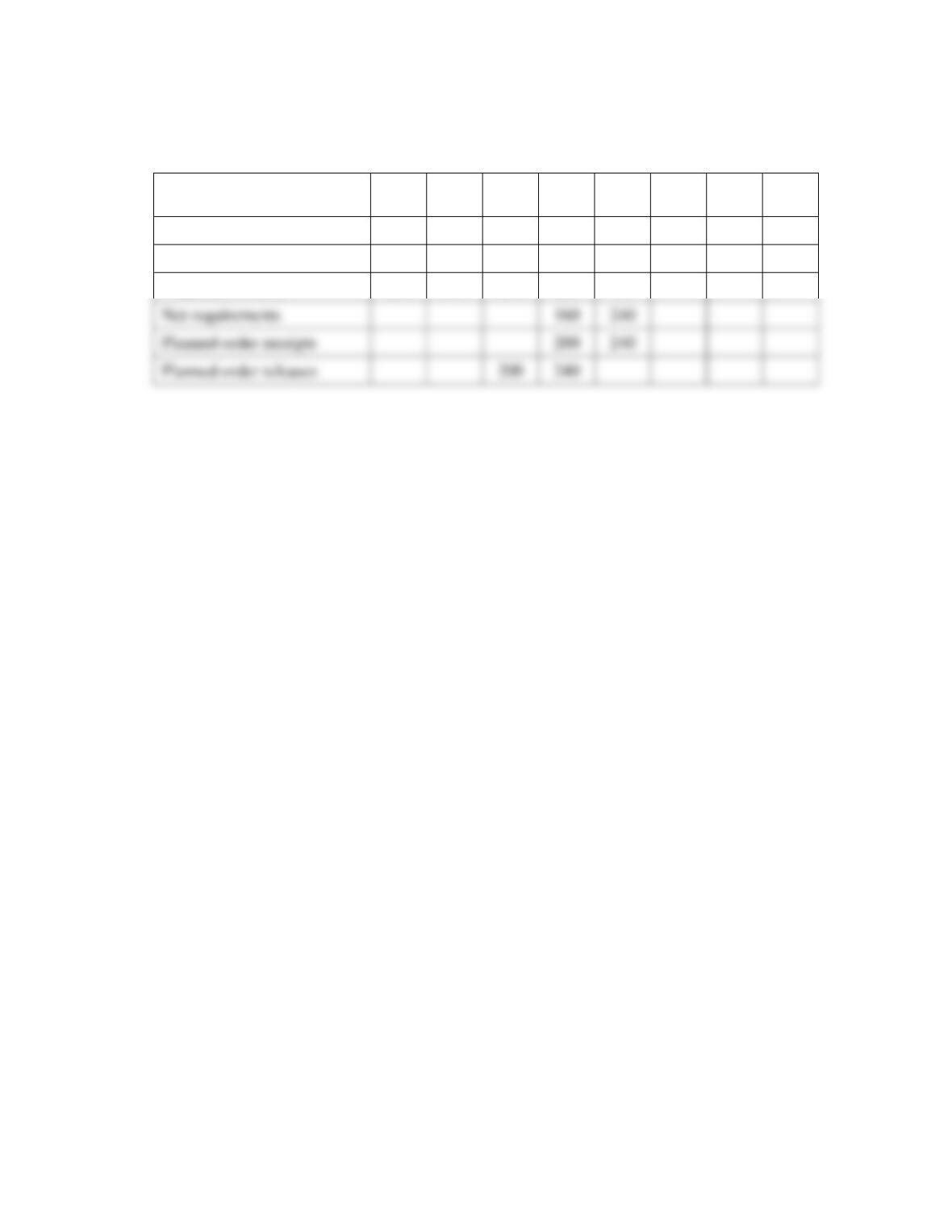
5. a. Product Structure Tree
c.
Master
Schedule
Weeks
Beg.
Inv.
1
2
3
4
5
6
7
Quantity
100
100
d.
P LT = 1 wk.
Beg.
Inv.
1
2
3
4
5
6
7
Gross requirements
100
100
Scheduled receipts
Projected on hand
Net requirements
100
100
Planned-order receipts
100
100
Planned-order releases
K LT = 2 wk.
Beg.
Inv.
1
2
3
4
5
6
7
Gross requirements
100
100
Scheduled receipts
10
30
Projected on hand
10
10
Net requirements
90
70
Planned-order receipts
90
70
Planned-order releases
90
70
G(3) LT = 1 wk.
Beg.
Inv.
1
2
3
4
5
6
7
Gross requirements
270
210
Scheduled receipts
Projected on hand
40
40
40
40
Net requirements
230
210
Planned-order receipts
253
231
Planned-order releases
253
231
P
L
Chapter 12 – MRP and ERP
12-13
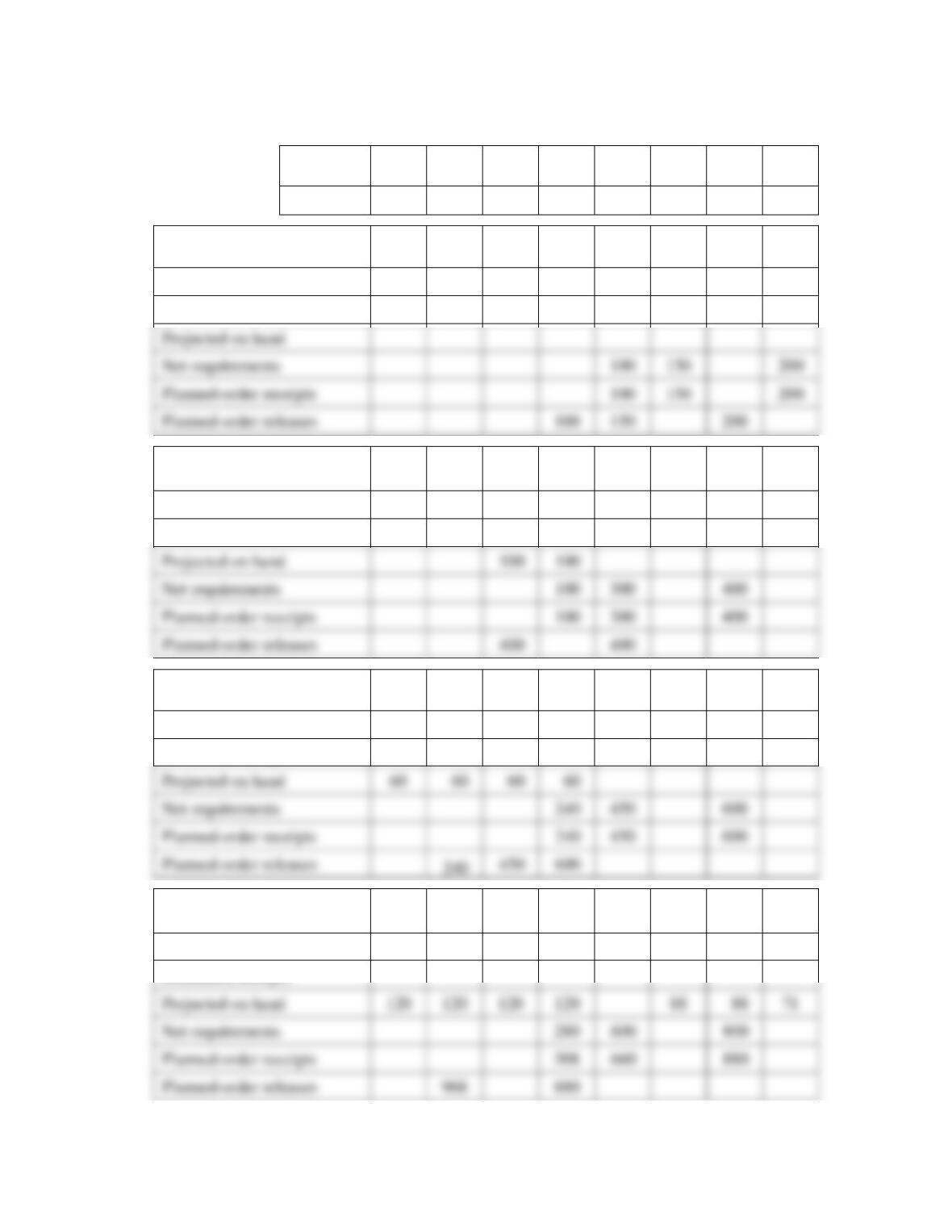
H(4) LT = 1 wk.
Beg.
Inv.
1
2
3
4
5
6
7
Gross requirements
360
280
Scheduled receipts
Projected on hand
200
200
200
200
40
Net requirements
160
240
Planned-order receipts
200
240
Chapter 12 – MRP and ERP
12-14
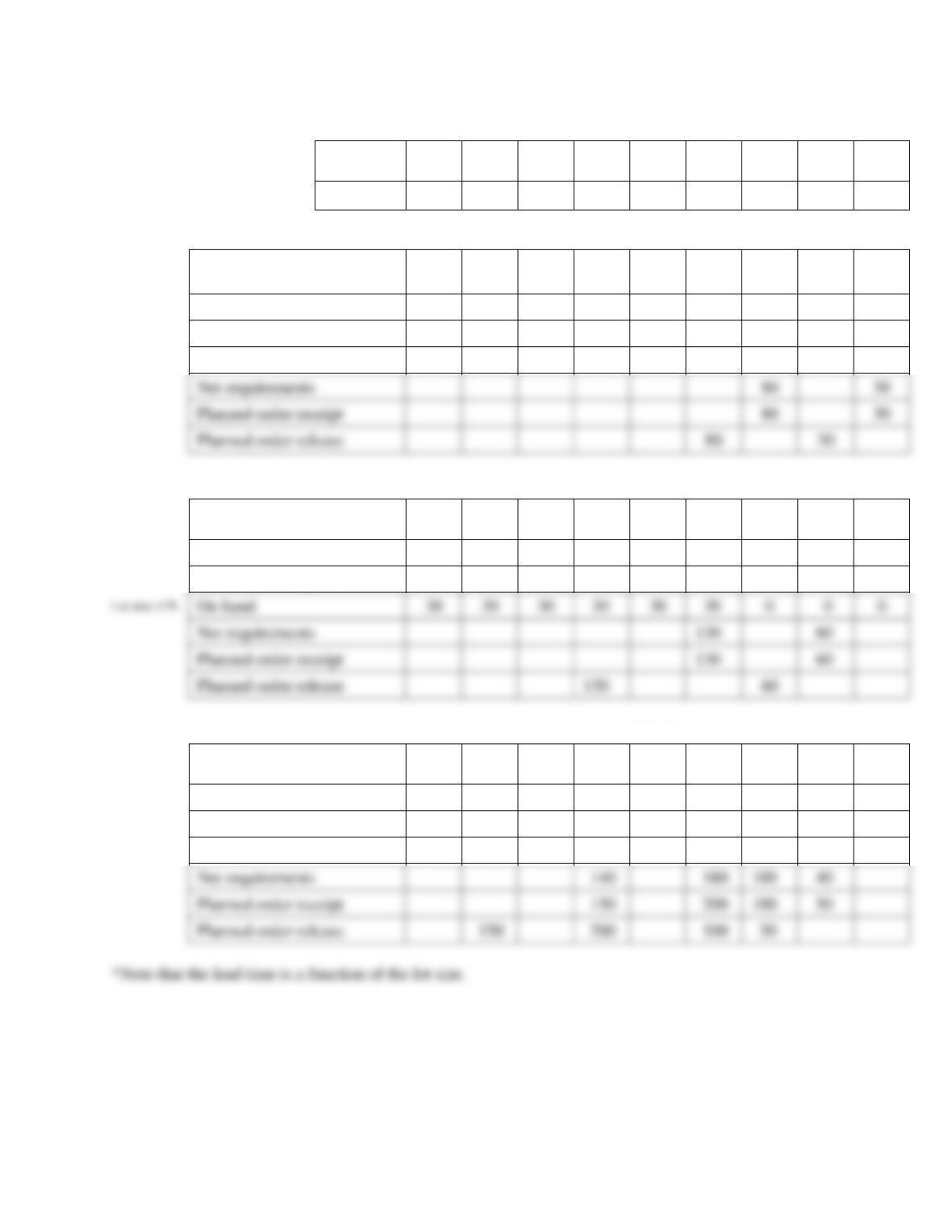
6.
Master
Schedule
Day
Beg.
Inv.
1
2
3
4
5
6
7
Quantity
100
150
200
Table
Beg.
Inv.
1
2
3
4
5
6
7
Gross requirements
100
150
200
Scheduled receipts
Wood Sections
Beg.
Inv.
1
2
3
4
5
6
7
Gross requirements
200
300
400
Scheduled receipts
100
Projected on hand
100
100
Net requirements
Planned-order receipts
100
300
400
Planned-order releases
400
400
Braces
Beg.
Inv.
1
2
3
4
5
6
7
Gross requirements
300
450
600
Scheduled receipts
Projected on hand
Net requirements
240
450
600
Planned-order receipts
240
450
600
Planned-order releases
Legs
Beg.
Inv.
1
2
3
4
5
6
7
Gross requirements
400
600
800
Scheduled receipts
Projected on hand
120
120
120
120
Net requirements
280
600
800
Planned-order receipts
308
660
880
Planned-order releases
968
880
Projected on hand
Net requirements
100
150
200
Planned-order receipts
100
150
200
Planned-order releases
Chapter 12 – MRP and ERP
12-15
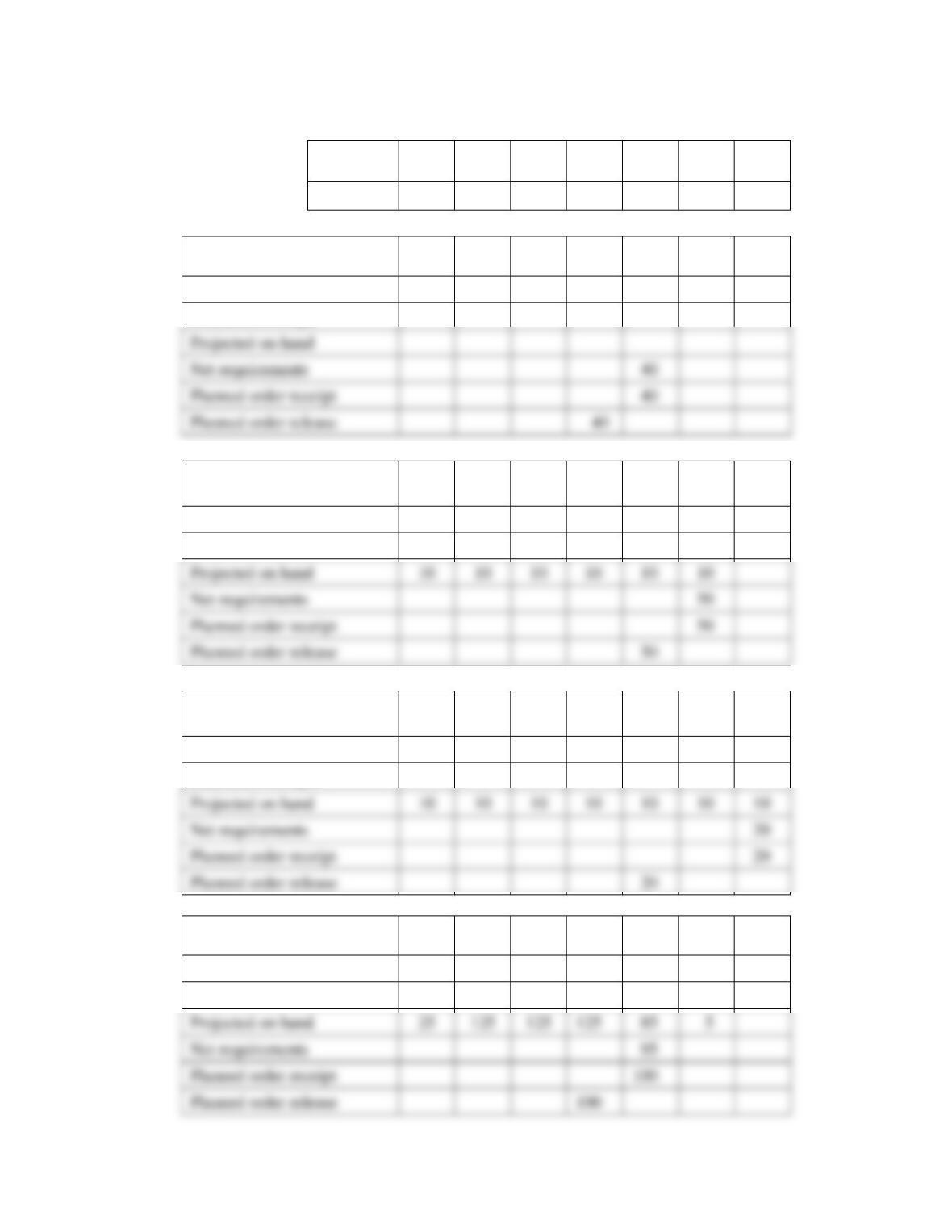
7.
Master
Schedule for: X
Week
Beg.
Inv.
1
2
3
4
5
6
7
8
Quantity
80
30
Week
Part X
Beg.
Inv.
1
2
3
4
5
6
7
8
Gross requirements
80
30
Lot size: LFL
Scheduled receipts
On hand
Week
Part B
Beg.
Inv.
1
2
3
4
5
6
7
8
Gross requirements
160
60
Scheduled receipts
On hand
30
30
Planned order receipt
130
60
Planned order release
130
Week
Part D
Beg.
Inv.
1
2
3
4
5
6
7
8
Gross requirements
260
240
120
90
Lot size = 50
Scheduled receipts
50
50
50
50
On hand
20
70
70
120
10
60
20
0
10
Net requirements
140
180
100
40
Planned order receipt
150
200
100
50
Planned order release
150
200
100
50
Net requirements
80
30
Planned order receipt
80
30
Planned order release
Chapter 12 – MRP and ERP
12-16
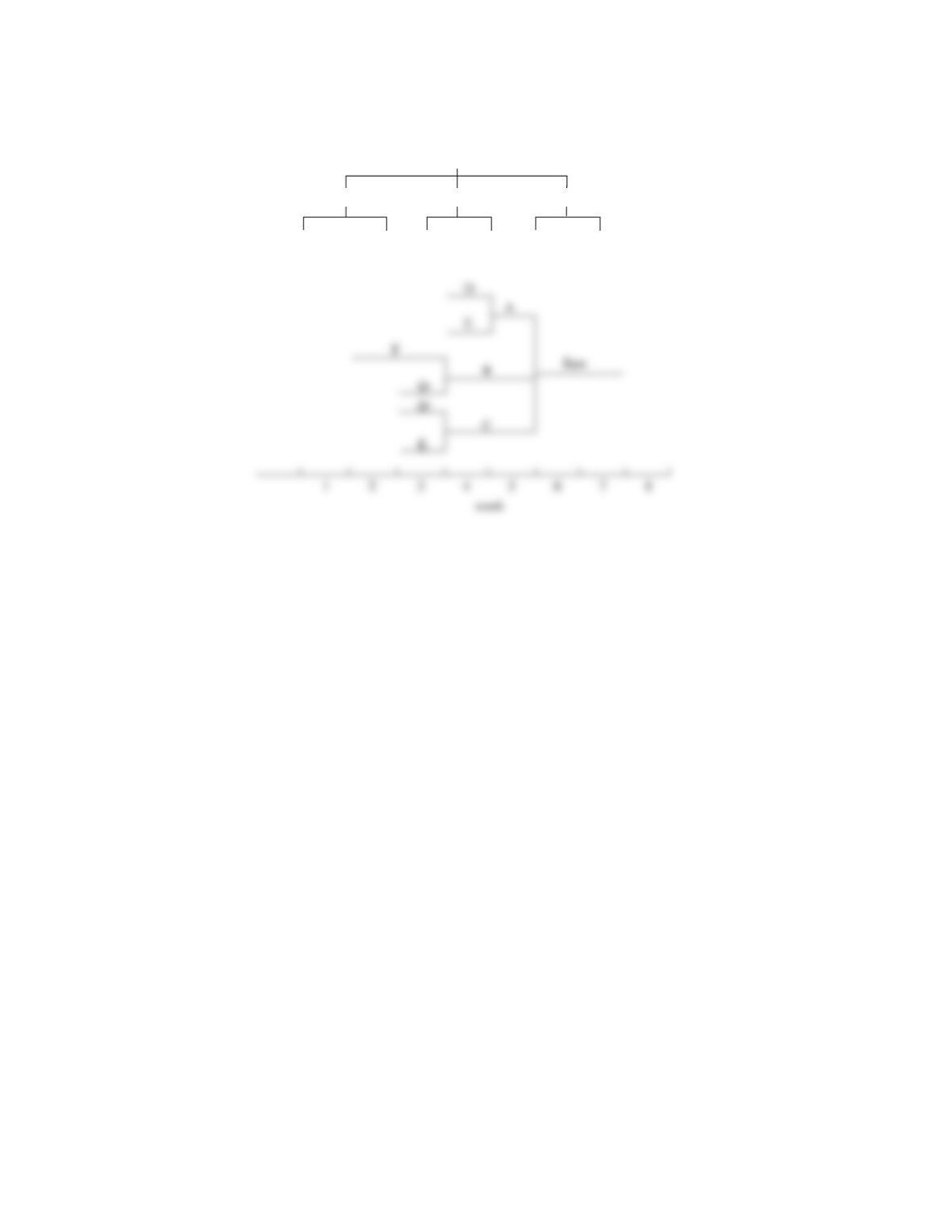
8.
Master
Schedule
Week
Beg.
Inv.
1
2
3
4
5
6
Quantity
40A
60B
30C
A LT = 1 wk.
Beg.
Inv.
1
2
3
4
5
6
Gross requirements
40
Scheduled receipts
B LT = 1 wk.
Beg.
Inv.
1
2
3
4
5
6
Gross requirements
60
Scheduled receipts
Projected on hand
10
10
10
Net requirements
50
Planned order receipt
50
Planned order release
50
C LT = 2 wks.
Beg.
Inv.
1
2
3
4
5
6
Gross requirements
30
Scheduled receipts
Projected on hand
10
10
10
10
Net requirements
20
Planned order receipt
20
Planned order release
20
D LT = 1 wk.
Beg.
Inv.
1
2
3
4
5
6
Gross requirements
40
180
Scheduled receipts
100
Projected on hand
125
85
Net requirements
95
Projected on hand
Net requirements
40
Planned order receipt
40
Planned order release
Chapter 12 – MRP and ERP
12-17
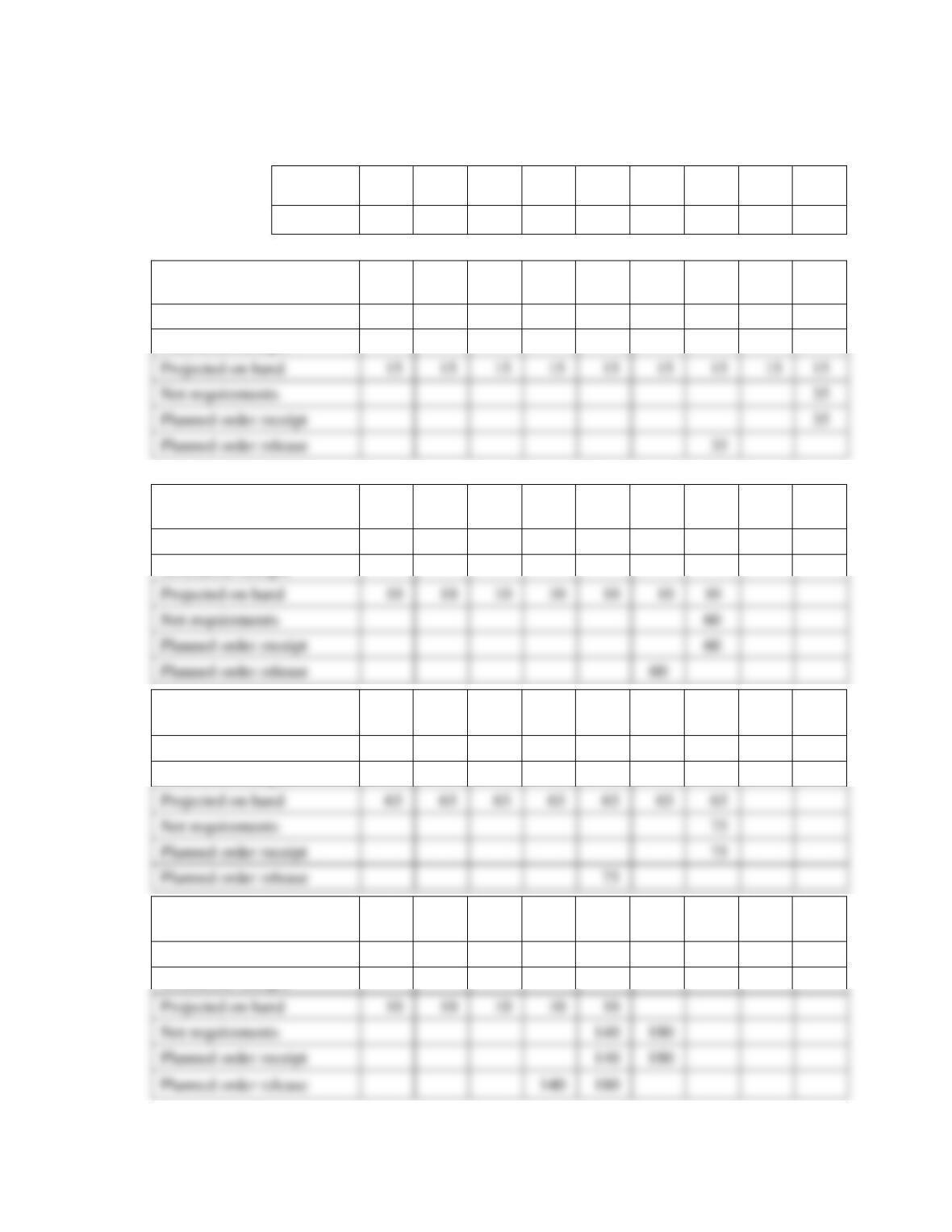
9.
Saw
A(2)
B
C(4)
E(3) D D(2) F(3) E(2) D(2)
Saw
E
E
D
D
F
Chapter 12 – MRP and ERP
12-18
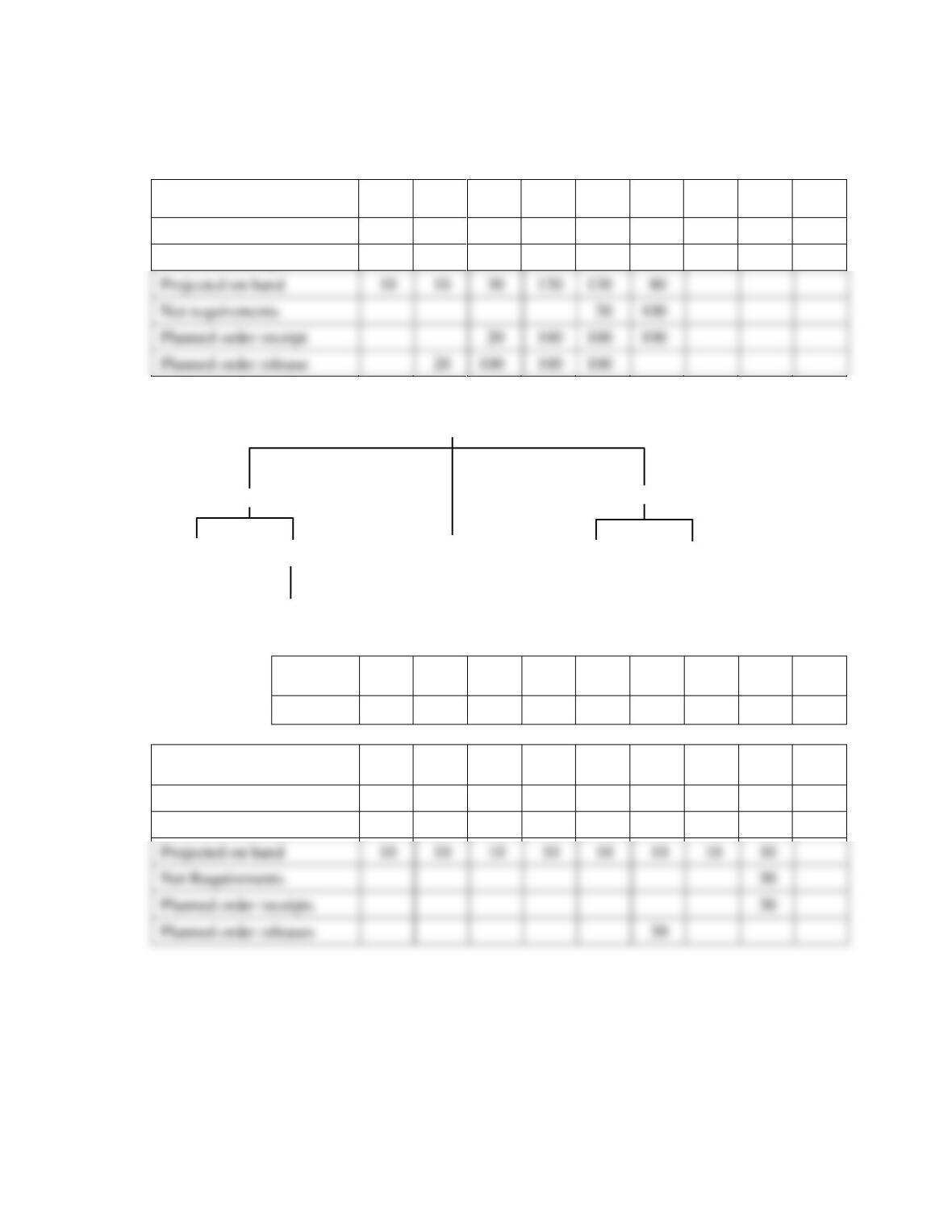
9. (continued)
Master
Schedule for
Saws
Week
Beg.
Inv.
1
2
3
4
5
6
7
8
Quantity
50
Week
Item: Saw LT = 2 wks.
Beg.
Inv.
1
2
3
4
5
6
7
8
Gross requirements
50
Scheduled receipts
Week
Item: A(2) LT = 1 wk.
Beg.
Inv.
1
2
3
4
5
6
7
8
Gross requirements
70
Scheduled receipts
Projected on hand
10
Net requirements
60
Planned order receipt
60
Planned order release
60
Item: C(4) LT = 2 wks.
Beg.
Inv.
1
2
3
4
5
6
7
8
Gross requirements
140
Scheduled receipts
Projected on hand
Net requirements
Planned order receipt
Planned order release
Item: E(3) & E(2) LT = 1 wk.
Beg.
Inv.
1
2
3
4
5
6
7
8
Gross requirements
150
180
Scheduled receipts
Projected on hand
Net requirements
Planned order receipt
140
180
Projected on hand
15
Net requirements
Planned order receipt
35
Planned order release
Chapter 12 – MRP and ERP
12-19
9. c.
E LT = 1 wk.
Beg.
Inv.
1
2
3
4
5
6
7
8
Gross requirements
150
180
Scheduled receipts
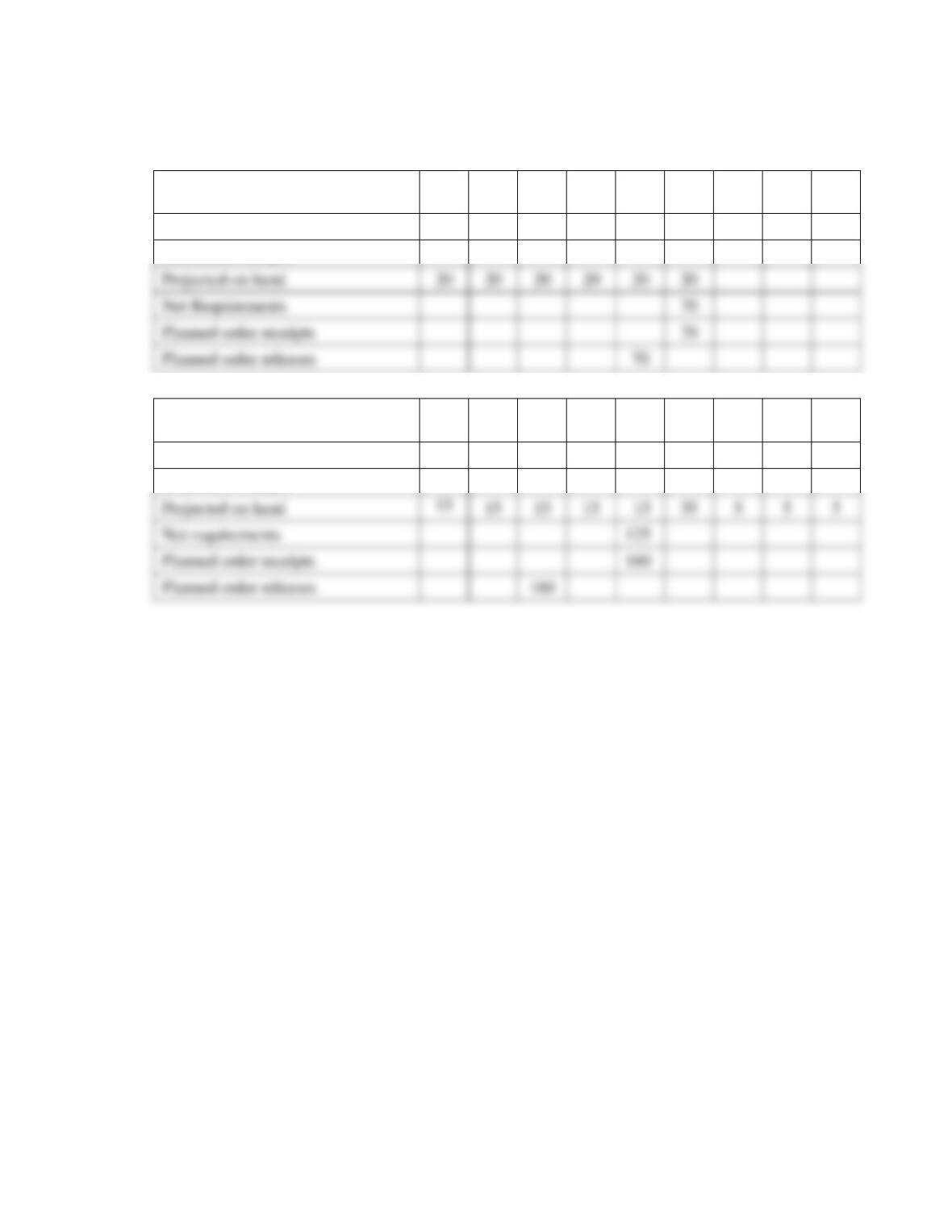
10.
Master
Schedule for
Robot
Week
Beg.
Inv.
1
2
3
4
5
6
7
8
Quantity
40
Item: Robot LT = 2 wks.
Beg.
Inv.
1
2
3
4
5
6
7
8
Gross requirements
40
Scheduled Receipts
Projected on hand
Net Requirements
Planned order receipts
Planned order releases
Robot
E F G G(2) H
B
C(3)
I
Projected on hand
130
Net requirements
100
Planned order receipt
100
100
Planned order release
100
100
Chapter 12 – MRP and ERP
12-20
10. (continued)
Item: C(3) LT = 1 wk.
Beg.
Inv.
1
2
3
4
5
6
7
8
Gross requirements
90
Scheduled receipts
Item: G(2C + 1 Robot) LT = 2 wks.
Beg.
Inv.
1
2
3
4
5
6
7
8
Gross requirements
140
30
Scheduled receipts
Projected on hand
15
15
15
35
Net requirements
125
Planned order receipts
160
Planned order releases
Projected on hand
20
20
20
20
20
20
Net Requirements
70
Planned order receipts
70
Planned order releases
70