54
R Q Average cost/day (averaged over 20 replications)
6 16 $12.08
6 17 $13.56
So a reorder point of 7 and reorder quantity of 18 seems to provide the lowest average
cost.
Teaching Note: Margate Hospital
Overview
The objective of this case is to expose students to ABC analysis in a non-manufacturing
operating environment. How ABC analysis is done in goods-producing firms is not always 100%
transferable to hospitals. A stockout of a C item can hurt the health of a patient and in extreme
circumstances cause the patient’s death. ABC analysis is used here to help control hospital
Case Questions for Discussion:
1. Using the case data, propose a breakdown for an ABC analysis, and clearly outline how
each category of items might be managed by the hospital. (Use the Excel ABC template in
MindTap.)
The ABC analysis using the Excel ABC template available in MindTap is as follows. Students have
two ways to handle the three critical inventory items. First, they can recommend managing the
55
Projected Projected Cumulative Cumulative Cumulative
Item Usage Dollar Usage Dollar Percent Percent
Number Annual Unit Cost Annual Usage of Total of Items
3 117 50.00$ $5,850.00 $5,850 18.41% 5%
8 27 210.00$ $5,670.00 $11,520 36.25% 10% Critical
1 212 24.00$ $5,088.00 $16,608 52.26% 15%
5 60 58.00$ $3,480.00 $20,088 63.21% 20%
6 48 55.00$ $2,640.00 $22,728 71.52% 25%
17 3 8.00$ $24.00 $31,778 100.00% 100%
Total $31,778.00
One possible ABC breakdown including critical SKUs is as follows:
• The first seven SKUs have a dollar annual usage above $2,000 so those are set as A
items. This is SKUs #3, 8, 1, 5, 6, 7, and 4. Item #8 is a critical item with annual usage of
Students will develop different breakpoints for A, B, and C items and that is fine as long as
there is some logic to the categories. The logic for the above breakdown is that by carefully
controlling the 7 A SKUs, you control 86% of the inventory. The other 13 SKUs are only 14%
of total SKUs. The fact that the students did an ABC analysis with fairly good logic is the
objective of this question.
56
If students decide to separate “critical” SKUs from the ABC analysis and create a fourth
category, ask them,
• “What criteria and process controls allow an SKU to be categorized as “critical?”
By the way, most health care inventory control systems have 3 to 10 inventory classification
categories whereas goods-producing applications have less.
2. How do you recommend managing these ABC and critical inventory categories?
As noted in the chapter, what types of inventory control system or management practice is best to
manage an inventory category is based on science and human judgment.
• Class A items should be monitored closely and stock replenishments should be weekly or
more frequently (i.e., daily, twice a week; Monday, Wednesday and Friday). This is more of a
fixed period model but one can argue that a fixed quantity system monitors SKUs closely.
Inventory analysts, buyers, nurses, and managers (people) normally monitor A items. And if
this is done well, then 86% of your inventory value is under control!
The best solution is probably to exclude critical SKUs from ABC analysis and have very strict
controls on when an SKU can be assigned such a critical classification (double approvals, critical
3. Can you think of any other inventory management systems besides health care where
some SKUs might be defined as “critical”?
57
Airline parts inventory — sometimes stock outs of critical SKUs such as a special alloy bolt
can stop an airplane from operating. Substitute bolts are not designed for the stress and
force of a flying airplane.
Teaching Plan
You may have two or three at most student teams present their case reports to the class or
handle the case in-class discussion yourself. A possible teaching plan is as follows:
(1) Ask a student to explain the concept of ABC analysis.
(2) How did you apply ABC analysis to these data? (Possibly show and defend their solution in
class) Explain.
Teaching Note: Hardy Hospital
Overview
A university and university hospital’s materials management systems are interdependent and
neither is under control. The ordering and inventory control system experienced stock outs on
some items, excessive inventory on other items, multiple stocking points throughout the hospital
and university with no assigned process or inventory item owner, used a paper-based system,
58
Case Questions for Discussion:
1. What are good estimates of order cost and inventory-holding cost? (State all assumptions
and show all computations.)
Problems 47 and 48 help prepare students for this question.
Order cost estimate = $18.00 per order
Inventory Carrying Cost = 27.24% if item value
Ask an accounting major to develop these costs in class. The topic of what types of costs do the
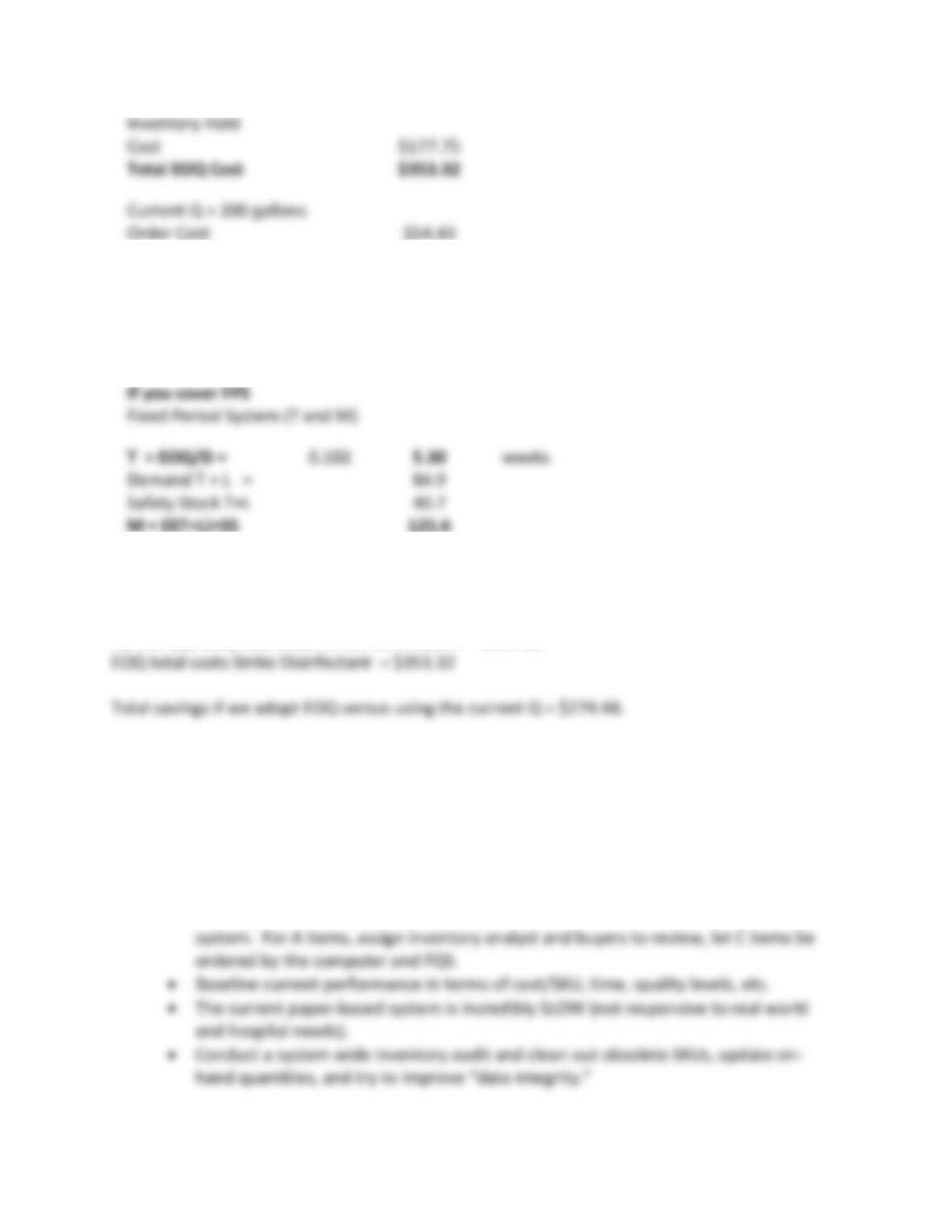
2. What is the EOQ and reorder point with safety stock for Strike Disinfectant given your
answer to question 1?
Use the data in Exhibit 12.29.
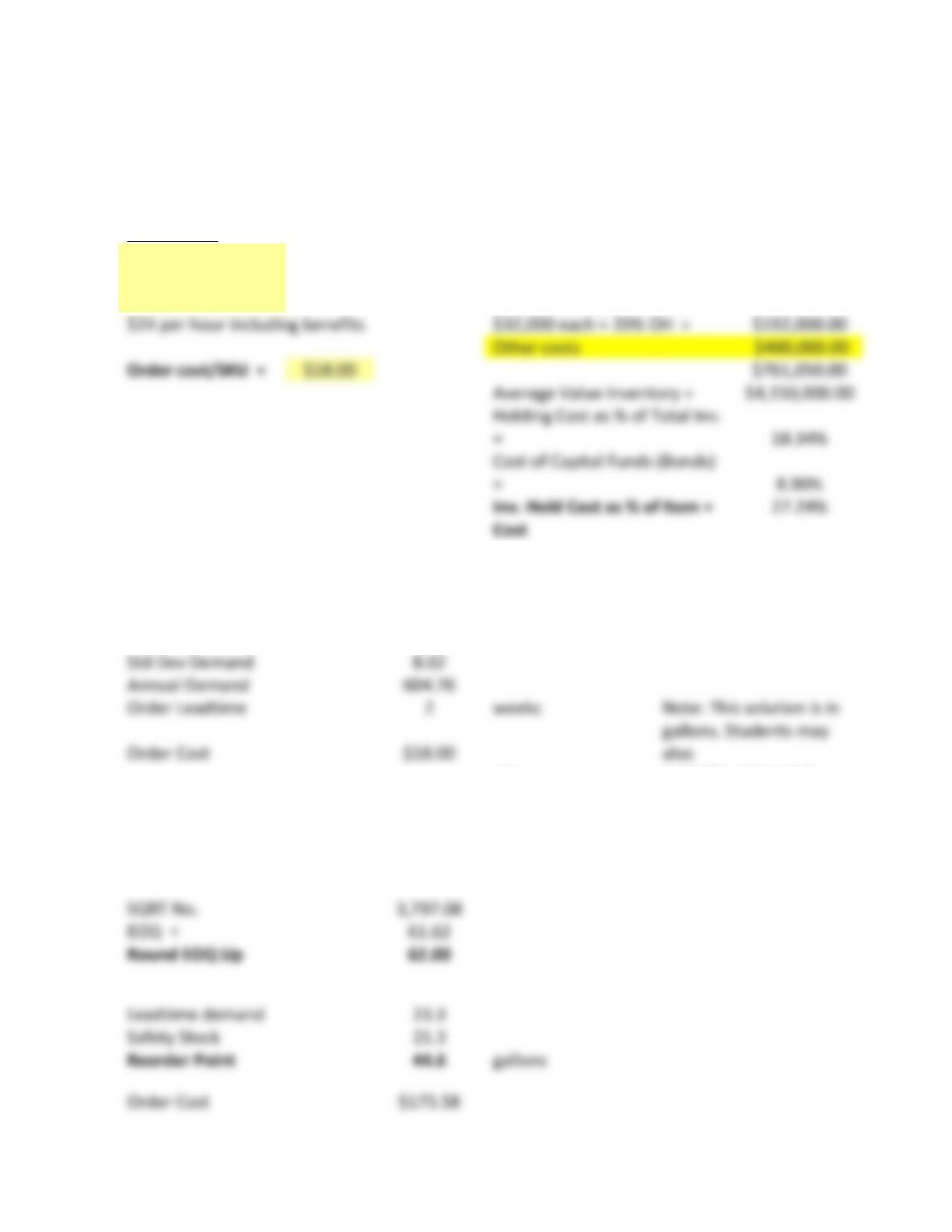
EOQ =2DCo
Ch
=(2(11.63)(52)($18.00)
(.2724)($21.05)
= 61.62 gallons
59
Hardy Hospital Case
Order Costs
Inventory Holding Cost
3 labor hours per
P.O.
36,750 sq ft @ $4.60/sq ft. =
$169,050.00
4 SKUs per P.O.
$24 per hour including benefits
$32,000 each + 20% OH =
$192,000.00
Other costs
Order cost/SKU =
$761,050.00
Average Value Inventory =
$4,150,000.00
Holding Cost as % of Total Inv.
Cost of Capital Funds (Bonds)
Inv. Hold Cost as % of Item =
Cost
5 warehouse personnel @
Strike Disinfectant
Current Order Quantity
200
Weeks/Year
52
Weekly Demand
11.63
Std Dev Demand
8.02
Annual Demand
604.76
Order Leadtime
weeks
Note: This solution is in
Order Cost
$18.00
gallons. Students may
Item Value ($84.20/4 Gallons)
$21.05
per
gallon
work the case out in
cases.
Inv. %
0.2724
Cycle Service Level
97.00%
Z-Value
1.88
SQRT No.
EOQ =
Round EOQ Up
Leadtime demand
Safety Stock
21.3
Reorder Point
gallons
Order Cost
60
Cost
$177.75
Total EOQ Cost
$353.32
Current Q = 200 gallons
Order Cost
Inventory Hold
Cost
$573.37
Current Q Total
Cost
$627.80
If Adopt EOQ Save
$274.48
If you cover FPS
Fixed Period System (T and M)
T = EOQ/D =
Demand T + L =
Safety Stock T+L
M = D(T+L)+SS
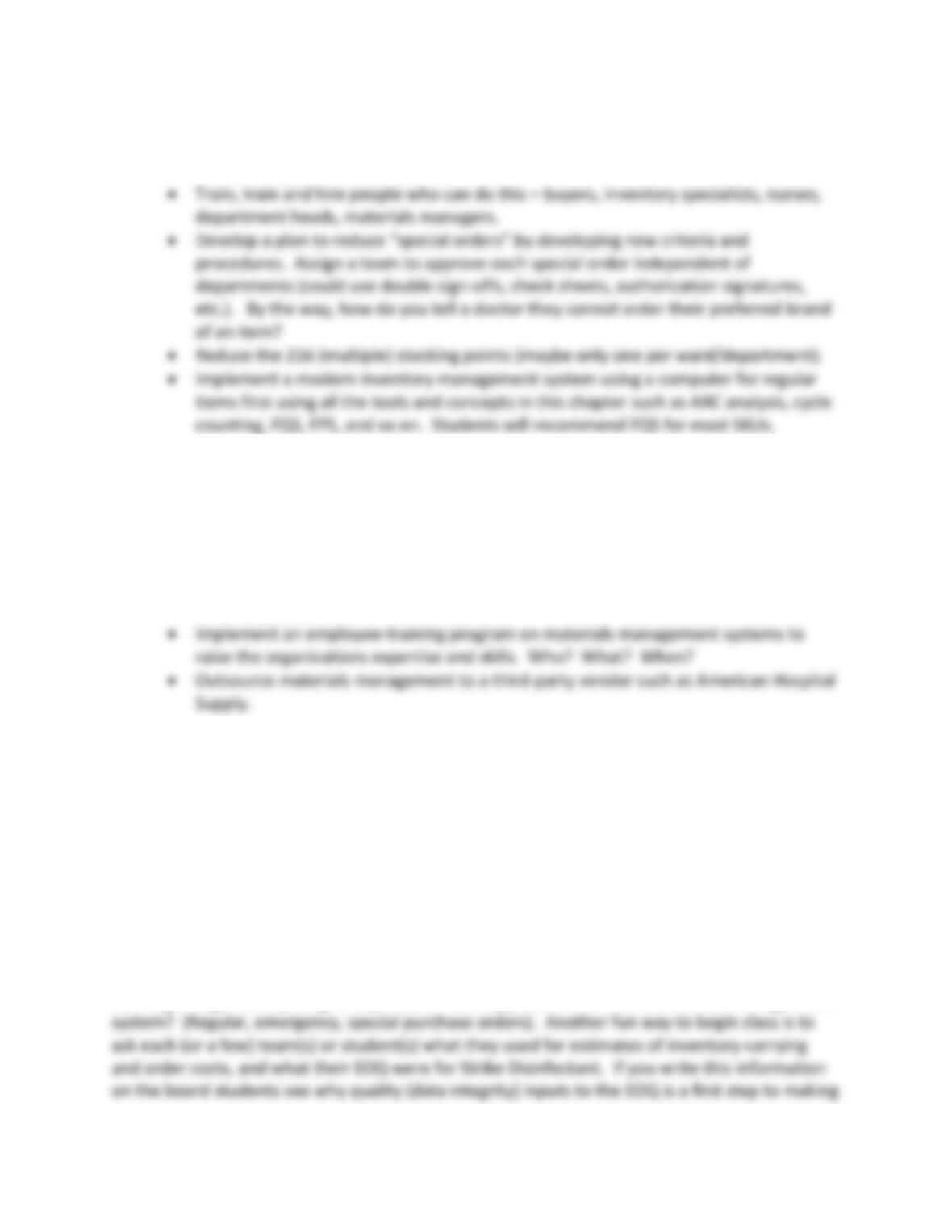
3. Compute the total order and inventory-holding costs for a fixed-quantity system (FQS)
and compare to the current order Q’s. Can you save money by adopting an FQS?
Current (Q=200) total costs Strike Disinfectant = $627.80
4. What are your final recommendations, including what you would recommend regarding
regular and special orders, the state bidding system, and overall control of the university
materials-management system? Explain the reasoning for your recommendations.
Typical recommendations (not in any particular order) include:
• This materials management system is totally out of control!
• Immediately do an ABC analysis to understand where inventory value resides in the
61
• How can they keep the state bidding system from being by-passed? Change state
system so a team (committee) reviews each order request and/or improve the
processes speed of delivery, etc.
• Reevaluate key buying and stocking processes making use of Chapter 7 and 10
concepts and tools to find bottlenecks, improve processing time, flowchart work
flow, etc. Understand work and order flow (flowchart, study).
• Train purchasing managers on latest methods such as negotiation, price breaks,
hedging, and so on.
• Begin to build a common database with uniform purchase order formats, data
formats, and controls for improved data integrity. Data integrity is the key to good
inventory decisions.
Undergraduate students will identify few of the “managerial issues or ways to improve” — they
simply do not have the experience — you will have to lead this class discussion. The following
spreadsheet answers many of the previous questions. What-if scenarios can be studied in class
or as an extra assignment.
Teaching Plan
The case is about Control versus Cost versus Service versus Liability. Ask your students, what if
the hospital stock out of a SKU and hurts a patient or if the patient dies due to lack of
inventory? Answer the four case questions with special emphasis on getting good estimates of
order and inventory holding costs.
You might begin class posing this question? Who approves what in this materials management
62
Integrative Case: Hudson Jewelers
A complete teaching note for all chapters is available in the Instructor Resources online.
Instructors should read the entire case and most of the case assignments at the end of each
chapter. Then decide if you want to assign all or part of the case questions.
Chapter 12 Case Questions for Discussion:
1. Research global supply and demand for diamonds and how it affects prices. What role do
“diamond reserves” (inventory) play in determining prices? Explain. What do you think
the demand-supply curves for diamonds looks like? Try to sketch it out.
In 2013 global diamond jewelry reached its record high of $79 billion, with demand forecasted
to continually grow into the second half of the 21st century. The diamond producers are a
What would happen if all diamond reserves flooded the marketplace? Prices would drop
greatly!
Ask the students, “How is the Internet changing the demand – supply balance in the global
diamond business? Is it disrupting the industry? How? And, of course, the answer is yes it is
changing the diamond industry and slowly breaking up the diamond cartel. Students are
surprised by the hold back of diamond inventories from the marketplace, so be prepared for
discussions of “Is this legal?” “Is this ethical?”
Also, note that existing diamonds are 100% recyclable so they reenter the global market place
63
64
Inelastic demand – The percentage change in quantity demanded is less than the percentage
change in price. Quantity demanded changes proportionately less than price changes. For
example, a 10% increase in price causes, say, a 5% reduction in quantity demanded.
2. What are the detailed components of inventory holding costs in this situation? What
other factors might influence holding costs, such as security costs, obsolescence costs, and
others. What is your estimate of inventory carrying costs as a percentage of item value?
Explain your reasoning.
Sources of the components of inventory carrying (holding) costs are the textbook plus what
students might search for via the Internet. The components are as follows:
• Cost of capital — money tied up in inventory, the opportunity cost of putting these funds to
other uses, interest rates from loans, revolving credit, bonds, and the weighted cost of
capital from the firm’s balance sheet.
65
other metals that can be melted and recycled.
As the jewelry store does more and more customized jewelry and CAD co-designs, ICC is lower
(i.e., less inventory in the store than traditional jewelers). A more make-to-stock jeweler with
little or zero customization would tend to have higher ICC.