Instructor’s Manual – OMSC2 – Collier/Evans – C12 Managing Inventories in Supply Chains
This chapter introduces students to basic inventory models and concepts. This includes
understanding types of inventories, key decisions, and costs; major characteristics that impact
inventory decisions; ABC analysis; fixed-order-quantity systems, the EOQ model, quantity
discounts, and safety stock models; fixed-period inventory systems; the single-period inventory
model; and Excel-based simulation models for fixed-order quantity systems.
Questions and problems are provided in four categories:
1. Review questions
2. Discussion questions and experiential activities
The chapter has three cases:
1. Margate Hospital focuses on ABC analysis in a health care setting. The case confronts
students with “critical” stock keeping units that may be “C” items from a pure economic
2. Hardy Hospital involves computing order cost and inventory carrying cost from accounting
3. The integrative case study, Hudson Jewelers, with case assignment questions in all chapters,
asks students to define the role of diamond inventory in the global supply chain and how it is
2
KEY TERMS
A backorder occurs when a customer is willing to wait for the item.
Demand that varies over time is referred to as dynamic demand.
The economic order quantity (EOQ) model is a classic economic model developed in the early
1900s that minimizes the total cost, which is the sum of the inventory-holding cost and the
ordering cost.
Many firms (as well as consumers) subscribe to environmentally preferable purchasing (EPP),
often referred to as green purchasing, which is the affirmative selection and acquisition of
products and services that most effectively minimize negative environmental impacts over their
life cycle of manufacturing, transportation, use, and recycling or disposal.
Finished-goods inventory is completed products ready for distribution or sale to customers.
Inventory management involves planning, coordinating, and controlling the acquisition,
storage, handling, movement, distribution, and possible sale of raw materials, component parts
and subassemblies, supplies and tools, replacement parts, and other assets that are needed to
meet customer wants and needs.
3
Raw materials, component parts, subassemblies, and supplies are inputs to manufacturing
and service-delivery processes.
The reorder point is the value of the inventory position that triggers a new order.
Safety stock is additional, planned on-hand inventory that acts as a buffer to reduce the risk of
a stockout.
A service level is the desired probability of not having a stockout during a lead-time period.
Work-in-process (WIP) inventory consists of partially finished products in various stages of
completion that are awaiting further processing.
REVIEW QUESTIONS
1. Define inventory and provide some examples.
Inventory is any asset held for future use or sale. These assets may be physical goods
used in operations, and include raw materials, parts, subassemblies, supplies, tools,
equipment or maintenance and repair items. For example, a small pizza business must
4
2. Explain the importance of inventory, types of inventories, and key decisions and costs.
Inventories may be physical goods used in operations, and include raw materials, parts,
subassemblies, supplies, tools, equipment or maintenance, and repair items. In some
service organizations, such as airlines and hotels, inventories are not physical goods that
customers take with them but provide capacity available for serving customers. Inventory
managers deal with two fundamental decisions:
• When to order items from a supplier or when to initiate production runs if the firm
makes its own items; and
Raw materials, component parts, subassemblies, and supplies are inputs to
manufacturing and service-delivery processes. Work-in-process (WIP) inventory
consists of partially finished products in various stages of completion that are waiting
3. How does inventory affect a firm’s financial performance?
High levels of inventory can represent a significant investment and tie up capital that can
5
4. Define environmentally preferable purchasing or green purchasing.
Many firms (as well as consumers) subscribe to environmentally preferable purchasing
5. Define and explain the different types of inventory costs that managers must consider in
making replenishment decisions. How can these costs be determined in practice?
Inventory costs can be classified into four major categories:
(1) Ordering or setup costs,
(2) Inventory-holding costs,
Ordering costs or setup costs are incurred as a result of the work involved in placing
purchase orders with suppliers or configuring tools, equipment, and machines within a
6. How does order cost differ from setup cost?
An order cost generally refers to purchasing items from external suppliers, while a setup cost
7. What is a SKU? Provide some examples in both goods and services.
8. Explain the difference between independent and dependent demand, deterministic and
stochastic demand, and static and dynamic demand. Provide an example of an
6
9. Define lead time. What factors affect lead time?
The lead time is the time between placement of an order and its receipt. Lead-time is
10. Describe the two different types of stockouts that firms often face. What must be done
to prevent them?
When stockouts occur, the item is either back ordered or a sale is lost. A backorder
11. Describe the major characteristics that impact inventory decisions. One of the first steps in
analyzing an inventory problem should be to describe the essential characteristics of the
environment and inventory system:
• Number of items. To manage and control these inventories, each item is often
assigned a unique identifier, called a stock-keeping unit (SKU).
12. Describe how to conduct an ABC inventory analysis. ABC analysis consists of categorizing
inventory items or SKUs into three groups according to their total annual dollar usage.
7
“A” items account for a large dollar value but a relatively small percentage of total items.
13. Define inventory position. Why is inventory position used to trigger orders in a FQS
rather than the actual stock level?
Inventory position (IP) is defined as the on-hand quantity (OH) plus any orders placed but
which have not arrived (called scheduled receipts, SR), minus any backorders (BO), or
14. Define cycle inventory and explain how it is computed.
Cycle inventory (also called order or lot size inventory) is inventory that results from
15. What is the EOQ model? What assumptions are necessary to apply it? How do these
assumptions change the nature of the cycle inventory pattern graphically?
The Economic Order Quantity (EOQ) model is a classic economic model developed in the
early 1900s that minimizes the total cost, which is the sum of the inventory-holding cost
and the ordering cost. Several key assumptions underlie the quantitative model we will
develop:
8
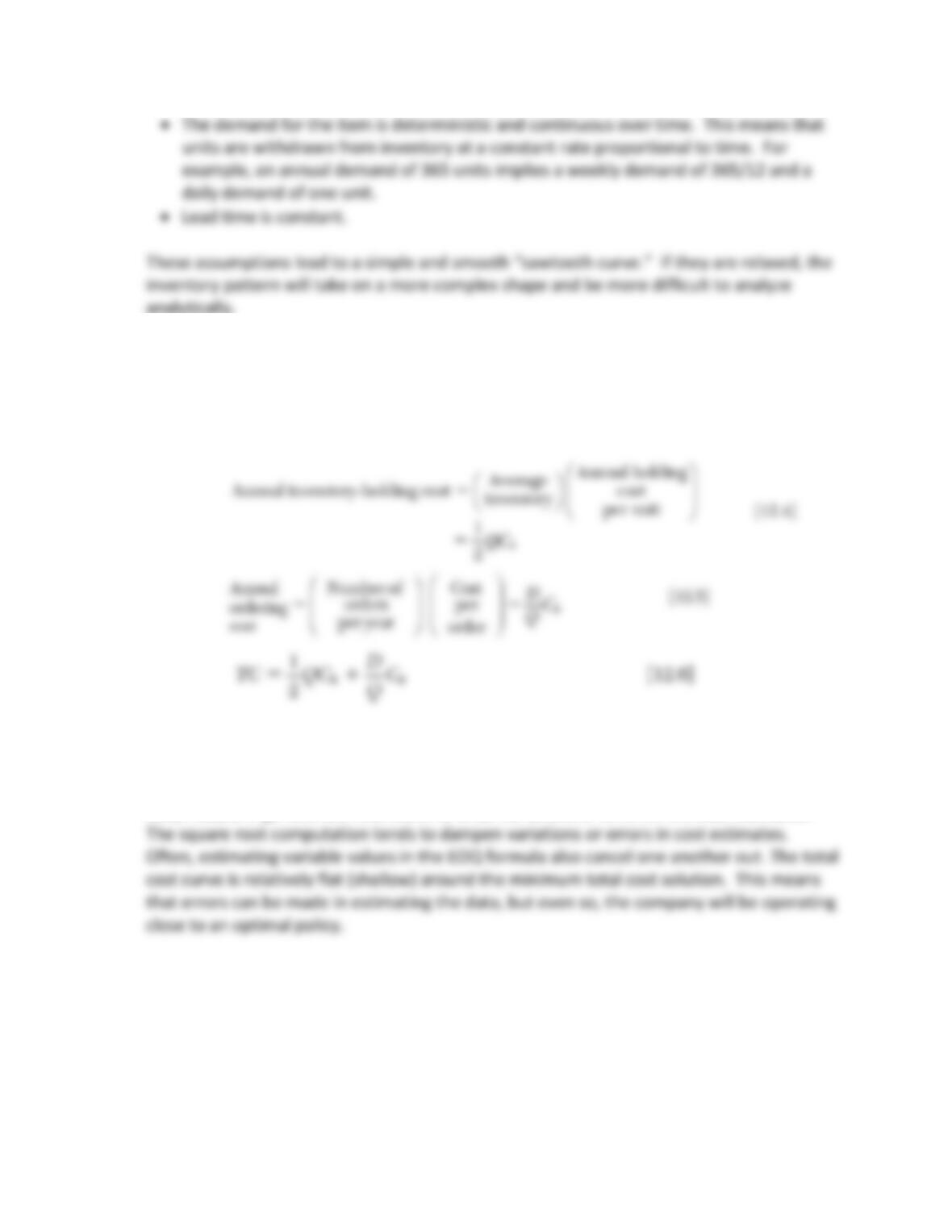
16. Explain how the total annual inventory cost is expressed in the EOQ model.
The total annual cost – inventory-holding cost given by equation plus order or setup cost
given by equation – can be expressed as
17. Discuss the sensitivity of the EOQ model’s optimal solution to changes in the model
parameters. Why is this important?
EOQ models in general are insensitive to small variations or errors in the cost estimates.
18. How are optimal lot sizes for a quantity discount model computed?
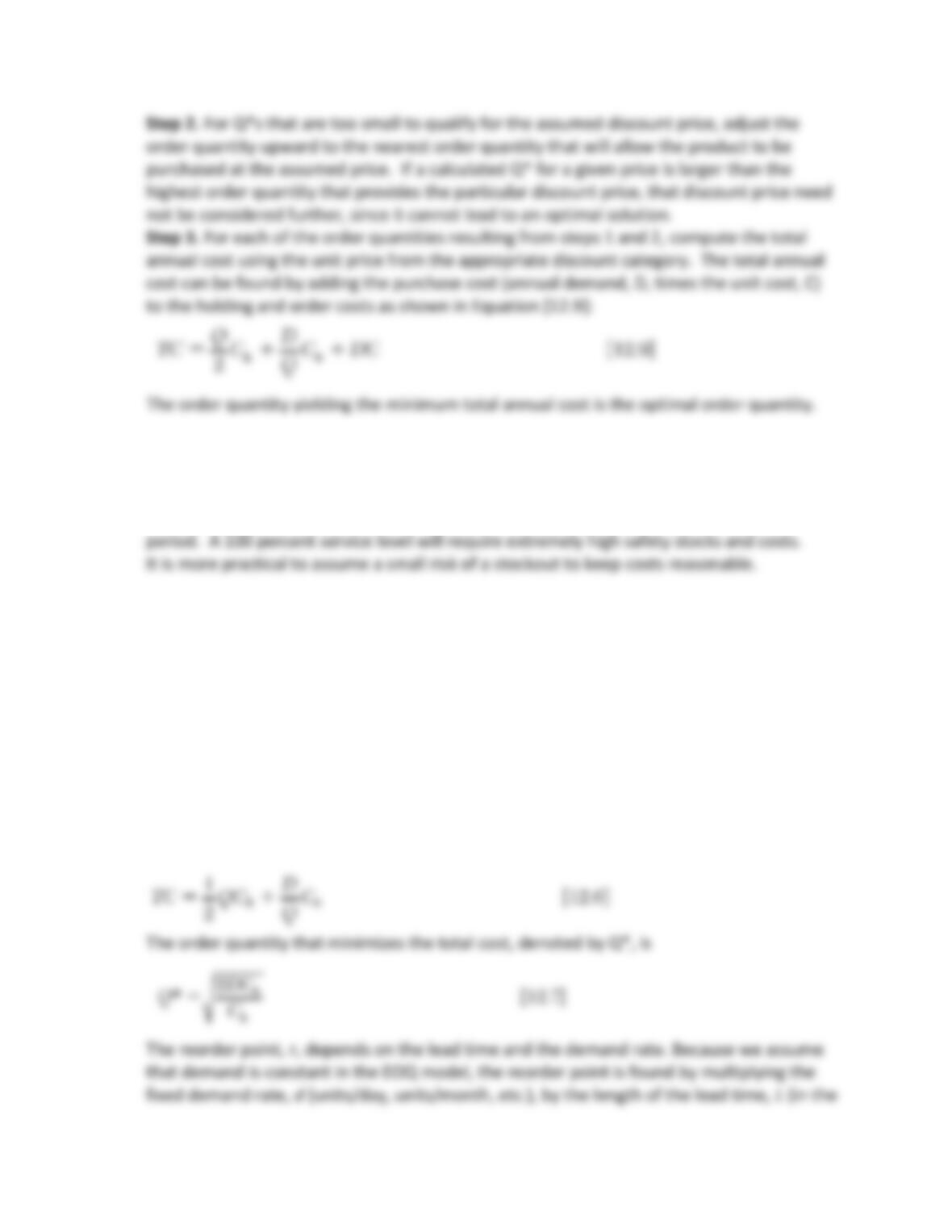
To compute the optimal order quantity, a three-step procedure is used.
Step 1. Compute Q* using the EOQ formula for the unit cost associated with each discount
category.
9
19. Define service level. Why is it not necessarily desirable to attempt to attain a 100–
percent service level?
A service level is the desired probability of not having a stockout during a lead-time
20. Explain how a fixed-order-quantity inventory system operates and how to use the EOQ and
safety stock models.
A way to manage a fixed-order-quantity system (FQS) is to continuously monitor the
inventory level and place orders when the level reaches some “critical” value. The process
of triggering an order is based on the inventory position. When the inventory position falls
at or below a certain value, r, called the reorder point, a new order is placed (see Exhibits
12.6 and 12.7).
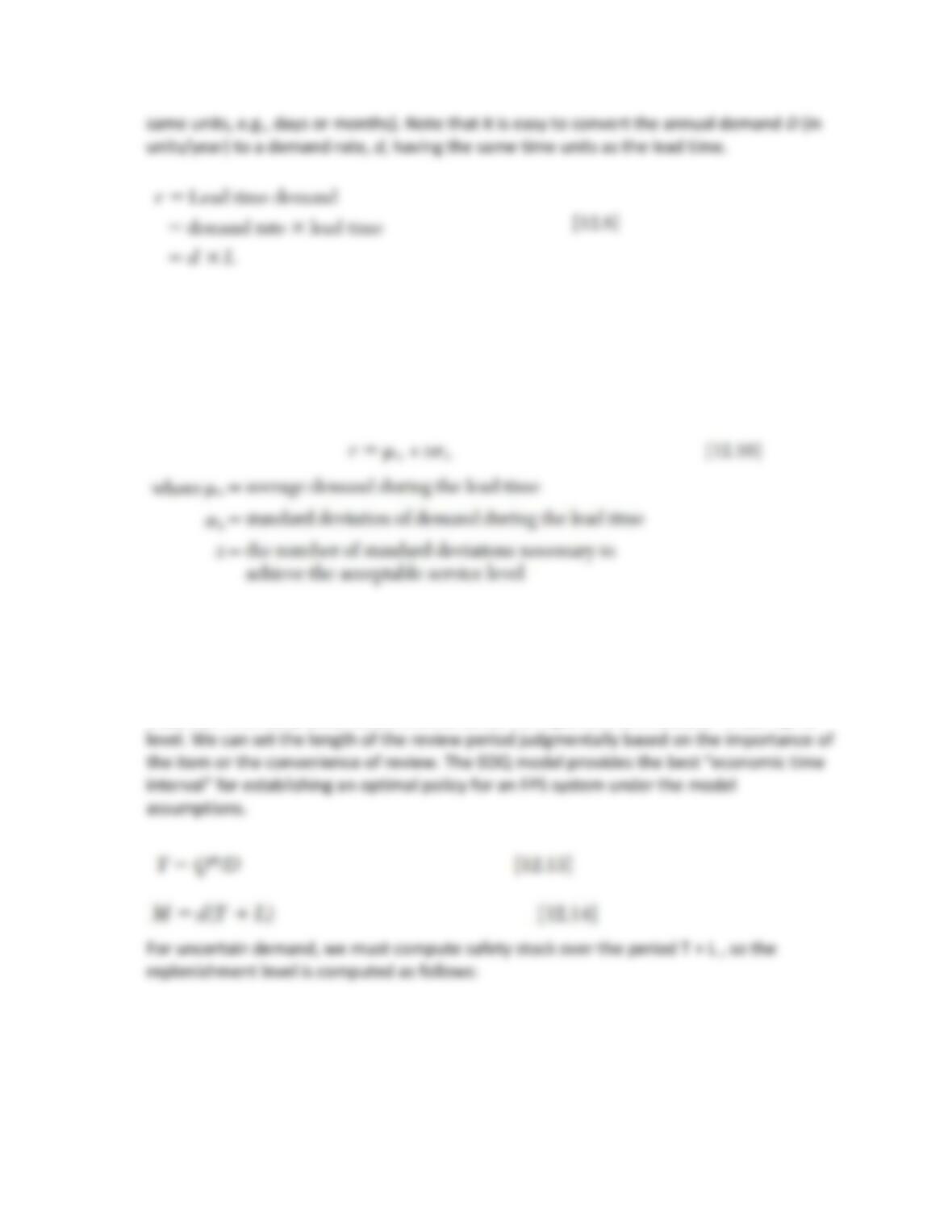
The total annual cost for the EOQ model is
10
When demand is uncertain, then the reorder point is the average demand during the lead
time, L plus the additional safety stock. The average demand during the lead time is
found by multiplying the average demand per unit of time by the length of the lead time
expressed in the same time units. When a normal probability distribution provides a good
approximation of lead-time demand, the general expression for reorder point is
21. Explain how a fixed-period inventory system operates.
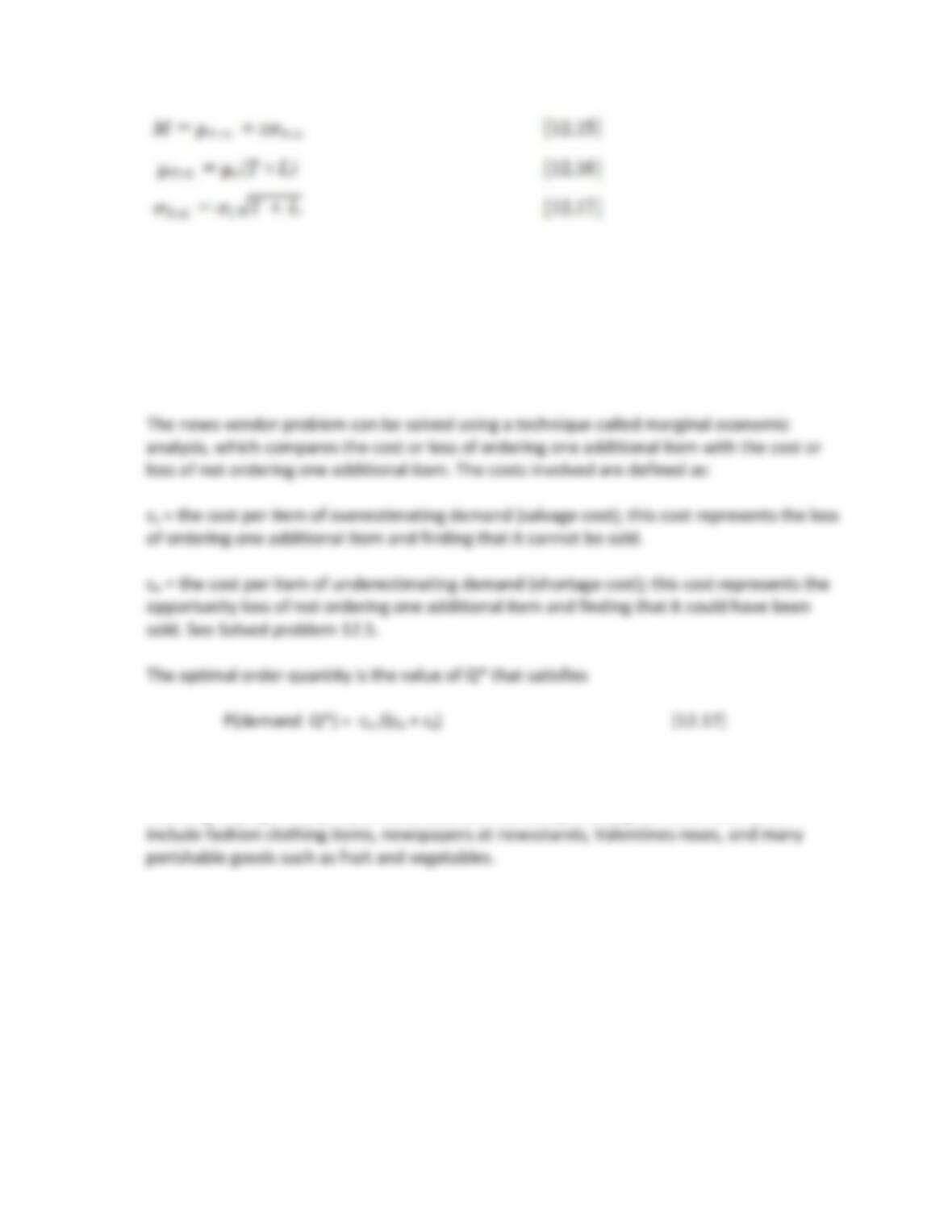
See Exhibits 12.13 and 12.14. For a fixed-period inventory system, at the time of review,
an order is placed for sufficient stock to bring the inventory position up to a predetermined
maximum inventory level, M, sometimes called the replenishment level, or “order–up–to”
11
22. Describe how to apply the single-period inventory model.
The single-period inventory model applies to inventory situations in which one order is
placed for a good in anticipation of a future selling season where demand is uncertain. At
the end of the period, the product has either sold out or there is a surplus of unsold items
to sell for salvage value.
23. Provide three examples of where the single-period model would apply in practice?
Stocking/buying holiday toys, trees, decorations, and specialty gifts. Other examples
DISCUSSION QUESTIONS AND EXPERIENTIAL ACTIVITIES
24. List some products in your personal or family “inventory.” How do you manage them? (For
instance, do you constantly run to the store for milk after it is gone? Do you throw out a
lot of milk because of spoilage?) How might the ideas in this chapter change your way of
managing these SKUs?
Any food items, printer ink cartridges, audio and video tapes, yard supplies such as
fertilizer, pencils and pens, gasoline for a lawnmower and/or automobile, clothes for
12
25. Discuss some of the issues that a small pizza restaurant might face in inventory
management. Would a pizza restaurant use a fixed order quantity or period system for
fresh dough (purchased from a bakery on contract)? What would be the advantages and
disadvantages of each in this situation?
A pizza restaurant must maintain inventories of dough, toppings, sauce, and cheese, and
other supplies such as boxes, napkins, cups, and so on. Because many of these items are
perishable, careful decisions must be made on the quantities to purchase. The perish
ability of the stock-keeping-unit (SKU) relates to the freshness, safety and quality of the
26. Find two examples of using RFID technology to monitor and control SKUs and explain the
advantages and disadvantages of adopting such technology.
The SKUs might be livestock, pallets, medicine, surgery instruments in a hospital, retail
store items, identifying counterfeit brands, patient tracking in hospitals and nursing homes,
27. Interview a manager at a local business about his or her inventory and materials–
management system, and prepare a report summarizing its approaches. Does the system
use any formal models? Why or why not? How does the manager determine inventory-
related costs?
Like many OM issues, many firms, especially small firms, do not take systematic
approaches to decisions. This question can help students understand how inventory
13
management decisions are made and also to identify potential opportunities for
28. Provide examples of perishable inventory. How does fresh fruit differ from a concert seat
even though both are perishable?
Perishability means that goods either deteriorate or become obsolete after a certain
period of time. Fresh fruit is tangible and eventually will spoil and be unfit to eat.
29. Find, describe, and draw an organization’s supply chain and identify the types of inventory
in it and if possible, there purpose and how it is monitored and controlled. (The example
could be a place you worked such as a call center, restaurant, factory, retail store, hotel,
school, or medical office.)
Students will try to draw a supply chain using the framework of the input-output model in
Exhibit 1.4, the pre- and postproduction model of defined in Exhibit 1.7 or the hierarchical
30. Does the EOQ increase or decrease if estimates of setup (order) costs include fixed, semi-
variable, and pure variable costs while inventory-holding costs include only pure variable
costs? Vice versa? What are the implications? Explain.
Because the EOQ model only depends on the order quantity, fixed costs associated with
any ordering or inventory holding are irrelevant (in accounting language, sunk costs). From
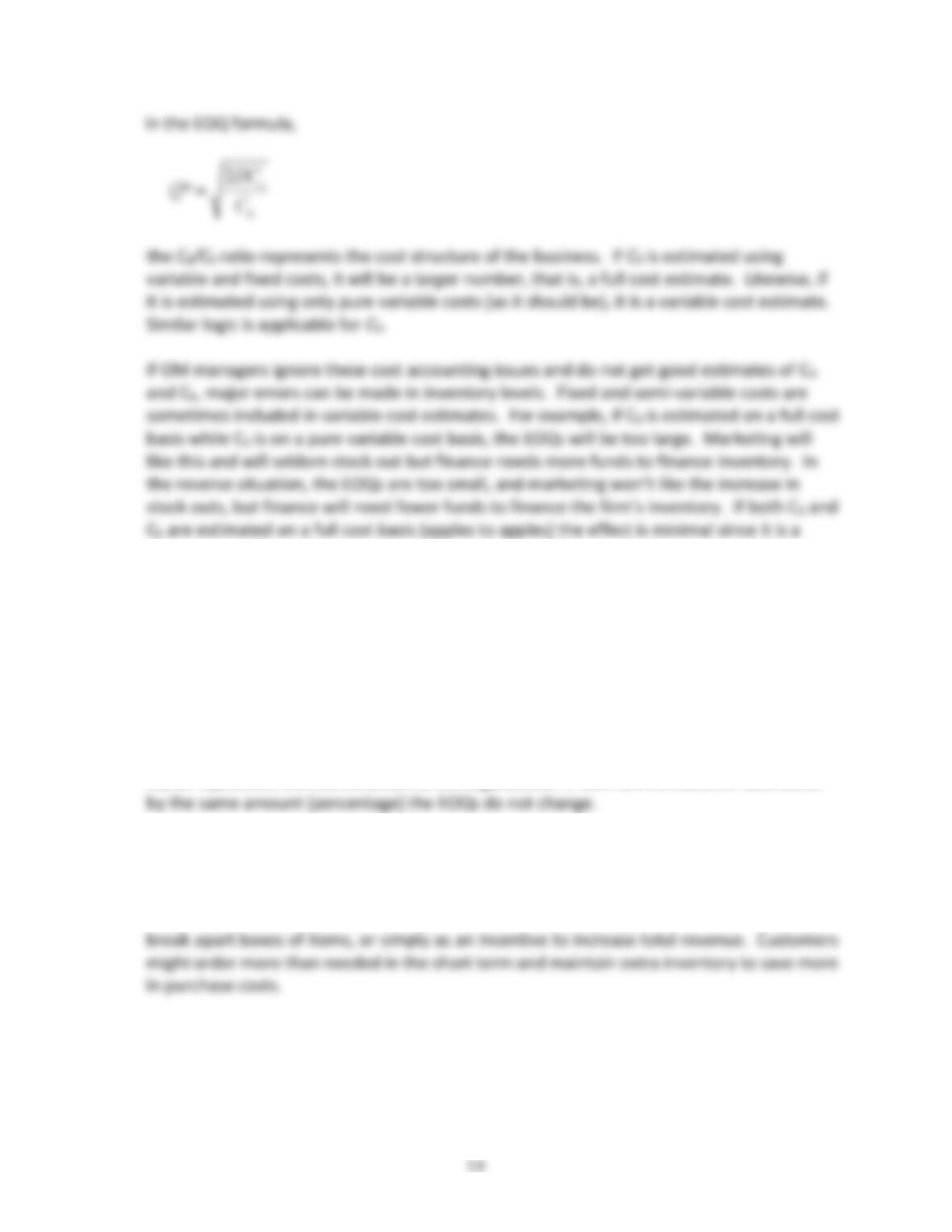
relative ratio. Also, the square root formula of the EOQ makes it robust with respect to
some degree of parameter estimation errors. The ideal way to estimate these two EOQ
variables is using a pure variable cost approach. One lesson for students is that process,
value chain, and OM managers need to understand cost accounting and exactly what types
of costs are used in their inventory models.
31. The Lemma Company manufactures and sells ten products. Managers find ways to reduce
the setup and inventory holding costs by one-half. What effect will this have on the EOQs
for the ten products?
32. Why are quantity discounts often given by suppliers? How do these affect the customer’s
inventory decisions?
This often occurs because of economies of scale of shipping larger loads, from not having to
33. Why does the fixed period model have to cover the time period of T + L while the fixed
order quantity model must cover only the time period L? Why is this important?
15
T+L is the review period plus the lead time. Note that when an order is placed it does not
34. When is simulation useful in analyzing inventory systems?
Simulation analysis is useful when the characteristics of an inventory system do not appear
COMPUTATIONAL PROBLEMS AND EXERCISES
These exercises require you to apply the formulas and methods described in the chapter. The
problems should be solved manually.
35. What is the inventory position if the on-hand quantity is 462 units, scheduled receipts are
200 units, and 130 units are on backorder?
36. If the order quantity is 220 units, inventory-carrying costs are 24 percent per year, and
each unit costs $18, what is the average cycle inventory? How much does it cost to carry
this cycle inventory per year?
Using Equation 12.2, Q/2 = 220/2 = 110 units.
37. What are the z-values for service levels of 80, 85, 90, 96, and 99 percent, assuming demand
is normally distributed?
Students should understand how to use Appendix A to find z-values.
Service level = 80% z = 0.84
38. Rapallo Sneakers, Inc. sells a pair of LG sneakers for $40. Due to the recent fitness craze,
16
these shoes are in high demand: 45 pairs of shoes are sold per week. The ordering cost is
$40 per order, and the annual holding cost is 20 percent of the selling price. If the store
operates 50 weeks a year, what can you say about the size of the current order quantity of
250 pairs?
Using Equation 12.3, Ch = I*C = 0.2*$40 = $8/pair/year
39. For Rapallo Sneakers, Inc. and the information in Problem 38, how much could be saved
by ordering in EOQs?
Using Equation 12.6,
TCQ=250 = (250/2)($8) + (2250/250)($40) = $1,000 + $360 = $1,360
40. Alice opens an aquarium store in a lively shopping mall and finds business to be booming
but she often stocks out of key items customers want. She decides to experiment with
inventory-control methods such as using a fixed-order quantity (FQS) and/or fixed-order
period (FPS) systems. The FLUVAL 303 Pump, a high margin and profitable pump, is one of
her best sellers but it stocks out frequently. You collect the following data with respect to
this pump’s sales.
a. What is inventory-carrying (holding) cost per pump per year?
Using Equation 12.3, Ch = I*C = 0.15*$80 = $12/pump/year
b. What is the economic order quantity?
c. What is the average number of orders per year if using the EOQ?
Average Number of orders/Year = D/Q = 250/41 = 6.1 orders/year
17
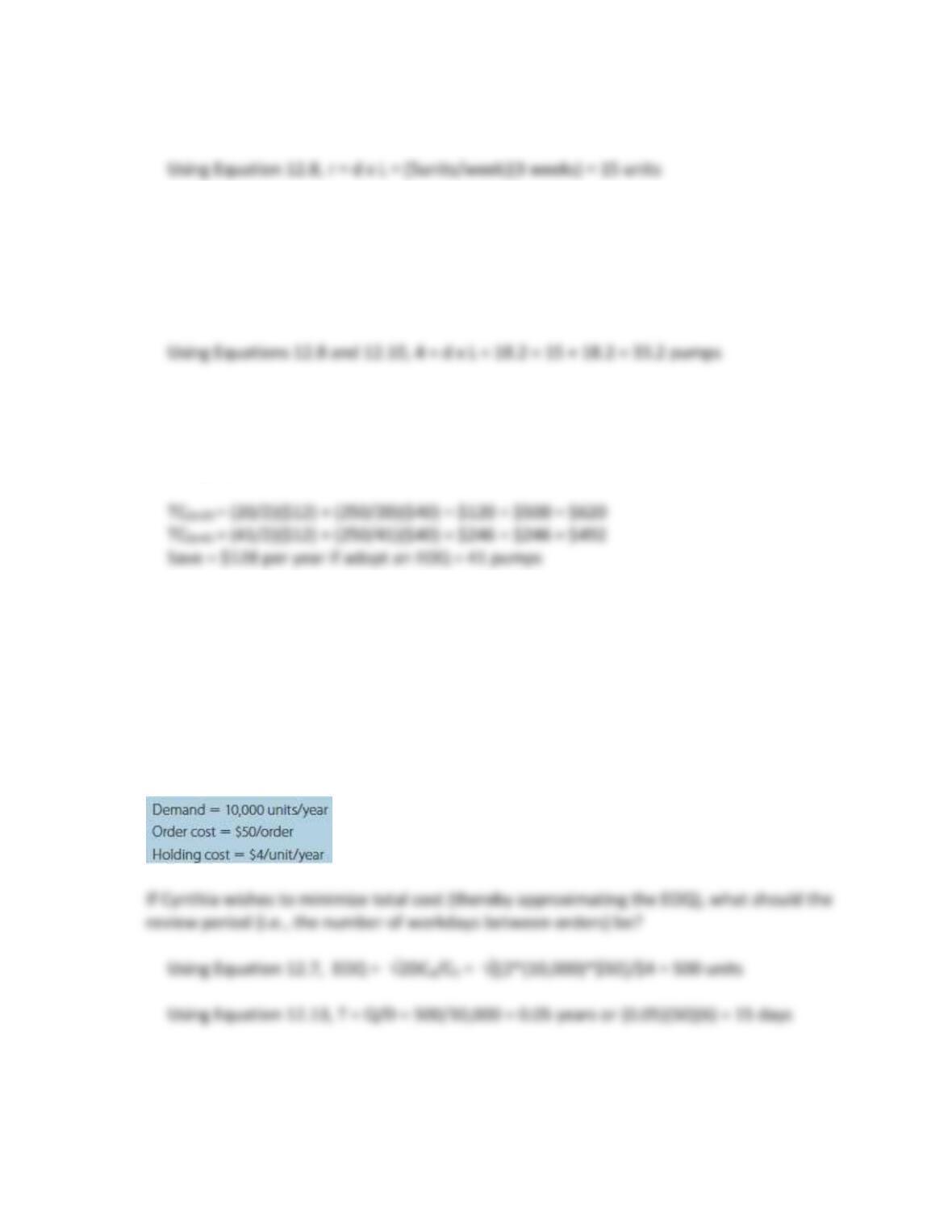
d. What is the reorder point without safety stock?
e. What is the safety stock quantity.
From Equation 12.10, safety stock = zL = 1.75*(63) = 18.2 units
f. What is the reorder point with safety stock?
g. If the current order quantity used by Alice is 20 pumps per order, how much money can
she save by adopting an EOQ ordering policy?
Using Equation 12.6 with Q = 20 units and EOQ = 41 units, the
41. If the EOQ = 80 units, annual demand =500 units, and there are 50 weeks in a year, what
is the fixed-order interval for a fixed-period system?
Using Equation 12.13, T = EOQ/D = 80/500 = 0.16 of a year or (0.16)(50) = 8 weeks.
42. Cynthia Baker, manager of a large medical supply house that operates 50 weeks per year
and six days per week, has decided to implement a fixed period inventory system for all
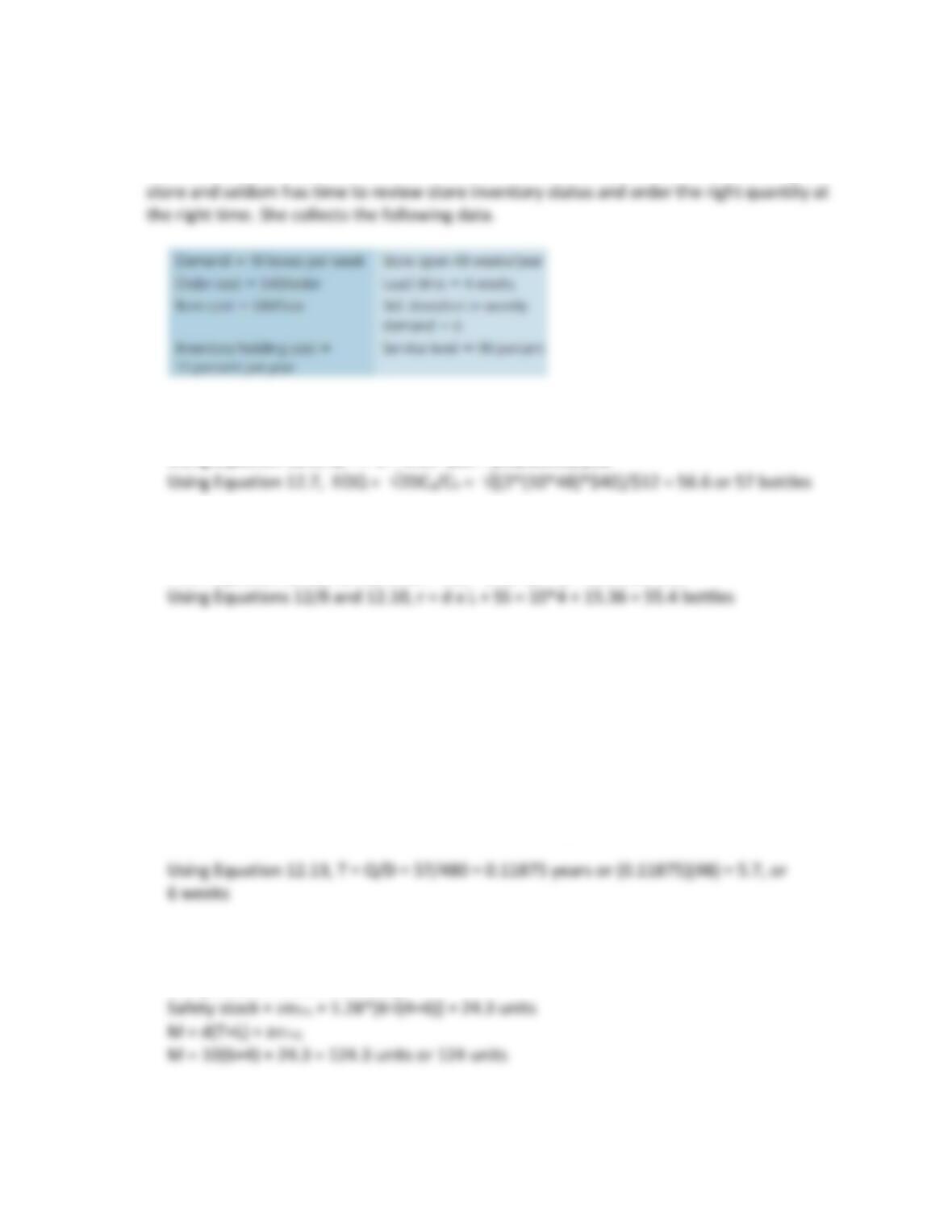
class A items. One such item has the following characteristics:
43. Brenda opened a pool and spa store in a lively shopping mall and finds business to be
booming but she often stocks out of key items customers want. She decides to experiment
with inventory control methods such as using a continuous review (fixed-order quantity)
18
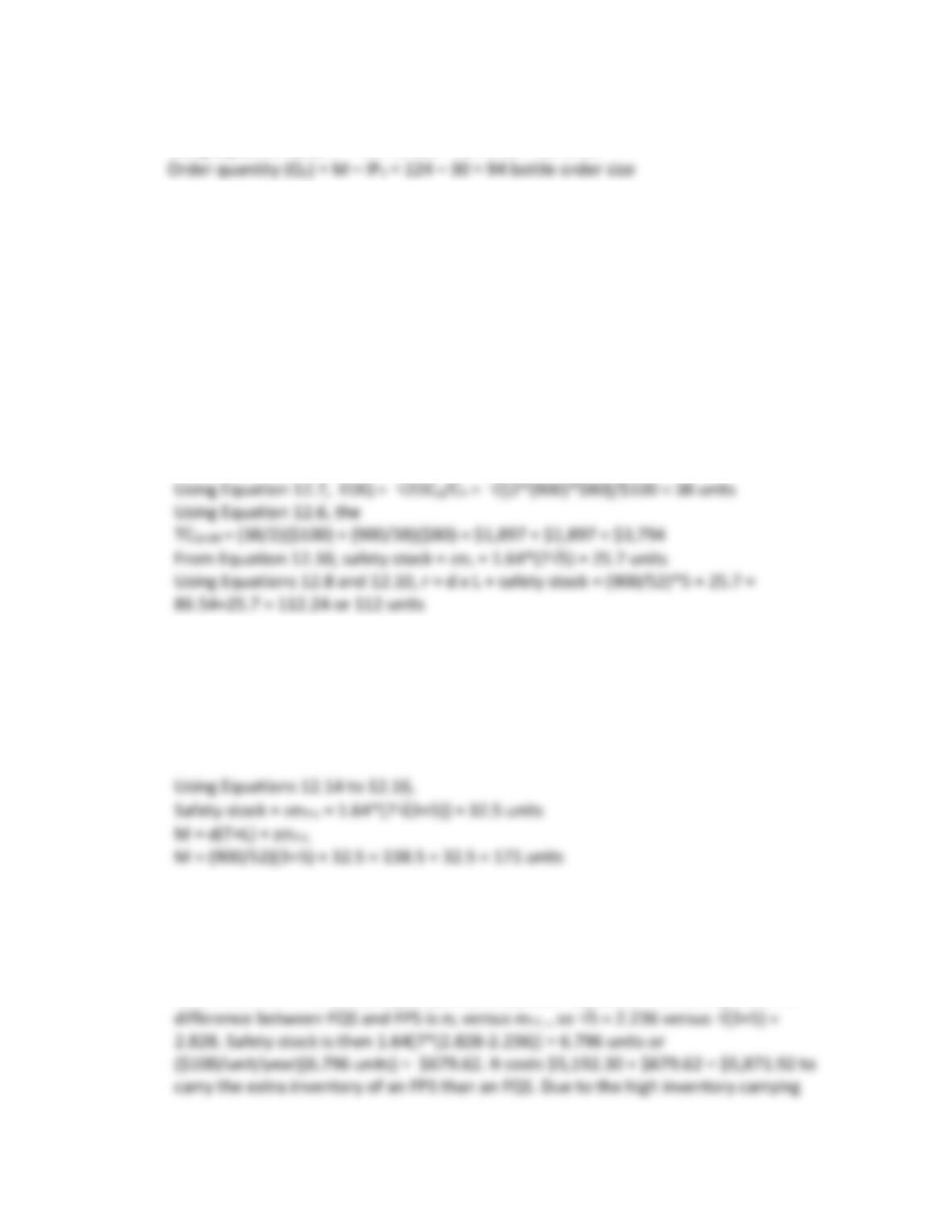
and/or (periodic review (fixed-order period) system. The 28-ounce bottle of Super
Algaecide (SA) is a high margin SKU, but it stocks out frequently. Ten SA bottles come in
each box, and she orders boxes from a vendor 160 miles away. Brenda is busy running the
a. What is the economic order quantity (EOQ) rounded to the next highest number?
b. What is the reorder point for SA with safety stock?
From Equation 12.10, safety stock = zL = 1.28*(64) = 15.36 bottles
c. What is the average number of orders per year using the EOQ?
Average Number of orders/Year = D/Q = 480/56.6 = 8.48 orders/year
44. Brenda, in Problem 43, wants to consider setting up a fixed-period inventory system for
the 28-ounce bottle of Super Algaecide (SA) SKU. At the beginning of the current week, D.
J. Kole, the materials manager, checked the inventory level and found 55 units on-hand.
There were no scheduled receipts and 25 units on back orders.
a. What is the review period (T) rounded to the next highest number?
b. What is stock replenishment level with safety stock (M)?
Using Equations 12.14 to 12.16,
c. How many units should be ordered?
19
Using Equation 12.1, IP = OH+SR-BO = 55+0-25 = 30 units
45. TV Galore is a new specialty store that sells television sets, video games, and other
television-related products. A new Japanese-manufactured game sells cost $400.
Because such games have a short life cycle and can be considered somewhat perishable,
inventory-carrying cost is high. It is at an annual rate of 25 percent of SKU value.
Ordering costs are estimated to be $80 per order. Annual demand is forecast at 900
units next year. The standard deviation of daily demand is seven units, the desired
service level is 95 percent, the lead time is five weeks, and assume 52 weeks per year.
a. Set up a fixed-order-quantity system computing the EOQ, reorder point with safety
stock, and total order and inventory carrying costs.
Using Equation 12.3, Ch = I*C = 0.25*$400 = $100/unit/year
b. Setup a fixed-period system computing the review period (T) and the replenishment
level (M) with safety stock. Round the review period to the next highest number.
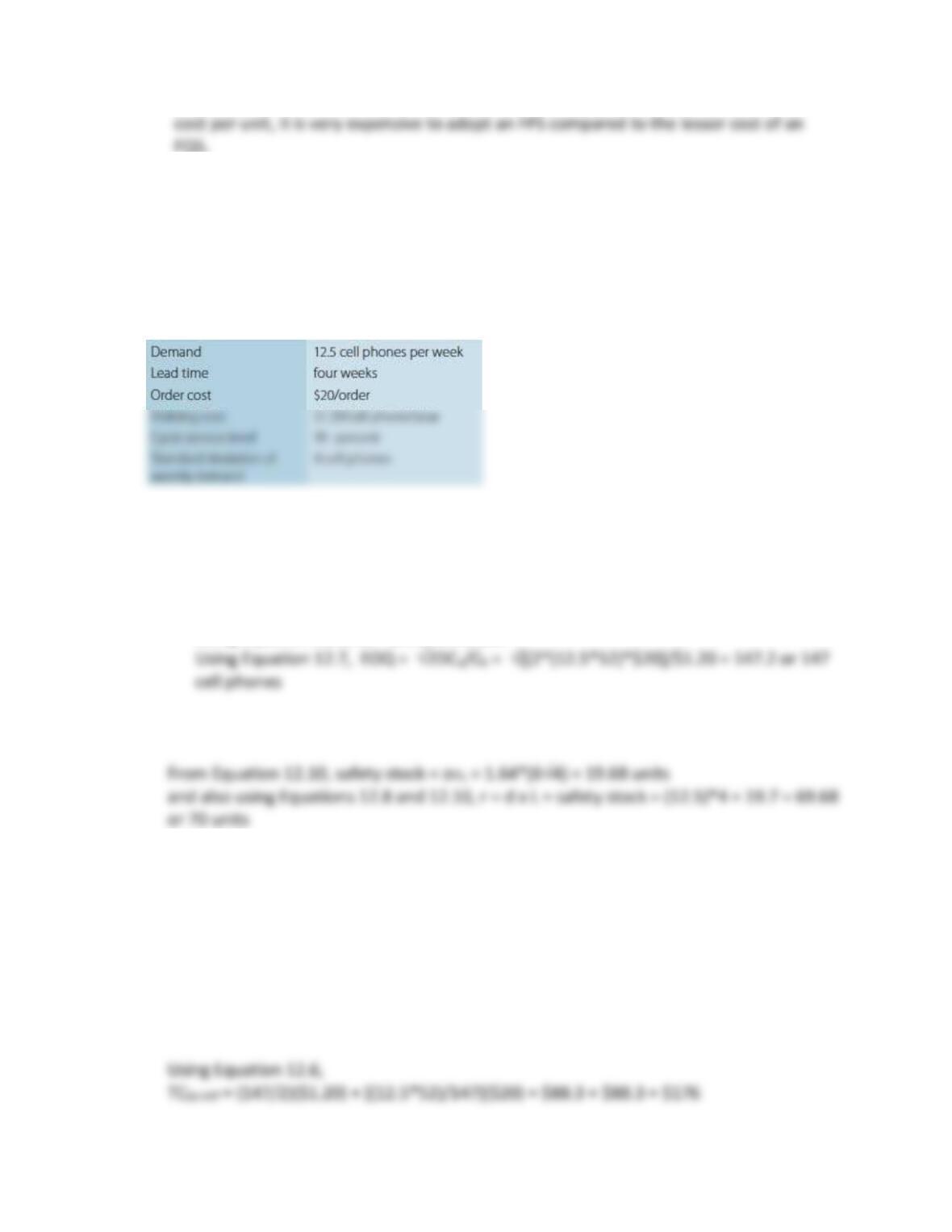
Using Equation 12.13, T = Q*/D = 38/900 = 0.0422 years or (0.0422)(52) = 2.196 weeks
or 3 weeks
c. How much more does it cost to carrying inventory in a FPS than a FQS using only dL
versus d(T+L) and safety stock = zL versus zT+L?
The demand during the lead time for the FQS is d x L and for the FPS, d(T+L), so the
difference is d x T or (900/52)(3)*($100/unit/year) = $5,192.3. For safety stock the
20
46. After one year you are promoted to assistant manager and realize current inventory
management practices are not systematic with too much stock of some SKUs and too little
of others. Your retail store operates 52 weeks per year and one SKU you stock is a high-end
cell phone. The company’s current order quantity is 250 cell phones per order. You collect
the following information about this cell phone and want to set up a fixed-order quantity
(FQS) to impress higher-level managers and get promoted again!
Current on-hand inventory is 35 cell phones, with a scheduled receipt for 20 cell phones
and no backorders.
a. What is the economic order quantity (EOQ)?
Using Equation 12.3, Ch = $1.20/unit/year
b. What is the reorder point with safety stock?
c. Based on the FQS information calculated previously, should an order be placed and if so,
for how many cell phones?
Using Equation 12.1, IP = OH+SR-BO = 35+20-0 = 55 units, so since 55 is less than a
reorder point of 70, no order should be placed.
d. What is the total annual cost savings using the EOQ you computed previously versus the
current ordering policy of Q = 250 cell phones?