Chapter 12 – MRP and ERP
Week
Straight Plastic Grip
(LT = 2 weeks)
Beg.
Inv.
1
2
3
4
5
6
7
8
Gross requirements
600
Scheduled receipts
On hand
Net requirements
600
Planned order receipts
600
Planned order releases
600
Week
Bent Blade (LT = 1 week)
Beg.
Inv.
1
2
3
4
5
6
7
8
Gross requirements
560
Scheduled receipts
On hand
350
350
350
350
350
210
Planned order receipts
210
Planned order releases
210
Week
Bent Plastic Grip
(LT = 2 weeks)
Beg.
Inv.
1
2
3
4
5
6
7
8
Gross requirements
560
Scheduled receipts
On hand
Net requirements
560
Planned order receipts
560
Planned order releases
560
Chapter 12 – MRP and ERP
12-35
15.
Week
1
2
3
4
Material
40
80
60
70
a. Capacity utilization
Week
1
2
3
4
Labor
53.3%
106.7%
80%
93.3%
Machine
60%
120%
90%
105%
b. Capacity utilization exceeds 100% for both labor and machine in week 2, and for machine
alone in week 4.
16.
Fabrication
Assembly
Packaging
Day
Product
Labor
Mach.
Labor
Mach.
Labor
Mach.
Mon
A
400
200
300
200
200
100
B
300
300
300
300
450
150
700
500
600
500
650
250
Tue
A
800
400
600
400
400
200
B
200
200
200
200
300
100
600
800
600
700
300
A
200
100
150
100
100
B
200
200
200
200
300
100
400
300
350
300
400
150
Week
Labor hr.
160
320
240
280
Mach. hr.
120
240
180
210
Chapter 12 – MRP and ERP
12-36
Shift 150 units of A (300 labor hours, 150 machine hours) to Wednesday in the Fabrication
Department. For assembly, a similar shift of 150 units of A could be made, although other
combinations are possible (e.g., some A and some B).
17.
Master
Schedule for
#565
Week
Beg.
Inv.
1
2
3
4
5
6
7
8
Quantity
180
Week
Item: #565 LT = 1 wk.
Beg.
Inv.
1
2
3
4
5
6
7
8
Gross requirements
180
Scheduled receipts
Week
Item: Y36(2) LT = 1 wk.
Beg.
Inv.
1
2
3
4
5
6
7
8
Gross requirements
360
Scheduled receipts
On hand
200
Net requirements
160
Planned order receipt
160
Planned order release
160
Week
Item: J27(4) LT = 2 wks.
Beg.
Inv.
1
2
3
4
5
6
7
8
Gross requirements
640
Scheduled receipts
On hand
Net requirements
640
Planned order receipt
640
Planned order release
640
On hand
Net requirements
180
Planned order receipt
180
Planned order release
180
Chapter 12 – MRP and ERP
12-37
18.
Master
Week
1
2
3
4
5
6
7
8
Schedule
Quantity
60
A LT = 1
Beginning
inventory
1
2
3
4
5
6
7
8
Gross requirements
60
Scheduled receipts
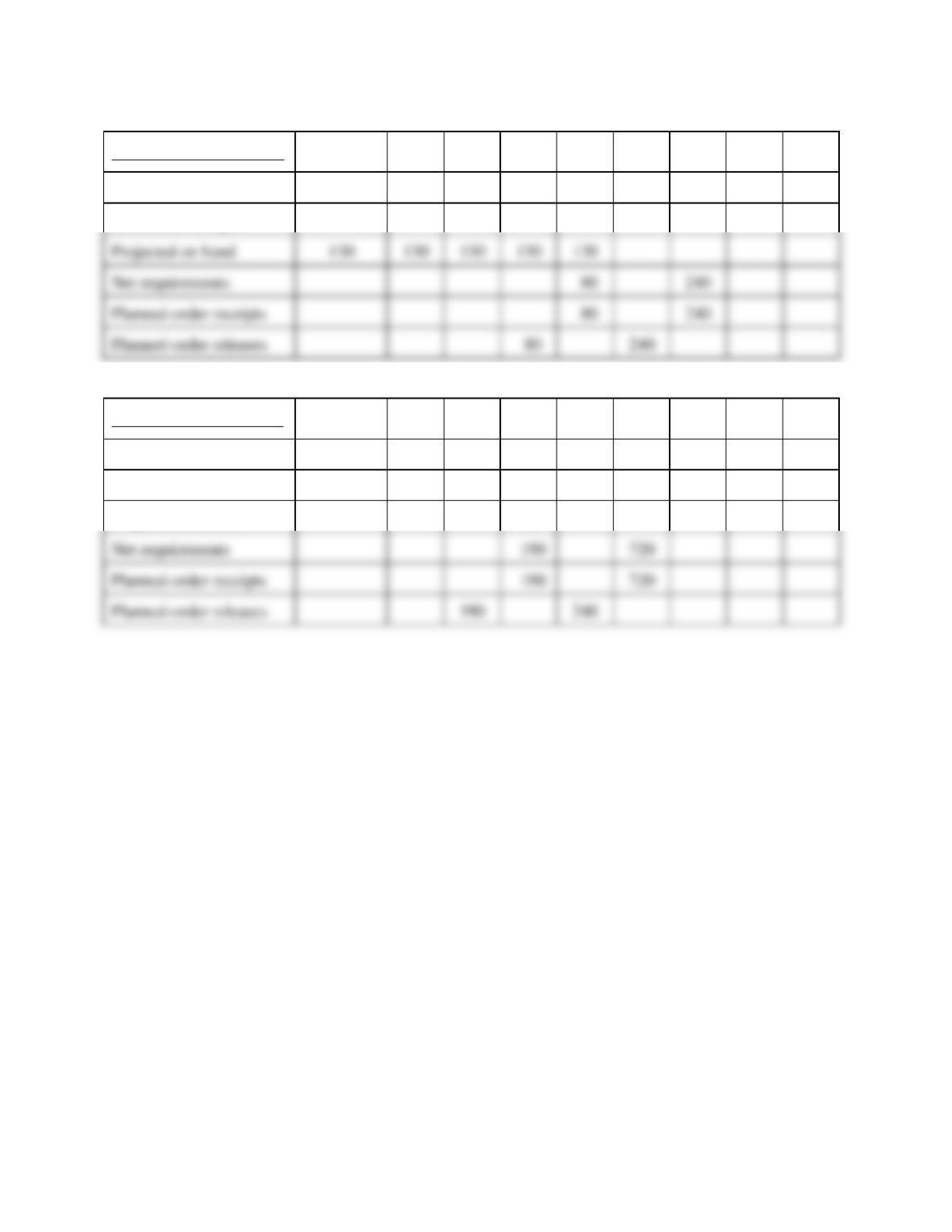
B(2) LT = 3
Beginning
inventory
1
2
3
4
5
6
7
8
Gross requirements
120
Scheduled receipts
Projected on hand
15
15
15
Net requirements
Planned-order receipts
Planned-order releases
105
C LT = 1
Beginning
inventory
1
2
3
4
5
6
7
8
Gross requirements
60
Scheduled receipts
Projected on hand
Net requirements
Planned-order receipts
Planned-order releases
Projected on hand
60
Planned-order releases
60
Chapter 12 – MRP and ERP
12-38
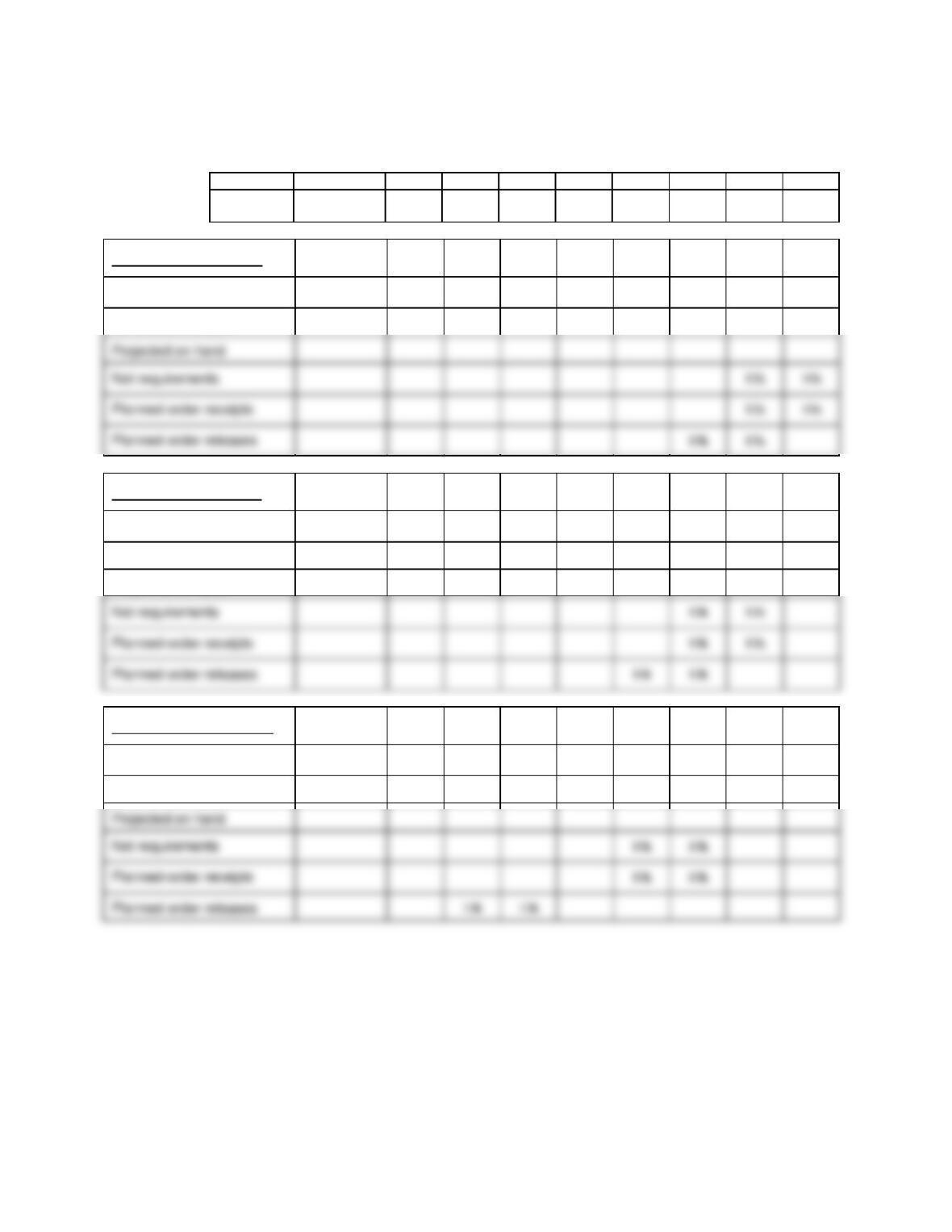
E(2) E(4) LT = 1
Beginning
inventory
1
2
3
4
5
6
7
8
Gross requirements
210
240
Scheduled receipts
H(E3) H(E3) LT = 1
Beginning
inventory
1
2
3
4
5
6
7
8
Gross requirements
240
720
Scheduled receipts
50
Projected on hand
50
50
Net requirements
720
Planned-order receipts
720
Planned-order releases
190
240
Projected on hand
Net requirements
80
240
Planned-order receipts
80
240
Planned-order releases
80
240
Chapter 12 – MRP and ERP
12-39
Case Promotional Novelties
Master
Week
1
2
3
4
5
6
7
8
Schedule
Quantity
10k
10K
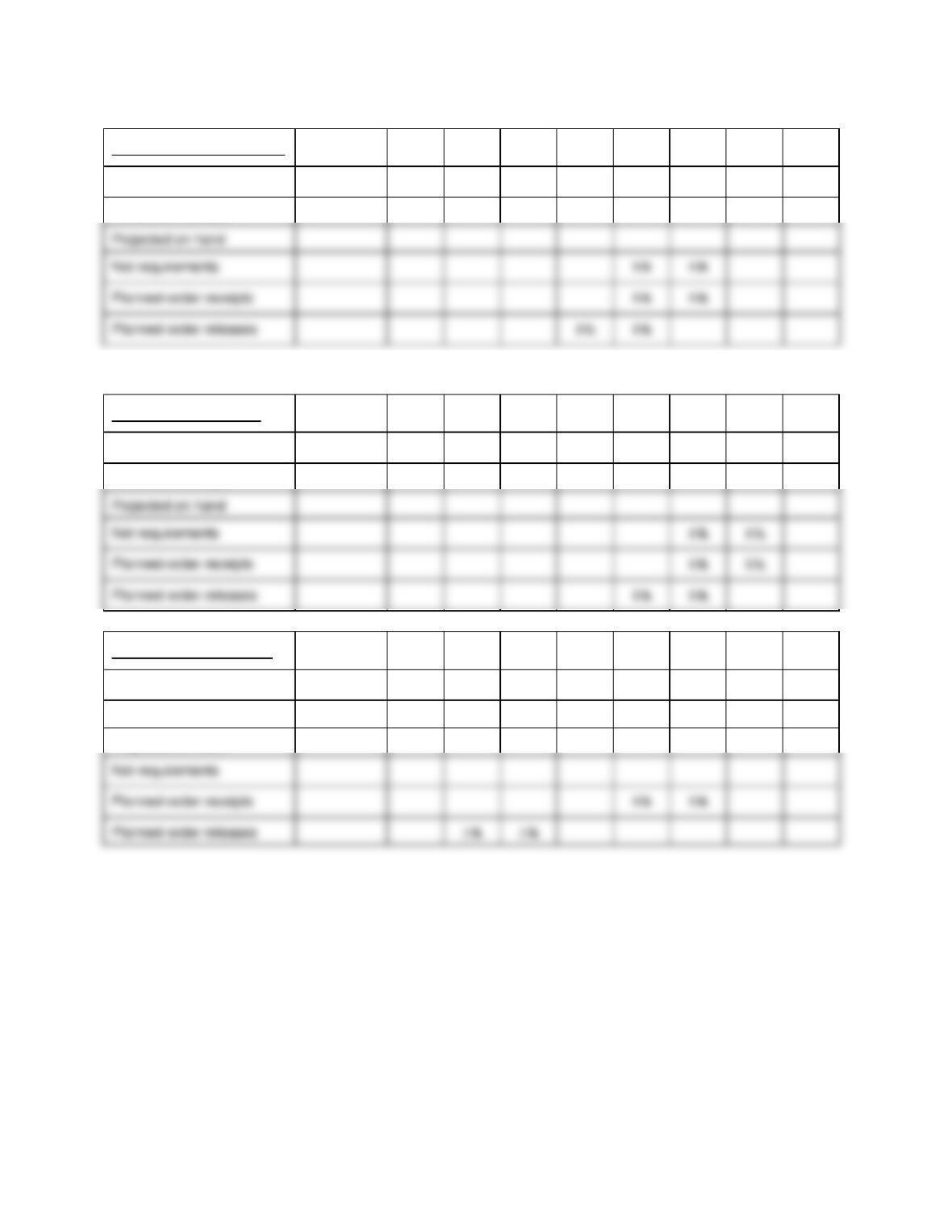
Tractor-trailer LT = 1
Beginning
inventory
1
2
3
4
5
6
7
8
Gross requirements
10k
10k
Scheduled receipts
Tractor LT = 1
Beginning
inventory
1
2
3
4
5
6
7
8
Gross requirements
10k
10k
Scheduled receipts
Projected on hand
Net requirements
10k
10k
Planned-order receipts
10k
10k
Planned-order releases
10k
10k
Tractor body LT = 3
Beginning
inventory
1
2
3
4
5
6
7
8
Gross requirements
10k
10k
Scheduled receipts
Projected on hand
Net requirements
10k
Planned-order receipts
10k
10k
Planned-order releases
Projected on hand
Net requirements
10k
10k
Planned-order receipts
10k
10k
Planned-order releases
10k
10k
Chapter 12 – MRP and ERP
12-40
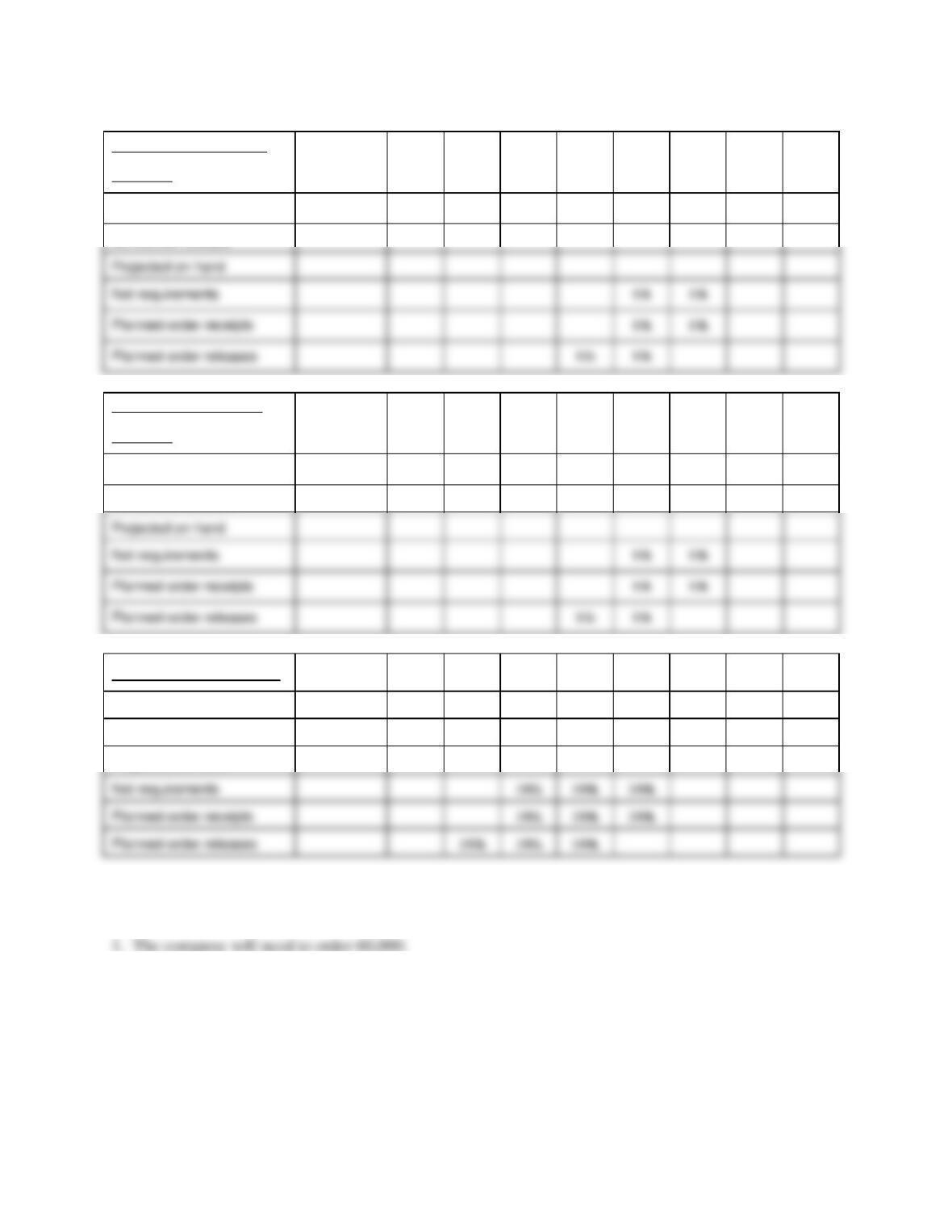
Wheel Assembly LT = 1
Beginning
inventory
1
2
3
4
5
6
7
8
Gross requirements
10k
10k
Scheduled receipts
Trailer LT = 1
Beginning
inventory
1
2
3
4
5
6
7
8
Gross requirements
10k
10k
Scheduled receipts
Projected on hand
Net requirements
10k
10k
Planned-order receipts
10k
10k
Planned-order releases
10k
10k
Trailer body LT = 3
Beginning
inventory
1
2
3
4
5
6
7
8
Gross requirements
10k
10k
Scheduled receipts
Projected on hand
Net requirements
Planned-order receipts
10k
10k
Planned-order releases
Projected on hand
Net requirements
10k
10k
Planned-order receipts
10k
10k
Planned-order releases
10k
10k
Chapter 12 – MRP and ERP
12-41
Tractor Wheel LT = 1
Assembly
Beginning
inventory
1
2
3
4
5
6
7
8
Gross requirements
10k
10k
Scheduled receipts
Trailer Wheel LT = 1
Assembly
Beginning
inventory
1
2
3
4
5
6
7
8
Gross requirements
10k
10k
Scheduled receipts
Projected on hand
Net requirements
10k
10k
Planned-order receipts
10k
10k
Planned-order releases
10k
10k
Wheels (6) (12) LT = 1
Beginning
inventory
1
2
3
4
5
6
7
8
Gross requirements
180k
180k
Scheduled receipts
Projected on hand
Net requirements
100k
100k
100k
Planned-order receipts
Planned-order releases
100k
100k
100k
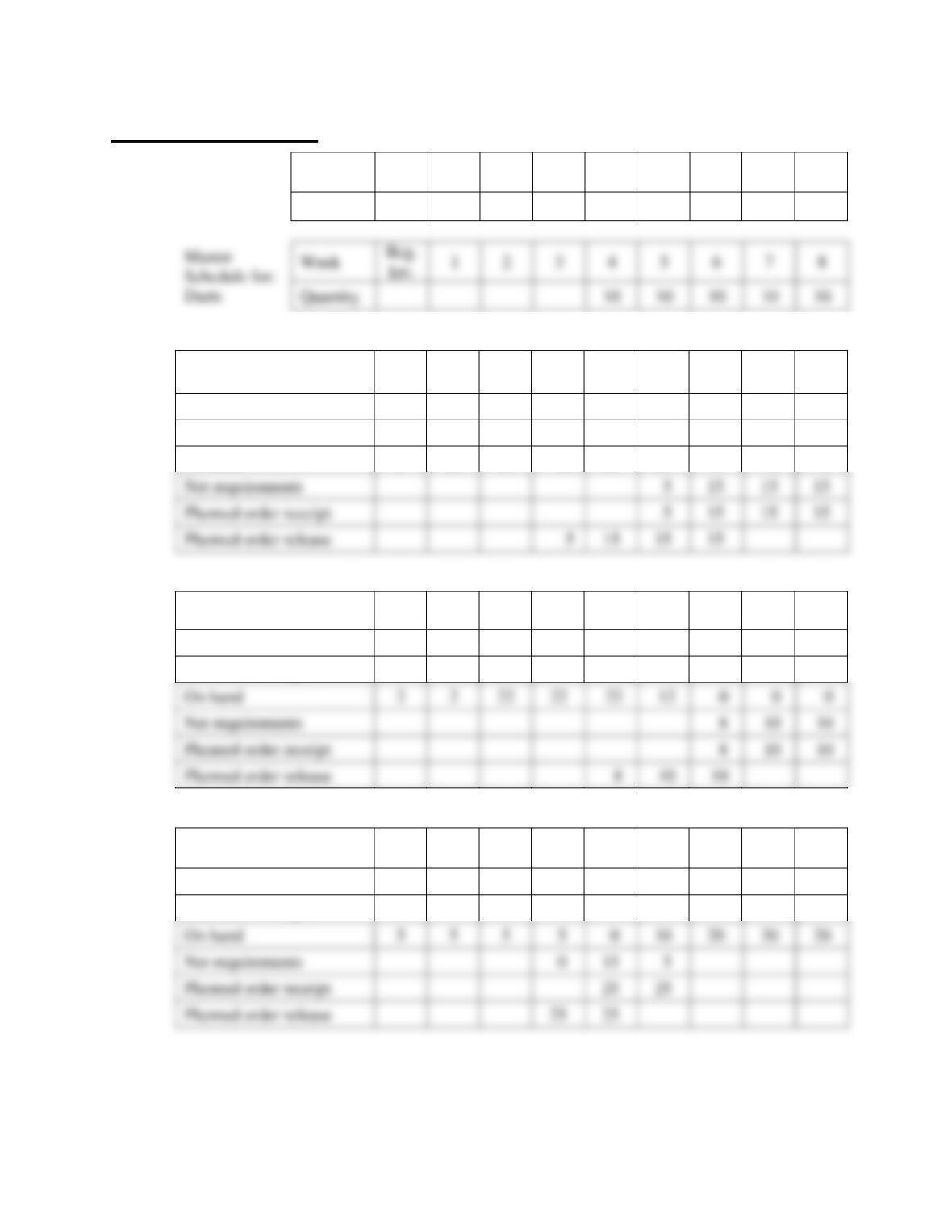
The company will need a total of 360,000 wheels. It will be able to produce only 300,000.
2. The company will need the wheels in week 5. If lead time will be 2-3 weeks, assume it
will be 3 weeks, and order in week 2.
Projected on hand
Net requirements
10k
10k
Planned-order receipts
10k
10k
Planned-order releases
10k
10k
Chapter 12 – MRP and ERP
12-42
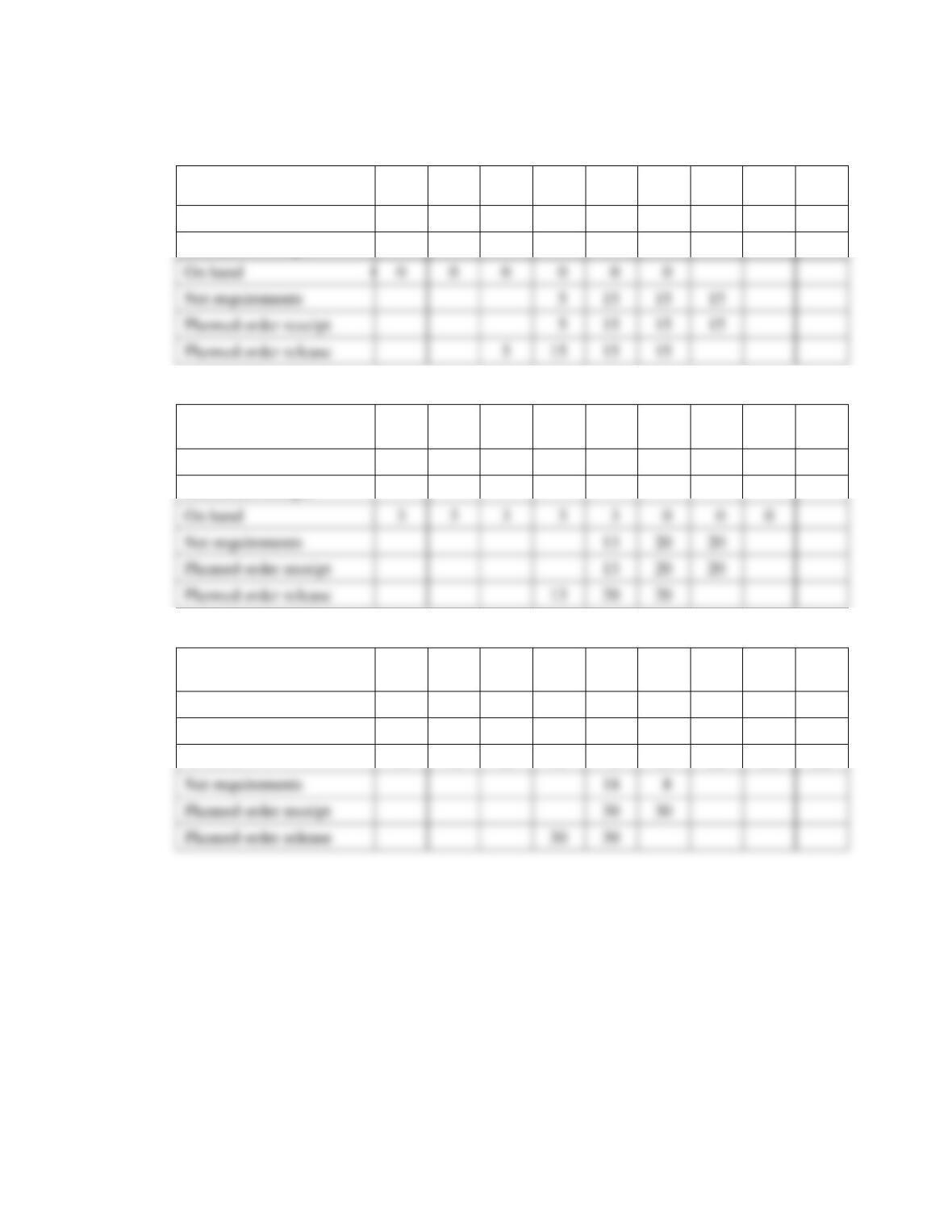
Case: DMD Enterprises
Master
Schedule for:
Arrows
Week
Beg.
Inv.
1
2
3
4
5
6
7
8
Quantity
15
15
15
15
15
Lot size: LFL
Week
Arrows LT = 2 wks.
Beg.
Inv.
1
2
3
4
5
6
7
8
Gross requirements
15
15
15
15
15
Scheduled receipts
20
On hand
5
25
25
25
25
10
0
0
0
Net requirements
5
15
15
15
Planned order receipt
5
15
15
15
Planned order release
15
15
15
Lot size: LFL
Week
Darts LT = 2 wks.
Beg.
Inv.
1
2
3
4
5
6
7
8
Gross requirements
10
10
10
10
10
Scheduled receipts
20
On hand 2
2
2
22
22
Net requirements
10
10
Planned order receipt
Planned order release
Lot size: 25
Week
Part X LT = 1 wk.
Beg.
Inv.
1
2
3
4
5
6
7
8
Gross requirements
5
15
15
15
Scheduled receipts
On hand 5
5
5
5
5
0
10
20
20
20
Net requirements
0
15
5
Planned order receipt
25
25
Planned order release
25
25
Week
Beg.
1
2
3
4
5
6
7
8
Chapter 12 – MRP and ERP
12-43
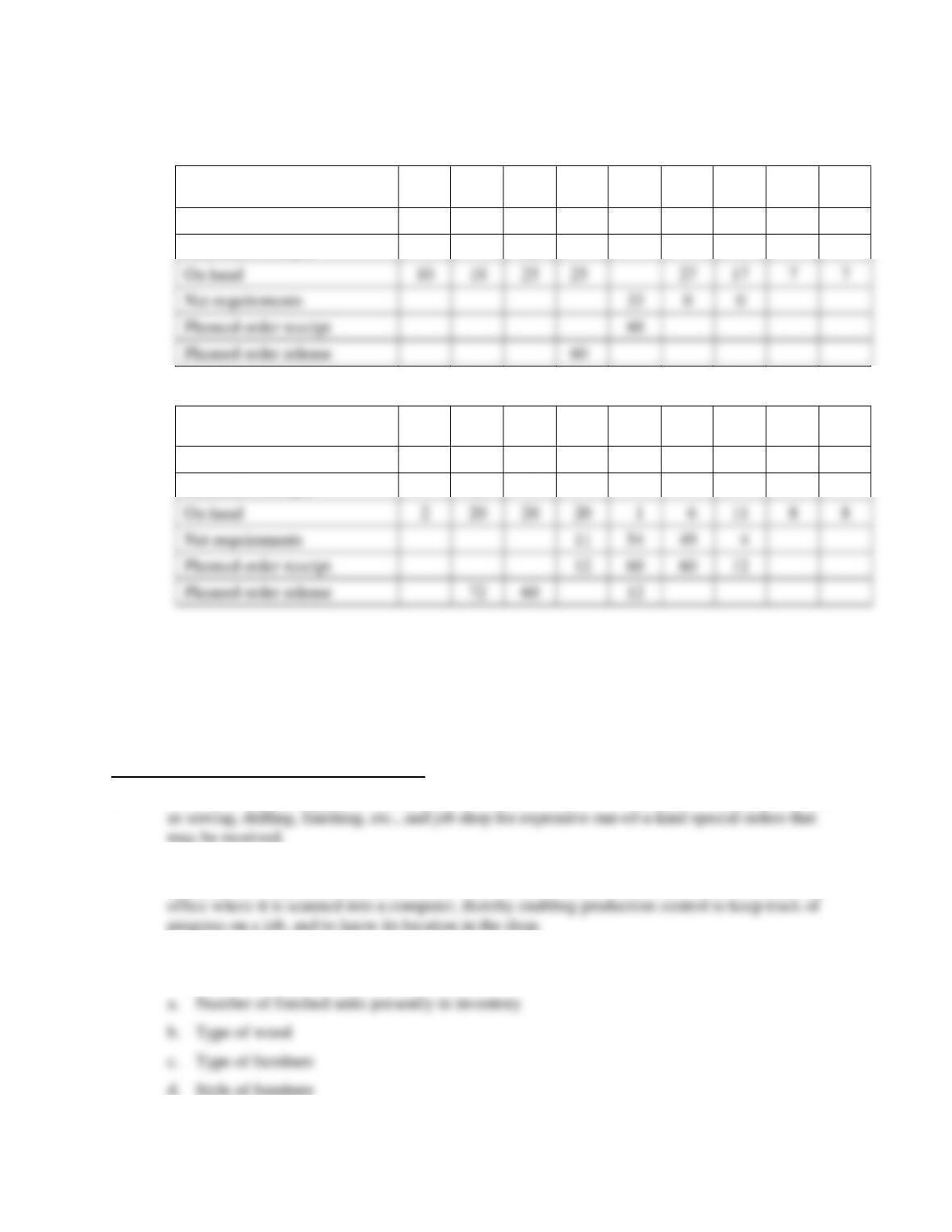
Case: DMD Enterprises (continued)
Lot size: LFL
Week
Part M LT = 1 wk.
Beg.
Inv.
1
2
3
4
5
6
7
8
Gross requirements
5
15
15
15
Scheduled receipts
Lot size: LFL
Week
Part K LT = 1 wk.
Beg.
Inv.
1
2
3
4
5
6
7
8
Gross requirements
16
20
20
Scheduled receipts
On hand 3
3
3
0
0
Net requirements
13
20
20
Planned order receipt
13
20
20
Planned order release
13
20
20
Lot size: 30
Week
Part Q LT = 1 wk.
Beg.
Inv.
1
2
3
4
5
6
7
8
Gross requirements
13
20
20
Scheduled receipts
On hand
15
15
15
15
2
12
22
22
22
Net requirements
18
8
Planned order receipt
30
30
Planned order release
30
30
On hand 0
0
0
0
Net requirements
5
15
15
15
Planned order receipt
5
15
15
15
Planned order release
15
15
15
Chapter 12 – MRP and ERP
12-44
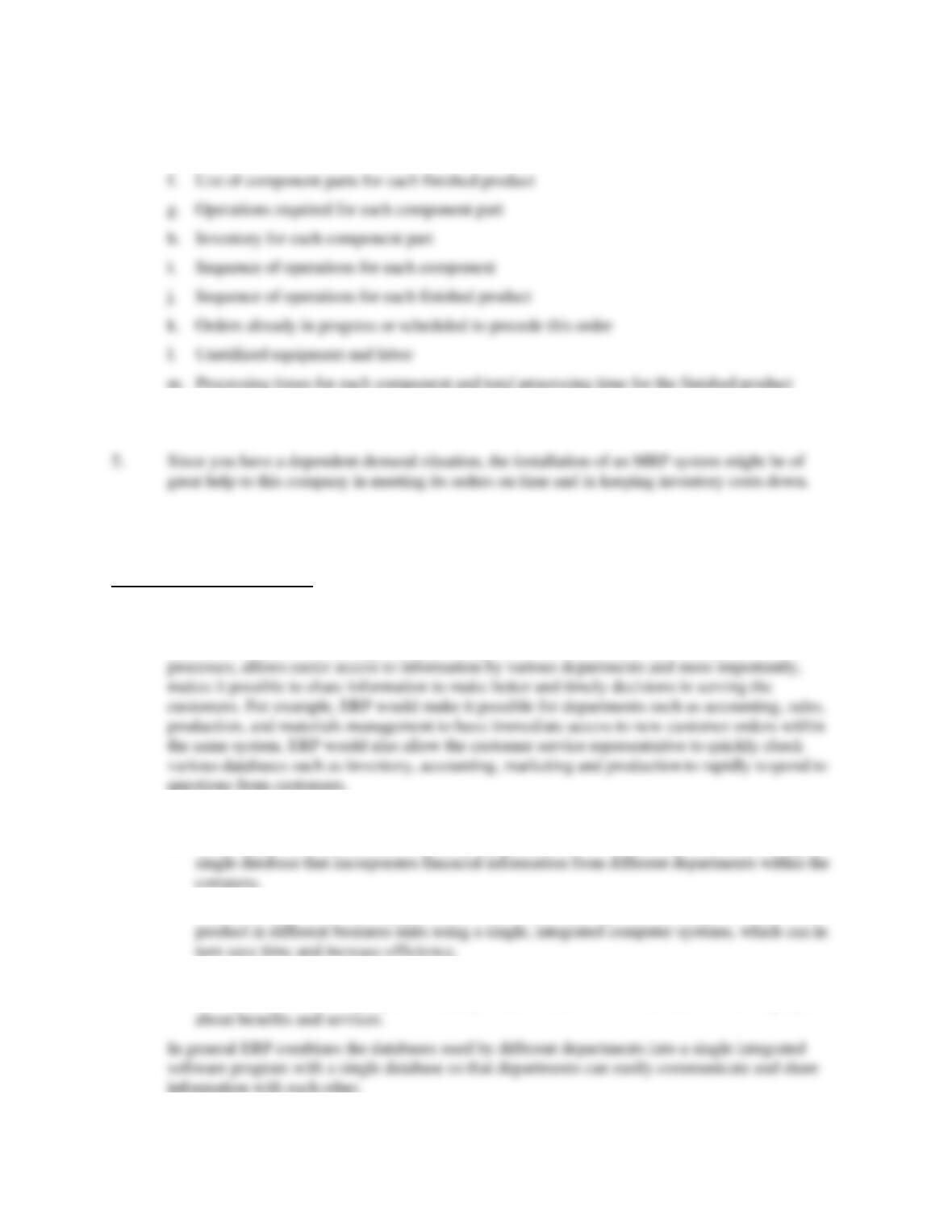
Case: DMD Enterprises (continued)
Lot size: 30
Week
Part F LT = 1 wk.
Beg.
Inv.
1
2
3
4
5
6
7
8
Gross requirements
25
33
10
10
Scheduled receipts
15
Lot size: 12
Week
Part W LT* = 2 or 3 wks.
Beg.
Inv.
1
2
3
4
5
6
7
8
Gross requirements
31
55
55
15
Scheduled receipts
18
On hand
20
20
20
1
6
11
Net requirements
11
54
49
4
Planned order receipt
12
60
60
12
Planned order release
72
60
12
*If the lot size is less than 36, then the lead time is 2 weeks, otherwise the lead time is 3
weeks.
Operations Tour: Stickley Furniture
1. Batches of different types of furniture, such as tables, chairs, desks, dressers, etc. Repetitive such
2. Each job is accompanied by a set of bar codes that I.D. the job and the operation. As each
operation is completed, the operator removes a bar code sticker and delivers it to the scheduling
3. The information needed to plan, schedule and process the order for 40 mission oak dining room
sets:
On hand
10
10
25
27
17
Net requirements
33
Planned order receipt
60
Planned order release
Chapter 12 – MRP and ERP
12-45
e. Number of finished products needed
4. One benefit would be the stability brought about by the maintenance of a constant size work
force. A negative point would be the buildup of inventories during certain quarters of the year.
Reading: ABCs of ERP
1. ERP (Enterprise Resource Planning) is an integrated information system that is used to plan the
resources and processes needed to produce, ship and account for all customer orders both in
manufacturing and service organizations. Integration of databases permits standardization of
2. Three main reasons that firms adopt ERP are:
1. To integrate financial data: ERP creates a single version of the financial statements using a
2. To standardize manufacturing processes: ERP standardizes processes that produce the same
3. To standardize HR information: In companies with multiple business units ERP unifies the
information to track employee time and provide a means of communication with employees
Chapter 12 – MRP and ERP
12-46
3. The hidden costs of ERP are:
1. Training: Employees need to learn a new set of processes
3. Data Conversion
4. Data Analysis
8. Implementation problems after it goes live
4. ERP offers a natural platform to connect the firm’s internal databases with e-commerce
operations of the company. However, due to specialized needs of e-commerce operations, ERP
vendors are unable to support all of the requirements and needs of Internet related operations of