
Chapter 12
Managing Economic Exposure and Translation Exposure
Lecture Outline
Managing Economic Exposure
Assessing Economic Exposure
Restructuring to Reduce Economic Exposure
Issues Involved in the Restructuring Decision
A Case on Hedging Economic Exposure
Savor Co.’s Dilemma
Assessment of Economic Exposure
Assessment of Each Unit’s Exposure
Hedging Exposure to Fixed Assets
Managing Translation Exposure
Using Forward Contracts to Hedge Translation Exposure
Limitations of Hedging Translation Exposure
Managing Economic Exposure and Translation Exposure ❖ 2
Chapter Theme
This chapter shows how an MNC can restructure its operations to reduce economic exposure. Such a
strategy is related to the firm’s long-run operations, unlike transaction exposure.
This chapter also briefly describes how translation exposure can be reduced. Yet, the limitations of
hedging translation exposure should receive as much attention as the hedging strategy itself.
Topics to Stimulate Class Discussion
1. Describe the economic exposure of a specific local small business in your city.
POINT/COUNTER-POINT:
Can an MNC Reduce the Impact of Translation Exposure by
Communicating?
POINT: Yes. Investors commonly use earnings to derive an MNC’s expected future cash flows. Investors
do not necessarily recognize how an MNC’s translation exposure could distort their estimates of the
MNC’s future cash flows. Therefore, the MNC could clearly communicate in its annual report and
elsewhere how the earnings were affected by translation gains and losses in any period. If investors have
this information, they will not overreact to earnings changes that are primarily attributed to translation
exposure.
COUNTER-POINT: No. Investors focus on the bottom line and should ignore to any communication
regarding the translation exposure. Moreover, they may believe that translation exposure should be
accounted for anyway. If foreign earnings are reduced because of a weak currency, the earnings may
continue to be weak if the currency remains weak.
WHO IS CORRECT? Use the Internet to learn more about this issue. Which argument do you support?
Offer your own opinion on this issue.
ANSWER: Both points have some merit. Some investors may believe that the bottom line earnings are
the key, which implies that there should not be an adjustment for translation exposure. This supports the
Managing Economic Exposure and Translation Exposure ❖ 3
Answers to End of Chapter Questions
1. Reducing Economic Exposure. Baltimore, Inc., is a U.S.-based MNC that obtains 10 percent of its
supplies from European manufacturers. Sixty percent of its revenues are due to exports to Europe,
where its product is invoiced in euros. Explain how Baltimore can attempt to reduce its economic
exposure to exchange rate fluctuations in the euro.
2. Reducing Economic Exposure. UVA Co. is a U.S.-based MNC that obtains 40 percent of its foreign
supplies from Thailand. It also borrows Thailand’s currency (the baht) from Thai banks and converts
the baht to dollars to support U.S. operations. It currently receives about 10 percent of its revenue
from Thai customers. Its sales to Thai customers are denominated in baht. Explain how UVA Co.
can reduce its economic exposure to exchange rate fluctuations.
3. Reducing Economic Exposure. Albany Corp. is a U.S.-based MNC that has a large government
contract with Australia. The contract will continue for several years and generate more than half of
Albany’s total sales volume. The Australian government pays Albany in Australian dollars. About
10 percent of Albany’s operating expenses are in Australian dollars; all other expenses are in U.S.
dollars. Explain how Albany Corp. can reduce its economic exposure to exchange rate fluctuations.
4. Tradeoffs When Reducing Economic Exposure. When an MNC restructures its operations to
reduce its economic exposure, it may sometimes forgo economies of scale. Explain.
5. Exchange Rate Effects on Earnings. Explain how a U.S.-based MNC’s consolidated earnings are
affected when foreign currencies depreciate.
6. Hedging Translation Exposure. Explain how a firm can hedge its translation exposure.
Managing Economic Exposure and Translation Exposure ❖ 4
7. Limitations of Hedging Translation Exposure. Bartunek Co. is a U.S.-based MNC that has
European subsidiaries and wants to hedge its translation exposure to fluctuations in the euro’s value.
Explain some limitations when it hedges translation exposure.
ANSWER: The limitations are as follows. First, Bartunek Inc. needs to forecast its foreign
8. Effective Hedging of Translation Exposure. Would a more established MNC or a less established
MNC be better able to effectively hedge its given level of translation exposure? Why?
9. Comparing Degrees of Economic Exposure. Carlton Co. and Palmer, Inc., are U.S.-based MNCs
with subsidiaries in Mexico that distribute medical supplies (produced in the United States) to
customers throughout Latin America. Both subsidiaries purchase the products at cost and sell the
products at 90 percent markup. The other operating costs of the subsidiaries are very low. Carlton
Co. has a research and development center in the United States that focuses on improving its medical
technology. Palmer, Inc., has a similar center based in Mexico. Each firm subsidizes its respective
research and development center on an annual basis. Which firm is subject to a higher degree of
economic exposure? Explain.
10. Comparing Degrees of Translation Exposure. Nelson Co. is a U.S. firm with annual export sales to
Singapore of about S$800 million. Its main competitor is Mez Co., also based in the United States,
with a subsidiary in Singapore that generates about S$800 million in annual sales. Any earnings
generated by the subsidiary are reinvested to support its operations. Based on the information
provided, which firm is subject to a higher degree of translation exposure? Explain.

Managing Economic Exposure and Translation Exposure ❖ 5
Advanced Questions
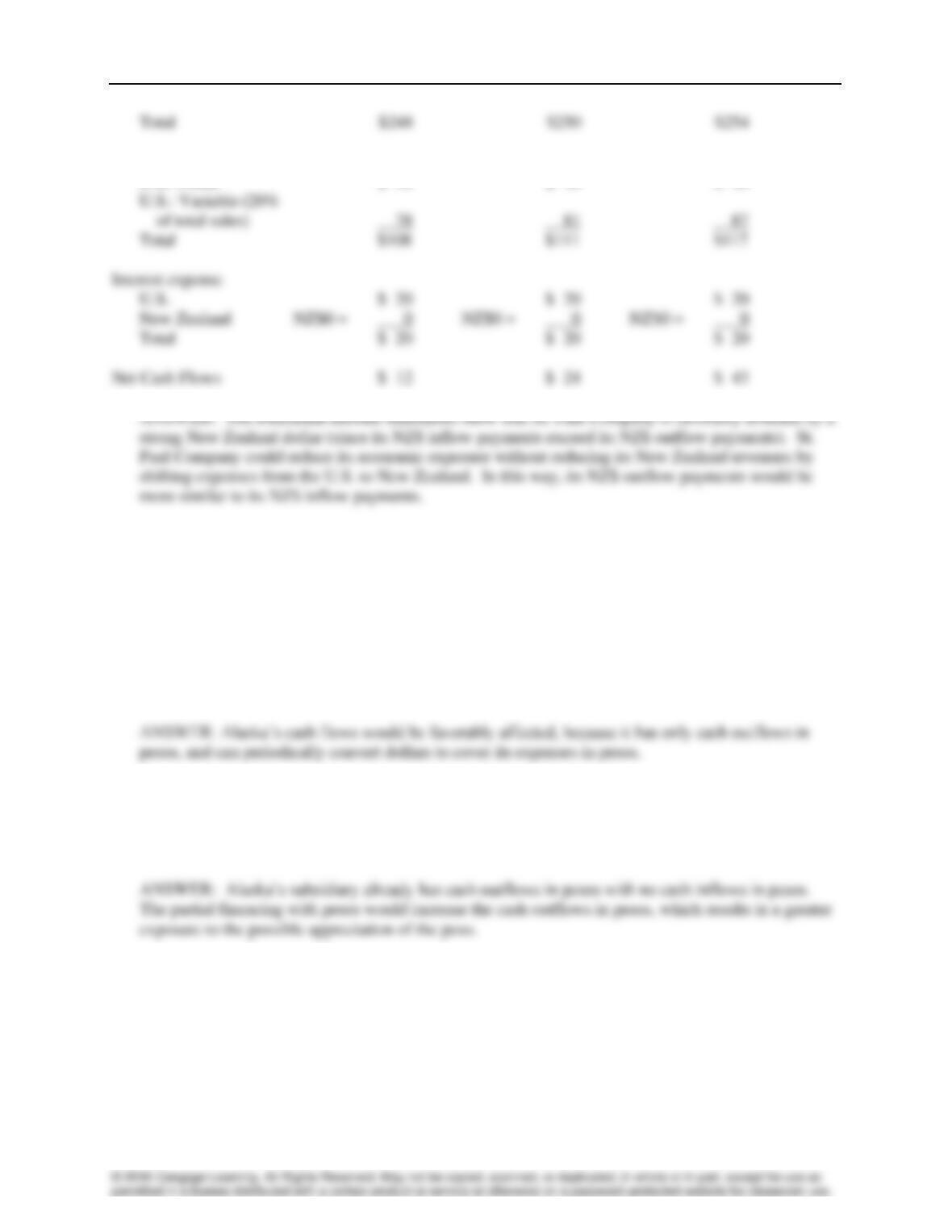
11. Managing Economic Exposure. St. Paul Co. does business in the United States and New Zealand.
In attempting to assess its economic exposure, it compiled the following information.
a. St. Paul’s U.S. sales are somewhat affected by the value of the New Zealand dollar (NZ$),
because it faces competition from New Zealand exporters. It forecasts the U.S. sales based on the
following three exchange rate scenarios:
Revenue from U.S. Business
Exchange Rate of NZ$ (in millions)
NZ$ = $.48 $100
NZ$ = .50 105
NZ$ = .54 110
b. Its New Zealand dollar revenues on sales to New Zealand invoiced in New Zealand dollars are
expected to be NZ$600 million.
c. Its anticipated cost of materials is estimated at $200 million from the purchase of U.S. materials
and NZ$100 million from the purchase of New Zealand materials.
d. Fixed operating expenses are estimated at $30 million.
e. Variable operating expenses are estimated at 20 percent of total sales (after including New
Zealand sales, translated to a dollar amount).
f. Interest expense is estimated at $20 million on existing U.S. loans, and the company has no
existing New Zealand loans.
Forecast net cash flows for St. Paul Co. under each of the three exchange rate scenarios. Explain how
St. Paul’s projected net cash flows are affected by possible exchange rate movements. Explain how it
can restructure its operations to reduce the sensitivity of its net cash flows to exchange rate
movements without reducing its volume of business in New Zealand.
ANSWER:
Forecasted Net Cash Flows for St. Paul Company
(Figures are in millions)
NZ$ = $.48 NZ$ = $.50 NZ$ = $.54
Sales
Managing Economic Exposure and Translation Exposure ❖ 6
Operating expenses
U.S.: Fixed $ 30 $ 30 $ 30
12. Assessing Economic Exposure. Alaska Inc. plans to create and finance a subsidiary in Mexico that
produces computer components at a low cost and exports them to other countries. It has no other
international business. The subsidiary will produce computers and export them to Caribbean islands
and will invoice the products in U.S. dollars. The values of the currencies in the islands are expected
to remain very stable against the dollar. The subsidiary will pay wages, rent, and other operating costs
in Mexican pesos. The subsidiary will remit earnings monthly to the parent.
a. Would Alaska’s cash flows be favorably or unfavorably affected if the Mexican peso depreciates
over time?
b. Assume that Alaska considers partial financing of this subsidiary with peso loans from Mexican
banks instead of providing all the financing with its own funds. Would this alternative form of
financing increase, decrease, or have no effect on the degree to which Alaska is exposed to
exchange rate movements of the peso?
13. Hedging Continual Exposure. Consider this common real-world dilemma by many firms that rely
on exporting. Clearlake Inc. produces its products in its factory in Texas, and exports most of the
products to Mexico each month. The exports are denominated in pesos. Clearlake Inc. recognizes that
hedging on a monthly basis does not really protect against long-term movements in exchange rates. It
also recognizes that it could eliminate its transaction exposure by denominating the exports in dollars,
but that it still would have economic exposure (because Mexican consumers would reduce demand if
the peso weakened). Clearlake Inc. does not know how many pesos it will receive in the future, so it
would have difficulty even if a long-term hedging method were available. How can Clearlake
Managing Economic Exposure and Translation Exposure ❖ 7
realistically deal with this dilemma and reduce its exposure over the long-term? [There is no perfect
solution, but in the real world, there rarely are perfect solutions.]
14. Sources of Supplies and Exposure to Exchange Rate Risk. Laguna Co. (a U.S. firm) will be
receiving 4 million British pounds in one year. It will need to make a payment of 3 million Polish
zloty in one year. It has no other exchange rate risk at this time. However, it needs to buy supplies and
can purchase them from Switzerland, Hong Kong, Canada, or Ecuador. Another alternative is that it
could also purchase one-fourth of the supplies from each of the 4 countries mentioned in the previous
sentence. The supplies will be invoiced in the currency of the country where they are imported from.
Laguna Co. believes that none of the sources of the imports would provide a clear cost advantage. As
of today, the dollar cost of these supplies would be about $6 million regardless of the source that will
provide the supplies.
The spot rates today are as follows:
British pound=$1.80
Swiss franc=$.60
Polish zloty=$.30
Hong Kong dollar=$.14
Canadian dollar =$.60
The movements of the pound and the Swiss franc and the Polish zloty against the dollar are highly
correlated. The Hong Kong dollar is tied to the U.S. dollar and you expect that it will continue to be
tied to the dollar. The movements in the value of Canadian dollar against the U.S. dollar are not
correlated with the movements of other currencies. Ecuador uses the U.S. dollar as its local currency.
Which alternative should Laguna Co. select in order to minimize its overall exchange rate risk?
ANSWER: After one year, assuming that today’s spot rates hold as the spot rates one year from now,
15. Minimizing Exposure. Lola Co. is (a U.S. firm) that expects to receive 10 million euros in one
year. It does not plan to hedge this transaction with a forward contract or other hedging techniques.
This is its only international business, and it is not exposed to any other form of exchange rate risk.
Lola Co. plans to purchase materials for future operations and it will send its payment for these
Managing Economic Exposure and Translation Exposure ❖ 8
materials in one year. The value of the materials to be purchased is about equal to the expected value
of the receivables. Lola Co. can purchase the materials from Switzerland, Hong Kong, Canada, or the
U.S. Another alternative is that it could also purchase one-fourth of the materials from each of the 4
countries mentioned in the previous sentence. The supplies will be invoiced in the currency of the
country from which they are imported.
The movements of the euro and the Swiss franc against the dollar are highly correlated and will
continue to be highly correlated. The Hong Kong dollar is tied to the U.S. dollar and you expect that
it will continue to be tied to the dollar. The movements in the value of Canadian dollar against the
U.S. dollar are independent of (not correlated with) the movements of other currencies against the
U.S. dollar. Lola Co. believes that none of the sources of the imports would provide a clear cost
advantage. Which alternative should Lola Co. select for obtaining supplies that will minimize its
overall exchange rate risk?
16. Financing to Reduce Exchange Rate Exposure. Nashville Co. presently incurs costs of about 12
million Australian dollars (A$) per year due to research and development expenses in Australia. The
parent company sells the products that are designed each year, and all of products sold each year
would be invoiced in U.S. dollars. Nashville anticipates revenue of about $20 million per year and
about half of the revenue would be from sales to customers in Australia. An Australian dollar is
presently valued at $1 (1 U.S. dollar), but it fluctuates a lot over time. Nashville Co. is planning a new
project in which it will expand its sales to other regions within the U.S. and the sales will be invoiced
in dollars. Nashville can finance this project with a 5-year loan by (1) borrowing only Australian
dollars, or (2) borrowing only U.S. dollars, or (3) borrowing one-half of the funds from each of these
sources. The 5-year interest rates on an Australian dollar loan and U.S. dollar loan are the same.
a. If Nashville wants to use the form of financing that will reduce its exposure to exchange rate risk
the most, what is the optimal form of financing? Briefly explain (this means that one or two sentences
should be sufficient if your explanation is clear).
b. Now assume that Nashville expects that the Australian dollar will appreciate over time. Suppose
the company wants to maximize its expected net present value of this project and is not concerned
about its exposure to exchange rate risk. Under these conditions, which financing alternative is most
appropriate. Briefly explain.
ANSWER:
Solution to Continuing Case Problem: Blades, Inc.
1. How will Blades be negatively affected by the high level of inflation in Thailand if the Thai customer
renews its commitment for another three years?
Managing Economic Exposure and Translation Exposure ❖ 9
2. Holt believes that the Thai importer will renew its commitment in two years. Do you think his
assessment is correct? Why or why not? Also, assume that the Thai economy returns to the high
growth level that existed prior to the recent unfavorable economic events. Under this assumption,
how likely is it that the Thai importer will renew its commitment in two years?
ANSWER: Before renewing its commitment to purchase a fixed number of products at a fixed price
from Blades, the Thai importer would have to assess the advantages and disadvantages of such an
3. For each of the three possible values of the Thai baht and the British pound, use a spreadsheet to
estimate cash flows for the next year. Briefly comment on the level of Blades’ economic exposure.
Ignore possible tax effects.
ANSWER: (See spreadsheet attached.) Blades, Inc. does not appear to be subject to a high level of
THB=$0.0220
THB=$0.0209
THB=$0.0198
BP=$1.530
BP=$1.485
BP=$1.500
Sales
(1) U.S. (520,000 units × $120/pair)
$ 62,400,000
$ 62,400,000
$ 62,400,000
Exchange Rate)
Exchange Rate)
(4) Total
$ 105,072,240
$ 103,442,628
$ 102,773,016
Cost of materials:
(5) U.S. ([900,000 – 80,000] units × $70)
$ 57,400,000
$ 57,400,000
$ 57,400,000
Exchange Rate)
(7) Total
$ 62,680,000
$ 62,416,000
$ 62,152,000
Operating Expenses:
(8) U.S.: Fixed
$ 2,000,000
$ 2,000,000
$ 2,000,000
(10) Total
$ 8,864,000
$ 8,864,000
$ 8,864,000
(11) Net cash flow
4. Now repeat your analysis in question 3 but assume that the British pound and the Thai baht are
perfectly correlated. For example, if the baht depreciates by 5 percent, the pound will also depreciate
by 5 percent. Under this assumption, is Blades subject to a greater degree of economic exposure?
Why or why not?
ANSWER: (See spreadsheet attached.) If the British pound and the Thai baht are perfectly
THB=$0.0220
THB=$0.0209
THB=$0.0198
BP=$1.50
BP=$1.425
BP=$1.350
Sales
(1) U.S. (520,000 units × $120/pair)
$ 62,400,000
$ 62,400,000
$ 62,400,000
Exchange Rate)
Exchange Rate)
(4) Total
$ 104,592,240
$ 102,482,628
$ 100,373,016
Cost of materials:
(5) U.S. ([900,000 – 80,000] units × $70)
$ 57,400,000
$ 57,400,000
$ 57,400,000
Exchange Rate)
(7) Total
$ 62,680,000
$ 62,416,000
$ 62,152,000
Operating Expenses:
(8) U.S.: Fixed
$ 2,000,000
$ 2,000,000
$ 2,000,000
(10) Total
$ 8,864,000
$ 8,864,000
$ 8,864,000
(11) Net cash flows
5. Based on your answers to the previous three questions, what actions could Blades take to reduce its
level of economic exposure to Thailand?
ANSWER: There are several actions Blades could take. The analysis above illustrates that economic
Managing Economic Exposure and Translation Exposure ❖ 11
Solution to Supplemental Case: Madison Co.
a. While economic exposure adversely affected the firm’s performance in a recent period, it should
favorably affect the firm’s performance in the future. A weak Canadian dollar (which has been
forecasted) would favorably affect Madison, Inc. under the prevailing operational structure. If the
structure is revised, Madison will be less exposed to the Canadian dollar’s exchange rate movements.
b. The prevailing operational structure allows the firm to benefit from a weaker Canadian dollar. Yet, if
the Canadian dollar appreciates, the Vice-president could be fired. Thus, the Vice-president may
choose a structure that reduces economic exposure, even though the expected earnings are reduced.
Shareholders would have preferred that Madison remained exposed, since the expected return is
higher, and do not suffer the same severe consequences as the Vice-president if the Canadian dollar
appreciates.
Small Business Dilemma
Hedging the Sports Exports Company’s Economic Exposure to Exchange Rate Risk
1. How could Logan adjust his operations to reduce his economic exposure? What is a possible
disadvantage of such an adjustment?
ANSWER: Jim could determine whether the material could be purchased from a British
manufacturer, so that he would have some payables in pounds to offset some of the receivables in
2. Offer another solution to hedging the economic exposure in the long run as Jim’s business grows.
What are disadvantages of this solution?
ANSWER: Jim may attempt to hire a person in the United Kingdom to do the production there.
Material could be purchased in the United Kingdom and then used by that person to produce the
Part 3—Integrative Problem
Exchange Rate Risk Management
Vogl Company is a U.S. firm conducting a financial plan for the next year. It has no foreign subsidiaries,
but more than half of its sales are from exports. Its foreign cash inflows to be received from exporting and
cash outflows to be paid for imported supplies over the next year are shown in the following table:
Currency
Total Inflow
Total Outflow
Canadian dollars (C$)
C$32,000,000
C$2,000,000
New Zealand dollars (NZ$)
NZ$5,000,000
NZ$1,000,000
Mexican pesos (MXP)
MXP11,000,000
MXP10,000,000
Singapore dollars (S$)
S$4,000,000
S$8,000,000
The spot rates and one-year forward rates as of today are:
Currency
Spot Rate
One-Year Forward Rate
C$
$ .90
$ .93
NZ$
.60
.59
MXP
.18
.15
S$
.65
.64
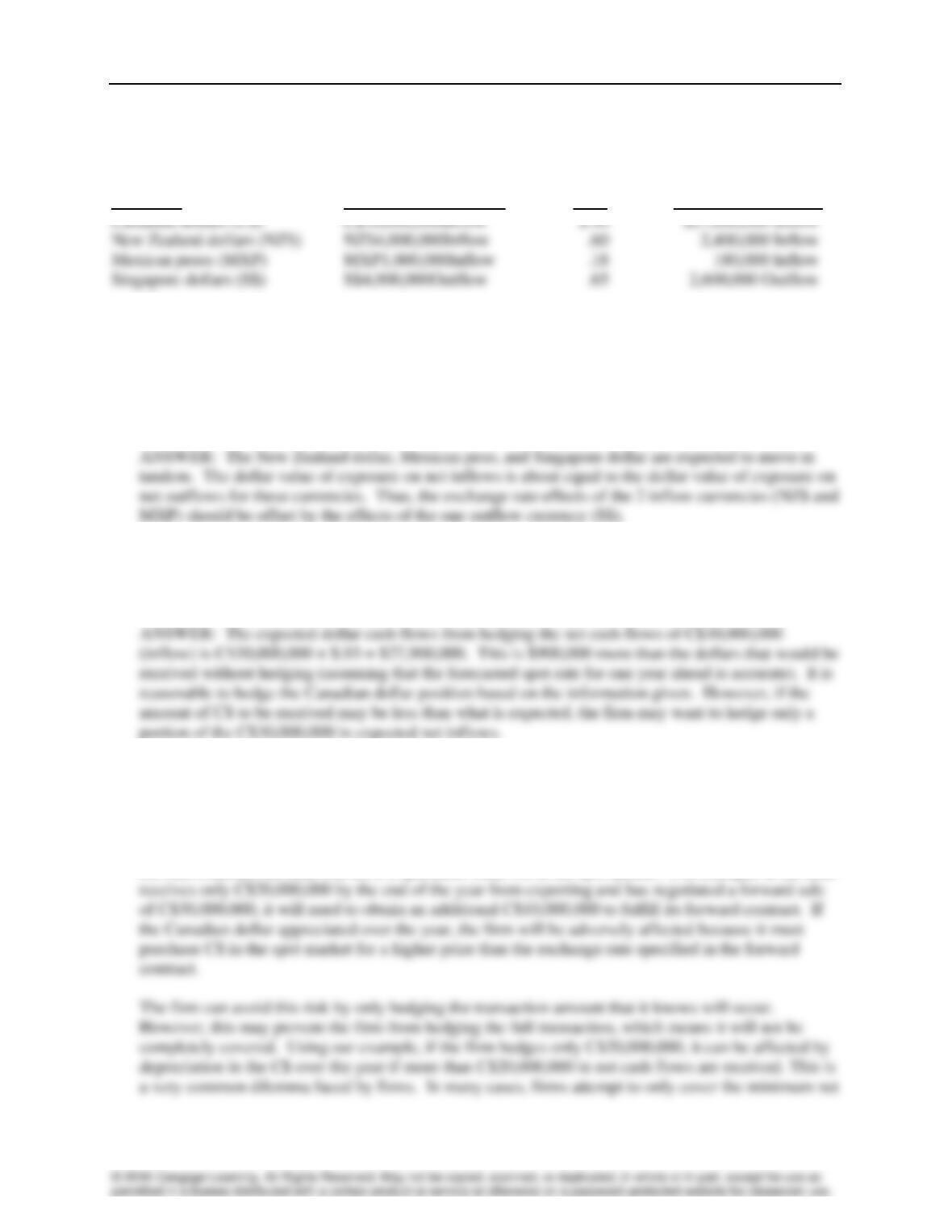
1. Based on the information provided, determine the net exposure of each foreign currency in dollars.
Managing Economic Exposure and Translation Exposure ❖ 13
ANSWER:
Currency
Net Inflow or Outflow
Spot
Exchange
Rate
Net Inflow or Outflow
Measured in Dollars
2. Assume that today’s spot rate is used as a forecast of the future spot rate one year from now. The
New Zealand dollar, Mexican peso, and Singapore dollar are expected to move in tandem against the
U.S. dollar over the next year. The Canadian dollar’s movements are expected to be unrelated to
movements of the other currencies. Since exchange rates are difficult to predict, the forecasted net
dollar cash flows per currency may be inaccurate. Do you anticipate any offsetting exchange rate
effects from whatever exchange rate movements do occur? Explain.
3. Given the forecast of the Canadian dollar along with the forward rate of the Canadian dollar, what is
the expected increase or decrease in dollar cash flows that would result from hedging the net cash
flows in Canadian dollars? Would you hedge the Canadian dollar position?
4. Assume that the Canadian dollar net inflows may range from C$20,000,000 to C$40,000,000 over the
next year. Explain the risk of hedging C$30,000,000 in net inflows. How can Vogl Company avoid
such a risk? Is there any tradeoff resulting from your strategy to avoid that risk?
ANSWER: If the C$ received are less than the amount to be sold by the firm as specified in the
forward contract, the firm will have to purchase some C$ in the spot market. For example, if the firm
5. Vogl Company recognizes that its year–to-year hedging strategy hedges the risk only over a given
year, and does not insulate it from long-term trends in the Canadian dollar’s value. It has considered
establishing a subsidiary in Canada. The goods would be sent from the U.S. to the Canadian
subsidiary and distributed by the subsidiary. The proceeds received would be reinvested by the
Canadian subsidiary in Canada. In this way, Vogl Company would not have to convert Canadian
dollars to U.S. dollars each year. Has Vogl eliminated its exposure to exchange rate risk by using this
strategy? Explain.
ANSWER: Vogl may avoid the year-to-year hedging decision with this strategy but is increasing its
exposure to the C$ over time. It is essentially reinvesting the proceeds in the same currency, thereby