Chapter 12 – Motivating Employees: Achieving Superior Performance in the Workplace
12–21
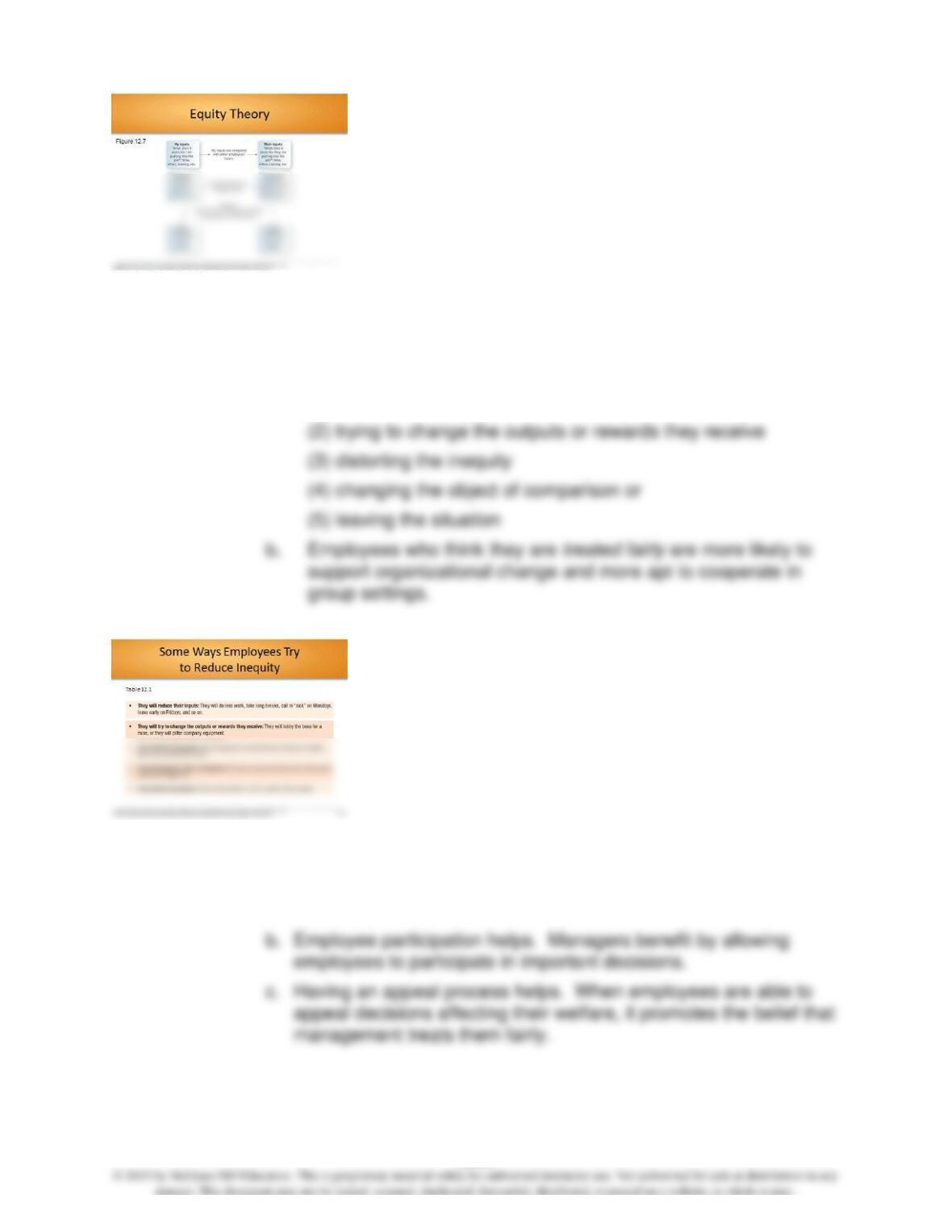
4. Using Equity Theory to Motivate Employees
a. Employees who feel they are underrewarded will react to the
inequity in negative ways by:
(1) reducing their inputs
5. Three practical lessons can be drawn from equity theory:
a. Employee perceptions are what count. Managers should provide
positive recognition and explain the reasons behind their
decisions.
Chapter 12 – Motivating Employees: Achieving Superior Performance in the Workplace
12–22
SELF-ASSESSMENT 12.4 (p. 388)
Measuring Perceived Fair Interpersonal Treatment
Go to connect.mheducation.com and take Self-Assessment 12.4.
Student Questions:
1. Are you being treated equitably?
2. Based on examining the three lowest-scoring items, what could your manager
do to improve your perceptions of equity?
You should be prepared to relate these lowest-scoring items to equity theory.
3. What can you do to increase your perceptions of fair interpersonal treatment?
You can describe the association between fair interpersonal treatment with job
Additional Activities:
You can also consult the Connect Instructors Manual for the post-assessment activity
D. Expectancy Theory: How Much Do You Want It and How Likely Are You to Get
It?
1. Expectancy theory proposed by Victor Vroom, suggests that people are
motivated by two things:
Chapter 12 – Motivating Employees: Achieving Superior Performance in the Workplace
2. According to the theory, motivation involves the relationship between
effort, performance and the desirability of the outcomes.
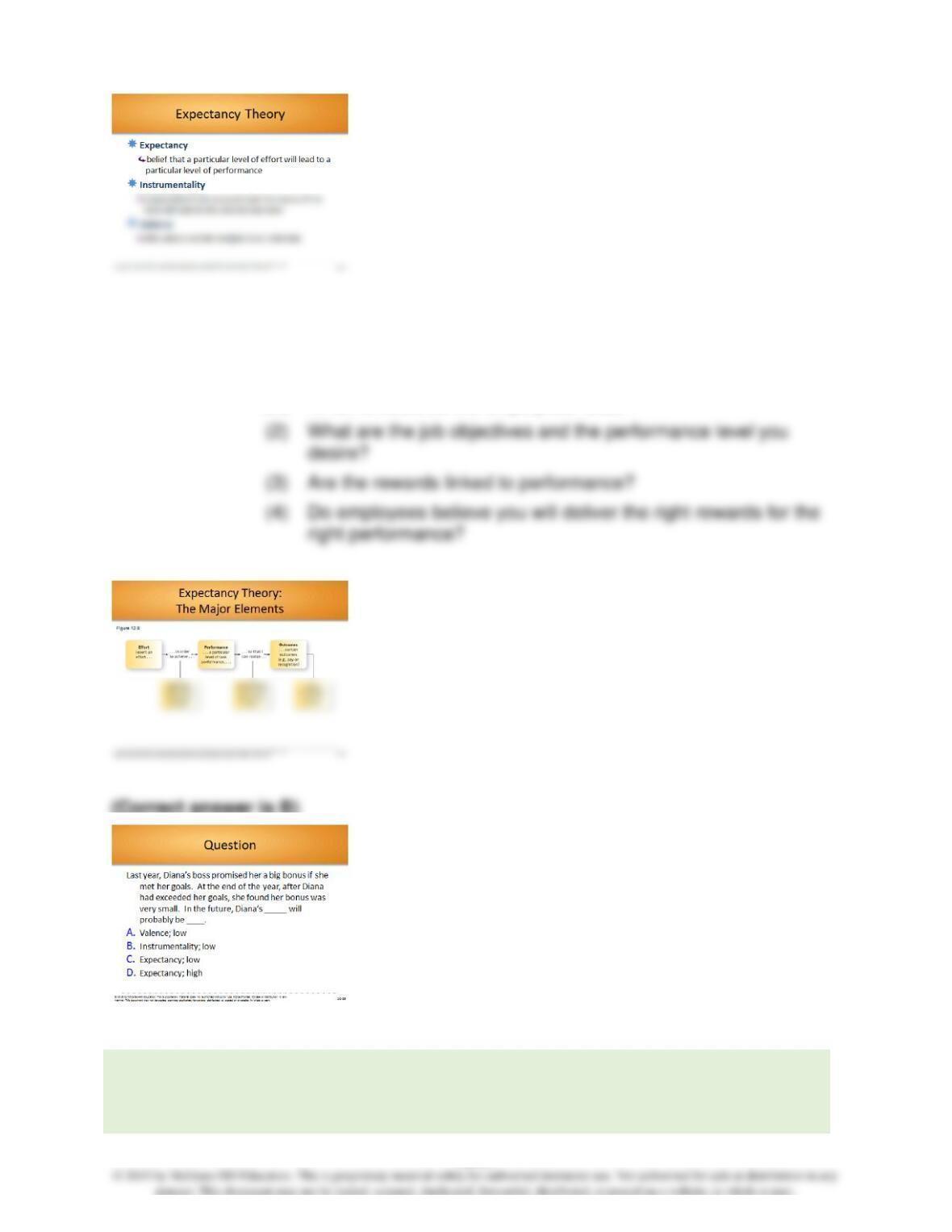
a. These relationships are affected by the three elements of
expectancy, instrumentality and valence.
b. Expectancy: “Will I be able to perform at the desired level on a task?”
ability to perform.
c. Instrumentality: “What outcome will I receive if I perform at this level?”
(1) Instrumentality is the expectation that successful performance
of the task will lead to the outcome desired.
d. Valence—”How much do I want the outcome?”
(1) Valence is value, the importance a worker assigns to the
Chapter 12 – Motivating Employees: Achieving Superior Performance in the Workplace
12–24
3. Using Expectancy Theory to Motivate Employees.
a. When attempting to motivate employees, managers should ask the
following questions:
(1) What rewards do the employees value?
(Correct answer is B)
Interactive Classroom Material:
EXAMPLE: Reducing the F’s: Applying Expectancy Theory to Failing Students
(p. 390)
Chapter 12 – Motivating Employees: Achieving Superior Performance in the Workplace
12–25
Dr. Tim Richard has used a motivational program called Celebration/Remediation to
YOUR CALL
How could you apply Richard’s program to reward performance in business?
Richard’s program can be utilized in performance evaluations in business.
Employees need to realize that if they perform, they will receive an outcome. The
Additional Activities:
You can use this Example as the basis for a group exercise by having students
consider how the other motivation theories described in the chapter might be used to
motivate struggling high school students. Possible discussion questions to assign to
teams might include:
Discuss how equity theory could be applied to explain the motivating power of the
E. Goal-Setting Theory: Objectives Should Be Specific and Challenging but
Achievable
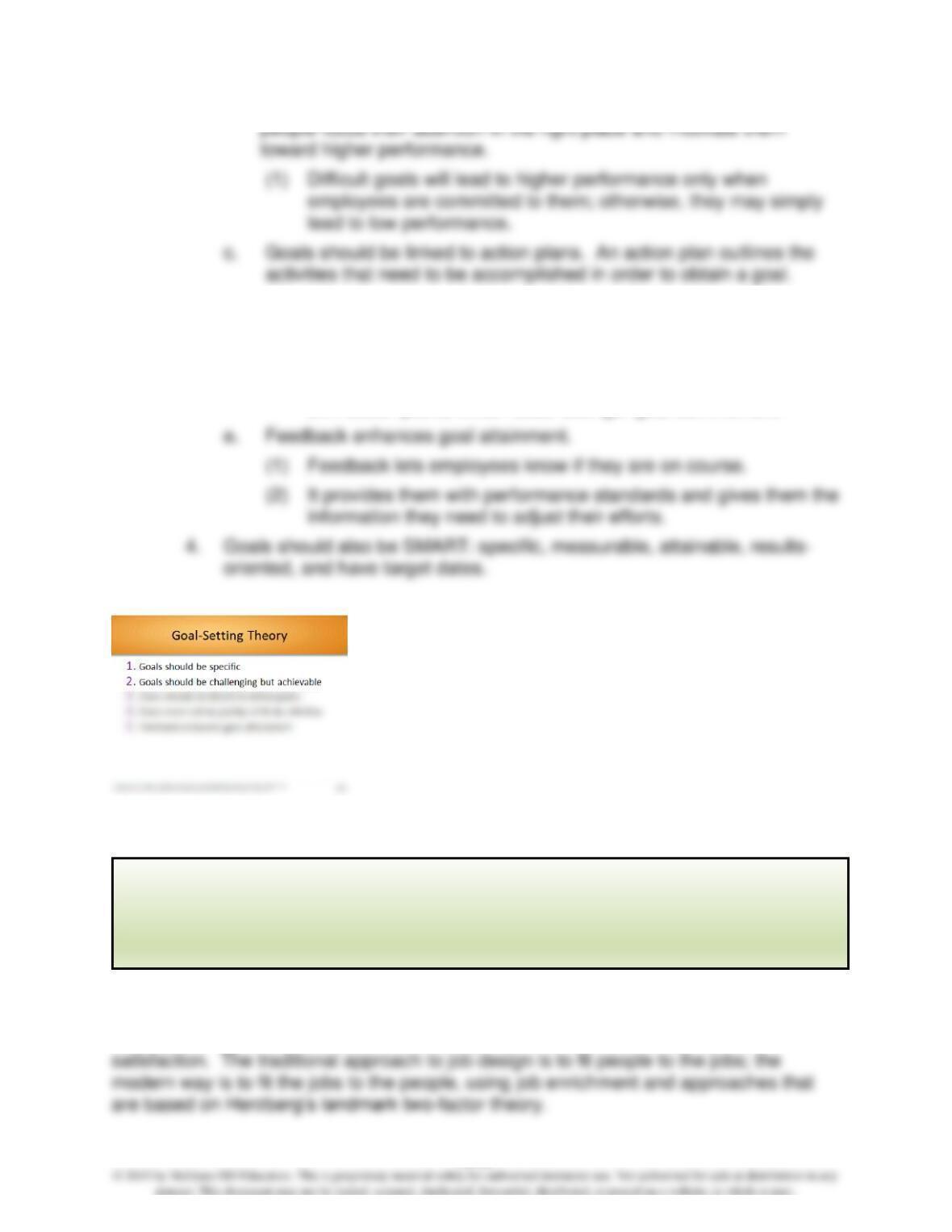
1. Goal-setting theory, developed by Edwin Locke and Gary Latham,
suggests that employees can be motivated by goals that are specific and
challenging but achievable.
Chapter 12 – Motivating Employees: Achieving Superior Performance in the Workplace
12–26
b. Goals should be challenging but achievable. They should make
d. Goals need not be set jointly to be effective.
(1) It doesn’t seem to matter whether goals are set by managers,
employees, or both together to be effective.
(2) However, employees should be encouraged to develop their
own action plans, which foster stronger goal commitment.
Section 12.4 discusses job design, the division of an organization’s work among
employees, applies motivational theories to jobs to increase performance and
12.4 Job Design Perspectives on Motivation (pp. 392-395)
What’s the best way to design jobs—adapt people to work or work to
people?
Chapter 12 – Motivating Employees: Achieving Superior Performance in the Workplace
12–27
Possible Topics for Discussion:
• Discuss the advantages and disadvantages of using job enlargement as a form
of job design.
Major Idea Outline:
A. Job design is:
1. the division of an organization’s work among its employees; and
B. There are two approaches to job design: fitting people to jobs and fitting
jobs to people.
1. The traditional way is fitting people to jobs.
a. This is based on the assumption that people will gradually adapt
(1) This increases employee efficiency and productivity.
2. Fitting jobs to people is based on the assumption that people are
underutilized at work and that they want more variety, challenges, and
responsibility. Two techniques:
a. Job enlargement consists of increasing the number of tasks in a
Chapter 12 – Motivating Employees: Achieving Superior Performance in the Workplace
12–28
b. Job enrichment consists of building into a job such motivating
factors as responsibility, achievement, recognition, stimulating
work, and advancement.
(1) Instead of the job-enlargement technique (known as
C. The Job Characteristics Model: Five Job Attributes for Better Work
Outcomes
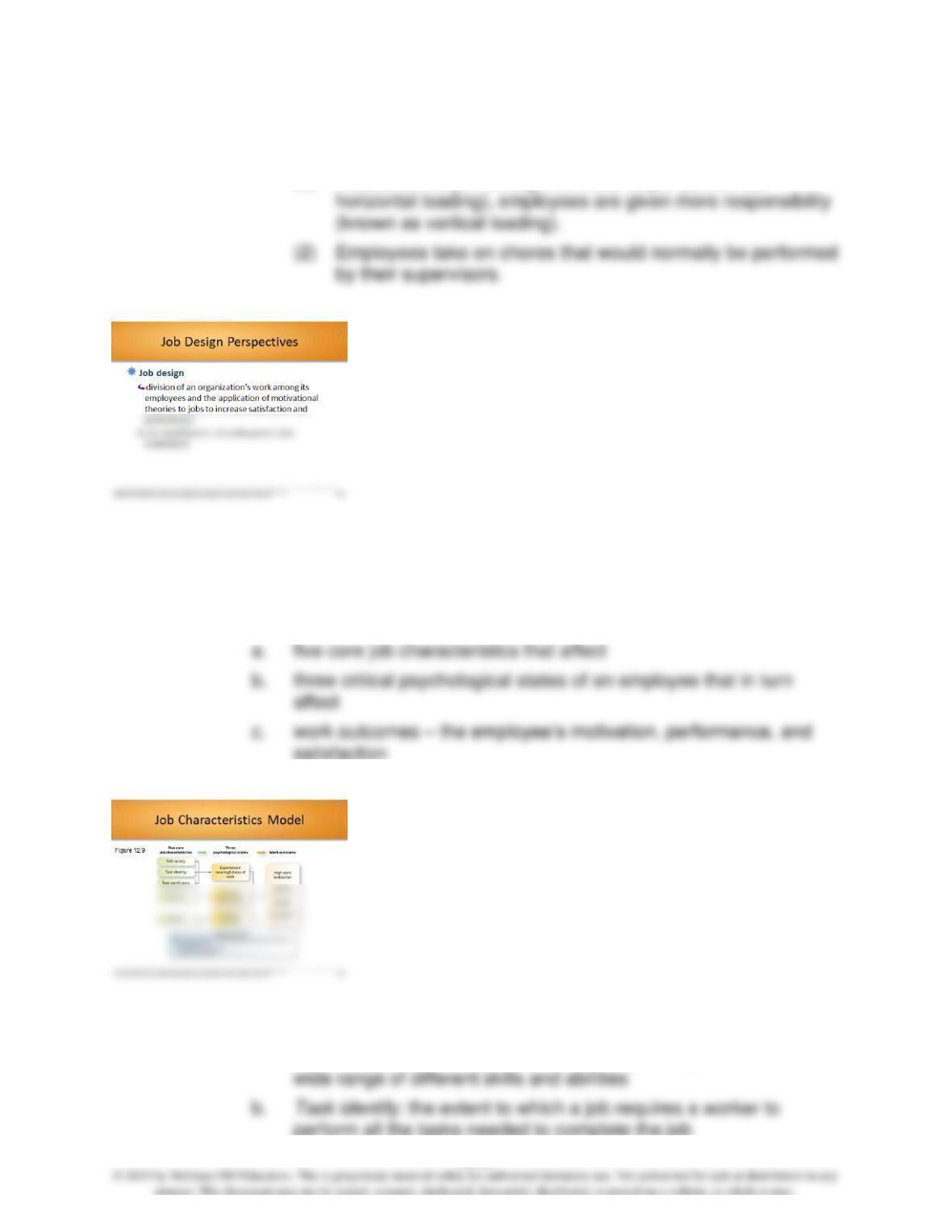
1. The job characteristics model, developed by J. Richard Hackman
and Greg Oldham, consists of:
2. The five job characteristics are:
a. Skill variety: the extent to which a job requires a person to use a
Chapter 12 – Motivating Employees: Achieving Superior Performance in the Workplace
12–29
3. These core characteristics affect critical psychological states:
meaningfulness of work, responsibility for results, and knowledge of
results.
a. In turn, these positive psychological states fuel high motivation,
high performance, high satisfaction, and low absenteeism and
turnover.
b. Contingency factors refer to the degree to which a person wants
4. Job design is positively associated with employee performance, job
satisfaction, organizational commitment, physical and psychological
well being, lower absenteeism and intentions to quit.
5. There are three major steps to follow when applying the job
characteristics model:
a. Diagnose the work environment to see whether a problem exists.
b. Determine whether job design is appropriate.
(1) If a person’s MPS score is low, an attempt should be made
Chapter 12 – Motivating Employees: Achieving Superior Performance in the Workplace
12–30
Section 12.5 discusses reinforcement theory. This theory suggests behavior will be
repeated if it has positive consequences and won’t be if it has negative consequences.
There are four types of reinforcement: positive reinforcement, negative reinforcement,
extinction, and punishment. This section also describes how to use some reinforcement
techniques to modify employee behavior.
Possible Topics for Discussion:
• Describe how positive reinforcement, negative reinforcement, and punishment
seek to change behavior.
reinforcement theory to modify employee behavior.
Major Idea Outline:
A. The reinforcement perspective, pioneered by Edward L. Thorndike and B. F.
Skinner, focuses on how the consequences of a certain behavior affect that
behavior in the future.
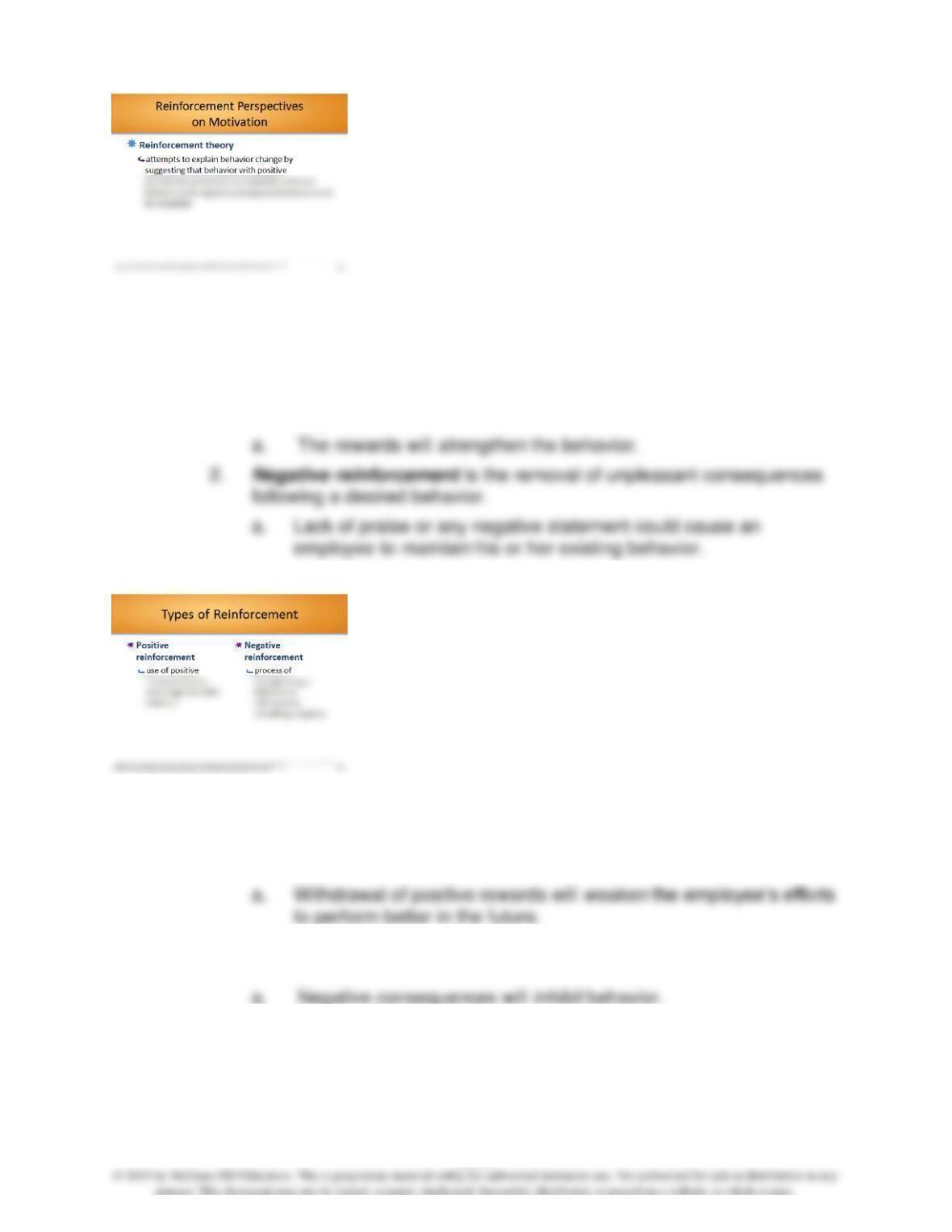
1. Reinforcement theory attempts to explain behavior change by
suggesting that behavior with positive consequences tends to be
12.5 Reinforcement Perspectives on Motivation (pp. 396-
398)
What are the types of incentives I might use to influence employee
behavior?
Chapter 12 – Motivating Employees: Achieving Superior Performance in the Workplace
12–31
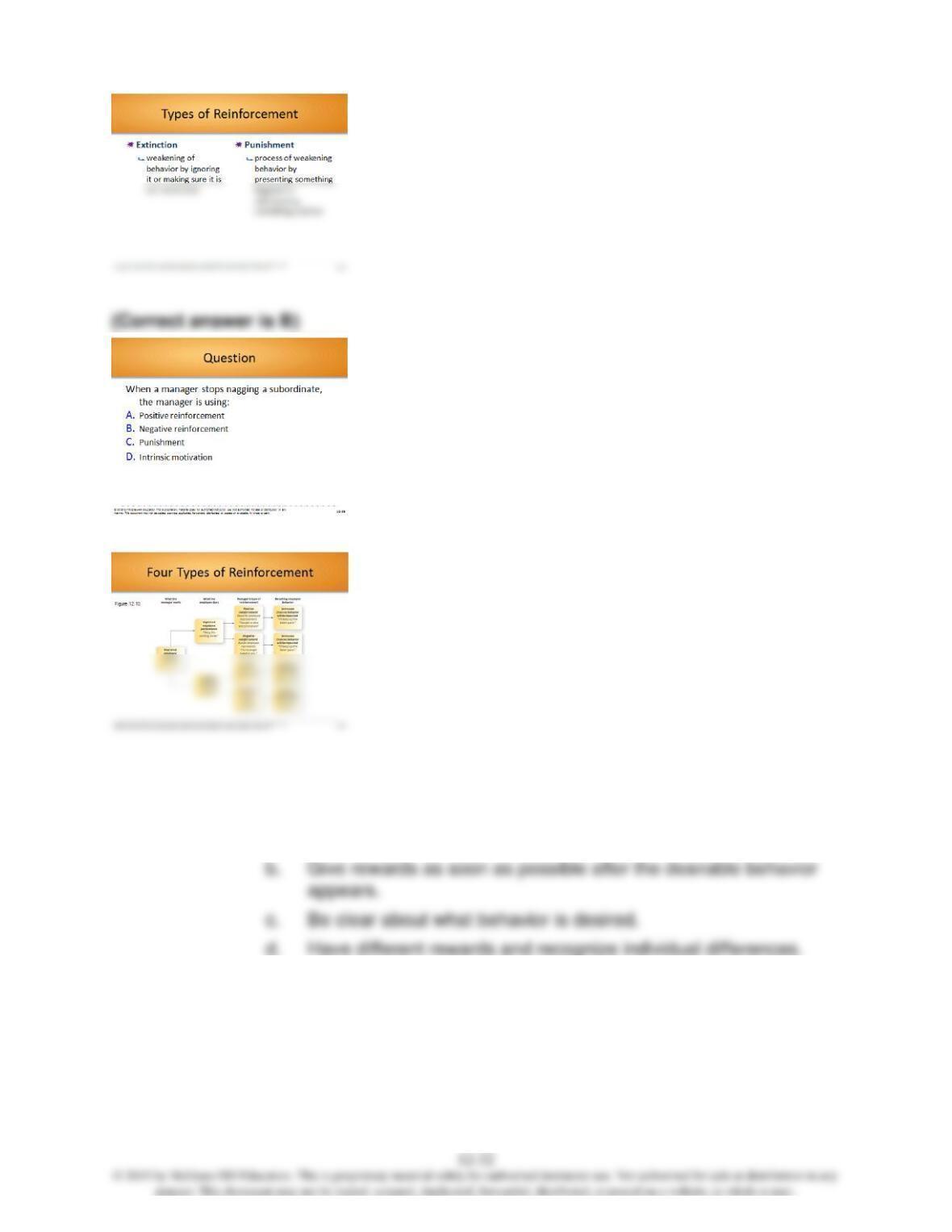
B. Reinforcement is anything that causes a given behavior to be repeated or
inhibited. There are four types: positive reinforcement, negative
reinforcement, extinction, and punishment.
1. Positive reinforcement is the use of positive consequences to
encourage desirable behavior.
3. Extinction is the withholding or withdrawal of positive rewards for
desirable behavior so that the behavior is less likely to occur in the
future.
4. Punishment is the application of negative consequences to stop or
change undesirable behavior.
Chapter 12 – Motivating Employees: Achieving Superior Performance in the Workplace
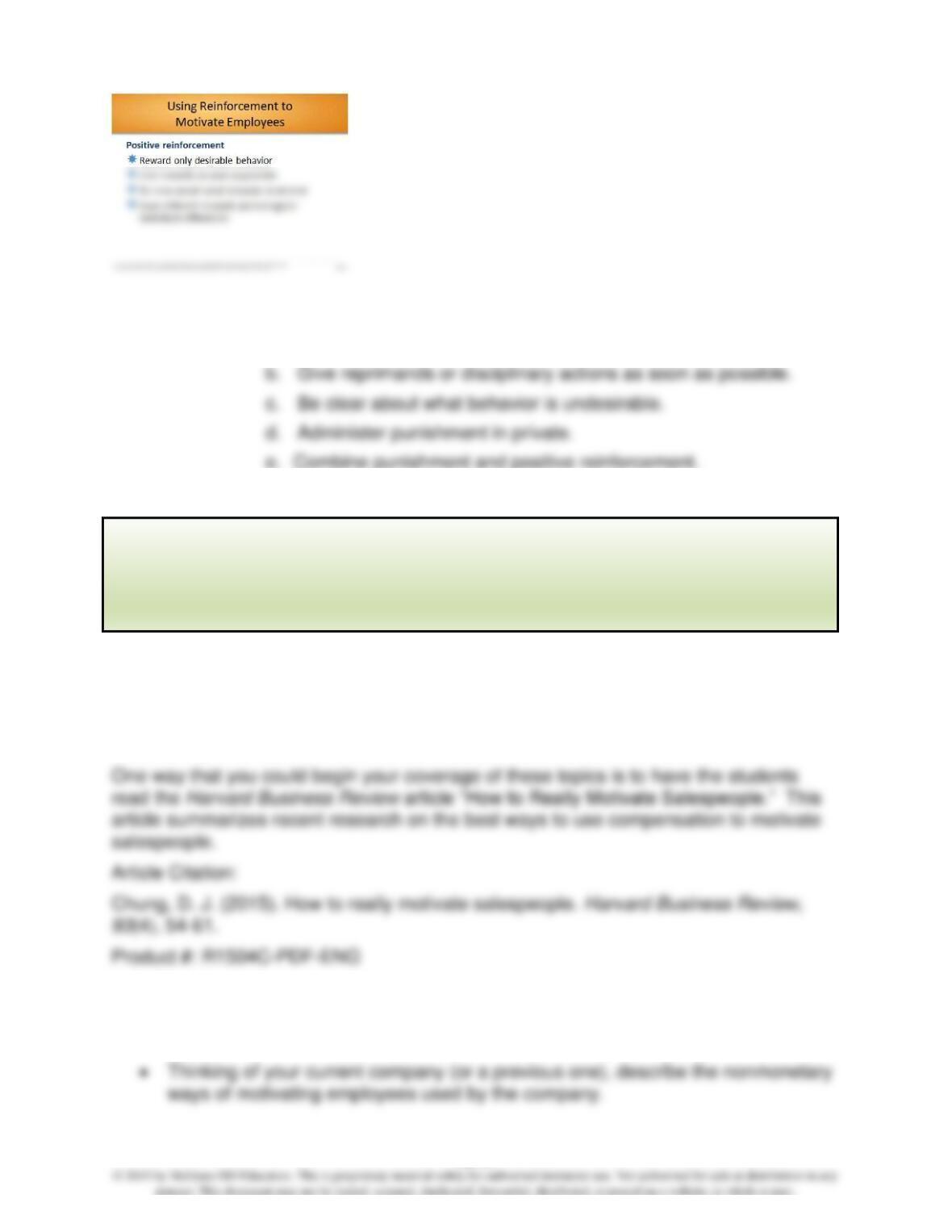
C. Using Reinforcement to Motivate Employees
1. Ways to use positive reinforcement:
a. Reward only desirable behavior.
Chapter 12 – Motivating Employees: Achieving Superior Performance in the Workplace
12–33
2. Ways to use punishment:
a. Punish only undesirable behavior.
Section 12.6 discusses compensation, the main motivator of performance.
Compensation includes pay for performance, bonuses, profit sharing, gainsharing, stock
options, and pay for knowledge. Other nonmonetary incentives address needs that
aren’t being met, such as work–life balance, growth in skills, and commitment.
Possible Topics for Discussion:
• Discuss the advantages and disadvantages of using profit sharing, gainsharing,
stock options and skill-based pay as forms of incentive compensation.
12.6 Using Compensation & Other Rewards to Motivate (pp.
399-403)
How can I use compensation and other rewards to motivate people?
Chapter 12 – Motivating Employees: Achieving Superior Performance in the Workplace
12–34
Major Idea Outline:
A. Motivating isn’t just about money.
2. The Great Place to Work Institute has determined that great employers
have three traits in common:
B. Motivation and Compensation
1. Most people are paid an hourly wage or a weekly or monthly salary.
a. These methods are easy for an organization to administer but
(1) Rewards must be linked to performance and be measurable.
(2) The rewards must satisfy individual needs.
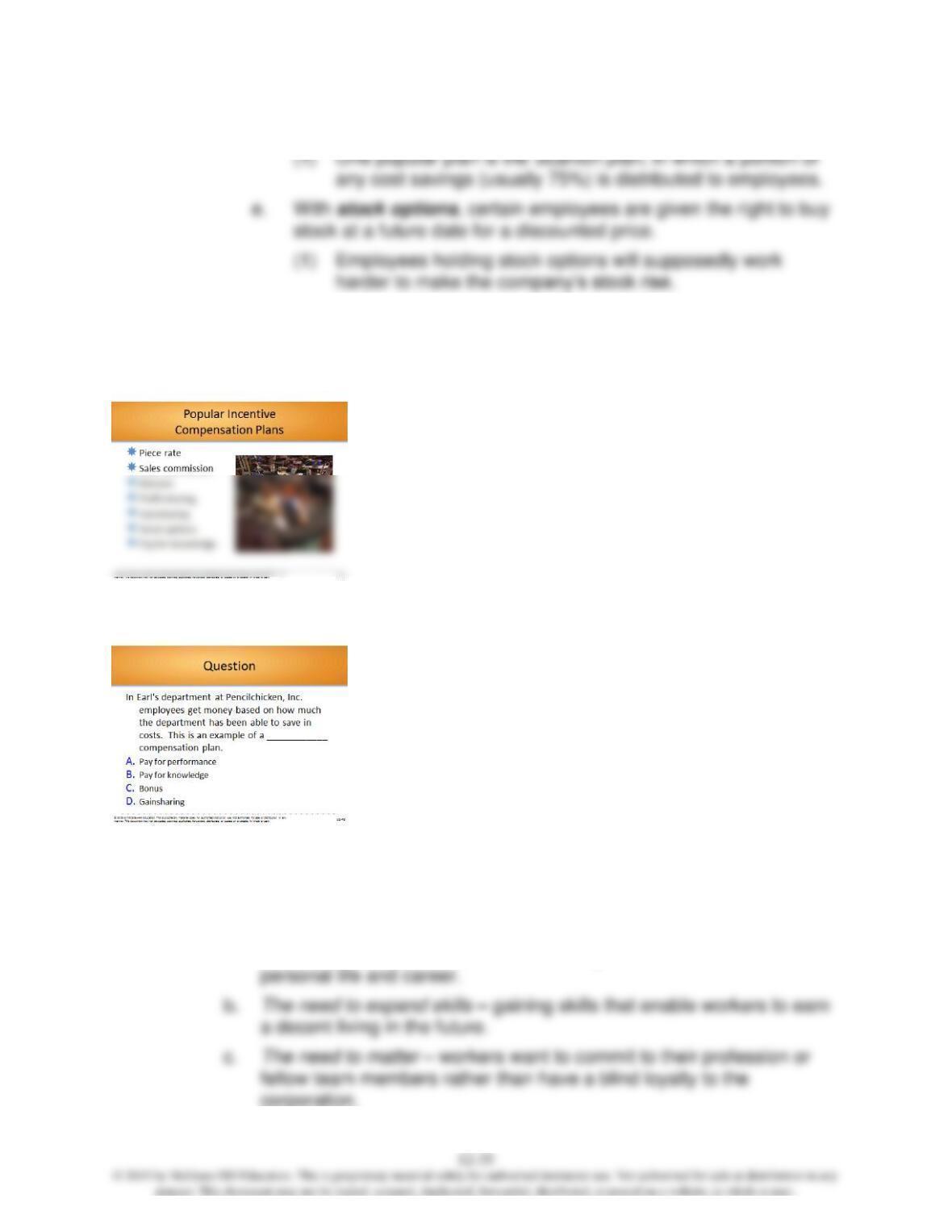
2. Popular incentive compensation plans include pay for performance,
bonuses, profit sharing, gainsharing, stock options, and pay for
knowledge.
a. Pay for performance, also known as merit pay, bases pay on
one’s results.
(1) In a piece rate, employees are paid according to how much
output they produce.
Chapter 12 – Motivating Employees: Achieving Superior Performance in the Workplace
d. Gainsharing is the distribution of savings or “gains” to groups of
employees who reduced costs and increased productivity.
f. Pay for knowledge, also known as skill-based pay, ties
employee pay to the number of job relevant skills or academic
degrees they earn.
(Correct answer is D)
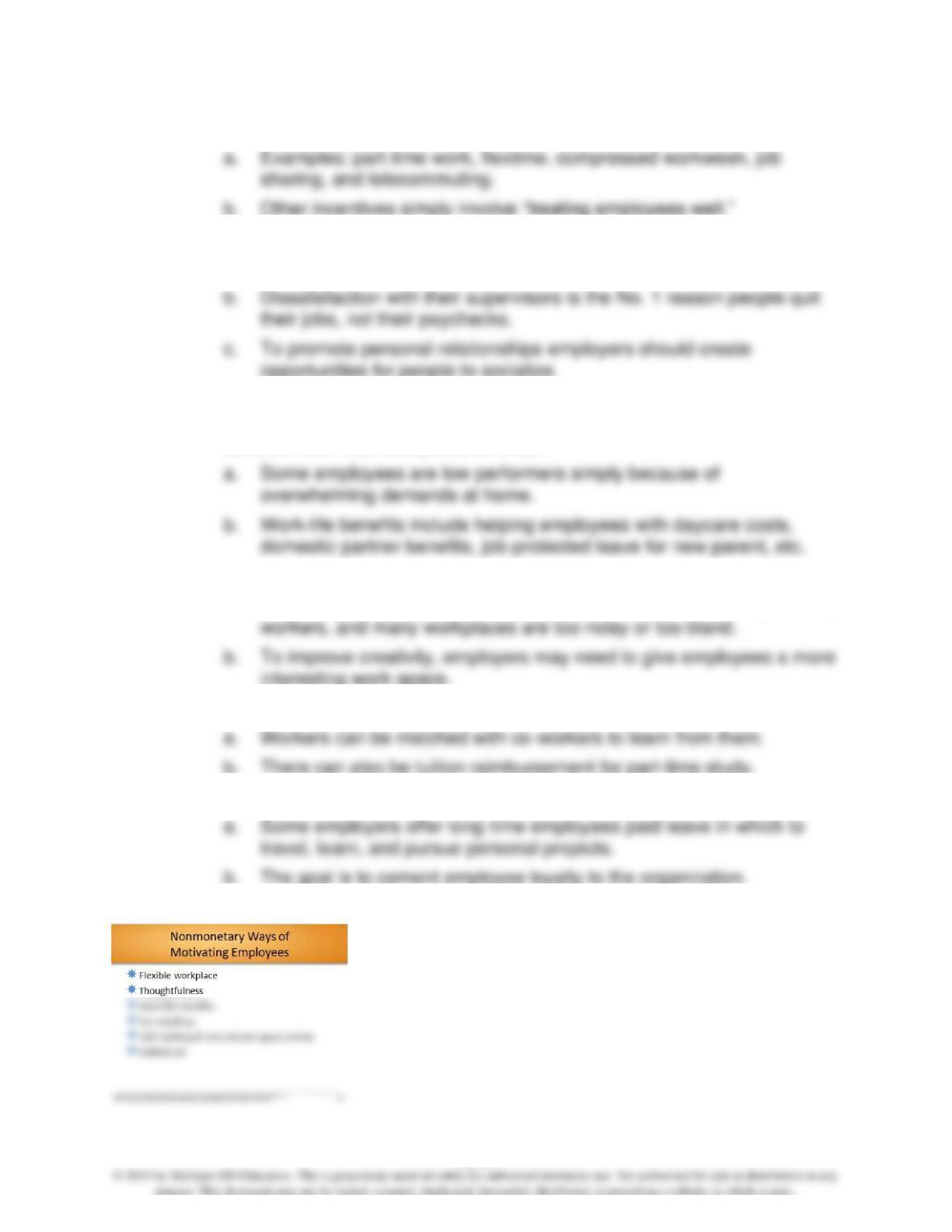
C. Nonmonetary Ways of Motivating Employees
1. Those employees who can solve problems and take initiative are the very
ones who may leave if their needs aren’t being met, specifically:
a. The need for work-life balance – attaining a balance between
Chapter 12 – Motivating Employees: Achieving Superior Performance in the Workplace
12–36
2. Companies can use a flexible workplace to attract, retain, and motivate
employees.
3. Thoughtfulness: the value of being nice
a. A majority of employees feel underappreciated.
4. Work-life benefits are programs used by employers to increase
productivity and commitment by helping employees strike a balance
between their work and personal lives.
5. Surroundings
a. According to new research, the cubicle is stifling the creativity of many
6. Skill-building and educational opportunities
7. Sabbaticals.
Chapter 12 – Motivating Employees: Achieving Superior Performance in the Workplace
12–37
Interactive Classroom Material:
EXAMPLE: The Flexible Workplace (pp. 401-402)
There are several types of alternative work schedules in organizations. 1) Part time
YOUR CALL
For what you’re doing right now at this point in your life, which of these
possibilities would suit you best, and why? Would it be workable for your
employer if all your coworkers did it as well?
Additional Activities:
One way to build on this Example is to have the students read the Harvard Business
Review article “Can a Work–at–Home Policy Hurt Morale?” This article is a HBR Case
Study and includes a fictional case and case commentary by industry experts. This
case looks at whether a company should expand the number of employees who are
allowed to work from home. You can ask students to read only the article or also ask
them to read the professional commentary. Consider using the following discussion
questions:
Summarize Vijay Nayak’s concerns with the firm’s work–at-home program.
Group Exercise #2: What Motivates You?
There is a group exercise available at the end of this chapter that provides students