Instructor Resource
Rowe, Cases in Leadership 5e
SAGE Publications, Inc., 2019
Case Notes
Case 12.2: Ratan Tata: Ethical Leadership
Ashok K. Dua and Sumita Rai wrote this teaching note as an aid to instructors in the classroom
use of the case Ratan Tata: Ethical Leadership, No. 9B17C017. This teaching note should not be
used in any way that would prejudice the future use of the case.
This publication may not be transmitted, photocopied, digitized, or otherwise reproduced in any
form or by any means without the permission of the copyright holder. Reproduction of this
Teaching Note
Synopsis
In 1962, Ratan Tata started his Tata journey on the shop floor of Tata Iron and Steel Company
Limited (now Tata Steel), in Jamshedpur, India. On March 25, 1991, he took over the reins of the
Tata group as executive chairman from the legendary Jehangir Ratanji Dadabhoy (J. R. D.) Tata.
In addition to Tata Steel, the Tata group conglomerate included Tata Motors, Tata Consultancy
Instructor Resource
Rowe, Cases in Leadership 5e
SAGE Publications, Inc., 2019
compromising values, ethics, and traditions. On December 28, 2012, when Ratan Tata turned 75,
he passed the leadership baton of the Tata group to Cyrus Pallonji Mistry. However, he
continued as chairman of the Tata trusts—the principal shareholders with 66 per cent
Learning Objectives
Instructors are encouraged to use the literature cited under “Relevant Readings” as a basis for the
class discussion. The case gives students an opportunity to
• discuss the nature of human values, as conceptualized by Milton Rokeach;
Instructor Resource
Rowe, Cases in Leadership 5e
SAGE Publications, Inc., 2019
Position in Course
The case is suitable for undergraduate and graduate students, and executives, in courses on
strategy and leadership. It focuses on organizational behaviour issues, specifically in relation to
values, ethics, and leadership.
Relevant Readings
• Hofstede, G. (1980). Culture’s consequences: International differences in work-related
values. Beverly Hills, CA: Sage Publications.
• Rokeach, M. (1973). The Nature of Human Values. New York: Free Press.
Assignment Questions
1. Do values operate behind all of our behaviors, actions, and decisions? What values did
Ratan Tata display when faced with challenging situations like those at Nelco and
TELCO?
2. What reforms did Ratan Tata implement during his reign as chairman of Tata Sons
from 1991 to 2012 to bring success to the Tata group?
Teaching Plan
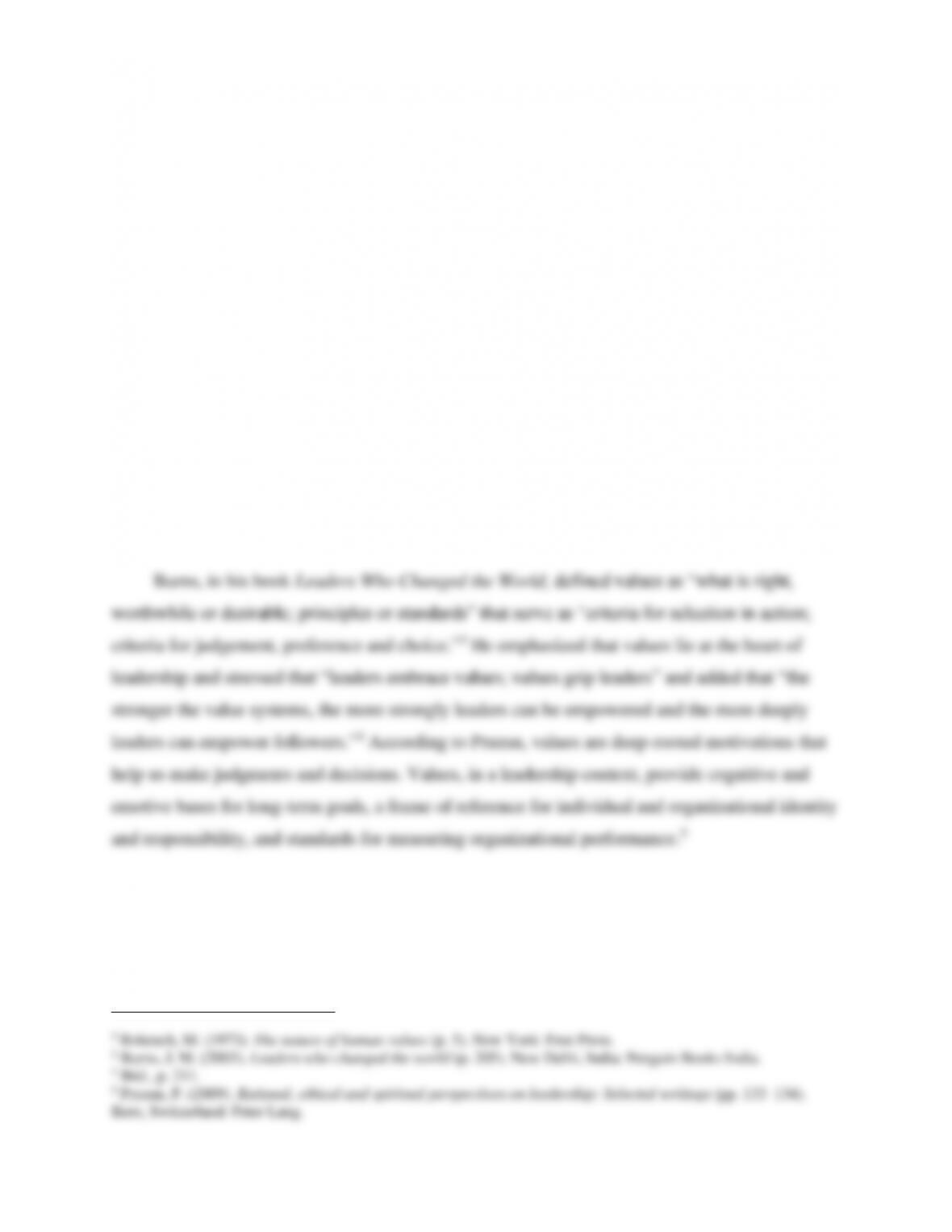
The following teaching plan is based on a 90-minute class. The time allocations can easily be
adjusted for shorter or longer class times.
Time in Minutes
Discussion Questions
10
Introduction
Tata group: history and evolution
Core purpose
Core values
Mission
Ratan Tata’s profile
20
The nature of human values, as conceptualized by Milton
Rokeach
15
Ratan Tata: His vision and strategic action plan for the growth
of the Tata group
15
Steps taken by Ratan Tata to successfully implement the
strategic action plan for the growth of the Tata group
15
Hofstede’s cultural values; the effect of different cultural
values, with an example from the United Kingdom and India
15
Ethical leadership, as defined by Brown, Treviño, and
Harrison; ethical leadership characteristics, as highlighted by
Kalshoven, Den Hartog, and De Hoogh
Instructor Resource
Rowe, Cases in Leadership 5e
SAGE Publications, Inc., 2019
Analysis
1. Do values operate behind all of our behaviors, actions, and decisions? What values did
Ratan Tata display when faced with challenging situations such as those at Nelco and
TELCO?
To answer this question, it is important to have conceptual knowledge of values and value
systems. Rokeach, in his seminal work The Nature of Human Values, defined value as “an
enduring belief that a specific mode of conduct or end-state of existence is personally or socially
preferable to an opposite or converse mode of conduct or end-state of existence.”2 Rokeach
referred to the desirable modes of conduct as “instrumental values” and desirable end-states of
existence as “terminal values.” Terminal values are the goals that a person would like to attain
using instrumental values. He further classified terminal values as “personal” and “social”
values, and instrumental values as “moral” and “competence” values. The Rokeach Value
Survey comprises a set of 18 terminal values and 18 instrumental values (see Exhibit TN-1).
2. What reforms did Ratan Tata implement during his reign as chairman of Tata Sons
from 1991 to 2012 to bring success to the Tata group?
In 1991, when Ratan Tata took over as chairman of Tata Sons from the legendary J. R. D. Tata,
the Tata group was a loose confederation of companies. He undertook a series of reforms to
create a unified group and, in turn, build an institution:
• He retired chief executives who had a personalized style of functioning and did not
follow the value system on which the foundation of the Tata group had been laid. This
3. What are the core values by which the Tata group has been driven since its inception?
Values play a significant role in how organizations function. They operate at two levels:
organizational and personal. Organizational values are the collective or shared values of the
individuals in an organization that shape the organization’s culture and decide the standards and
4. What strategy should the Tata group adopt as it expands globally? Should it retain its
“Indian-ness,” and leverage its values and ethos while addressing the global markets? Or
should it shed its national brand image and become a part of “stateless globalism”?
Globalization has offered companies the opportunity to grow and expand their business around
the world. At the same time, it has created challenges in terms of managing people from different
5. What is ethical leadership? What are the dimensions of ethical leadership behaviour? Is
Ratan Tata an ethical leader?
Ethical and moral leadership entails conducting business in accordance with ethics and morals,
which are influenced by a leader’s personal values and characteristics. Ethical leadership
includes leading by example. Ciulla defined ethical leadership as “the influence of a moral
person who moves others to do the right thing in the right way for the right reasons.”18
Treviño and colleagues, based on their exploratory research study, described ethical
leadership along two related dimensions: the moral person and the moral manager. The moral