Instructor Resource
Rowe, Cases in Leadership 5e
SAGE Publications, Inc., 2019
Case Notes
Case 11.2: Nedbank: Coaching Capabilities for Growth Strategy Execution
Dr. Caren Scheepers and Emme Kane wrote this teaching note as an aid to instructors in the
classroom use of the case Nedbank: Coaching Capabilities for Growth Strategy Execution, No.
9B16C003. This teaching note should not be used in any way that would prejudice the future use
of the case.
This publication may not be transmitted, photocopied, digitized or otherwise reproduced in any
form or by any means without the permission of the copyright holder. Reproduction of this
Teaching Note
Synopsis
In 2015, Mike Brown, chief executive officer (CEO) of Nedbank Ltd. (Nedbank), reflected on
the last couple of years and how far the South African bank, Nedbank, had come since its decline
that necessitated a major transformation of the bank’s strategy and execution practices to enable
a financial turnaround between 2003 and around 2009. He was intent on preventing a recurrence
of the turnaround situation, and realized that the bank’s growth strategy execution entailed a host
Case Objectives
The teaching objectives are:
• Improve discernment of strategic options to improve top-line growth, like
internationalization.
Position in Course
The case can be used in an honors or masters business program for courses on: strategy,
organizational development, human resources strategy and talent management courses.
Relevant Readings
• Sull, D., Homkes, R., & Sull, C. (2015, March). Why strategy execution unravels and
what to do about it. Harvard Business Review, 58–66.
• Prahalad, C. K., & Doz, Y. L. (1987). “Dynamics of global competition,” Chapter 3, 38–
66 and “Responding to host government policies,” Chapter 4, 67–100. In The

Instructor Resource
Rowe, Cases in Leadership 5e
SAGE Publications, Inc., 2019
Assignment Questions
1. Evaluate Nedbank’s strategic actions towards top-line growth strategy execution,
2. Consider the “internationalization” orientation of Nedbank and compare with transnational,
global and multinational orientations, as described by Prahalad, C. K., & Doz, Y. L. (1987).
3. Review Nedbank’s leadership interventions, such as the internal coaching capability,
referring to: The McKinsey article (2011) on Leadership for Growth: Katherina
Teaching Plan
Given the teaching objectives above, instructors could plan to spend at least two hours per
objective. Therefore the teaching on this Nedbank case could potentially consist of up to six
hours of class time with a four hour class and a break in between prior to the last two hours.
Alternatively, the three sessions of two hours each per question, could be spread over a period,
depending on the course schedule.
The teaching plan for all three questions could consist of three phases:
• First, preparation by reading the case study and articles and considering the questions as
part of students’ preparation.
Instructor Resource
Rowe, Cases in Leadership 5e
SAGE Publications, Inc., 2019
theoretical principle, as well as an element of application of the principle to the Nedbank
case study.
With assignment question 1, instructors could divide the class in five groups of around five to
eight students in a group, depending on the number of students. With a smaller amount of
students, a group could be allocated more than one of the five myths (discussed below). Each
group may prepare a presentation on, first, the definition or theory of the myth, and second, the
Instructor Resource
Rowe, Cases in Leadership 5e
SAGE Publications, Inc., 2019
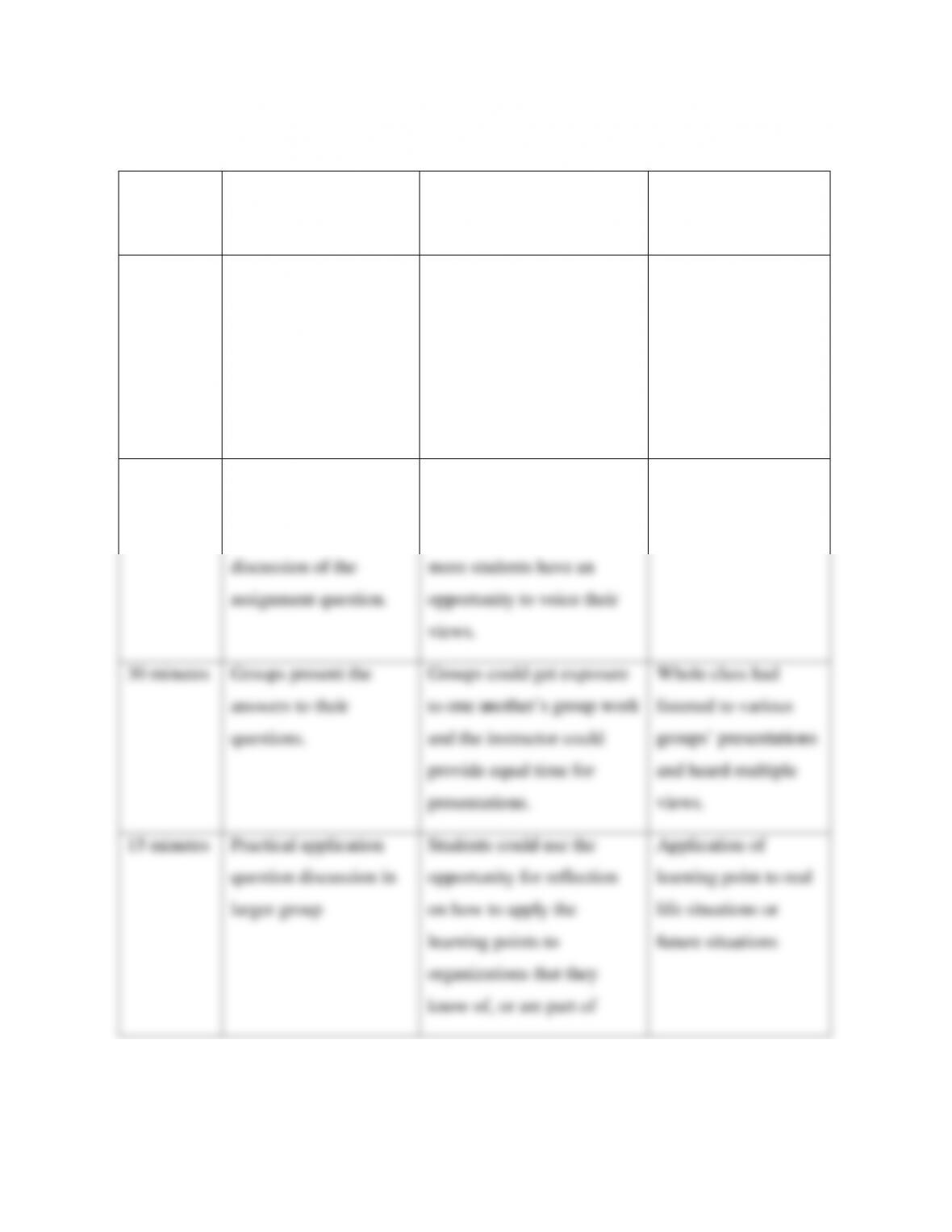
In summary the two-hour session time schedule includes,
Time
schedule
Activity
Rationale
Outcome
15 minutes
Orientation around top-
line growth strategy
execution
Students often do not make
a distinction between
strategy formulation and
strategy execution. The
orientation will assist in this
clarification.
An orientation to the
lecture as well as an
introduction to the
assignment question
30 minutes
Divide class into
smaller groups and
allow time for
discussion of the
assignment question.
In larger classes, there is
less participation and in
smaller group discussion
more students have an
opportunity to voice their
views.
A flip chart paper
where the question
has been answered
30 minutes
Groups present the
answers to their
questions.
Groups could get exposure
to one another’s group work
and the instructor could
provide equal time for
presentations.
Whole class had
listened to various
groups’ presentations
and heard multiple
views.
15 minutes
Practical application
question discussion in
larger group
Students could use the
opportunity for reflection
on how to apply the
learning points to
organizations that they
know of, or are part of
Application of
learning point to real
life situations or
future situations
Analysis
1. Evaluate Nedbank’s strategic actions towards top-line growth strategy execution,
referring to Sull, D., Homkes, R., & Sull, C. (2015, March). Why strategy execution
unravels and what to do about it. Harvard Business Review, 58–66.
The instructor could refer students to the case and point out that Nedbank declared that the
increased competition for transacting clients and share of wallet had increased the risk of lower
revenue growth and resulted in a higher expense burden. In mature markets, product innovation
Five Myths on Strategy Execution
Execution Equals Alignment
Nedbank implemented the balanced scorecard of Kaplan and Norton and, usually, this
implementation would be perceived as alignment and therefore as a strategy execution. However,
1 Hough, J., Thompson, A. A., Jr., Strickland, A. J., III., & Gamble, J. E. (2008). Crafting & executing strategy:
Instructor Resource
Rowe, Cases in Leadership 5e
SAGE Publications, Inc., 2019
in the Sull, Holmes and Sull’s article of 2015, the authors explicitly referred to extensive
research in this area and said that only 9 per cent of managers stated they could rely on
Execution Means Sticking to the Plan
The Nedbank case did not refer specifically to execution in terms of sticking to their plans, however
there were references made to the measurement of strategic targets and the yearly reporting in the
annual reports, etc.
Communication Means Understanding
Various road shows were mentioned in “Transformational Leadership in Sustainable

Instructor Resource
Rowe, Cases in Leadership 5e
SAGE Publications, Inc., 2019
A Performance Culture Drives Execution
It seems that the regular measurement of individual’s, teams’, and divisions’ performances
would drive these entities’ performance and, given the pressures in the various clusters and
business units at Nedbank, a performance culture would exist.
Execution Should be Driven from the Top
The Nedbank case portrayed the executive as influential and it appeared that the strategy was
driven from the top. The group head office was rather prominent in both formulating, as well as
executing, strategy.
2. Consider the “internationalization” orientation of Nedbank and compare with
transnational, global and multinational orientations, as described by Prahalad, C. K., &
Doz, Y. L. (1987). “Dynamics of Global Competition,” Chapter 3, 38–66 and Chapter 4, 67–
100, “Responding to Host Government Policies. In The multinational mission: Balancing
local demands and global vision. New York: The Free Press.
The instructor could refer students to the work of C. K. Prahalad and Yves L. Doz, The
Multinational Mission: Balancing Local Demands and Global Vision (New York: The Free Press,
1987). The well–known matrix will highlight that Nedbank started an internationalization process.
3. Review Nedbank’s leadership interventions, such as the internal coaching capability,
referring to Katherina Herrmann, Asmus Komm and Sven Smit, “Do you Have the right
leaders for your growth strategies?” McKinsey Quarterly, July (2011): 1–5, and “Potential
Coaching,” in Coaching Leaders (Randburg: Knowres, 2012), 8, 229–86.
The instructor could facilitate a discussion on the phases Nedbank went through, for instance, its
survival during a steep decline and the process of a truly sustainable turnaround (see Exhibit TN-
1).
The next phase in the life cycle of the organization was the growth phase. In this phase,
distinct leaders or leaders with different characteristics would be required. Nedbank had a number
of ways in which they developed their leaders, and the case mentioned the company’s training
academies that were playing an important role in professionalizing risk, human resources
Leadership for Executing Growth Strategy
Herrmann, Komm and Smit’s research at McKinsey revealed specific competencies required to
facilitate growth in an organization. The instructor could refer to this article and lead the
Thought Leadership and Market Insight: Looking Beyond Current Context
The instructor can obtain competitor analysis reports in Nedbank’s annual report to indicate the
way it gathers information from the different business units and uses the business intelligence.
Thought Leadership: Strategic Orientation
Nedbank’s 2030 Fair Share vision of energy interdependence is an example of longer-term
orientation. Fair Share 2030 represents a business strategy that responds to the premise that, to be
People and Organizational Leadership: Change Leadership