13
Discussion Questions for Objective 11.8:
1. In your life at school or work today, is there ever a time when you “unplug” from
ICTs? Why or why not? How connected do you need to be in order to be effective at
school and at work? What impact does it have on your quality of life and health?
Suggested Answer:
2. Examine the knowledge management system you have in place for organizing e-mail,
texts, schoolwork, work-related projects, and so on. Is your technology up to the task?
Are you using it to full advantage? What can you do to improve your system?
Suggested Answer:
Student responses will vary.
Discussion Questions for Objective 11.9:
1. Imagine that your instructor has organized your class to work in teams to plan a
fundraiser for a local not-for-profit group. There are four teams of six to eight people, and
you are all expected to work virtually. Given what you have learned in this chapter,
design a virtual organization within which all teams and their individual members can
accomplish this task.
Suggested Answer:
Student responses will vary. First and foremost, a strong team leader should be identified.
2. Try to find out information about the policies for employees use of social networking
sites at a familiar virtual organization. If you were charged with creating guidelines for
the use of social networking sites at work in this organization, would you make any
14
changes in these rules to empower or restrict social networking at work? In general, what
would your top five rules for use of social networking sites at work be?
Suggested Answer:
Student responses will vary.
Discussion Questions for Objective 11.10:
1. From your own experiences, create a list of “dos and don’ts” for how to manage
relationships virtually.
Suggested Answer:
2. Compare the leadership skills needed in face-to-face versus virtual teams. What
similarities or differences can you identify? How can you make virtual team members
feel empowered, connected, and grounded by well-defined norms?
Suggested Answer:
Student responses will vary. To be most effective when working virtually, you must
15
END OF CHAPTER ACTIVITIES: EXPERIENCING LEADERSHIP
Modular Planning on a Global Scale: The ICT Revolution
Millions of people now have access to communication networks that were unheard of 40
years ago. In fact, these networks made the revolution known as The Arab Spring
possible. By using social networking sites, activists organized and publicized the
1. In a group or on your own, research how social media and ICTs are enabling sweeping
social changes. Organizations like Witness.org, Wiser.org, SierraClub.org, and the
GlobalOneness Project are good starting points.
2. What future changes or revolutions can you envision happening as a result of ICTs
such as social media and IT networks?
3. How do you think ICTs and social media have affected an “awareness revolution” in
unethical and irresponsible business practices and environmental and social issues?
Suggested Answer:
Student responses will vary. As students research starting with the above mentioned
organizations, they will quickly realize that these organizations are non-profit cause-
16
Leading with Emotional Intelligence: I Can’t Live without My Smartphone
Sociotechnical systems theory helps us to see that both technology and people must be
considered in relationships and at work. Organizations need to recognize that if strong,
1. Make a list of the five to eight ICTs that you rely on the most in order of importance to
your day-to-day functioning.
2. Identify three ways that each ICT helps promote emotional intelligence.
3. Next, make a list of three ways that each of those same ICTs hinder or inhibit
emotional intelligence.
As you make your lists, consider the following:
• What value does this communication technology add to my life?
• If I were not using this particular ICT, how else could I send and receive information?
• What can I do to improve self-awareness and relationship management through ICTs?
• What do I gain in interpersonal communication from ICTs and what do I lose?
Suggested Answer:
Student responses will vary. ICTs — the hardware and software related to electronic
communication and information sharing. ICTs now help us with virtually everything:
Leading with Critical Thinking Skills: Becoming a Cyber Sleuth
Ever since the Internet has become a global tool for sharing information and data,
countless organizations have gone virtual. They rely on ICTs to coordinate employees
and customers as they produce, distribute, or provide goods or services. As the virtual
17
world of business and personal data has expanded, so, too, has cybercrime. According to
regulated, and by whom.
1. Become your own cyber sleuth. Research the top five cybercrimes or scams that are
currently a threat to business and personal security. Write a short description of each
threat and what, if anything, is being done to address it.
2. Next research the group Anonymous, the Internet “hacktivist” group whose unofficial
slogan is “The corrupt fear us, the honest support us.” How are groups like Anonymous
forcing governments to rethink their own security?
3. How is Anonymous forcing businesses, like the recording and film industries, to
rethink their online strategies in terms of serving their own business interests while, at the
same time, respecting the rights of the public?
4. Discuss the following:
• What is your own personal view of hacktivism?
• Does it provide the same service as a consumer watchdog organization, or is it just
another cybercriminal movement?
Suggested Answer:
Student responses will vary. As students research the top cybercrime issues, some of
Ethical Leadership: Your Password, Please
Some employers and schools have made it standard practice to review potential
applicants’ Facebook profiles. In some cases, they have gone even further: They demand
that applicants hand over their passwords so they can view individuals’ restricted
profiles. Currently, the federal government is reviewing the legality of the practice
because a person’s age, sexual orientation, religion, and political affiliation may be just
some of the private information disclosed. Whatever the outcome of this investigation in
the United States, it is worth noting that this practice also exists elsewhere in the world.
18
1. Suppose your best friend has applied for a job with your employer. She has a very
2. In a group or on your own, research the issue and discuss the consequences of schools
and employers seeking applicants and new hires’ personal passwords.
3. In the above scenario, discuss what your options are. Do you tell HR? Do you say
nothing, hoping not to draw attention to the posts? Do you research your legal rights?
4. Discuss whether the practice is ethical. Do some basic social media legal rights
research. Does this practice violate the first, fourth, and fifth amendments to the
Constitution?
Suggested Answer:
Student responses will vary. This is a dicey issue where students will be on both sides:
ADDITIONAL SUPPORTING MATERIALS
VIDEOS
• New Future of the Workplace – No Office
“ABC World News segment on the Future of Work, featuring companies such as Crayon,
Accenture, and IBM. A great feature on how productivity and proximity don’t have to go

19
• Work in Second Life – The Evolution of the Virtual Workplace
“Second Life is the leader of virtual meeting, event, training, prototyping, and simulation
solutions that catalyze innovation while reducing the cost and environmental impact of
• Tim Berners-Lee on the next Web
“20 years ago, Tim Berners-Lee invented the World Wide Web. For his next project, he’s
building a web for open, linked data that could do for numbers what the Web did for
• Tim Berners-Lee: The year open data went worldwide
“Tim Berners-Lee called for “raw data now” — for governments, scientists and
institutions to make their data openly available on the web. At TED University in 2010,
• Chris Anderson of WIRED on tech’s Long Tail
“Chris Anderson, the editor of WIRED, explores the four key stages of any viable
technology: setting the right price, gaining market share, displacing an established
• Kevin Kelly on the next 5,000 days of the web
“At the 2007 EG conference, Kevin Kelly shares a fun stat: The World Wide Web, as we
know it, is only 5,000 days old. Now, Kelly asks, how can we predict what’s coming in
INDIVIDUAL EXERCISES
1. Using your management class as an example, ask students to brainstorm the plusses
and minuses of online learning. How would this class change if it were 80%
asynchronous and only 20% synchronous? Next, ask them to break into teams and design
2. Part 1: This is a visualization exercise that can be done alone or as a two part exercise. Part 2
follows this exercise. Ask students to close their eyes. Tell them to visualize that they are walking
a dog on the end of a leash.
20
a) Ask them to observe what happens; does the dog respond perfectly? Are they in charge?
Do they feel they are not in control?
3. Ask students to close their eyes again. This time, the leash is around their neck. Someone, it
could be anyone of their choice, is walking them around. Ask them how they perceive control
now. Ask them how they feel?
4. Ask students to work in pairs or teams of 3-4 people. Tell them to think of an
experience in which they were in control (driving a car, playing a sport or game,
another (others) feel comfortable when they are in control.
TEAM EXERCISE
Virtual Classroom
Break the class into 3 separate teams. Assuming every student has a laptop, blackberry,
or smart phone, have them solve the following problem using only email/texting. They
may not talk to each other but only email or text their ideas and opinions electronically.
21
Additional Research
Working from Home
Working from home, or telecommuting, is a trend that has been facilitated by technology.
One in three Americans telecommuted at some time, with the average being about two
days per month according to a Gallup poll conducted in 2006.i However, a 2008 poll by
the same organization found that telecommuting continues to be a rare perk for American
workers. Only 12% of those polled responded that their work has encouraged
Virtual Work
When speaking of virtual technology, the word “virtual” has come to mean a number of
things. For instance, it can mean giving the resemblance of a known type of physical
location or object, such as a virtual store or virtual school. It can also refer to the idea of
Wikipedia.org, a virtual encyclopedia database, defines a virtual business as one that
employs electronic means to conduct its business operations rather than a traditional
“brick and mortar business.” Virtual-work scholar Matti Vartiainen notes that the
emerging language to describe the organization of virtual work can be confusing, with
22
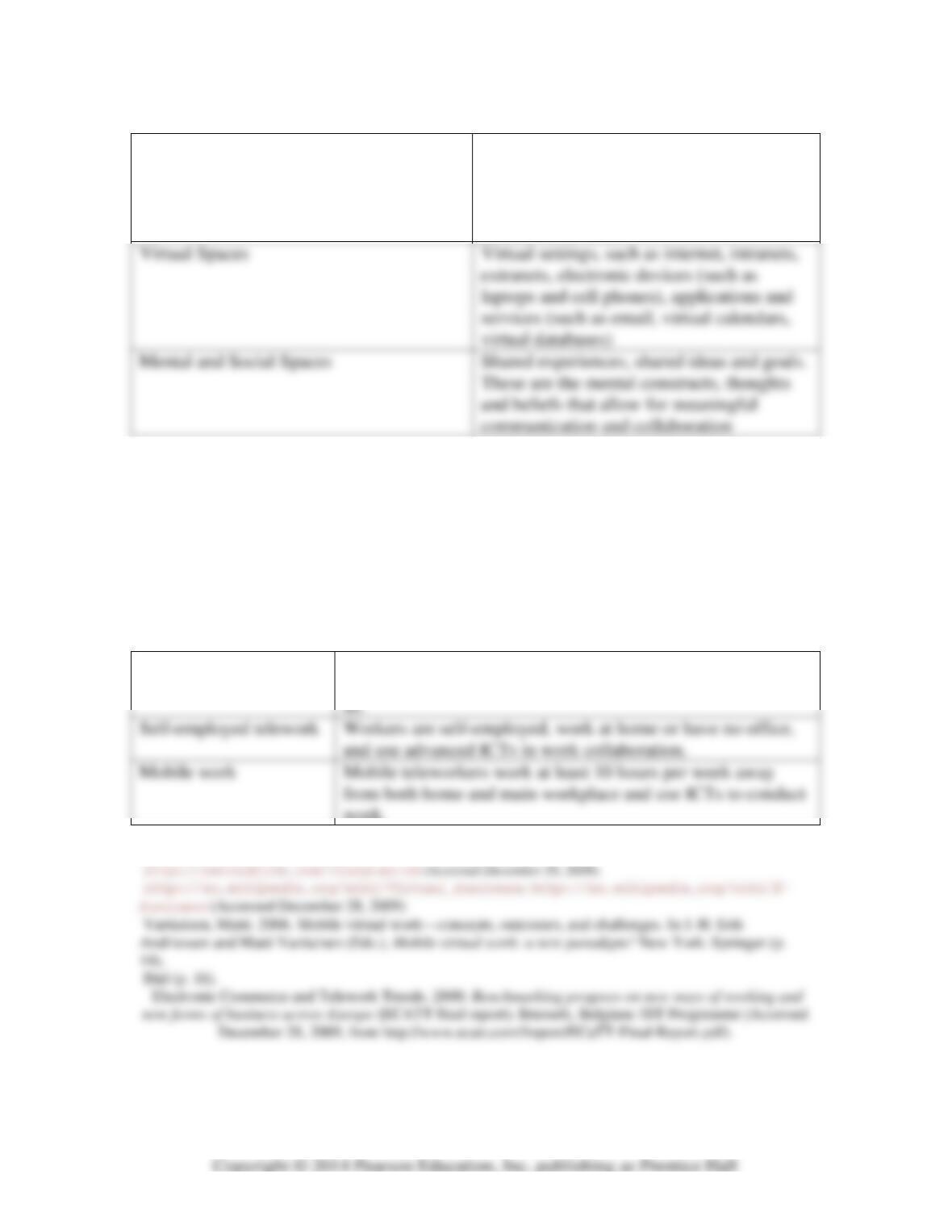
Table XX: Spaces of Work
Physical Spaces
Physical settings, such as at home, in the
office, in moving spaces (such as cars,
trains, and airplanes), the premises of other
organizations, and public spaces (such as
hotels, cafes, etc.)
Vartiainen argues that the focus should be on pairs or groups of workers whose work is
organized through ICTs, since the virtual organization of work is really the organization
of communication. The choice of technologies varies with the contexts for
communication and collaboration and the types of work to be done. He describes three
models of virtual mobile work, or e-work, in Table XX:
Table XX: Types of Virtual Work Structures
Home-based telework
so.
Self-employed telework
Workers are self-employed, work at home or have no office,
and use advanced ICTs in work collaboration.
Mobile work
Mobile teleworkers work at least 10 hours per week away
from both home and main workplace and use ICTs to conduct
Employees work from home at least one day per work week,
using a personal computer and telecommunication links to do
work.
Burn, Janice, Marshall, Peter, and Barnett, Martin. 2002. E-business strategies for virtual organizations.
Woburn, MA: Butterworth-Heinemann.

23