Schermerhorn & Bachrach Exploring Management 6th edition Instructor’s Manual
Ask students how the leaders they have experienced stack up—“strong or weak,” “moral or
immoral”? Discuss what makes the most difference in the ways leaders are viewed in the eyes
of followers?
Hot Topic: Leaders Turn Vision into Inspiration
Dr. Lorraine Monroe began her career in the New York City Schools as a teacher. She went on to
found the Frederick Douglass Academy, a public school in Harlem named after an escaped slave,
prominent abolitionist, and civil rights leader. She believes leadership must be vision driven and
Insight: There’s no substitute for integrity
Whether you call it ethical leadership or moral leadership, the lesson is the same: Respect flows
toward leaders who behave with integrity. If you have integrity, you’ll be honest, credible, and
consistent in all that you do. This seems obvious. “This is what we Selfless have been taught since
Schermerhorn & Bachrach Exploring Management 6th edition Instructor’s Manual
who is the real leader in you?
Quick Case: Playing Favorites as a Team Leader
One of your colleagues just returned from a leadership training session at which the instructor
presented the LMX, or leader-member exchange, theory. Listening to her talk about the training
caused to think about your own leader behaviors, and you came to a somewhat startling conclusion:
You may be playing “favorites.” In fact, the last person you recommended for promotion was a
Terms to Define
Authority decision
Autocratic leader
Laissez-faire leader
Leadership
Schermerhorn & Bachrach Exploring Management 6th edition Instructor’s Manual
Multiple-Choice Questions
1. When managers use offers of rewards and threats of punishments to try to get others to do
what they want them to do, they are using which type of power?
2. When a manager says, “Because I am the boss, you must do what I ask,” what power base is
being put into play?
3. The personal traits that are now considered important for managerial success include _____.
(d) personality
4. In the research on leader behaviors, which style of leadership describes the preferred “high–
high” combination?
5. In Fiedler’s contingency model, both highly favorable and highly unfavorable leadership
situations are best dealt with by a ______ motivated leadership style.
(d) relationship
6. Which leadership theorist argues that one’s leadership style is strongly anchored in
personality and therefore very difficult to change?
7. Vision, charisma, integrity, and symbolism are all attributes typically associated with
_______ leaders.
(a) people-oriented
Schermerhorn & Bachrach Exploring Management 6th edition Instructor’s Manual
Integration and Application Questions:
20. When Marcel Henry took over as leader of a new product development team, he was both
excited and apprehensive. “I wonder,” he said to himself on the first day in his new
assignment, “if I can meet the challenges of leadership.” Later that day, Marcel shares this
concern with you during a coffee break.
Question: How would you describe to Marcel the personal implications of current thinking
on transformational and moral leadership and how they might be applied to his handling of
this team setting?
Schermerhorn & Bachrach Exploring Management 6th edition Instructor’s Manual
Self-Assessment 11: Least Preferred Co-Worker Scale
Instructions
Think of all the different people with whom you have ever worked—in jobs, in social clubs,
in student projects, or whatever. Next, think of the one person with whom you could work
least well—that is, the person with whom you had the most difficulty getting a job done. This
is the one person—a peer, boss, or subordinate—with whom you would least want to work.
Describe this person by circling numbers at the appropriate points on each of the following
pairs of bipolar adjectives. Work rapidly. There is no right or wrong answer.
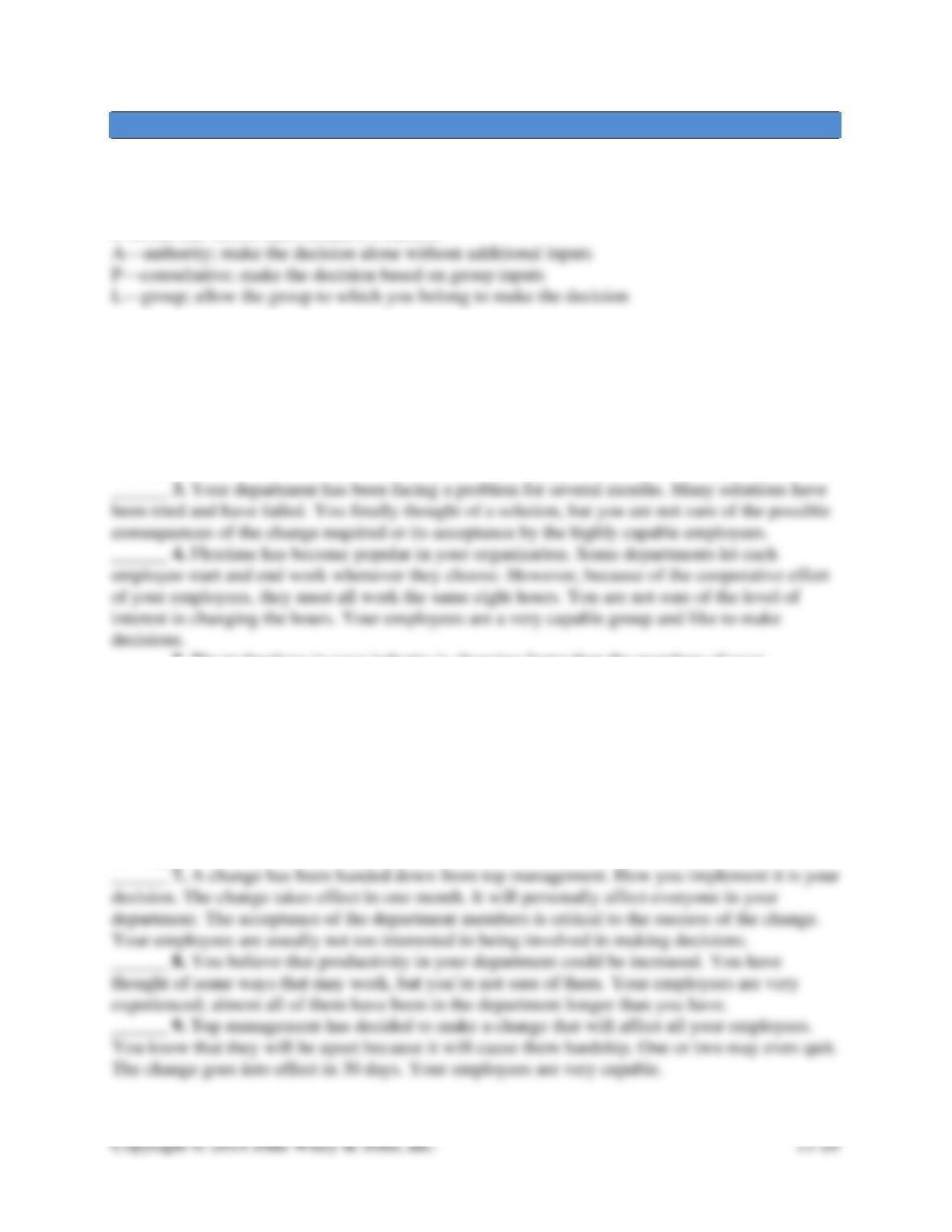
Pleasant 8 7 6 5 4 3 2 1 Unpleasant
Supportive 8 7 6 5 4 3 2 1 Hostile
Boring 1 2 3 4 5 6 7 8 Interesting
Quarrelsome 1 2 3 4 5 6 7 8 Harmonious
Gloomy 1 2 3 4 5 6 7 8 Cheerful
Open 8 7 6 5 4 3 2 1 Guarded
Scoring
This is called the “least–preferred co–worker scale” (LPC). Compute your LPC score by totaling all
the numbers you circled; enter that score here [LPC = ___________].
Interpretation
The LPC scale is used by Fred Fiedler to identify a person’s dominant leadership style. Fiedler
believes that this style is a relatively fixed part of one’s personality and is therefore difficult to
change. This leads Fiedler to his contingency views, which suggest that the key to leadership
Schermerhorn & Bachrach Exploring Management 6th edition Instructor’s Manual
Class Exercise 11: Leading by Participation
Procedure
1. For the 10 situations described here, decide which of the three styles you would use for that
unique situation. Place the letter A, P, or
L on the line before each situation’s number.
Decision Situations
______ 1. You have developed a new work procedure that will increase productivity. Your boss
likes the idea and wants you to try it within a few weeks. You view your employees as fairly
capable and believe that they will be receptive to the change.
______ 2. Your main product has new competition in the industry. Your organization’s revenues
have been dropping. You have been told to lay off three of your ten employees in two weeks.
You have been the supervisor for over one year. Normally, your employees are very capable.
______ 5. The technology in your industry is changing faster than the members of your
organization can keep up. Top management hired a consultant who has given the recommended
decision. You have two weeks to make your decision. Your employees are capable, and they
enjoy participating in the decision-making process.
______ 6. Your boss called you on the telephone to tell you that someone has requested an order
for your department’s product with a very short delivery date. She asked that you call her back
with the decision about taking the order in 15 minutes. Looking over the work schedule, you
realize that it will be very difficult to deliver the order on time. Your employees will have to
push hard to make it. They are cooperative, capable, and enjoy being involved in decision
making.
Schermerhorn & Bachrach Exploring Management 6th edition Instructor’s Manual
______10. A customer has offered you a contract for your product with a quick delivery date.
The offer is open for two days. Meeting the contract deadline would require employees to work
Team Project 11: Leadership Believe-It–Or-Not
You would think leaders would spend lots of time talking with the people who make products
and deliver services, trying to understand problems and asking for advice. But Business Week
reports a survey that shows quite the opposite. Persons with a high school education or less are
asked for advice by only 24% of their bosses; for those with a college degree, the number jumps
to 54%.
Question
What stories do your friends, acquaintances, family members, and you tell about their bosses
that are truly hard to believe?
Instructions
1. Listen to others and ask others to talk about the leaders they have had or presently do have.
What strange-but-true stories are they telling?
2. Create a journal that can be shared with class members that summarizes, role-plays, or
3. For each of the situations in your report, try to explain the boss’s behaviors.
4. Also for each of the situations, assume that you observed or heard about it as the boss’s
Schermerhorn & Bachrach Exploring Management 6th edition Instructor’s Manual
Cases for Critical Thinking: Zappos – They Do It with Humor
When Zappos CEO Tony Hsieh was the featured guest on The Colbert Report, host Stephen
Colbert grilled him about the company’s success and customer loyalty. Hsieh replied that it’s
1. DISCUSSION
What leadership traits and style does Tony Hsieh demonstrate at Zappos? What aspects of his
leadership can you criticize, if any? Is his leadership approach transferable to other leaders and
other organizations, or is it person and situation specific?
Hsieh demonstrates the all the traits identified in table 11.1: Traits Often Shared by Effective
Leaders:
✓ Drive
✓ Business knowledge
Hsieh demonstrates the democratic leadership style where he encourages participation with a
strong emphasis on both task and people. Students may identify no structure or direction as a
limitation in the leadership style. The approach Hsieh uses is certainly teachable and
transferrable to others.
Aspects of Tony Hsieh’s leadership that can be criticized:
Tony Hsieh emphasizes cultural fit over talent because he believes that cultural fit is essential to
long term employee engagement, productivity, and retention.
Is his leadership approach transferable to other leaders and other organizations, or is it person
and situation specific?
Schermerhorn & Bachrach Exploring Management 6th edition Instructor’s Manual
Suggested Team Exercise for Chapter 11
Break the class into teams and have the teams perform the following discussion tasks:
• Ask students to individually list the three most important characteristics they want in a
leader. Next, put them in groups of three and have them compile their lists and come to a
consensus on the top three. Ask them if they displayed any of the highly rated