11-1
Chapter 11
Decentralization, Performance Evaluation,
and the Balanced Scorecard
Concept Questions
1. (LO1—Advantages and disadvantages of decentralization)
The benefits of decentralization include higher job satisfaction and on-the-job
training for managers, the freeing up of top management to devote time to long-
2. (LO2—Responsibility accounting)
Responsibility accounting holds managers accountable only for things under their
3. (LO3—Investment centers)
An investment center has control over costs, revenues, and the investment of
4. (LO4—Segment costs versus common costs)
Segment costs are incurred solely because of the existence of the segment and
5. (LO5—Residual income versus ROI)
Solutions Manual
11-2
Residual income is measured in dollars and is the amount of income earned in
6. (LO5—ROI versus residual income)
ROI is a more useful performance measure than residual income when a
7. (LO1—Balanced scorecard)
The balanced scorecard approach integrates financial and nonfinancial
8. (LO3—Definition of quality)
In today’s environment, quality includes many facets and can be measured in
9. (LO3—Costs of quality)
Prevention and appraisal costs are costs of controlling quality, whereas internal
and external failure costs are costs of failing to control quality. Prevention costs
Chapter 11: Decentralization, Performance Evaluation, and the Balanced Scorecard
11-3
10. (LO8—Noncash compensation)
Noncash compensation is important for motivational purposes. Companies that
Brief Exercises
1. (LO1—Decentralized organizations)
a. False
b. False
c. True
d. False
e. True
2. (LO2, 3—Performance measures and centers)
a. investment center
b. cost center
3. (LO4—Profit centers and segmented income statements)
a. Segment margin
b. Common costs
c. segmented income statement
d. Segment costs
4. (LO5—ROI with margin and turnover and residual income)
A. Margin = Net operating income/Sales = $80,000/$800,000 = 10%
Turnover = Sales/Average operating assets = $800,000/$1,000,000 = 0.8

Solutions Manual
B. ROI = (Net operating income/Sales) × (Sales/Average operating assets)
ROI = ($80,000/$800,000) × ($800,000/$1,000,000) = 8%
5. (LO6—Balanced scorecard)
a. financial
6. (LO7—Quality costs)
a. external failure costs
b. internal failure costs
c. appraisal costs
d. prevention costs
e. International Standards Organization
f. continuous improvement
Exercises
7. (LO4—Segmented income statement)
BTO, Inc.
Contribution Format Segment Statement
X-100 X-200 Total
Sales revenue $425,000 $513,000 $938,000
8. (LO4—Segment and contribution margin)
Cheeseburgers Division:
11_sawyer_SM_ch11.doc 411_sawyer_SM_ch11.doc 4 10/21/2011 3:36:25 PM10/21/2011 3:36:25 PM
Chapter 11: Decentralization, Performance Evaluation, and the Balanced Scorecard
11-5
Chiliburgers Division:
9. (LO4—Segmented income statements)
Henrietta, Ltd.
Segmented Income Statements
Professional Formal
Sales revenue $1,200,000 $1,750,000
10. (LO5—ROI and residual income)
Store A ROI: ($50,000/$800,000) × ($800,000/$500,000) = 10%

Solutions Manual
11-6
11. (LO5—ROI and margin)
12. (LO5—ROI and asset turnover)
13. (LO5—ROI with margin and turnover and residual income)
A. Margin = Net operating income/Sales
B. ROI = Margin × Turnover
Chapter 11: Decentralization, Performance Evaluation, and the Balanced Scorecard
11-7
14. (LO5—ROI with margin and turnover and residual income)
A. Margin = Net operating income/Sales
B. ROI = Margin × Turnover
15. (LO5—ROI with margin and turnover and residual income)
Hotel Aster ROI:
Each hotel has the same ROI, 10 percent, but the similarity ends there. Hotel
Aster has a margin of 2 percent, while Hotel Bella has a margin of 5 percent.
Also, Hotel Aster has turnover of 5 and Hotel Bella has turnover of 2. Hotel Aster
is more effectively employing its operating assets in generating sales, but Hotel
Bella is more successful at generating profits from sales.
expected given that Hotel Bella appears to be larger than Hotel Aster. Because
Solutions Manual
16. (LO5—Residual income)
Residual income (RI):
17. (LO5—Net operating income and residual income)
Formulas for return on investment (ROI) and residual income (RI):
A. Upland Stowe
Average operating assets $200,000 $150,000
× ROI × 18.75% × 14%
B. Upland is currently more profitable than Stowe. Management should not
compare the two locations on the basis of ROI because the Upland store has
the coffee shop—a different line of business.
Chapter 11: Decentralization, Performance Evaluation, and the Balanced Scorecard
11-9
18. (LO6—Dimensions of the balanced scorecard)
Financial perspective: costs, variances, profits, segment margin, return on
investment
19. (LO6—Assessing quality and internal business perspective)
From a customer perspective, there are two primary measures of quality: the
20. (LO7—Quality costs)
A. Quality training $ 305,000
Total prevention costs $ 305,000
B. Statistical process control $ 400,000
Solutions Manual
11-10
21. (LO7—Quality costs)
Prevention costs: costs related to training, quality supervision, and quality
improvement programs
22. (LO7—Quality costs)
A. Quality training $ 305,000
Total prevention costs $ 305,000
B. Statistical process control $ 650,000
23. (LO7—Quality costs)
A. Employee training $15,000
Total prevention costs $15,000
Chapter 11: Decentralization, Performance Evaluation, and the Balanced Scorecard
11-11
24. (LO7—Quality costs)
A. Employee training $15,000
Total prevention costs $15,000
B. Inspection of ingredients $5,000
Total appraisal costs $5,000
25. (LO8—Stock options and restricted stock)
A stock option is the right to buy a share of stock at a set price at some point in
the future. The purchaser of the stock may either buy and hold the stock or
immediately sell the stock. The value of stock options increases as the stock
Problems
26. (LO4—Segment margin and contribution margin)
Solutions Manual
11-12
B.
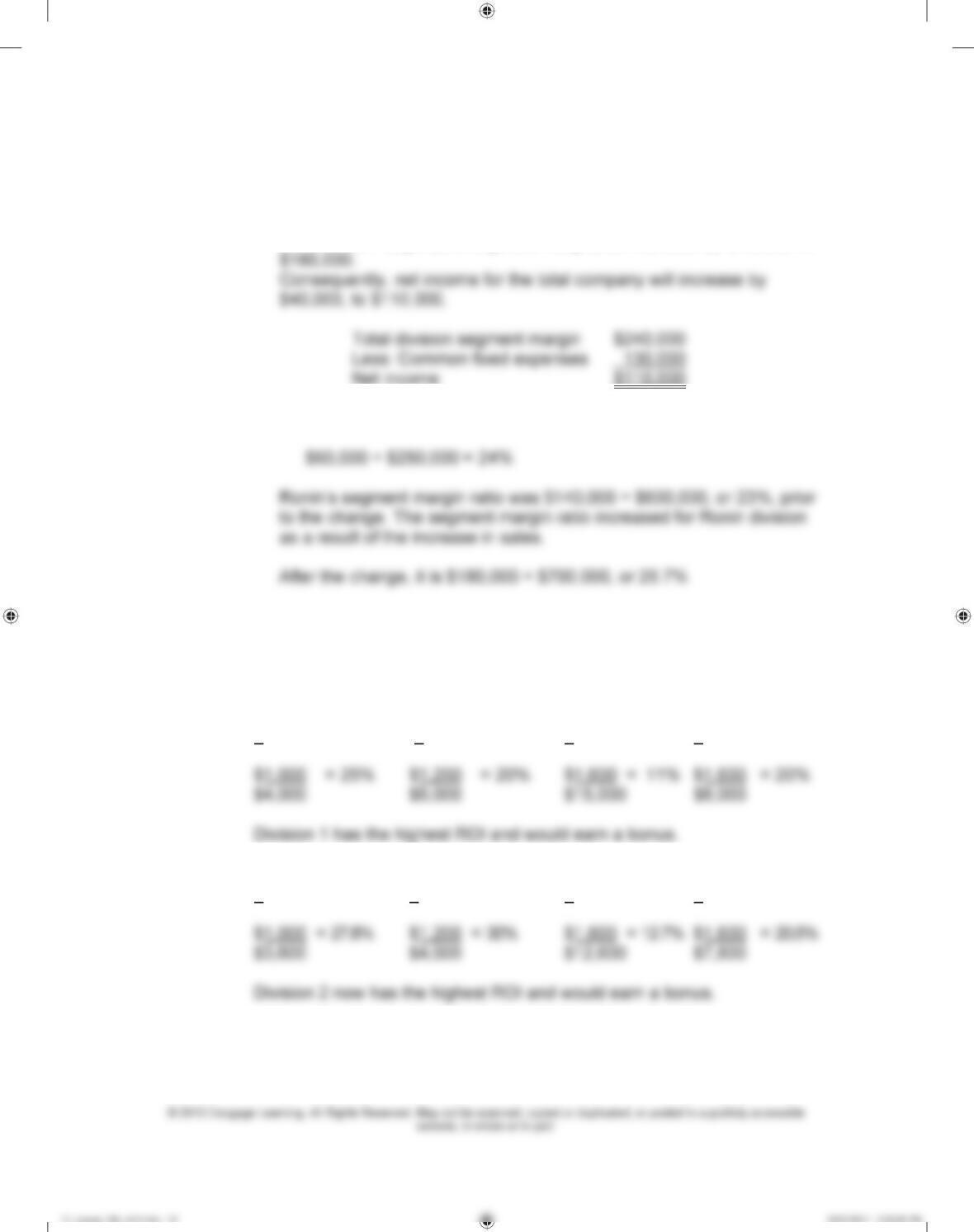
1. Gordon’s segment margin remains the same.
Because Ronin’s contribution margin ratio is 40 percent, its
contribution margin (and segment margin) will increase by $40,000, to
2. Gordon’s segment margin ratio remains the same.
C. Students should note that although the contribution margin ratio remains
constant as sales increase and decrease, the segment margin ratio does not.
27. (LO5—ROI versus residual income, using different asset measures)
A.
1 2 3 4
B.
1 2 3 4
Chapter 11: Decentralization, Performance Evaluation, and the Balanced Scorecard
11-13
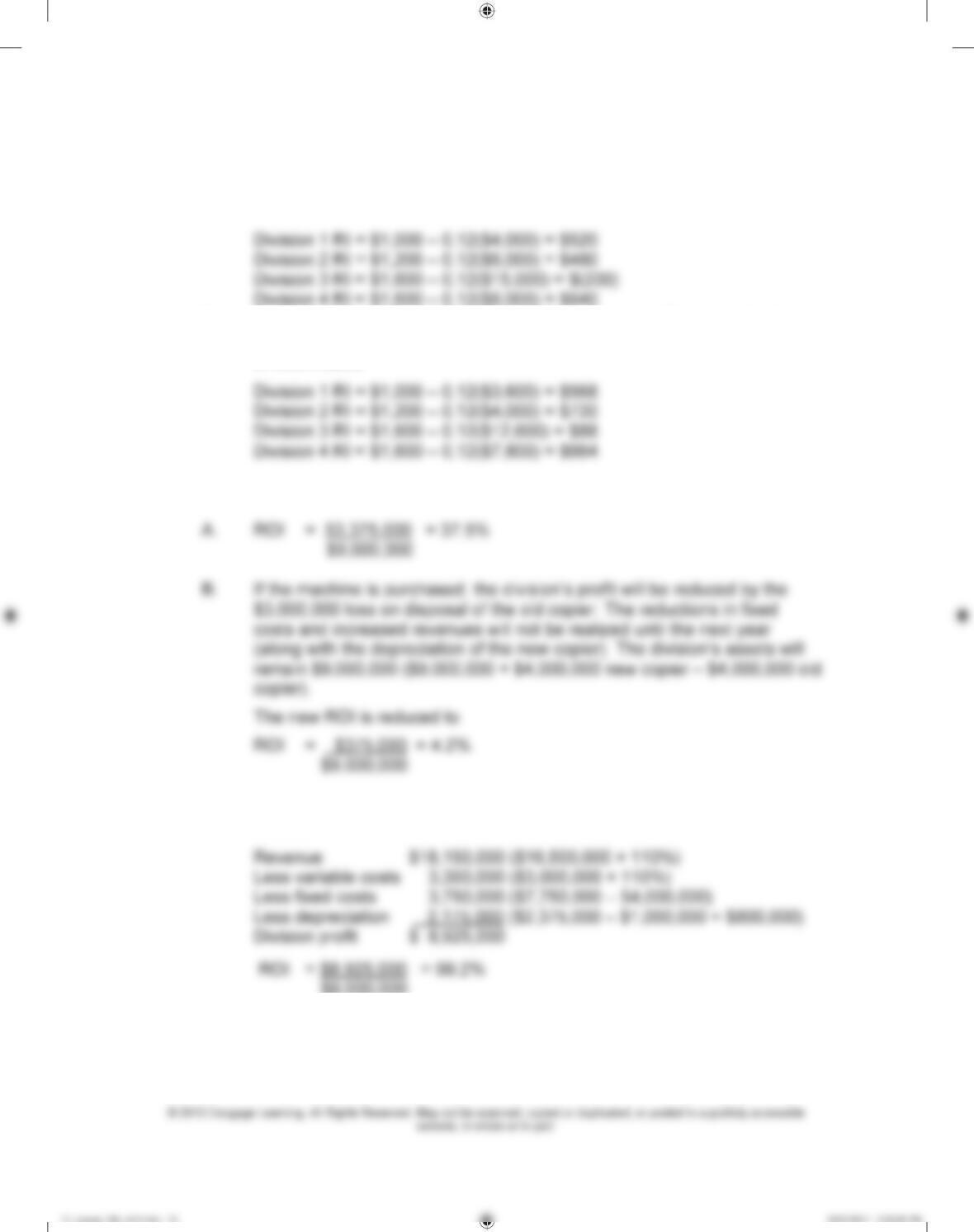
C. Under this approach, Division 4 would earn a bonus. (Students should
note that residual income should not be used to compare divisions of
different size.)
D. Under this approach, Division 2 would earn a bonus. (Students should
note that residual income should not be used to compare divisions of
different size.)
28. (LO5—ROI: Decision focus)
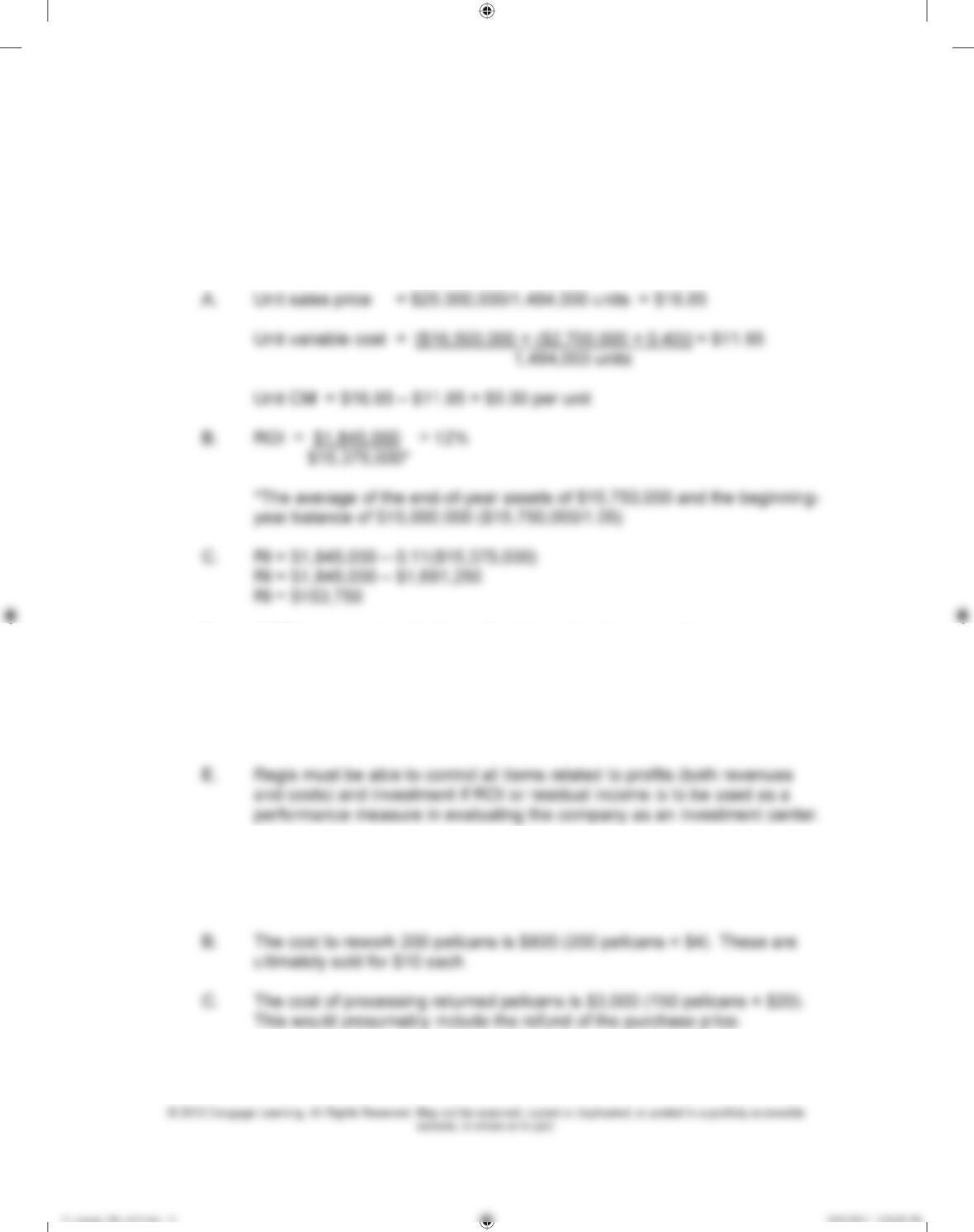
C. Next year, the division’s profit will increase to $8,925,000, calculated as
follows:
$9,000,000
Solutions Manual
11-14
D. Although top management would prefer the long-run improvement in
profitability provided by the new copier, if the divisional manager’s
performance is based on short-run ROI, the copier is unlikely to be
purchased.
29. (LO5—ROI versus residual income: Decision focus)
D. If ROI were used as the basis for determining bonuses, the investment
would likely be rejected. Regis’s current ROI is 12 percent. An investment
in the new acquisition (with an ROI of 11.5 percent) would reduce the
division’s overall ROI. Using residual income as the performance
measure, management will invest in any project with a return in excess of
their 11 percent minimum return.
30. (LO7—Quality costing)
A. The total profit lost on defective pelicans is $4,500 (900 defective pelicans
that were not reworked × $5 per pelican).
Chapter 11: Decentralization, Performance Evaluation, and the Balanced Scorecard
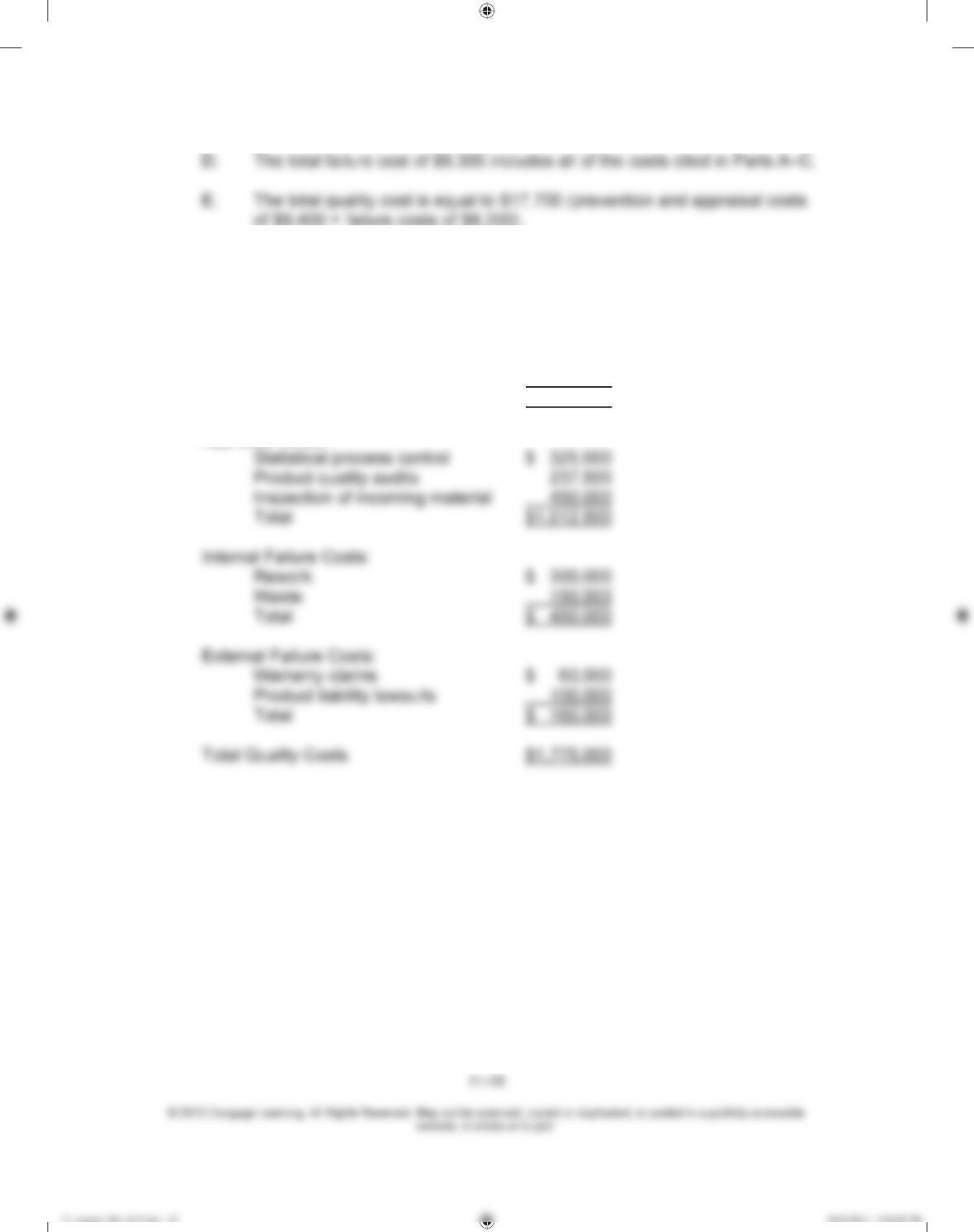
31. (LO7—Quality costs report)
Wailai Macadamia Confectioners
Cost-of-Quality Report
Prevention Costs:
Quality training $ 152,500
Total prevention costs $ 152,500
Appraisal Costs:
Total quality costs are 7.1 percent of sales. While the internal and external failure
costs are less than 2.5 percent of sales, increasing spending in prevention
activities might be prudent. In addition, the company should explore requiring its
suppliers to absorb some of the costs of inspecting incoming materials. By
holding suppliers responsible for quality, Wailai can reduce appraisal costs to
$562,500.
11-16
32. (LO7—Quality costs, Excel)
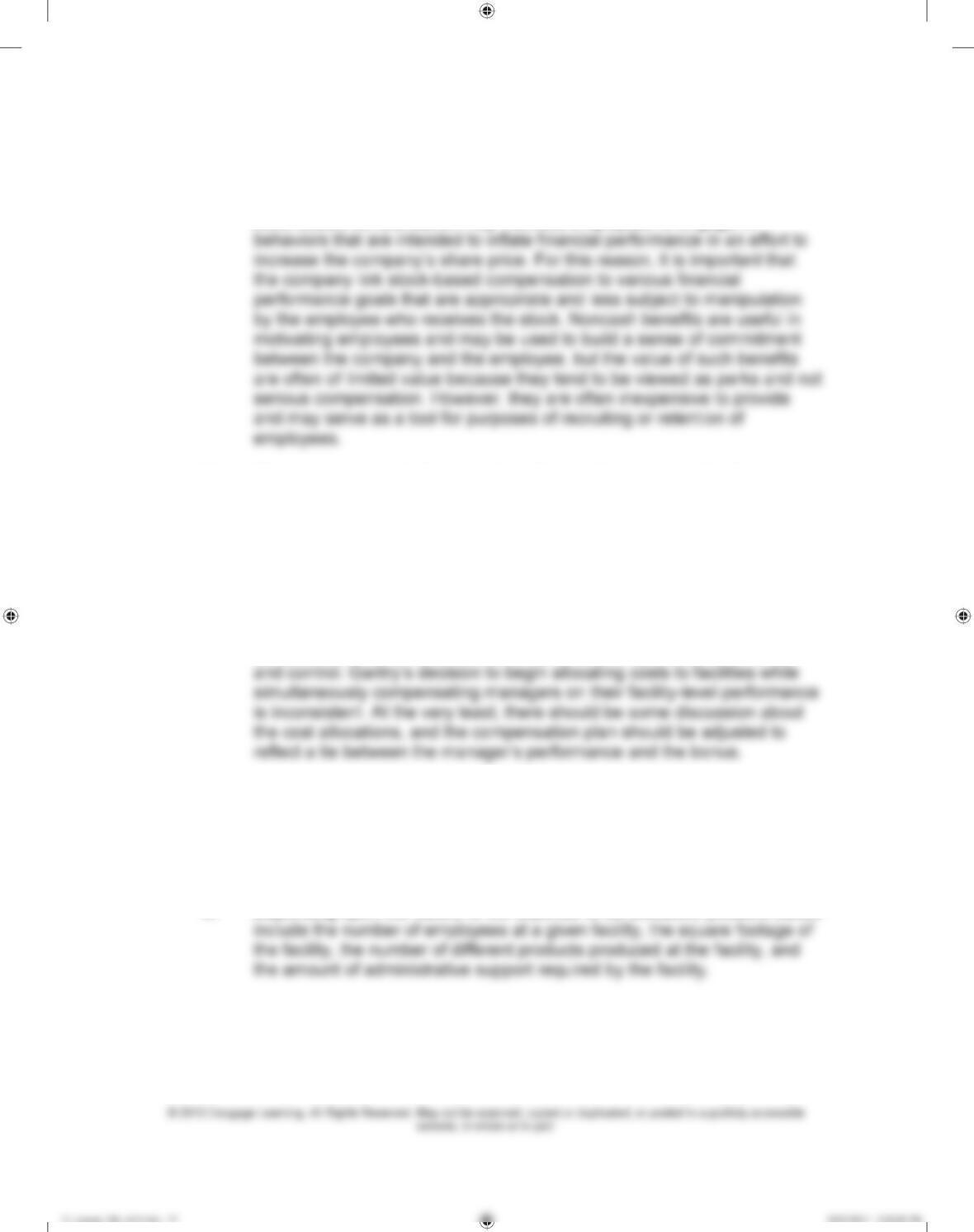
A. Students’ graphs should appear approximately as below:
B. Student responses will vary, but the following discussion contains the
necessary elements: Tanner is clearly investing more money in prevention
33. (LO8—Forms of management compensation)
A. Other than cash compensation, the two basic types of compensation
discussed in the chapter that may be used by WWH are stock-based
B. Stock-based compensation schemes such as stock options or restricted
stock grants reduce the company’s cash outlay and might be
Chapter 11: Decentralization, Performance Evaluation, and the Balanced Scorecard
11-17
easily convert the stock into cash. This issue pertains particularly to grants
of restricted stock, which frequently require that the employee not sell the
shares for some specified period. Another potential disadvantage is that
stock-based compensation may motivate employees to engage in
C. Students’ answers to this question will vary. It is important that the student
provide some basis for his or her recommendation.
Cases
34. (LO2, 4, and 8—Comprehensive responsibility accounting, segment margin, and
management compensation)
A. Key to responsibility accounting is that managers should be held
accountable only for those activities over which they exercise influence
B. The primary implication is that the bonus plan may well become ineffective
because managers will feel as though they do not exercise control over
many of their costs. In fact, managers may look to cut costs in areas that
are under their control, possibly leading to other problems related to
production or administrative services within the facility.
C. Depending upon the nature of the expense to be allocated, possible bases
Solutions Manual
35. (LO5, 8—Comprehensive ROI: Decision focus)
12.5%.
B. Student responses will vary because of the subjective nature of this
question. However, most students are likely to suggest that Elaine be
truthful with Blake. She should take another look at the research results to
verify her earlier interpretation, and then she should communicate her