
11-1
Management Information Systems, 13E, Global Edition
Laudon & Laudon
Lecture Files, Barbara J. Ellestad
Chapter 11 Managing Knowledge
“When people leave organizations today, they are potentially taking with them
knowledge that’s critical to the future of the business,” says David DeLong, a business
consultant and author of Lost Knowledge: Confronting the Threat of an Aging Workforce.
11.1 The Knowledge Management Landscape
Creating and using knowledge is not limited to information-based companies; it is
necessary for all organizations, regardless of industry sector. It’s not enough to make
good products. Companies must make products that are better, less expensive to produce,
Important Dimensions of Knowledge
We discussed the difference between data and information in previous chapters. The next
step up from information literacy is knowledge. An organization must transform the
information it gathers and put it into meaningful concepts that give it insight into ways of
improving the environment for its employees, suppliers, and customers. Wisdom then is

11-2
turns around. The manual is an example of explicit knowledge—that which is
documented.
Table 11-1 below shows that every organization has four dimensions of knowledge:
• Knowledge is a firm asset.
How it handles them is what can make the organization a successful one that seems to
outrun the competition, or one that seems to muddle through the best it can. Examine
your organization and determine how well it values its knowledge.
Organizational Learning and Knowledge Management
In the last few years, companies have downsized and flattened their organizations. Many
employees who were laid off had been with these companies for years. When they
walked out the door, they took experience, education, contacts, and information with
them. Companies are finding out how important human resources are to their success and
11-3
are establishing organizational learning mechanisms to capture and use this corporate
knowledge.
That is, organizations gain experience by:
• Collecting data
The Knowledge Management Value Chain
To understand the concept of knowledge management, think of knowledge as a
resource, just like buildings, production equipment, product designs, and money. All
these resources need to be systematically and actively managed.
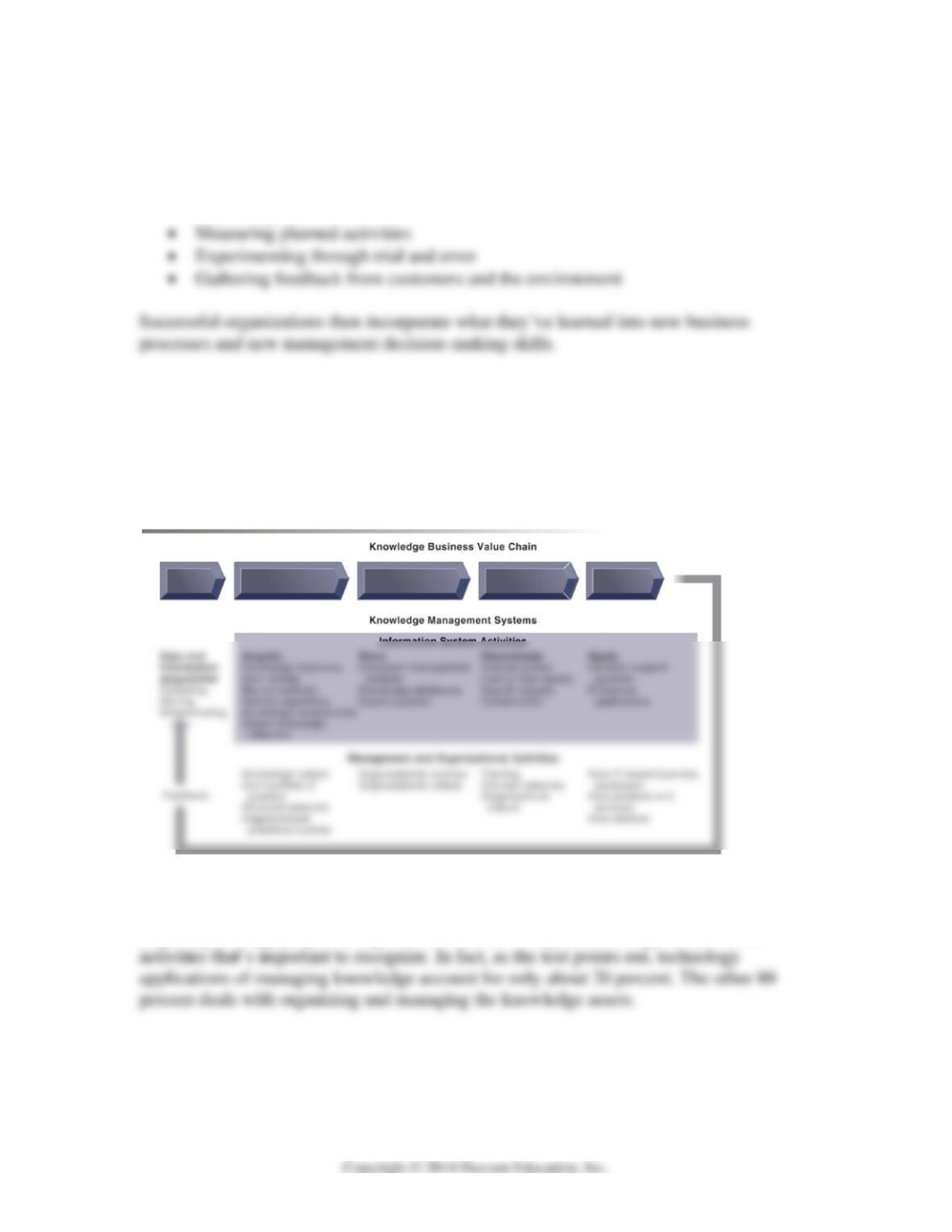
Figure 11-1: The Knowledge Management Value Chain
Figure 11-1 shows you the activities that go into successfully managing knowledge from
acquiring it to applying it throughout the firm. It’s not just technology related to the
Knowledge Acquisition
11-4
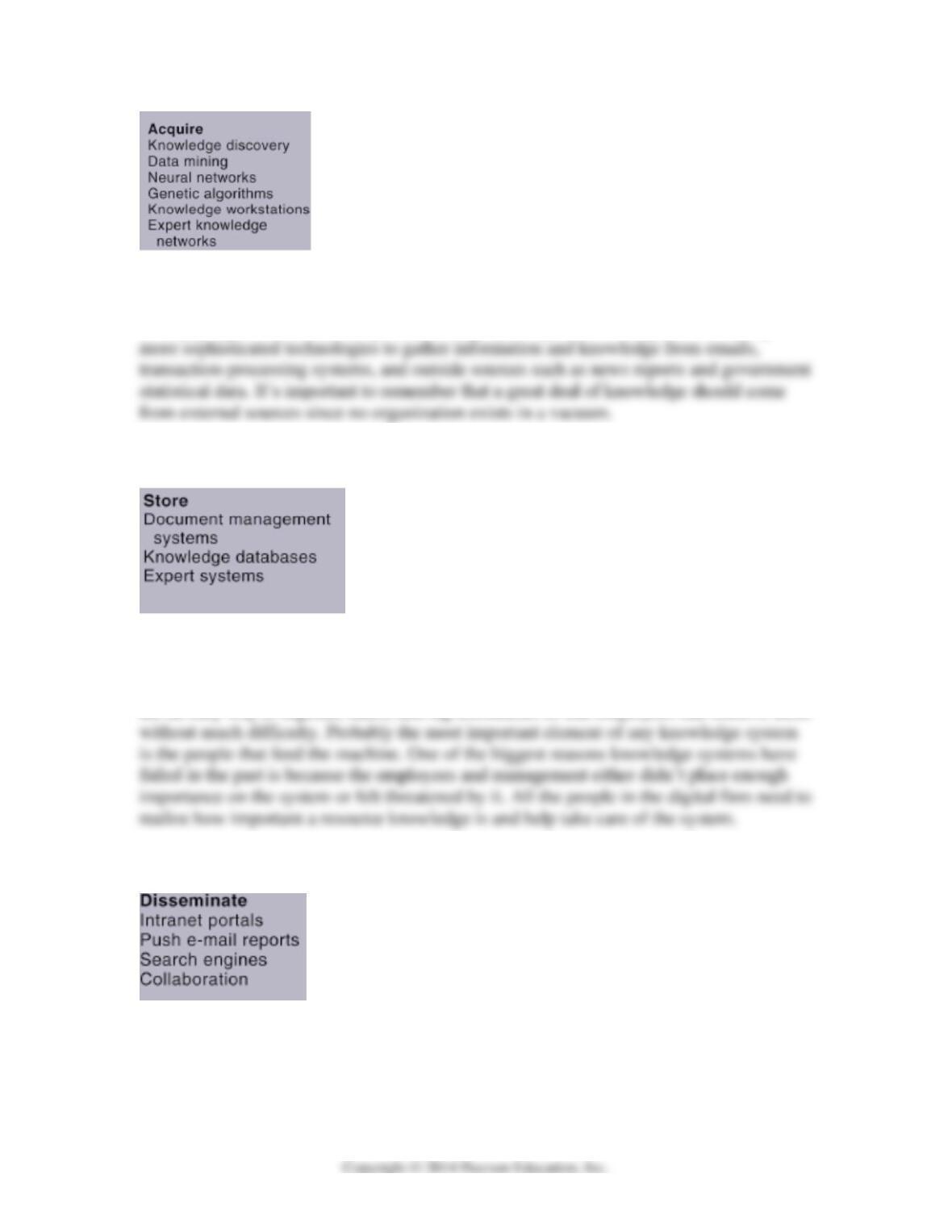
Figure 11-1a: Acquiring Knowledge
Knowledge comes from a variety of sources. Early attempts of gathering knowledge were
a hodgepodge of documents, reports, and employee input. Now companies are using
Knowledge Storage
Figure 11-1b: Storing Knowledge
Remember, knowledge management is a continual process, not an event. As you gather
knowledge you must store it efficiently and effectively. Document management systems
are an easy way to digitize, index, and tag documents so that employees can retrieve them
Knowledge Dissemination
Figure 11-1c: Disseminating Knowledge
Once you’ve built the system, acquired and stored the knowledge, you need to make it
easy and efficient for employees to access the knowledge. Portals, wikis, social networks,
IM, and email are just some of the tools you can use to disseminate information easily

11-5
Knowledge Application
Figure 11-1d: Applying Knowledge
You can have all the information and knowledge you need to master any task, but if you
don’t build knowledge application into every functional area and every system used
Building Organizational and Management Capital: Collaboration,
Communities of Practice, and Office Environments
As knowledge becomes a central productive and strategic asset, the success of the
organization increasingly depends on its ability to gather, produce, maintain, and
disseminate knowledge. One way companies are responding to the challenge is by
No one person has all the knowledge a digital firm needs. For that you must rely on many
different people from many different locations. Communities of practice (COP) are built
on the idea of combining ideas and knowledge from various sources and making it
available to people inside and outside the organization. Professional conferences,
newsletters, journals, and online newsgroups are excellent sources of information that
center on the communities of practice concept.
11-6
Four areas where COP can make a difference are:
• Reuse knowledge
Types of Knowledge Management Systems
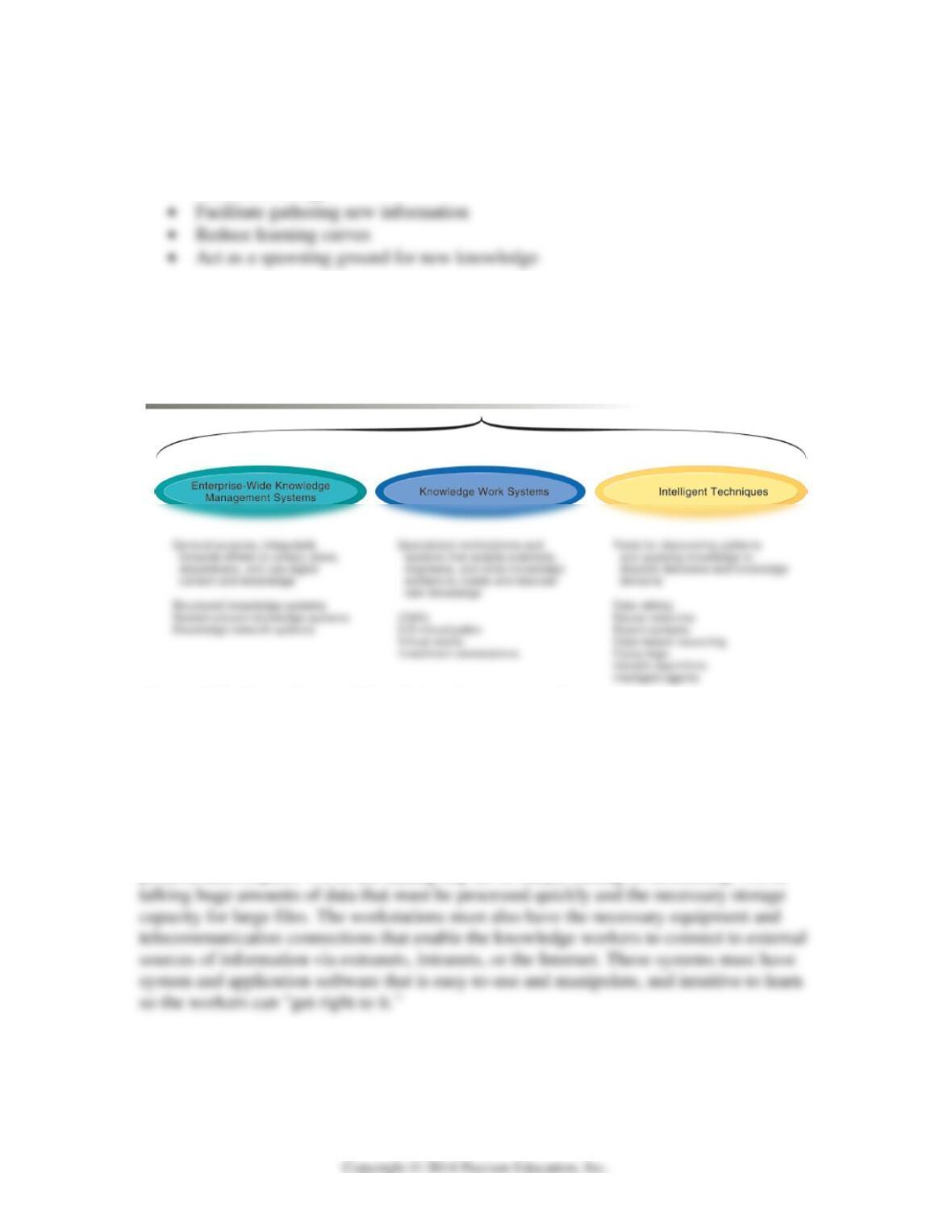
Let’s look at three major types of knowledge management systems as shown in Figure
11-2.
Figure 11-2 Major Types of Knowledge Management Systems
Enterprise-wide knowledge management systems are spread across the organization
and offer a way to systematically complete the information system activities we just
reviewed: acquiring, storing, disseminating, and applying knowledge.
Knowledge work systems use powerful workstations that can process the huge graphics
files some professionals need or to perform the massive calculations other types of
professionals require. We’re not talking clip art or simple adding or subtracting. We’re
Intelligent techniques, which we’ll look at more closely at the end of this chapter,
include expert systems, neural networks, and genetic algorithms, to name a few.

11-7
Bottom Line: Knowledge is an important asset that must be managed throughout
11.2 Enterprise-Wide Knowledge Management Systems
There are three primary types of knowledge in every organization:
• Structured documents: stored in reports, letters, or presentations
• Semistructured: stored in emails, videos, digital pictures, or brochures
Enterprise Content Management Systems
Traditionally, knowledge wasn’t considered a corporate resource. Many systems were
built without the necessary infrastructure for gathering, storing, and retrieving
knowledge. That started changing in the 1990s when companies started realizing how
Before you get all the data, information, and knowledge into your enterprise content
management system, you need to create a taxonomy that will help organize the
information into meaningful categories. That makes it easy to find things later on. For
example, you have lots of digital renderings of your company logo. Set up a taxonomy
called “Logo.” Now, whenever you add another digital file of a logo, you tag it with the
taxonomy.

11-8
Interactive Session: Organizations: Albassami’s Job is not Feasible Without IT (see
page 469 of the text) describes how the Saudi Arabian market for car transportation
services relies heavily on accurate data about clients, branches, and asset
availability, without which their business would not work effectively.
Knowledge Network Systems
Because it’s simply too expensive and too time-consuming to continually reinvent the
wheel, corporations are turning to knowledge network systems in an attempt to link
Collaboration and Social Tools and Learning Management Systems
Knowledge systems are often used by and support professional employees such as
engineers, researchers, analysts, and highly skilled technical workers. Portals provide
easy-to-use access to these systems and help provide internal and external information
others have discovered to be successful solutions or best practices. The organizational
As you surf through the Web and find news articles, videos, pictures, or soundtracks that
you want to track or share with others, you can use social bookmarking techniques to
tag the information with keywords. You store the shared bookmarks in folksonomies so
that your friends or co-workers can easily find the bookmarks.
Because business processes and work methods are constantly and continually changing,
organizations must devise ways to make learning less expensive and easier to deliver. By

11-9
systems. Regardless of where the employee and educator are located, they can collaborate
together whenever necessary.
Bottom Line: Enterprise content management systems, knowledge network systems,
11.3 Knowledge Work Systems
Many of the systems we’ve discussed centered on how to collect, store, distribute, and
apply knowledge. Let’s talk about how to create knowledge in this section.
Knowledge Workers and Knowledge Work
Knowledge work systems support the creation and integration of new knowledge that is
beneficial to the organization. KWS are often used by and support professional
Requirements of Knowledge Work Systems
The first requirement of a KWS is that it provides knowledge workers with the following
necessary tools:
• Graphics tools

11-10
Examples of Knowledge Work Systems
Pick up any business or technology magazine or surf news channels and you’ll find
numerous examples of how companies are using knowledge work systems to re-create
their core processes, create new products or services, or improve old ones.
Computer-aided design (CAD) applications are used by design engineers to build new
products or improve old ones. It used to take 3–4 years and millions of dollars to design a
new car. With improved CAD systems, automobile manufacturers have reduced the time
Virtual reality systems have sophisticated imagery that makes you feel like you’re
“right there!” You may have seen this system on TV shows or in the movies. You’re
Augmented reality allows you to keep one foot in the real world and put one foot in an
enhanced computer-generated imagery world. If you’ve ever watched a professional
especially enamored with the idea of interacting with customers in new and different

11-11
Interactive Session: Technology: Firewire Surfboards Lights Up With CAD (see
page 460 of the text) describes how one company uses new CAD technology as a way
to attract new customers and improve its design and manufacturing processes.
VRML (Virtual Reality Modeling Language) is a set of specifications for interactive
3-D modeling on the Web. Many companies are putting their training systems right on
the Internet so that people can have access to the latest information and can use it when
they need it. Some Web sites use Java applets to help process the programs on a local
workstation.
How would you like to make investment decisions based on information that is 90 days
old or older? Would you have very much faith in a system that told you only how the
Bottom Line: Information and knowledge are key business assets that must be
nurtured, protected, grown, and managed for the benefit of the entire organization.
Knowledge work systems create and manage knowledge using computer aided
design systems, virtual reality systems, augmented reality, and VRML.
11.4 Intelligent Techniques
There are quite a few ways organizations can capture knowledge using technology.
Knowledge discovery tools and techniques help people find patterns, categories, and
generate solutions to problems that can’t be solved by humans alone.
Capturing Knowledge: Expert Systems
Expert systems are a common form of intelligent techniques. They are used to assist
humans in the decision-making process, but they don’t replace humans. Many of the

11-12
How Expert Systems Work
Expert systems rely on a knowledge base built by humans based on their experiences and
knowledge. The base requires rules and knowledge frames in which it can process data.
When you think about it, humans work the same way. You look out the window to see if
The programming environment of an expert system uses rules, frames, and an inference
engine to accomplish its tasks. The inference engine uses forward chaining or backward
chaining to move through the rules and the frames.
In our example, using a forward chaining inference engine, you would start with the
idea that it’s raining. You’d move through a series of decisions until you reached a
conclusion and acted on it. You would determine that it’s raining, then you’d decide how
much, then you’d decide how wet you don’t want to be, then you’d decide to take an
umbrella. As long as the answer continues to be yes, you keep moving forward.
Examples of Successful Expert Systems
You measure the success of an expert system by the following criteria:
• Reduced errors

11-13
• Improved quality and services
• Happy users and happy customers
Most problems solved by expert systems are mundane situations. “If it’s raining, then
take an umbrella.” But what happens if it’s cloudy and only “looks” like it will rain?
Expert systems should not replace managers. They can aid managers in the decision-
making process, but managers have to make the final call. For instance, you suggest to
your boss that you should receive a pay raise. You have many subjective reasons why
you should receive the raise; you arrive early and stay late, your work is always (well,
almost always) turned in on time, you filled in for Sam while he was on vacation, and
you’re a good worker. What happens if your boss relies on an expert system that uses
Organizational Intelligence: Case-Based Reasoning
So far, we’ve concentrated on capturing the individual knowledge in an expert system.
Through practical experience, you’ve realized that “two heads are better than one.” Very
seldom will only one individual work on a project. Or perhaps one individual works on
the candy bar ad campaign while another works on the breakfast cereal campaign. They
have different and yet similar experiences. What if you could tap into each person’s
experience and knowledge on a collective basis? Take the best of the best from each one
11-14
of IF this is the problem, THEN try this. Access the Help files in your desktop software
and try it.
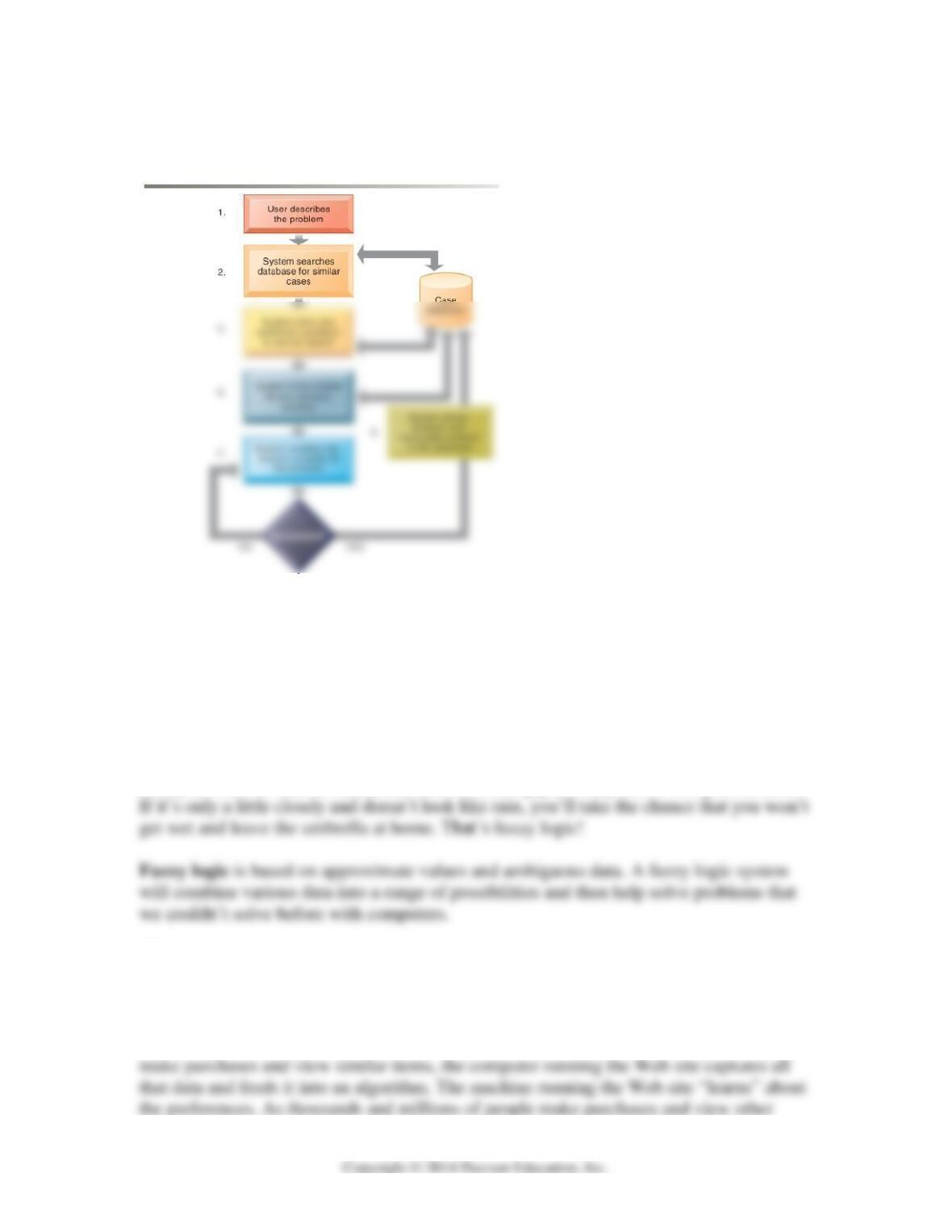
Figure 11-7: How Case-Based Reasoning Works
Figure 11-7 gives you an excellent overview of how a case-based reasoning system
works.
Fuzzy Logic Systems
Okay, one more time, back to our umbrella. If it’s only cloudy outside, how do you know
whether to take the umbrella? “It depends on how cloudy it is,” you say. If it looks like
rain, you know to take the umbrella; there is a strong possibility that it will pour buckets.
Machine Learning
If you’ve made a purchase on Amazon.com or a clothing Web site like JC Penney,
you’ve probably seen a feature displaying suggestions about what other people purchased
when they purchased your item. How does the Web site know that? Because as people

11-15
Neural Networks
This type of knowledge system is as close to emulating the human ability to learn as
we’ve been able to come. Let’s return to our umbrella example. How do you know to
take an umbrella when it’s raining? You probably got wet a few times without one. Then
you tried using one when it rained and discovered that you didn’t get wet. You learned
that when it rains, an umbrella will keep you dry. That’s basically how neural networks
work.
The Difference between Neural Networks and Expert Systems
• Expert systems emulate human decision making.
• Neural networks learn human thought processes and reasoning patterns.

11-16
Genetic Algorithms
We’ve evolved as a human race through genetics. We are made up of many combinations
of generations of humans. That’s how genetic algorithms work. Solutions to problems
are examined by the system. The best solution is retained for future use, while the worst
a problem from all directions.
Hybrid AI Systems
We’ve mentioned before about taking the best of the best and that’s just what hybrid AI
systems do. They take the best parts of expert systems and the best parts of fuzzy logic,
Intelligent Agents
Jump on the Web and find the best price for computer printer supplies. Simply typing the
words “computer printer supplies” into your favorite search engine will result in
thousands of pages with more than just price information. You can find specific
information on prices much faster using an intelligent agent. These software programs
learn your personal preferences for accomplishing simple tasks and can take the drudgery
Another way companies are using intelligent agent technology is by developing agents
that mimic real entities—customers, supply chains, and stock markets. Agent-based

11-17
modeling uses the agents to model behavior and help managers make decisions. For
example, it seems reasonable to assume that it’s better to wait until you have a full
Bottom Line: Businesses are interested in artificial intelligence to preserve the
intelligence and knowledge of their employees and use it to their competitive
advantage. Expert systems emulate humans in the decision-making process but
cannot replicate the intuition and reasoning that still require the human touch.
Many new technologies can help humans solve difficult problems or take advantage
of new opportunities. Neural networks learn how to make decisions. Fuzzy logic uses
“ranges of possibilities” instead of giving black-and-white, yes-no answers.
Intelligent agents take much of the drudgery out of repetitive and predictable tasks.
Discussion Questions
1. Discuss the difference between tacit knowledge and explicit knowledge and give
some examples of each.
2. Discuss management and organization activities necessary to enable information
Answers to Discussion Questions
1. Tacit knowledge is undocumented experience and expertise employees keep in their
2. There are four information system activities in a knowledge management system:

11-18
3. Organizations can use consumer Web 2.0 technologies, including portals, blogs,
wikis, and social bookmarking, to collaborate with other employees, customers,
4. Expert systems require people to input all decision-making rules into the rule base. A
knowledge engineer pulls information from various sources and fits it into the expert
5. Augmented reality combines the real world with computer-generated graphics or
other effects that enhance users’ experiences. Some potential uses include:
• Landscape architects could enhance a photo of your front yard with potential