Instructor’s Manual
11-1
CHAPTER ELEVEN
Decentralization,
Performance Evaluation, and
the Balanced Scorecard
This chapter examines performance evaluation in a decentralized
environment. It discusses responsibility accounting and responsibility
Key Concepts
• The Decentralized organizations must have managers who are
competent, are experienced, and have the authority required to make
decisions.
• The key to effective decision making in a decentralized organization is
responsibility accounting: holding managers responsible for only those
things under their control.
• The balanced scorecard approach integrates financial and
nonfinancial performance measures.

Instructor’s Manual
• The traditional view of quality costs is that total quality costs are
minimized at some acceptable level of defects, whereas the
Learning Objectives
LO1— Describe the structure and management of decentralized organizations
and evaluate the benefits and drawbacks of decentralization.
LO2— Evaluate how responsibility accounting is used to help manage a
decentralized organization.
LO8— Recognize the importance of using incentives to motivate managers and
discuss the advantages and disadvantages of using cash-based, stock-
based, and other forms of managerial compensation.
Lecture Outline
A. Introduction
The degree to which managers can exercise control over activities differs
across different levels in an organization. Likewise, the extent to which
managers can be held responsible for different activities is also different
Instructor’s Manual
11-3
B. Management of Decentralized Organizations (LO1)
A decentralized organization is an organization in which decision-making
authority is spread throughout the organization. The decentralized
1. Benefits of Decentralization
o Decentralization fosters an environment of
entrepreneurship and innovation.
o In a decentralized set up, by pushing decision-making

Instructor’s Manual
2. Drawbacks of Decentralization
o When decision-making authority is spread among too
many managers, the company may lack focus.
o Managers may not be adequately trained in decision
making at the early stages of their careers. The costs of
C. Responsibility Accounting and Segment Reporting (LO2)
1. The key to effective decision making in a decentralized organization
is responsibility accounting: holding managers responsible for only
Key Concept
The Decentralized organizations must have managers who are competent,
are experienced, and have the authority required to make decisions.
Making It Real:
Instructor’s Manual
11-5
2. Companywide budgets, cost standards, income statements, and so
on are not sufficient to evaluate the performance of each of a
D. Cost, Revenue, Profit, and Investment Centers (LO3)
Businesses are often broken into responsibility centers as a means to
evaluate managers’ performance levels. Organizations typically identify the
different segments or levels of responsibility, as cost, revenue, profit, or
investment centers and attach different levels of responsibility to each
segment.
1. Cost Centers
A cost center is an organizational segment, or division, in which the
manager has control over costs but not over revenue or investment
decisions.
o The manager of a cost center should be evaluated on how
Key Concept
The key to effective decision making in a decentralized organization is
Instructor’s Manual
2. Revenue Centers
Revenue center is an organizational segment, or division, in which
3. Profit Centers
Profit center is an organizational segment, or division, in which
the manager has control over both costs and revenue but not
4. Investment Centers
Investment center is an organizational segment, or division, in
which the manager has control over costs, revenue, and investment
Instructor’s Manual
11-7
E. Profit Center Performance and Segmented Income Statements (LO4)
1. Segmented income statements are reports that calculate income
for each major segment of an organization in addition to the
company as a whole. Although it is usually easy to keep records of
sales by segment, tracing costs to a particular segment (segment
2. Divisions
A business may be divided into a number of departments and each
Key Concept
Businesses are often broken into cost, revenue, and profit centers as a means to
evaluate managers’ performance levels.
Instructor’s Manual
F. Investment Centers and Measures of Performance (LO5)
In addition to being responsible for a segment’s revenue and expenses, an
investment center manager is responsible for the amount of capital invested
in generating the segment’s income. For this reason, performance reports of
an investment centre focus on measures specifically developed for that
purpose: return on investment and residual income.
1. Return on Investment
Return on investment (ROI) measures the rate of return generated
by an investment center’s assets. ROI is generally broken down
into two components: a measure of operating performance (called
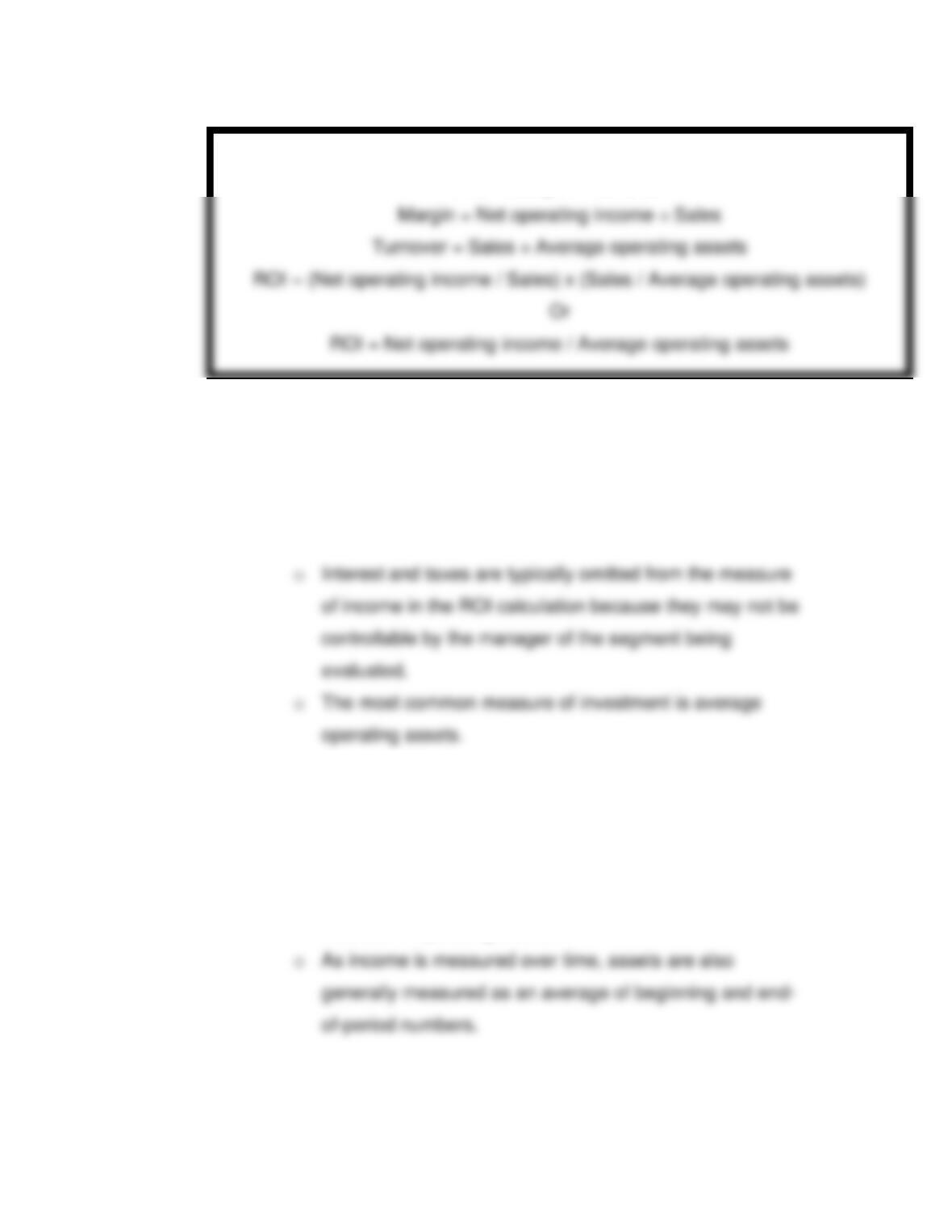
Instructor’s Manual
11-9
o Net operating income is most frequently used as the
measure of income in the ROI formula.
o Net operating income is a measure of operating
performance and is defined as net income from operations
before interest and taxes.
o Operating assets typically include cash, accounts
receivable, inventory, and the property, plant, and
equipment needed to operate a business.
o Land and other assets held for resale or assets that are
idle (e.g., a plant that is not being used) are typically not
included in operating assets.
Key Formulas
ROI = Margin × Turnover
Instructor’s Manual
o By focusing on operating income and average operating
assets, ROI attempts to isolate the financial performance of
a company’s core operations.
o The use of net book value (the cost of the assets less
accumulated depreciation) is consistent with the calculation
of operating income (which includes depreciation expense)
but can have some undesirable consequences.
a. Using net book value can cause ROI to increase over
c. Both of these factors may discourage managers from
replacing old assets, such as manufacturing equipment.
If managers are evaluated on the basis of ROI, they
may be reluctant to replace aging machinery with a low
book value with an expensive, but more efficient, piece
of equipment.
o The use of gross book value to measure operating assets
eliminates the age of an asset as a factor in the ROI
11-11
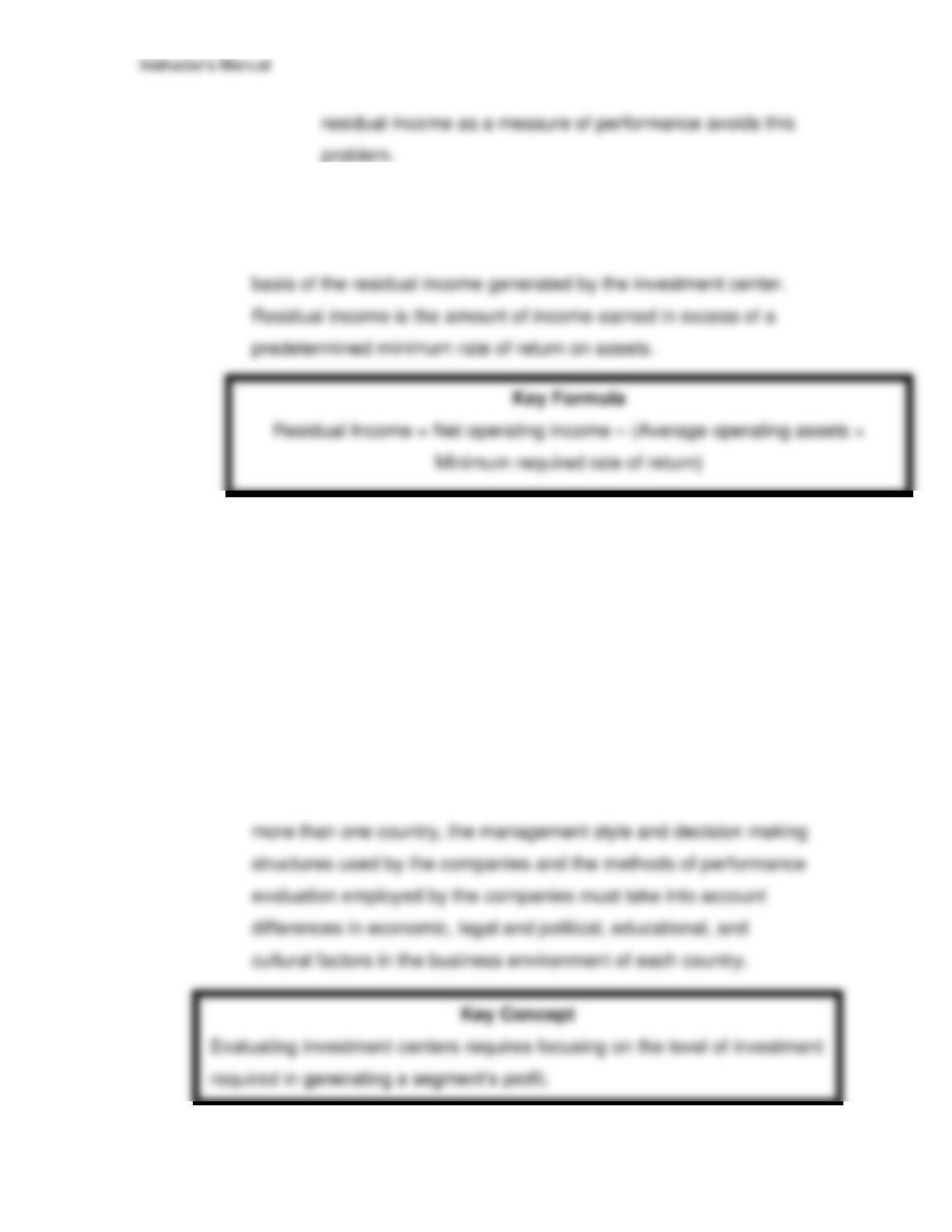
2. Residual Income
As an alternative to evaluating the manager of an investment
center on the basis of ROI, the manager can be evaluated on the
o All other things being equal, the higher the residual income
of an investment center, the better off the center will be.
o As residual income is an absolute measure, it should not
be used to compare the performance of investment centers
of different sizes.
3. Decentralization and Performance Evaluation in a Multinational
Company
Segments or divisions in a multinational company are often created
along geographic lines. When responsibility centers are located in

Instructor’s Manual
G. Performance Evaluation Using the Balanced Scorecard (LO6)
The balanced scorecard approach to performance measurement uses a set
of financial and nonfinancial (customer satisfaction, quality issues,
productivity, efficiency, and employee satisfaction) measures that relate
to the overall strategy of the organization. Utilizing a balanced scorecard
approach requires looking at performance from four different, but related,
perspectives: financial, customer, internal business, and learning and
growth.
1. Financial Perspective
o The primary goal of every profit-making enterprise is to
o Critical success factors under financial perspective include
sales, costs, measures of profit such as operating income
and segment margin, and measures of investment center
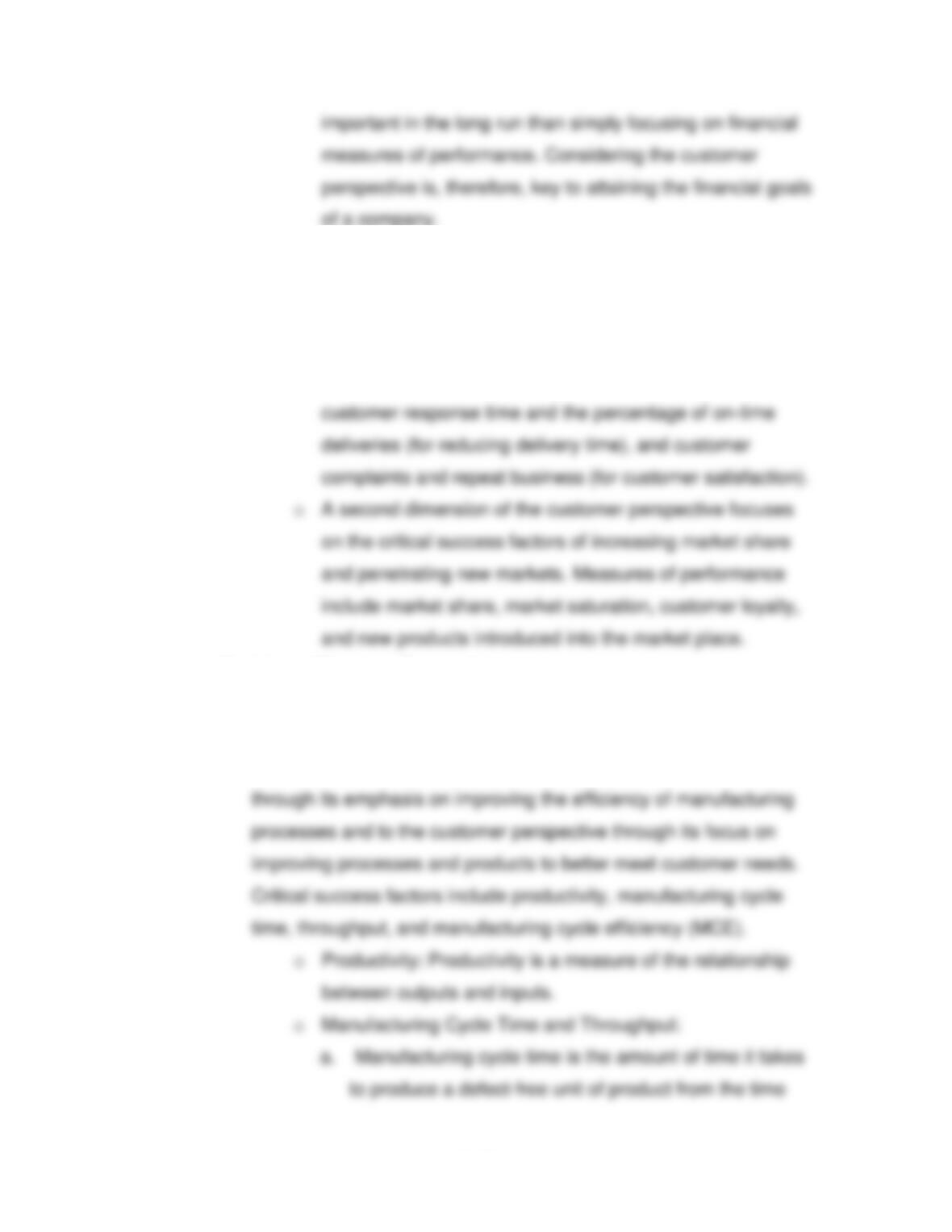
2. Customer Perspective
o Many successful businesses have found that focusing on
customers and meeting or exceeding their needs is more
Key Concept
Evaluating the performance of investment center managers is complex
Instructor’s Manual
11-13
o Critical success factors under customer perspective are
likely to include improving the quality of products and
services, reducing delivery time, and increasing customer
satisfaction. Measures of performance include the number
of warranty claims and returned products (for quality),
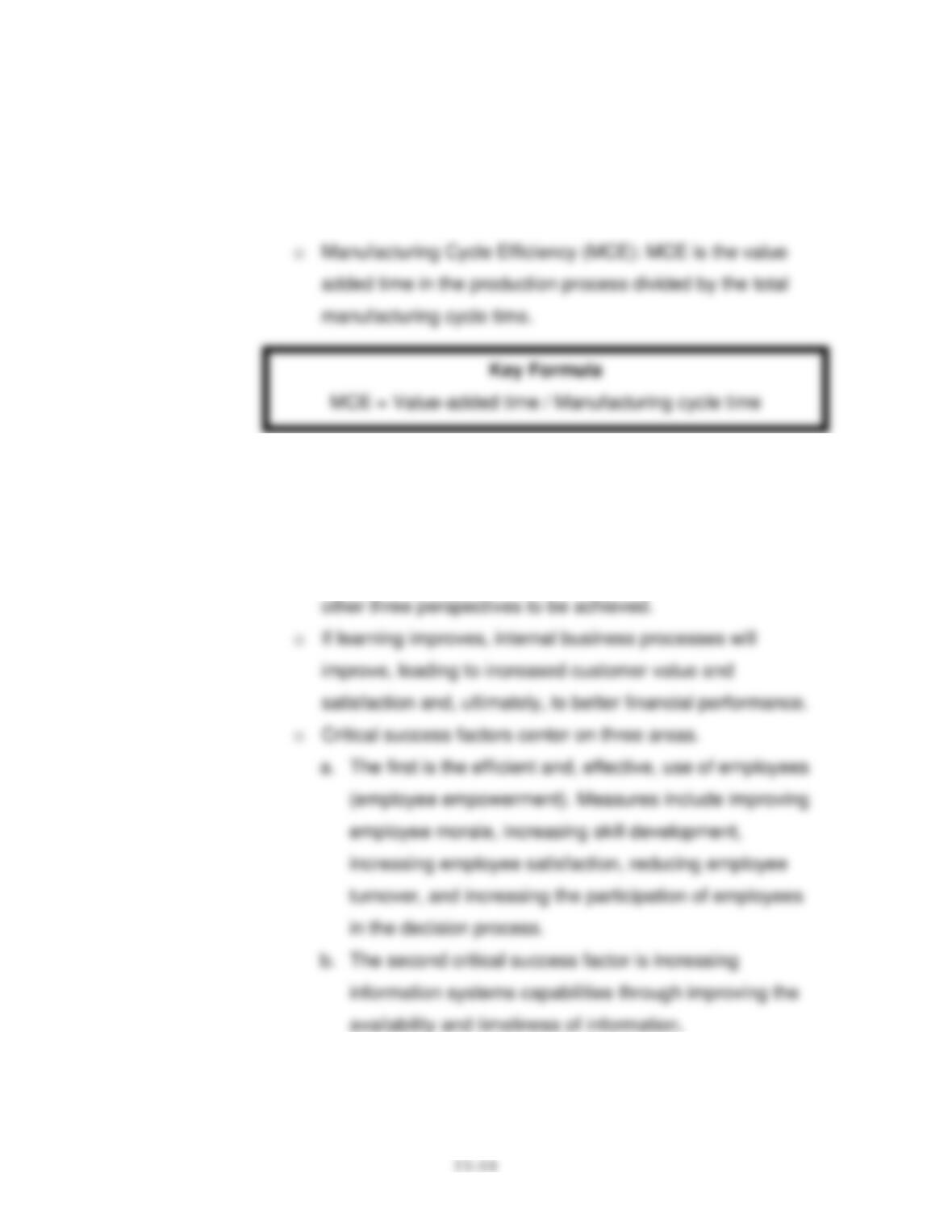
3. Internal Business Perspective
The internal business perspective deals with objectives across the
company’s entire value chain: from research and development to
post-sale customer service. It is linked to the financial perspective
Instructor’s Manual
raw material is received until the product is ready to
deliver to customers.
b. Throughput refers to the number of defect-free units
that can be made in a given period.
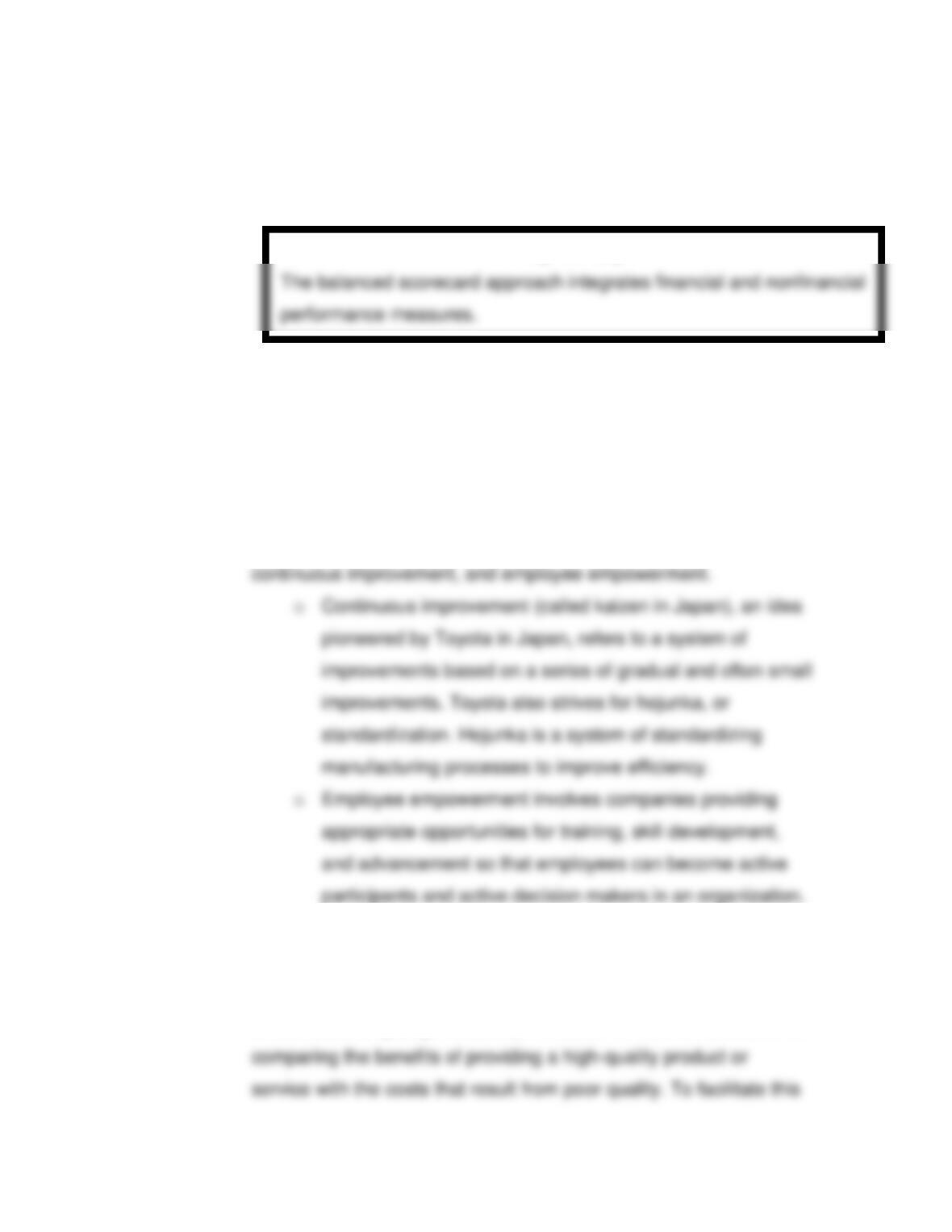
4. Learning-and-Growth Perspective
o The learning-and-growth perspective links the critical
success factors in the other perspectives and ensures an
environment that supports and allows the objectives of the
Instructor’s Manual
11-15
c. The third critical success factor involves measures of
product innovation, such as increasing the number of
new products, new patents, and so on.
H. Measuring and Controlling Quality Costs (LO7)
1. Quality is usually defined as meeting or exceeding customers’
expectations. Companies have focused on improving the quality of
the products or services through a variety of initiatives. All these
initiatives focus on meeting or exceeding customer expectations,
2. The Costs of Quality
Improving quality can be expensive, requiring significant
investments in training and infrastructure. In evaluating managers
on the basis of quality initiatives, it is useful to have a framework for
Key Concept
Instructor’s Manual
comparison, quality costs are typically classified into four general
categories:
o Prevention costs are costs incurred to prevent product
failures typically related to design and engineering.
3. Minimizing Quality Costs
o The goal is to minimize the costs of quality while
maintaining a high-quality product or service. Increasing
expenditures in one or more areas to decrease other costs
could be the way to go. For example, both external and
Key Concept
The traditional view of quality costs is that total quality costs are minimized
total quality costs are minimized at a zero defect level.
Making It Real:
Six Sigma at Caterpillar
Instructor’s Manual
11-17
I. Performance and Management Compensation Decisions (LO8)
In order to motivate managers and ensure goal congruence, the
compensation of managers should be linked to performance and based on a
combination of short-term and long-term goals. The compensation given to
the managers may be one or combinations of the following forms:
1. Cash Compensation
Cash compensation can be paid in the form of salary or end-of–
period bonuses. Many companies use a combination of the two in
which a base salary is paid and bonuses are paid if managers meet
or exceed established goals.
2. Stock-Based Compensation
To encourage managers to take a longer term view, many
Making It Real:
Instructor’s Manual
managers owners. Two forms of stock based compensation are as
follows:
o Stock option: is the right to buy a share of stock at a set
price (called the option price or strike price) at some point
in the future. Stock options as a form of compensation
suffers from the following limitations:
a. The use of stock options as compensation can result in
short-term dysfunctional behavior if managers focus on
o Restricted stock: is a form of management compensation
in which employees receive shares of stock with
restrictions such as requirements to stay with the company
for a set length of time or requirements to meet established
performance measures.
3. Noncash Benefits and Perks
Most management compensation plans include a variety
4. Measuring and Rewarding Performance in a Multinational
Environment

Instructor’s Manual
11-19
End-of-Chapter Material
Brief exercises, exercises, problems, and cases based on different learning
objectives have been provided at the end of the chapter. These-end-of chapter
Key Concept
In order to motivate managers and ensure goal congruence, the compensation of
Making It Real:
CEO Compensation and Performance