Chapter 11 – Managing Individual Differences and Behavior: Supervising People as People
21
Interactive Classroom Material:
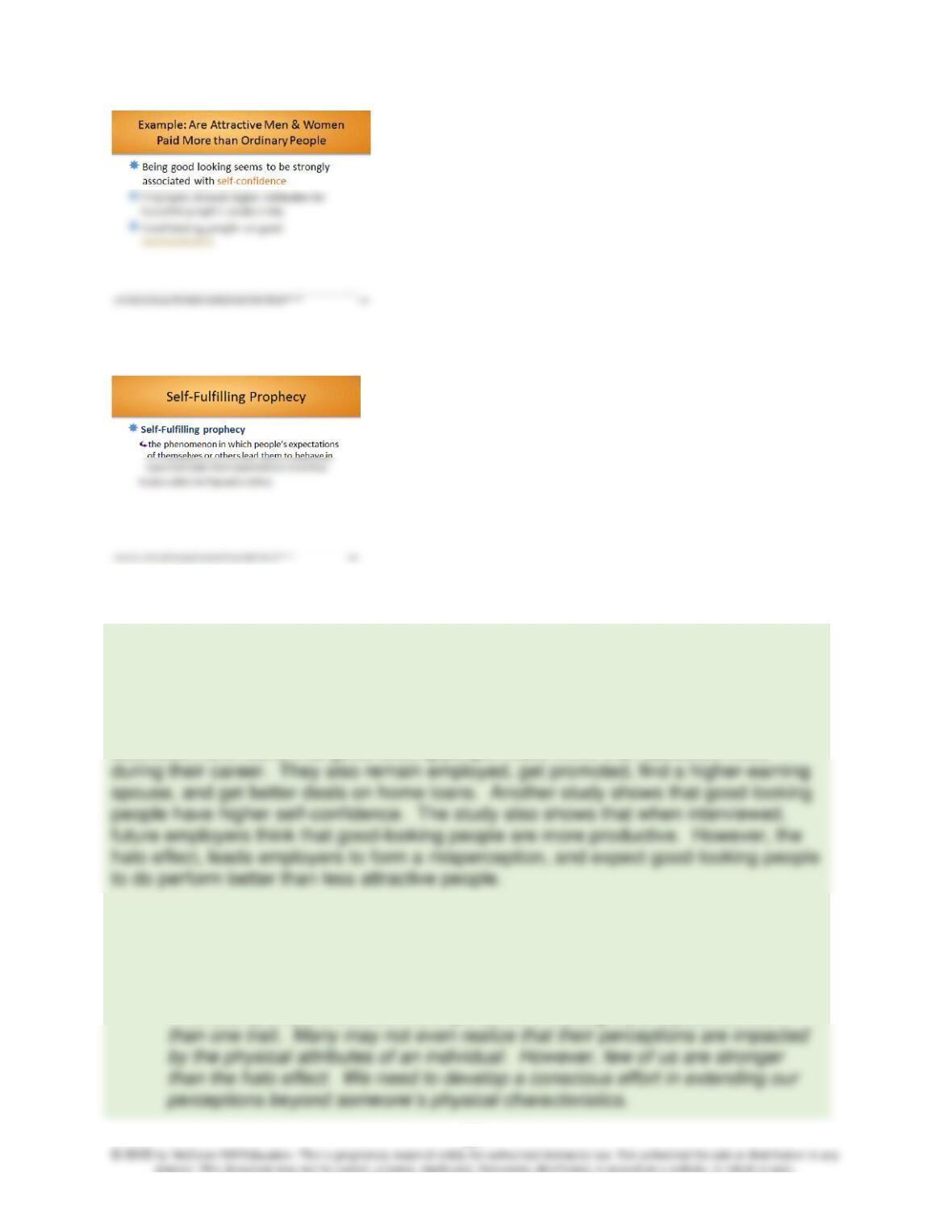
EXAMPLE: The Halo Effect: Do Good Looks Make People Richer and Happier
(p. 350)
This Example asks the question if good-looking people have positive outcomes in life.
Scientists have found that good-looking people make more than $250,000 more
YOUR CALL
Are you yourself influenced in your judgment of people by how attractive they
are? Do you think as a manager you could look beyond people’s physical
appearances to be a good judge of their competence? Why?
This example demonstrates the importance of basing a perception on more
Chapter 11 – Managing Individual Differences and Behavior: Supervising People as People
22
Additional Activities:
One way that you could build on this Example is to show a clip that demonstrates how
people respond to others differently as a function of their appearance and their height.
How can managers seek to overcome the halo effect based on appearance when
determining which job applicants to hire?
Discuss how your height likely impacts how others perceive you.
As a result of watching this video, are you likely to change how you form first
impressions of others? Defend your position.
Interactive Classroom Material:
EXAMPLE: The Recency Effect: Can You Use It to Get a Better Performance
Review? (p. 351)
This example describes how often the annual employee performance review system
YOUR CALL
What decision(s) would you admit to making in which you were influenced by
the recency effect?
This example demonstrates the detrimental impact of the recency effect.
Additional Activities:
One way that you could build on this example is to have the students read the MIT
Chapter 11 – Managing Individual Differences and Behavior: Supervising People as People
23
Describe best practices organizations should follow to reduce the impact of
perceptual biases in the performance appraisal process.
Discuss the role that framing effects could play in the performance appraisal
process.
Interactive Classroom Material:
PRACTICAL ACTION: How Can Managers Harness the Pygmalion Effect to Lead
Employees? (p. 352)
Research in a variety of industries and occupations shows that the effect of the self–
YOUR CALL
How can you put the Pygmalion effect to use in college organizational life?
Students can apply the 10 management suggestions to create a positive
Additional Activities:
One way that you could build on this Practical Action is to show the students the video
clip “The Pygmalion Effect and the Power of Positive Expectations.” In this 5-minute
video, Robert Rosenthal summarizes the results of a research study that
Chapter 11 – Managing Individual Differences and Behavior: Supervising People as People
24
Group Exercise: Using Attribution Theory to Resolve Performance Problems: The
Case of Mary Martin
There is a group exercise available at the end of this manual that applies attribution
theory.
Exercise Objectives
This section of the chapter discusses the key work-related attitudes and behaviors.
This is critical because these attitudes and behavior are connected to effort and
productivity. When managers focus on engagement, job satisfaction, and
organizational commitment, employees’ behavior changes for the better. Much
research has been done concerning these three attitudes and the behaviors they foster.
It is easy to facilitate students in this conversation because they can see an impact of
the same attitudes toward their courses.
11.4 Work-Related Attitudes & Behaviors Managers Need to
Deal With (pp. 353-356)
Is it important for managers to pay attention to employee attitudes?
Chapter 11 – Managing Individual Differences and Behavior: Supervising People as People
25
Possible Topics for Discussion:
• Describe activities in which you participate that get your highest level of
engagement. Why do you think you prefer these activities?
Major Idea Outline:
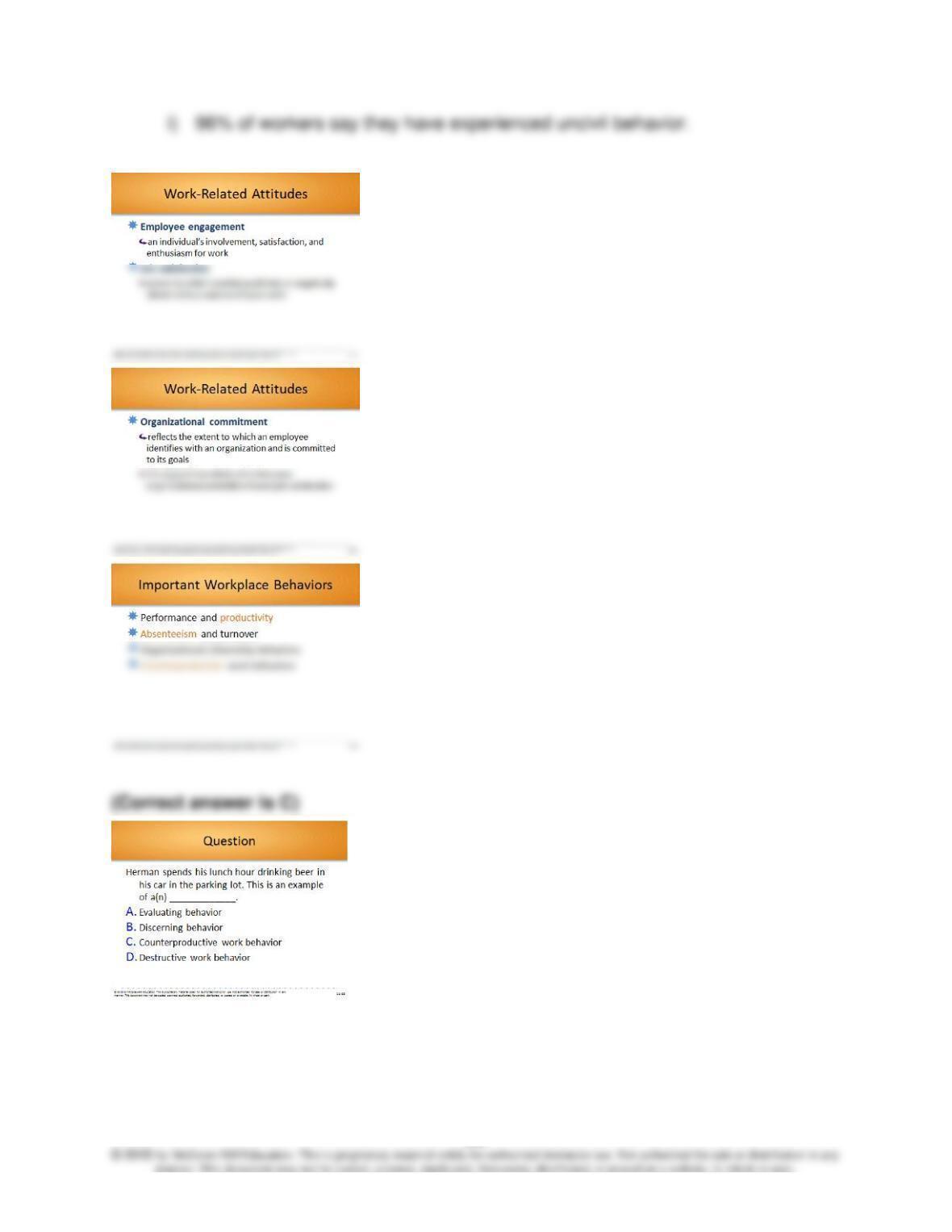
1) Work Related Attitudes
a) Employee Engagement – defined as an individual’s involvement, satisfaction,
and enthusiasm for work.
i) Engaged employees are enthusiastic, focused, and committed.
2) Workplace Behaviors
a) Performance and Productivity
i) The method of evaluating performance must match the job.
b) Absenteeism and Turnover
i) Absenteeism may be a precursor to turnover.
ii) 5 practical ways to reduce turnover:
c) Organizational Citizenship Behavior – those behaviors that are not directly part of
the employee’s job description; behaviors that exceed their work role
requirements.
Chapter 11 – Managing Individual Differences and Behavior: Supervising People as People
26
Chapter 11 – Managing Individual Differences and Behavior: Supervising People as People
27
SELF-ASSESSMENT 11.3 (p. 353)
To what extent are you engaged in your studies?
Go to connect.mheducation.com and take Self-Assessment 11.3.
Student Questions:
1. What is your level of engagement?
Engagement is an indicator of how dedicated and involved you are in an
2. Find your lowest three rated items. Based on the content of these items, what
can you do to improve your level of engagement? Hint: doing this requires
you to identify the cause of the low ratings for each item.
Students should be given a chance to identify their lowest three rated items.
Additional Activities:
You can also consult the Connect Instructors Manual for the post-assessment activity
and corresponding PowerPoint slides used for this Self-Assessment in Connect. In
SELF-ASSESSMENT 11.4 (p. 354)
How satisfied are you with your present job?
Go to connect.mheducation.com and take Self-Assessment 11.4.
Student Questions:
1. What is your level of satisfaction with recognition, compensation, and
supervision?
Students will each have varied satisfaction levels concerning recognition,
2. If you have low to medium satisfaction with any aspect of the job, identify what
can be done to increase your job satisfaction. Be sure to consider what you
can do, what your boss might do, or what the organization might do. Be
Chapter 11 – Managing Individual Differences and Behavior: Supervising People as People
specific.
Students should be given the opportunity to reflect on their low to medium
Additional Activities:
You can also consult the Connect Instructors Manual for the post-assessment activity
Interactive Classroom Material:
EXAMPLE: Extreme Counterproductive Work Behaviors: Violence in the
Workplace (p. 356)
This example describes extreme counterproductive work behaviors in the workplace.
YOUR CALL
If a coworker of yours said something like, “I could KILL my boss for
[something he or she did],” how would you take it? What would you do?
This example has students considering their reactions to counterproductive
Additional Activities:
One way that you could build on this Example to is to have the students watch the
Chapter 11 – Managing Individual Differences and Behavior: Supervising People as People
Describe warning signs of workplace violence that you believe Mark demonstrates
in this video.
Critique how Mark’s co-workers responded to his actions. How might you have
handled the situation differently?
This section of the chapter is designed to examine the diversity elements that seem
most important to the workplace. By using the diversity wheel, we can compare both
internal and external dimensions of an individual that might reflect in diversity. Further,
the current trends in the workplace are outlined with particular attention to the impact on
the workforce. Finally there are six barriers to diversity in the workplace that are
addressed.
One way to begin your coverage of these topics is to discuss the extent of diversity
Possible Topics for Discussion:
• Why is it important for companies to understand and effectively manage
diversity?
Major Idea Outline:
1) How to think about Diversity: Which Differences are Important?
11.5 The New Diversified Workforce (pp. 357 – 362)
What trends in workplace diversity should managers be aware of?
Chapter 11 – Managing Individual Differences and Behavior: Supervising People as People
30
a) Diversity represents all the ways people are unlike and alike – the differences
and similarities in age, gender, race, religion, ethnicity, sexual orientation,
capabilities, and socioeconomic background.
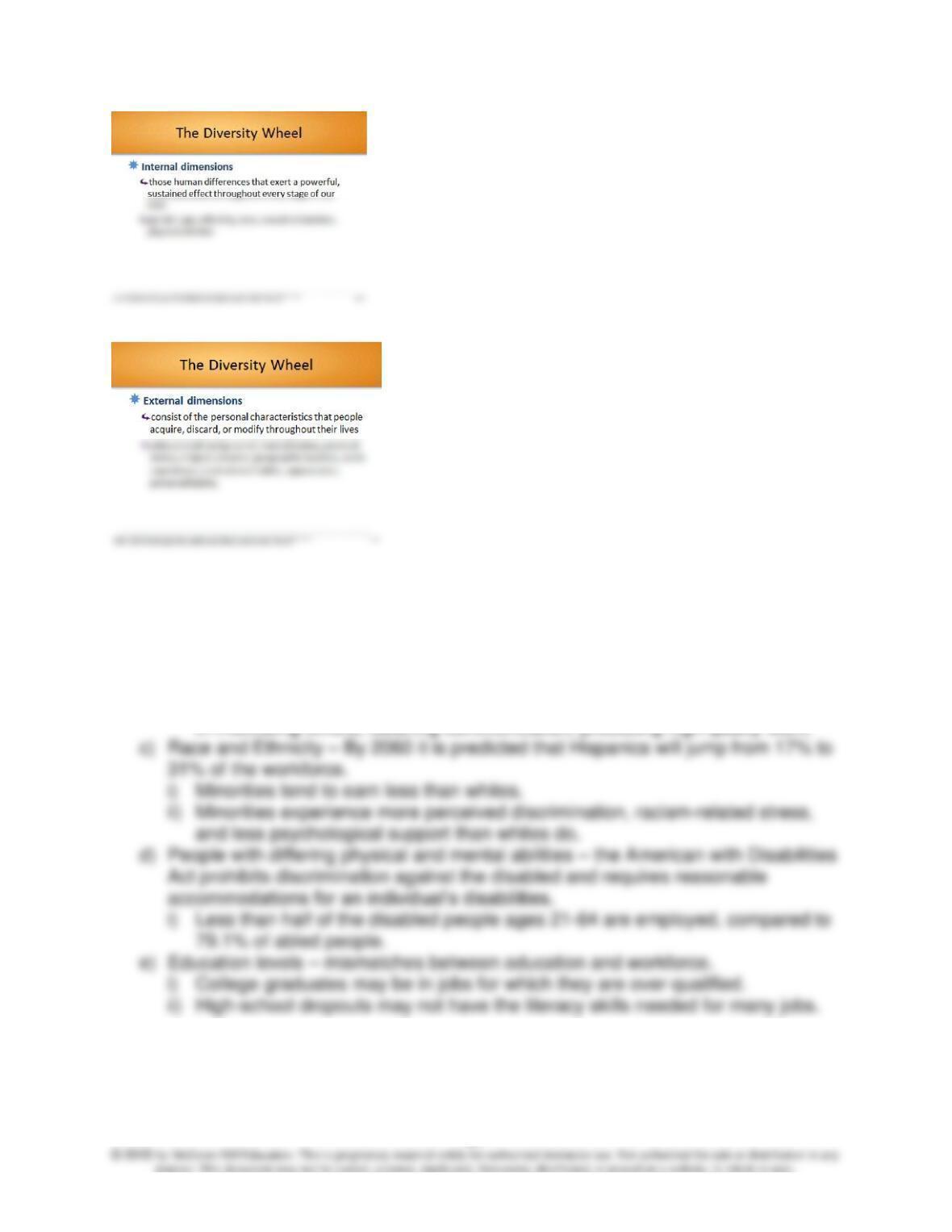
b) Diversity Wheel (Figure 11.3, p, 358)
i) Personality – center of wheel, stable characteristics.
(2) Often associated with stereotypes.
iii) External dimensions – include an element of choice, personal characteristics
that people acquire, discard, or modify throughout their lives; secondary
iv) Organizational dimensions.
(1) Management status, union affiliation, work location, seniority, work
content, and division or department
Chapter 11 – Managing Individual Differences and Behavior: Supervising People as People
31
2) Trends in Workforce Diversity
a) Age – workers age 55 and older are expected to make up over 25% of the labor
force in 2022.
b) Gender – glass ceiling is the metaphor used for an invisible barrier that prevents
women and minorities from being promoted to top executive jobs.
i) Several studies suggest that women rate higher than their male counterparts
in motivating others, fostering communication, producing high quality work.
Chapter 11 – Managing Individual Differences and Behavior: Supervising People as People
32
3) Barriers to Diversity – some stem from inside the organization itself.
a) Stereotypes and prejudice – sometimes differences are viewed as being
weakness.
i) Ethnocentrism – the belief that one’s native country, culture, language,
abilities or behavior is superior to those of another culture.
SELF-ASSESSMENT 11.5 (p. 360)
What are your attitudes about working with older employees?
Go to connect.mheducation.com and take Self-Assessment 11.5
Student Questions:
1. What is the quality of your relationships with older employees? How about
your satisfaction with working with older people?
2. How might the quality of relationships with older employees affect your
Chapter 11 – Managing Individual Differences and Behavior: Supervising People as People
33
performance and promotability?
Students should understand that low quality relationships with older employees
3. To what extent might your satisfaction with working with older people impact
your performance and promotability?
The students’ satisfaction with working with older people will impact their
Additional Activities:
You can also consult the Connect Instructors Manual for the post-assessment activity
and corresponding PowerPoint slides used for this Self-Assessment in Connect. In
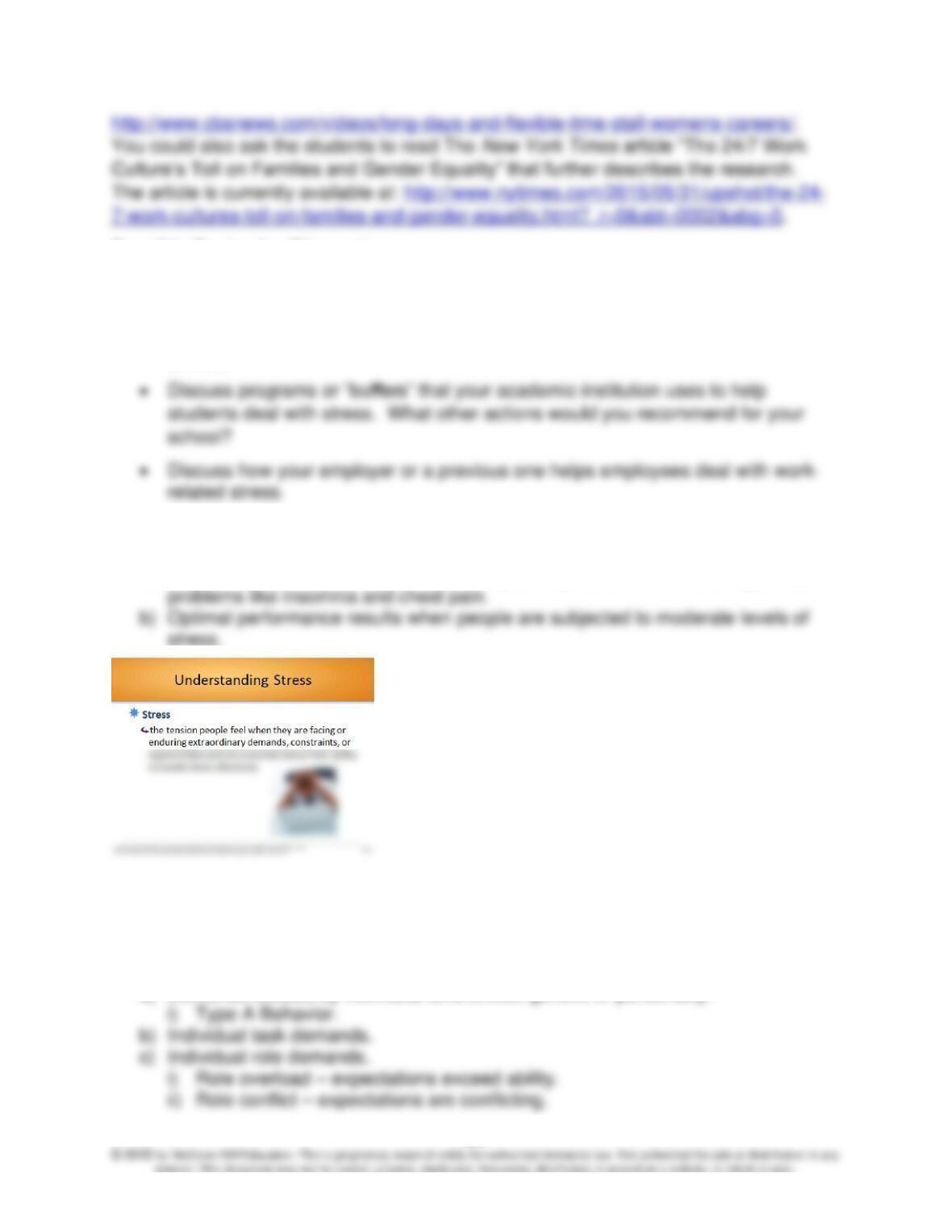
This section of the chapter highlights the impact stress has on an individual’s behavior.
The American Psychological Association found that almost 65% of American adults cite
work as a significant source of stress. Stress has a direct impact on job satisfaction,
organizational commitment, and job performance. The sources of stress as well as the
consequences of stress are discussed. Students will relate directly to the idea of stress
impacting performance.
11.6 Understanding Stress & Individual Behavior
(pp. 363 – 367)
What causes workplace stress, and how can it be reduced?
Chapter 11 – Managing Individual Differences and Behavior: Supervising People as People
34
Possible Topics for Discussion:
• Describe the job-related sources of stress you experience. How do these
stressors impact your performance?
• Discuss how stress has created negative consequences for you at school and/or
at work.
Major Idea Outline:
1) The Toll of Workplace Stress
a) Stress can cause conflict at work, make you fatigued all the time, and generate
2) How Does Stress Work?
a) Stress has physical and emotional components.
b) Stress can be both negative and positive.
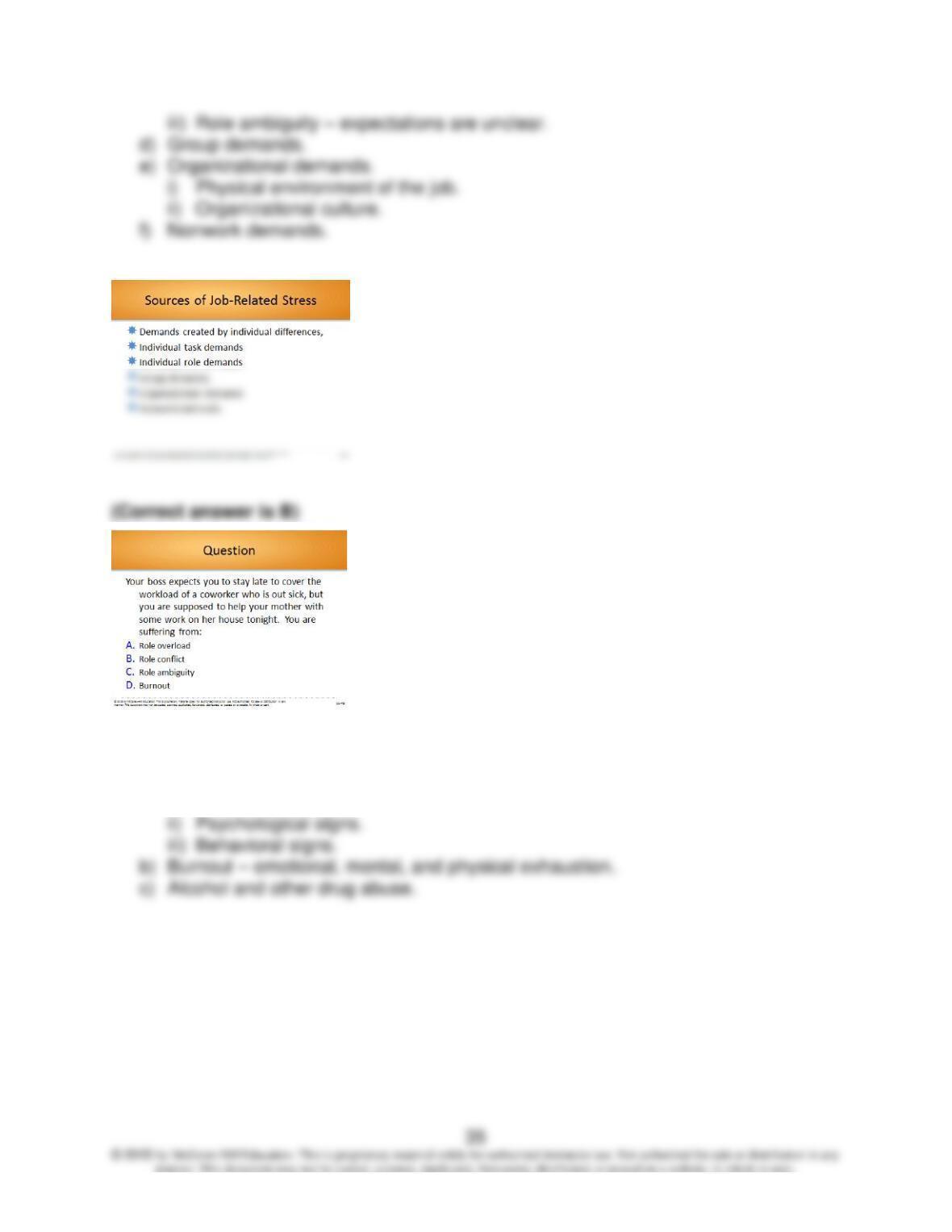
3) The Sources of Job-Related Stress
a) Demands created by individual differences: genetic or personality.
Chapter 11 – Managing Individual Differences and Behavior: Supervising People as People
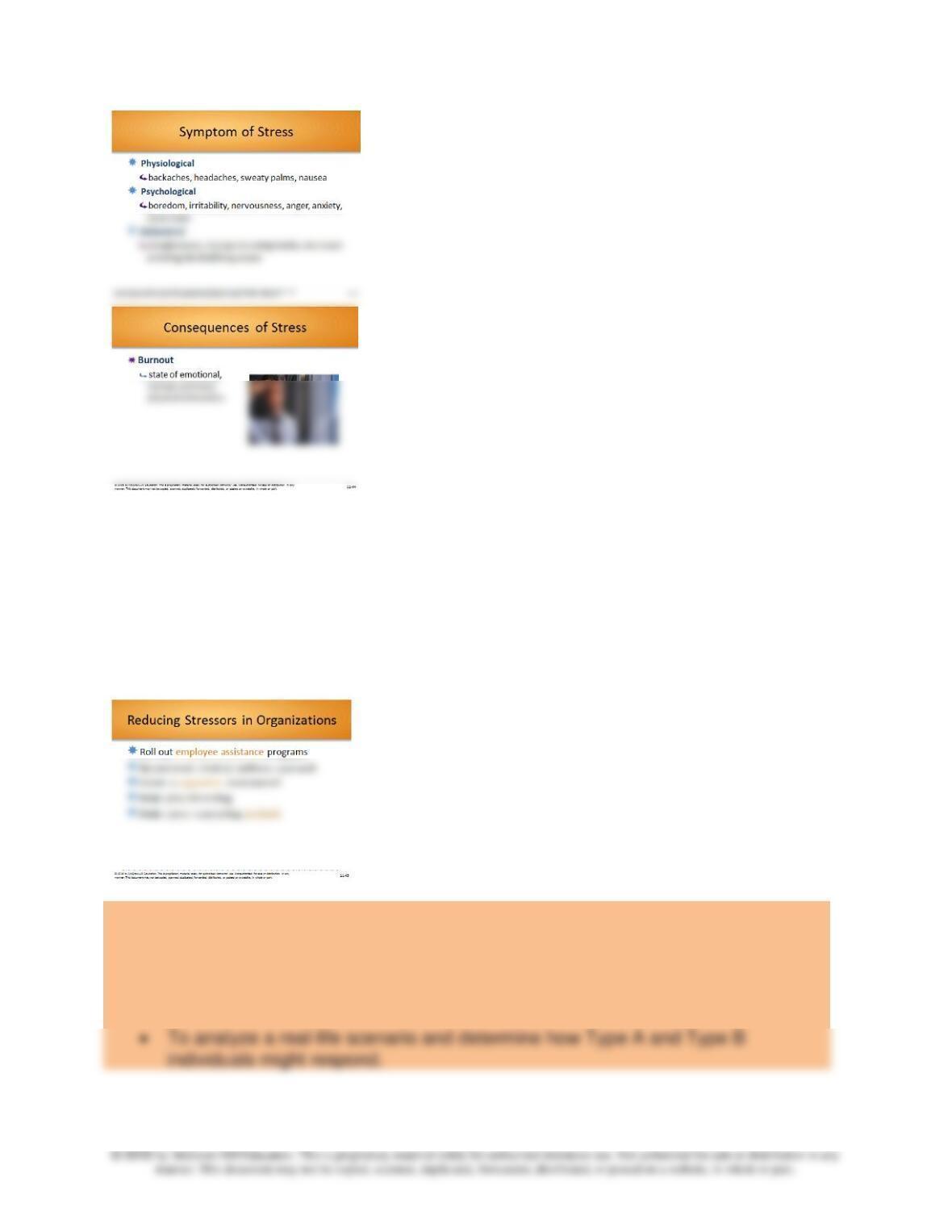
4) The Consequences of Stress
a) Symptoms of stress:
i) Physiological signs.
Chapter 11 – Managing Individual Differences and Behavior: Supervising People as People
36
5) Reducing Stressors in the Organization
a) Roll out employee assistance programs.
b) Recommend a holistic wellness approach.
c) Create a supportive environment.
d) Make jobs interesting.
e) Make career counseling available.
Group Exercise: The Type A Behavior Pattern
There is a group exercise available at the end of this manual that explores Type A
and Type B individuals.
Exercise Objectives
Chapter 11 – Managing Individual Differences and Behavior: Supervising People as People
37
11.1 In the hiring process, do employers care about one’s personality and
individual traits?
Employers do care about one’s personality and individual traits throughout the
hiring process. Personality consists of the stable psychological traits and
behavioral attributes that give a person his or her identity. Personality dimensions
11.2 How do the hidden aspects of individuals – their values and attitudes – affect
employee behavior?
Values are abstract ideas that guide one’s thinking and behavior across all
situations. Attitudes are a learned predisposition toward a given object. These
11.3 What are the distortions in perceptions that can cloud one’s judgment?
There are four distortions in the perception process. Stereotyping is the tendency
to attribute to an individual the characteristics one believes are typical of the group
CHALLENGE: MAJOR QUESTIONS