Chapter 11 – Business/IT Strategies for Development
11-1
11 Business/IT Strategies for Development
CHAPTER OVERVIEW
Chapter 11: Business/IT Strategies For Development emphasizes the importance of the planning process in
developing IT/business strategies and the implementation challenges that arise when introducing new IT-based
business strategies and applications into an organization.
LEARNING OBJECTIVES
1. Discuss the role of planning in the business use of information technology, using the scenario approach, and
planning for competitive advantage as examples.
SUMMARY
• Organizational Planning. Managing information technology requires planning for changes in business goals,
processes, structures, and technologies. Planning is a vital organizational process that uses methods like the scenario
• Business/IT Planning. Strategic business/IT planning involves aligning investment in information technology
• Implementing Business Change. Implementation activities include managing the introduction and
implementation of changes in business processes, organizational structures, job assignments, and work relationships
Chapter 11 – Business/IT Strategies for Development
11-2
KEY TERMS AND CONCEPTS
1. Business model ():
2. Business/IT planning ():
The business planning process focuses on discovering innovative approaches to satisfying a company’s
customer value and business value goals.
a. Business Application planning ():
Application planning begins after strategic planning and includes the evaluation of proposals, business case
3. Change management ():
Change management describes the process of implementing major changes in information technology, business
processes, organizational structures, and job assignments to reduce the risks and costs of change and optimize
its benefits.
4. End-user involvement ():
5. End-user resistance ():
End user resistance describes employees‘ natural aversion to risk associated with change.
6. Implementation ():
7. Information technology architecture ():
8. Organizational planning ():
9. Planning for competitive advantage ():
This type of planning involves an evaluation of potential benefits and risks an organization faces for strategic
use of IT-based strategies and technologies.
10. Scenario approach to planning ():
11. SWOT analysis ():
Chapter 11 – Business/IT Strategies for Development
11-3
ANSWERS TO REVIEW QUIZ
Q.
A.
Key Term
Q.
A.
Key Term
1
Organizational planning
8
Implementation
2
Business/IT planning
9
Change management
3
Information technology architecture
End-user resistance
4
Planning for competitive advantage
End-user involvement
5
Scenario approach to planning
Business model
6
Business application planning
Strategic planning
7
SWOT analysis
E-business architecture planning
ANSWERS TO DISCUSSION QUESTIONS
1. “Planning is a useless endeavor because developments in e-business and e-commerce and in the political,
economic, and societal environments are moving too quickly nowadays.” Do you agree or disagree with
this statement? Why?
Disagree. Planning is never a useless endeavor – whether it is in the old economy or in the new economy. The
business environment.
2. “Planning and budgeting processes are notorious for their rigidity and irrelevance to management
action.” How can planning be made relevant to the challenges facing a business?
Planning brings forward activities for consideration and prioritization by management. As such, planning is not
Organizational planning components:
• team building, modelling, and consensus
• evaluating what an organization has accomplished and the resources they have acquired
Chapter 11 – Business/IT Strategies for Development
11-4
3. Refer to the Real World Challenge introduced at the beginning of this chapter. If the ERP package
implemented by the Sloan Valve Company “vaguely supported the business as it existed” and “it was not
crafted to support any new business process that we wanted,” according to the CEO, then why do you
think it was implemented in the first place? Were these issues—that it was not going to have a great
impact on the business—evident at the outset?
From what can be seen in the case, it would appear that the precious CIO implemented an ERP that was
“comfortable” for the organization, one that did not interrupt the workflow as it existed at the time. Changes
4. What planning methods would you use to develop business/ IT strategies and applications for your own
business? Explain your choices.
Four models:
• Competitive forces model – competitors, customers, suppliers, new entrants, and substitutes.
5. What are several e-business and e-commerce strategies and applications that should be developed and
implemented by many companies today? Explain your reasoning.
Suggestions
• Market creator – use the Internet to define a new market by identifying a unique customer need. This
Chapter 11 – Business/IT Strategies for Development
6. Refer to the Real World Solution in the chapter. The CIO/CPO of the Sloan Valve Company mentioned
that although technology issues were challenging, it was really the people issues that were the most
difficult. Why is this the case?
People generally do not like to change the way they do things, the way they do their jobs, because the actions
have been ingrained over a period of time and they are comfortable with the way they do things. Getting people
7. How can a company use change management to minimize the resistance and maximize the acceptance of
changes in business and technology? Give several examples.
Change management strategies
• Involve top management
8. “Many companies plan really well, yet few translate strategy into action.” Do you think this statement is
true? Why or why not?
Yes
Talk is cheap.
11-6
9. Review the real-world examples on user resistance and involvement in the chapter. What else would you
recommend to encourage user acceptance in both cases? Explain your recommendations.
Recommendations in the book
1
• Answer questions
Other ideas
2
Invite end user discussion regarding problems with the current system
End users tend to grow accustomed to and overlook flaws in legacy systems. By inviting discussion about the
10. What major business changes beyond e-business and e-commerce do you think most companies should be
planning for in the next 10 years? Explain your choices.
10 year planning
• Significantly increased mobile computing
1
These bullet points are not part of the required answer – they are for reference only. As per the question, students
should present ideas that are not included in the book.
2
This is not an exhaustive list.
Chapter 11 – Business/IT Strategies for Development
11-7
• Storage capacity as a commodity
• Software as a service
• Terrorism
ANSWERS TO ANALYSIS EXERCISES
1. Business on the Fly
a) Use the Internet to research credit card readers that connect to computers. What features do they offer?
How much do they cost?
Features:
• Computer connection type
b) Use the Internet to research mobile point of sales devices on the Internet. What features do they offer?
What advantages does mobility provide?
Searching on “mobile point of sales” produces useful results
Features:
• Type of wireless network (computer, cell phone)
c) Look up the “Authorize.Net” website. Read and summarize a retail merchant case study.
A two page case study illustrates a self-serve payment solution for hotel-based business centers by Showcase
Business Centers. Hotel guests use a self-service system produced by Kiosk Logix to pay for photocopies and faxes.
Chapter 11 – Business/IT Strategies for Development
11-8
2. Online University Degrees
a. Use news.google.com to find and read three articles about successful online degree programs. What are
the key elements for success mentioned in the articles?
This is a hot topic in education, and students should have little difficulty finding articles. Examples:
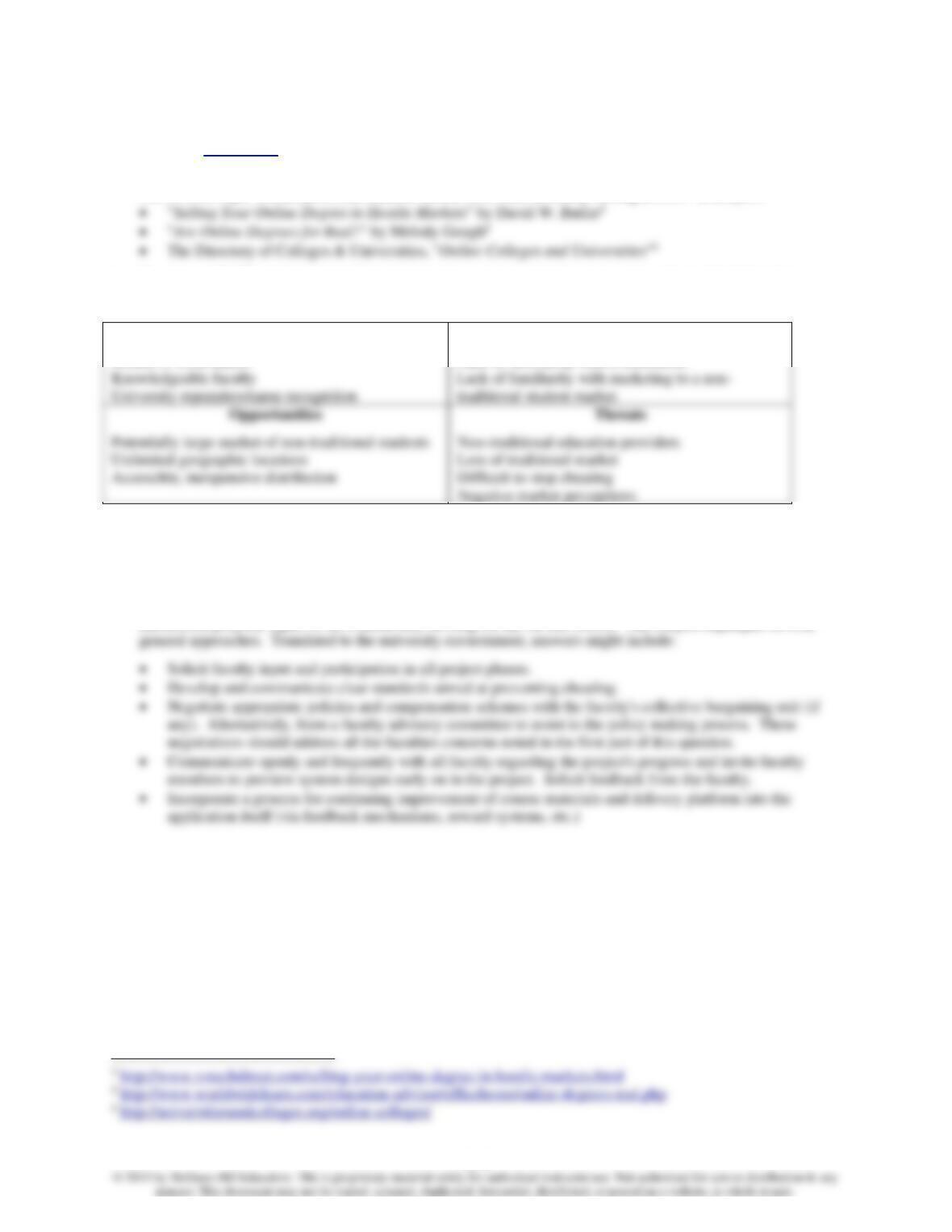
b. Prepare a SWOT analysis describing this business opportunity for your university’s administration.
Example:
Strengths
Wealth of information
Weaknesses
Lack of familiarity with e-commerce
c. What sorts of concerns might the faculty have about an online degree program? What steps would you
recommend the administration take in order to make an online degree initiative attractive to the faculty,
whose help is required to make the endeavor a success?
The faculty may be concerned about the affect on their traditional students, the university’s reputation, and the
intellectual property rights of the content they develop for the on-line course. The chapter highlights several
Chapter 11 – Business/IT Strategies for Development
11-9
3. Strategic Opportunities Matrix
a. Online sale and distribution of digital college textbooks.
Low ability to deliver with IT: while anyone can distribute digital files, no technology has yet fully prevented
b. Customized news alerts by topic, industry, region, business function, or other key word.
High ability to deliver with IT: news and text based search engines already exist, and several companies
c. Online college degrees from accredited universities.
Low ability to deliver with IT: it is technically difficult to provide online performance evaluation while keeping
delivery costs low and maintaining the degree’s integrity. In short, it is difficult to make sure students are not
cheating without actually having a “live” human monitoring the evaluation process.
d. Brainstorm opportunities that might fit both the “High Ability to Deliver with IT” and the “High
Strategic Business Potential” categories. Present your best idea to the class and explain how it fits both
classifications.
Chapter 11 – Business/IT Strategies for Development
11–10
4. Practical Change Management
a. Briefly describe the proposed change.
d. Apply the change management principles outlined in this chapter to describe the steps you think
leadership could take to ensure success at the lowest reasonable cost.
5. Planning & Culture
Solutions
a) Could Facebook‘s leadership have anticipated this backlash?
b) Why do you think Facebook’s leadership chose to make this an opt-out rather than an opt-in feature?
Facebook’s leadership likely needed test data quickly. By making the feature opt-out, they guaranteed a very
c) Should Facebook change the feature so users must opt–in? Should they remove the feature entirely? Why
or why not?
Various Rationale
• Since the feature is popular, changing it to opt-in should have little impact
d) After viewing Pirillo‘s video, do you believe that privacy is (or will soon be) an illusion?
Privacy is an illusion
• We’re videoed nearly everywhere
Chapter 11 – Business/IT Strategies for Development
11–11
Privacy is still possible
• People can choose to use only public computers, not publish personal information (on Facebook, for
ANSWERS TO REAL WORLD CHALLNGE/SOLUTION
Real World Challenge
1. What is a company seeking to achieve when it extensively customizes an ERP system? Are you surprised
at what the Sloan Valve Company obtained as a result of its efforts?
2. Given the structure of the company and its processes at the time, what would be the major bottlenecks or
issues that make it difficult to develop new products successfully? How can IT help alleviate those issues?
Major bottlenecks
• lack of accountability
How can IT help?
• facilitate process improvement (or reengineering) discussions
3. The case states that innovation processes worked well until the late 1990s, when it became evident that
they were not cutting it anymore. What would be some reasons for this change? Why would ad hoc and
informal work before but not anymore?
Reasons for change
• expansion
Chapter 11 – Business/IT Strategies for Development
11–12
Real World Solution
1. The endeavor chronicled here would arguably be considered a success. What were the key success factors
changes, practices, techniques, and so on – that made this possible? How did each contribute to the
positive outcomes of the project?
Key success factors
• leadership training
2. The company adopted a two-level governance structure with a strategic and a process level. How would
this approach work? What kind of issues should be discussed in each level? What are the advantages of
taking such an approach?
Two-level governance structure
• strategic-level: top management across all departments work to set the direction, set priorities, and
ANSWERS TO REAL WORLD CASES
RWC 1: IT Leaders
Case Study Questions
1. How does the job of the CIO change with the assumption of customer responsibilities? Do you agree with
this new development. Why or why not?
Job Change
Chapter 11 – Business/IT Strategies for Development
11–13
2. Why would there be internal resistance to CIOs becoming more externally customer-focused than they
were before? Does this present a threat to executives in other areas of a company?
Customers “belong” to sales and marketing, people who carefully guard their customer relationship. At worst,
3. How do companies benefit from having their CIO meet customers and generally become more involved
with product development? What can companies do now that was not possible before? Provide a few
examples.
Opportunity
• Improved customer service
Examples
• Certain Sony TVs can not stream movies wirelessly
Real World Activities
1. The IT function is notorious for being dynamic, and its leaders are no exception. Go online to research
recent trends affecting the traditional roles of senior IT executives and how those roles are changing.
Prepare a presentation to share your findings with the rest of the class.
Search terms
7
This author‘s own experience with direct communications during sales: a prospective client made
workflow/collaboration central to winning a proposal. The sales team recognized this and brought me onto their
team. Not only did I end up writing the technical part of the winning proposal, but I participated in bi-monthly
Chapter 11 – Business/IT Strategies for Development
11–14
Other trends
• e-Waste disposal
2. “In the future, the prevalence of IT in product offerings will blur the distinction between IT and other
areas of the company, to the extent that the IT function will cease to exist as a separate entity.” Do you
agree with this statement? Why? Break into small groups with your classmates to see if you can reach a
consensus on the issue.
Agree
At least the management end of IT (MIS) may cease to exist as a separate entity for the simple reason that the
RWC 2: Centene, Flowserve, and Shaw Industries
Case Study Questions
1. Why do you think the practices described in the case led to success for these companies?
2. How do they change the structure of projects so that the likelihood of a positive outcome increases?
Senior management becomes more involved. Communications increases. IT spends less time waiting for
3. In the case of Shaw Industries, how did Scrum help?
Scrum forced interaction between IT and the business. It required participants to identify top priorities and
4. Provide three specific examples from the case, and explain where and how those activities helped the
company move their projects along.
a. Centene used proven technology, experienced implementers, and good team relationships to implement its
Chapter 11 – Business/IT Strategies for Development
5. Using examples from the case and your own understanding of how those worked, can you distill a set of
recommendations that companies should follow when managing technology–based projects? Would these
be universal, or would you add any limitations to their applicability?
Recommendations
• Business considerations (business value) must drive IT projects
Real World Activities
1. The Scrum approach to project management has become quite popular in recent years. Go online and
research other companies that are using it to organize their projects. Have those experiences been
positive as well? What can you tell about how the approach works from your research? Prepare a report
to summarize your findings.
2. Would the issues discussed in the case be solved by making a business executive the head of any projects
involving IT? Why or why not? Break into small groups with your classmates and develop a justification
for both alternatives.