
Chapter 11 – Managing Individual Differences and Behavior: Supervising People as People
11
Chapter
Managing Individual Differences and
Behavior:
Supervising People as People
Major Questions the Student Should Be Able to Answer 2
Mapping the Class: Chapter Outline 3
Overview of the Chapter 4
Classroom Outline 6
CHAPTER CONTENTS
Chapter 11 – Managing Individual Differences and Behavior: Supervising People as People
11.1 Personality & Individual Behavior
MAJOR QUESTION: In the hiring process, do employers care about one’s
personality and individual traits?
11.4 Work-Related Attitudes & Behaviors Managers Need to Deal
With
MAJOR QUESTION: Is it important for managers to pay attention to employee
attitudes?
11.5 The New Diversified Workforce
MAJOR QUESTIONS THE STUDENT SHOULD BE ABLE TO ANSWER
Chapter 11 – Managing Individual Differences and Behavior: Supervising People as People
UD
11.1 Personality & Individual Behavior
11.2 Values, Attitudes, & Behavior
• Organizational Behavior: Trying to Explain and Predict
11.3 Perception & Individual Behavior
11.4 Work-Related Attitudes & Behaviors Managers Need to Deal
With
11.5 The New Diversified Workforce
• How to Think about Diversity: Which Differences Are Important?
11.6 Understanding Stress & Individual Behavior
• The Toll of Workplace Stress
• How Does Stress Work?
MAPPING THE CLASS: CHAPTER OUTLINE
Chapter 11 – Managing Individual Differences and Behavior: Supervising People as People
11.1 Personality & Individual Behavior
Personality represents a set of stable psychological traits and behavior attributes that
define the identity of an individual. Personality is often distilled down into the Big Five
Personality Dimensions. Extroversion represents how outgoing a person is.
11.2 Values, Attitudes, & Behavior
Organizational behavior focuses on workplace behavior in two particular areas:
individual behavior and group behavior. Values guide our thinking and behavior in all
settings. They have a direct impact on our behavior patterns. For this reason the more
11.3 Perception & Individual Behavior
Perception is the process of interpreting and understanding one’s environment.
Forming perceptions is a four-step process. A person must: (1) use selective
attention, (2) form an evaluation, (3) remember the event or person, and (4) retrieve the
OVERVIEW OF THE CHAPTER
Chapter 11 – Managing Individual Differences and Behavior: Supervising People as People
5
11.4 Work-Related Attitudes & Behaviors Managers Need to Deal with
Attitudes do impact behavior. As managers, we are interested in three of these.
Employee engagement is a reflection of employees’ involvement, satisfaction, and
enthusiasm, for their work. Job satisfaction represents the level of positive affect that
11.5 The New Diversified Workforce
Diversity represents the multitude of individual differences and similarities that exist
among people. Diversity may be divided into four layers: personality, internal, external,
and organizational dimensions. Personality represents a stable set of characteristics
11.6 Understanding Stress & Individual Behavior
Stress is the tension people feel when they are facing extraordinary demands,
constraints or opportunities. Stress is the feeling of tension and pressure. The source
of stress is labeled a stressor. Stress has a physical and emotional component. The
Chapter 11 – Managing Individual Differences and Behavior: Supervising People as People
6
The Manager’s Toolbox: Managing the Millennials: What’s Different about Today’s
Generation of Younger Workers
Millennials are considered to be very independent, tech-savvy, diverse, educated, and
anxious. They have very specific ways they like to be managed. They want
Possible Topics for Discussion:
• As a worker, you might hope to be led by someone who would follow the
preceding suggestions. But suppose your boss is of the old “tough guy” school
and doesn’t manage this way. In a difficult job market, would you stick it out?
Section 11.1 defines personality, using the Big Five, as well as self-evaluations (self-
efficacy, self-esteem, locus of control, and emotional stability) and emotional
intelligence. Each of these individual differences impacts the manager’s ability to
predict the employee’s behaviors.
CLASSROOM OUTLINE
11.1 Personality and Individual Behavior (pp. 338-343)
In the hiring process, do employers care about one’s personality and
individual traits?
Chapter 11 – Managing Individual Differences and Behavior: Supervising People as People
7
Possible Topics for Discussion:
• Discuss why as manager you would want to know your employee’s Big Five.
Major Idea Outline:
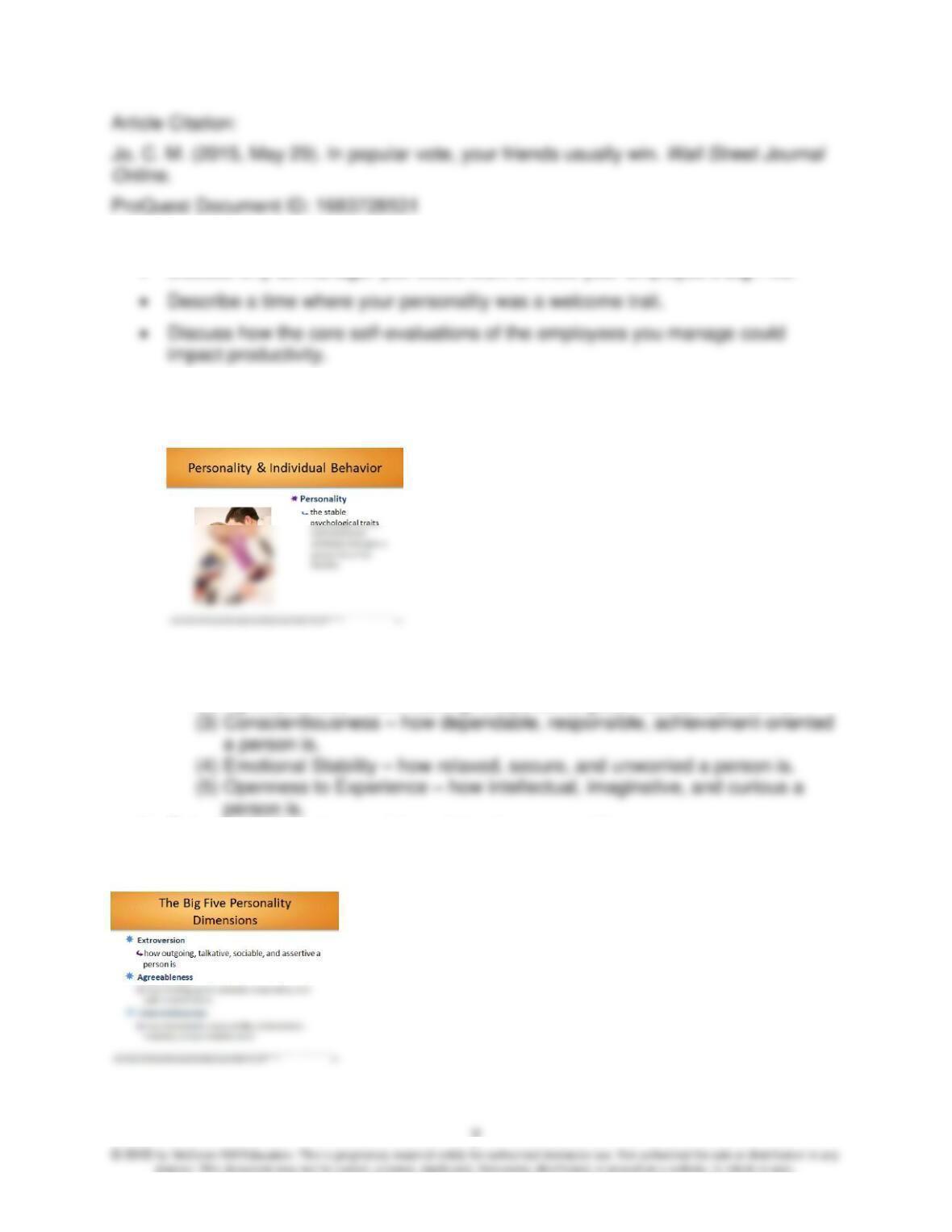
1) Personality – consists of the stable psychological traits and behavioral attributes that
give a person his or her identity.
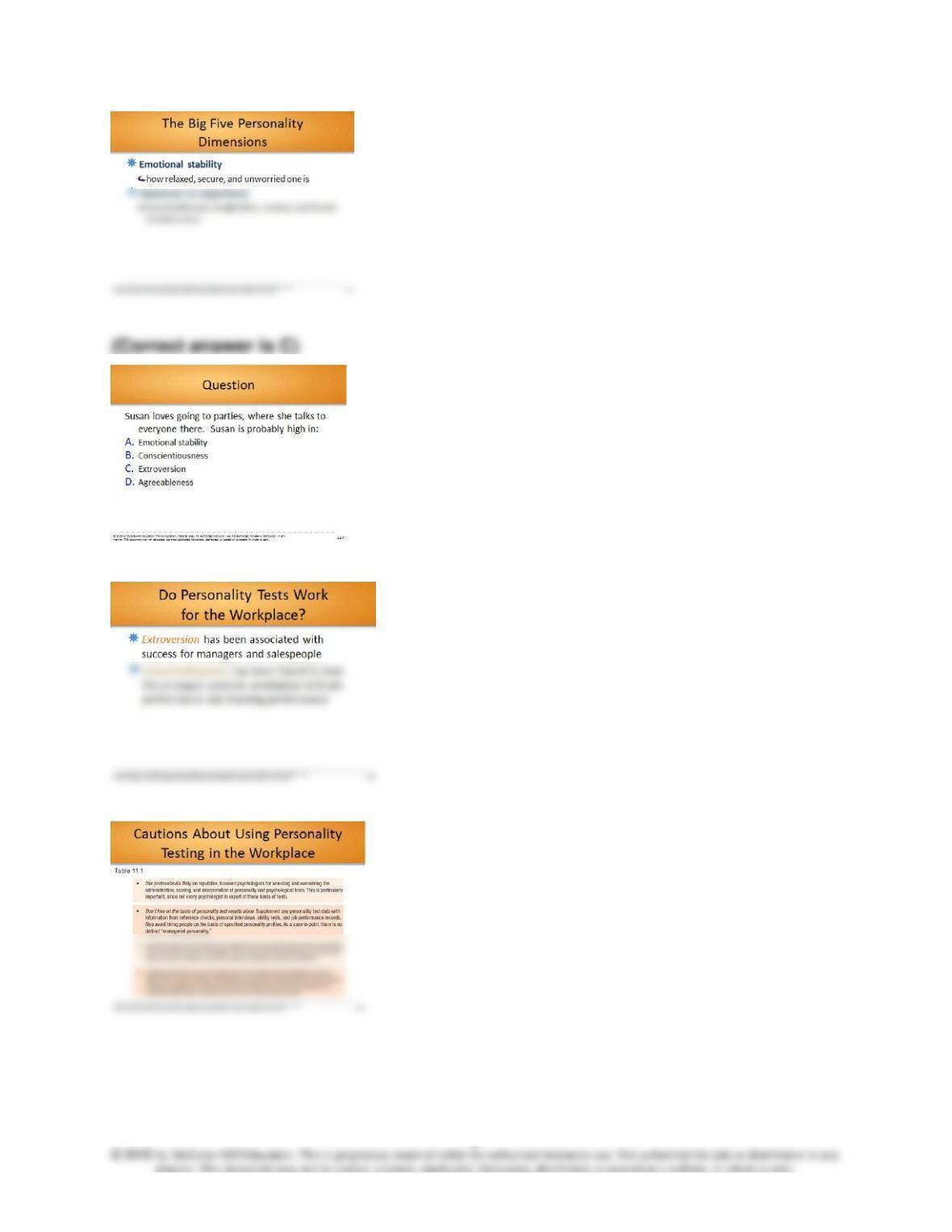
a) The Big Five Personality Dimensions
(1) Extraversion – how outgoing, sociable a person is.
(2) Agreeableness – how trusting, cooperative, good-natured a person is.
b) Extraversion is a stronger job predictor than agreeableness.
c) Conscientiousness holds the strongest positive correlation with job performance.
d) Proactive Personality – someone who is more likely to take initiative.
Chapter 11 – Managing Individual Differences and Behavior: Supervising People as People
8
Chapter 11 – Managing Individual Differences and Behavior: Supervising People as People
9
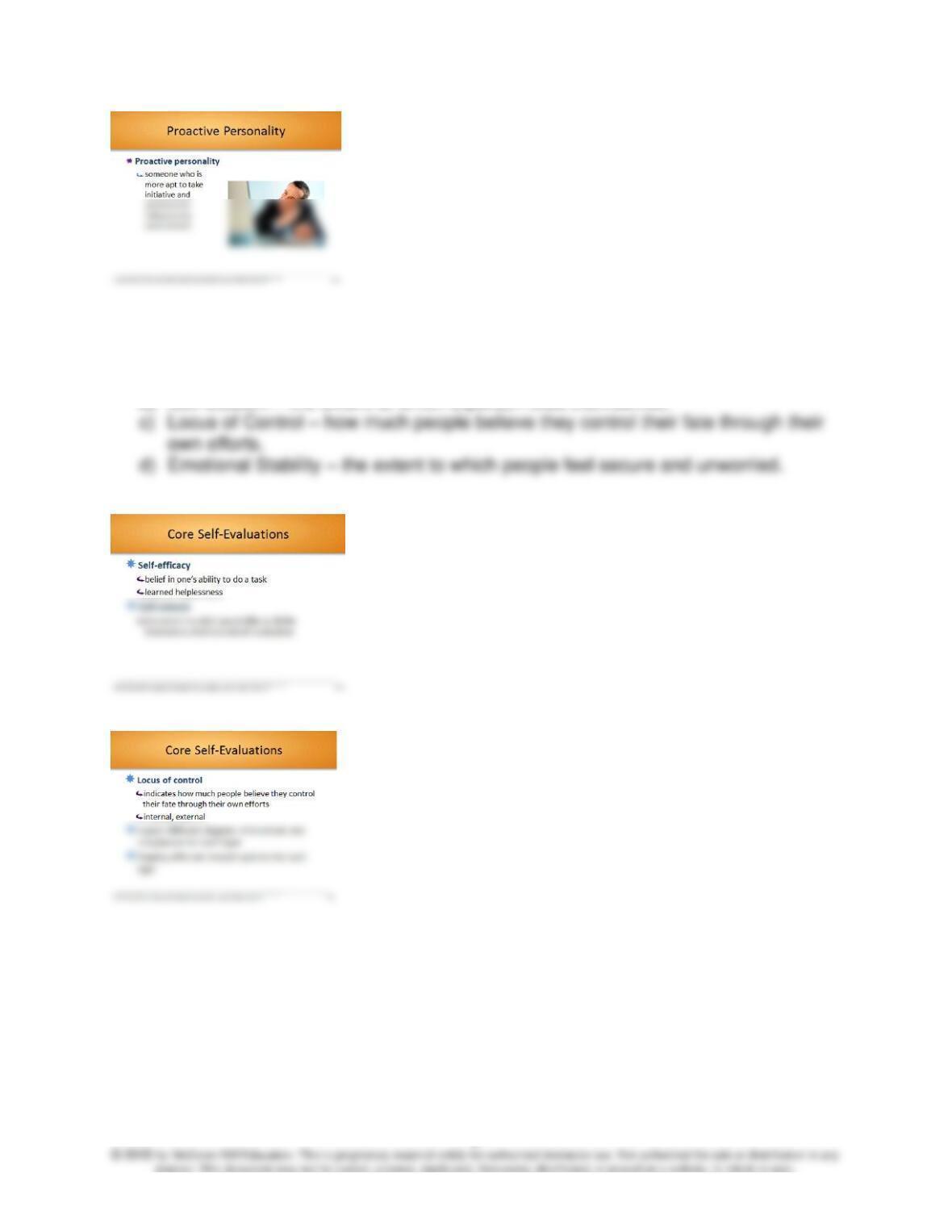
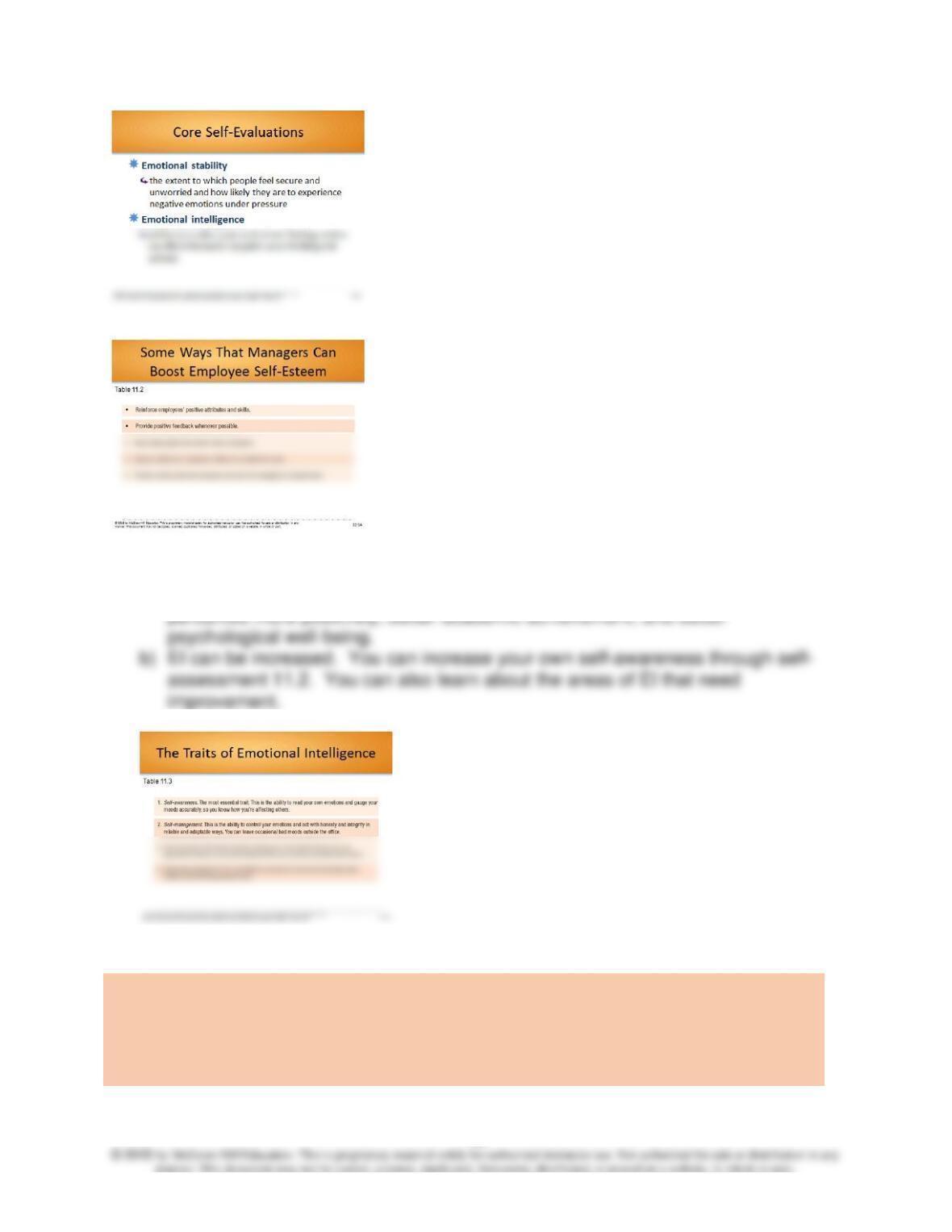
2) Core Self-Evaluation – a broad personality trait comprising the four positive
individual traits below:
a) Self-Efficacy – the belief in your own ability to do a job.
b) Self-Esteem – the extent to which a person likes themselves.
Chapter 11 – Managing Individual Differences and Behavior: Supervising People as People
10
3) Emotional Intelligence – the ability to monitor your and other’s feelings and the ability
to use this information to guide your thinking and actions.
a) EI is associated with better social relations, better family relations, being
SELF-ASSESSMENT 11.1 (p. 339)
Where do you stand on the Big Five Dimensions of personality?
Go to connect.mheducation.com and take Self-Assessment 11.1.
Chapter 11 – Managing Individual Differences and Behavior: Supervising People as People
11
Student Questions:
1. What is your personality profile according to the Big Five?
2. Which of the Big Five is most likely going to help you achieve good grades in
your classes and to gain employment after graduation?
Conscientiousness is the dimension that is most likely to help achieve good
achievement-orientation and persistence.
Additional Activities:
You can also consult the Connect Instructors Manual for the post-assessment activity
and corresponding PowerPoint slides used for this Self-Assessment in Connect. In
this activity, place students into groups based on their Self-Assessment scores.
Students who scored lowest on a particular personality dimension should be grouped
together. Students should analyze their assigned dimension based on the following:
What are the disadvantages of being high or low on this particular dimension?
SELF-ASSESSMENT 11.2 (p. 343)
What is Your Level of Emotional Intelligence?
Go to connect.mheducation.com and take Self-Assessment 11.2.
Student Questions:
1. How do you stand on the five dimensions of emotional intelligence?
2. Use the scores from the items to identify your strengths and liabilities.
3. Identify two things you might focus on to enhance your emotional intelligence.
Ask students to identify two activities that they can begin doing right after class
Chapter 11 – Managing Individual Differences and Behavior: Supervising People as People
12
strengths, or activities that combat their liabilities.
Additional Activities:
You can also consult the Connect Instructors Manual for the post-assessment activity
and corresponding PowerPoint slides used for this Self-Assessment in Connect. In
this activity, place students into groups based on their Self-Assessment scores.
Interactive Classroom Material:
EXAMPLE: Emotional Intelligence: Self-Understanding Should Include “the
Good, the Bad, & the Ugly” (p. 343)
This example describes how Charlotte Beers received feedback that surprised her
concerning how others thought she was behaving as a leader. Colleagues
considered her “menacing” while she thought of herself as “friendly.” After carefully
watching herself, she realized that her colleagues’ perceptions were accurate. Beers
believes we should all watch our behavior and consider the good, the bad, and the
ugly.
YOUR CALL
Do you agree? Could you conduct this kind of research about yourself in an
impersonal way to find out how others see you?
This example demonstrates why it is important for employees to be open to
feedback. Others often build their perceptions about us based on our
would also allow students to make adjustments in their own behavior.
Additional Activities:
One way to build on this Example is to have the students watch the video “Five Habits
of the Emotionally Intelligent.” In this 4-minute video, Myeong-Gu Seo and Kathryn
Chapter 11 – Managing Individual Differences and Behavior: Supervising People as People
13
Bartol from University of Maryland discuss how emotional intelligence can help in
dealing with “stretch assignments.” Consider using the following discussion
questions:
Describe a time you faced a “stretch assignment” at work or school and how your
emotional intelligence helped or hindered your success on the assignment.
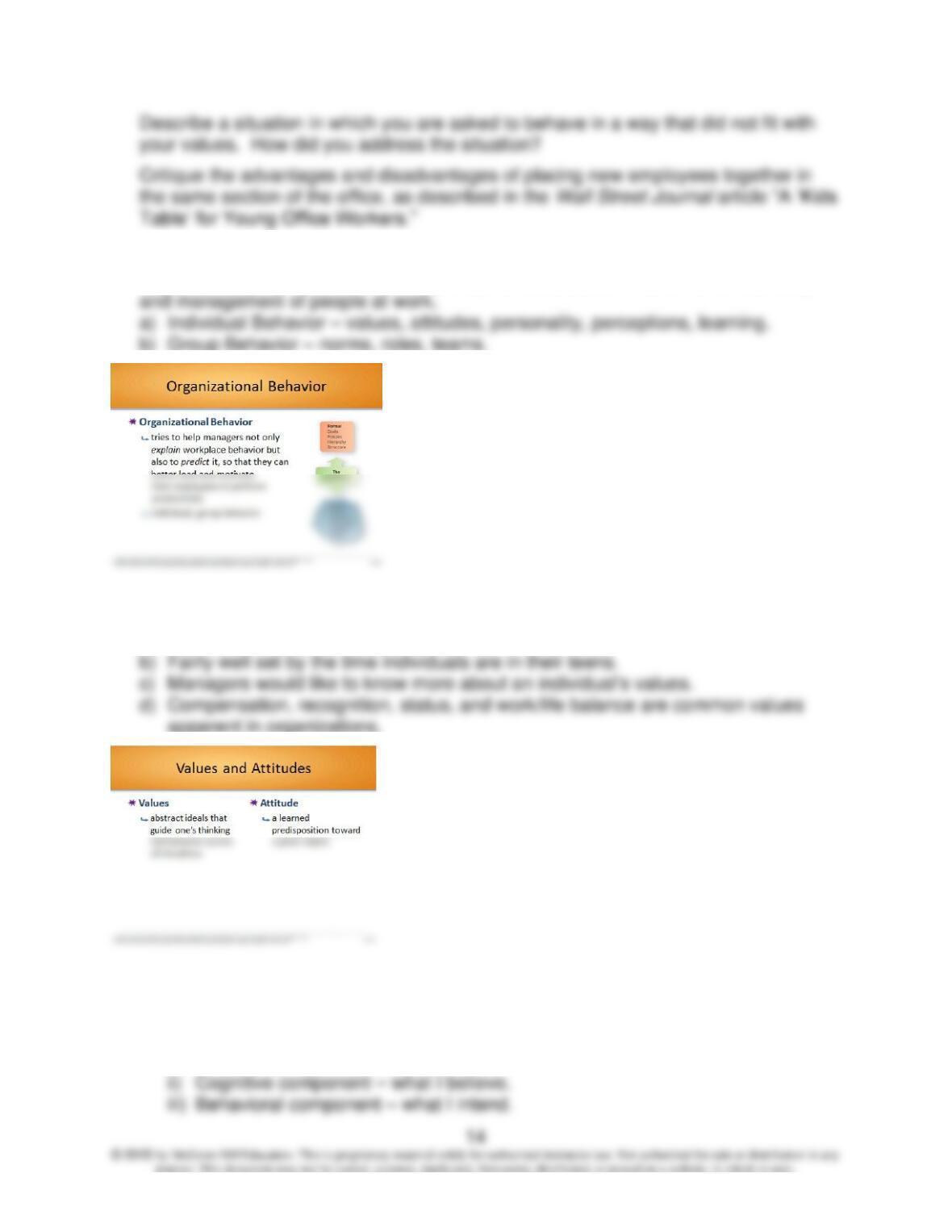
Section 11.2 highlights the idea that organizational behavior (OB) is the field of study
which tries to explain and predict workplace behavior. OB looks at two areas: Individual
Behavior and Group Behavior. Individual Behavior consists of values, attitudes, and
behaviors. Values are the abstract ideals that guide an individual’s thinking and
behavior. While values are abstract and consistent, attitudes are considered to be
ProQuest Document ID: 1678495870
Possible Topics for Discussion:
Assume in a job interview that the interviewer asks you to describe your workplace
values. How would you answer the question?
11.2 Values, Attitudes, & Behaviors (pp. 344-347)
How do the hidden aspects of individuals – their values and attitudes –
affect employee behavior?
Chapter 11 – Managing Individual Differences and Behavior: Supervising People as People
Major Idea Outline:
1) Organizational Behavior – interdisciplinary field dedicated to better understanding
2) Values – abstract ideals that guide one’s thinking and behavior across all situations
a) These present as lifelong patterns.
3) Attitudes – a learned predisposition toward a given object.
a) Attitudes directly influence our behavior
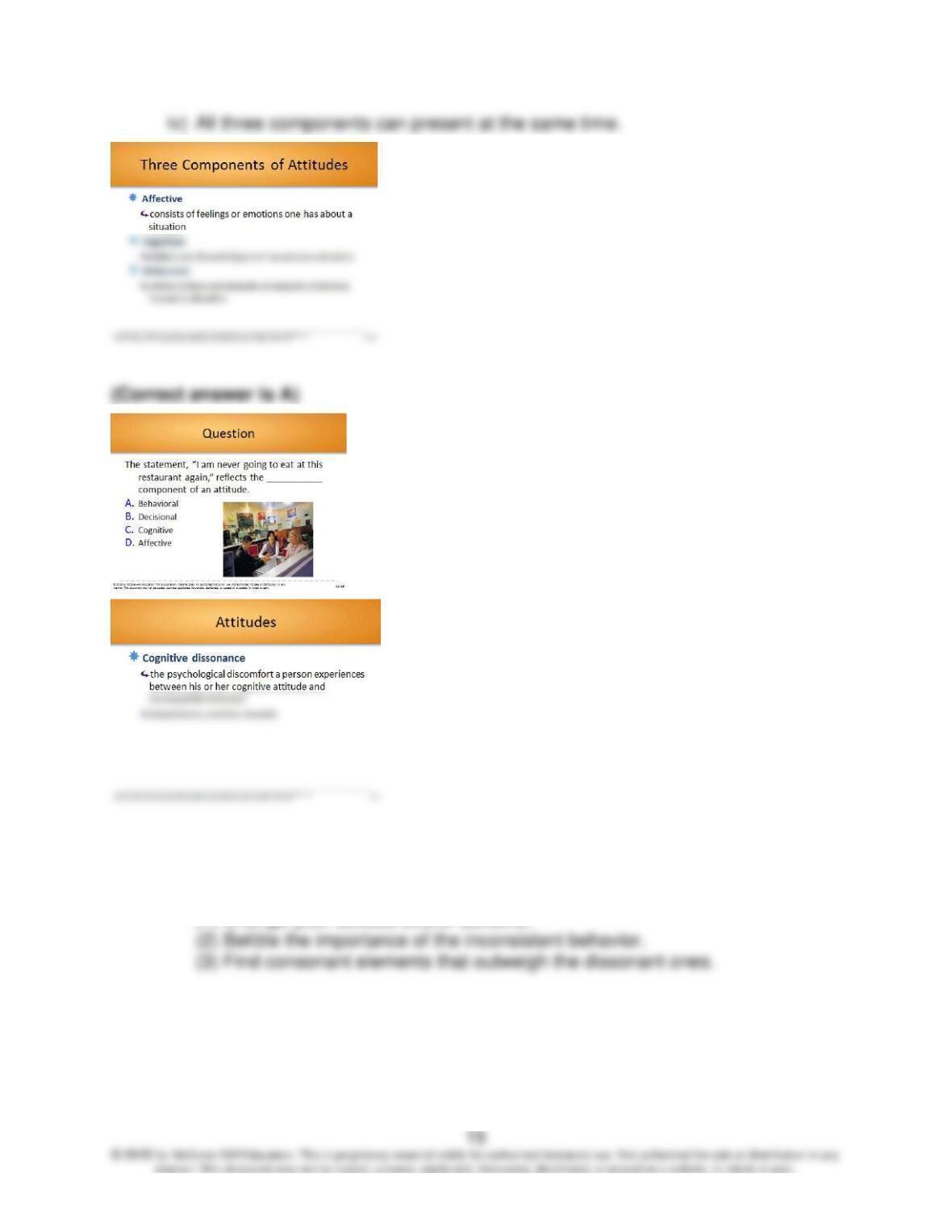
b) Three components of attitudes:
i) Affective component – what I feel.
Chapter 11 – Managing Individual Differences and Behavior: Supervising People as People
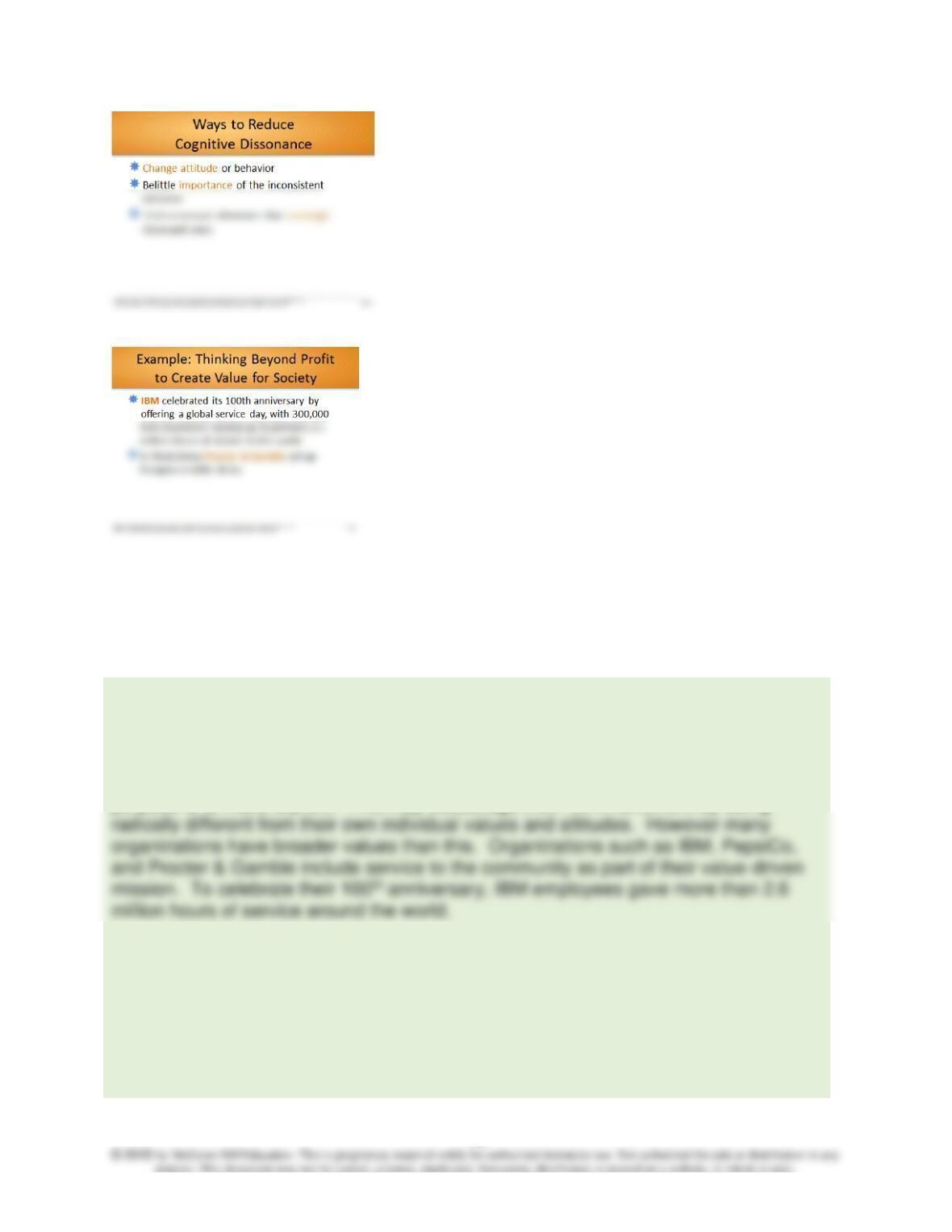
c) Cognitive Dissonance – psychological discomfort a person experiences between
his or her cognitive attitude and incompatible behavior.
i) People must reduce dissonance.
(1) Change your attitude and/or behavior.
Chapter 11 – Managing Individual Differences and Behavior: Supervising People as People
16
4) Behavior
a) Values and attitudes are generally in harmony – but not always.
b) Values and attitudes influence people’s workplace behavior.
Interactive Classroom Material:
EXAMPLE: How Values & Attitudes Affect Behavior: Thinking Beyond Profit to
Create Value for Society (p. 347)
This example describes how at times employees could think that a company’s sole
purpose is to make a profit. This may discourage their full involvement by being
YOUR CALL
Where do you think the inspiration for giving a firm a motivating purpose and
values beyond making money should come from? Does it come from a
company’s leaders? Do you think it could begin as voluntary activity, as with
employees finding each other through company chat rooms and sharing ideas
in their free time?
This example demonstrates the importance of aligning individual values with
Chapter 11 – Managing Individual Differences and Behavior: Supervising People as People
17
Additional Activities:
One way that you could build on this Example is to profile Keller Williams Realty’s
annual day of service, RED Day. On RED Day, which stands for Renew, Energize
and Donate, the firm’s employees spend the day serving worthy organizations and
Describe the advantages and possible disadvantages of companies organizing
sponsored employee service days such as Keller Williams’ RED Day.
If you were responsible for coordinating an event similar to Keller Williams’ RED
Day, what types of projects would you find rewarding?
This section of the chapter introduces students to the perceptual process and the four
causes for distortion in this process. Individual perceptions can be distorted through
stereotyping. These stereotypes, while strong, can be dismantled through objective
data. The “halo effect” also distorts our perceptions when individuals build perceptions
based on one characteristic only. All traits of an individual must be considered to make
11.3 Perception & Individual Behavior (pp. 348 – 352)
What are the distortions in perception that can cloud one’s judgment?
Chapter 11 – Managing Individual Differences and Behavior: Supervising People as People
18
One way that you could begin your coverage of these topics is to conduct an exercise
similar to the one profiled in the Harvard Business Review article “We Can’t Recall
Logos We See Every Day.” This article from the June 2015 edition discusses how more
than 100 students were asked to draw the Apple logo from memory. Despite the fact
that most of the students believed they could accurately draw the logo, only one person
Possible Topics for Discussion:
• Assume it is time for you to give your annual performance review to one of your
employees who failed to achieve his performance goals for the year. How will
you determine the root cause for the employee’s performance deficiencies?
Major Idea Outline:
1) The Four Steps in the Perceptual Process
a) Perception – the process of interpreting and understanding one’s environment.
i) Selective attention.
Chapter 11 – Managing Individual Differences and Behavior: Supervising People as People
2) Four Distortions in Perception
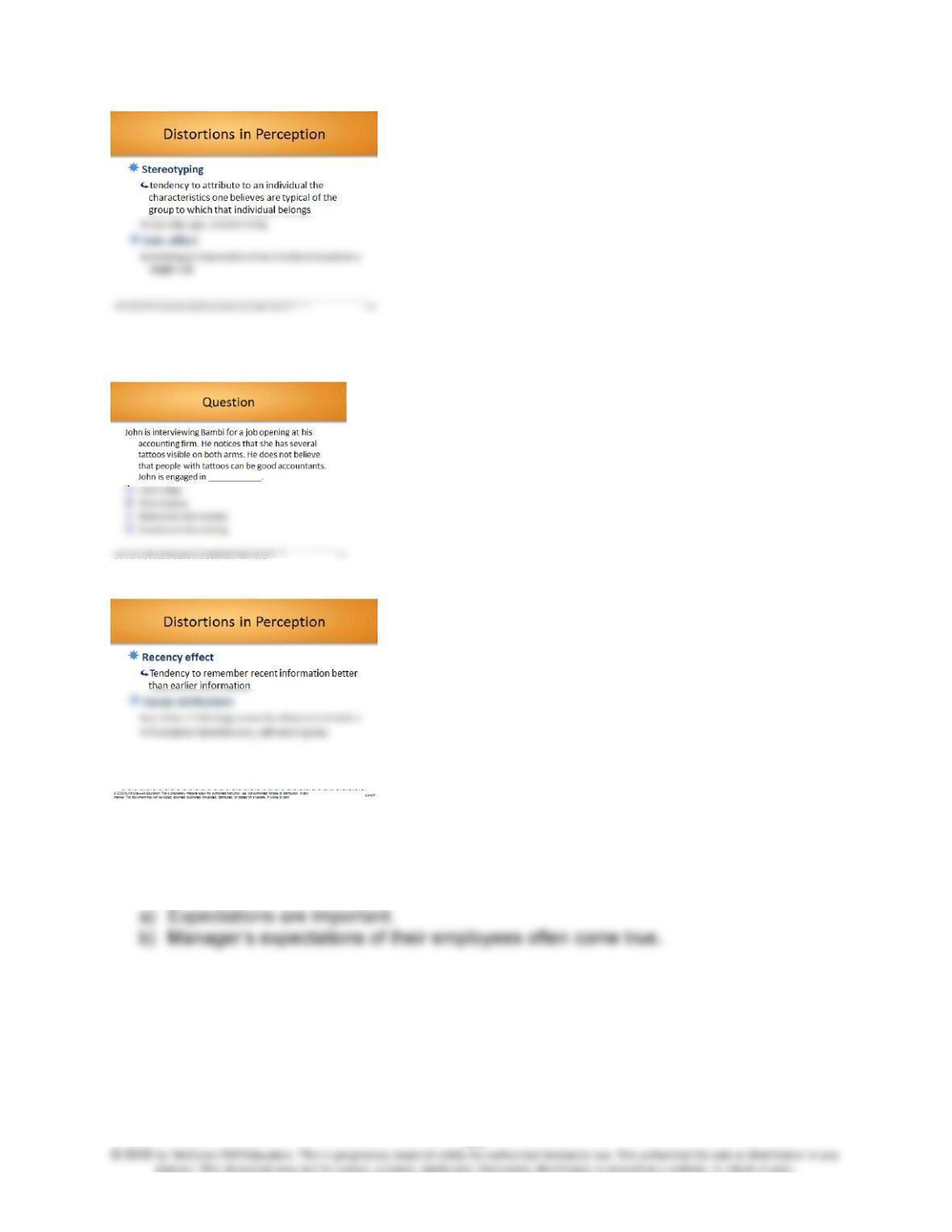
a) Stereotyping – the tendency to attribute to an individual the characteristics one
believes are typical of the group to which that individual belongs.
i) Sex-role stereotyping – differing traits make each gender well suited for
different roles.
American managers in the United States.
b) Halo Effect – perceptions are formed based on one single trait.
i) Physically attractive people are impacted by the halo effect.
Chapter 11 – Managing Individual Differences and Behavior: Supervising People as People
20
(Correct answer is B)
3) The Self-Fulfilling Prophecy, or Pygmalion Effect – the phenomenon in which
people’s expectations of themselves or others lead them to behave in ways that
make those expectations come true.