11-96 CHAPTER 11: GRAPHING AND OPTIMIZATION
Step 2:
x
x
35. lim
x
x
2
e
x
Step 1:
lim
x e4x = ∞ and lim
x x2 = ∞. Therefore, L’Hôpital’s rule applies.
Step 2:
x
x
4
x
4
x
4
x
Step 3:
x
4
x
4
x
4
x
36. 0
lim
x2
2
xx
ee
x
Step 1:
Step 2:
x
x
Step 3:
x
x
x
x
00
x2
x
37.
0
lim
x
11x
x
Step 1:
lim
11x = 0 and
lim
x
= 0.
CHAPTER 11 REVIEW 11-97
Step 2:
x
lim
11
x
Dx
=
lim
12
1(1 )
2
x
=
lim
x
0
x
x
38. lim
x 5
ln
x
x
Step 1:
Step 2:
x
x
x
ln
x
Dx
1
x
1
ln
x
39. lim
x
ln(1 6 )
ln(1 3 )
x
x
Step 1:
Step 2:
x
x
x
x
6
Step 3:
x
x
(2[1 3 ])
x
Dx
(2 6 )
x
Dx
6
40. 0
lim
x
ln(1 6 )
ln(1 3 )
x
x
Step 1:
lim
lim
11-98 CHAPTER 11: GRAPHING AND OPTIMIZATION
Step 2:
x
lim
x
Dx
lim
6
16
x
x
= 0
lim
x
x
x
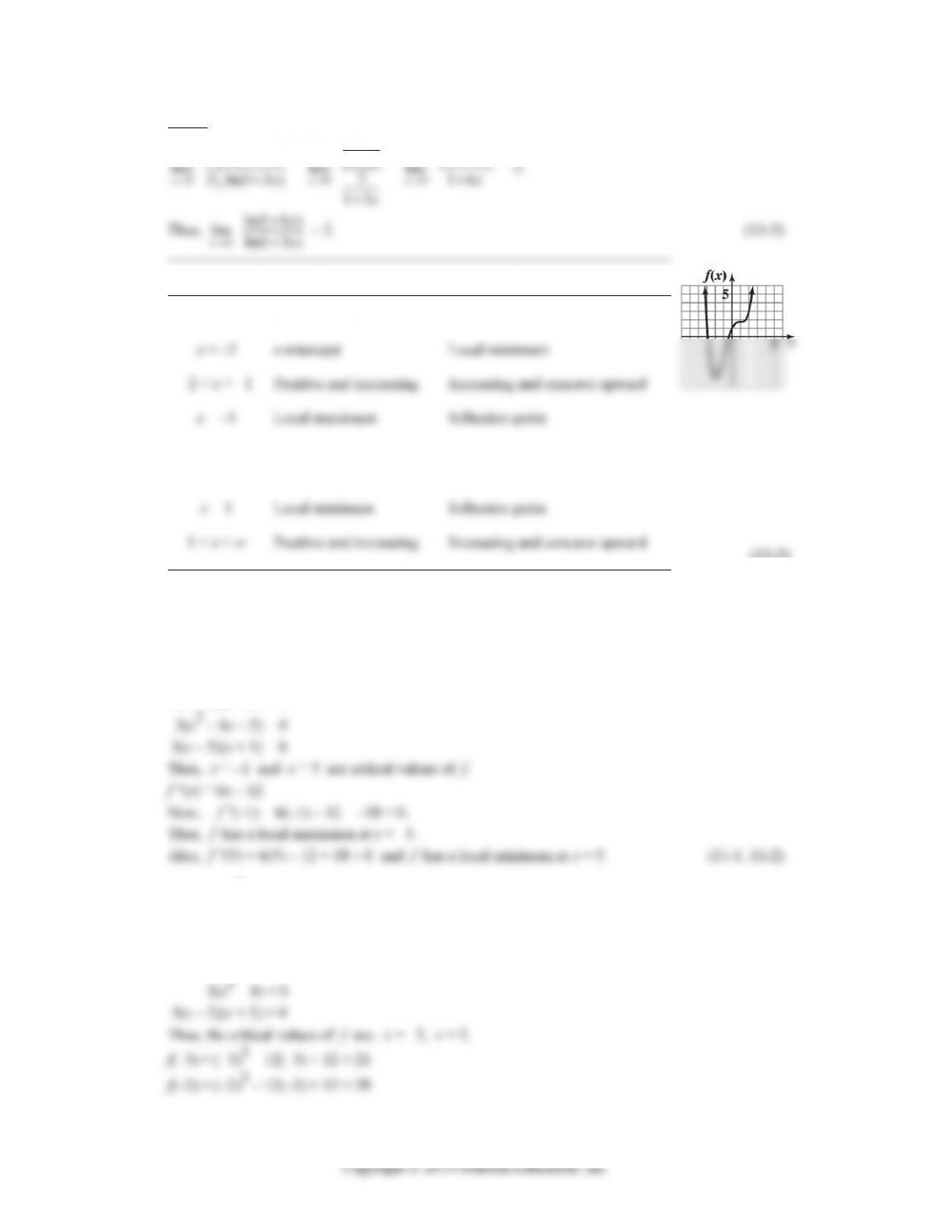
41. x f ‘ (x) f(x)
(11-2)
–∞ < x < –2 Negative and increasing Decreasing and concave upward
–1 < x < 1 Positive and decreasing Increasing and concave
downward
42. The graph in (C) could be the graph of y = f ‘ (x) . (11-2)
43. f(x) = x3 – 6x2 – 15x + 12
f ‘ (x) = 3x2 – 12x – 15
Critical values: f ‘ is defined for all x:
3x2 – 12x – 15 = 0
44. y = f(x) = x3 – 12x + 12, –3 ≤ x ≤ 5
f ‘ (x) = 3x2 – 12
Critical values: f ‘ is defined for all x:
3x2 – 12 = 0
CHAPTER 11 REVIEW 11-99
Copyright © 2019 Pearson Education, Inc.
f(2) = 23 – 12(2) + 12 = –4 Absolute minimum
f(5) = 53 – 12(5) + 12 = 77 Absolute maximum (11-5)
45. y = f(x) = x2 + 2
16
x
, x > 0
32
4
232x
=
4
2( 16)x
=
2
2( 2)( 2)( 4)xxx
x
46. f(x) = 11x – 2x ln x, x > 0
f ‘ (x) = 11 – 2x1
x
– (ln x)(2) = 11 – 2 – 2 ln x = 9 – 2 ln x, x > 0
Critical value(s):
9 – 2 ln x = 0
x
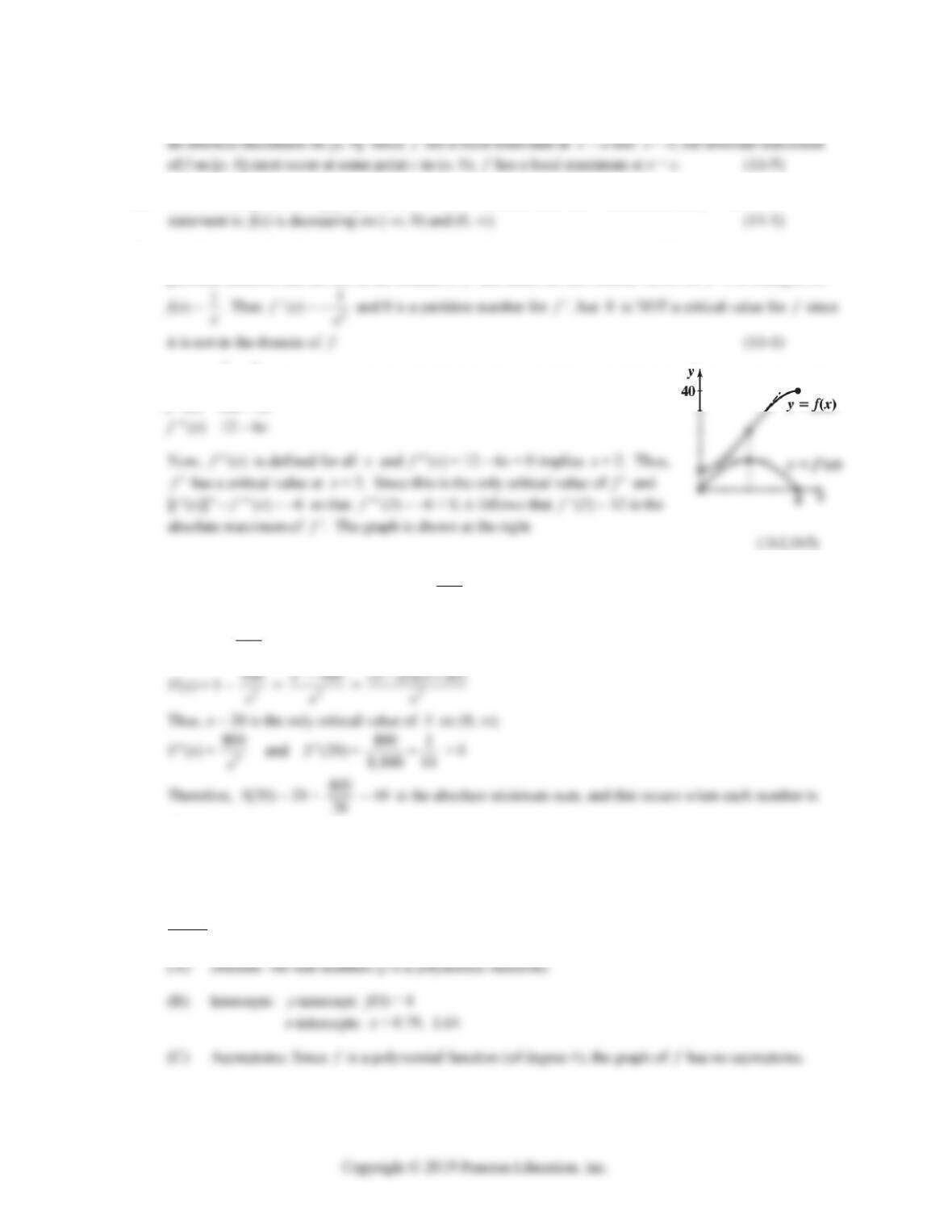
Since x = e9/2 is the only critical value, and f ‘ ‘ (e9/2) < 0, f has an absolute maximum at x = e9/2. The
47. f(x) = 10xe–2x, x > 0
f ‘ (x) = 10xe–2x(–2) + 10e–2x(1) = 10e–2x(1 – 2x), x > 0
Critical value(s):
10e–2x(1 – 2x) = 0
2
Since x = 1
2 is the only critical value, and f ‘ ‘ 1
2
= –20e–1 < 0, f has an absolute maximum at x = 1
2.
2
2
x
11-100 CHAPTER 11: GRAPHING AND OPTIMIZATION
48. Yes. Consider f on the interval [a, b]. Since f is a polynomial, f is continuous on [a, b]. Therefore, f has
49. No, increasing/decreasing properties are stated in terms of intervals in the domain of f. A correct
50. A critical value for f is a partition number for f ‘ that is also in the domain of f. However, f ‘ may have
partition numbers that are not in the domain of f and hence are not critical values for f. For example, let
x
1
51. f(x) = 6x2 – x3 + 8, 0 ≤ x ≤ 4
f ‘ (x) = 12x – 3x2
52. Let x > 0 be one of the numbers. Then y = 400
x
is the other number. Now, we have:
S(x) = x + 400
x
, x > 0,
400
x
2
400x
= 2
( 20)( 20)xx
x
20.
(11-6)
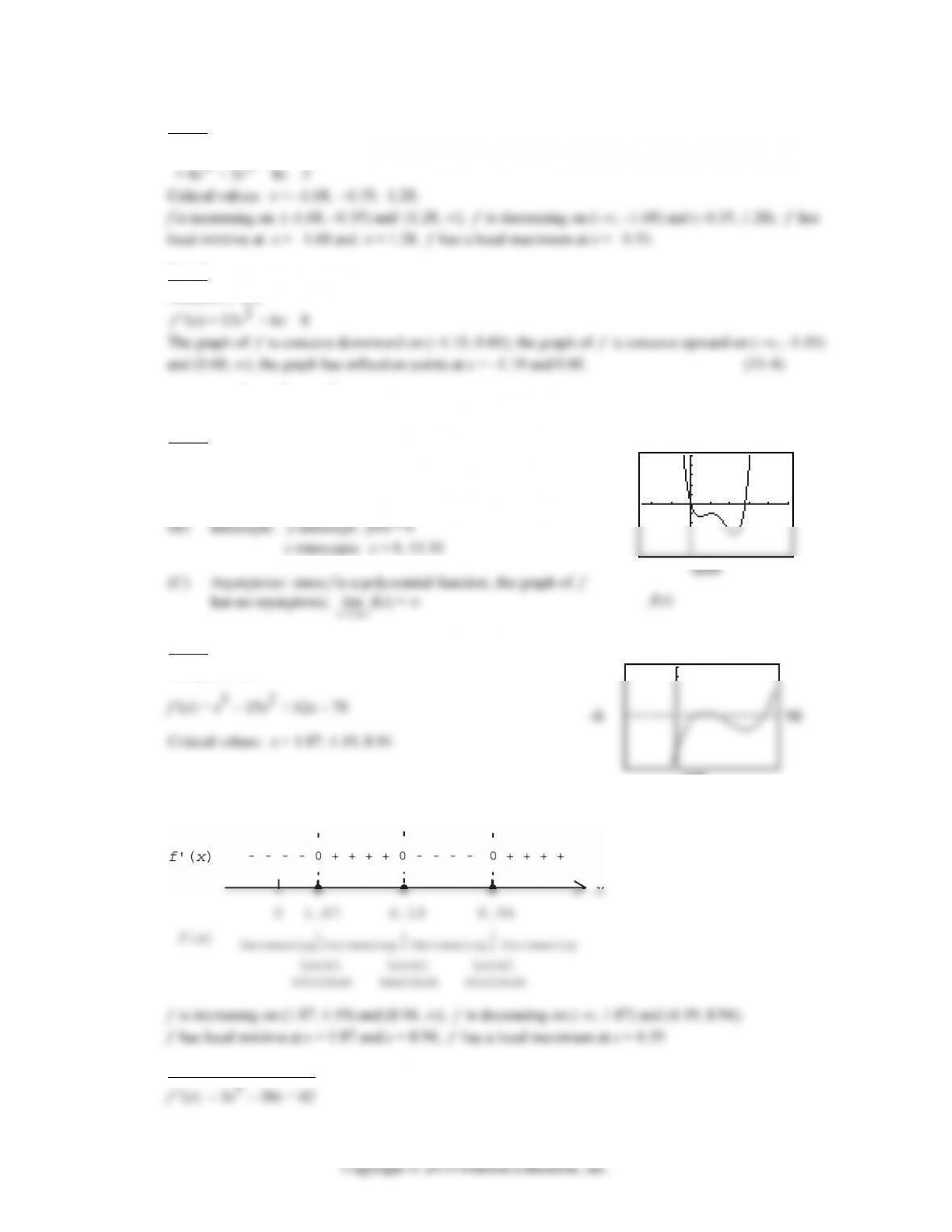
53. f(x) = x4 + x3 – 4x2 – 3x + 4.
Step 1:
Analyze f(x):
CHAPTER 11 REVIEW 11-101
Step 2:
Analyze f ‘(x):
Step 3:
Analyze f ‘ ‘ (x):
54. f(x) = 0.25x4 – 5x3 + 31x2 – 70x
Step 1:
Analyze f(x):
(A) Domain: all real numbers
200
20
-10
Step 2:
Analyze f ‘‘(x):
100
-100
Sign chart for f ‘‘ :
Step 3. Analyze f ‘ ‘ (x):
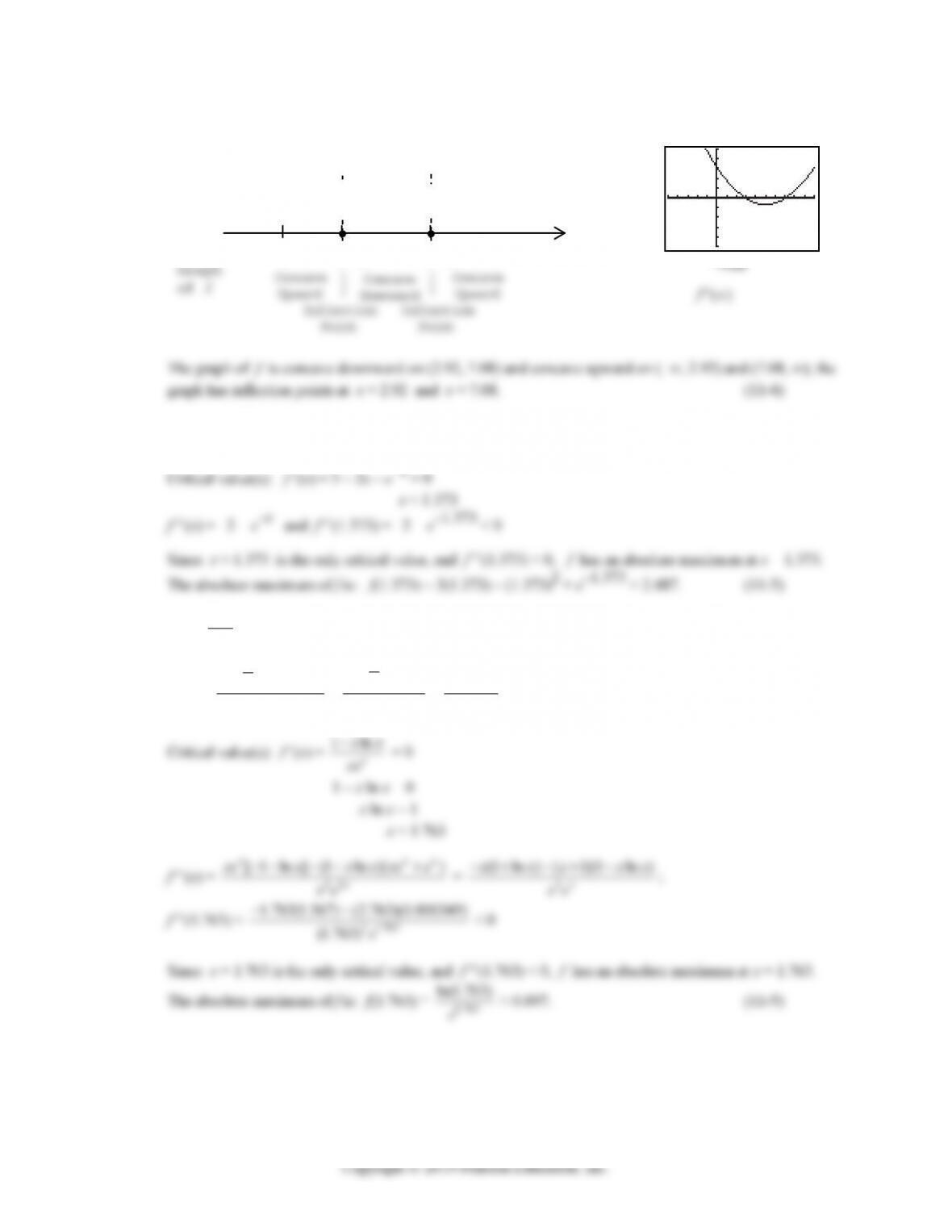
11-102 CHAPTER 11: GRAPHING AND OPTIMIZATION
Partition numbers for f ‘ ‘ : x ≈ 2.92, 7.08
Sign chart for f ‘ ‘ :
x
f“(x)
0 2.92 7.08
+ + + + 0 – – – – 0 + + + +
100
10
-5
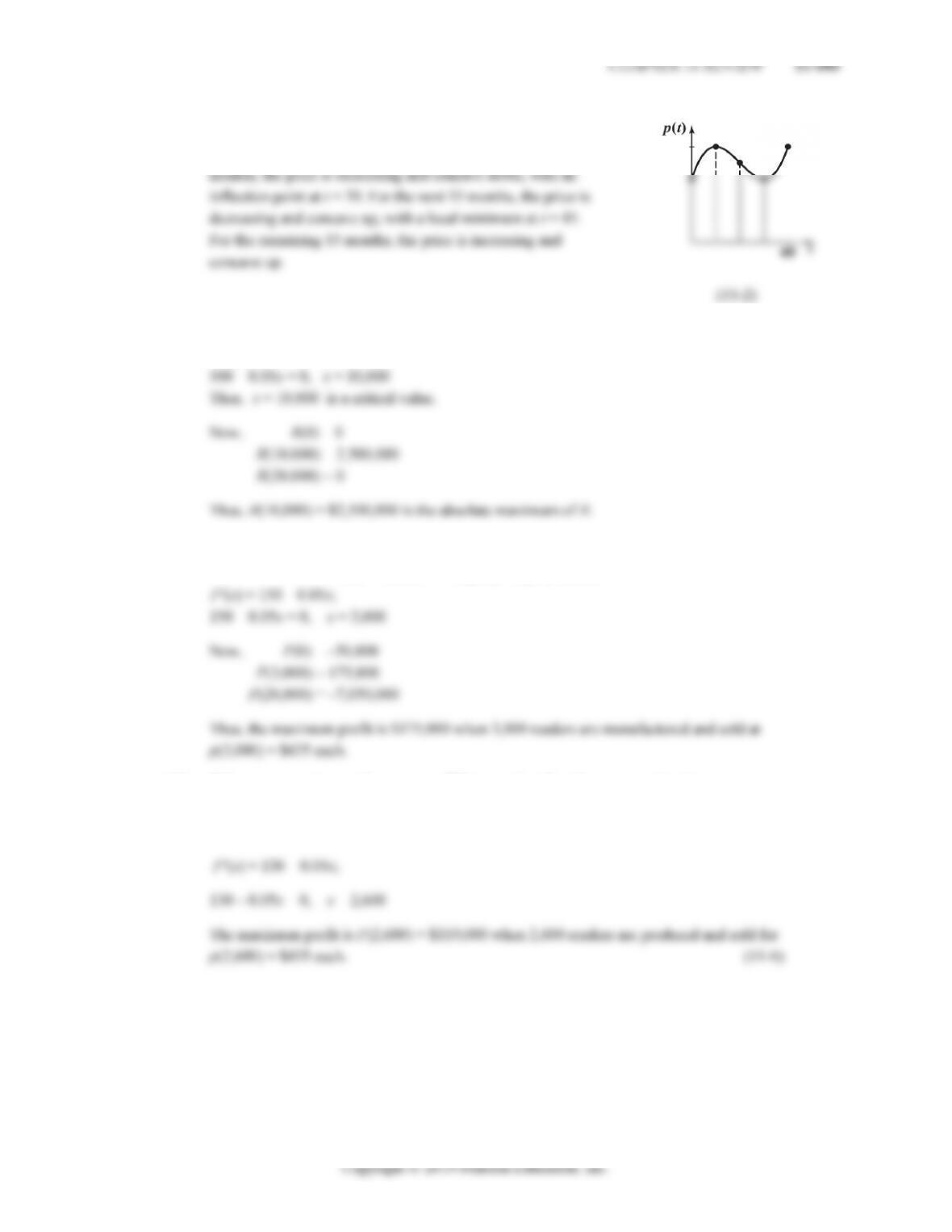
55. f(x) = 3x – x2 + e–x, x > 0
f ‘ (x) = 3 – 2x – e–x, x > 0
56. f(x) = ln
x
x
e, x > 0
f ‘ (x) = 2
1(ln )
()
x
x
x
exe
x
e
= 2
1ln
x
x
ex
x
e
= 1ln
x
x
x
xe
, x > 0
x
x
11-104 CHAPTER 11: GRAPHING AND OPTIMIZATION
59. $5/ft
$15/ft
$5/ft
$5/ft
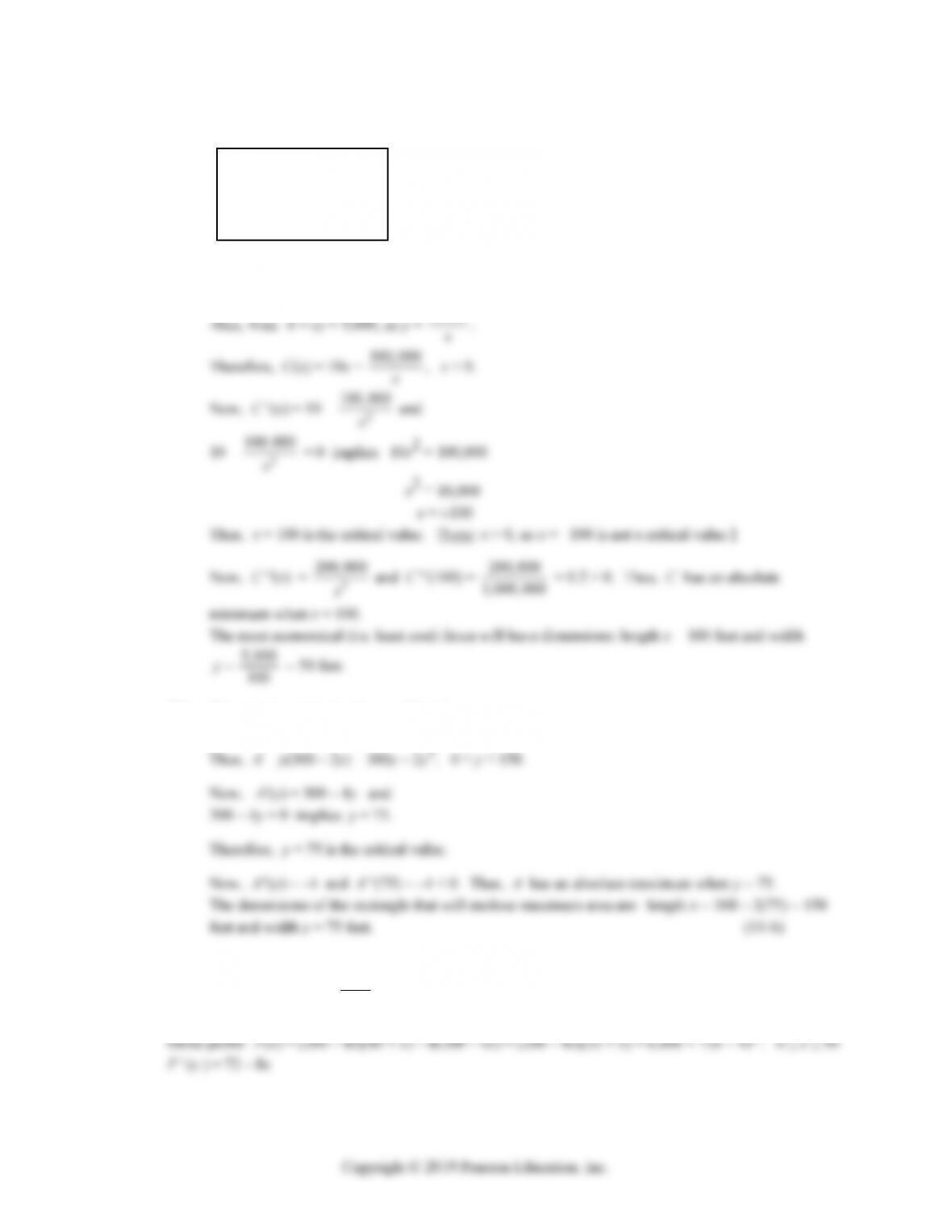
Let x be the length and y the width of the
rectangle.
(A) C(x, y) = 5x + 5x + 5y + 15y = 10x + 20y
(B) We want to maximize A = xy subject to
C(x, y) = 10x + 20y = 3,000 or x = 300 – 2y
60. Let x = the number of dollars increase in the nightly rate, x ≥ 0. Then 200 – 4x rooms will be rented at
(40 + x) dollars per room. [Note: Since 200 – 4x ≥ 0, x ≤ 50.] The cost of service for 200 – 4x rooms at
$8 per room is 8(200 – 4x). Thus:
CHAPTER 11 REVIEW 11-105
Critical value:
72 – 8x = 0, x = 9
61. Let x = number of times the company should order. Then, the number of boxes per order = 7, 200
x
.
The average number of unsold boxes is given by:
7, 200
2
x
= 3, 600
x
x
x
x
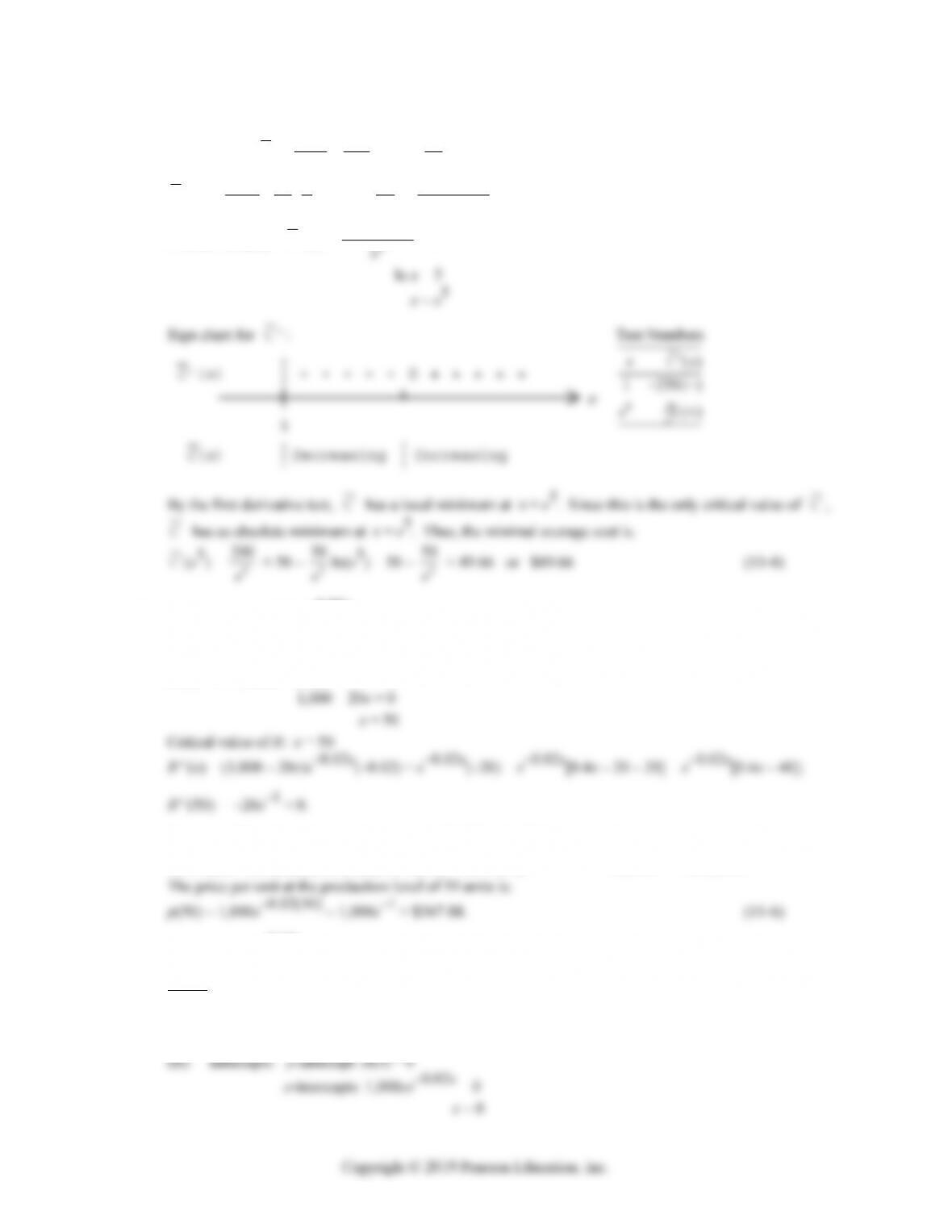
62. C(x) = 4,000 + 10x + 0.1x2, x > 0
Average cost = C(x) = 4, 000
x
+ 10 + 0.1x
x
C′′ (x) = 3
8, 000
x
> 0 on (0, ∞).
11-106 CHAPTER 11: GRAPHING AND OPTIMIZATION
63. Cost: C(x) = 200 + 50x – 50 ln x, x ≥ 1
Average cost: C = () 200Cx
x
x
+ 50 – 50
x
ln x, x ≥ 1
C′(x) = 2
200 50 1
x
x
x
+ (ln x)2
50
x
= 2
50(ln 5)x
x
, x ≥ 1
Critical value(s): C′(x) = 2
50(ln 5)x
= 0
x
64. R(x) = xp(x) = 1,000xe–0.02x
R′ (x) = 1,000x · e–0.02x (–0.02) + 1,000e–0.02x = (1,000 – 20x)e–0.02x
R′ (x) = 0: (1,000 – 20x)e–0.02x = 0
Since x = 50 is the only critical value and R′ ′ (50) < 0, R has an absolute maximum at a production level
of 50 units. The maximum revenue is R(50) = 1,000(50)e–0.02(50) = 50,000e–1 ≈ $18,394.
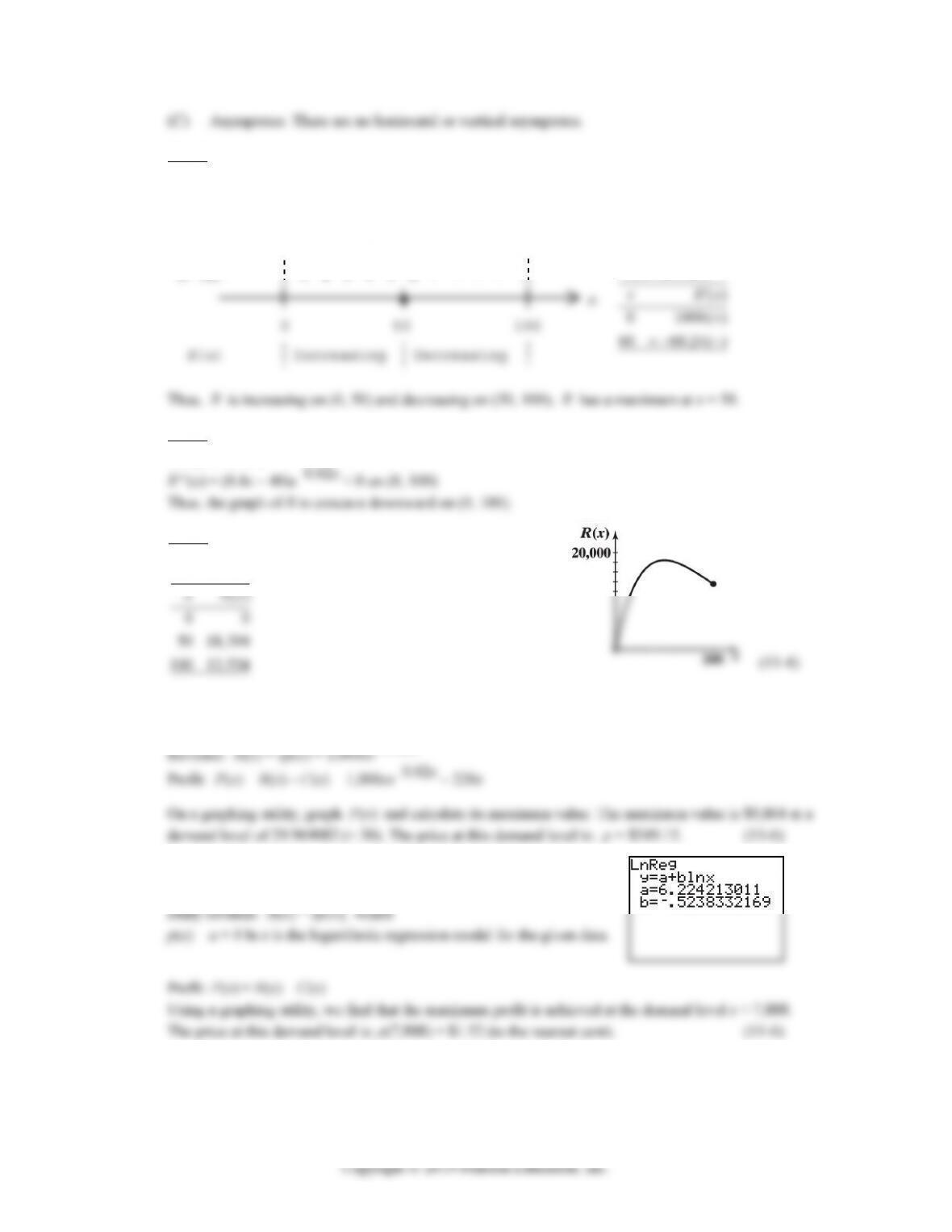
65. R(x) = 1,000xe–0.02x, 0 ≤ x ≤ 100
Step 1:
Analyze R(x):
(A) Domain: 0 ≤ x ≤ 100 or [0, 100]
CHAPTER 11 REVIEW 11-107
Copyright © 2019 Pearson Education, Inc.
(C)Asymptotes: There are no horizontal or vertical asymptotes.
Step 2:
Analyze R′ (x):
R′ (x) = (1,000 – 20x)e–0.02x and x = 50 is a critical value.
Sign chart for R′ :
R‘(x)+ + + + + 0 – – – – –
Test Numbers
Step 3:
Analyze R′ ′ (x):
Step 4:
Sketch the graph of R:
66. Cost: C(x) = 220x
Price-demand equation: p(x) = 1,000e–0.02x
67. Let x = the number of cream puffs.
Daily cost: C(x) = x (dollars)
11-108 CHAPTER 11: GRAPHING AND OPTIMIZATION
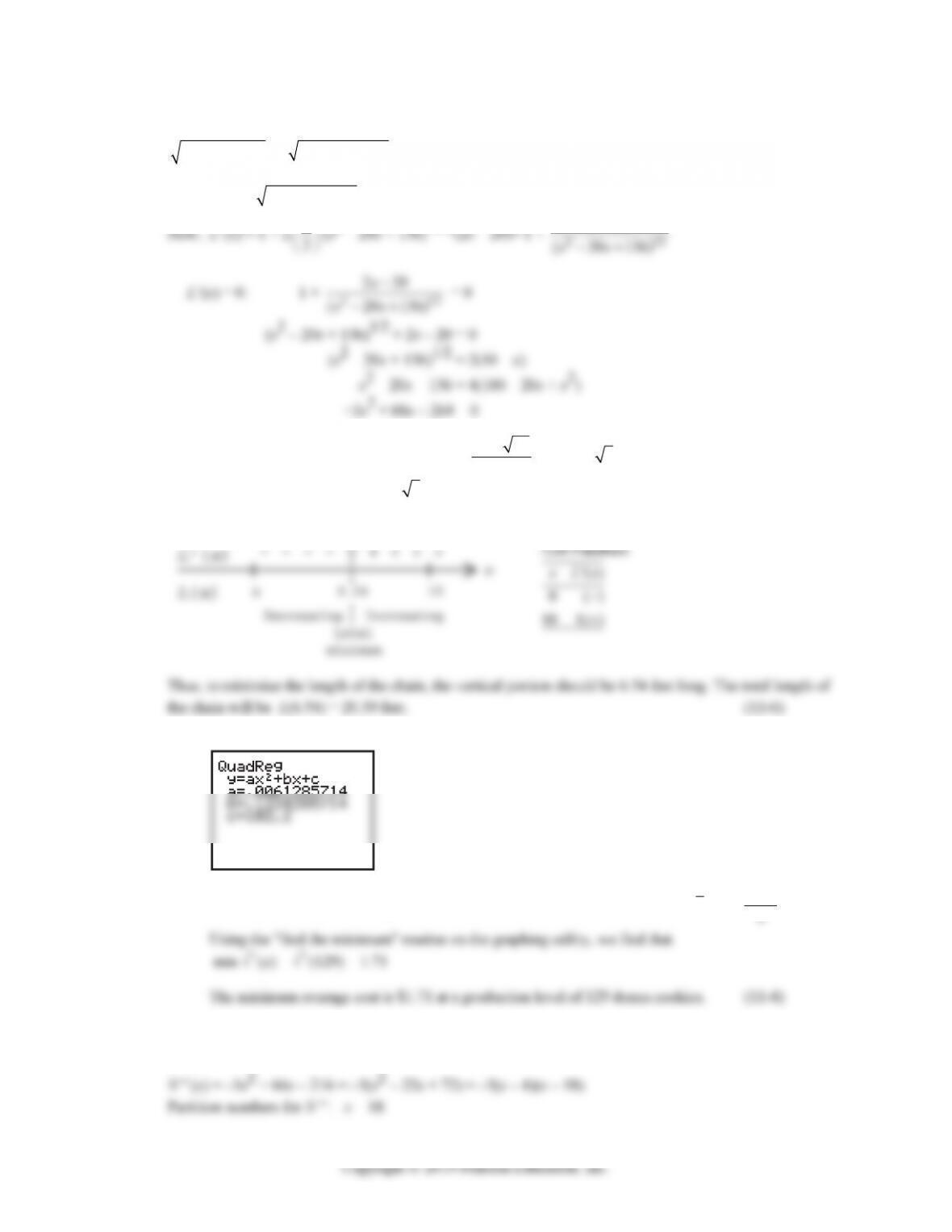
68. Let x be the length of the vertical portion of the chain. Then the length of each of the “arms” of the “Y” is
2
(10 ) 36x = 220 136xx. Thus, the total length is given by:
L(x) = x + 2 220 136xx, 0 ≤ x ≤ 10
220
x
x = 20 48
2
= 10 ± 2 3
Critical value (in (0, 10)): x = 10 – 2 3 ≈ 6.54
Sign chart for L′ (x) :
L‘(x)
L(x)
x
– – – – 0 + + + +
010
6.54
Test Numbers
‘( )
0()
x
Lx
69. (A)
(B) Let C(x) be the regression equation from part (A). The average cost function C(x) = ()Cx
x
.
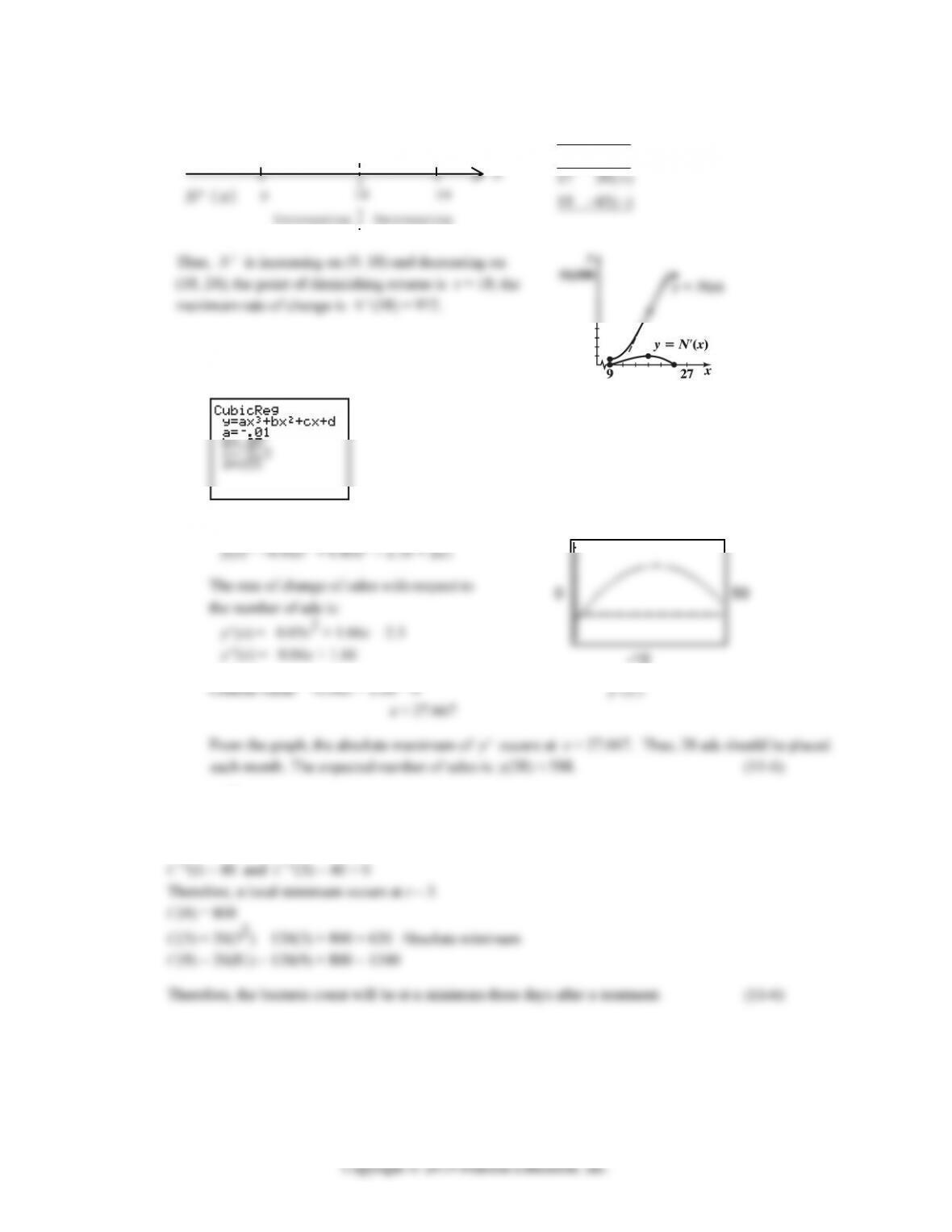
70. N(x) = –0.25x4 + 11x3 – 108x2 + 3,000, 9 ≤ x ≤ 24
N ′ (x) = –x3 + 33x2 – 216x
CHAPTER 11 REVIEW 11-109
Sign chart for N ′ ′ (x):
N“(x)
x
+ + + + 0 – – – –
Test Numbers
“( )
x
Nx
(11-2)
71. (A)
(B) The regression equation found in (A) is:
30
72. C(t) = 20t2 – 120t + 800, 0 ≤ t ≤ 9
C ′ (t) = 40t – 120 = 40(t – 3)
Critical value: t = 3
11-110 CHAPTER 11: GRAPHING AND OPTIMIZATION
73. N = 10 + 6t2 – t3, 0 ≤ t ≤ 5
Now, find the critical values of the rate function R(t):
R(t) = dN
dt = 12t – 3t2
2
dN
Critical value: t = 2
R′ ′ (t) = –6 and R′ ′ (2) = –6 < 0
Therefore, R(t) has an absolute maximum at t = 2. The rate of increase will be a maximum after two years.
(11-6)