11 GRAPHING AND OPTIMIZATION
EXERCISE 11–1
2. 3
() on (0, ):increasingmx x 4.
2
( ) on (0, ) : decreasingkx x
10. (b, c); (c, d); (f, g) 12. (a, b); (d, f); (g, h)
18. f has a local maximum at x = d, and a local minimum at x = b; f does not have a local extremum at x = a or
22. No local extremum; (h)
26. (3) 1f is a local minimum; (a)
28. (A)
22
3273 933 3fx x x x x
30. (A)
2
2
5
54
4
fx x
x
32. (A)
2/3
2/3
11
33
fx x
x
34. f(x) = 5x2 – 10x + 3
x
11-2 CHAPTER 11: GRAPHING AND OPTIMIZATION
Copyright © 2019 Pearson Education, Inc.
Therefore, f is decreasing on (–∞, 1) and increasing on (1, ∞); f has a local minimum at x = 1,
which is f(1) = – 8.
36. f(x) = –3x2 + 12x – 5
f ꞌ(x) = –6x + 12
f ꞌ is continuous for all x and
38. f(x) = –x3 – 2x – 5
40. 3
() 3 7fx x x
22
‘( ) 3 3 3(1 )
f
xx x which is continuous for all x.
f
42. 32
() 3 9 720 15fx x x x
2
EXERCISE 11-1 11-3
+ + + + + + +
f
‘( )
x
fx
44. 43
() 8 32fx x x
32
‘( ) 4 24
f
xx x which is continuous for all x.
46. () ( 2)
x
f
xxe
f
x
xx
30.0498e
at x = –3.
48. 21/3
() ( 4)fx x .
50. f(x) = 2x2 – 8x + 9
f ꞌ(x) = 4x – 8
f ꞌ is continuous for all x and
11-4 CHAPTER 11: GRAPHING AND OPTIMIZATION
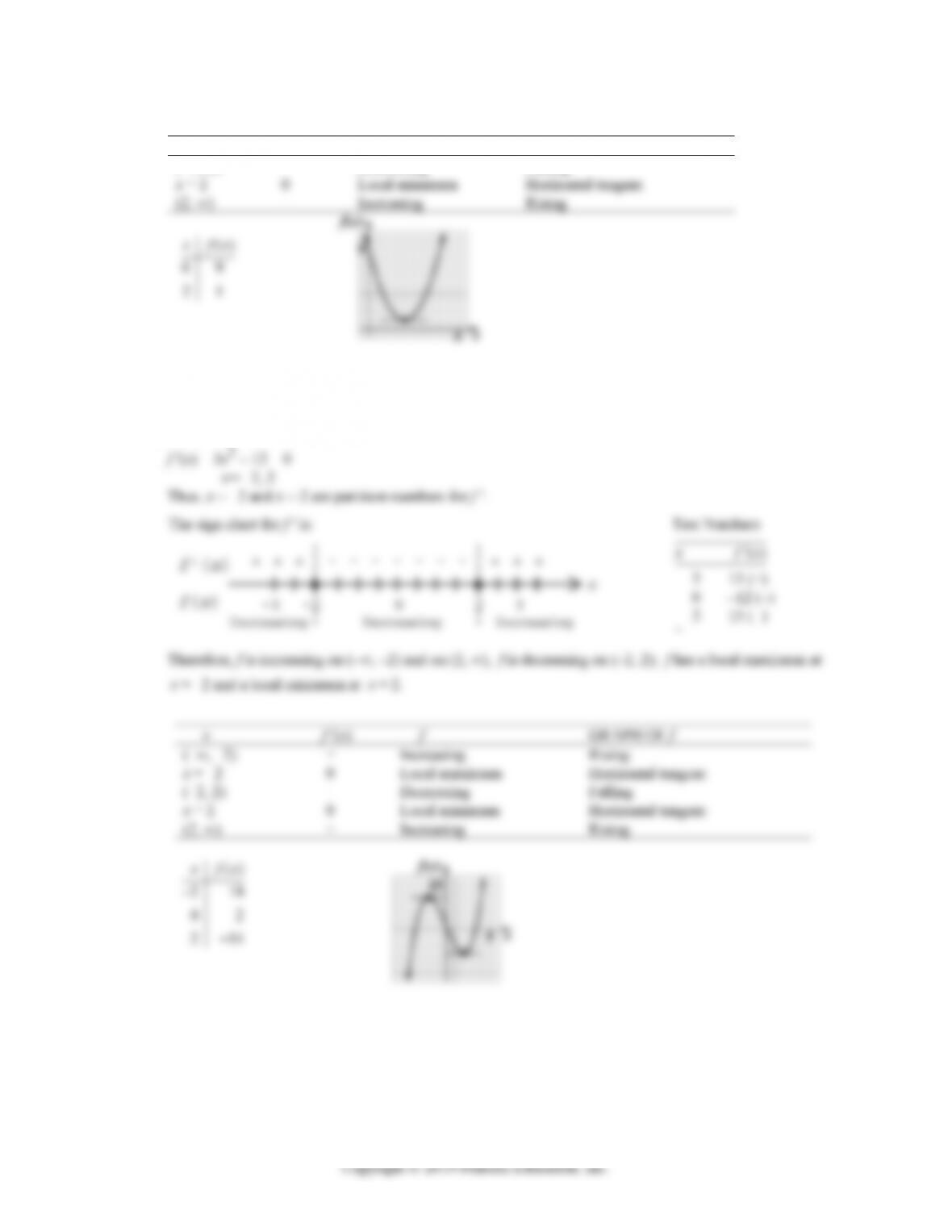
Therefore, f is decreasing on (–∞, 2) and increasing on (2, ∞); f has a local minimum at x = 2.
x f ′(x) f GRAPH OF f
(–∞, 2) – Decreasing Falling
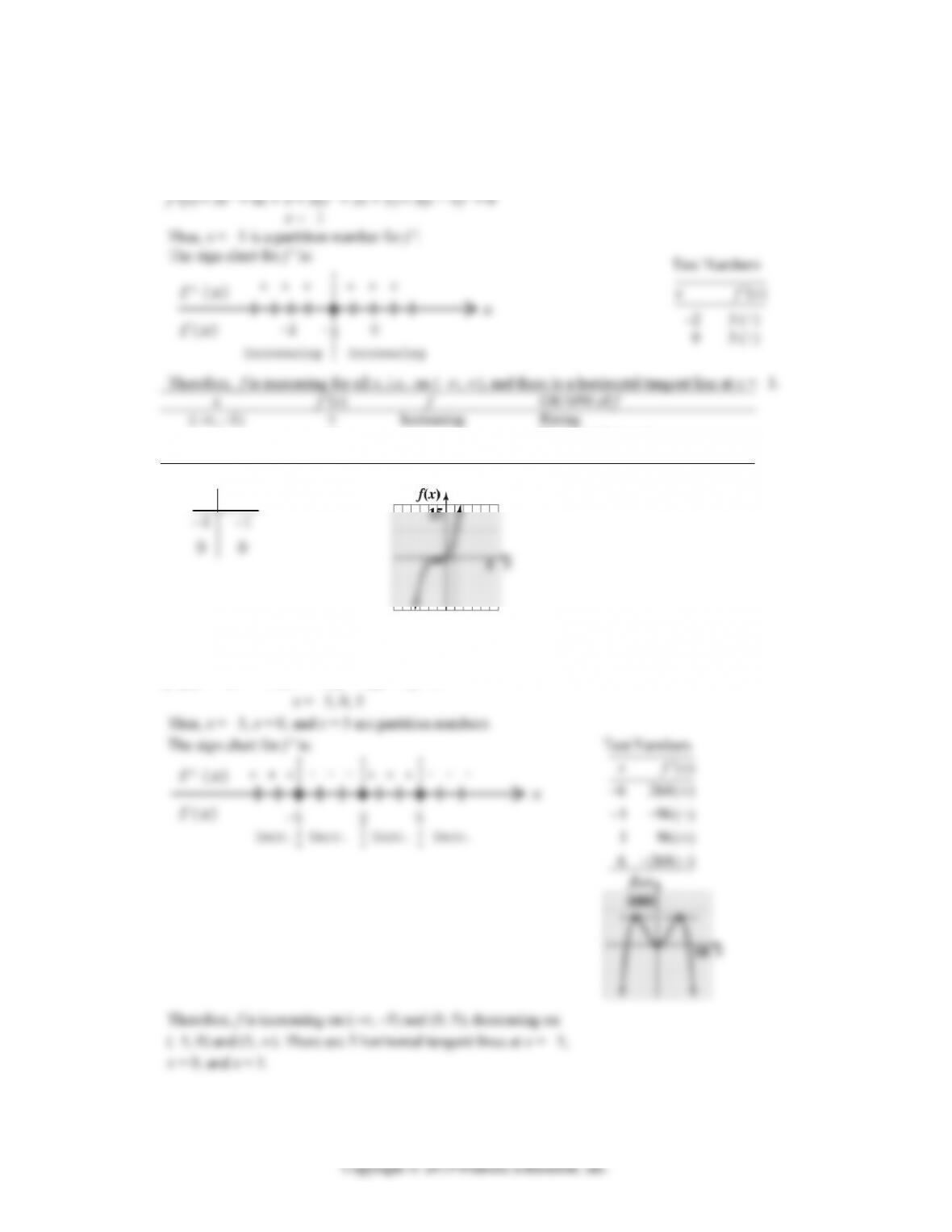
52. f(x) = x3 – 12x + 2
f ꞌ(x) = 3x2 – 12
f ꞌ is continuous for all x and
EXERCISE 11-1 11-5
54. f(x) = x3 + 3x2 + 3x
f ꞌ(x) = 3x2 + 6x + 3
f ꞌ is continuous for all x and
–1 0 Horizontal tangent
(–1, ∞) + Increasing Rising
()
x
fx
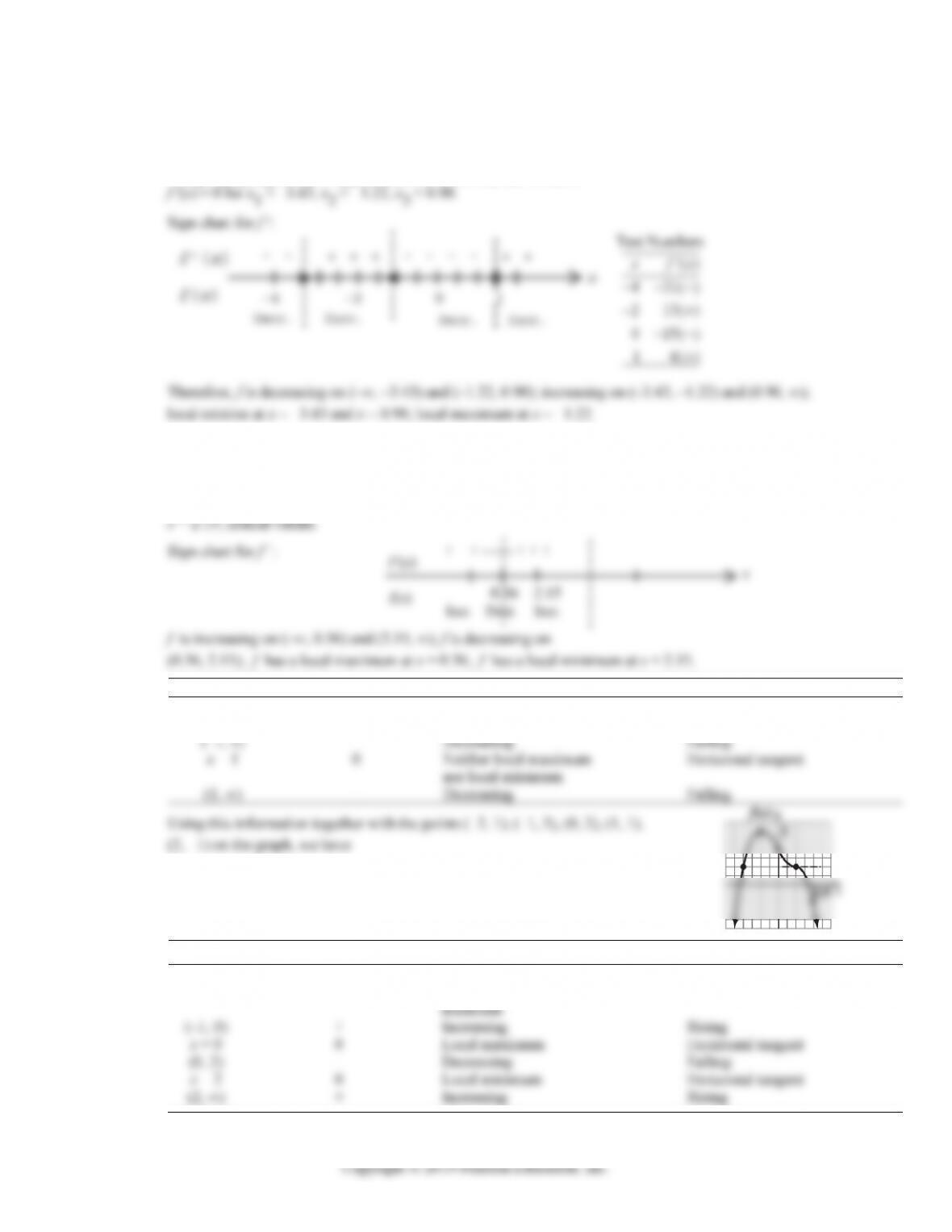
56. f(x) = –x4 + 50x2
f ꞌ(x) = –4x3 + 100x which is continuous for all x.
f ꞌ(x) = –4x3 + 100x = –4x(x – 5)(x + 5) = 0
11-6 CHAPTER 11: GRAPHING AND OPTIMIZATION
58. f(x) = x4 + 5x3 – 15x is a polynomial.
f ꞌ(x) = 4x3 + 15x2 – 15
Using a graphing utility to approximate the zeros of f ꞌ(x) we have:
≈ 0.90.
60. f(x) = ex – 2x2; domain of f: (–∞, ∞)
f ′(x) = ex – 4x; f’ is continuous for all x.
Using a root-approximation routine, f ′(x) = 0 at x = 0.36 and
62. x f ꞌ(x) f(x) GRAPH of f
(–∞, –1) + Increasing Rising
x = –1 0 Local maximum Horizontal tangent
64. x f ꞌ(x) f(x) Graph of f(x)
(–∞, –1)
x = –1
+
Not defined
Increasing
Neither local maximum nor local
Rising
Vertical tangent
EXERCISE 11-1 11-7
Copyright © 2019 Pearson Education, Inc.
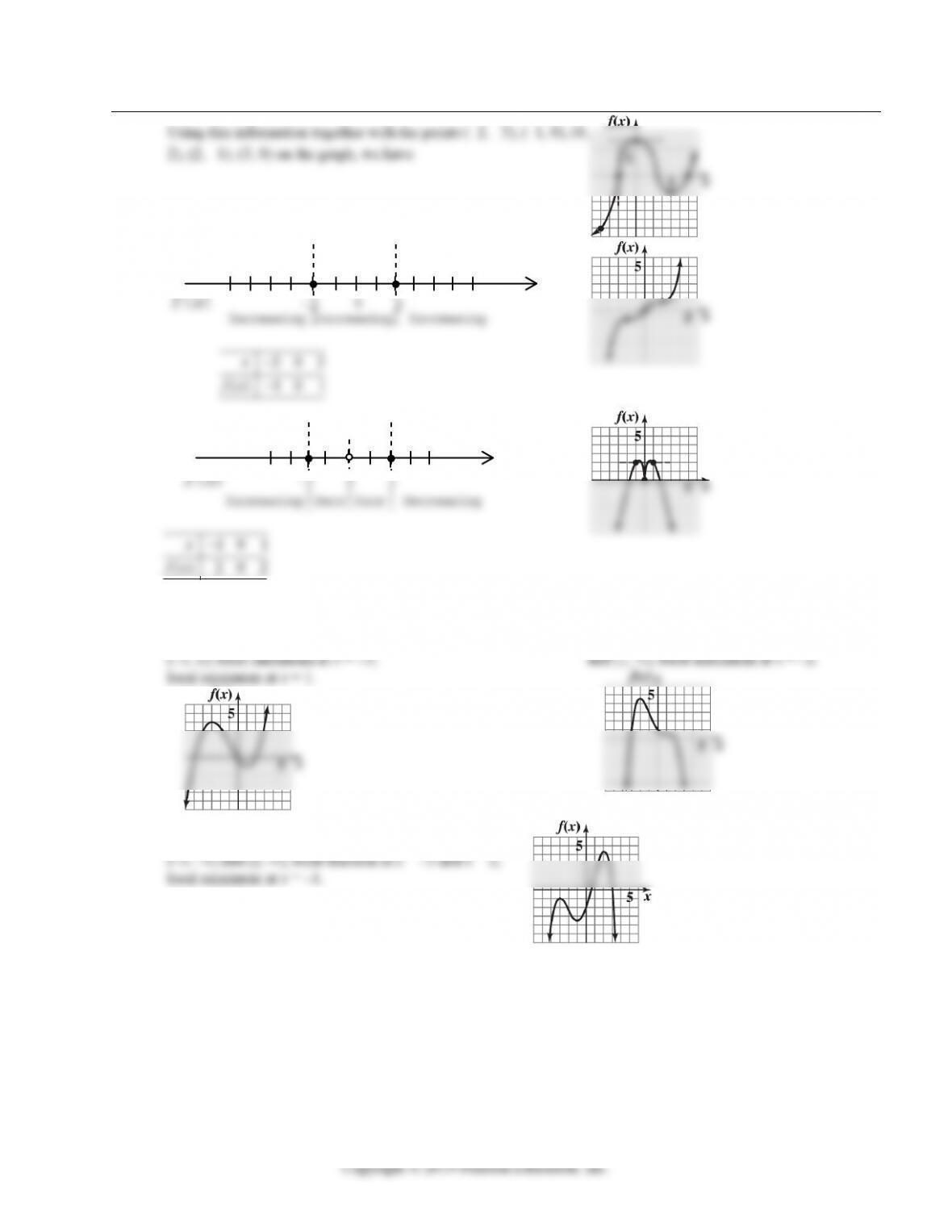
Using this information together with the points (–2, –3), (–1, 0), (0,
2), (2, –1), (3, 0) on the graph, we have
66. + + + + + + + + +
f‘(x)
x
68.
f‘(x)
x
+ + + – – + + – – –
ND
() 2 0 2
fx
70. 2
f
= g172. 4
f
= g374. 6
f
= g5
76. Increasing on (–∞, –3) and (1, ∞); decreasing on
78. Increasing on (–∞, –2); decreasing on (–2, 1)
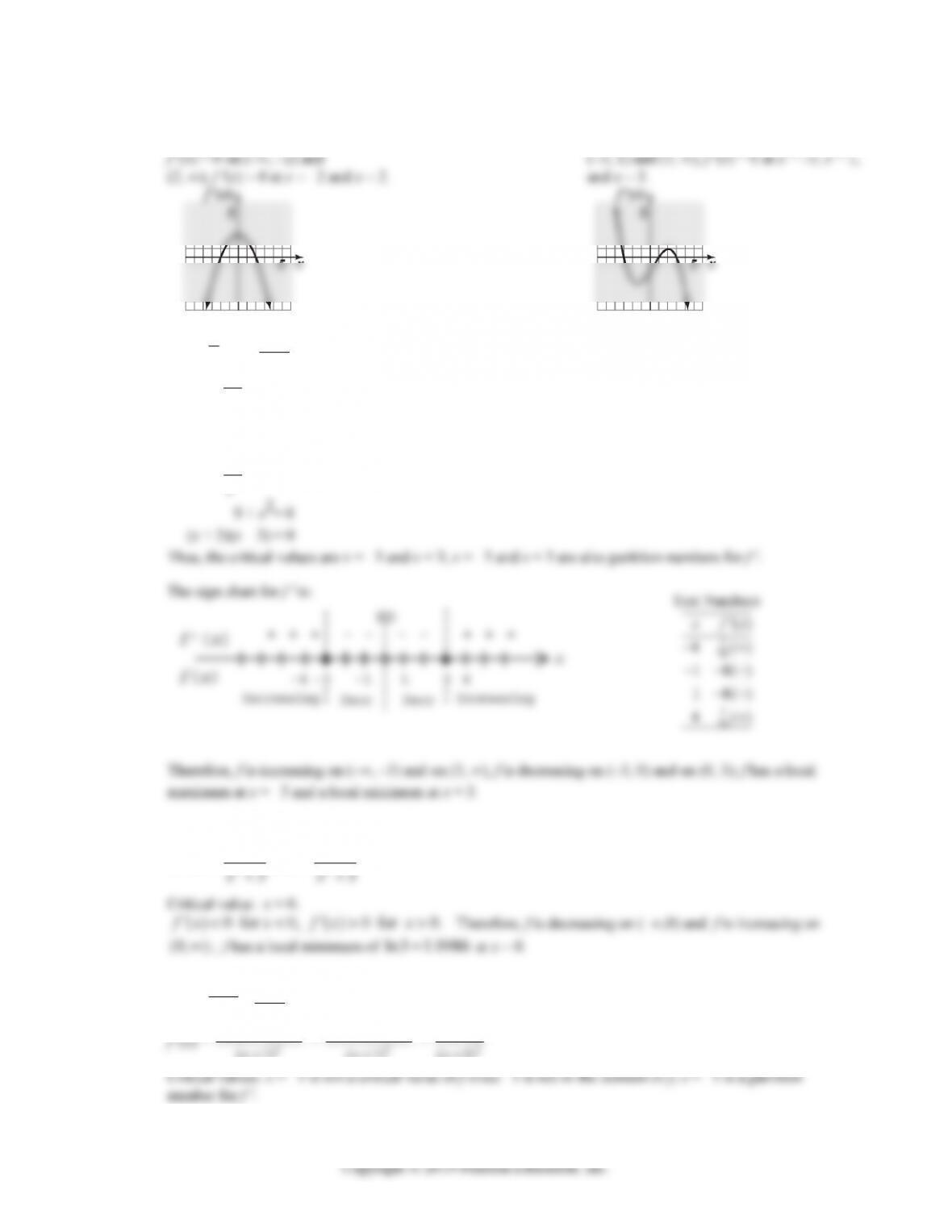
80. Increasing on (–∞, –3) and (–1, 2); decreasing on
11-8 CHAPTER 11: GRAPHING AND OPTIMIZATION
82. f ꞌ(x) > 0 on (–2, 2);
84. f ꞌ(x) > 0 on (–∞, –3) and (1, 3); f ꞌ(x) < 0 on
86. f(x) = 9
x
+ x [Note: f is not defined at x = 0.]
f ꞌ(x) = –2
9
x
+ 1
Critical values: x = 0 is not a critical value of f since 0 is not in the domain of f, but x = 0 is a partition
number for f ꞌ.
f ꞌ(x) = –2
9
x
+ 1= 0
88. 2
() ln( 3)fx x
; f is defined for all x.
22
12
‘( ) (2 )
x
fx x
90. f(x) =
2
1
x
x
[Note: f is not defined at x = –1.]
2
2( 1)
(1)
x
xx
x
=
22
22
(1)
x
xx
x
=
2
2
(1)
x
x
x
EXERCISE 11-1 11-9
f ꞌ(x) =
2
2
2
(1)
x
x
x
= 0
Thus, the critical values are x = –2 and x = 0; –2 and 0 are also partition numbers for f ꞌ.
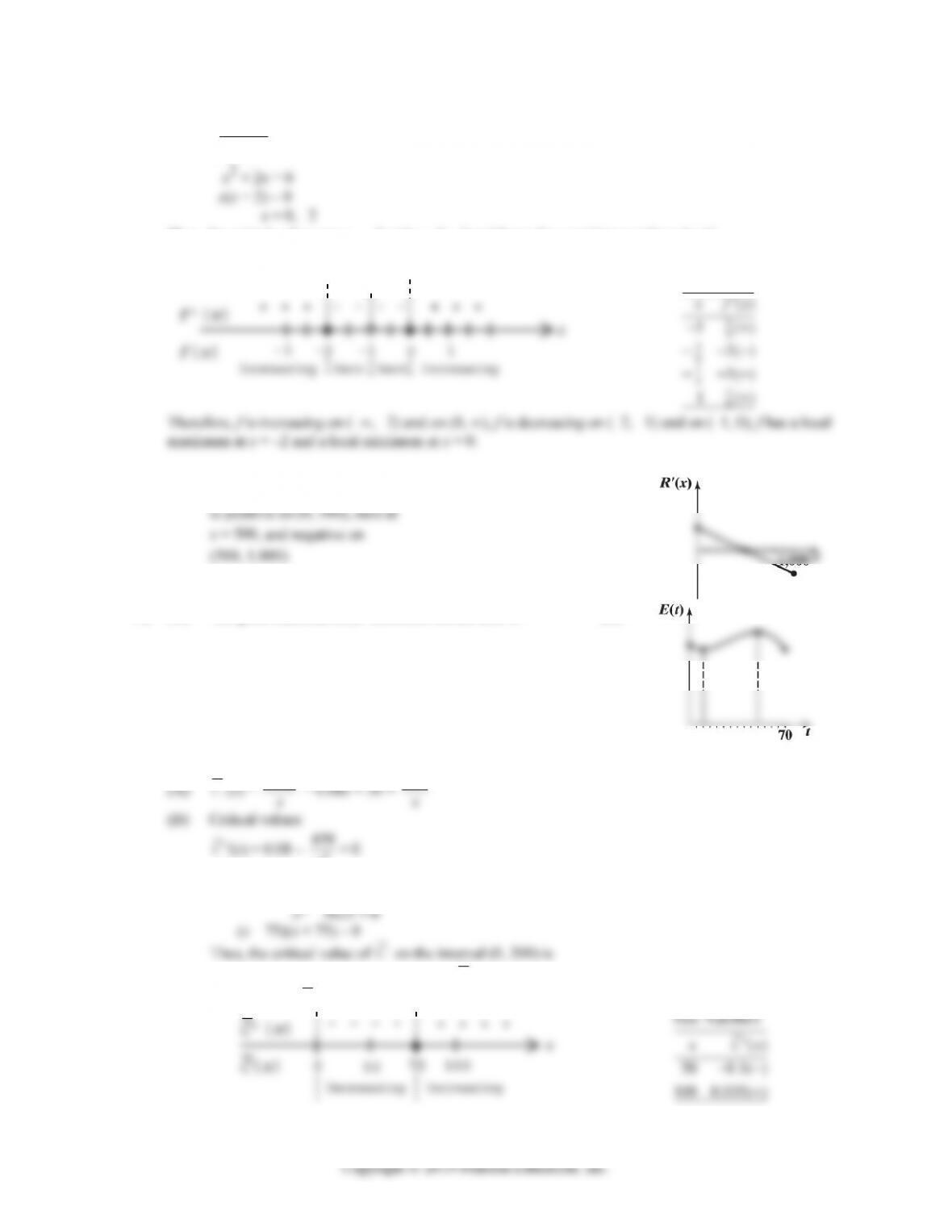
The sign chart for f ꞌ is:
x
ND
Test Numbers
92. (A) The marginal revenue function, R‘,
(B)
94. (A) The price function, E(t), decreases for the first 10 (B)
96. C(x) = 0.08x2 + 30x + 450
x
x
x
0.08x2 – 450 = 0
x = 75. x = 75 is a partition number for C‘.
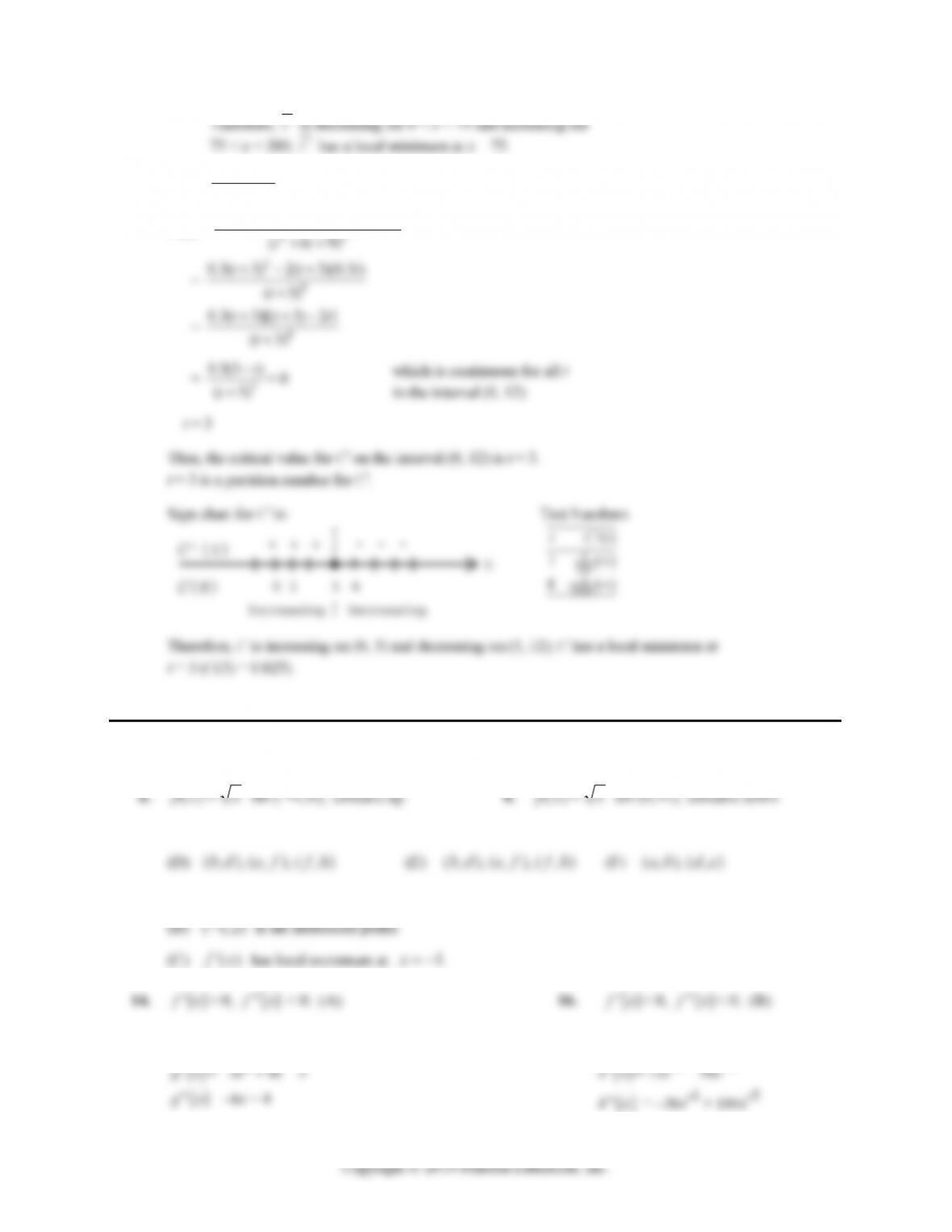
Sign chart for C‘ is:
IncreasingDecreasing
x
– – – – + + + +
50
C‘(x)
C(x)100075
Test Numbers
‘( )
50 0.1( )
100 0.035( )
x
Cx
11-10 CHAPTER 11: GRAPHING AND OPTIMIZATION
Copyright © 2019 Pearson Education, Inc.
Therefore, C is decreasing for 0 < x < 75 and increasing for
75 < x < 200; C has a local minimum at x = 75.
98. C(t) = 2
0.3
69
t
tt
, 0 < t < 12
C‘(t) =
2
0.3( 6 9) (2 6)(0.3 )
tt t t
EXERCISE 11–2
2. ( ) on ( , );fx x neither 4. 3
( ) on (0, );mx x concave up
10. (A) ( , ), ( , ), ( , )bd e f f h (B) (,),(,)ab de (C) (,),(,)ab de
12. (A) ( 3) 0 is a local minimum; (1) 4 is a local maximumff .
18. g(x) = –x3 + 2x2 – 3x + 9
g
x= –3x2 + 4x – 3
g
x
= –6x + 4
20. k(x) = –6x–2 + 12x–3
kx= 12x–3 – 36x–4
kx = –36x–4 + 144x–5
11-12 CHAPTER 11: GRAPHING AND OPTIMIZATION
f
f
f
f
36. f(x) = x4 – 2x3 – 5x + 3
f
x
= 4x3 – 6x2 – 36
f
x = 12x2 – 12x = 12x(x – 1)
f
f
f
38. f(x) = ln(x2 – 4x + 5)
f
x
=
2
22
(45) 24
45 45
dxx x
dx
xx xx
f
22
2( 45)(24)(24) 2( 43) 2(1)(3)
xx x x xx xx
f
f
f
40. 34
() 16 9
x
x
f
xee
f
34
x
x
x
f
f
f
f
EXERCISE 11-2 11-13
Copyright © 2019 Pearson Education, Inc.
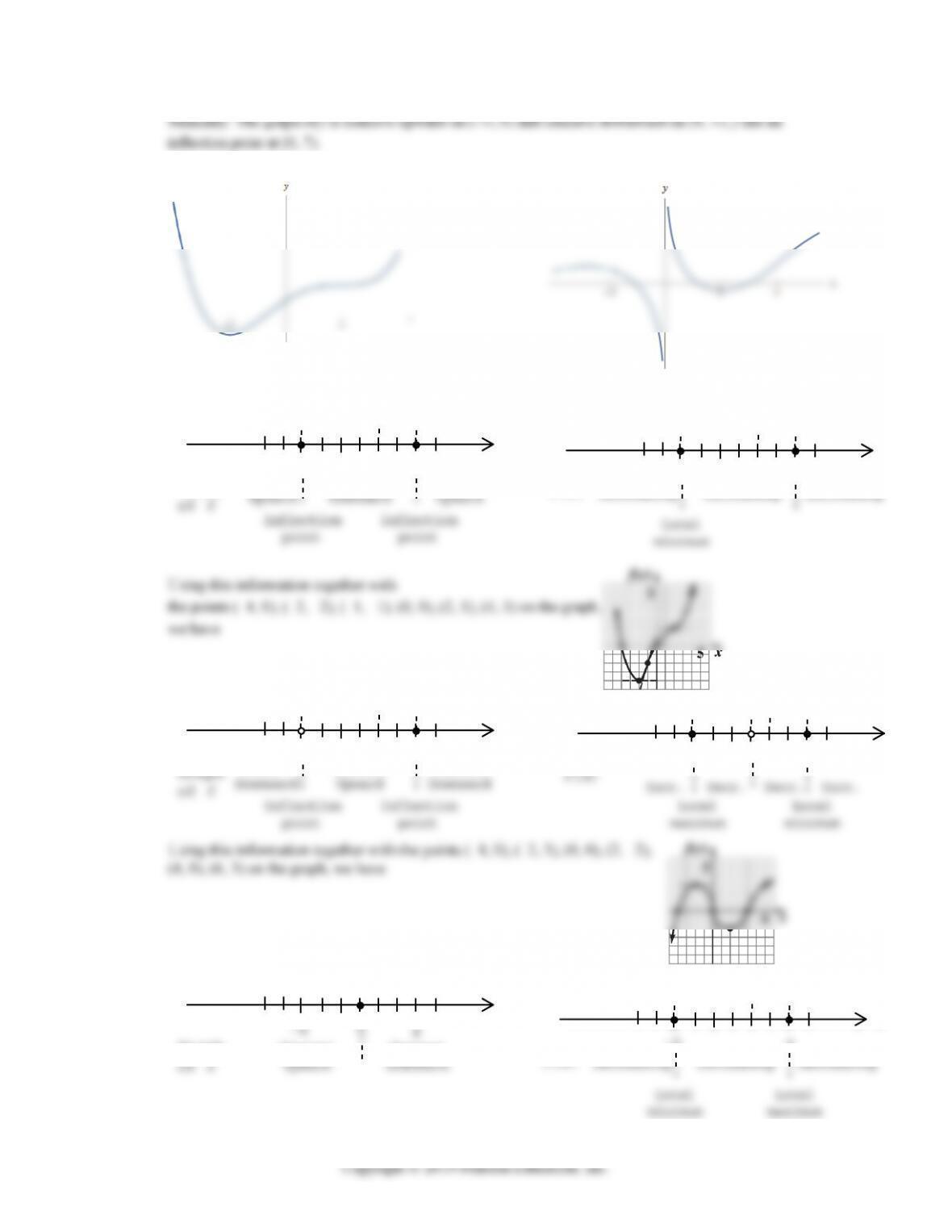
Summary: The graph of f is concave upward on (–∞, 0) and concave downward on (0, ∞). f has an
inflection point at (0, 7).
42. 44.
46. + + + 0 – – – – – 0 + + +
x
f“(x)
Graph
Concave
Concave
-1 2Concave
– – – 0 + + + + + 0 + + +
x
f‘(x)
f(x)
-2 2
Decreasing Increasing Increasing
48. – – – ND + + + + 0 – – –
x
f“(x)
Concave
Concave
0 4Concave
+ + + 0 – – ND – – 0 + + +
x
f‘(x)
-2 2
0
50. + + + + + 0 – – – – –
x
f“(x)
Graph
Concave
-2 2
Concave
0
– – – 0 + + + + + 0 + + +
x
f‘(x)
f(x)
-2 2
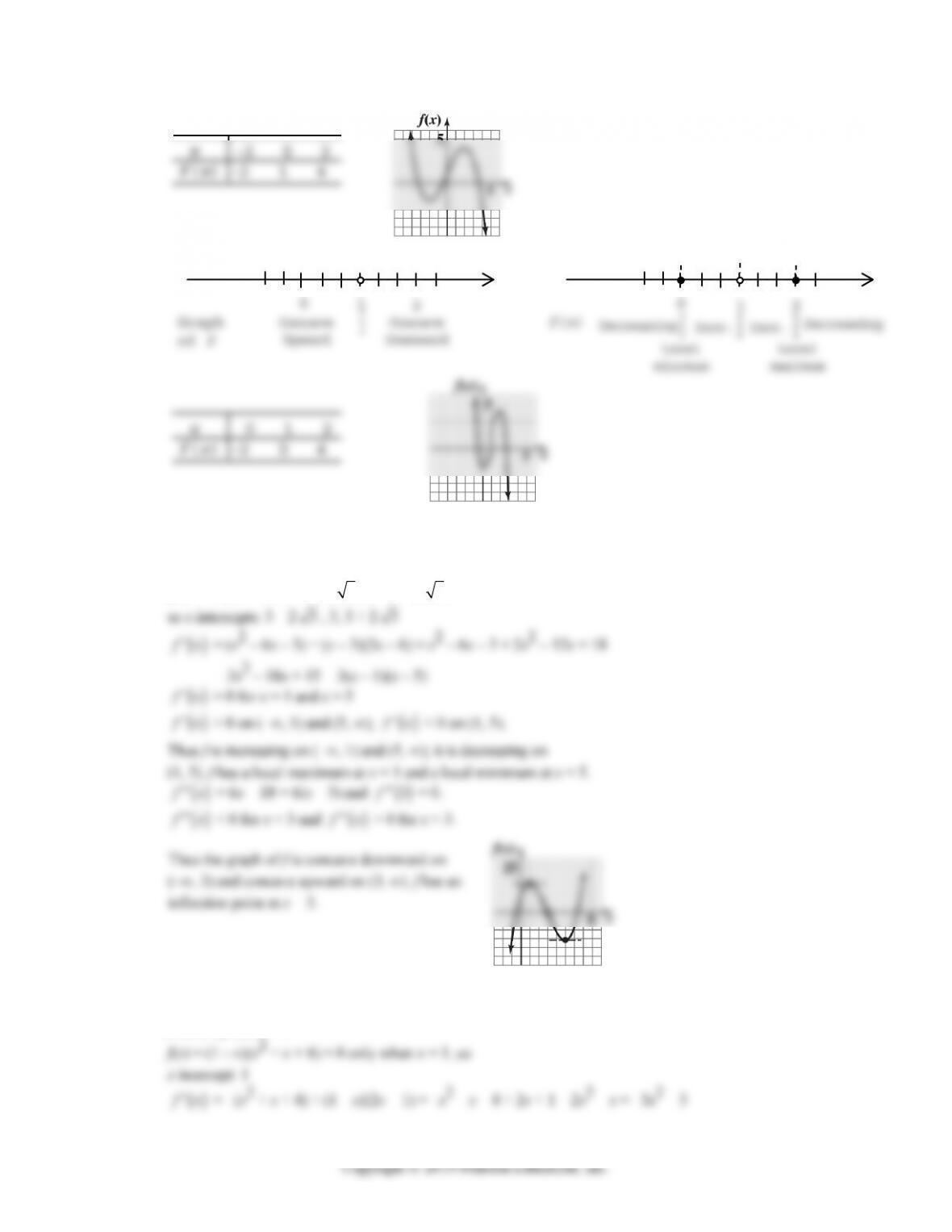
11-14 CHAPTER 11: GRAPHING AND OPTIMIZATION
Copyright © 2019 Pearson Education, Inc.
52. + + + + + ND – – – – –
x
f“(x)
0 2
1
– – – 0 + + ND + + 0 – – –
x
f‘(x)
02
1
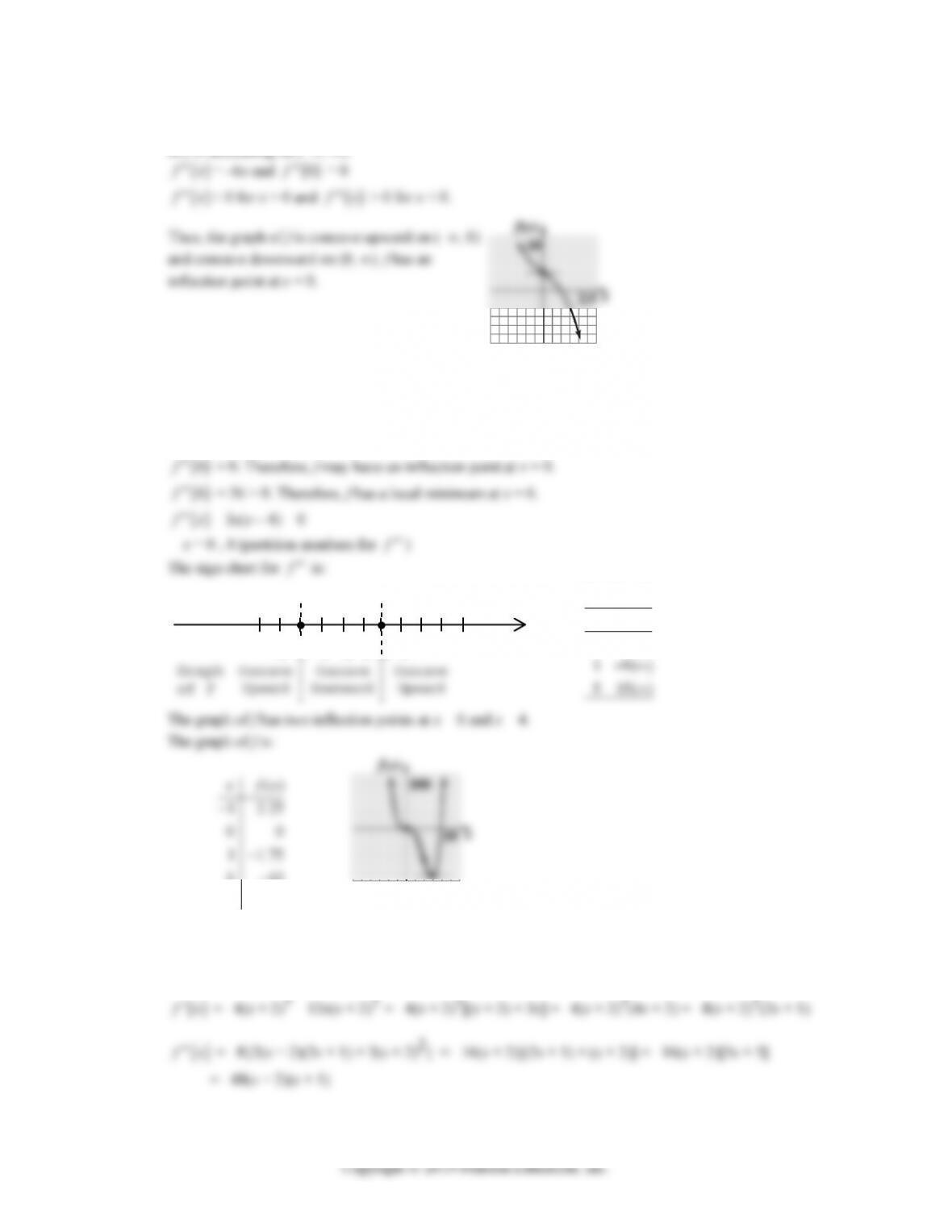
54. f(x) = (x – 3)(x2 – 6x – 3)
Domain: All real numbers
y intercept: f(0) = (0 – 3)(0 – 0 – 3) = 9
f(x) = 0 for x = 3, x = 3 – 2 3, x = 3 + 2 3,
56. f(x) = (1 – x)(x2 + x + 4)
Domain: all real numbers
y intercept: f(0) = 4
EXERCISE 11-2 11-15
= –3(x2 + 1) < 0 for all x
so f is decreasing on (–∞, ∞).
f
f
f
58. f(x) = 0.25x4 – 2x3
f
x = x3 – 6x2 = x2(x – 6)
f
x
= 3x2 – 12x = 3x(x – 4)
Critical values: x = 0, 6
f
f
f
f“(x)
x
+ + + – – – – + + +
-1 0 1 2 3 4 5
Test Numbers
“( )
115()
x
fx
x
212
80
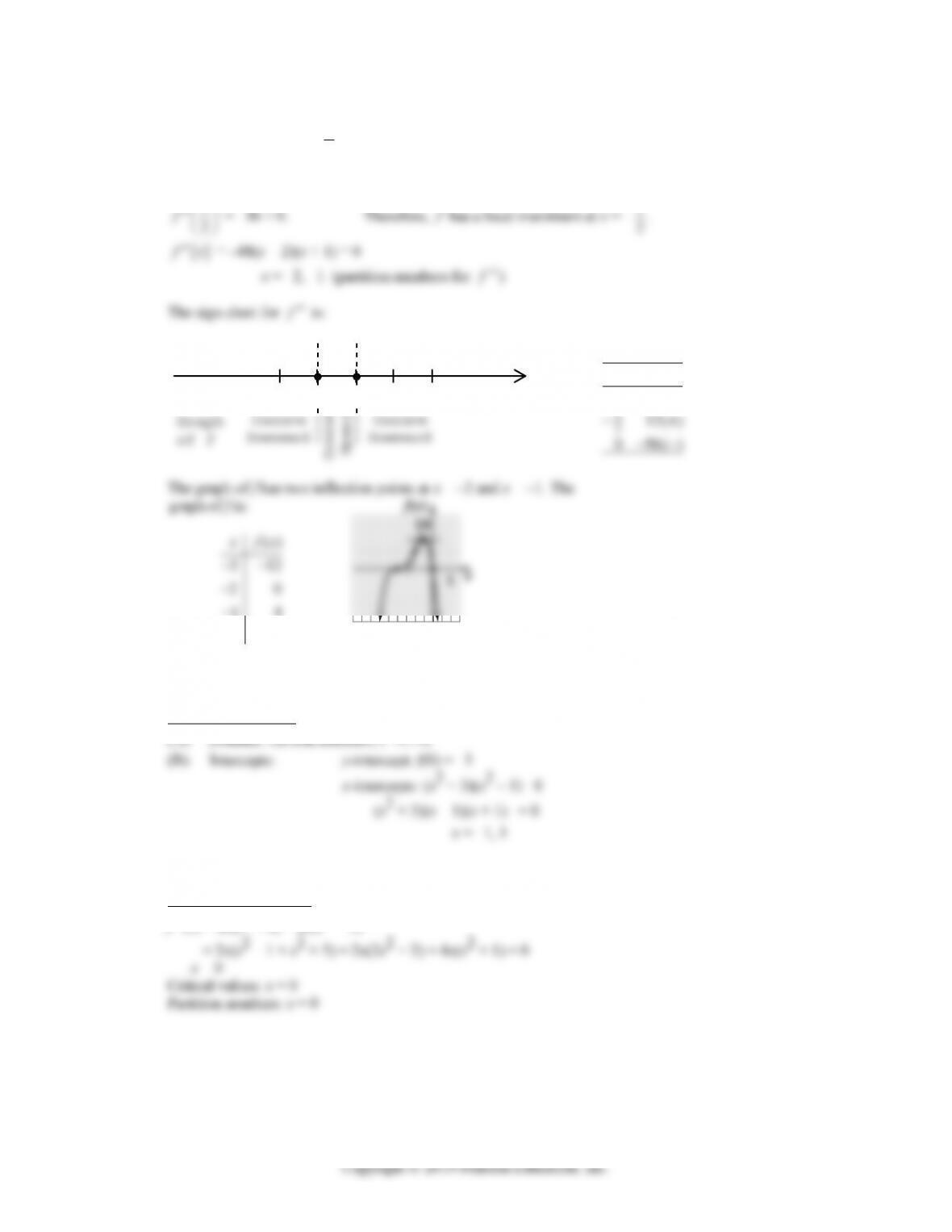
60. f(x) = –4x(x + 2)3; Domain: All real numbers; y-intercept: 0;
x-intercepts: 0, –2.
f
f
11-16 CHAPTER 11: GRAPHING AND OPTIMIZATION
Critical values: x = –2, –1
2; f increasing on (–∞, –0.5) and decreasing on (–0.5, ∞).
2f = 0. Therefore, f may have an inflection point at x = –2.
1
f“(x)
x
– – – ++ – – –
Co nc ave
Up wa rd
-3 -2 -1 0
Test Numbers
“( )
396()
x
fx
x
14
00
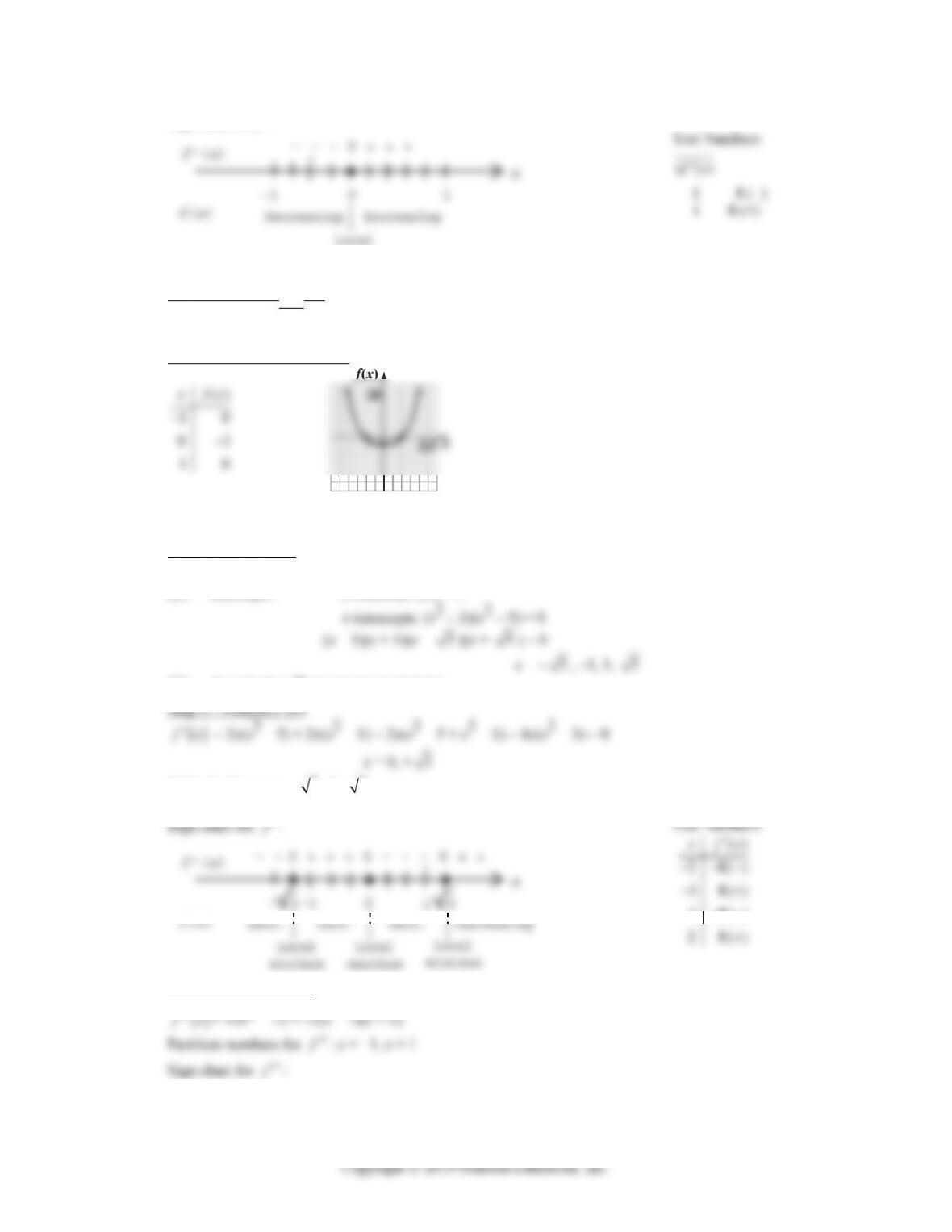
62. f(x) = (x2 + 3)(x2 – 1)
Step 1. Analyze f(x):
(A) Domain: All real numbers, (–∞, ∞).
(C) Asymptotes: There are no asymptotes.
Step 2. Analyze f ꞌ (x):
f ꞌ (x) = 2x(x2 – 1) + 2x(x2 + 3)
EXERCISE 11-2 11-17
Sign chart for f ꞌ:
minimum
Step 3. Analyze ”
f
(x):
f
x
= 12x2 + 4 > 0 for all x. Thus, the graph of f is concave upward on (–∞, ∞).
Step 4. Sketch the graph of f:
10
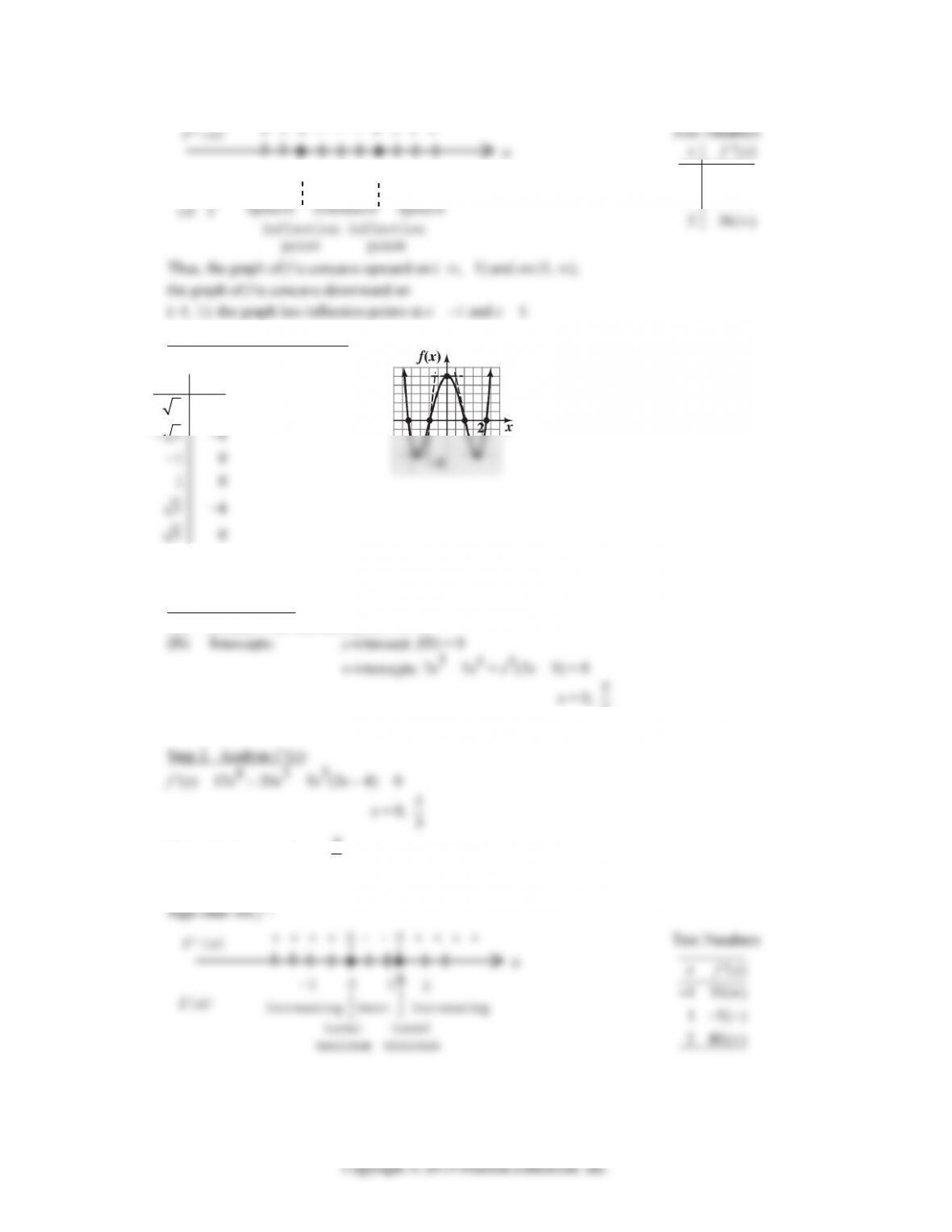
64. f(x) = (x2 – 1)(x2 – 5)
Step 1. Analyze f(x):
(A) Domain: All real numbers, (–∞, ∞).
(B) Intercepts: y-intercept: f(0) = 5
(C) Asymptotes: There are no asymptotes.
f
Critical values: x = –3, 0, 3
Partition numbers: Same as critical values.
Decr.
f(x)
-1 1
Increasing
Local
minimum
Decr.
0
3
–3
Incr.
Local
minimum
Local
maximum
18()
Step 3. Analyze f ꞌꞌ (x):
f
x = 12x2 – 12 = 12(x – 1)(x + 1)
Partition numbers for f : x = –1, x = 1
Sign chart for f :
11-18 CHAPTER 11: GRAPHING AND OPTIMIZATION
Copyright © 2019 Pearson Education, Inc.
+ + 0 – – – 0 + + +
f“(x)
Graph
Concave
-2 0
Concave
-1
12
Concave
Test Numbers
236()
012()
Step 4. Sketch the graph of f:
()
50
x
fx
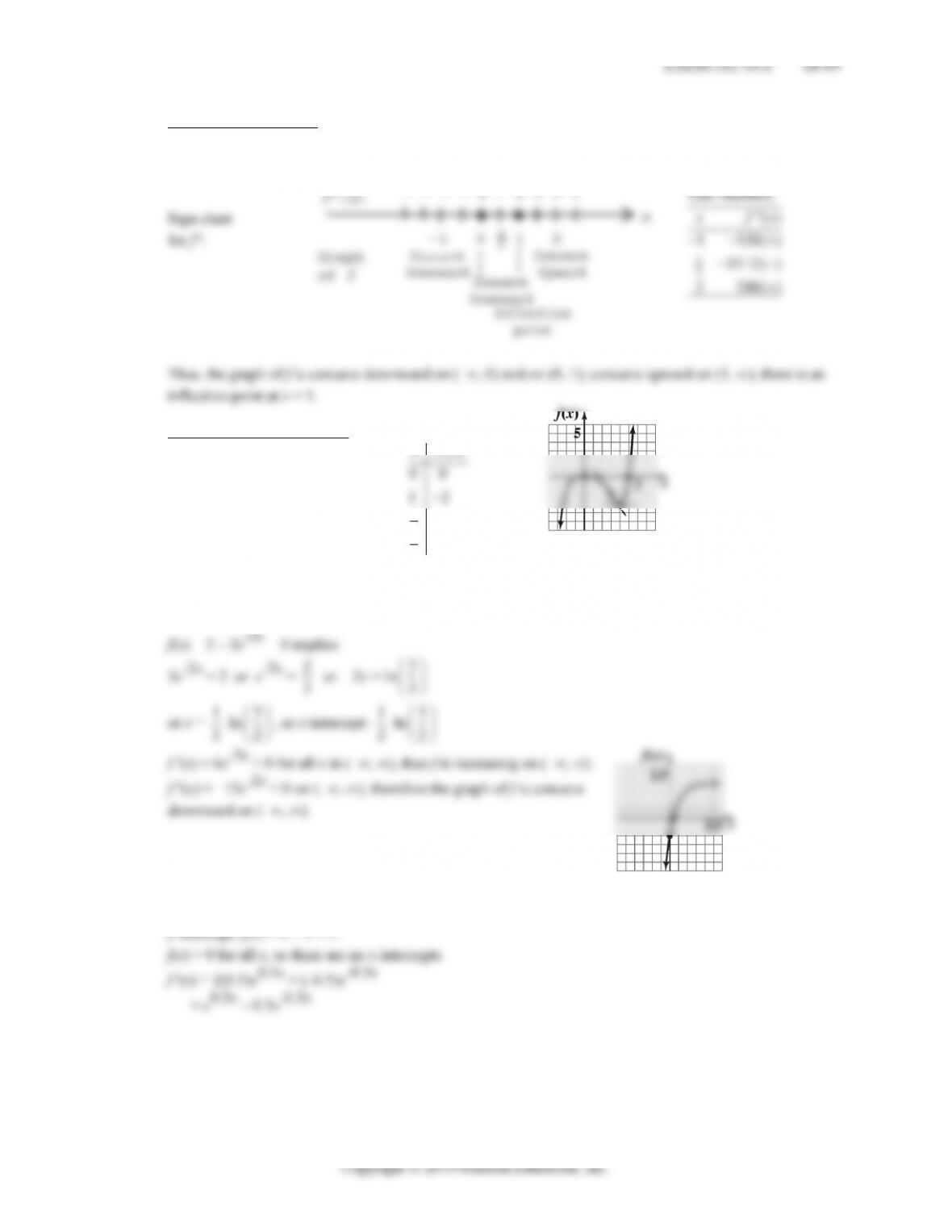
66. f(x) = 3x5 – 5x4
Step 1. Analyze f(x):
(A) Domain: All real numbers, (–∞, ∞).
3
(C) Asymptotes: There are no asymptotes.
Critical values: x = 0, x = 4
3
Partition numbers: Same as critical values.
x
minimum
maximum
x
11-20 CHAPTER 11: GRAPHING AND OPTIMIZATION
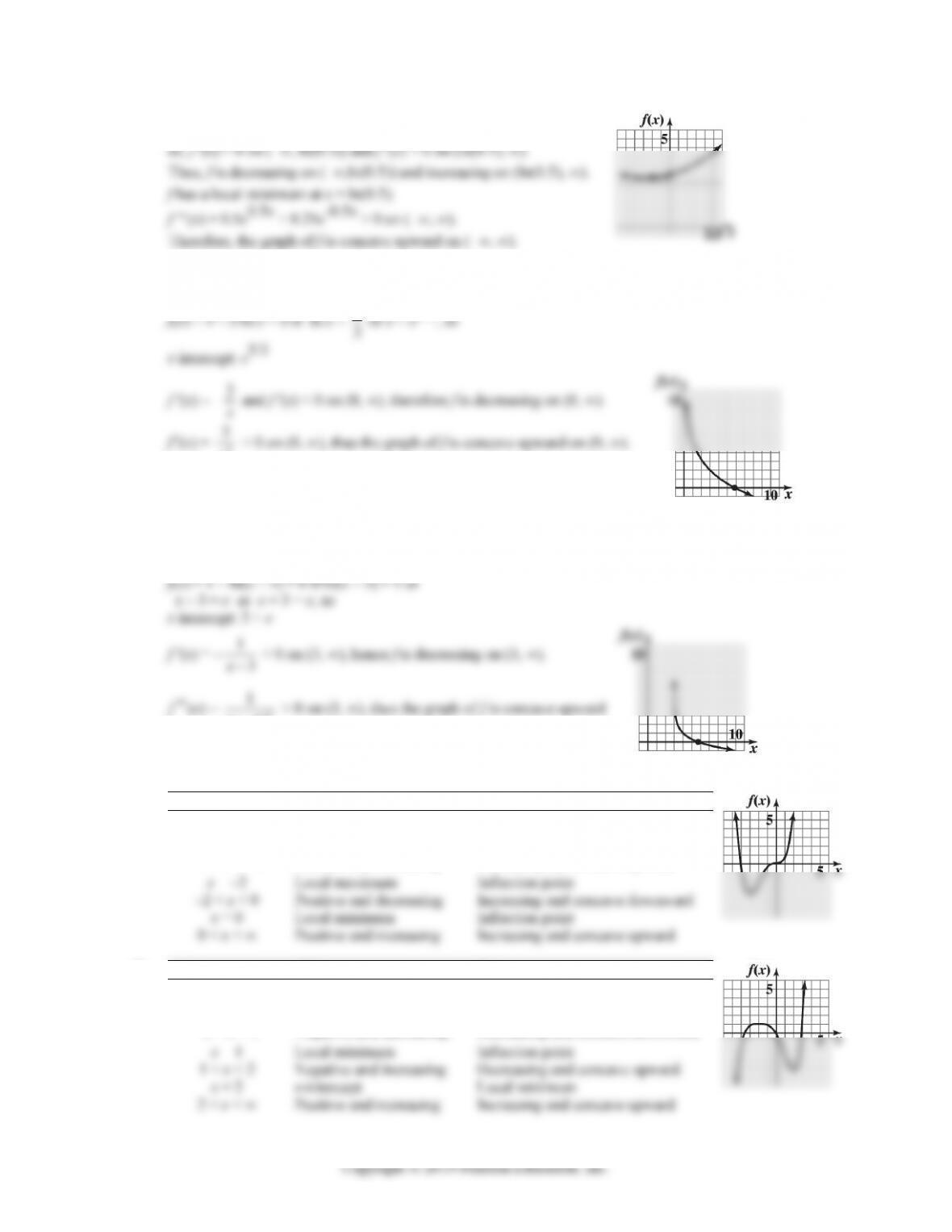
f ′(x) > 0 if e0.5x > 0.5e–0.5x or ex > 0.5 or x > ln(0.5)
72. f(x) = 5 – 3 ln x
Domain: (0, ∞)
x
74. f(x) = 1 – ln(x – 3)
Since ln is defined for positive numbers x – 3 > 0 or x > 3. Thus
Domain: (3, ∞)
f
(x) = 2
(3)x > 0 on (3, ∞), thus the graph of f is concave upward
on (3, ∞).
76. x f ꞌ(x) f(x)
–∞ < x < –3 Negative and increasing Decreasing and concave upward
x = –3 x-intercept Local minimum
–3 < x < –2 Positive and increasing Increasing and concave upward
78. x f ꞌ(x) f(x)
–∞ < x < –2 Positive and decreasing Increasing and concave downward
x = –2 x-intercept Local maximum
–2 < x < 1 Negative and decreasing Decreasing and concave downward