Chapter 11 – Effective Team Management
11-20
Lecturer Enhancer 11.1
TEAMWORK AND NASCAR
New MBA students at Wake Forest University’s Babcock Graduate School of Management
back. The winning team was recognized at the end of the evening.
In addition to building team skills, these students gained exposure to a booming business
enterprise that has become one of the nation’s fastest-growing sports. As with other winning
enterprises, NASCAR drivers and crews rely on solid teamwork to succeed. Even with all of the
emphasis that NASCAR places upon high-performing equipment, the best racecar cannot
messages and tokens of appreciation after each race, sponsor recognition of the team, media
appearances
Focused leadership: Leaders provide common focus for the team, facilitating timely feed back
on individual and collective performance, providing needed resources for accomplishing
responsibilities, holding team and individuals accountable for assigned tasks, walking the talk,
LECTURE ENHANCERS
Chapter 11 – Effective Team Management
11-21
2004 and Robert M. Williamson, “NASCAR: A Model for Equipment Reliability and Teamwork,” MRO Today, Copyright 2000.
Lecture Enhancer 11.2
REWARDS AND CHALLENGES OF WORKING IN A TEAM
A common type of team is the temporary unit, usually composed of members from different
departments and job levels, formed to make policy, re-engineer operations, or design products,
among other tasks. Team members may or may not leave their old jobs.
Working in a team environment can be tricky. On one hand, you get to showcase your skills to
team members from all corners of the company, often including influential senior executives.
And team assignments tend to be critical and closely watched.
Shaunna Sowell’s team experiences at Texas Instruments led to promotions and a better career
path than she ever envisioned. But she also burned some bridges with a boss. Sowell was leading
a plant design team in 1988 when she was tapped for a product-quality steering committee that
was loaded with managers. She initially was intimidated, but her confidence grew with her
experience.
But the experience also created friction. “My visibility was getting wider than that of my boss,”
she said. “It was pretty uncomfortable.” The relationship cooled and eventually she moved to
another position, although still working on teams.
Mary Kinnear feared she risked her career at Boston Gas by joining a re-engineering tem. The
gamble paid off, but not without some uncomfortable moments. In leading a team charged with
redesigning Boston Gas’s distribution operation, Ms. Kinnear, a human resources specialist, also
knew she risked offending some influential executives whose turf was being threatened. Some
Chapter 11 – Effective Team Management
11-22
already voiced skepticism about her abilities to do effective work on the team, she said. “We
were all assured there would be some kind of amnesty for team members,” she says. “But there
were no guarantees.”
Sometimes the fears are real. Deloitte & Touche consultant Boris Lukan was part of a joint re-
engineering team working with a client, when animosity over cutbacks proposed by the project
team forced one team member from the client company to leave. “For people who want to be
recognized, projects that drive change are great places to be,” he says, “but you’ve got to be
ready for the potential impacts that could come out of upsetting how other people do their work.”
Still, such influence became so seductive to Margaret Colquhoun, who was on a team reshaping
the work processes at her hospital, which she found it difficult to go back to the humdrum
routine of her manager’s job, even after a promotion. She left to join a consulting firm that
specializes in team development.
These managers offer some advice to others working in teams:
• Be an expert, not an advocate. The team needs your specialized knowledge, but doesn’t
want an obstructionist who continually says, “You just don’t understand how we do things in
finance.”
• Research the team as you would any job opportunity. Are there cliques? Is there one
person who dominates? What happens to team members after they leave the team? How
Lecture Enhancer 11.3
SOCIAL LOAFING
Professor Bibb Latane, a professor of psychology, conducted research on social loafing at Ohio
State University in the 1980s. Latane concluded people tend to slack off, or loaf, when they work
in a group more than they do when working alone.
Chapter 11 – Effective Team Management
Much of Latane’s experimentation was done by him and his colleagues in his offices under the
stands of the Ohio Stadium. There the researchers organized Buckeye student volunteers into
groups of varying sizes and asked them to clap or shout as loud as they could. In this and other
experiments, the researchers found that when subjects either were in a group or were led to
believe that they were (through the use of blindfolds and headphones), they consistently made
less noise per person than when they shouted or clapped alone.
Notes for Topics for Discussion and Action
DISCUSSION
1. Why do all organizations need to rely on groups and teams to achieve their goals and gain a
competitive advantage?
2. What kinds of employees would prefer to work in a virtual team? What kinds of employees
would prefer to work in a team that meets face-to-face?
MANAGEMENT IN ACTION
11-24
3. Think about a group that you are a member of, and describe that group’s current stage of
development. Does the development of this group seem to be following the forming-storming-
norming-performing-adjourning stages described in the chapter?
4. Discuss the reasons why too much conformity can hurt groups and their organizations.
There are several reasons why people conform to group norms: they want to obtain rewards and
avoid punishments, they want to imitate group members they admire, or they have internalized
5. Why do some groups have very low levels of cohesiveness?
6. Imagine that you are the manager of a hotel. What steps will you take to reduce social loafing
by members of the cleaning staff who are responsible for keeping all common areas and guest
rooms spotless?
Chapter 11 – Effective Team Management
11-25
Social loafing occurs in groups when individuals put forth less effort because they believe that
their individual contribution will not be noticed within the context of the group. This behavior
can result in lower group performance and may prevent a group from attaining its goals.
ACTION
7. Interview one or more managers in your community to identify the types of groups and teams
that the organization uses to achieve its goals. What challenges do these groups and teams face?
Chapter 11 – Effective Team Management
11-26
Diagnosing Group Failures
Think about the last dissatisfying or discouraging experience you had as a member of a group or
team. Perhaps the group did not accomplish its goals, perhaps group members could agree
about nothing, or perhaps there was too much social loafing. Now answer the following
questions:
(Note to the instructor: Due to the nature of this question, student answers will vary. The
following answers illustrate the main points that each student should include.)
1. What type of group was this?
2. Were group members motivated to achieve group goals? Why or why not?
3. How large was the group and what group roles did members play?
BUILDING MANAGEMENT SKILLS
Chapter 11 – Effective Team Management
11-27
4. What were the group’s norms? How much conformity and deviance existed in the group?
5. How cohesive was the group? Why do you think the group’s cohesiveness was at this level?
What consequences did this level of group cohesiveness have for the group and its members?
6. Was social loafing a problem in this group? Why or why not?
Chapter 11 – Effective Team Management
11-28
Copyright © 2017 McGraw-Hill Education. All rights reserved. No reproduction or distribution without the prior written consent of McGraw-Hill
Education.
In order to counter the effects of social loafing, managers need to make individual contributions
identifiable so that group members perceive that low and high levels of effort will be noticed and
individual contributions evaluated. Managers may also assign individuals to groups on the basis
of the valuable and unique contributions that each person can make to the group as a whole. In
addition, groups should be kept as small as possible. Small groups allow individual contributions
to be more easily recognized and valued.
7. What could the group’s leader or manager have done differently to increase group
effectiveness?
8. What could group members have done differently to increase group effectiveness?
AACSB: Analytic
1. Either individually or in a group, think about the ethical implications of social loafing in a
self-managed team.
It certainly does seem not seem fair to allow one team member to work harder than others,
MANAGING ETHICALLY
11-29
Copyright © 2017 McGraw-Hill Education. All rights reserved. No reproduction or distribution without the prior written consent of McGraw-Hill
Education.
roles. However, if the team’s task is not sufficiently complex or if communication problems exist
between team members, such adjustments may be difficult to make.
2. Do managers have an ethical obligation to step in when they are aware of social loafing in a
self-managed team? Why or why not? Do other team members have an obligation to try to
curtail the social loafing? Why or why not?
AACSB: Ethics
Creating a Cross-Functional Team
1. Indicate who should be on this important cross-functional team and why.
Since the team is cross-functional, team members should come from a variety of departments.
The team should have a member who is responsible for monitoring costs and maintaining the
2. Describe the goals the team should be trying to achieve.
The goals that the team should be trying to achieve should be the ones that remedy the problems
SMALL GROUP BREAKOUT EXERCISE
Chapter 11 – Effective Team Management
11-30
devise a vegetarian and a low-fat, high-fiber menu that appeals to both students and faculty. The
3. Describe the different roles that will need to be performed on this team.
Group roles are sets of behaviors and tasks that members of a group are expected to perform
because of their positions in the group. Members of this team should be performing behaviors
and tasks that are related to their special areas of expertise. The nutritionist should propose menu
4. Describe the steps you will take to help ensure that the team has a good balance between
conformity and deviance and a moderate level of cohesiveness.
A good balance between conformity and deviance is essential to ensure that a group is able to
control members’ behavior and channel it in the direction of high performance and group goal
accomplishment. This balance also ensures that dysfunctional norms or behaviors are discarded
Chapter 11 – Effective Team Management
11-31
AACSB: Reflective Thinking
Although you feel your other responsibilities are going well, you know your virtual team is not
operating like a team at all; and no matter what you try, discussions in virtual team meetings are
forced and generally unproductive. What are you going to do to address this problem?
AACSB: Reflective Thinking
Case Synopsis: Thinking of Quitting? The Boss Knows
BE THE MANAGER
THE WALL STREET JOURNAL CASE IN THE NEWS
Chapter 11 – Effective Team Management
11-32
Copyright © 2017 McGraw-Hill Education. All rights reserved. No reproduction or distribution without the prior written consent of McGraw-Hill
Education.
post 80% of open jobs, and cold-call employees when jobs open up. To kindle closeness among
team members, and help forestall attrition, Box has encouraged managers to throw more social
events, recognize team-based work, and hold more mentoring meetings between senior leaders
and newer employees.
Companies also are trying to predict when workers might leave their positions, but not
necessarily the company. Wal-Mart is trying to determine in advance which employees are likely
to get promoted so that it can line up replacements more quickly.
AACSB: Analytic
Working in Teams: Cross Functional Dysfunction
SUPPLEMENTAL FEATURES
MANAGER’S HOT SEAT (MHS)
Chapter 11 – Effective Team Management
11-33
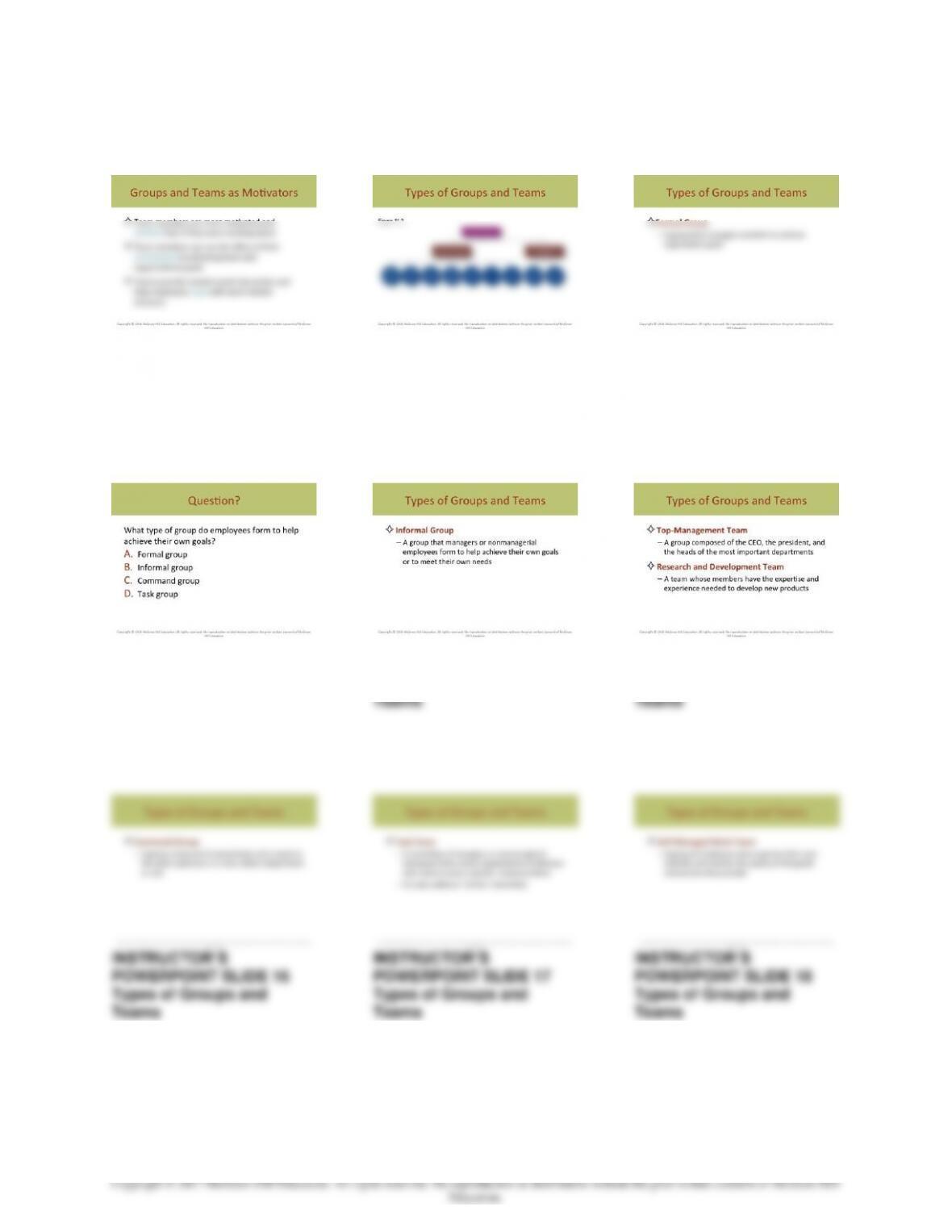
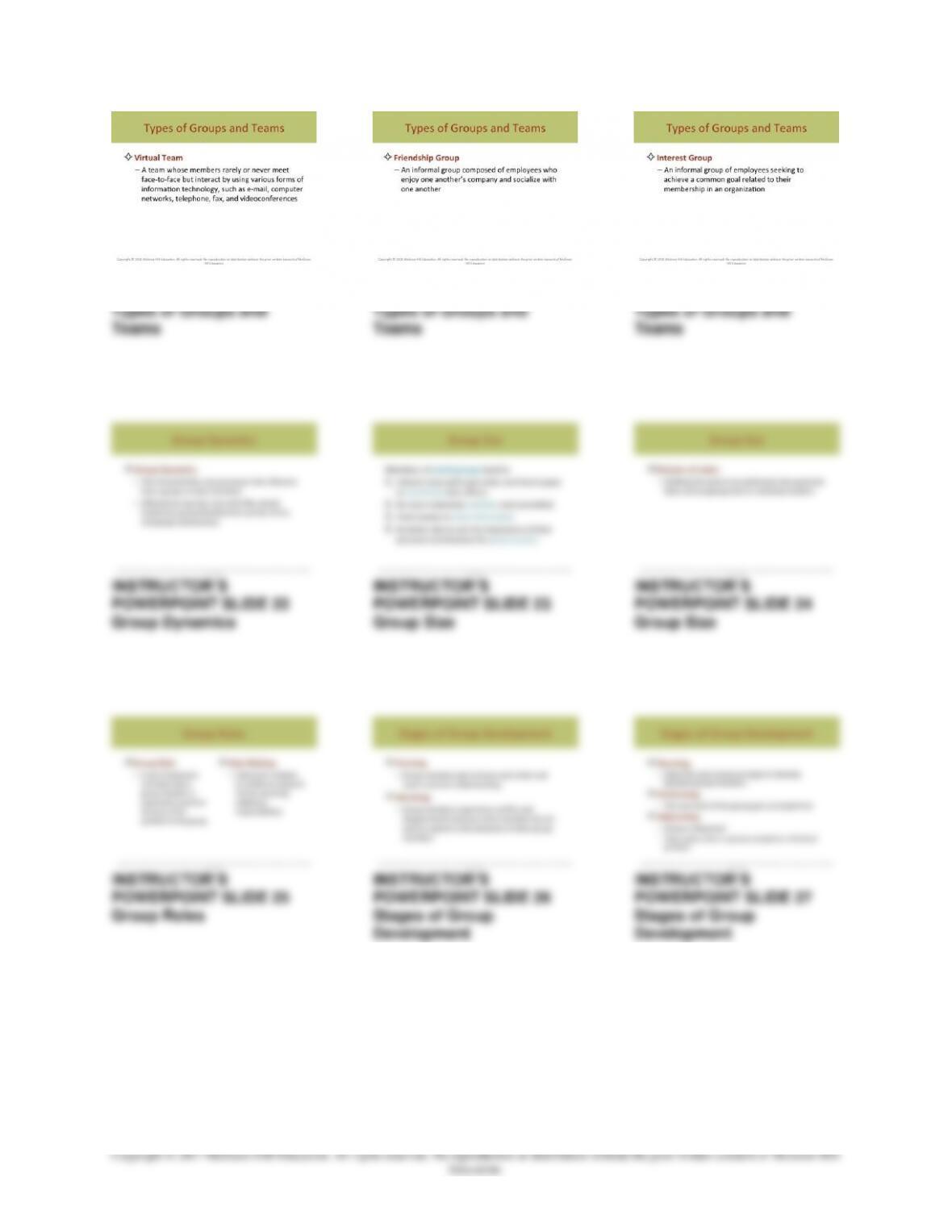
These Instructor’s PowerPoint slides can be used to supplement the lecture material.
INSTRUCTOR’S POWERPOINT SLIDES
Chapter 11 – Effective Team Management
11-34
INSTRUCTOR’S
POWERPOINT SLIDE 10
Groups and Teams as
Motivators
INSTRUCTOR’S
POWERPOINT SLIDE 11
Figure 11.2 – Types of
Groups and Teams in
Organizations
INSTRUCTOR’S
POWERPOINT SLIDE 12
Types of Groups and
Teams
INSTRUCTOR’S
POWERPOINT SLIDE 13
Question?
INSTRUCTOR’S
POWERPOINT SLIDE 14
Types of Groups and
INSTRUCTOR’S
POWERPOINT SLIDE 15
Types of Groups and
Chapter 11 – Effective Team Management
11-35
INSTRUCTOR’S
POWERPOINT SLIDE 19
INSTRUCTOR’S
POWERPOINT SLIDE 20
INSTRUCTOR’S
POWERPOINT SLIDE 21
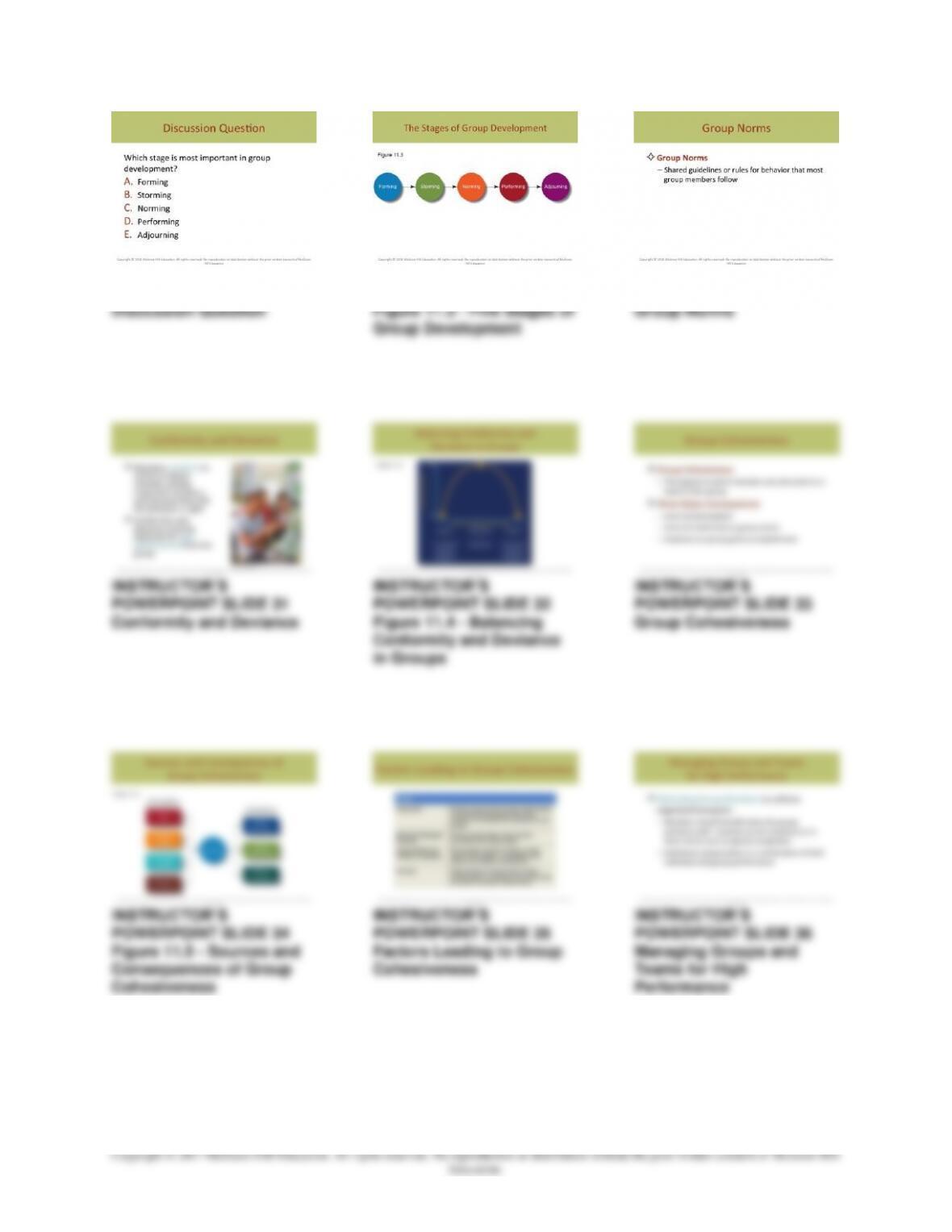
Chapter 11 – Effective Team Management
11-36
INSTRUCTOR’S
POWERPOINT SLIDE 28
INSTRUCTOR’S
POWERPOINT SLIDE 29
INSTRUCTOR’S
POWERPOINT SLIDE 30
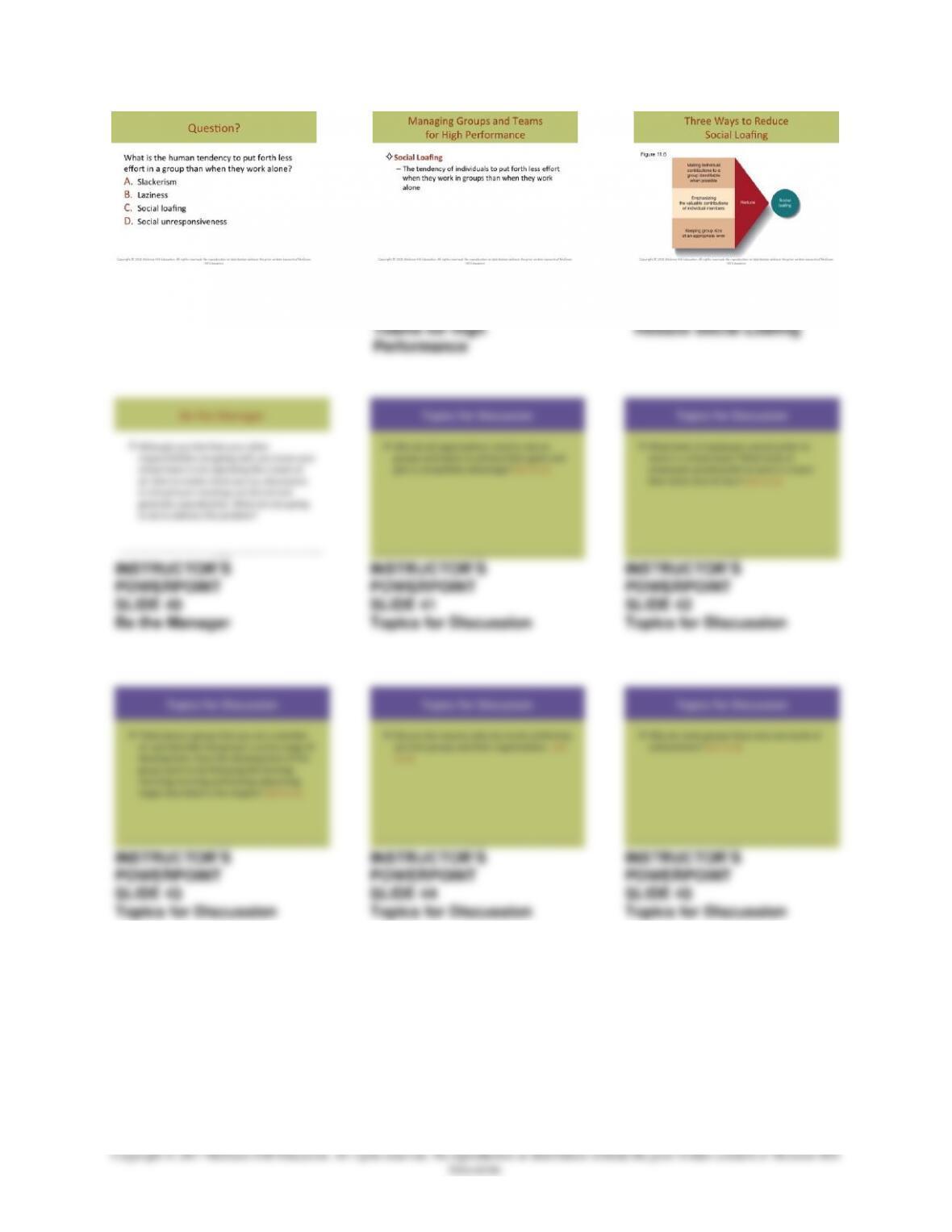
Chapter 11 – Effective Team Management
11-37
INSTRUCTOR’S
POWERPOINT SLIDE 37
Question?
INSTRUCTOR’S
POWERPOINT SLIDE 38
Managing Groups and
INSTRUCTOR’S
POWERPOINT SLIDE 39
Figure 11.6 – Three Ways to
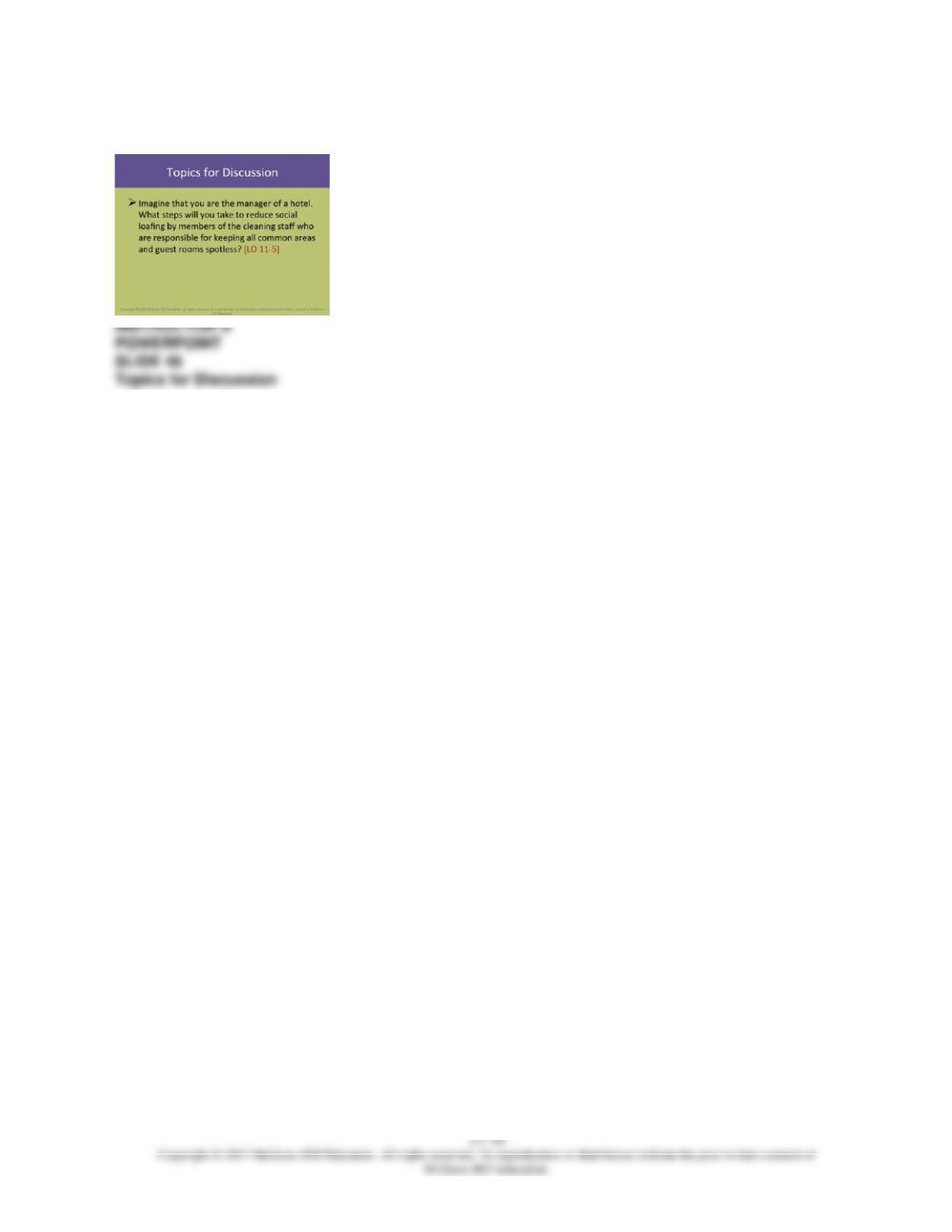
Chapter 11 – Effective Team Management
INSTRUCTOR’S
POWERPOINT
SLIDE 46
Topics for Discussion