Chapter 11 – Skills for Developing Others
11-1
Part 3: Focus on the Followers
Chapter 11: Skills for Developing Others
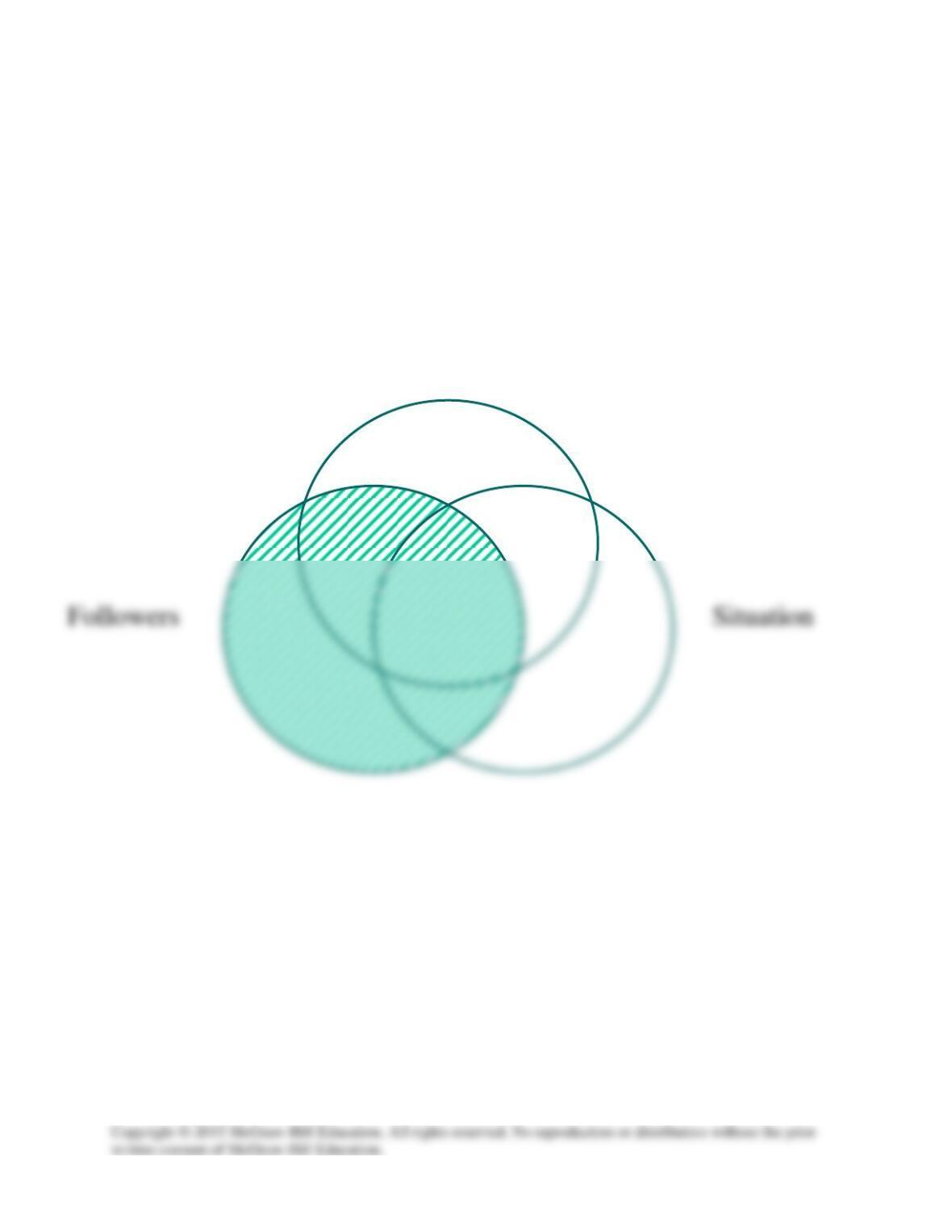
Leader
Chapter 11 – Skills for Developing Others
11-2
Overview of Chapter 11 Skills for Developing Others
Similar to the overviews we presented in Chapters 3 and 8, the ensuing paragraphs outline what
is contained in this chapter, Chapter 11 – Skills for Developing Others. The intent of this chapter
is to align the skills and associated exercises most relevant to the “Focus on the Follower”
The included skills are designed to be integrated with the material from the relevant chapters of
the text; therefore, we focus exclusively on presenting an outline of the skills, as well as
exercises to develop and enhance some of these specific skills. To meet this objective, the
Chapter 11 – Skills for Developing Others
11-3
Chapter 11 Skills for Developing Others Outline
Setting Goals
Goals should be specific and observable
Goals should be attainable but challenging
Goals require commitment
Goals require feedback
Providing Constructive Feedback
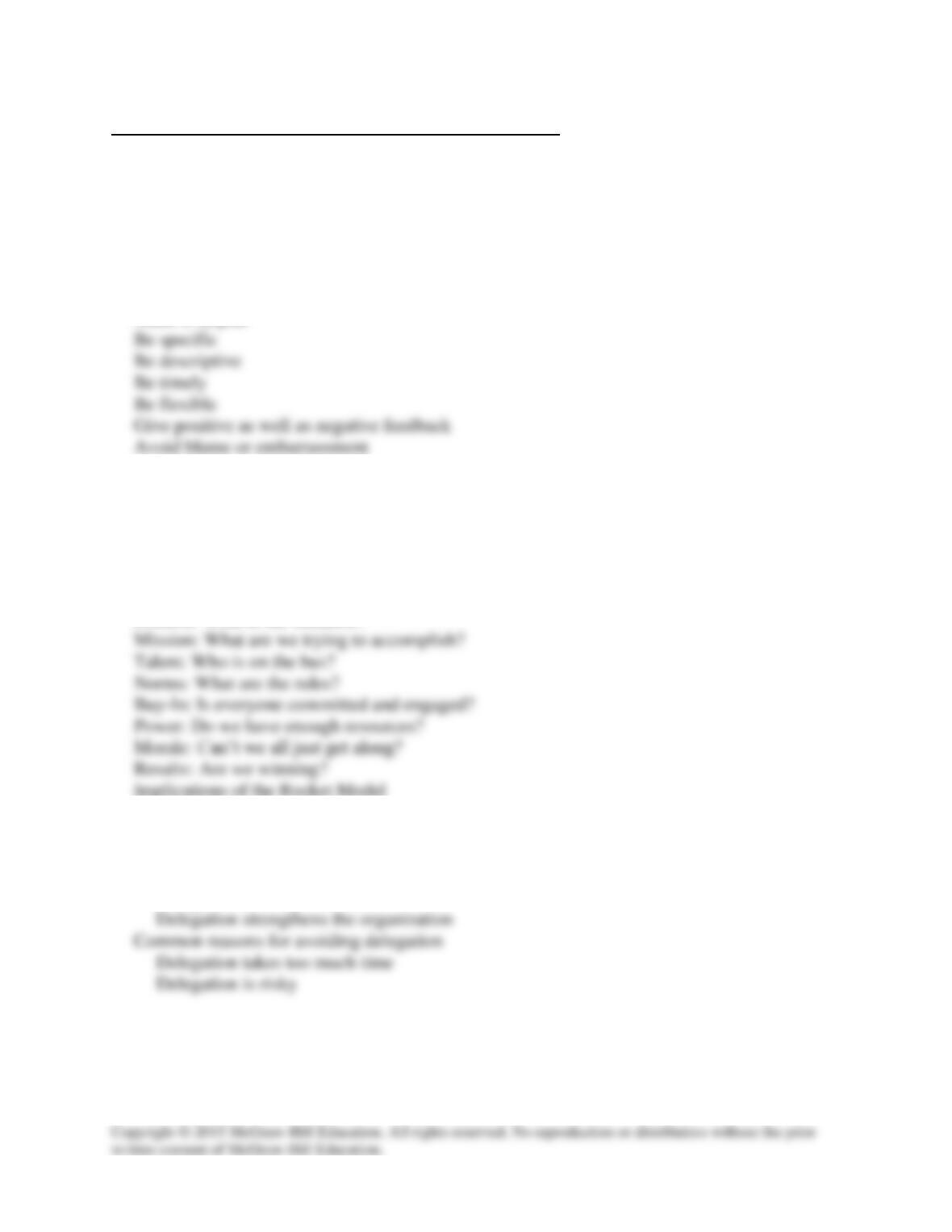
Make it helpful
Team Building for Work Teams
Team-building interventions
What does a team-building workshop involve?
Examples of interventions
Building High-Performance Teams: The Rocket Model
Context: What is the situation?
Implications of the Rocket Model
Delegating
Why delegating is important
Delegation frees time for other activities
Delegation develops followers
Chapter 11 – Skills for Developing Others
11-4
The job will not be done as well
The task is a desirable one
Others are already too busy
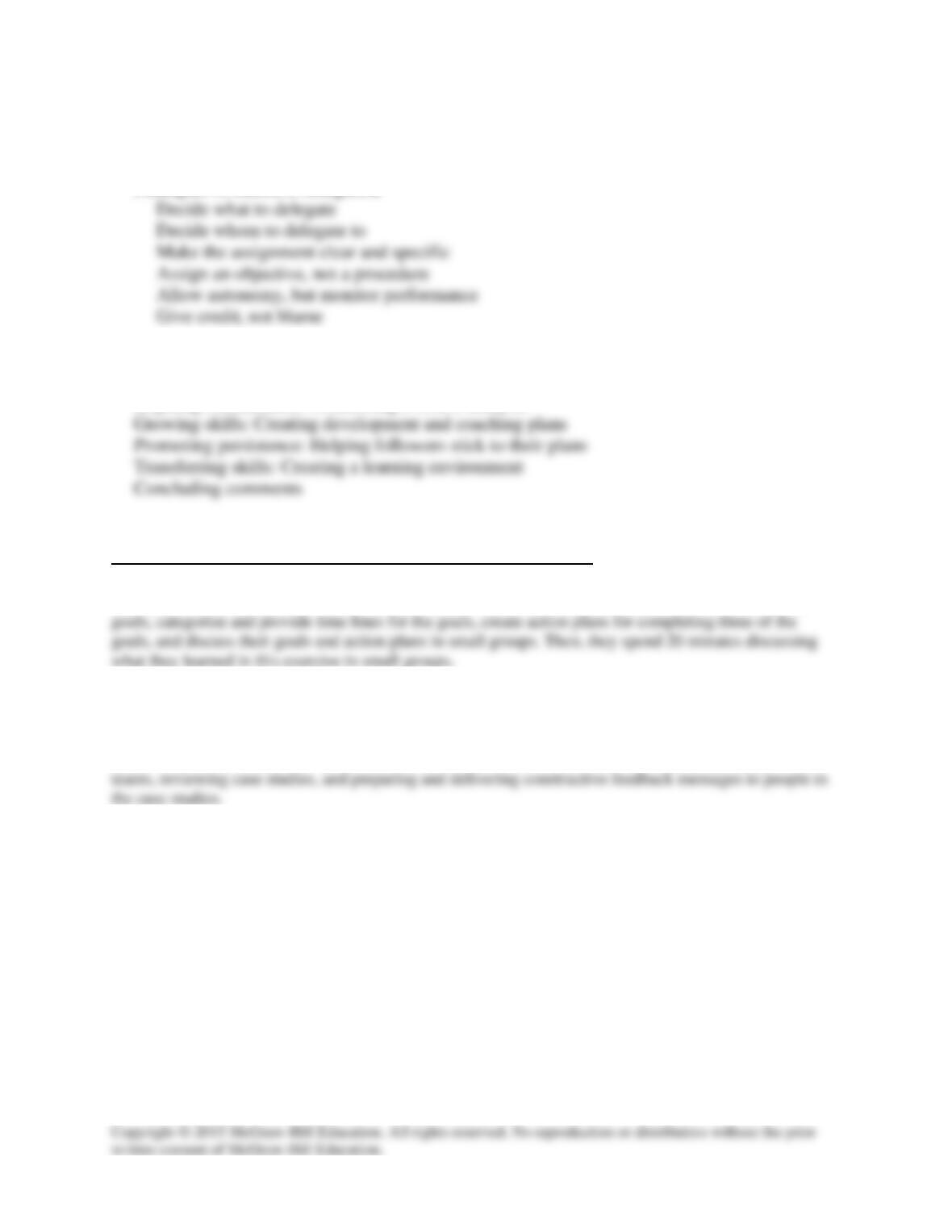
Principles of effective delegation
Coaching
Forging a partnership
Inspiring commitment: Conducting a GAPS analysis
Overview of the Learning Resources for Chapter 11
Exercise 11-1: Charting Your Career or Life Goals. As homework, students determine their work and life
Exercise 11-2: The SMART-B Goal Checklist. Students spend 30 minutes applying a checklist and
discussing how well certain goals conform to the best practices of goal setting.
Exercise 11-3: Providing Constructive Feedback. This 45-minute exercise has students forming small

Chapter 11 – Skills for Developing Others
11-5
Chapter 11 Exercises & Instructions
Exercise 11-1
Exercise Title: Charting Your Career or Life Goals
Purpose: To determine what an individual’s career or life could be. The exercise helps those students
who have not mapped out their life goals to find a start and hopefully use the exercise as a stepping-stone
to life planning.
Summary: Begin by having students brainstorm their own individual goals. Direct them not to set
limitations—let their mind flow freely. Let students take about 15 minutes to write down their list. Once
completed, have the students separate their list into three categories: economic, personal development,
It will take about 45 minutes to complete this exercise. However, instructors can ask students to
identify, categorize, assign time frames, choose three goals, and do action plans for these goals as a
homework assignment. This means that instructors will only need to spend 20 minutes in class
doing a small and large group discussion session.

Chapter 11 – Skills for Developing Others
11-6
Exercise 11-2
Exercise Title: The SMART-B Goal Checklist
Purpose: To give students the opportunity to evaluate goals using a best practice checklist.
Summary: Ask students to either set or review personal goals or gather the stated goals from a team,
group, or organization as a homework assignment. Students should review these goals using the SMART-
It will take about 30 minutes to conduct this exercise.
Chapter 11 – Skills for Developing Others
SMART-B Goal Checklist
❑ Specific Does the goal set a clear numeric target for success?
❑ Measurable Does the goal include specific measures or metrics? Can data be collected and
used to evaluate progress?
❑ Time-Bound Is a final goal completion date set?
Chapter 11 – Skills for Developing Others
11-8
Exercise 11-3
Exercise Title: Providing Constructive Feedback
Purpose: To demonstrate how to give effective feedback, seek relevant feedback, and use feedback.
Summary: Break students into small teams of 4–6 people, and have each team read Case Study # 1, 2, 3,
6, or 8. Have each student team role play and discuss how they would provide constructive feedback to