1
C H A P T E R 1 1
INTELLECTUAL PROPERTY
Intellectual property is an essential part of business. In legal terms intellectual property (IP) is
any product or result of a mental process that is given legal protection against unauthorized use.
Intellectual property represents about 87% of a firm’s value. There are four types of IP: patents;
copyrights; trademarks; and trade secrets.
A patent is a government grant to exclude others from making, using or selling an invention
I. PATENTS. Article I of the U.S. Constitution specifically grants Congress the authority to
grant patents.
A. Utility Patents protect novel, useful, and non-obvious process, machine,
manufacture, or composition of matter, or any novel, useful, non-obvious
improvement. The application must show that the “invention” has utility and is
novel.
1. Novel.
• Biotechnology. Diamond v. Chakrabarty, 447 U.S. 303 (1980), patent
statutes include “anything under the sun that is made by man,” allowing
patents for living organisms, and DNA-based patents.
CASE 11.1 Bilski v. Kappos, 130 S.Ct. 3218 (2010). Alleged
“invention” that explains how buyers and sellers of
BAGLEY, MANAGERS AND THE LEGAL ENVIRONMENT 7TH ED—INSTRUCTOR’S MANUAL
2
commodities in the energy market use hedging was not
patentable because it was only an abstract idea.
B. Design Patents protect any novel, original (rather than non-obvious), and
C. Plant Patents are granted for man-made inventions of any distinct and new variety
of plant that is asexually reproduced.
D. Obtaining Patent Protection. The inventor must file a patent application with the
U.S. Patent and Trademark Office (PTO). Each application has four parts:
1. Specifications.
6. Provisional Patent Applications.
E. Types of Infringement. There are three ways to infringe upon a patent.
1. Direct Infringement. The doctrine of equivalents allows a patent holder to
claim infringement when the replication works in substantially the same way as
the patented device.
F. Defenses. One accused of patent infringement has a variety of legal defenses.
1. Noninfringement asserts that the allegedly infringing matter does not fall
within the claims of the issued patent.
CHAPTER 11 INTELLECTUAL PROPERTY
3
G. First Sale Doctrine. Authorized sale of a patented article exhausts the patent
holder’s exclusive rights as to that article, to the extent the article embodies the
invention.
H. Remedies. Patent holders may seek remedies for alleged infringement of their
patent rights.
II. COPYRIGHTS. Books, novels, films, software and CDs are all copyrightable. Under the
U.S. Copyright Act, works must be fixed in a tangible medium and original. If an author
can establish fixity and originality, copyright protection is automatic. Copyright owners
are given certain exclusive economic rights in the work to: (1) reproduce the copyrighted
work; (2) prepare derivative works; (3) distribute copies of the copyrighted work; (4)
perform the work publicly; and (5) display the copyrighted work publicly.
A. Ownership and Scope of Protection. The author is either the creator of the work
or, employer in the case of a work made for hire.
BAGLEY, MANAGERS AND THE LEGAL ENVIRONMENT 7TH ED—INSTRUCTOR’S MANUAL
4
1. Copyright Notice is not required, but advisable for it prevents a claim of
innocent infringement.
G. Copyright Infringement includes copying, modification, display, performance, or
distribution of a work without the permission of the copyright owner.
1. Types of Infringement.
(i) Direct infringement occurs when one party violates at least one of
the five exclusive rights of the copyright holder.
CASE 11.2 MGM Studios v. Grokster, Ltd., 545 U.S 913 (2005). In
the matter of file sharing, copyright holders sued Grokster
and StreamCast Networks (software distributors) for
CHAPTER 11 INTELLECTUAL PROPERTY
H. Defenses to Copyright Infringement include fair use, first sale and copyright
misuse.
1. “Fair Use” Doctrine. A person may infringe on a copyrighted work if the
activity involves literary criticism, social comment, news reporting,
I. Piracy. In the music area, the Recording Industry Association of America is using
technology and lawsuits to prevent file sharing. Estimates of software piracy
J. Remedies. Plaintiff is entitled to recover actual damages, the defendant’s profits,
and attorneys’ fees.
III. REGISTERED MASK WORK. The Semiconductor Chip Protection Act of 1984 protects
registered masks as intellectual property for ten (10) years, but allows reverse
engineering.
IV. TRADEMARKS. Trademark law concerns itself with how trademarks are created, how its
rights arise, are preserved, and why certain trademarks gain more protection than others.
A. Ownership and Scope of Protection. Federal trademark act is the Lanham Act of
1988.
1. There are four different purposes of a trademark: (i) To provide an
BAGLEY, MANAGERS AND THE LEGAL ENVIRONMENT 7TH ED—INSTRUCTOR’S MANUAL
B. Other Marks. Trademarks should not be confused with other forms of protected
marks, such as service marks, trade names, and certification marks.
1. Service Marks are used in connection with services
C. The Varying Distinctiveness of Trademarks. Under trademark law, the degree of
protection is based on its distinctiveness. Marks that are the most distinctive
generally have the greatest protection.
1. Fanciful and Arbitrary Marks, often called strong marks, need no proof of
distinctiveness.
4. Suggestive Marks suggest something about the product without directly
describing it (Chicken of the Sea tuna).
5. Descriptive Marks specify certain characteristics of the goods, such as
size, quality or color (Gold Medal flour).
• Geographic Terms are generally non-distinctive.
CHAPTER 11 INTELLECTUAL PROPERTY
7
6. Generic Terms. Trademark law grants no protection to generic terms,
such as “spoon” or “software,” not even via a secondary meaning.
D. Creating Rights in a Trademark. Trademark rights are obtained through use of the
mark in commerce or the filing of an intent-to-use application with the PTO.
1. Trademark Searches. Companies should discover if an intended mark is
freely available. Though some trademarks are not registered, searching is
evidence of a good faith effort to determine whether any other entity has
pre-existing rights.
E. Loss of Trademark Rights. Failure to use one’s mark may result in the loss of
rights.
1. Actual Abandonment an owner discontinues use of the mark without intent
to resume use.
F. Trademark Infringement. To establish infringement, a trademark owner must
prove a valid mark, priority of usage, and a likelihood of confusion in the minds
CASE 11.3 1-800 Contacts, Inc. v. WhenU.com, 414 F.3d 400 (2d Cir. 2005).
WhenU.com is an Internet marketing company that provides its
BAGLEY, MANAGERS AND THE LEGAL ENVIRONMENT 7TH ED—INSTRUCTOR’S MANUAL
8
proprietary “SaveNow” software without charge to computer users,
usually as part of a software bundle that the user voluntarily
G. Defenses against trademark infringement include first sale and fair use doctrines,
nominative use, genericity, and the First Amendment.
1. First Sale Doctrine provides a trademark seller cannot act against
resellers.
2. Fair Use Doctrine allows a competitor to use a rival’s trademark to
identify the other’s product.
H. Remedies for Trademark Infringement. Owners can petition for injunctive relief,
an accounting for lost profits due to customer confusion, and damages on a case-
by-case basis.
V. DOMAIN NAMES AND CYBERSQUATTING. The Internet Corporation for Assigned
Names and Numbers (ICANN) in the international regulatory body that oversees the
VI. TRADE DRESS. The Lanham Act also protects trade dress, packaging of a product.
CHAPTER 11 INTELLECTUAL PROPERTY
9
VII. TRADE SECRETS law is designed to prevent the unauthorized disclosure of sensitive
information.
A. Scope of Protection. Generally trade secret law is covered by state laws on
contracts and tort. Some awards range in the millions.
D. Criminal Liability Under the Economic Espionage Act falls upon any person who
intentionally or knowingly steals a trade secret or knowingly receives or
purchases a wrongfully obtained trade secret.
E. Creating Rights In a Trade Secret. There is no formal process to establish a trade
secret. The information merely must remain private.
F. Protection a Trade Secret is best maintained through the implement of a
protection program covering:
1. Notification.
2. Identification.
G. Remedies for Trade Secret Misappropriation. The typical trade secret case may
involve more than one form of relief:
1. Injunction.
BAGLEY, MANAGERS AND THE LEGAL ENVIRONMENT 7TH ED—INSTRUCTOR’S MANUAL
10
4. Criminal Liability. The Federal Economic Espionage Act and state
statutes impose criminal sanctions on theft or wrongful use of trade
secrets.
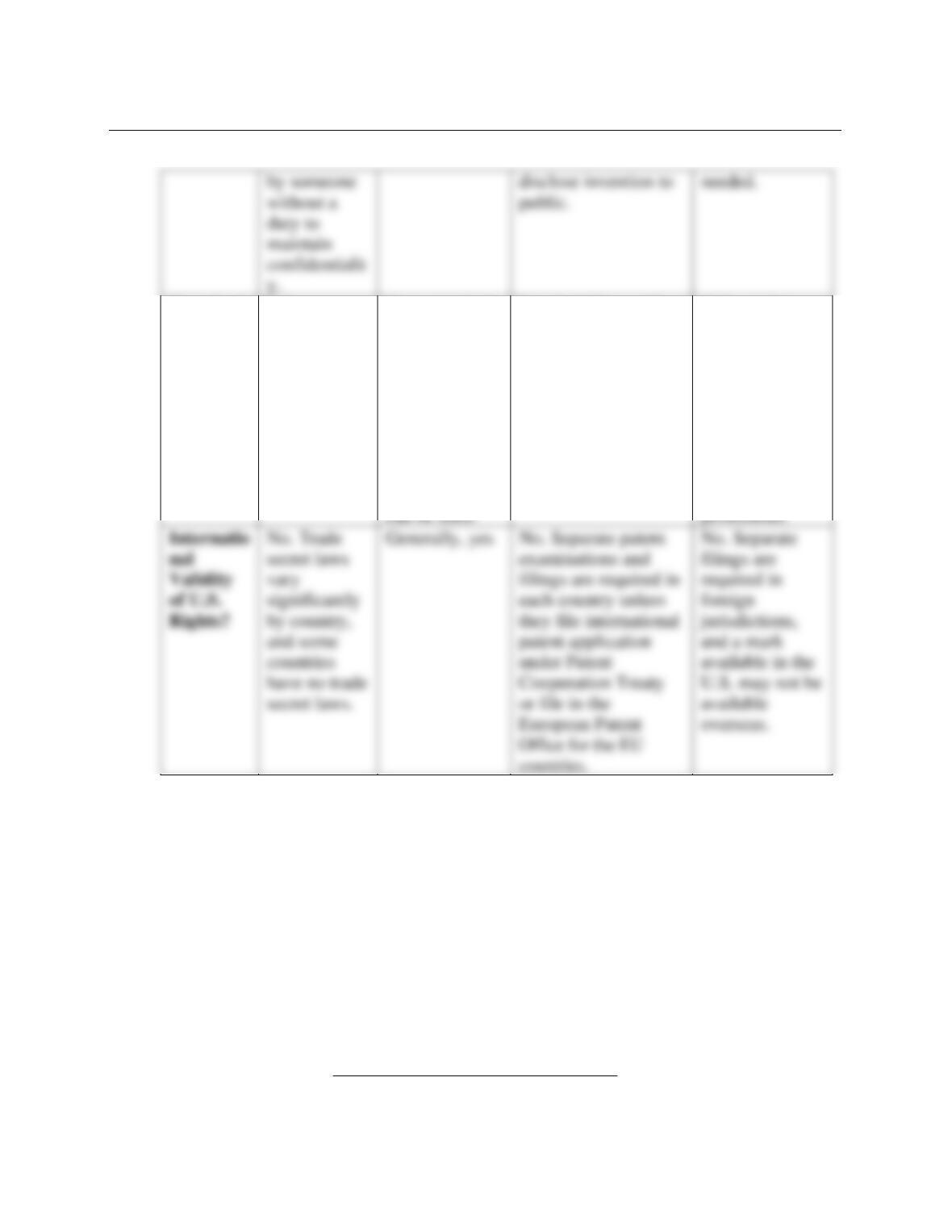
INTELLECTUAL PROPERTY PROTECTION: COMPARATIVE
ADVANTAGES
protection for
sensitive,
information;
very
inexpensive
copying of a
wide array of
literary expres-
sions,
including
inexpensive.
protection; provides
exclusive right to
making, using, and
selling an invention;
protects the idea
that customers
use to identify a
prevents others
from using
confusingly
identifying
Trade
Copyright
Patent
Trademark
marks.
Duration
So long as
the
information
remains
valuable and
is kept
confidential
Life of author
plus 50 years;
for
corporations,
75 years from
date of first
publication or
100 years from
date of
creation,
whichever is
shorter.
20 years from date of
filing utility or plant
patent application; 14
years from date of
filing design patent
application.
As long as the
mark is not
abandoned and
steps are taken
to police its use.
disclosure,
independent
creation by a
or disclosure
the idea itself;
hard to detect
copying in
expensive and time
consuming to pursue
(especially when
needed); must
little else; can
be costly if
multiple
registrations are
CHAPTER 11 INTELLECTUAL PROPERTY
11
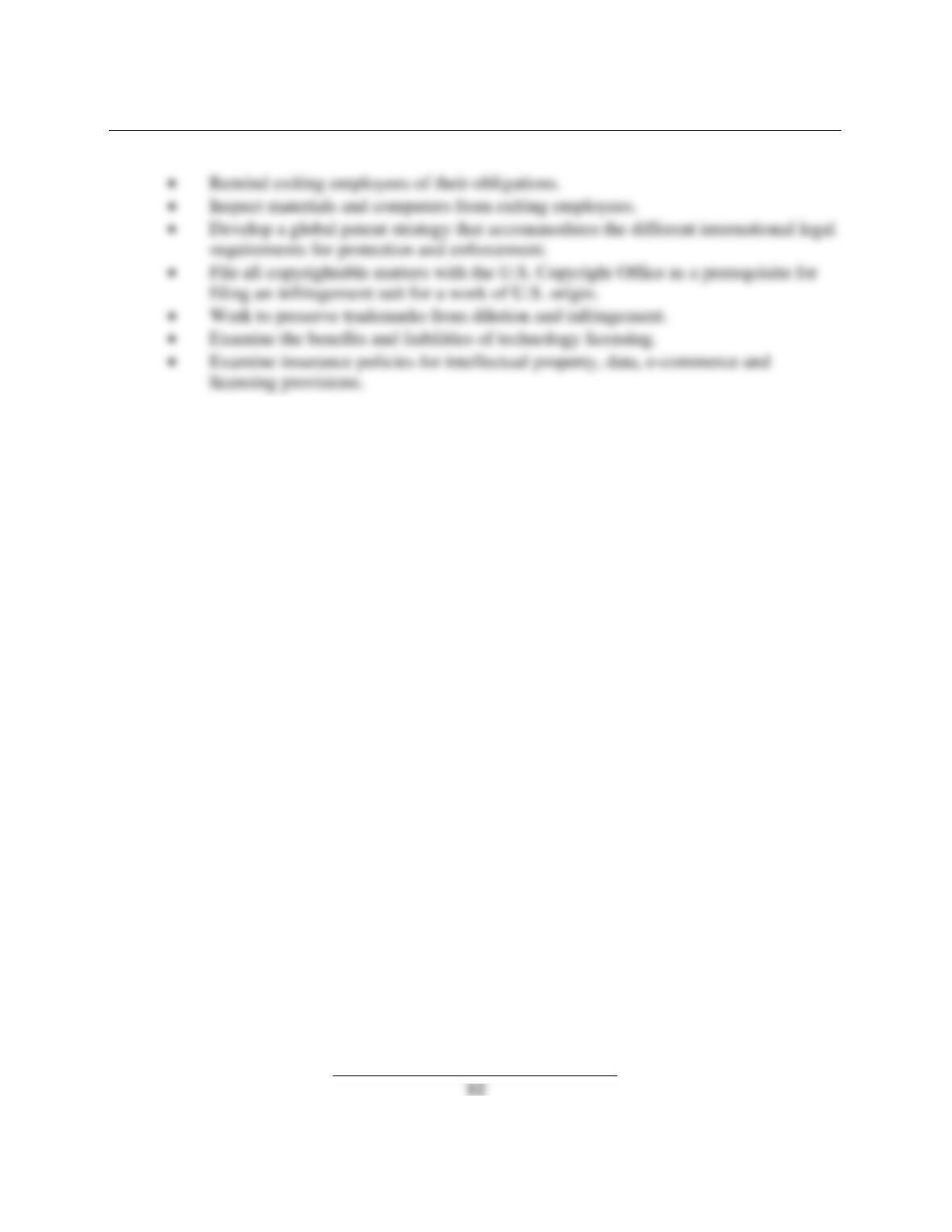
Required
Steps
Take
reasonable
steps to
protect—
generally a
trade secret
protection
program.
countries
have no trade
under Patent
Cooperation Treaty
available in the
U.S. may not be
None required;
however,
notice and
filing can
strengthen
rights and
filing is
required before
an action for
infringement
Detailed filing with
U.S. Patent and
Trademark Office
that requires search
for prior art and hefty
fees.
Only need to
use mark in
commerce;
however, filing
with U.S. Patent
and Trademark
Office is
usually
desirable to
gain stronger
RESPONSIBLE MANAGER: TEACHING SUGGESTIONS
1. As managers, discuss the advantages and disadvantages for licensing versus selling
software.
2. Below is a possible policy “checklist” for managers to protect the intellectual property of
their company. Discuss what issues may arise within smaller or larger companies.
• Provide written notice to all employees that it has a policy for IP and trade secrets
and violating the policies will result in civil and criminal liability.
by someone
without a
maintain
disclose invention to
public.
needed.
BAGLEY, MANAGERS AND THE LEGAL ENVIRONMENT 7TH ED—INSTRUCTOR’S MANUAL
3. Should an inventor be allowed to patent the process for making human clones?
4. Should living organisms be patentable?