10–21
2. Often OD is introduced by a change agent, a consultant with a
B. OD can be used to address the following three matters:
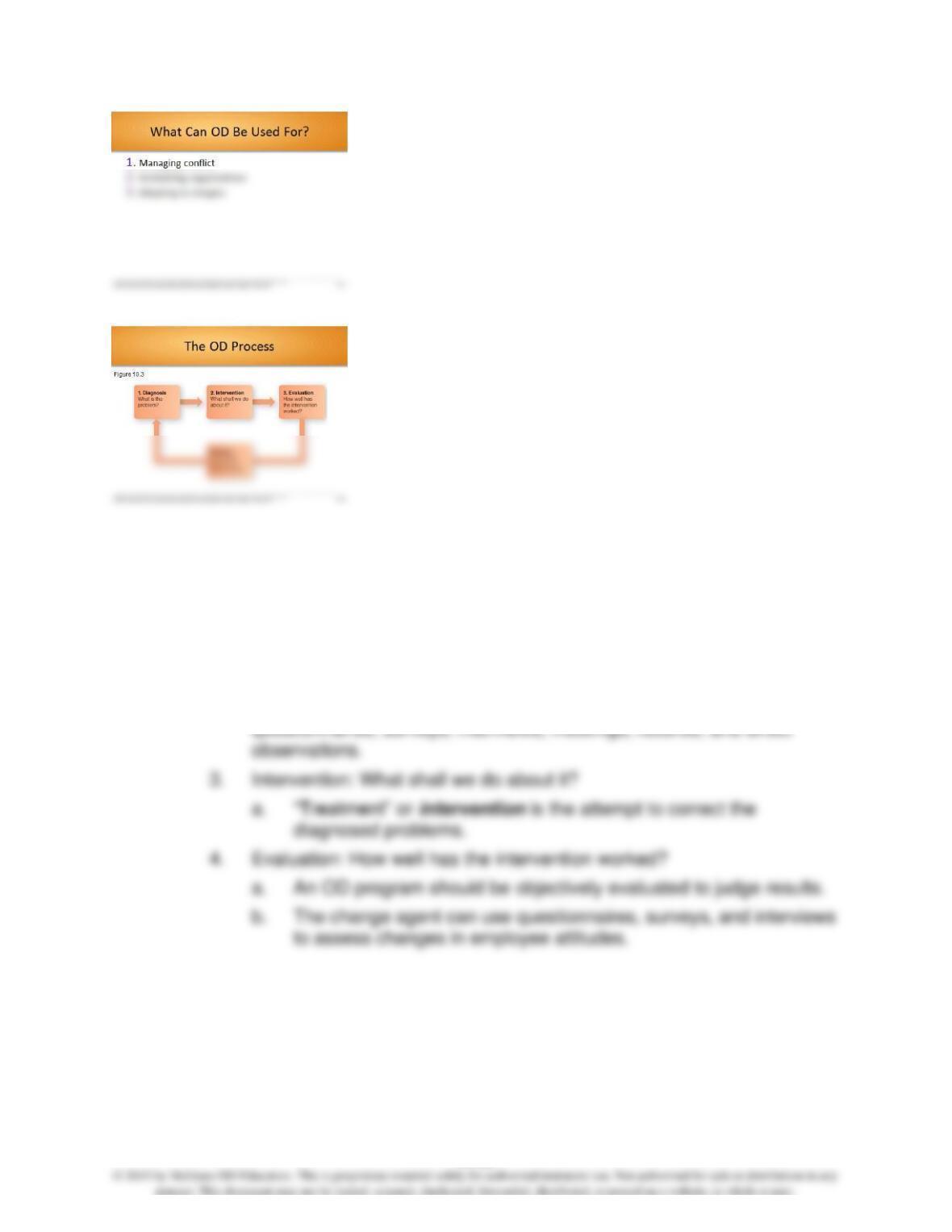
1. Managing conflict
2. Revitalizing organizations
a. Changing information technology is forcing nearly all
3. Adapting to mergers
a. Mergers and acquisitions can create increased anxiety, stress,
Chapter 10 – Organizational Change & Innovation: Lifelong Challenges for the Exceptional Manager
10–22
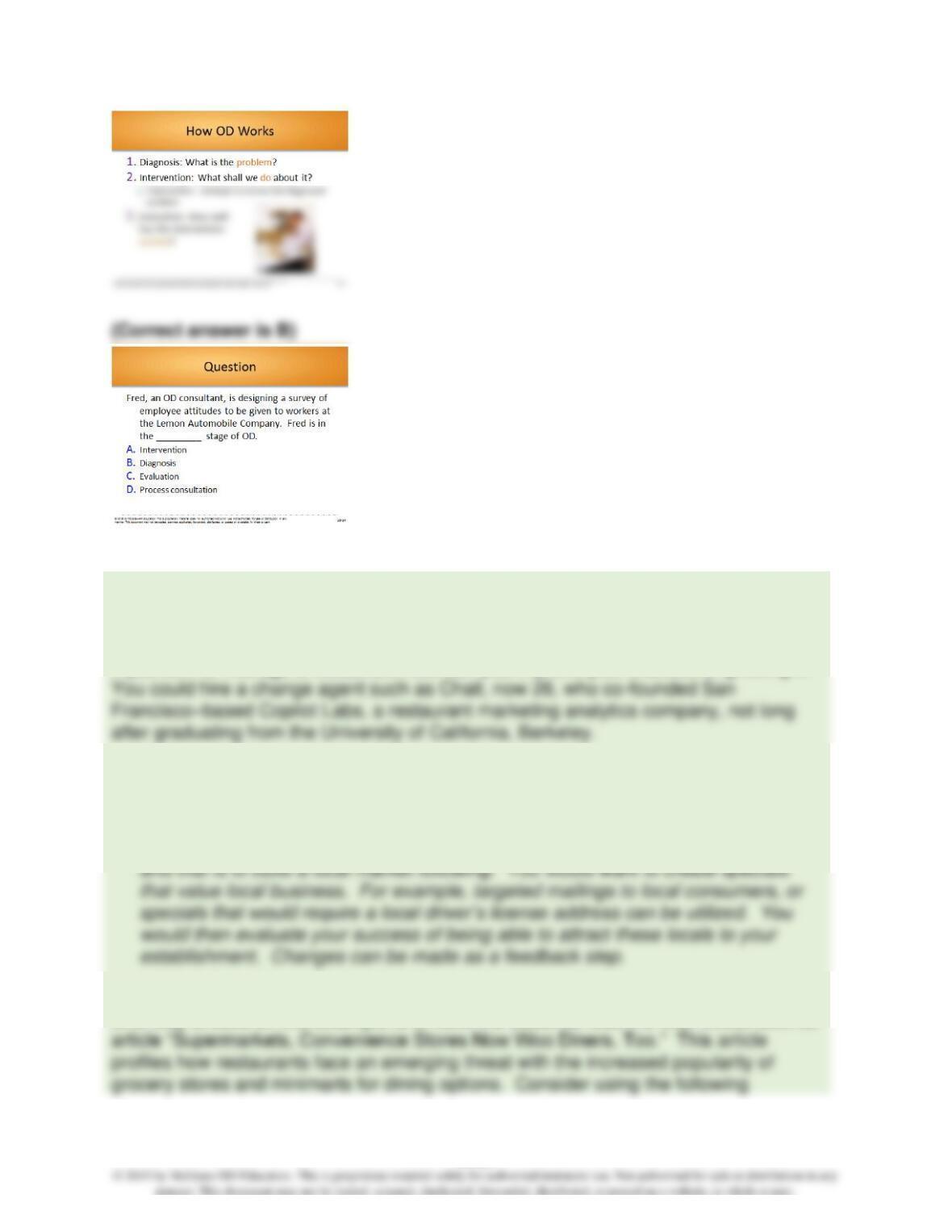
C. How OD Works
1. OD managers follow a medical-like model, approaching the
organization as if it were a sick patient, using diagnosis, intervention,
and evaluation.
a. To use a more current formulation, they follow the rules of
evidence-based management.
2. Diagnosis: What is the problem? OD consultants can use
Chapter 10 – Organizational Change & Innovation: Lifelong Challenges for the Exceptional Manager
10–23
Interactive Classroom Material:
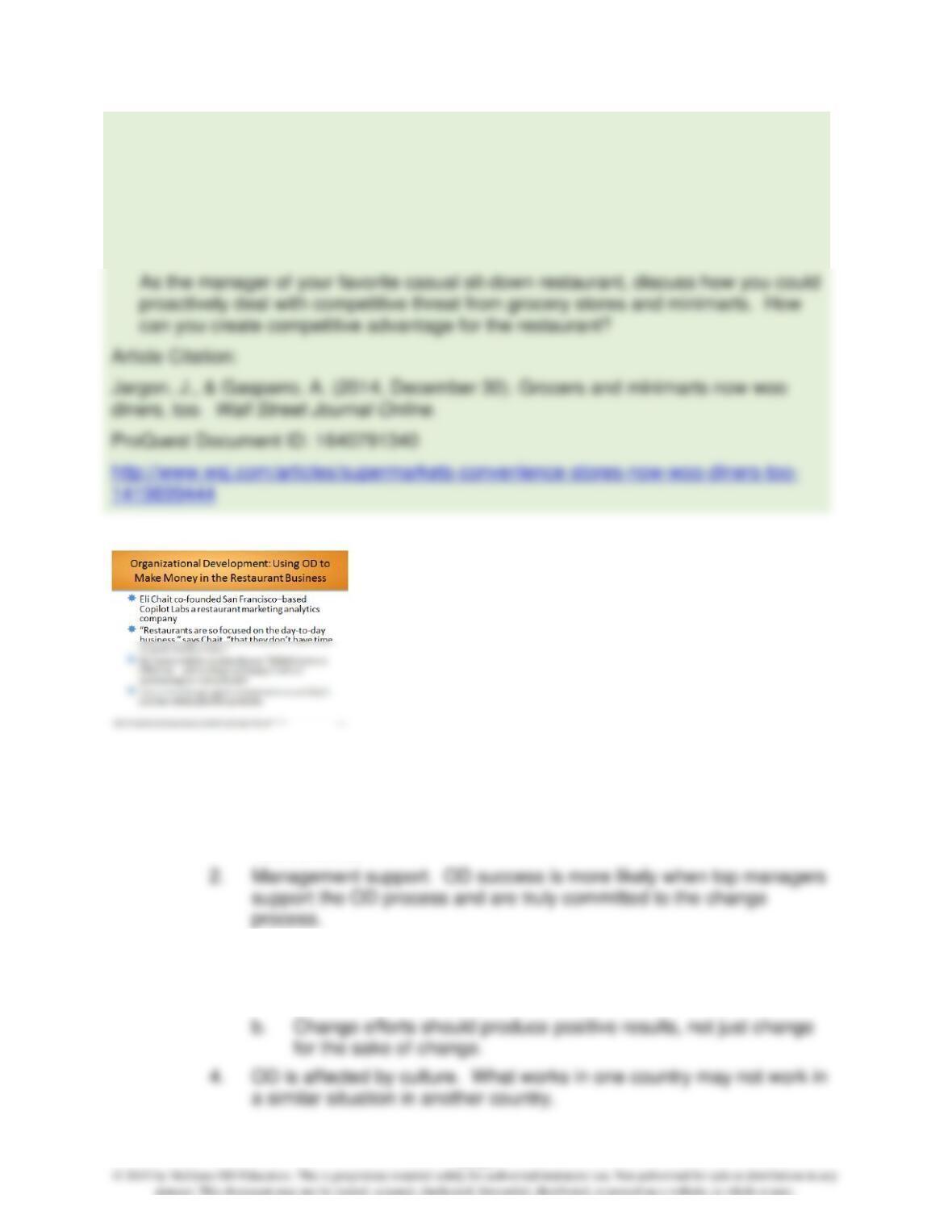
EXAMPLE: Organizational Development: Using OD to Make Money in the
Restaurant Business (pp. 318-319)
If you own or manage a restaurant, how can you improve your chances of growing it?
YOUR CALL
Do you think an organizational development approach can be helpful to this
effort?
An OD approach can be helpful. You would want to diagnose what the issue is,
Additional Activities:
One way to build on this Example is to have the students read the Wall Street Journal
Chapter 10 – Organizational Change & Innovation: Lifelong Challenges for the Exceptional Manager
10–24
discussion questions:
Discuss forces for change that are increasing the popularity of grocery stores and
minimarts for dining options.
Assume you are the manager of your favorite casual sit-down restaurant and you
have noticed a decline in sales recently. How could you use OD to address the
problem?
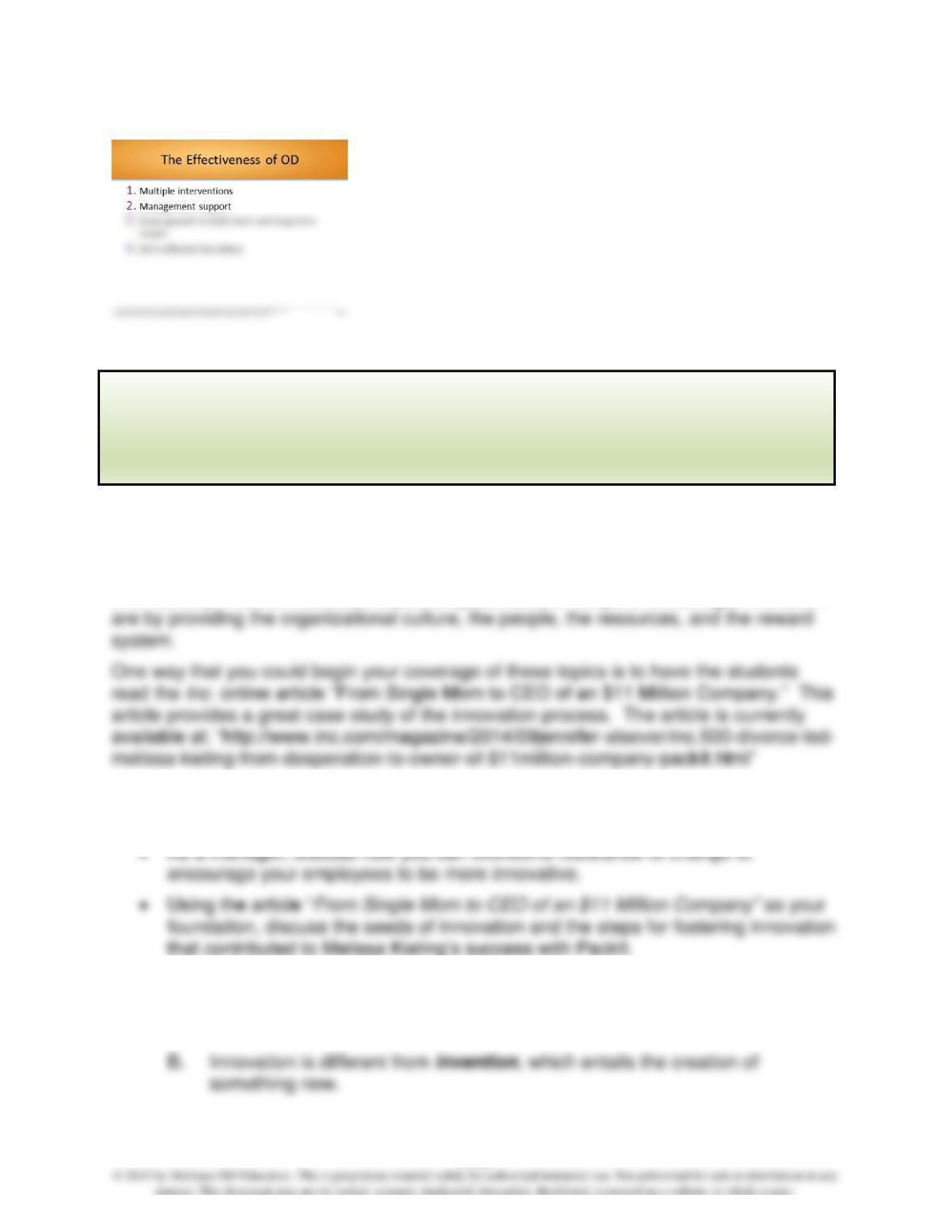
D. The Effectiveness of OD – OD is most apt to be successful under the
following conditions:
1. Multiple interventions. Combined interventions work better than single
interventions.
3. Goals geared to both short- and long-term results.
a. Change programs are more successful when they create both
short-term and long-term results.
Chapter 10 – Organizational Change & Innovation: Lifelong Challenges for the Exceptional Manager
10–25
Section 10.4 discusses the promotion of innovation within an organization. Innovation
may be a product innovation or a process innovation, a core (incremental) innovation or
a transformational (radical) innovation. Two myths about innovation are that it happens
in a “Eureka!” moment and that it can be systematized. Ways to encourage innovation
Possible Topics for Discussion:
• Discuss the organizational factors that encourage innovation.
Major Idea Outline:
A. Innovation is the activity of creating new ideas and converting them into
useful applications.
10.4 Promoting Innovation within the Organization (pp. 320-
326)
What do I need to know to encourage innovation?
Chapter 10 – Organizational Change & Innovation: Lifelong Challenges for the Exceptional Manager
10–26
C. It is also different from creativity, which is the process of developing
something new or unique.
D. The spirit of innovation is essential to keeping an organization vital and in
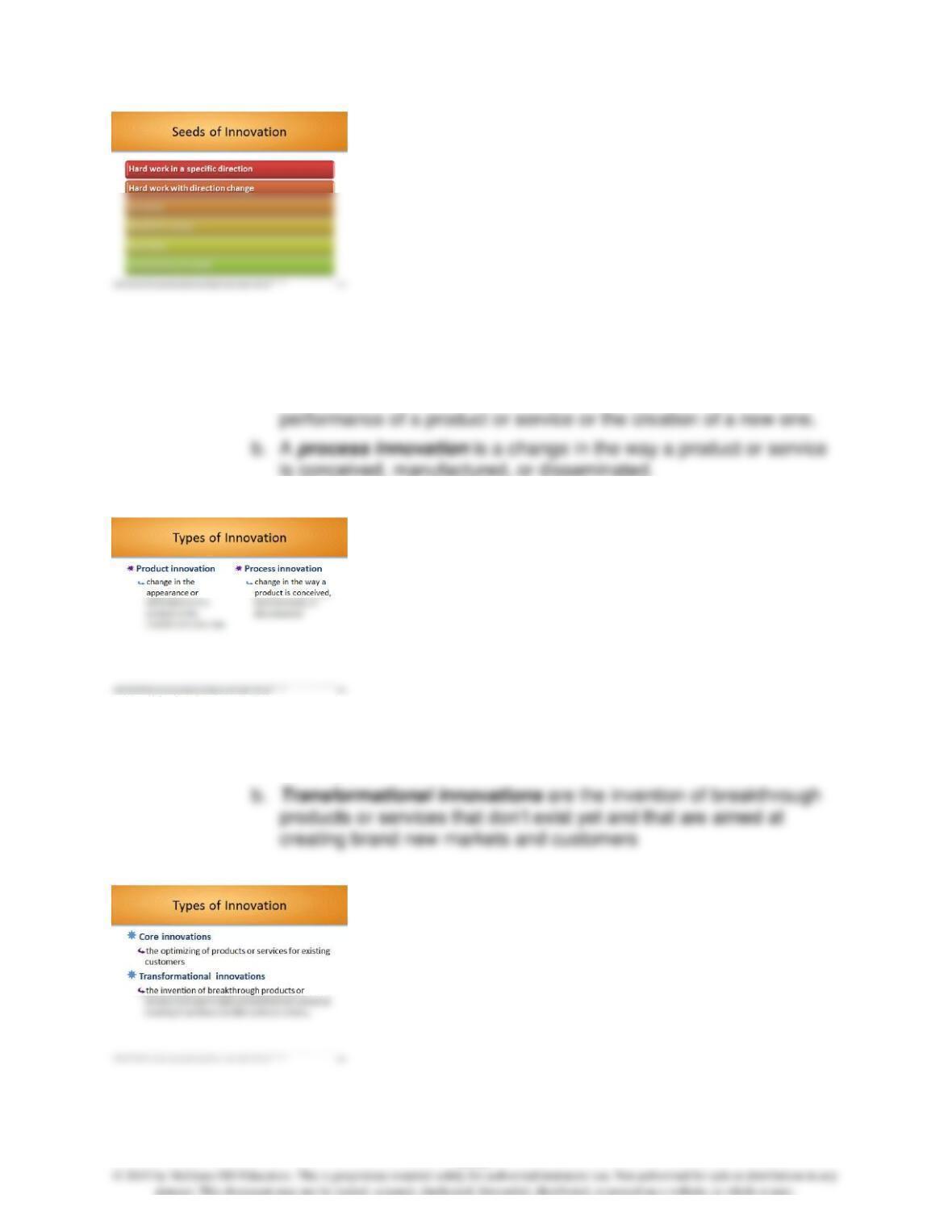
G. Former Microsoft employee and author Scott Berkun identified six seeds of
innovation, the starting point for organizational innovation.
1. Hard work in a specific direction. Most innovations come from
dedicated people diligently working to solve a well-defined problem.
2. Hard work with direction change. Innovations frequently occur when
people change their approach to solving a problem.
Chapter 10 – Organizational Change & Innovation: Lifelong Challenges for the Exceptional Manager
10–27
H. Types of Innovation: Product or Process, Incremental or Radical
1. Product versus process innovations.
a. A product innovation is a change in the appearance or
2. Core versus Transformational Innovations
a. Core innovations are the optimizing of products or services for
existing customers.

Chapter 10 – Organizational Change & Innovation: Lifelong Challenges for the Exceptional Manager
10–28
(Correct answer is B)
Interactive Classroom Material:
PRACTICAL ACTION: What Makes a Successful Startup? (p. 322)
The odds of succeeding in a startup are higher for certain industries, such as
computers. Thus, it’s not all entrepreneurial talent that drives success in a startup.
Entrepreneurs tend to do things better and faster, and have a higher tolerance for
ambiguity.
YOUR CALL
What “better and faster” niche opportunity do you see? Assuming it’s not a
computer company that you’re starting, what do you think your chances are of
being successful?
Most better and faster opportunities are in information technology, which is where
Additional Activities:
One way that you could build on this Practical Action is to have the students read the
Chapter 10 – Organizational Change & Innovation: Lifelong Challenges for the Exceptional Manager
10–29
Describe the characteristics Daymond John looks for when deciding people in
which to invest.
Would you describe Bubba’s Q World Famous Bar-B-Q, Bombas and Titin’s
innovations as product or process, and core or transformational? Defend your
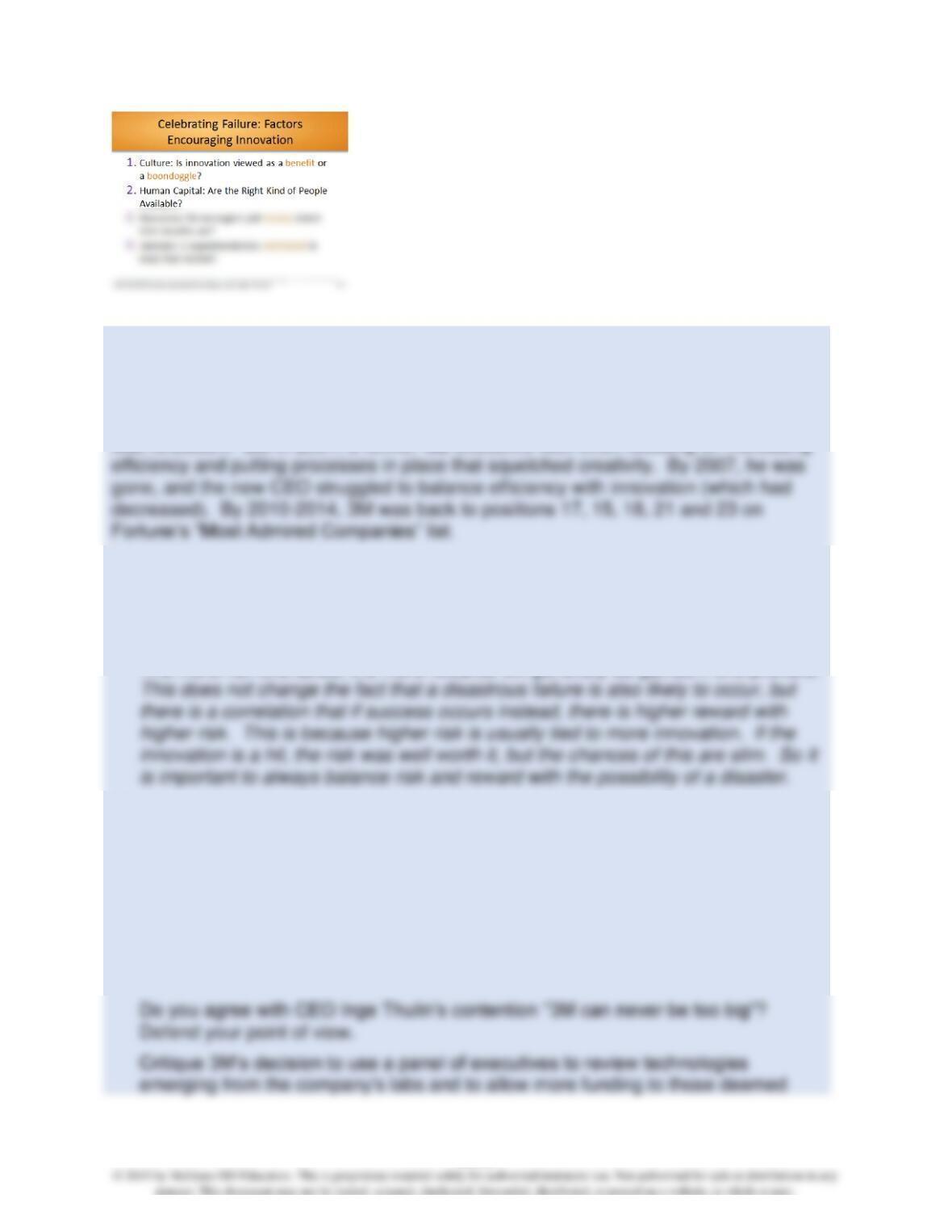
I. Celebrating Failure: Cultural and Other Factors Encouraging Innovation
1. Organizations have to develop ways to make innovation happen. Four
ways to do so are by providing the right organizational culture, the right
(1) An organizational culture that doesn’t just allow but celebrates
failure is vital toward fostering innovation.
2. Human capital: are the right kind of people available?
3. Resources: Do managers put money where their mouths are?
4. Rewards: Is experimentation reinforced in ways that matter?
Chapter 10 – Organizational Change & Innovation: Lifelong Challenges for the Exceptional Manager
10–30
Interactive Classroom Material:
PRACTICAL ACTION: Achieving Success by Celebrating Failure: 3M’s On-Again
Off-Again On-Again Culture of Innovation (p. 324)
3M built innovation into its culture. Mistakes were allowed and destructive criticism
was forbidden. But in 2001, a former GE executive took over, focusing on increasing
YOUR CALL
While risk taking can lead to either spectacular success or disastrous failure,
looking only at successes will show a positive correlation between success and
risk taking. Do you think this is true?
The more risk one takes, the more rewards will generally be gained if one prevails.
Additional Activities:
One way that you could build on this Practical Action is to have the students read the
Wall Street Journal article “3M’s Image Problem: Its Products Are Everywhere, But
Often Overlooked.” The article ponders the question: “How do you foster a high-tech
reputation when your best-known products include kitchen sponges and masking
tape?” Consider using the following discussion questions:
Discuss the challenges of creating innovation with a product line as diverse as
3M’s.
Chapter 10 – Organizational Change & Innovation: Lifelong Challenges for the Exceptional Manager
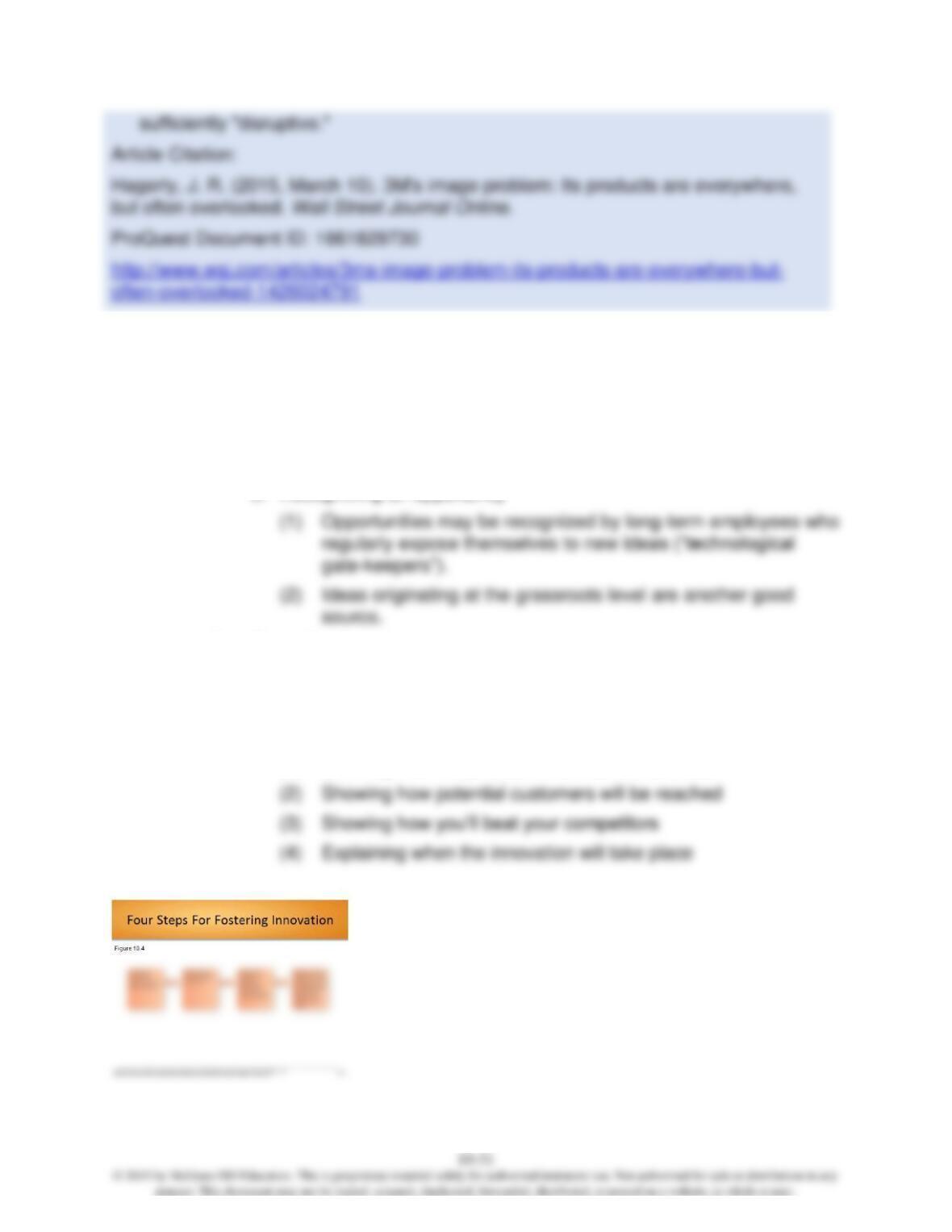
J. How You Can Foster Innovation: Four Steps
1. Recognize problems and opportunities and devise solutions.
a. Recognizing a problem
(1) Problems tend to seize our attention and these problems may
suggest solutions, such as new business ideas.
b. Recognizing an opportunity
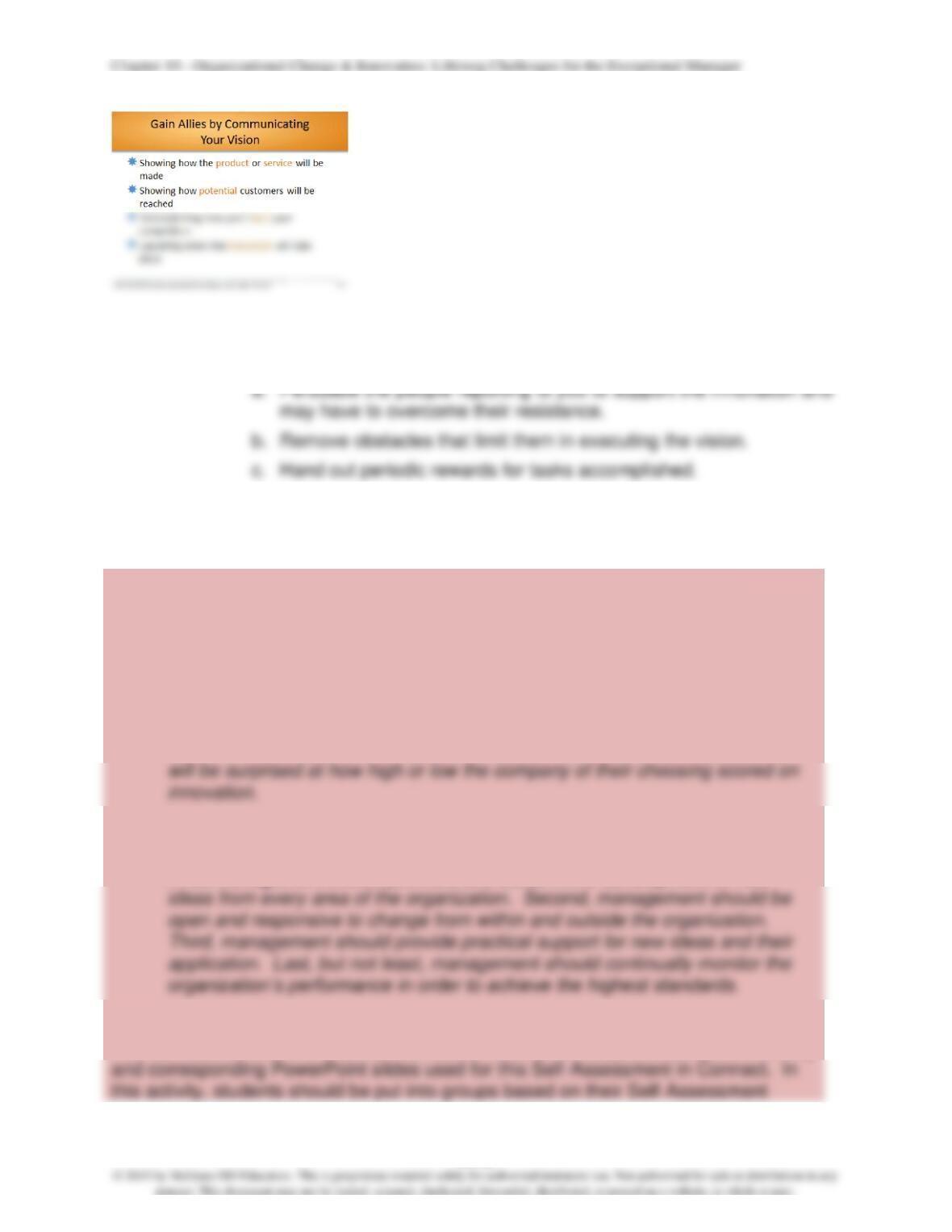
2. Gain allies by communicating your vision.
a. The process starts with developing and communicating your vision.
b. Start by persuading others inside the organization to support you.
c. Among the details you need to communicate are:
(1) Showing how the product or service will be made
10–32
3. Overcome employee resistance, and empower and reward them to
achieve progress.
4. Execute well. Execution will make or break an organization’s attempts
at bringing new products and services to market.
SELF-ASSESSMENT 10.2 (p. 326)
How Innovative Is the Organizational Climate?
Go to connect.mheducation.com and take Self-Assessment 10.2.
Student Questions:
1. To what extent does the company have an innovative climate?
Student responses will differ based on assessment results. Some students
2. Based on your survey scores, what advice would you give to management if
they wanted to increase innovation? Be specific.
First, management should promote and assist in the development of new
Additional Activities:
You can also consult the Connect Instructors Manual for the post-assessment activity
Chapter 10 – Organizational Change & Innovation: Lifelong Challenges for the Exceptional Manager
10–33
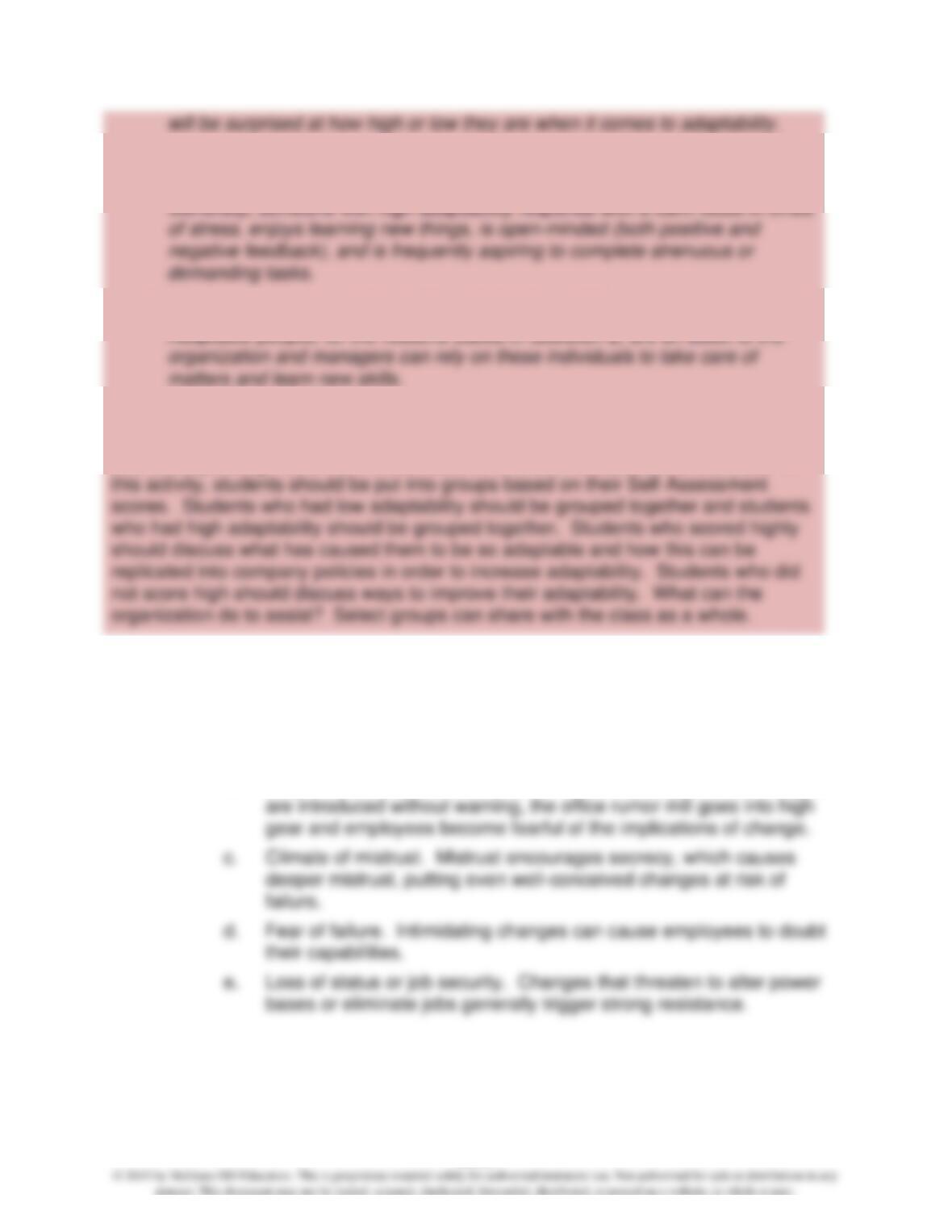
Section 10.5 discusses the causes of resistance to change and the reasons employees
fear change. Resistance can be considered to be the interaction of three causes: (1)
employee characteristics, (2) change agent characteristics, and (3) the change agent–
employee relationship.
Possible Topics for Discussion:
• Describe a time a change initiative at your company (or a previous one) failed or
was not as successful as it should have been. Discuss the resistance to change
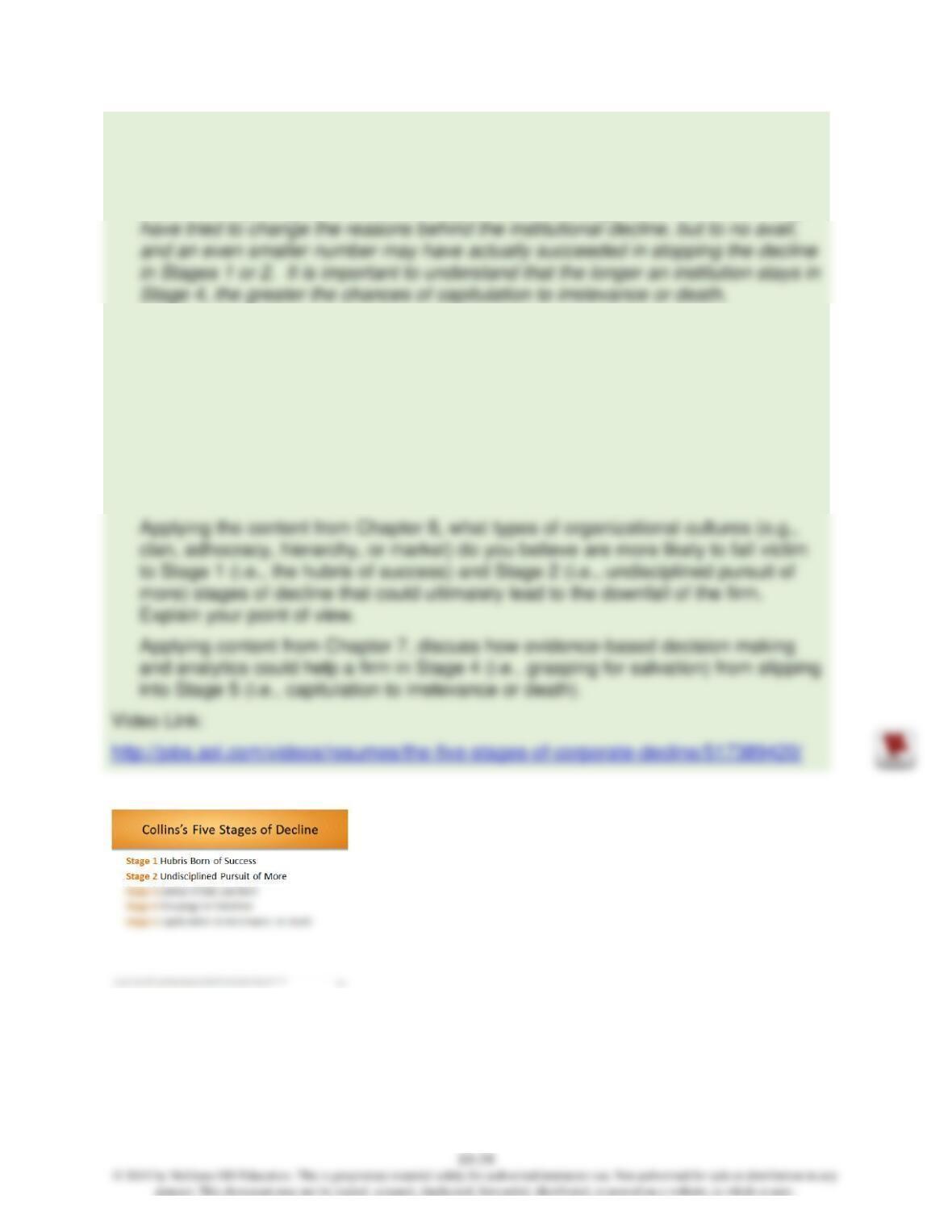
Interactive Classroom Material: Recognizing the Need for Change: Collins’s
Five Stages of Decline (p. 327)
Collins has found that there are five stages of institutional decline. The stages, which
are largely self-inflicted, are as follows: 1) Hubris born of success, 2) Undisciplined
pursuit of more, 3) Denial of risk and peril, 4) Grasping for salvation, and 5)
Capitulation to irrelevance or death.
10.5 The Threat of Change: Managing Employee
Fear & Resistance (pp. 327-330)
How are employees threatened by change, and how can I help them
adjust?
Chapter 10 – Organizational Change & Innovation: Lifelong Challenges for the Exceptional Manager
YOUR CALL
Have you ever experienced any one or more of these stages in a company?
What was it? What would you have done to try to change it?
Students may bring up examples of any of these five stages. Some of them may
Additional Activities:
One way to build on this Example is to have the students watch the AOL video “The
Five Stages of Corporate Decline.” In this 4-minute video, Jim Collins further
elaborates on how to recognize the five stages of corporate decline and why they
cause the destruction of the company. Consider using the following discussion
questions:
Identify firms that you believe are in each of the five stages of decline. Provide
specific examples of why you believe the firm is in the stage you believe it is in.
Major Idea Outline:
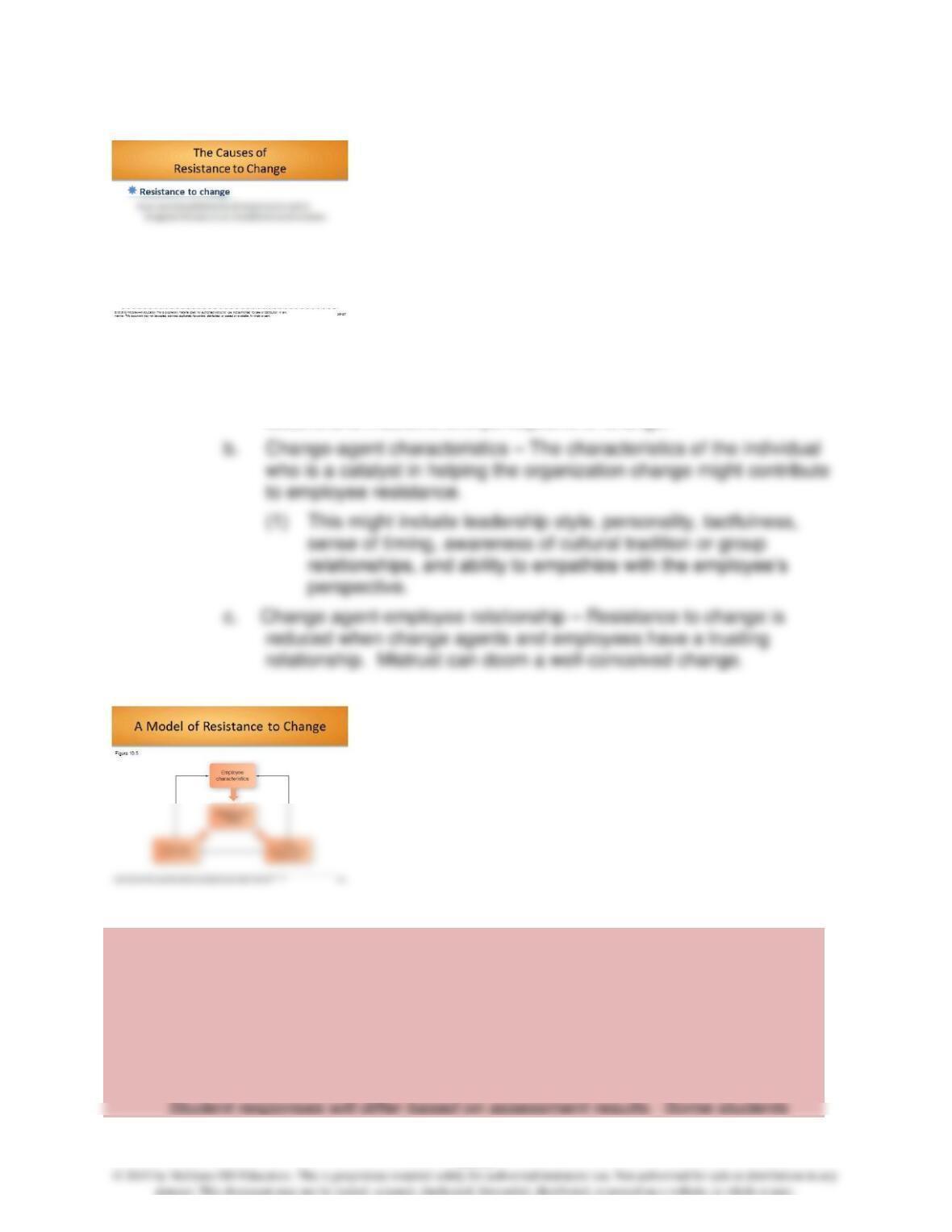
A. The Causes of Resistance to Change
1. Resistance to change is an emotional/behavioral response to real or
imagined threats to an established work routine.
Chapter 10 – Organizational Change & Innovation: Lifelong Challenges for the Exceptional Manager
10–35
2. There are three sources of resistance to change:
a. Employee characteristics – An employee’s individual differences,
actions and inactions and perceptions of change.
SELF-ASSESSMENT 10.3 (p. 328)
How Adaptable Are You?
Go to connect.mheducation.com and take Self-Assessment 10.3.
Student Questions:
1. What is your level of adaptability? Are you surprised by the results?
Chapter 10 – Organizational Change & Innovation: Lifelong Challenges for the Exceptional Manager
10–36
2. Based on your scores, identify three things you can do to increase your level
of adaptability? Explain.
3. Why would recruiters prefer to hire adaptable people?
Additional Activities:
You can also consult the Connect Instructors Manual for the post-assessment activity
and corresponding PowerPoint slides used for this Self-Assessment in Connect. In
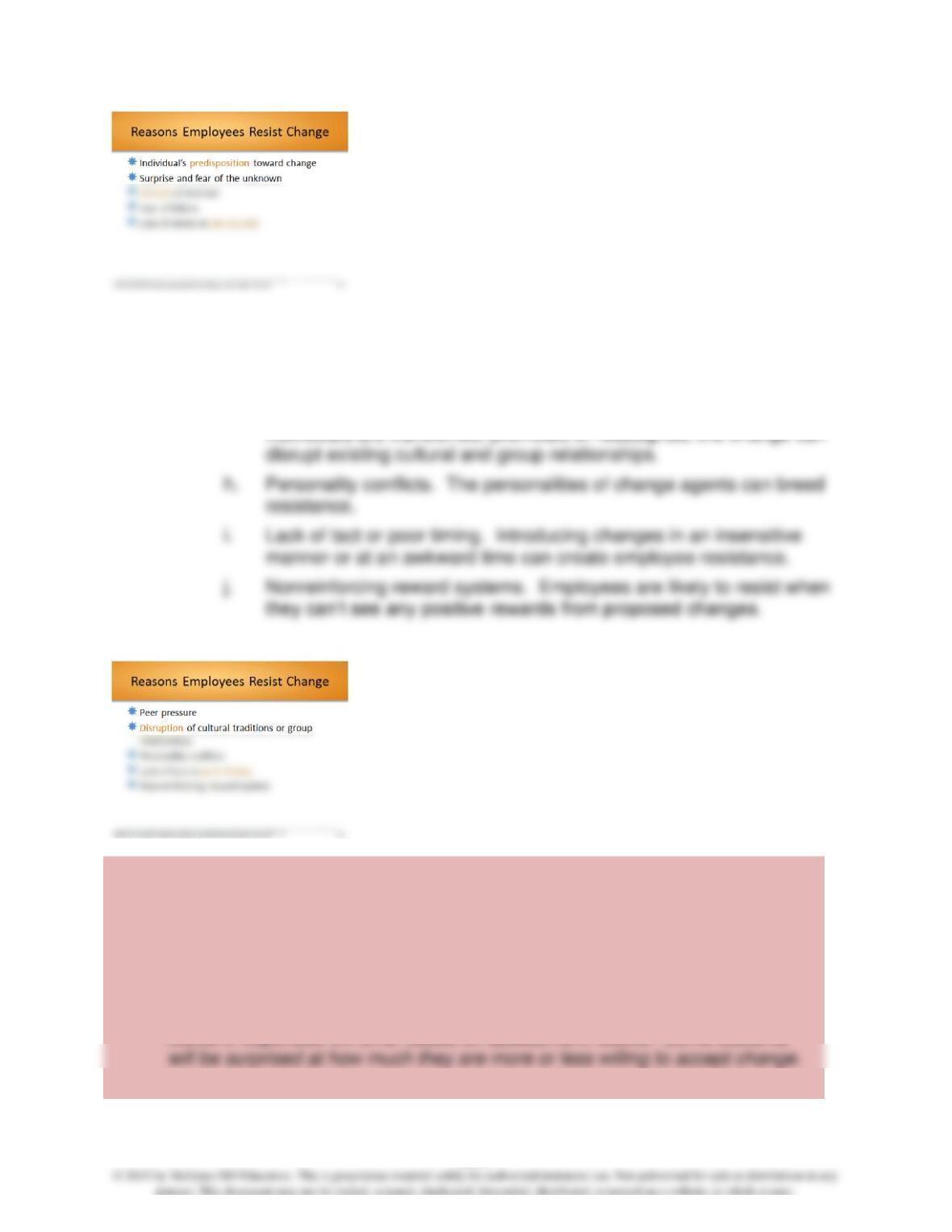
2. Whether changes are adaptive, innovative or radically innovative,
employees may resist them for all kinds of reasons, including:
a. Individual’s predisposition to change. How people react to change
depends on how they learned to handle change as children.
b. Surprise and fear of the unknown. When radically different changes
Chapter 10 – Organizational Change & Innovation: Lifelong Challenges for the Exceptional Manager
10–37
f. Peer pressure. Even people who are not directly affected by
impending changes may actively resist in order to protect the
interests of coworkers and friends.
g. Disruption of cultural traditions or group relationships. Whenever
SELF-ASSESSMENT 10.4 (p. 330)
Assessing Your Resistance to Change
Go to connect.mheducation.com and take Self-Assessment 10.4.
Student Questions:
1. Are you more or less willing to accept change? Discuss.
Student responses will differ based on assessment results. Some students
2. Based on your scores, identify three things you can do to lower your
Chapter 10 – Organizational Change & Innovation: Lifelong Challenges for the Exceptional Manager
10–38
resistance to change. These changes may involve new thoughts or beliefs or
the display of new behaviors.
Generally, individuals should be prepared for new things, and even seek them
3. What questions might a recruiter ask during an interview to determine whether
or not you tend to resist change? What would be your answers?
Recruiters may ask about a time when the candidate had to embrace change,
adapting to it, may weaken the candidate’s chance at the job.
Additional Activities:
You can also consult the Connect Instructors Manual for the post-assessment activity
and corresponding PowerPoint slides used for this Self-Assessment in Connect. In
this activity, Students should be put into groups based on their Self-Assessment
Group Exercise #1: Creating Personal Change through Force-Field Analysis
There is a group exercise available at the end of this manual that provides students
with the opportunity to apply force-field analysis to a behavior or situation they would
like to change.
Exercise Objectives
• To apply force-field analysis to a behavior or situation you would like to
Group Exercise #2: Overcoming Resistance to Change
There is a group exercise available at the end of this manual that provides students
with the opportunity to evaluate the causes of employees’ resistance to change.

Chapter 10 – Organizational Change & Innovation: Lifelong Challenges for the Exceptional Manager
Exercise Objectives
• To evaluate the causes of employees’ resistance to change.