
Chapter 10 – Groups, Teams and Their Leadership
BLIZZARD!
Interesting Team/Individual Facts
Average Individual Score 63.2
Average Individual Score for Females 61.7
Some Selected Results:
Top Management Teams (N=106) 48.5
Boy Scout Executives (N=3) 50.7
School Principles (N=29) 51.3
Chapter 10 – Groups, Teams and Their Leadership
10–22
Exercise 10-3
Exercise Title: Building Squares
Purpose: To demonstrate the value of cooperativeness in group problem solving.
Summary: This exercise requires groups of five participants each, with any number of observers for each
Here are five envelopes, each of which contains puzzle pieces for building squares. The task for your
group is to form five squares of identical size. You must follow these rules in building the squares:
1. No one may speak or signal in any way to another member of the group to pass a piece.
Observers should pay special attention to the following sorts of dynamics in the group(s) and
bring them out during the discussion:
– To what extent did group members focus attention on what could be useful to others (as
opposed to what they needed)?
This exercise takes 5 minutes to set up, another 10 minutes to do, and about 10 minutes to debrief.
Chapter 10 – Groups, Teams and Their Leadership
10–23
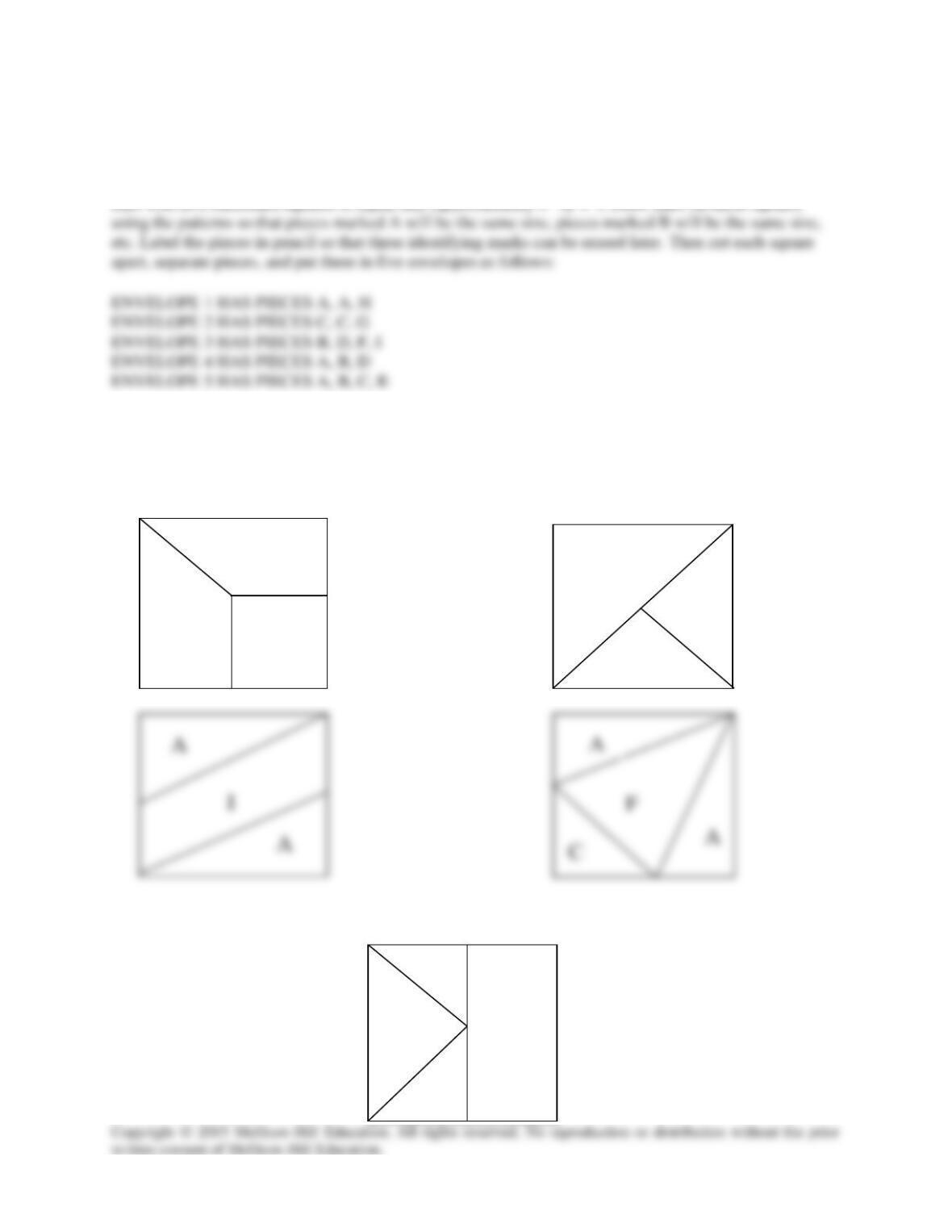
Instructions for Building a Set of Squares
Each set of squares consists of five envelopes containing pieces which, when assembled properly, form
five squares of identical size. Patterns for the five assembled squares are shown below. To construct a set,
start with five cardboard squares of equal size (approximately 6” by 6”). Draw lines on these squares
Erase the penciled letter from each piece and label each piece with the number corresponding to its
envelope (for easier return to the proper envelopes for the next time you will use the exercise).
A
F
A
C
D
D
E
I
B
G
B
H
B
C
C

10–24
Exercise 10-4
Exercise Title: Willow in the Wind
Purpose: To demonstrate the importance of trust in leadership and team building.
Summary: Break the class into groups of 6–8 people. Ask each group to form a fairly small circle (no
more than 4–5 feet across), and ask one group member to move to the center of the circle. Give the person
Chapter 10 – Groups, Teams and Their Leadership
10–25
Exercise 10-5
Exercise Title: Building Models
Purpose: To demonstrate the importance of vision, clarity, commitment, empowerment, and
communication in teams.
Summary: This exercise requires a preassembled tinker toy model. The model should resemble some
The group will have 20 minutes to perform this task, and the following rules apply:
1. Only the leader can see the preassembled model.
2. The leader must remain at least 12 feet away from the preassembled model at all times. (You can
implement this rule by allowing leaders to only look at the model from the doorway.)
Once the rules have been read, begin timing the exercise. Teams should begin by sending their leaders out
to view the model so that they can begin the assembly process. However, because the leader cannot speak
unless asked a question, teams often forget to ask the leader for periodic feedback on their progress. Also,
because the leader can only see the model when sent by the team, some teams get so engrossed with the
assembly of the model that they forget to send the leader out for repeated viewings. You may also want to
rotate the model periodically so that leaders see different aspects of the model (some leaders will even
This exercise takes about 35 minutes to complete.

Chapter 10 – Groups, Teams and Their Leadership
Exercise 10-6
Exercise Title: The Crossing
Purpose: To demonstrate group dynamics and decision making.
Summary: This exercise requires a 200+ ft. length of rope and blindfolds for all participants. Knots
should be tied in the rope every 20 ft. or so. This exercise is best conducted outside, and the rope should
be placed on the ground and strung around several obstacles, etc. To begin the exercise, have the
participants put their blindfolds on before seeing the rope. Have the participants form a line, so that the
left hand of each participant is on the shoulder of the person in front of him or her. The person in the front
Because the participants are all blindfolded for this exercise, instructors should ensure that the rope
“course” is free of potential safety hazards (fences, roots and low limbs of trees, ditches, etc.). The course
can be made more challenging if another rope is tied to the main rope, with the secondary and main ropes

Chapter 10 – Groups, Teams and Their Leadership
10–27
Exercise 10-7
Exercise Title: What Makes a Team Tick?
Purpose: To discuss how to build an effective team using material from Lao Tzu, a Chinese philosopher.
The exercise highlights leadership skills, successful team building, and followership.
Summary: Have the class break into groups and read the selected chapters of Lao Tzu’s Tao Te Ching,

Chapter 10 – Groups, Teams and Their Leadership
10–28
Exercise 10-8
Exercise Title: The Team Assessment Survey
Purpose: To diagnose team performance using The Rocket Model described in the Advanced Leadership
Skills Chapter.
Summary: The Rocket Model and corresponding Team Assessment Survey can be used as a prescriptive
intervention to help learning teams get started on the right foot, or to provide diagnostic feedback to
existing learning teams. Instructors can also ask students to rate learning teams they have been on in the
If students are in learning teams and will be rating an intact team, students should complete the Team
Assessment Survey independently. Once the ratings are completed, the surveys should be combined and
It takes about 20 minutes to complete and score the TAS (longer if doing this with intact learning teams),
and another 20–30 minutes to review and discuss the results.
An on-line version of the Team Assessment Survey and Feedback Report for organizational teams is
available through Curphy Consulting Corporation. Instructors wanting additional information about this
version of the TAS and how to use it in consulting engagements or in leadership development programs
should contact:
Chapter 10 – Groups, Teams and Their Leadership
10–29
Team
Assessment
Survey for
Learning Teams
Team:
Chapter 10 – Groups, Teams and Their Leadership
Use the following scale to respond to the items:
1——-————-——-2————–——–3———–————4——————-5
Strongly Disagree Disagree So–So Agree Strongly Agree
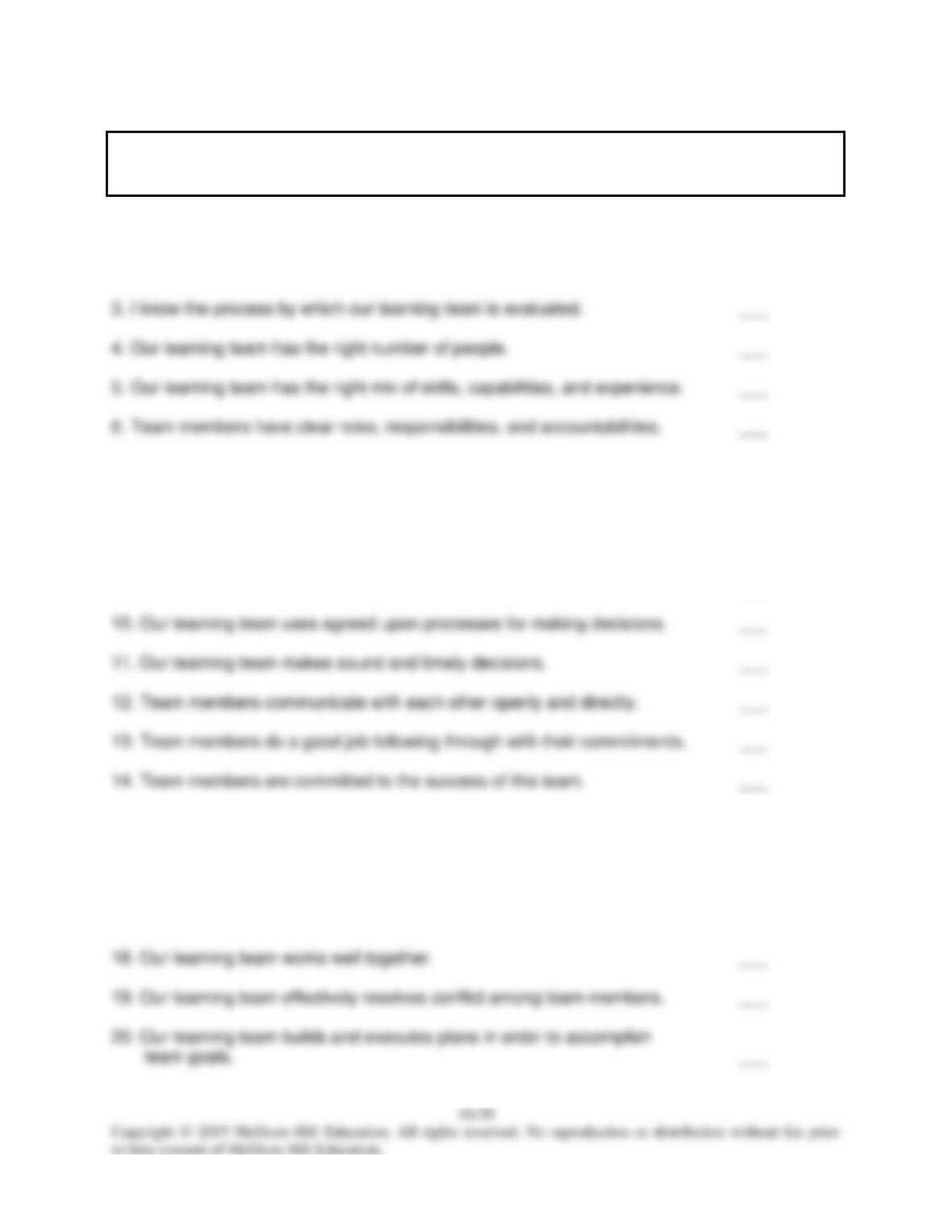
1. I have a clear understanding of our learning team’s purpose. ___
2. I understand our learning team’s overall goals. ___
7. Our learning team takes the time to learn from both successes and failures. ___
8. Our learning team plans and manages meetings in order to make
efficient use of time. ___
9. Our learning team spends enough time working on proactive versus
reactive issues. ___
15. Team members are actively involved with team goal setting and
decision making. ___
16. Our learning team has the authority it needs to make team decisions. ___
17. Our learning team has the resources necessary to achieve team goals. ___

Chapter 10 – Groups, Teams and Their Leadership
10–31
21. Our learning team successfully achieves team goals. ___
Chapter 10 – Groups, Teams and Their Leadership
10–32
Team Assessment
Survey Feedback
Report for Learning
Teams
Chapter 10 – Groups, Teams and Their Leadership
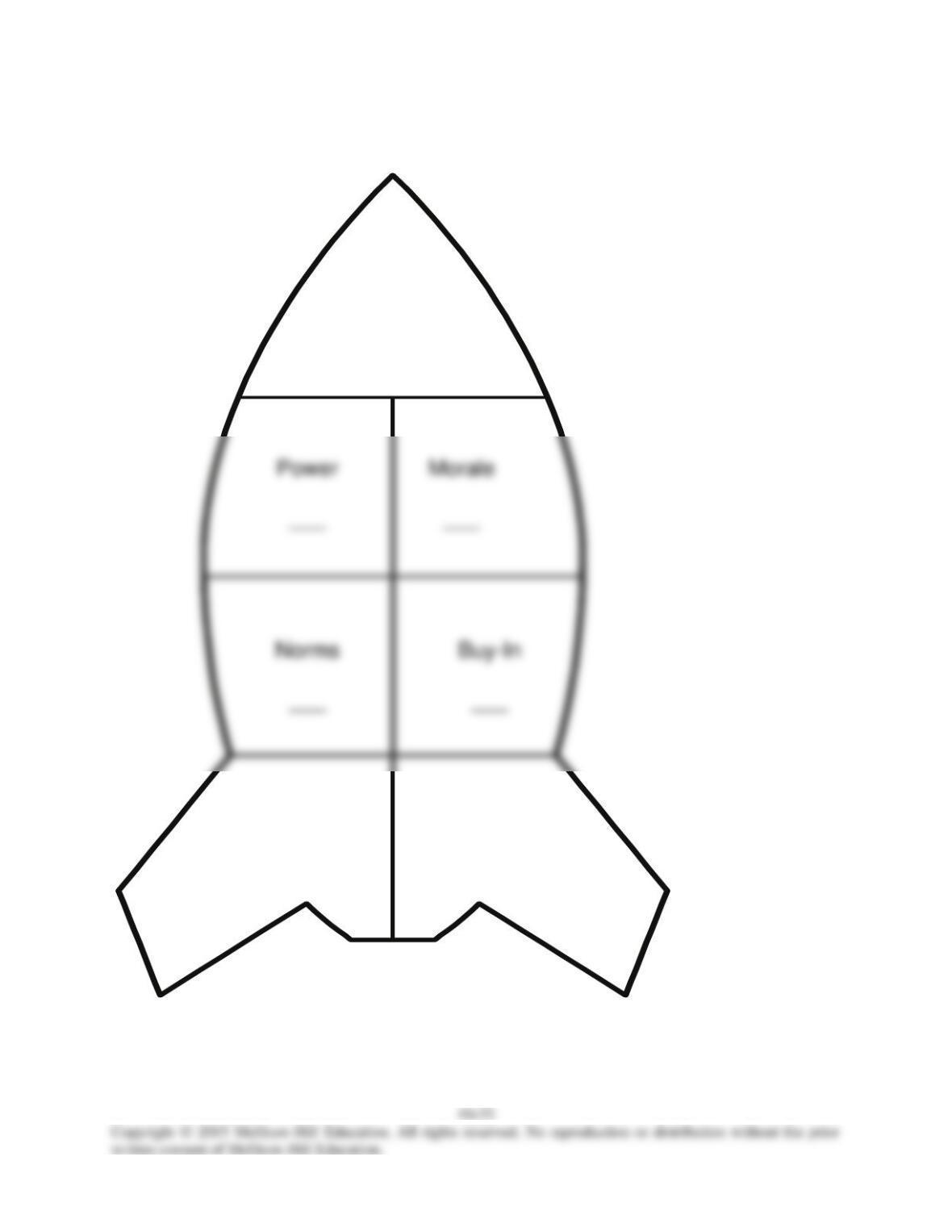
The Rocket Model: Average Scores
Number of Raters = ________
Mission
___
Talent
___
Results
____