10-1
Chapter 10
E-Commerce: Digital Markets, Digital Goods
Learning Objectives
1. What are the unique features of e-commerce, digital markets, and digital goods?
2. What are the principal e-commerce business and revenue models?
3. How has e-commerce transformed marketing?
Chapter Outline
10.1 E- Commerce and the Internet
E-Commerce Today
10.2 E-Commerce: Business and Technology
Types of E-Commerce
10.3 The Mobile Digital Platform and Mobile E-Commerce
Location-based Services and Applications
Other Mobile Commerce Services
10.4 Building an E-Commerce Presence
Pieces of the Site-Building Puzzle
Business Objectives, System Functionality, and Information Requirements
Building the Web Site: In-House Versus Outsourcing
Key Terms
The following alphabetical list identifies the key terms discussed in this chapter. The page
number for each key term is provided.

10-2
Business-to-business (B2B), 413
Business-to-consumer (B2C), 413
Co-location, 437
Community providers, 416
Exchanges, 431
Free/freemium revenue model, 419
Geoadvertising, 433
Geoinformation services, 433
Geosocial services, 433
Micropayment systems, 419
Mobile commerce (m-commerce), 413
Net marketplaces, 430
Personalization, 408
Podcasting, 415
10-3
Subscription revenue model, 419
Transaction costs, 405
Transaction fee revenue model, 419
Wisdom of crowds, 420
Teaching Suggestions
The opening case, “Groupon’s Business Model: Social and Local,” illustrates the evolution of e–
commerce from that of simply buying goods or services online to creating social experiences
shared by hundreds, thousands, or millions of people. It also shows how e-commerce is
becoming more “localized” because of the vast amounts of data collected about users and
Section 10.1, “E–Commerce and the Internet” This part of the text stresses the use of the
Internet and the World Wide Web for electronic commerce and business. Ask your students to
identify several of the many benefits that the Internet offers to organizations. Ask them to
provide specific examples that they have read about in the text or have personally observed. If
you have a student in your class who works for a company that participates in electronic business
and electronic commerce ask him/her to explain the company’s activities.
Discuss with your students how the Internet has unbundled the information about products and
services from the actual products and services. Ask the students to compare how they would
shop for a car today, as opposed to how they might have shopped for a car ten years ago. Use this
10-4
Section 10.2, “E–Commerce: Business and Technology” Students are introduced to electronic
commerce categories and related terminology. Even though millions of people use the Web
everyday, many companies have found ways to personalize their interfaces with individual
customers. That is a remarkable feat when you think about it. Have students visit Web sites that
offer such personalization and report on the products or features they find. For instance, Web
portals like Yahoo! and Google let users customize the home page to fit their personal needs.
Interactive Session: Organizations: Location-based Marketing and Advertising
Case Study Questions
1. Two different approaches to capturing consumer interest are described above.
Explain the difference between the approaches of Placecast and AdLocal.
Placecast uses geo-fencing to try to direct consumers to specific locations that they have
opted to have “pushed” to them when in the vicinity. On the other hand Adlocal is a
2. Do you think that targeted advertising is better than a blanket approach? What is
the difference for the advertiser and the consumer?
Obviously this is a matter of opinion. As far as the advertiser is concerned, the more
advertising is aimed at the right set of people the more cost effective it is. Wasting
10-5
3. The information from the comScore survey did not differentiate between age
groups, only country. Do you think there are major differences between behavior in
the different age groups that would make location-based marketing better for one
group than another?
Although there will be differences between countries there will be a further
differentiation between age groups with younger people making more use of their mobile
4. Think of businesses in your high street that might benefit from joining the O2
scheme. What could they offer?
The type of business that would benefit could be almost any offering goods or services.
Interactive Session: People: Social Commerce Creates New Customer Relationships
Case Study Questions
1. Assess the management, organization, and technology issues for using social media to
engage with customers.
Management: Levi’s creating a “Levi’s Guy” to help build interest in the company’s brand.
Personalizing the company was a huge success. The company also created a personalized
10-6
2. What are the advantages and disadvantages of using social media for advertising,
brand building, market research, and customer service?
Advantages:
• Advertising: Twitter has developed new offerings for advertisers like Promoted
Tweets and Promoted Trends. These features give advertisers the ability to have their
Disadvantages:
• Starbucks’s social media contest backfired on the company when people posted
3. Give some examples of management decisions that were facilitated by using social
media to interact with customers.
Wrigleyville knows which customers respond to its promotions, how much they spent, and
what they purchased. It can measure conversion rates, the value of keyword buys, and the
10-7
4. Should all companies use Facebook and Twitter for customer service and advertising?
Why or why not? What kinds of companies are best suited to use these platforms?
Before a company jumps into using Facebook and Twitter it needs to make sure the “back
room” mechanics are in place to process customer service requests. Best Buy did it right by
Section 10.3, “The Mobile Digital Platform and Mobile E-Commerce” M-commerce consists
of selling anything over a mobile wireless device or Net appliance. It is also a method used by
marketers to target advertising more directly to consumers. Wireless mobile devices are turning
up everywhere. The newer appliances integrate a number of features traditionally only found in
Section 10.4, “Building an E–Commerce Presence” This may be the first time students are
exposed to the mechanics of designing and building an e-commerce Web site. No doubt they all
have used e-commerce Web sites before but probably have never thought about the challenges
facing business managers who are responsible for building a successful online business. While
10-8
Review Questions
1. What are the unique features of e-commerce, digital markets, and digital goods?
Name and describe four business trends and three technology trends shaping e–
commerce today.
Students can answer this question by including information outlined in Table 10-1, which
List and describe the eight unique features of e-commerce.
Table 10-2 outlines eight unique features of e-commerce which include:
• E-commerce technology is ubiquitous, meaning that it is available just about
Define a digital market and digital goods and describe their distinguishing features.
Digital markets are said to be more “transparent” than traditional markets. Table 10-3
describes distinguishing features of digital markets. The Internet has created a digital
marketplace where millions of people are able to exchange massive amounts of information
10-9
directly, instantly, and for free. Information asymmetry is reduced. Digital markets are very
flexible and efficient, with reduced search and transaction costs, lower menu prices, and the
2. What are the principal e-commerce business and revenue models?
Name and describe the principal e-commerce business models.
Table 10-5 identifies seven Internet business models.
• E-tailer: Sells physical products directly to consumers or individual businesses.
• Transaction broker: Saves users money and time by processing online sale
Name and describe the e-commerce revenue models.
There are six e-commerce revenue models:
• Advertising revenue: Generates revenue by attracting a large audience of visitors
who can then be exposed to advertisements. It’s the most widely used revenue model
10-10
3. How has e-commerce transformed marketing?
Explain how social networking and the “wisdom of crowds” help companies improve
their marketing.
Networking sites sell banner, video, and text ads; sell user preference information to
marketers; and sell products such as music, videos, and e-books. Corporations set up their
Define behavioral targeting and explain how it works at individual Web sites and on
advertising networks.
Behavioral targeting refers to tracking the click-streams of individuals for the purpose of
understanding their interests and intentions, and exposing them to advertisements which are
uniquely suited to their behavior. Ultimately, this more precise understanding of the customer
leads to more efficient marketing and larger sales and revenues. Behavioral targeting of
10-11
Define the social graph and explain how it is used in e-commerce marketing.
A social graph is a depiction of all the people you know and all the people they know. A
digital social graph is a mapping of all significant online social relationships. It’s
synonymous with the idea of a “social network” used to describe offline relationships. The
4. How has e-commerce affected business-to-business transactions?
Explain how Internet technology supports business-to-business electronic commerce.
Business-to-business transactions can occur via a company Web site, net marketplace, or
private exchange. Web sites make it easy to sell and buy direct and indirect goods over the
Define and describe Net marketplaces and explain how they differ from private
industrial networks (private exchanges).
A net marketplace is a single digital marketplace based on Internet technology linking many
5. What is the role of m-commerce in business, and what are the most important m-
commerce applications?
List and describe important types of m-commerce services and applications.
10-12
The most popular categories of m-commerce services and applications for mobile computing
include:
• Location-based services: Users are able to locate restaurants, gasoline stations, local
6. What issues must be addressed when building an e-commerce Web site?
List and describe each of the factors that go into the building of an e-commerce Web
site.
• Remain aware of the main areas that require decisions.
• Form a team of individuals who possess the skill sets needed to make key
List and describe four business objectives, four system functionalities, and four
information requirements of a typical e-commerce Web site.
Table 10-8 lists nine business objectives with accompanying system functionalities and
information requirements necessary for each. Four of the most common are:
• Display goods (objective) using a digital catalog (system functionality) for
10-13
List and describe each of the options for building and hosting e-commerce Web sites.
Figure 10-10 depicts the alternatives to consider when building and hosting an e-commerce
site. They include:
• Completely hosting and building the site in-house.
Discussion Questions
1. How does the Internet change consumer and supplier relationships?
One clear change is that consumers can research products and services online and then make
their purchases either on the Internet or in physical stores. As the Internet increases the
richness and range of information that is available, it shrinks information asymmetry.
2. The Internet may not make corporations obsolete, but the corporations will have to
change their business models. Do you agree? Why or why not?
Most students will probably agree, but whichever way they go, they must support their case.
If you have students on both sides of the issue, lead a discussion that challenges the position
of both sides.
The megatrends include:
• New channels are revolutionizing sales and brand management.
• The balance of power may be shifting to the customer.
• Competition is intensifying across all dimensions.
3. How have social technologies changed e-commerce?
The sheer numbers of people using social networking, over 120 million users every day in
the United States, changes e-commerce business models and strategies. The networking sites
sell banner, video, and text ads; sell user preference information to marketers; and sell
Hands-On MIS Projects
Management Decision Problems
10-15
1. Columbiana: A small, independent Caribbean island that wants to develop its tourist
industry and attract more visitors. How can a Web presence help? What Internet business
model would be appropriate? What functions should the Web site perform?
2. Company-sponsored blog: Visit Blue Nile, J.Crew, Lowe’s, and Priceline. Determine
which of these Web sites would benefit most from adding a company-sponsored blog to the
Web site. List the business benefits of the blog. Specify the intended audience for the blog.
Specify the intended audience for the blog. Decide who in the company should author the
blog, and select some topics for the blog.
• Blue Nile: This company would probably benefit from a blog that would discuss different
kinds of diamond products and other jewelry. The blog written by one of the company’s
Improving Decision Making; Using Spreadsheet Software to Analyze a Dot-Com Business
Software skills: Spreadsheet downloading, formatting, and formulas
Business skills: Financial statement analysis
Answers will vary, depending on the company they select and the time period over which it is
analyzed. The files provided here are merely for purposes of illustration and the income
10-16
Achieving Operational Excellence: Evaluating E-Commerce Hosting Services
Software skills: Web browser software
Business skills: Evaluating e-commerce hosting services
You would like to set up a Web site to sell towels, linens, pottery, and tableware from
Portugal and are examining services for hosting small business Internet storefronts. Your
Web site should be able to take secure credit card payments and to calculate shipping costs
and taxes. Initially you would like to display photos and descriptions of 40 different
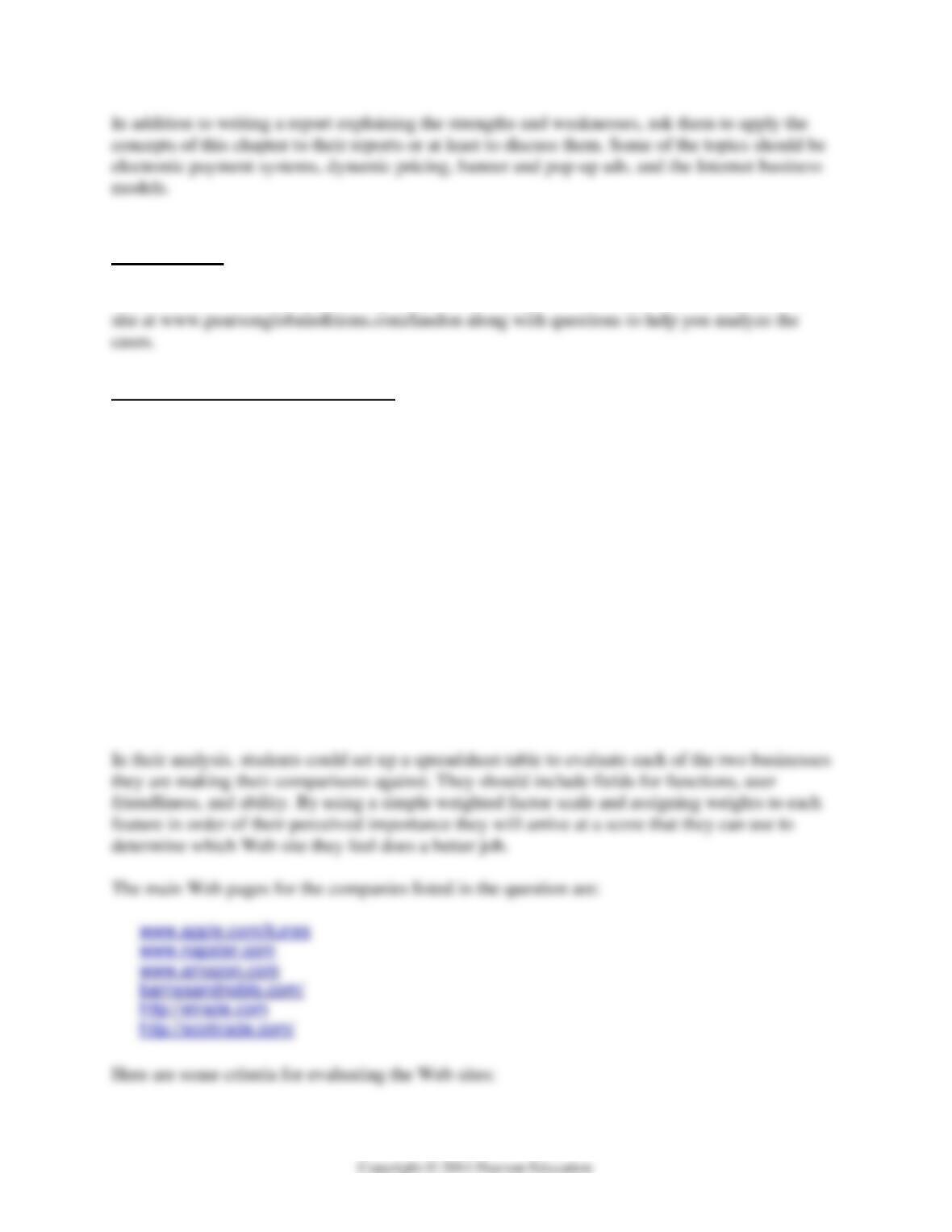
products. Visit Yahoo! Small Business, GoDaddy, and Comcast and compare the range of
e-commerce hosting services they offer to small businesses, their capabilities and costs. Also
examine the tools they provide for creating an e-commerce site. Compare these services
and decide which you would use if you were actually establishing a Web store. Write a
brief report indicating your choice and explaining the strengths and weaknesses of both.
YAHOO! Small Business Merchant Solutions
Starter
Standard
Professional
Deluxe Plan
$39.95/month
$99.95/month
$299.95/month
10-17
Video Cases
You will find video cases illustrating some of the concepts in this chapter on the Laudon Web
Collaboration and Teamwork: Performing a Competitive Analysis of E-Commerce Sites
Form a group with three or four of your classmates. Select two businesses that are
competitors in the same industry and that use their Web sites for electronic commerce.
Visit these Web sites. You might compare, for example, the Web sites for iTunes and
Napster, Amazon and BarnesandNoble.com, or E*Trade and Scottrade. Prepare an
evaluation of each business’s Web site in terms of its functions, user friendliness, and
ability to support the company’s business strategy. Which Web site does a better job?
Why? Can you make some recommendations to improve these Web sites? If possible, use
Google Sites to post links to Web pages, team communication announcements, and work
assignments; to brainstorm; and to work collaboratively on project documents. Try to use
Google Docs to develop a presentation of your findings for the class.
Answers for this project will vary as students will select different businesses from which to
complete the comparison. The simplest method would be to go directly to each of the company’s
main Web page as listed in the question.
10-18
Case Study: To Pay or Not to Pay: Zagat’s Dilemma
Case Study Questions
1. Evaluate Zagat using the competitive forces and value chain models.
Zagat was the victim of two competitive forces, new market entrants and substitute products
and services, when Yelp, Groupon, Google Places, and other similar services offering free
2. Compare Zagat’s and Yelp’s e-commerce business models. How have those models
affected each company’s Web strategy?
For much of 2011, Zagat trailed Yelp and other free review sites in the battle for eyeballs.
10-19
3. Why was Zagat’s content well suited for the Web and for the mobile digital platform?
Zagat’s content is appealing to people on the move. When visiting major cities, people may
not know the best places to eat, the kinds of food served in particular restaurants, or the hours
of operations. Zagat’s mobile app features access to Zagat premium ratings and reviews and
4. Do you think Zagat’s decision to use a pay wall for its Web site was a mistake? Why or
why not?
In all likelihood, the decision to use a pay wall severely harmed Zagat’s position as the
premier food and restaurant guide and gave its competitors an easy opportunity to infringe on
its territory. People are used to getting free content and tend to bypass pay-for-view sites in
5. Will Zagat’s acquisition by Google make it more competitive? Explain your answer.
Google purchased Zagat.com in September, 2011. The acquisition strengthens Google’s
position in mobile and local search, helping it to compete against Yelp for high-volume

10-20