Hitt 13e Case Teaching Notes
Case 10: The Movie Exhibition Industry: 2018 and Beyond
Case Synopsis
The motion picture industry has been in a precarious position over the last several years. While
box office attendance has varied year by year, there has been an overall decline of 21% since
2002. Ticket prices have steadily increased, and some say these prices may be exceeding the
These players include three essential categories of participants: studios, some of which make
multimillion-dollar investments in the hope that a gross-sales-to-production-cost ratio of 2.0
allows them to break even; distributors, which are responsible for marketing, logistics, and
administration as well as providing digital copies of films to exhibitors; and exhibitors, or movie
theaters, which are dominated by a few chains that have the ability to negotiate better deals
and realize economies of scale due to their large sizes. Given that film rental fees average 54%
of box office receipts, theaters must seek additional revenues from concessions and
advertising.
In response to these innovations that have virtually eroded their competitive advantage,
exhibitors are looking for ways to restore the theater experience to a place of prominence in
consumers’ minds. These initiatives include even larger screens, a 4D viewing experience
Learning Objectives
• Explain the importance of analyzing and understanding the firm’s external environment.
(Chapter 2)
• Define and describe the general environment and the industry environment. (Chapter 2)
• Discuss the relationship between customers and business-level strategies in terms of
who, what, and how. (Chapter 4)
• Describe business models and explain their relationship with business-level strategies.
(Chapter 4)
• Explain the differences among five types of business-level strategies. (Chapter 4)
• Use the five forces of competition model to explain how firms can earn above-average
Strategic Issues and Suggested Discussion Questions & Answers
1. Studio A is producing a fast-paced action movie—starring three of the hottest young
actors of the moment—targeted at 12- to 24-year-olds at a cost of $210 million. Studio
B is producing a drama set in the 1960s—starring two beloved, 60-something icons of
the screen—targeted at the 60+ market at a cost of $107 million. Use several factors in
both the industry and general environment to analyze the potential for each project.
Which do you think is the better investment?
Studio A’s action movie is designed to appeal to the demographic group that views movies in
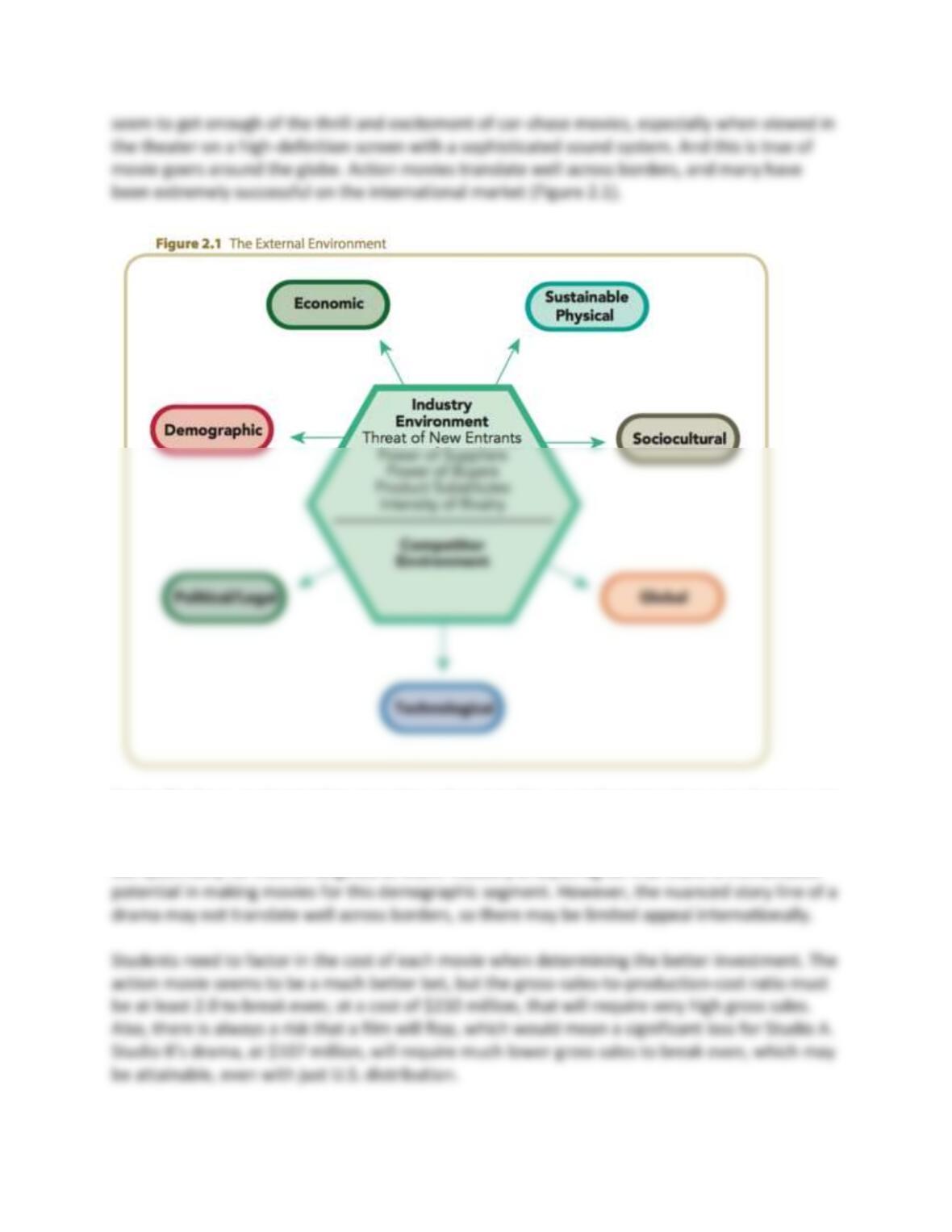
Studio B’s drama is designed to appeal to a demographic group that attends movies far less, yet
it is the fastest growing segment of the population. Relatively few movies are made for this
segment, meaning there are few product substitutes, so older adults have been known to come
out specifically for movies targeted at them. Industry analysts agree that there is tremendous
2. Traditionally, what were theaters’ core competencies, and how were they used to
provide competitive advantage over other forms of entertainment, both inside and
outside the home?
In previous decades, theaters possessed quite a few core competencies that created
competitive advantages over other forms of entertainment, whether it was external events
3. Describe some of the tactics theater chains plan to use to regain competitive
advantage in the future. How will these tactics be used by chains following a
differentiation strategy? How will they be used by chains practicing a cost leadership
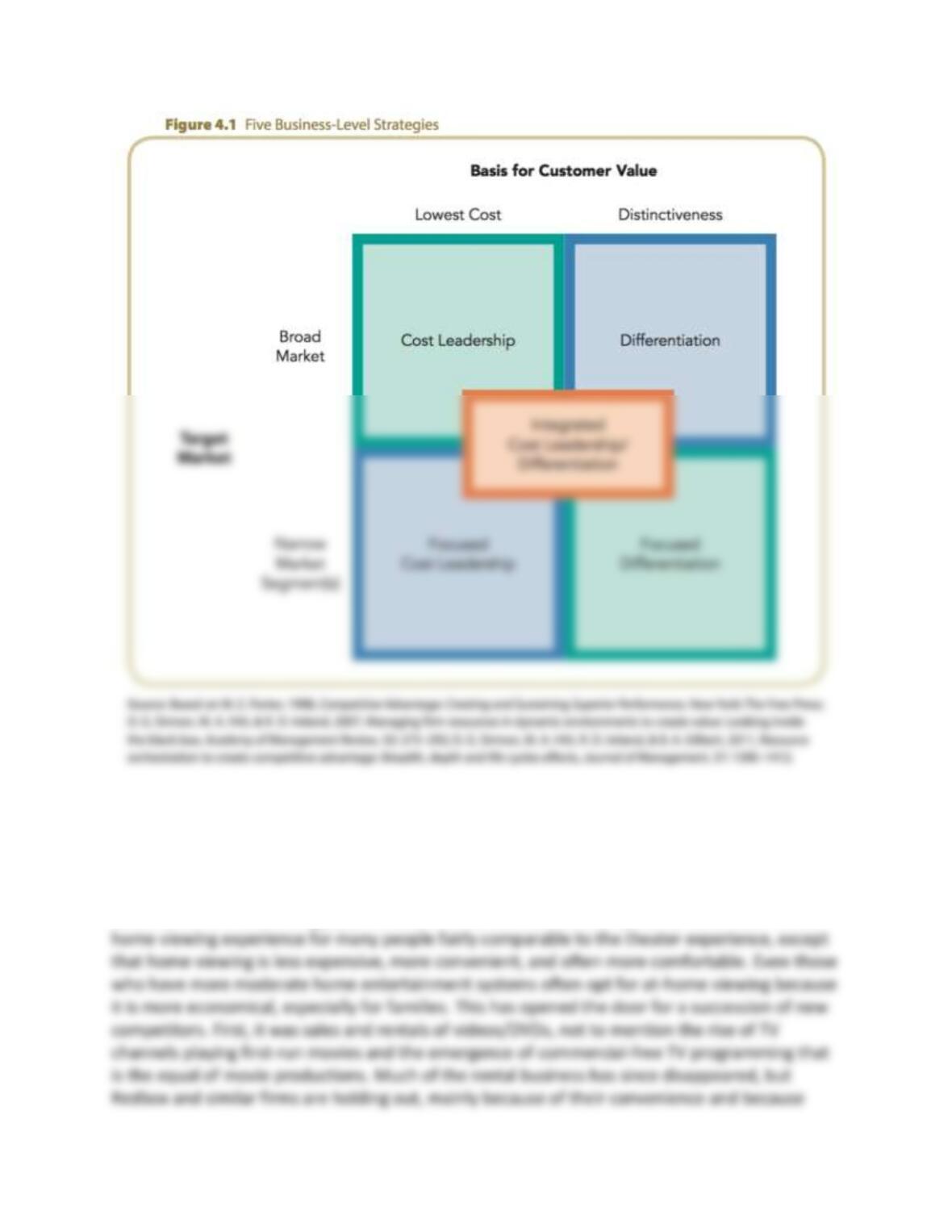
strategy? Is it possible for a theater chain to practice the integrated
cost/differentiation strategy?
Theater exhibitors have proposed a number of ways to regain competitive advantage in
consumers’ minds. These initiatives include engineering even larger and higher definition
screens, generating a 4D viewing experience (including tactile sensations, such as scent and
4. Describe the competitive dynamics of the movie delivery business of today. To what
degree do these competitors share common markets and similar resources?
Movie theaters today face fierce competition from rivals in the movie delivery business. Huge
advancements in technology, particularly in TV screens and sound systems, have made the at–
5. If you viewed movie theaters as a single entity within the overall entertainment
industry, would you say they were competing in a slow-cycle, fast-cycle, or standard-
cycle market? How are theaters positioned within its cycle?
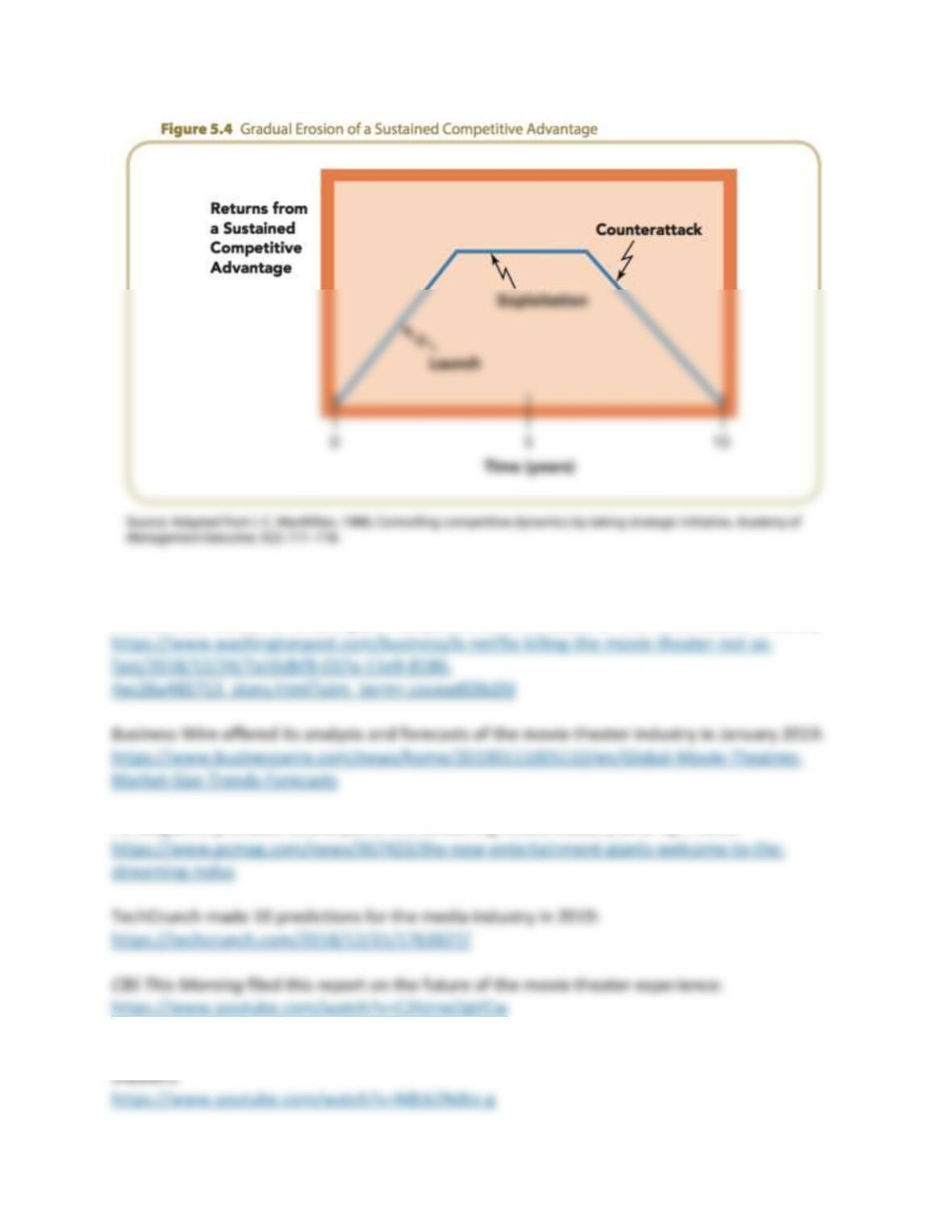
Movie theaters, taken together as a single entity or “focal firm,” should be seen as a competitor
in a slow-cycle market. In the past, theaters had several competitive advantages over other
forms of entertainment, such as concerts, sporting events, and at-home activities like watching
Additional Resources
In December 2018, The Washington Post published this analysis of the movie theater industry:
PC Magazine provided its analysis of the streaming media industry as of April 2019:
At TEDx North Carolina in December 2018, Alan Jackson gave this talk on the future of movie

This YouTube video features comments from Steven Spielberg and George Lucas on the future
of movie making: