Instructor’s Manual
10-1
CHAPTER TEN
Variance Analysis—
A Tool for Cost Control and Performance Evaluation
This chapter examines variance analysis as a tool for cost control and
performance evaluation. In particular, it examines sales price variance,
Key Concepts
• The type of standard (practical or ideal) chosen to evaluate
performance can have significant effects on employee morale and
behavior.
• The flexible budget variance is the difference between the flexible
• The variable overhead efficiency variance does not measure the
efficient use of overhead; instead, it measures the efficient use of the
cost driver, or overhead allocation base that appears in the flexible
budget.
Instructor’s Manual
• Management by exception is the key to effective variance analysis
and involves taking action only when actual and planned results differ
significantly.
Learning Objectives
LO1— Describe methods of determining standard costs and discuss the use of
ideal versus practical standards.
LO5— Compute and interpret price and usage variances for direct materials.
LO6— Compute and interpret rate and efficiency variances for direct labor.
LO7— Compute and interpret spending and efficiency variances for variable
overhead.
Lecture Outline
A. Introduction
1. At the end of an accounting period (month, quarter, year),
2. Variance analysis allows managers to see whether sales,
Instructor’s Manual
10-3
costs differ from those budgeted. The key to effective variance
analysis is management by exception.
B. Standard Costing (LO1)
1. Standards can be determined in a couple of ways.
o Management can analyze historical cost and production
data to determine how much materials and labor were
used in each unit of product and how much the materials
2. Ideal versus Practical Standards
Because standard costs are used to evaluate performance, human
behavior can influence how the standards are determined. Should
Instructor’s Manual
10-4
the standards be ideal or practical? The type of standard (practical
3. Use of Standards by Nonmanufacturing Organizations
Standard costing applies to merchandising and service
organizations as well. For example, CPA firms have standards for
Key Concept
The type of standard (practical or ideal) chosen to evaluate performance can
have significant effects on employee morale and behavior.
Making It Real:
Instructor’s Manual
C. Flexible Budgeting with Standard Costs (LO2)
1. A flexible budget is based on the actual volume of production rather
2. A static budget is based on estimated production and sales.
Comparing the static budget with the actual results does not make
much sense as it is like comparing apples with oranges.
D. Flexible Budget Variance (LO3)
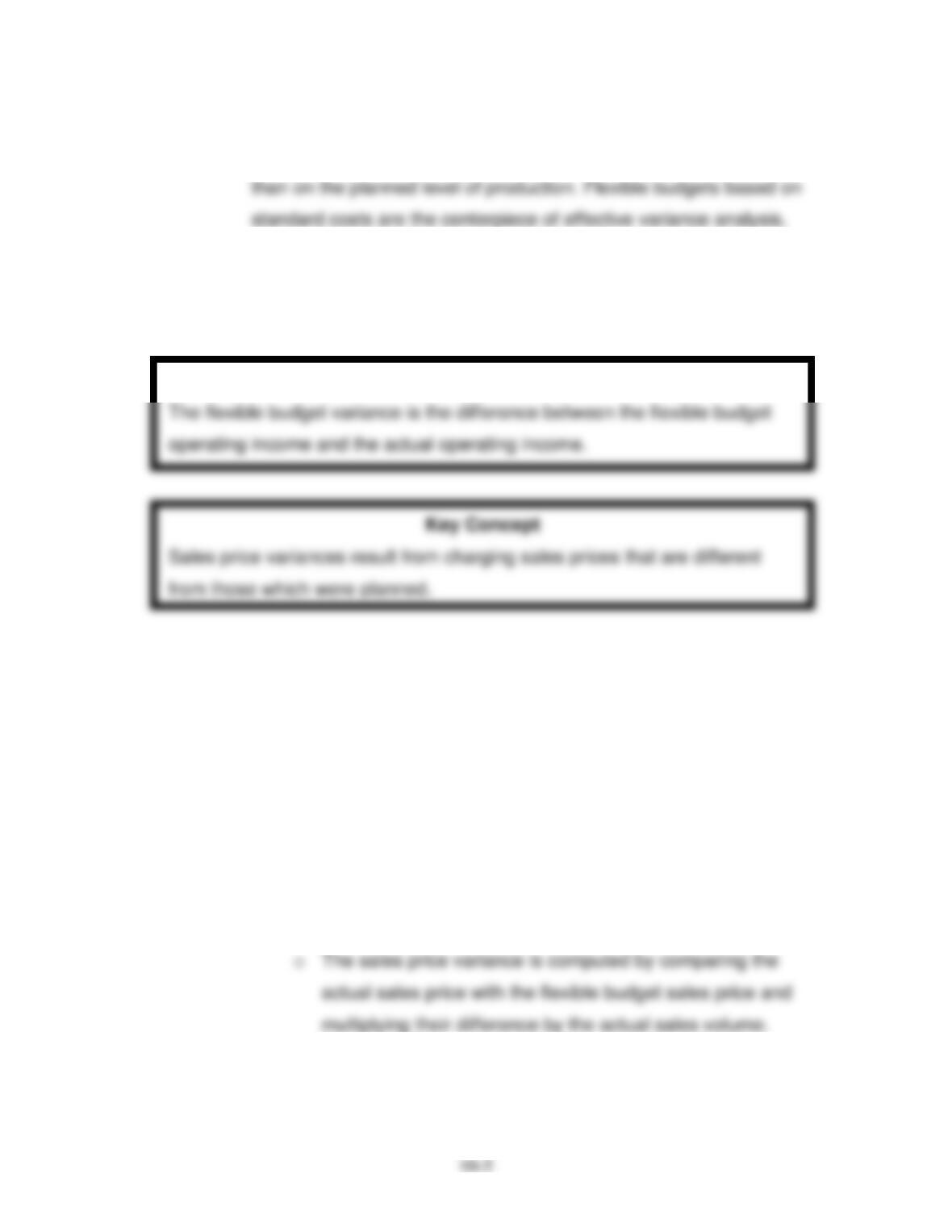
The flexible budget variance is the difference between the flexible budget
operating income and actual operating income. The flexible budget variance
can be broken into sales price variance, variable manufacturing cost
variances, fixed manufacturing overhead spending variance, variable selling
and administrative cost variance, fixed selling and administrative cost
variance. Sales price variance and selling and administrative expense
variance are discussed below:
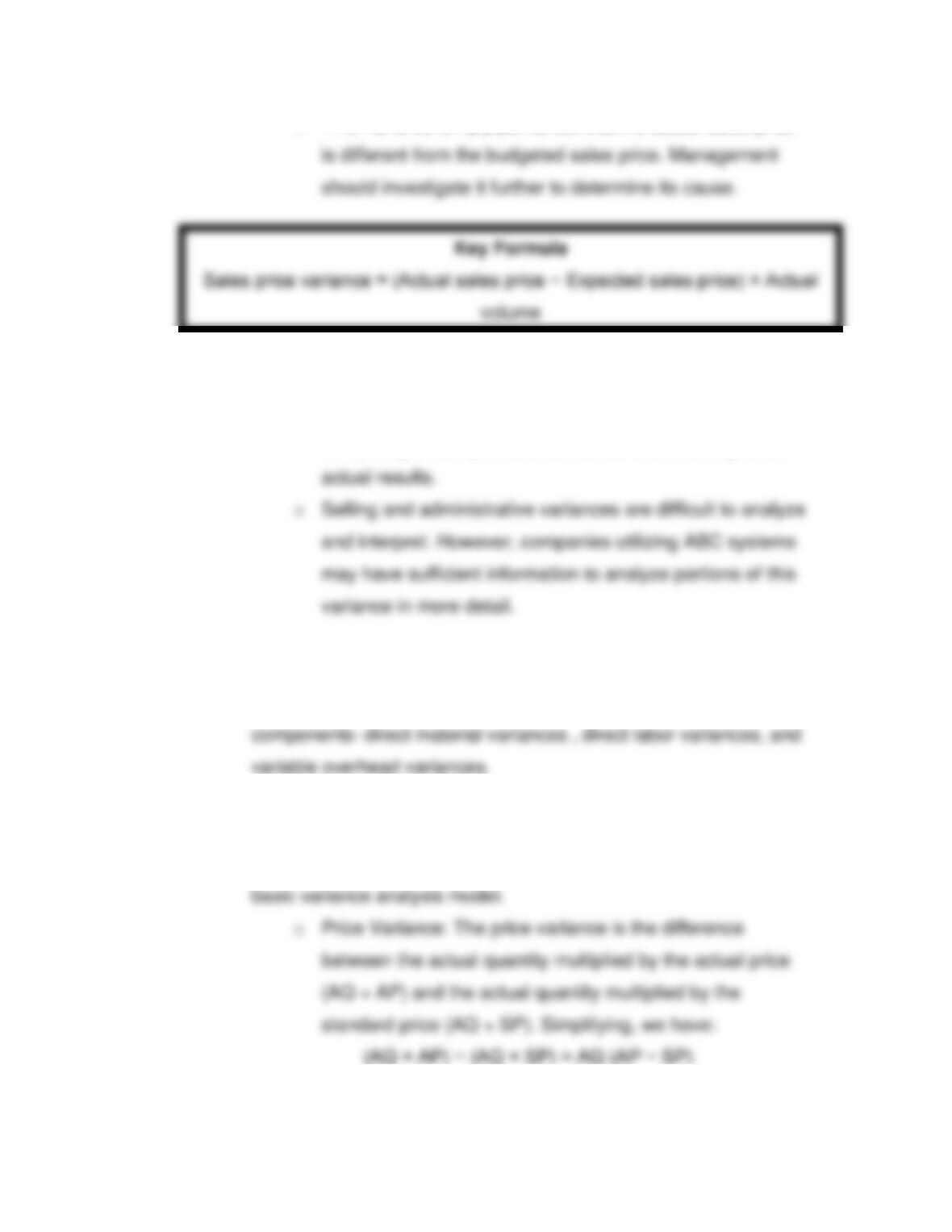
1. Sales Price Variance
Key Concept
Instructor’s Manual
10-6
o The variance simply points out that the actual sales price
2. Selling and Administrative Expense Variance
o Selling and administrative variances are computed by
comparing the respective amounts in flexible budget and
E. Variable Manufacturing Cost Variances (LO4)
1. Variable manufacturing cost variances can broken into three
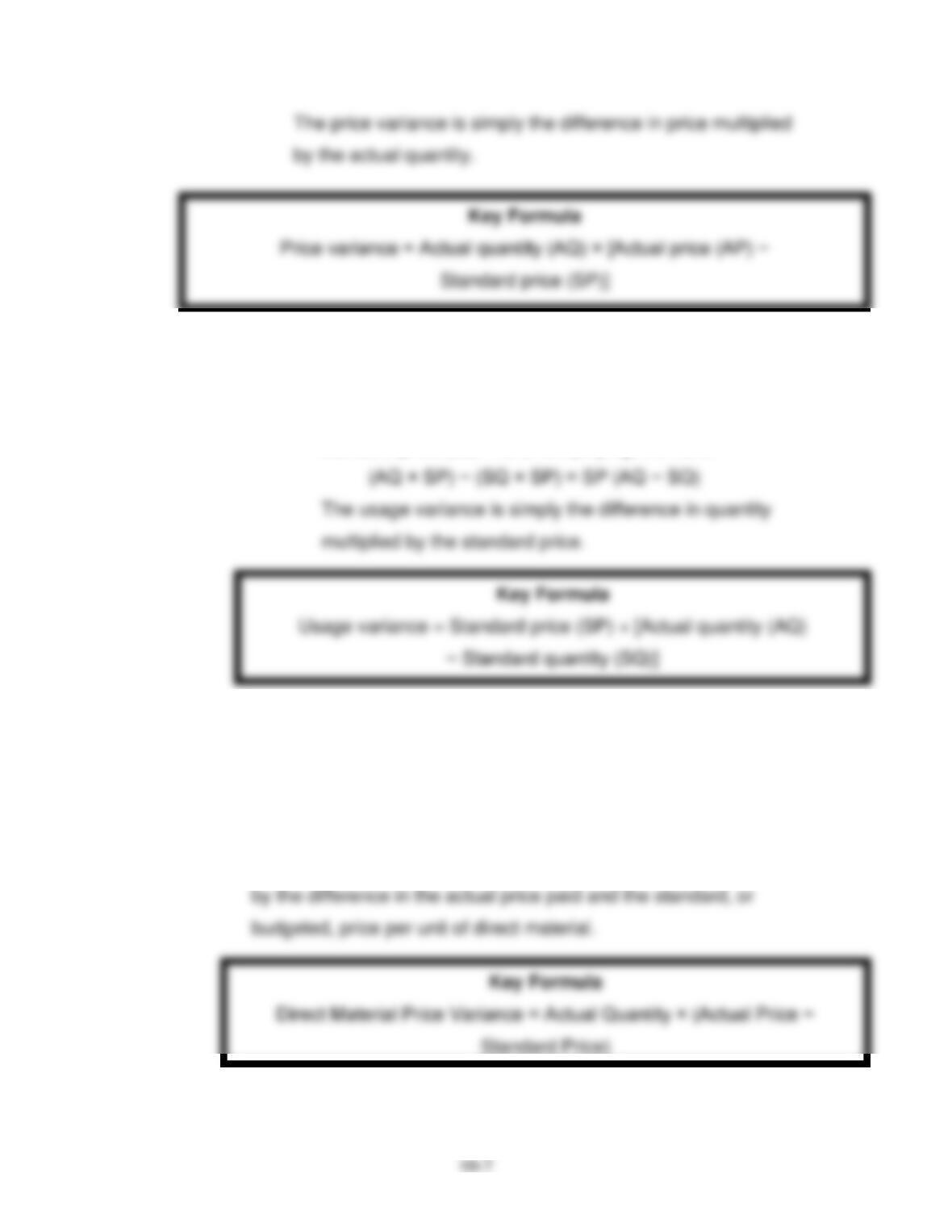
2. The Variance Analysis Model: The direct material, direct labor, and
variable overhead variances can be broken into their components
(a price variance and a usage, or quantity, variance), using the
Instructor’s Manual
o Usage Variance: The usage variance is the difference
between the actual quantity multiplied by the standard
price (AQ × SP) and the standard quantity multiplied by the
standard price (SQ × SP). Simplifying, we have:
F. Direct Material Variances (LO5)
Direct material variance can be broken into direct material price variance
and direct material usage variance.
1. Direct Material Price Variance: The direct material price variance is
calculated by multiplying the actual amount of material purchased
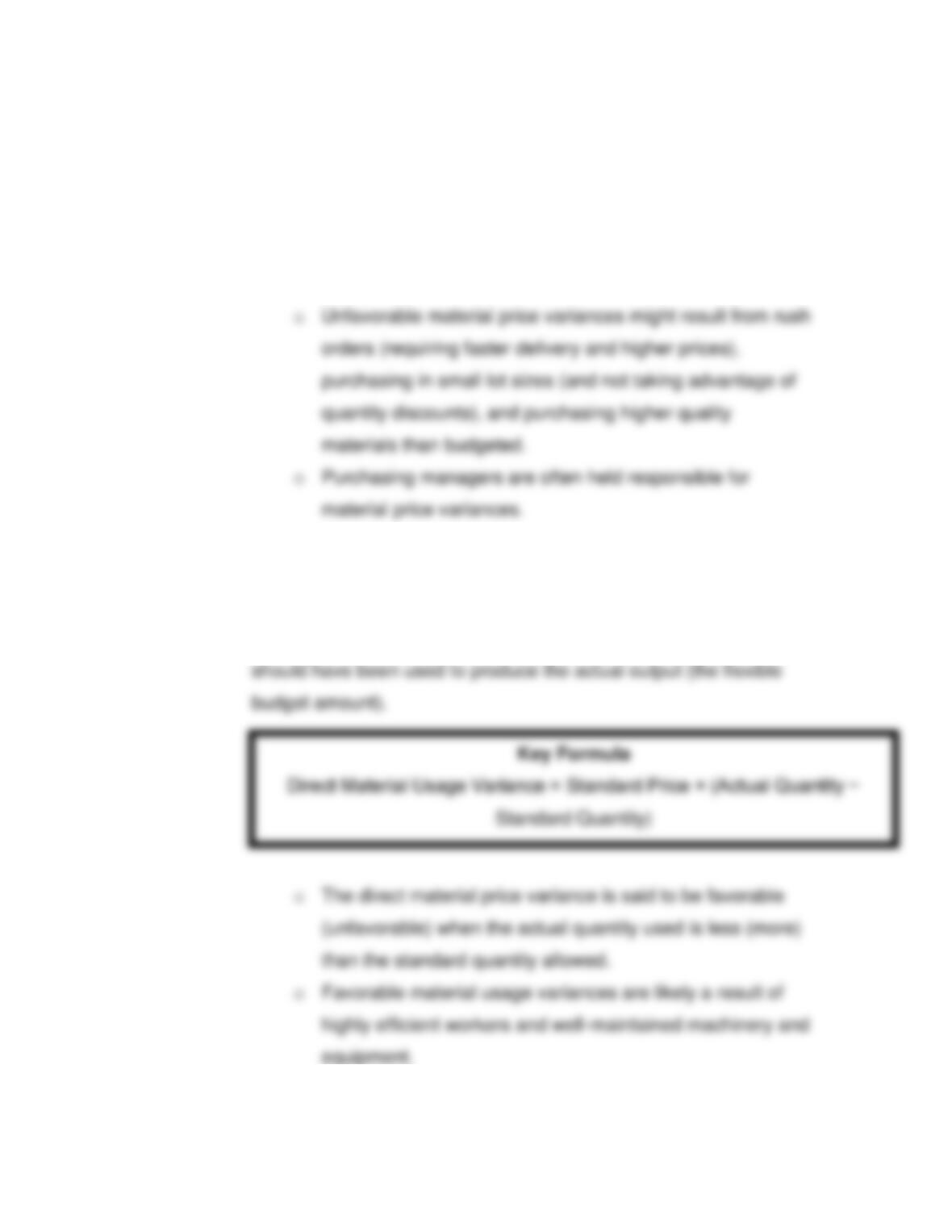
Instructor’s Manual
10-8
o The direct material price variance is said to be favorable
(unfavorable) when the actual price is less (more) than the
standard price.
o Possible reasons for a favorable price variance include
taking advantage of unexpected quantity discounts or
negotiating reduced prices with suppliers.
2. Direct Material Usage Variance: The direct material usage variance
is calculated by multiplying the standard price by the difference in
the actual quantity used and the standard quantity allowed. The
standard quantity allowed is the amount of direct material that
Instructor’s Manual
3. Direct Material Variances When Amount Purchased Differs from
Amount Used
If the amount of material purchased is not the same as the amount
of material used in production, the variance model for materials
must be modified slightly.
o The price variance should be calculated by using the total
amount of material purchased (not material used), whereas
the usage variance should be calculated on the basis of
G. Direct Labor Variances (LO6)
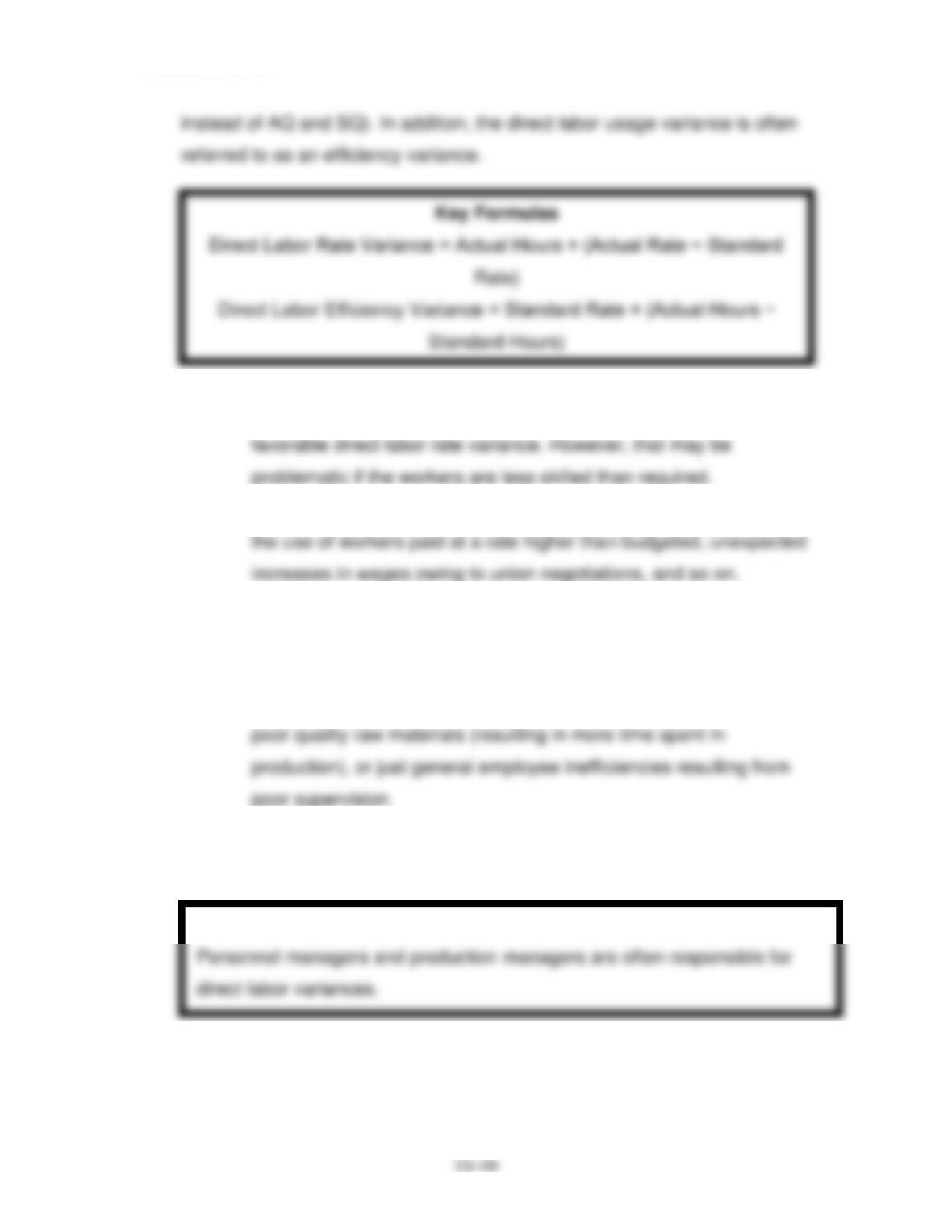
Direct labor variances are calculated with the same basic variance model
used to calculate direct material variances. However, we substitute rates for
price (AR and SR instead of AP and SP) and hours for quantity (AH and SH
Instructor’s Manual
1. Hiring workers at a lower wage rate is one obvious reason for a
2. Potential causes of unfavorable direct labor rate variances include
3. Favorable labor efficiency variances most often result from using
highly skilled workers.
4. Potential causes of an unfavorable direct labor efficiency variance
include poorly trained workers, machine breakdowns, the use of
5. Personnel managers and production managers are often
responsible for direct labor variances.
Key Concept
Instructor’s Manual
10-11
H. Variable Overhead Variances (LO7)
With slight modifications, we can calculate variable overhead variances with
the same variance model we used for direct material and labor variances.
is the amount of applied variable overhead. The price and usage variances
for variable overhead are called variable overhead spending variance, and
variable overhead efficiency variance respectively.
1. A spending variance for variable overhead indicates that the actual
2. The variable overhead efficiency variance does not measure the
3. The unfavorable variable overhead efficiency variance tells us
Key Formulas
Instructor’s Manual
I. Fixed Overhead Variances (LO8)
Fixed overhead variances consist of a budget variance and a volume
variance.
1. The budget variance (or spending variance) is simply the difference
between the amount of fixed overhead actually incurred and the
2. The volume variance is the difference between the flexible budget
amount and the amount of fixed overhead applied to products.
Overhead is applied by multiplying the predetermined overhead
Key Concept
The variable overhead efficiency variance does not measure the efficient
Instructor’s Manual
10-13
because fixed overhead is not “applied” to products rather
is simply expensed in the period incurred.
o The fixed overhead volume variance is calculated primarily
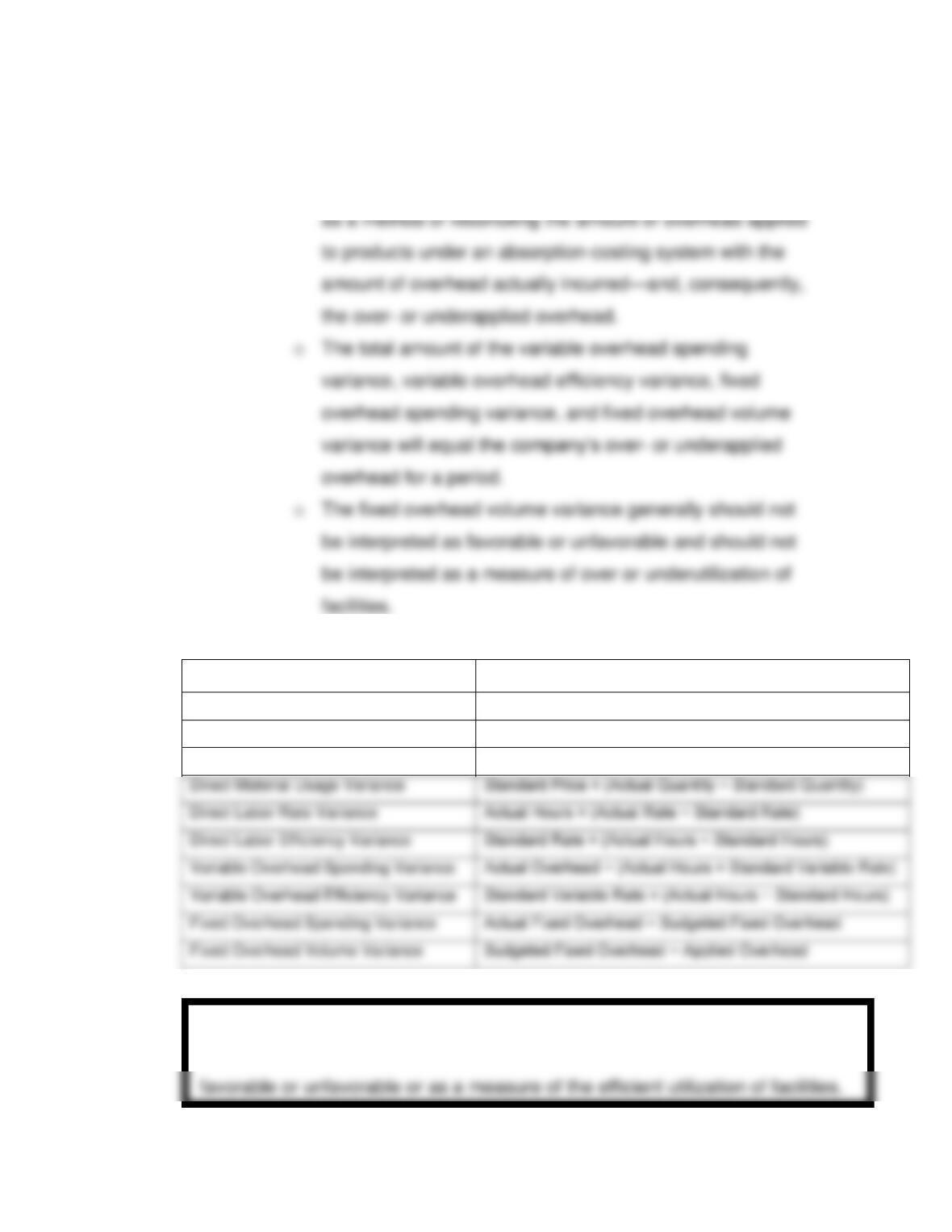
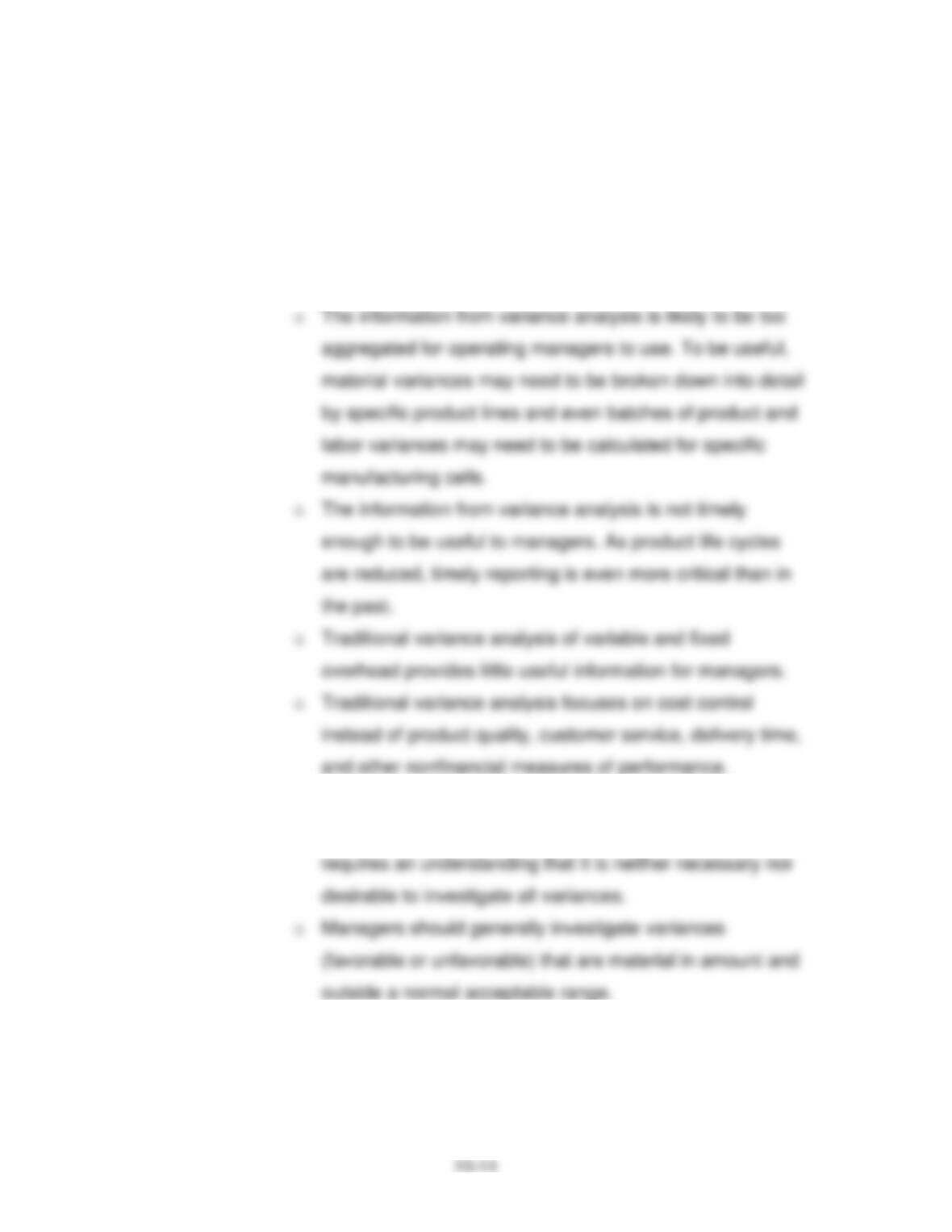
3. A summary of the variance formulas is as follows:
Variance
Formula
Flexible Budget Variance
Flexible Budget − Actual Results
Sales Price Variance
Actual − Expected Sales Price) × Actual Volume
Direct Material Price Variance
Actual Quantity × (Actual Price − Standard Price)
Direct Material Usage Variance
Standard Price × (Actual Quantity − Standard Quantity)
Actual Overhead − (Actual Hours × Standard Variable Rate)
Fixed Overhead Spending Variance
Actual Fixed Overhead − Budgeted Fixed Overhead
Fixed Overhead Volume Variance
Budgeted Fixed Overhead − Applied Overhead
Key Concept
The fixed overhead volume variance should not be interpreted either as
Instructor’s Manual
J. Interpreting and Using Variance Analysis (LO9)
1. Standard costs and variance analysis are most effective in stable
companies. They may not be of much help for however, in rapidly
changing companies. Actually, variance analysis has a number of
drawbacks when used in modern manufacturing set up:
2. Management by Exception
o The proper application of “management by exception”
Instructor’s Manual
10-15
3. Interpreting Favorable and Unfavorable Variances
o Although we have referred to variances as favorable or
unfavorable, these designations should not necessarily be
4. Behavioral Considerations
o The use of standard costs and variance analysis, although
valuable for control and performance evaluation, can also
cause dysfunctional behavior among employees and
management.
measure of performance.
Key Concept
Management by exception is the key to effective variance analysis and involves
Instructor’s Manual
End-of-Chapter Material
Brief exercises, exercises, problems, and cases based on different learning
objectives have been provided at the end of the chapter. These-end-of chapter