
CHAPTER 10
PAY-FOR-PERFORMANCE: INCENTIVE REWARDS
CHAPTER OUTLINE
10.1 Strategic Reasons for Incentive Plans
10.1a Incentive Plans as Links to Organizational Objectives
10.2 Setting Performance Measures
10.3 Administering Incentive Plans
10.4 Individual Incentive Plans
10.4b Standard Hour Plan
10.4c Bonuses
10.4d Merit Pay
10.4f Sales Incentives
10.5 Group Incentive Plans
10.5a Team Compensation
10.6 Enterprise Incentive Plans
10.6a Profit Sharing Plans
10.6b Stock Options
10.7 Incentives for Professional Employees
10.8 Incentives for Executives
10.8a The Executive Pay Package
10.8c Executive Compensation Reform
LEARNING OUTCOMES
After studying this chapter, students should be able to:
1. Implement a strategic incentive program.
3. Differentiate how gains may be shared with employees under different group incentive
plans like the Scanlon plan and improshare gainsharing systems.
5. Understand how to apply different incentive systems designed for professionals and
executives.
2 Part 4: Implementing Compensation and Security
GENERATING INTEREST
This exercise will help students consider employee issues that can affect organizations
that use pay-for-performance.
Students are to assume that they must make a decision between two similar job offers that
have comparable job assignments, nearly identical benefits packages, similar work
environments, and the same advancement opportunities. The major difference is the pay
structure:
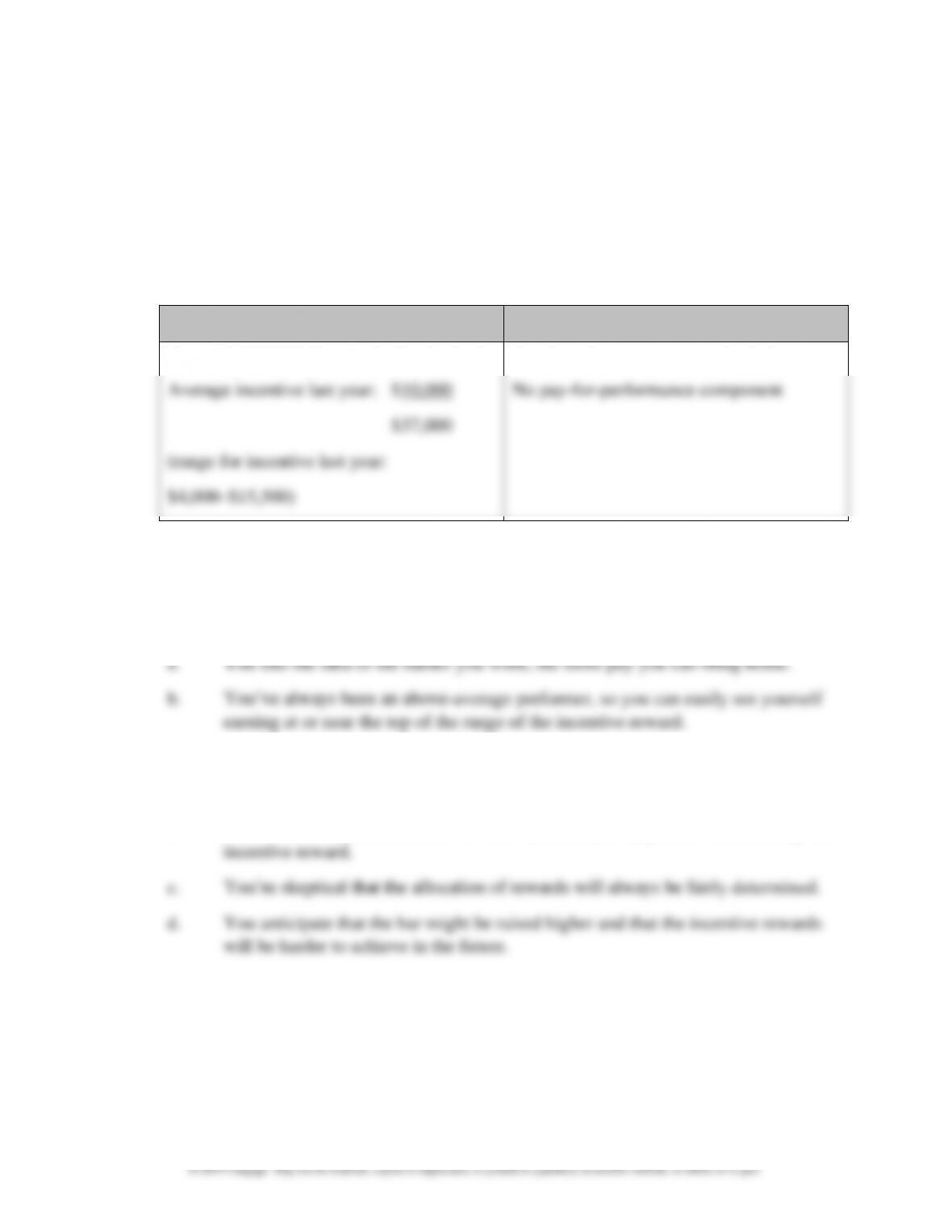
Job Offer A
Job Offer B
Base salary: $27,000
Average incentive last year: $10,000
$37,000
(range for incentive last year:
$4,000–$15,500)
Base salary: $34,000
No pay-for-performance component
Questions
1. Would you choose Job Offer A or Job Offer B?
2. If you chose Job Offer A, what was your most compelling reason for choosing the job
offer with a pay-for-performance component? Possible responses:
3. If you chose Job Offer B, identify the main reason for doing so. Possible responses:
a. You prefer the predictability of a set pay amount.
b. You’re not sure you can trust how the standards are being set for determining the
Chapter 10: Pay-for-Performance: Incentive Rewards 3
LECTURE OUTLINE
Discussion Starter #1: A popular example of a highly successful profit sharing plan is the one in use
at Lincoln Electric. Each year the company distributes a large percentage of its profits to employees
in accordance with their salary level and merit ratings. It is not uncommon for employees’ annual
bonuses to exceed 50 percent of annual wages. Lincoln Electric has been profitable every year
since 1934 and as of 2017 has had 84 years of paying employees profit sharing bonuses.
Because of competitive forces within your industry, you have decided to implement a profit
sharing plan for your employees. Discuss the advantages of profit sharing and identify specific
characteristics that will ensure success for your plan.
ANSWER: Profit sharing plans are intended to give employees the opportunity to increase their
10.1 Strategic Reasons for Incentive Plans Figure 10.1
Figure 10.2
Figure 10.3
Variable pay is tying pay to some measure of individual, group, or organizational
performance. Variable pay programs consist of bonuses, incentives, or recognition for
Teaching Tip: Use Figure 10.1 to discuss the types of incentive plans.
Use Figure 10.2 to discuss the performance that an employee or group must attain to qualify for
incentive payments.
10.1a Incentive Plans as Links to Organizational Objectives
Contemporary arguments for incentive plans focus on linking compensation
Teaching Tip: Use Figure 10.3 to discuss the advantages of incentive pay programs.
© 2019 Cengage. May not be scanned, copied or duplicated, or posted to a publicly accessible website, in whole or in part.
10.1b Requirements for a Successful Incentive Plan
Employees should consider incentive payments to be a reward that must be
earned, not an entitlement. Successful incentive plans have the following
characteristics:
• Identify important organizational metrics that encourage employee
behavior.
Discussion Starter #2: Working individually or in groups, identify the factors for a successful
incentive plan.
ANSWER: For an incentive plan to succeed, employees must believe in it. Employees must be able to
see a clear connection between the incentive payments they receive and their job performance. This
connection is more visible if there are objective quality or quantity standards by which they can judge
EOC Discussion Question #1: Working individually or in groups, identify the factors for a
successful incentive plan.
10.2 Setting Performance Measures Figure 10.4
Measuring and differentiating performance among employees is a difficult task for
Chapter 10: Pay-for-Performance: Incentive Rewards 5
Teaching Tip: Use Figure 10.4 to discuss the do’s and don’ts of measuring performance for
incentives.
10.3 Administering Incentive Plans
Three guidelines can help you administer incentive plans:
• Allowing incentive payments to become pay guarantees defeats the motivational
intent of the incentive.
10.4 Individual Incentive Plans Figure 10.5
10.4a Piecework
Straight piecework is an incentive plan under which employees receive a certain
rate for each unit produced. A differential piece rate is a compensation rate
under which employees whose production exceeds the standard amount of output
receive a higher rate for all of their work than the rate paid to those who do not
exceed the standard amount. The piecework system is more likely to succeed in
the following situation:
• Units of output can be measured readily.
Computing the Piece Rate
The incentive rates must be based on hourly wage rates that would otherwise be
paid for the type of work being performed.
Piecework: The Drawbacks
10.4b Standard Hour Plan
The standard hour plan is an incentive plan that sets rates based on the
completion of a job in a predetermined standard time.
6 Part 4: Implementing Compensation and Security
Discussion Starter #3: Contrast the differences between straight piecework, differential piece rate,
and standard hour plans. Explain where each plan might best be used.
ANSWER: Straight piecework is an incentive plan under which employees receive a certain rate for
EOC Discussion Question #2: Contrast the differences between straight piecework, differential
piece rate, and standard hour plans. Explain where each plan might best be used.
10.4c Bonuses
10.4d Merit Pay
A merit pay program links an increase in base pay to how successfully an
Teaching Tip: Use Figure 10.5 to discuss why merit pay can fail to motivate employees.
Problems with Merit Raises
Merit guidelines are guidelines for awarding merit raises that are tied to
performance objectives. The amount of a merit increase can change every year.
EOC Discussion Question #3: A frequently heard complaint about merit raises is that they do
little to increase employee effort. What are the causes of this belief? Suggest ways in which the
motivating value of merit raises may be increased.
10.4e Incentive Awards and Recognition
Teaching Tip: Use Figure 10.6 to discuss how incentives should align with organizational objectives.
8 Part 4: Implementing Compensation and Security
The Scanlon Plan
The Scanlon plan is a bonus incentive plan using employee and management
Teaching Tip: Use Figure 10.7 to discuss the suggestion process used by the Scanlon plan.
Improshare
Improshare is a gainsharing program under which bonuses are based on the
EOC Discussion Question #5: What are the reasons for the success of the Scanlon and
improshare plans?
10.6 Enterprise Incentive Plans
All organizational members participate in an enterprise incentive plan. Common
10.6a Profit Sharing Plans
Profit sharing is any procedure by which an employer pays, or makes available
to all regular employees, special current or deferred sums based on the
EOC Discussion Question #6: Because of competitive forces within your industry, you have
decided to implement a profit sharing plan for your employees. Discuss the advantages of profit
sharing and identify specific characteristics that will ensure success for your plan.
10 Part 4: Implementing Compensation and Security
Teaching Tip: Use Figure 10.8 to discuss incentives for professional employees. Ask students to
suggest specific types of rewards for professionals.
EOC Discussion Question #7: Create a list of different types of incentives companies can offer
professionals not interested in administrative positions.
10.8a The Executive Pay Package
Executive compensation plans consist of five basic components:
• Base salary
• Short-term incentives or bonuses
Executive Base Salaries
Executive base salaries represent between 30 and 40 percent of total annual
compensation.
Executive Short-Term Incentives
Annual bonuses, usually given in cash, represent the main element of executive
Executive Long-Term Incentives
Stock options are the primary long-term incentive for executives. A variety of
Teaching Tip: Use Figure 10.9 to discuss types of long-term incentive plans. Ask students to identify
the differences among the stock options.
Executive Benefits
Benefits offered to executives may be the same as those offered to other
employees, but the benefits are broader in coverage and free of charge. Additional
executive benefits may include estate planning, payment of mortgage interest, and
legal help.
Executive Perks
Perquisites (perks) are special nonmonetary benefits given to executives.
12 Part 4: Implementing Compensation and Security
ANSWERS TO END-OF-CHAPTER DISCUSSION QUESTIONS
1. For an incentive plan to succeed, employees must believe in it. Employees must be able
to see a clear connection between the incentive payments they receive and their job
performance. This connection is more visible if there are objective quality or quantity
2. Straight piecework is an incentive plan under which employees receive a certain rate for
each unit produced. A differential piece rate is a compensation rate under which
employees whose production exceeds the standard amount of output receive a higher rate
3. Compensation specialists recognize the following problems with merit pay plans:
• Money available for merit increases may be inadequate to satisfactorily raise all
employees’ base pay.
• Managers may have no guidance in how to define and measure performance;
Chapter 10: Pay-for-Performance: Incentive Rewards 13
© 2019 Cengage. May not be scanned, copied or duplicated, or posted to a publicly accessible website, in whole or in part.
Organizations using a true merit pay plan often base the percentage pay raise on merit
guidelines tied to performance appraisals. For example, a certain pay increase, such as “3
percent,” will be tied to a certain performance evaluation, such as “above average.” The
percentages may change each year, depending on various internal or external concerns
such as profit levels or national economic conditions as indicated by changes in the
consumer price index. To prevent all employees from being rated outstanding or above
average, managers may be required to distribute the performance rating according to
some preestablished formula (such as only 10 percent can be rated outstanding).
Additionally, when setting merit percentage guidelines, organizations should consider
individual performance along with such factors as training, experience, and current
earnings.
4. The enthusiasm and drive required in most types of sales work demand that sales
employees be highly motivated. Incentive plans must provide a source of motivation that
will elicit cooperation and trust.
5. Perhaps the most important lesson to be learned from the Scanlon plan and improshare—
or any gainsharing program—is that management expecting to gain the cooperation of its
6. Profit sharing is any procedure by which an employer pays, or makes available to all
regular employees, special current or deferred sums based on the organization’s profits.
As defined here, profit sharing represents cash payments made to eligible employees at
© 2019 Cengage. May not be scanned, copied or duplicated, or posted to a publicly accessible website, in whole or in part.
2. It is unlikely that many students would agree with the pay policies of Peter Drucker.
Current competition for top executive talent, plus the demands of the job, would make the
3. The answer to this question may depend on how interested individuals are in reading
company financial statements particularly related to executive pay. If a shareholder is
Case Study 2: Team-Based Incentives: Not Your Usual Office
1. Complaints noted by the representatives are typical problems found in research studies on
ineffective teams. Not all employees like working in teams and may prefer working alone
or in an environment where they either rise or fall on their own merit. Free-riders (those
2. Students may offer various changes to improve the incentive reward program. Several of
the more obvious changes might be as follows:
• Ensure that all teams have an equal chance to earn the maximum. If some regions
© 2019 Cengage. May not be scanned, copied or duplicated, or posted to a publicly accessible website, in whole or in part.
3. When establishing teams, experience has demonstrated that it is always prudent to
involve employees both in the design and implementation of the program. Employee
involvement helps to achieve commitment to the program since employees have a say in
FLIP TIPS
Step 1: Read the following article:
http://www.spring.gov.sg/Resources/Documents/Guidebook_Productivity_Gainsharing.p
df
Step 2: Divide into groups of four. Your instructor will assign an industry, such as