Chapter 10 – Leaders and Leadership
10–20
How does one qualify as a topnotch global boss? First, learn their language. Global managers
speak a combination of straight-shooting American pragmatism, Japanese-inspired management
ideas (like kaizen, or continuous improvement), and M.B.A. jargon such as “strategic resource
allocation.” They’re tough, smart, and flexible enough to survive in the global economy.
Big companies must go global to be near the billions of new consumers and to find the best deal
worldwide on wages, taxes, and local talent. That takes a savvy global boss. A New York
headhunter once described a search he did for a semiconductor company. “They were looking for
someone [who understands why] the chips were designed in India, water-etched in Japan, diced
and mounted in Korea, assembled in Thailand, encapsulated in Singapore, and distributed
everywhere,” he said. “About one in a million fits that description.”
Indeed, there aren’t enough global bosses to go around, even if many companies haven’t yet
figured out that they need them. Few large U.S. companies, for instance, have foreigners on their
boards. The coming of the global boss is less of a revolution than culture creep. For example,
don’t we hear much about the Japanese way of doing business, as we did in the ‘80s? Because
everyone has adopted it. Today American executives chant “corporate benchmarking” in their
sleep and the Japanese idolize Bill Gates.
“That sense of cross–border trust was a big step for a Japanese firm,” said the U.S. president of
Fujitsu. So was Fujitsu’s decision to put him, a former Apple exec, in charge. He says that his
Tokyo bosses “stopped thinking in terms of local control of worldwide enterprise.” Like global
bosses everywhere, they can’t afford to.
Lecture Enhancer 10.2
TYPE A MANAGERS
Chapter 10 – Leaders and Leadership
10–21
Up to 80 percent of corporate executives exhibit varying degrees of hostile behavior that, at the
extreme, are working against the best interests of their own companies, according to David
Glass, a social psychologist. The behavior being exhibited by these managers is called Type A.
accomplishments in terms of numbers and speed.
In its extreme, Type A behavior is addictive in the same manner of other addictions, such as
gambling and excessive use of alcohol. Managers who exhibit this behavior are at increased risk
of heart disease and other stress-related illnesses and so are the people who work for them. The
fuel for the addiction, in this case, is the body’s own adrenaline. The individual gets a bio-
rise to the highest levels. Another possibility is that the impatience and irritation that accompany
extreme Type A behavior are often incompatible with the long-term decision-making strategies
of top management. A third factor is that the hostile behavior of Type A’s may make them
enemies along the way which can count against the managers when promotion time comes.
Another alternative is that Type A’s are more likely to quit organizational life and become
Chapter 10 – Leaders and Leadership
10–22
Notes for Topics for Discussion and Action
DISCUSSION
1. Describe the steps managers can take to increase their power and ability to be effective
leaders.
A manager should ensure that he or she has sufficient levels of power. For example, in order to
use their legitimate power they must be given the authority or necessary responsibilities within
2. Think of specific situations in which it might be especially important for a manager to engage
in consideration and initiating structure.
Leaders engage in consideration when they show their subordinates that they trust, respect, and
care about them. A manager is performing consideration behaviors when he/she takes steps that
3. Discuss why managers might want to change the behaviors they engage in, given their
situation, their subordinates, and the nature of the work being done. Do you think managers are
able to readily change their leadership behaviors? Why or why not?
MANAGEMENT IN ACTION
Chapter 10 – Leaders and Leadership
10–23
Because different types of leading behaviors work best in different situations, the manager must
4. Discuss why substitutes for leadership can contribute to organizational effectiveness.
A leadership substitute is something that acts in place of the influence of a leader and makes
5. Describe what transformational leadership is and explain how managers can engage in it.
Transformational leadership occurs when a manager has an extremely dramatic effect on his or
her subordinates and/or organizations. Transformational leadership occurs when managers
6. Imagine that you are working in an organization in an entry level position upon graduation
and have come up with what you think is a great idea for improving a critical process in the
organization that relates to your job. In what ways might your supervisor encourage you to
implement your idea? How might your supervisor discourage you from even sharing your idea
with others?
ACTION
7. Interview a manager to find out how the three situational characteristics that Fiedler
identified affect his or her ability to provide leadership.

Chapter 10 – Leaders and Leadership
10–24
When a situation is favorable for leading, it is relatively easy for a manager to influence
Chapter 10 – Leaders and Leadership
10–25
Copyright © 2017 McGraw-Hill Education. All rights reserved. No reproduction or distribution without the prior written consent of McGraw-Hill
Education.
Task structure describes the extent to which the work to be performed by a leader’s subordinates
is clear-cut, so that they know what needs to be accomplished and how to go about doing it. If an
organization possesses high task structure, the situation is more favorable for leading.
Position power describes the amount of legitimate, reward, and coercive power a leader has by
virtue of his or her position in an organization. If a manager has strong position power, the
situation is more favorable for leading.
8. Find a company that has dramatically turned around its fortunes and improved its
performance. Determine whether a transformational manager was behind the turnaround and, if
one was, what this manager did.
(Note to the instructor: Students’ answers may vary. The answer given below is merely
indicative.)
AACSB: Reflective Thinking
Analyzing Failures of Leadership
Think about a situation you are familiar with in which a leader was very ineffective. Then,
answer the following questions:
1. What sources of power did this leader have? Did the leader have enough power to influence
his or her followers?
BUILDING MANAGEMENT SKILLS
Chapter 10 – Leaders and Leadership
10–26
The sources of power are legitimate power, reward power, coercive power, expert power, and
2. What kinds of behaviors did this leader engage in? Were they appropriate for the situation?
Why or why not?
3. From what you know, do you think this leader was a task-oriented leader or a relationship-
oriented leader? How favorable was this leader’s situation for leading?
4. What steps did this leader take to motivate his or her followers? Were these steps appropriate
or inappropriate? Why?
Chapter 10 – Leaders and Leadership
10–27
Copyright © 2017 McGraw-Hill Education. All rights reserved. No reproduction or distribution without the prior written consent of McGraw-Hill
Education.
• Allow followers a say in decisions that affect them.
The appropriateness of specific motivational techniques will depend on many factors, including
the follower’s needs, expectancies, and possible concerns about overpayment or underpayment
inequity.
5. What signs, if any, did this leader show of being a transformational leader?
AACSB: Reflective Thinking
(Note to Instructor: Student answers will vary.)
1. Either alone or in a group, think about the ethical implications of the use of coercive power.
2. To what extent do managers and organizations have an ethical obligation to put limits on the
extent to which coercive power is exercised?
MANAGING ETHICALLY
Chapter 10 – Leaders and Leadership
10–28
Improving Leadership Effectiveness
1. Analyze the sources of power that Caruso has available to her to influence the decorators.
What advice can you give her to either increase her power base or use her existing power more
effectively?
2. Given what you have learned in this chapter (for example, from the behavior model and path-
goal theory), does Caruso seem to be performing appropriate leader behaviors in this situation?
What advice can you give her about the kinds of behaviors she should perform?
Caruso does not seem to be performing appropriate behaviors. She is nowhere close to
performing the steps that are suggested in path-goal theory to motivate subordinates. She should
clearly identify the outcomes that her decorators are trying to achieve from the situation. Do they
actually want to make customers unhappy or are they unaware that is what they are doing? She
3. What steps would you advise Caruso to take to increase the decorator’s motivation to deliver
high quality customer service?
SMALL GROUP BREAKOUT EXERCISE
Chapter 10 – Leaders and Leadership
10–29
Copyright © 2017 McGraw-Hill Education. All rights reserved. No reproduction or distribution without the prior written consent of McGraw-Hill
Education.
In order to increase the decorator’s motivation, Caruso should initiate structure and set goals for
them to accomplish. She should also motivate workers to perform at the highest level possible by
setting challenging goals, expecting them to be met, and showing that she is confident that the
decorators will be able to meet those goals.
4. Would you advise Caruso to try to engage in transformational leadership in this situation? If
not, why? If so, what steps would you advise her to take.
AACSB: Analytic
Questions
What are you going to do to improve the performance and effectiveness of your company?
BE THE MANAGER
Chapter 10 – Leaders and Leadership
10–30
Case Synopsis: Managers Need to Make Time for Face Time
As businesses expect more senior leaders both to manage more far-flung teams and spend more
time with distant clients, face time has become a precious commodity—and a source of
Questions
1. Why might making sure to incorporate time for face-to-face interactions be an important
component for many managers’ personal leadership styles?
2. How might face-to-face interactions contribute to managers effectively engaging in
consideration and initiating structure?
NEW YORK TIMES CASE IN THE NEWS
Chapter 10 – Leaders and Leadership
10–31
qualities when talking in person with an employee as opposed to emailing or even
3. How might face-to-face interactions help managers effectively engage in transformational
leadership?
4. How might emotional intelligence help managers to ensure that they have effective face-to–
face interactions?
AACSB: Analytic
• There are no Manager’s Hot Seat Exercises for this Chapter
SUPPLEMENTAL FEATURES
MANAGER’S HOT SEAT (MHS)
Chapter 10 – Leaders and Leadership
10–32
These Instructor’s PowerPoint slides can be used to supplement the lecture material.
INSTRUCTOR’S POWERPOINT SLIDES
Chapter 10 – Leaders and Leadership
10–33
INSTRUCTOR’S
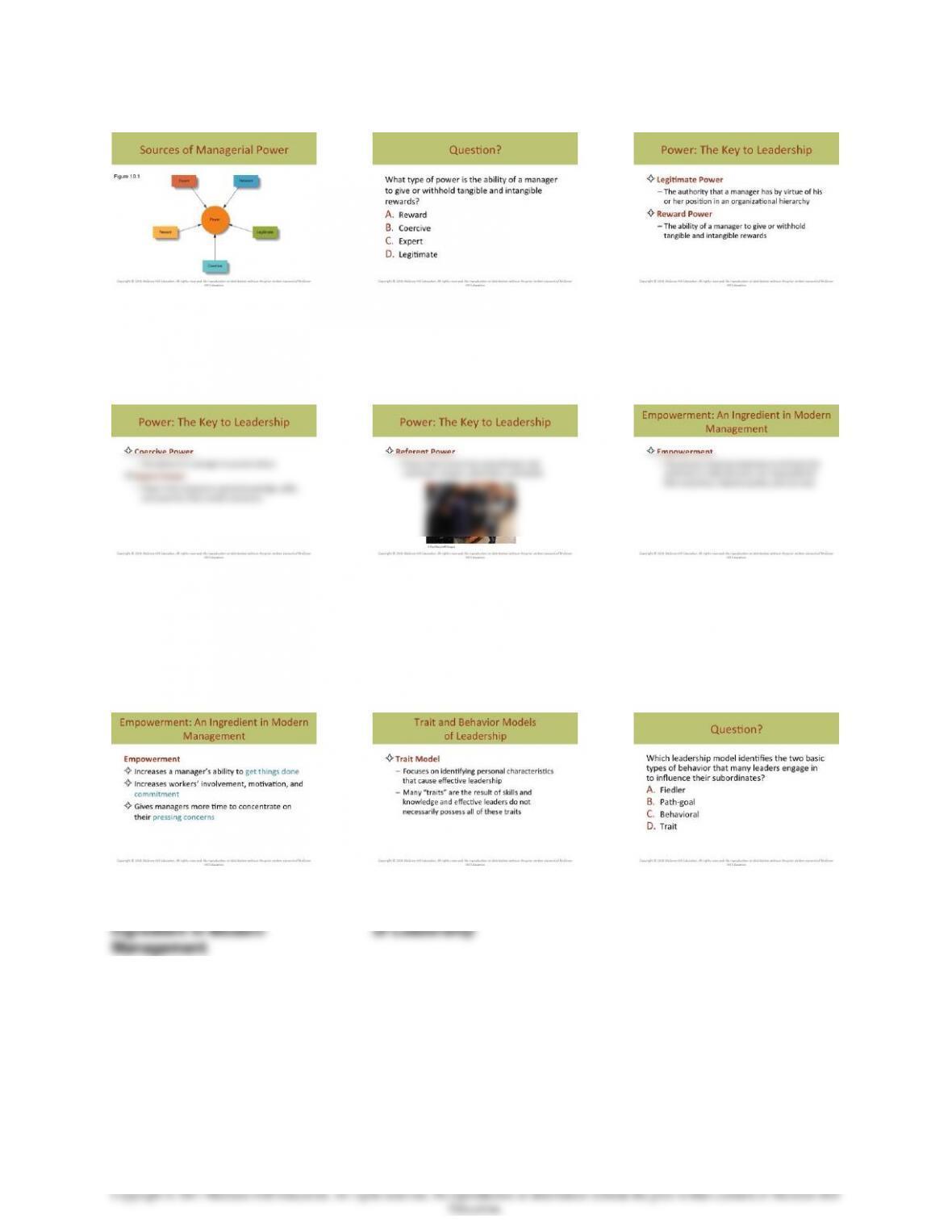
POWERPOINT SLIDE 10
Figure 10.1 – Sources of
Managerial Power
INSTRUCTOR’S
POWERPOINT SLIDE 11
Question?
INSTRUCTOR’S
POWERPOINT SLIDE 12
Power: The Key to
Leadership
INSTRUCTOR’S
POWERPOINT SLIDE 13
Power: The Key to
Leadership
INSTRUCTOR’S
POWERPOINT SLIDE 14
Power: The Key to
Leadership
INSTRUCTOR’S
POWERPOINT SLIDE 15
Empowerment: An
Ingredient in Modern
Management
INSTRUCTOR’S
POWERPOINT SLIDE 16
Empowerment: An
INSTRUCTOR’S
POWERPOINT SLIDE 17
Trait and Behavior Models
INSTRUCTOR’S
POWERPOINT SLIDE 18
Question?
Chapter 10 – Leaders and Leadership
10–34
INSTRUCTOR’S
POWERPOINT SLIDE 19
INSTRUCTOR’S
POWERPOINT SLIDE 20
INSTRUCTOR’S
POWERPOINT SLIDE 21
Contingency Theory of
Leadership
Chapter 10 – Leaders and Leadership
10–35
INSTRUCTOR’S
POWERPOINT SLIDE 28
INSTRUCTOR’S
POWERPOINT SLIDE 29
INSTRUCTOR’S
POWERPOINT SLIDE 30
Intellectually
Consideration
Chapter 10 – Leaders and Leadership
INSTRUCTOR’S
POWERPOINT SLIDE 37
INSTRUCTOR’S
POWERPOINT SLIDE 38
INSTRUCTOR’S
POWERPOINT SLIDE 39

INSTRUCTOR’S
POWERPOINT
SLIDE 46
Topics for Discussion