
Chapter 10 – Groups, Teams and Their Leadership
10-1
Part 3: Focus on the Followers
Followers
Situation
Chapter 10: Groups, Teams, and Their Leadership
Leader

Chapter 10 – Groups, Teams and Their Leadership
10-2
Chapter 10 Outline
Groups, Teams, and Their Leadership
Introduction
Individuals versus Groups versus Teams
The Nature of Groups
Teams
Effective team characteristics and team building
Team leadership model
Outputs
Process
Summary
Chapter 10 – Groups, Teams and Their Leadership
10-3
Key Learning Points
Introduction
In this chapter, the focus on the followers continues but with an emphasis on the leadership of groups
Individuals versus Groups versus Teams
It is clear that individuals are different from either groups or teams, but how do groups differ from
teams? Two identifying characteristics of groups are: 1) mutual interaction and 2) reciprocal
The Nature of Groups
Although people belong to many different groups and organizations, it is important to note that
groups and organizations are not the same. People tend to be able to identify with groups more
readily than with organizations; however, people pay very little attention to the factors that affect
Teams
Today’s organizations devote a great deal of time and effort to the ideas of teamwork and team
effectiveness—and everyone knows teams vary in their degrees of effectiveness, but what factors can
account for these varying degrees of effectiveness? Descriptive research at the Center for Creative

Chapter 10 – Groups, Teams and Their Leadership
10-4
outputs and what we can tell about the team by actually observing team members at work), and
outputs at the top (how well the team did in accomplishing its objectives, ideally a high-performance
Virtual Teams
Given the growth of the global marketplace, the final section of the chapter addresses virtual teams,
which are challenging to leaders because they are not only dispersed geographically but are often
Chapter 10 – Groups, Teams and Their Leadership
10-5
Brief Definitions of the Key Terms for Chapter 10
Group perspective: Focuses on how different group characteristics can affect relationships with
the leader and among the followers.
Group: Two or more persons who are interacting with one another in such a manner that each
person influences and is influenced by each other person.
work.
Social facilitation: Increased effort due to the presence of other people.
Forming: First group development stage characterized by polite conversation, gathering
information, and low trust.
Storming: Second group development stage characterized by intragroup conflict, heightened
emotions, and status differentiation.
Norming: Third group development stage characterized by emergence of a leader and
development of group norms and cohesiveness.
Dysfunctional roles: Role problems where a person’s behavior serves selfish or egocentric
purposes.
Role conflict: Another role problem that involves receiving contradictory messages about
expectations.
Intrasender role conflict: Inconsistent/mixed role signals/expectations from the same person.
Intersender role conflict: Inconsistent/mixed role signals/expectations from several other
people.
Chapter 10 – Groups, Teams and Their Leadership
10-6
Groupthink: A disadvantage of highly cohesive groups; group becomes more concerned with
striving for unanimity than in objectively appraising alternatives.
Ollieism: Variation of groupthink; occurs when illegal actions are taken by overly zealous and
loyal followers because they think it will please their leaders.
Organizational shells: An analysis tool developed to help team leaders evaluate the various
team design setting these can be psychological as opposed to physical).
Dream: A function for team leadership that establishes a clear vision for the team.
Design: A function for team leadership that involves manipulating the organizational system or
individual inputs to form the best team.
Development: Ongoing work done with a team at the process level to continue to find ways to
improve.

Chapter 10 – Groups, Teams and Their Leadership
10-7
Overview of the Learning Resources for Chapter 10
Exercise 10-1: NASA Exercise: Lost on the Moon. This 45-minute experiential exercise is very
good at demonstrating group processes, the power of group versus individual decision making,
group roles, and group conflict.
Exercise 10-2: Blizzard! A modified version of the Lost on the Moon exercise, but this time the
Exercise 10-3: Building Squares. In this 25-minute exercise, small groups are asked to construct
Exercise 10-5: Building Models. In this 35-minute exercise, leaders work with their team to build
an object out of Tinker Toys or Legos. However, the team leader cannot see the object to be built
very well and has to operate under a set of rules that make success difficult.
Exercise 10-6: The Crossing. This 30-minute experiential exercise is best conducted outside,
Exercise 10-7: What Makes a Team Tick? In this 25-minute exercise, small groups of students
Exercise 10-8: The Team Assessment Survey. This assessment can be used by individuals or
intact learning teams, and is based on The Rocket Model of team building described in the
Advanced Leadership Skills Chapter. It will take individuals or teams 20–30 minutes to complete
and score the survey and another 30 minutes to discuss the results.
Case Studies: The minicase, “Integrating Teams at Hernandez & Associates,” at the end of
Chapter 10 – Groups, Teams and Their Leadership
10-8
Sample Lesson Plans for Chapter 10
Lesson 1: 60 minutes
Pre-work: Exercise 10-1, NASA Exercise: Lost on the Moon.
Lesson Plan: The purpose of this lesson is to highlight the benefits of groups and multiple
perspectives by thinking about the key aspects of why and how groups perform better than
individuals (using this decision-making task as one example).
• Instructors should provide a brief overview of the task (5 minutes).
Alternate set-up: Instructors can have half of the class (and groups) complete the “Lost on the
Moon” exercise and the other half of the class complete Exercise 10–2, “Blizzard.” During the
Lesson 2: 60 minutes
Pre-work: Exercise 10-8, Team Assessment Survey. Students should be asked to complete the
survey as a homework assignment. Instructors need to clearly explain the reference point for the
ratings—will the students rate an intact team or will they select a team they are a member of and
make individual ratings?
Lesson Plan: Scoring and debriefing the Team Assessment Survey
• Instructors should provide students with the scoring key for the assessment and have them

Chapter 10 – Groups, Teams and Their Leadership
10-9
• Instructors should conclude the class with a large group debrief (10 minutes).
Chapter 10 – Groups, Teams and Their Leadership
10–10
Minicase, “Integrating Teams at Hernandez & Associates,” Sample Answers
Question 1: Like many leaders, Marco has a team in place and does not have the luxury of
building a new team from the ground up to adapt to the changing business environment his
and identify leverage points for change.
Question 1a: Consider the major functions of the TLM—input, process, and output. Where
do most of the firm’s challenges fall?
This case is a good way to interject the idea that situational/environmental changes can and do play a significant
Process: A significant issue is that Marco needs to have a clear strategy for how the team/firm is
going to change. The “old” strategy that had been successful for them will no longer work due to the
Inputs: With respect to the individual factors/characterisitcs, it is unlikely the skills and abilities or
interpersonal behavior would be a significant issue; however, interest/motives and values/attitudes
could be a significant factor. If the team members value creativity and design above all else, they are
not likely to react well to a strategy that has them focusing more on administrative tasks as opposed to
creative ones. The lower level of interest and motivation to do these tasks could create individual
satisfaction problems as well as group dynamic problems.

Chapter 10 – Groups, Teams and Their Leadership
10–11
Question 1b: What are the team’s goals for outputs?
Outputs: It is not entirely clear that Marco understands or is able to elaborate the required goals for
members “on board.”
Question 2: Identify potential resources for Marco and his team in implementing a strategy
to change the way they do business at Hernandez & Associates.
Ultimately, there are many resources required to make the change effort happen. Some of the resources
are material in nature. For instance, new marketing materials are needed for the company to let clients
know what “new” offerings they have. There might be equipment requirements (computer and otherwise)

Chapter 10 – Groups, Teams and Their Leadership
10–12
Chapter 10 Exercises & Instructions
Exercise 10-1
Exercise Title: NASA Exercise: Lost on the Moon
Purpose: To demonstrate differences between individual and group decision making.
Summary: Instructors should pass out the NASA Exercise: Lost on the Moon handout to students, read
the scenario, and then ask students to spend 10 minutes working individually to rank 15 items in terms of
After the groups have completed their consensual rankings, give them the NASA Scoring Sheet. The
students should use the NASA rankings to: 1) individually determine the sum of the absolute difference
This exercise takes about 45 minutes.
Reference
Hall, J. (1971). Decisions, decisions, decisions. Psychology Today, November, 1971, 51-54, 86-88.

Chapter 10 – Groups, Teams and Their Leadership
10–13
NASA EXERCISE: LOST ON THE MOON
Your spaceship has crash-landed on the dark side of the moon, and you are scheduled to rendezvous with
the mother ship that is 200 miles away on the lighted side of the moon. The crash has ruined the ship and
destroyed all the equipment except for the 15 items listed below. Your crew’s survival depends on
reaching the mother ship, so you must choose the most critical items available to take on the 200 mile
trip. Your task is to rank-order the 15 items in the order of their importance for your survival. Place a “l”
beside the most important item, a “2” beside the second most important item, and so on until you have
ranked all the 15 items.
_____ Box of matches
_____ One case of dehydrated milk
_____ Two 100 pound tanks of oxygen
_____ Stellar map
_____ Self-inflating life raft
Chapter 10 – Groups, Teams and Their Leadership
NASA’S SCORING OF THE RANKING SHEET
ITEM NASA’S REASON FOR RANKING RANKING
Box of matches No oxygen on moon; worthless 15
Food concentrate Efficient means of energy 4
Dehydrated milk Bulkier duplicate of food 12
concentrate
Oxygen tanks Most pressing survival need 1
Stellar map Primary means of navigation 3

Chapter 10 – Groups, Teams and Their Leadership
10–15
Exercise 10-2
Exercise Title: Blizzard!
Purpose: To demonstrate differences between individual and group decision making.
Summary: Instructors should pass out the two-page Blizzard handout to students, read the scenario, and
then ask students to spend 10 minutes working individually to rank 15 items in terms of their value in a
survival situation. Once all the individual rankings are completed, the students will then get 15 minutes to
This exercise takes about 45 minutes.
Chapter 10 – Groups, Teams and Their Leadership
10–16
BLIZZARD!
The Situation
Your hunting party has been caught by a sudden blizzard while trekking in a remote region of the
Rockies. A mad dash back to your jeep resulted in a few scratches from slipping in the snow, but
none of your party sustained any major injuries.
You are unsure of your exact position. Your best estimate is that you are 35 miles from the
nearest paved secondary road.
Your jeep station wagon is equipped with standard features including bucket seats in front and a
continuous back seat and storage area in the rear. All windows are glass.
In the storage area, you have the following items: several magazines, a magnetic compass, a map
of the immediate area, one pound of beef jerky, a first-aid kit, a sheath knife, a shovel, several
You are to assume that:
• All members of the party have agreed to stay together.
Chapter 10 – Groups, Teams and Their Leadership
10–17
BLIZZARD!
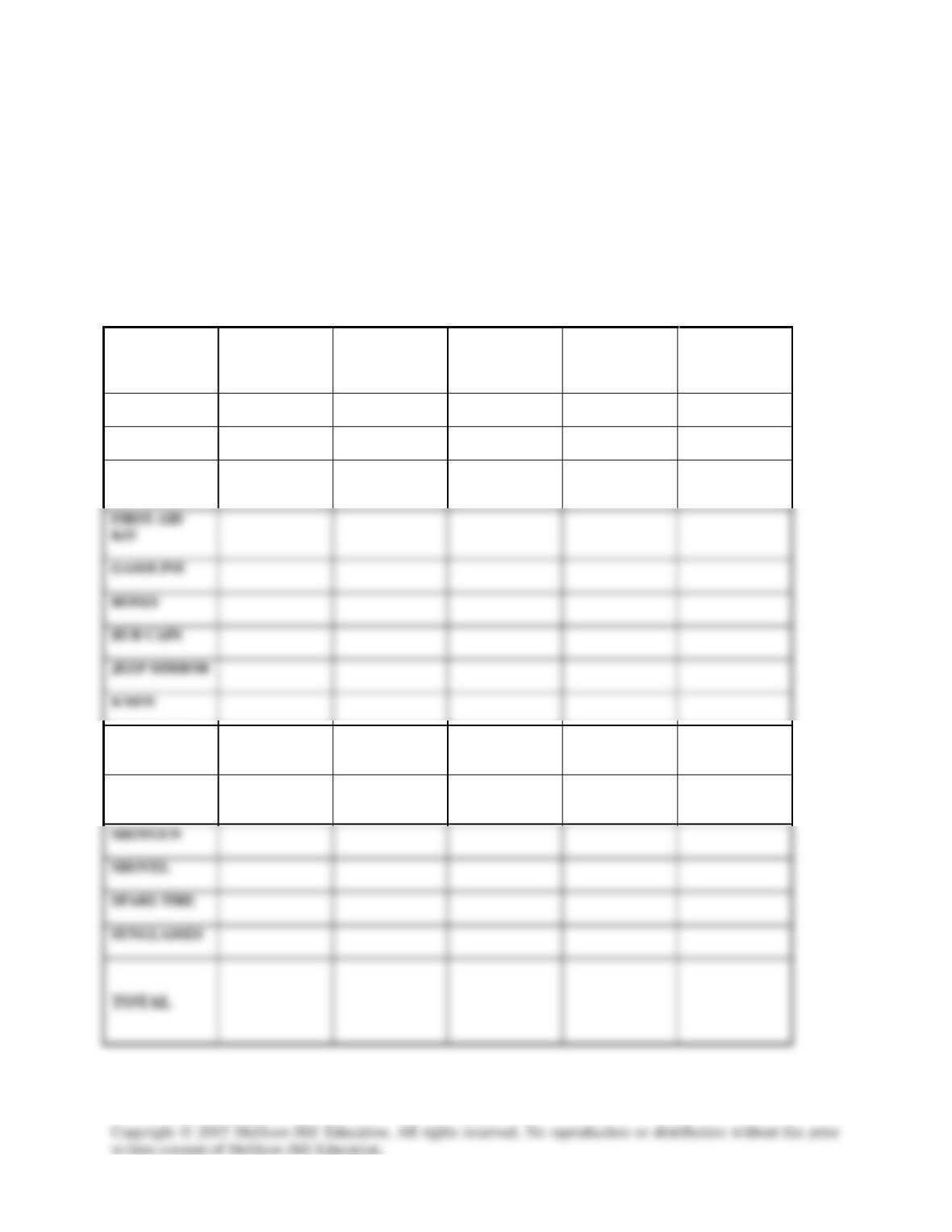
LISTED BELOW ARE THE 15 ITEMS YOUR GROUP HAS COMPILED.
YOUR TASK IS TO RANK THEM ACCORDING TO THEIR IMPORTANCE FOR
YOUR SURVIVAL.
Place the number “1” by the most important item, the number “2” by the second most
important , and so on, through number “15.”
STEP 1
Individual
Ranking
STEP 2
Team
Ranking
STEP 3
Planning
Experts
STEP 4
Difference
between
steps 1 and 3
STEP 5
Difference
between
steps 2 and 3
BEEF JERKY
BLANKETS
CIGARETTE
LIGHTER
KIT
GASOLINE
HOSES
JEEP MIRROR
KNIFE
MAGNETIC
COMPASS
MAP OF THE
AREA
SHOTGUN
SHOVEL
SPARE TIRE
SUNGLASSES
Chapter 10 – Groups, Teams and Their Leadership
10–18
BLIZZARD!
Rationale and Scoring Key
In this survival situation, there are three life-threatening problems:
• Death from exposure can occur in a few hours.
exhaustion, etc.
#1. Knife. The most pressing survival need is to insulate your body against the cold. The
#2. Two Blankets. Heat flows from warm to cooler surfaces. Any areas of the body left
unprotected allow heat to be conducted away from the body. The head is the most efficient
portion of the body’s heating system. Up to 50 percent of the body’s heat production can be
#3. Jeep Mirror. Effective signaling is impossible during a blizzard. Once the storm ends,
#4. Cigarette Lighter. Any of several items will suffice to spark a fire, with the cigarette
lighter being the handiest tool. Besides its other more obvious uses, fire is the most effective
night signal.
#5. Gasoline. The best fuel for the fire. It can be siphoned with a water hose.

Chapter 10 – Groups, Teams and Their Leadership
10–19
#8. Spare Tire. A tire, which can be easily ignited if deflated and soaked with gasoline,
will burn for some time, throwing off black clouds of acrid smoke. The burning tire will
#9. Sunglasses. Once the weather clears, the reflection of the sun off the surface of the
#10. Shotgun. Other than the fire, the shotgun is the only effective night-signaling device.
Three blasts in a rapid succession is an international distress signal.
#11. Beef Jerky. Death from dehydration and/or exposure would occur long before death
from starvation. However, once fires are started to melt the snow, eating the beef jerky will
produce body heat and ward off physical exhaustion which usually occurs as the result of
#12. Shovel. A snow cave is warmer than a car, which conducts heat into the atmosphere.
#13. First-Aid Kit. Aside from the obvious uses, creams, sunburn ointments, gauze, and
bandages provide useful protection against the sun.
#14. Map of the Area. Worthless, except as fuel.
#15. Magnetic Compass. Potentially the most dangerous item because it might encourage
the party to try to walk out. Walking out during a blizzard would result in almost certain

Chapter 10 – Groups, Teams and Their Leadership
10–20
References
Stewart, J. Growing Weak By Degrees. Sports Illustrated. Chicago: Time-Life, 42:10 (March 10,
1975), 58-59.