
Quality in Practice: Building Business Excellence in Hungary1
One of Europe’s major success stories since the fall of the Iron Curtain is Hungary, whose
economy grew even during the recent worldwide recession. Quality improvement is credited by
many as the reason for the country’s success. Some of the firms that achieved recognition
include Burton-Apta, a manufacturer of ceramic products and systems used in kilns; Westel
Mobile Telecommunications Co. and Herend Porcelain Manufacturing.
Burton-Apta engaged in quality initiatives beginning in the 1970s. A breakthrough
occurred in 1986 when Shoji Shiba, a Japanese professor, brought the concept of TQ to Hungary.
Burton-Apta learned about quality concepts and established a quality council. The company
received ISO 9000 certification in 1993, the first Hungarian National Quality Award in the mid-
sized business category in 1997, the European Quality Prize in 1999, and finally the European
Quality Award (EQA) in 2000. Because it was no longer eligible for the EQA, the company
decided to conduct self-assessments to maintain its focus on continuous improvement. These
self-assessments resulted in improvements in many areas, including management commitment,
strategy and planning, human resources, customer satisfaction, employee satisfaction, social
impact, and business results. Some of the specific opportunities for improvement that were
identified and acted upon included the following:
• Managers taking more responsibility as role models and systematically disseminating
best practices from all over Hungary and abroad
• Incorporating the opinions of all stakeholders in strategic planning activities
• Developing a career and recruitment plan that includes evaluation of managers by
themselves, employees, and outside experts; increased employee empowerment; and a more
efficient suggestion system
• Improvements in safety, increased compensation and other employee benefits, and better
recognition of employees
1 Pál Molnár, “Hungary’s Journey to Business Excellence,” Quality Progress, February 2003,
55–64. © 2003 American Society for Quality. Reprinted with permission.
• Special emphasis on the environment that exceeds that of other midsized companies in
the region
Westel Mobile Telecommunications Co. Ltd. is the leading provider of Hungarian
wireless telecommunications service. Westel uses self-assessment to appraise the performance of
the organization and its overall leadership. It began using the Baldrige criteria in 1994, and in
1995 became Hungary’s first telecom provider to achieve ISO 9000 certification. In 1996, 25
managers participated in Westel’s first EFQM self-assessment. Criterion owners were appointed,
each responsible for ensuring areas for improvement were prioritized and improvement plans
developed, built into the business plan, and implemented. In 2001, Westel received the European
Quality Award.
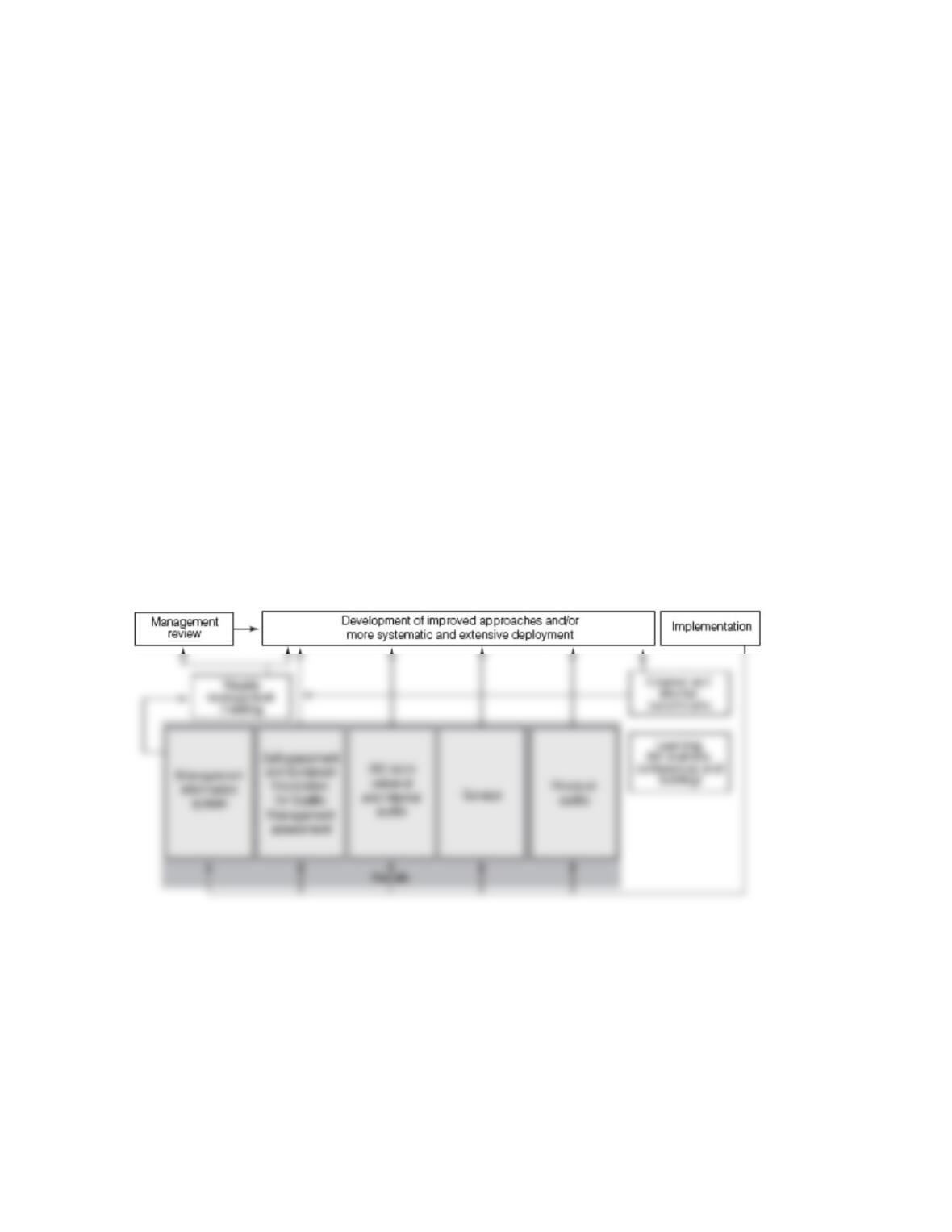
Westel’s assessment and review system is shown in Figure 1. This system is focused on
ensuring delivery of the company’s vision and mission via policies, strategies, and processes that
deliver stakeholder satisfaction. The company’s recent mission and vision aim are for Westel to
be trusted and relied on by all stakeholders. Society, which includes the general population, peer
and key people, the press, authorities and regulatory bodies, is included in the list of
stakeholders. Westel meets its societal obligations through direct employment, job creation, and
sponsorship of and donations to various programs, such as the Hungarian Olympic committee
and the Budapest Festival Orchestra. It also focuses heavily on environmental responsibility; as
one example, it encourages clients to dispose of batteries in special bio waste bins.
Herend Porcelain Manufacturing, in business since 1826, achieved ISO 9000 certification
in 1995, but decided to strengthen its TQ system by being driven by employee and customer
satisfaction. This decision led to implementation of the ISO 14001 environmental management
system and the British Standards Institute health and safety management system as part of their
quality management system. Employees became more involved and empowered to improve such
areas as professional skills, quality attitudes, environmental protection and safety,
communication and problem solving, and compliance with customer needs and expectations,
making continuous improvement a daily routine.
Herend takes a data-driven approach to managing, using 132 different indicators to
follow up on goals stated in their mission and strategic plan. Reviews and assessments of
approaches and processes are performed by internal audits. These assessments go far beyond
simple certification of conformance and focus on overall performance, as well as determining
areas for improvement, increasing customer satisfaction, and improving organizational
effectiveness. Herend won the first Hungarian National Quality Award in 1996.
Key Issues for Discussion
1. Westel operates in an industry sector with both expressed and latent (those that customers
do not express) customer and market needs and expectations. Why are latent needs
important in the telecommunications industry? What does their importance mean for
managing such a company?
2. Each of these firms uses some sort of self-assessment process to understand their
management practices. Could the results they realized have been achieved without these
self-assessments? Why or why not?
3. How important do you think a national quality award is to a nation’s economic growth?
Figure 1 Westel’s Assessment and Review System