The Baldrige Framework for Performance Excellence 17
• Traditional management practices
• Growing awareness of the importance of quality
• Development of a solid quality management system
• Outstanding, world-class management practice
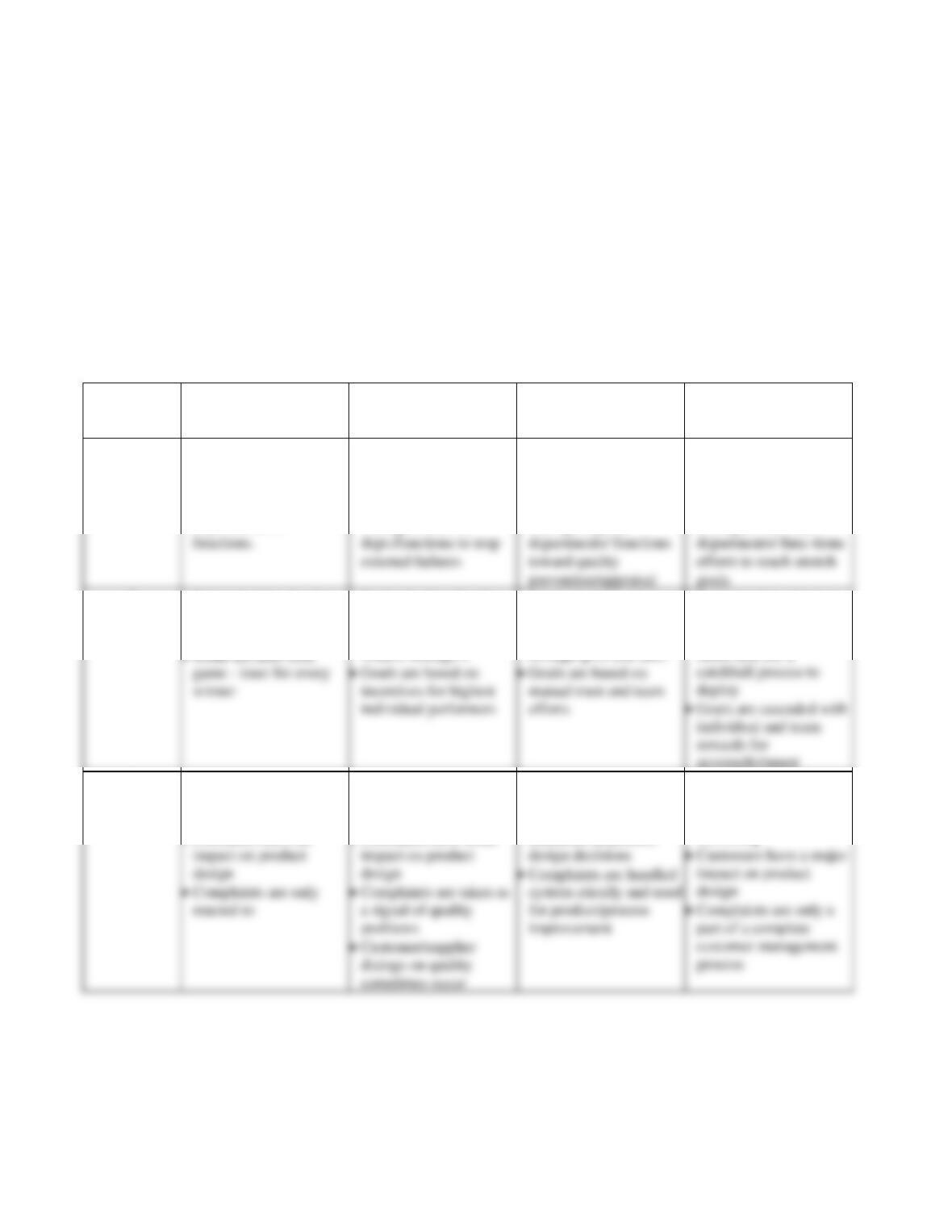
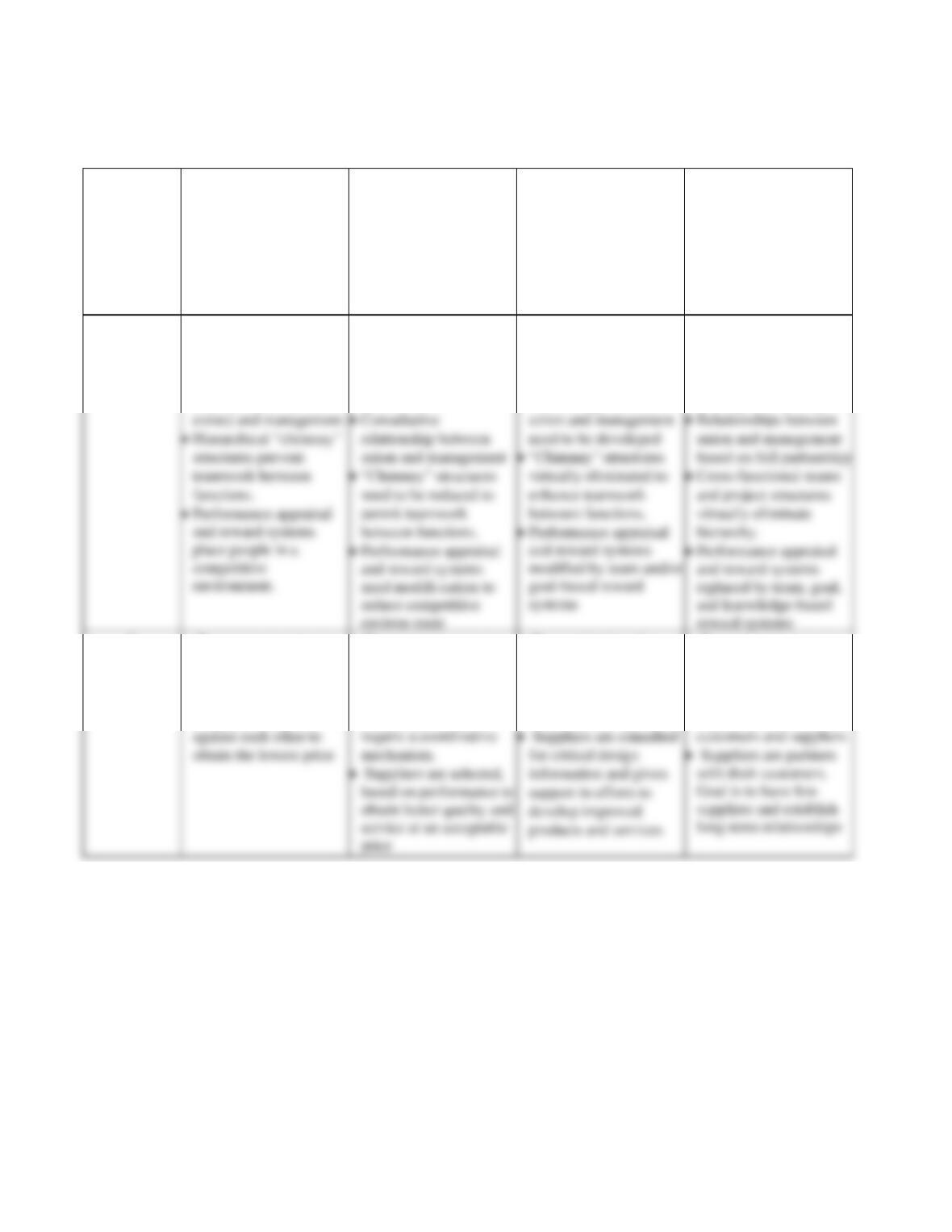
In each cell of the matrix, list two to five characteristics that you would expect to see for a
company in each of the four situations for that criteria category. How might this matrix be
used as a self-assessment tool to provide directions for improvement?
There are many ways to answer this; here is one:
Baldrige
Category
Traditional
Management Practices
Growing
Awareness of Quality
Quality Management
System
World-Class
Quality Management
1
• Senior leaders’ job is to
maintain the status quo
by preventing change
• Managers oversee
departments or
• Senior leaders’ job is to
ensure that quality
problems are brought to
mgt.’s attention
• Managers oversee
• Senior leaders’ job is to
define and manage
change toward a quality
mgt. system
• Managers guide
• Senior leaders’ job is to
develop vision and
encourage innovation
and change.
• Managers facilitate
2
• Senior leaders develop
goals and pass down to
lower levels
• Senior leaders develop
goals in consultation
with
middle managers
• Senior leaders and lower
level managers develop
goals and resolve
through give and take.
• Senior leaders develop
mission and vision on
which stretch goals are
based and use a
3
• Customers are outsiders
in the domain of
marketing and sales
• Customers have no
• Customers needs are the
focus of marketing and
sales
• Customers have some
• Customers are surveyed
to determine satisfaction
• Customers/suppliers are
consulted in product
• Customers are insiders
in the domain of design,
production, and
marketing
The Baldrige Framework for Performance Excellence 18
4
• Control is achieved by
pre-established
inflexible responsive
patterns
• Information is generally
considered to be secret
• Control is achieved by
somewhat flexible
responsive patterns
• Information is generally
considered to be
confidential, but
available
• Control is achieved by
cooperative team efforts
to improve processes
• Information is
considered to be widely
available to those inside
the organization
• Control is achieved by
alignment with goals
• Information is
interlinked and is
considered to be openly
available unless
proprietary or personally
sensitive
5
• People are an
interchangeable
commodity
• Adversarial relation-ship
between union (if one
• People often have
valuable unique skills
and should be rewarded
for indivi-dual
contributions
• People should be
encouraged to work in
teams to solve problems
• Cooperative
relationships between
• People should be
empowered to work
individually and in
teams to meet individual
and organizational goals
6
• Processes are seen as a
collection of separate,
specialized units, in a
functional hierarchy.
• Suppliers are pitted
• Processes are seen as a
collection of separate
units, in a functional
hierarchy, but cross-
functional activities
• Reorganization of
processes of some
separate units, out of the
functional hierarchy, is
seen as advantageous
• Processes are seen as a
system of
interdependent sub-
processes linking the
organization to
The Baldrige Framework for Performance Excellence 19
7
• Results are primarily
stated financially
• Any negative deviation
is a cause for corrective
action and search for a
• Results are primarily
stated in financial and
market terms
• Any negative deviation
is a cause for corrective
• Results are stated in
financial, market,
operating, quality
“metrics”
• Any negative deviation
• Results are stated as a
“balanced scorecard”
• Benchmarking and
historical comparisons
are used for setting
7. Examine the questions in the Baldrige Criteria and discuss which ones relate to the concept
of organizational sustainability as defined in this chapter? Why is sustainability an important
issue in business?
In a sense, all of the Baldrige criteria pertain to the concept of sustainability. Within the Baldrige
framework, sustainability refers to an organization’s ability to address current business needs and to
have the agility and strategic management to prepare successfully for the future, and to prepare for
real-time or short-term emergencies. Recently, concepts of workforce and customer engagement
have been integrated within the Baldrige criteria.
In particular, senior leaders are charged with the responsibility of developing a sustainable
8. Discuss the implications of the Baldrige Criteria for e-commerce. What are the specific
challenges that e-commerce companies face within each category of the criteria?
As in many areas or types of organization, the Baldrige Criteria and process can be effective in
developing high-quality e-commerce organizations.
Leaders (Category 1) such as Bill Gates, Michael Dell, and Jeff Bezos possess strong corporate
visions. They seem to have the ability to transform existing business models into strategic
The Baldrige Framework for Performance Excellence 20
Customers (Category 3) requires an understanding of the power of the customer in the e–
marketplace. Building relationships with customers is harder than ever in e-commerce, but more
vital to the health of the business. Mass customization, market segmentation, value-added service,
and customer relationship management are all essential to healthy e-business.
Analytics, reflected in Category 4 is a big part of e-commerce. The challenge is to turn data into
information. It doesn’t matter if an e-business web site is getting 10,000 hits a week. What matters
are the characteristics of the people who are buying the organization’s products or services. Thus,
Amazon.com uses sophisticated software to suggest items that may appeal to a customer, based on
his/her previous purchases, as well as purchases of others with similar interests.
9. As we noted in the chapter, process items in the Baldrige Criteria are assessed on four
dimensions: approach, deployment, learning, and integration. The following are opportunities
for improvement that an examiner team identified in the Leadership Category for a Baldrige
applicant. Discuss which of the four dimensions are implied in these comments (some may
address more than one dimension).
Process items in the Baldrige Criteria are assessed on four dimensions: approach, deployment,
a. The applicant presents limited evidence of systematic evaluation and refinement of several
key leadership approaches that may support operational excellence and enhance sustainability.

The Baldrige Framework for Performance Excellence 21
These include approaches for innovation, performance leadership, creation of a workforce
culture that delivers a consistently positive customer experience, and enhancement of
leadership skills. Other examples are the Leadership Development Series, legal and ethical
approaches, methods used to create a focus on action, and Legendary Service
standards.
Dimension: deployment. It appears that several approaches have been developed, but failure to
b. A systematic process is not evident to create and balance value for the applicant’ s
customers and stakeholders (regulators, shareholders, and the community). For example, the
applicant does not describe the activities, people, and steps involved in the Leadership System
and in aligning associates to customers through the Performance Management and
Development Process.
Dimension: approach and integration. The applicant apparently has not developed an adequate
c. Several key leadership approaches do not appear to be fully deployed. For example, it is
unclear how the Mission/Vision/Values (MVV) are deployed to key suppliers and partners;
how
development opportunities are deployed to all workforce members; and whether the MVV,
service standard training, and legal and ethical requirements are deployed to support center
employees (nearly 20 percent of the workforce).
Dimension: deployment. There are numerous leadership approaches listed here, which have not
been deployed.
d. It is not evident that the applicant deploys its approaches to ethical behavior to interactions
with customers, partners, suppliers, and other stakeholders. For example, the applicant
describes only one approach focused on non-workforce stakeholders, and no
enabling/monitoring processes appear to include them. This gap may be significant in light of
the applicant’s numerous supplier and partner relationships.
Dimension: deployment and learning. In addition to the approaches to ethical behavior not being
SUGGESTIONS FOR PROJECTS. ETC.
1. Visit the Baldrige Program website (http://www.nist.gov/baldrige) and write a report on the
information that can be found there.

The Baldrige Framework for Performance Excellence 22
This website is an excellent location for information about the Baldrige process, winner profiles,
events, and news items.
2. Find the application summary for a recent Baldrige recipient on the Baldrige website, and
identify at least three “role–model” practices among the first six categories. Justify why you
consider them “role model” practices.
This exercise helps students to identify strengths of applicants, which fit the Baldrige criteria. To be
3. Obtain the current Baldrige Excellence Framework document for business and nonprofit
organizations. For each numbered set of questions in Categories 1– 6 of the Baldrige Criteria,
determine whether each of the core values and concepts are reflected (a) strongly, (b)
moderately, or (c) little to not at all. Summarize your results in a matrix (rows represent
core values and columns represent the item questions).
This project allows student to map the core values and concepts versus the questions in each of the
six categories of the Baldrige process. The goal is to have students discover that the Criteria are,
indeed, closely integrated with the core values and concepts.
4. Does your state have a quality award program? If so, obtain some current information
about the program and report on it. If not, try to find a neighboring state with an award
program and report on it.
Since approximately 45 out of the 50 states do have awards, most students will discover that their
ANSWERS TO CASE QUESTIONS
The cases in this chapter are taken from Baldrige training case studies and designed to help students
understand how to interpret the criteria questions and gain insight into how a Baldrige examiner
might assess an organization. We don’t expect students to be able to do this easily (even first year

The Baldrige Framework for Performance Excellence 23
Instructors might consider an alternative option that the author has found effective; namely,
Arroyo Fresco – Assessing Customer Focus
These are the questions from the Baldrige Excellence Builder:
3.1 Voice of the Customer: How do you obtain information from your customers?
(1) how do you listen to, interact with, and observe customers to obtain actionable
information?
(2) how do you listen to potential customers to obtain actionable information?
(3) how do you determine customer satisfaction, dissatisfaction, and engagement?
(4) how do you obtain information on customers’ satisfaction with your organization relative
to other organizations?
3.2 Customer Engagement: How do you engage customers by serving their needs and building
relationships?
(1) how do you determine product offerings?
(2) how do you enable customers to seek information and support?
(3) how do you determine your customer groups and market segments?
(4) how do you build and manage customer relationships?
(5) how do you manage customer complaints?
Here are the comments from the case study evaluation team:
3.1 Voice of the Customer
Your score in this Criteria item for the Consensus Review is in the 50–65 percentage range. (Please
refer to Figure 5a, Process Scoring Guidelines.)
STRENGTHS
• a Multiple listening and learning tools used to capture the voice of current, former,
potential, and competitors’ patients help AF identify their key requirements (Figure
3.1-1). Approaches include CCKs, an innovation that aids community outreach; Patient
Family Advisory Boards; and personal health profiles (PHPs). To ensure that the
information is actionable, the Service with Spirit Team (SWST), formed in a cycle of
learning, aggregates and analyzes customer and market data.
• b(1) Various methods of measuring patient and community satisfaction and engagement help

The Baldrige Framework for Performance Excellence 24
Packer survey captures real-time feedback at the point of service, and a short version of the
survey is used to measure community satisfaction.
• b(2) To obtain data on satisfaction with other organizations for use in the SPP, AF asks six
questions that correlate with identified patient requirements, ensuring that requirements are
OPPORTUNITIES FOR IMPROVEMENT
• a It is not clear how AF tailors listening and learning approaches to all identified
patient segments (Figure 3.1–1), how it obtains feedback from patients’ families, or how
it reaches out to the Native American patient segment, which represents a major
market segment in one county. The examples given appear to cover only the addressing
of Spanish language barriers and the provision of alternative feedback venues for older
patients. Obtaining information from patient segments may help AF meet patients’
needs and therefore enhance market share.
• a(1), b(2) It is unclear how AF obtains the VOC relative to partners and competitors that do
not participate in the Packer survey or are not represented in the Community Climate Survey,
such as partners providing ambulatory and specialty care and health care providers in
3.2 Customer Engagement
Your score in this Criteria item for the Consensus Review is in the 50–65 percentage range. (Please
refer to Figure 5a, Process Scoring Guidelines.)
STRENGTHS
• a(2) Aligned with the core competency of patient-centered care, AF provides 19 access
mechanisms (Figure 3.2-1) for patients and other customers. The mechanisms are determined
by the SWST using data and information from the customer listening posts. Approaches
The Baldrige Framework for Performance Excellence 25
• a(3) AF identifies current customer groups and market segments and anticipates future
changes during the SPP using a cross-site analysis that considers projections of health care
needs based on population growth and current trends. The evaluation focuses AF on gaps in
services and health care disparities to determine which new market segments and
opportunities to pursue. Determinations are based on the accomplishment of AF’s VMV and
support the vision of making the people of western Arizona the healthiest in the state.
• b(1) AF systematically builds engagement through the four phases of the Relationship-
Building Methods (Figure 3.2-2), which begin with new patients establishing a PHP that
OPPORTUNITIES FOR IMPROVEMENT
• b(1) Approaches to attract and retain patients, meet requirements, and exceed expectations
are not deployed to all patient and stakeholder groups or all types of health care services and
contexts in which they are provided. For example, post-discharge phone calls are the only
mechanism presented to regain patients who received care from an inpatient facility.
Although families are described as customers, there is no evidence of approaches to acquire

The Baldrige Framework for Performance Excellence 26
• a(1) A systematic approach to identify and adapt service offerings to meet the requirements
and exceed the expectations of patient and other customer groups is not evident. For
example, it is not evident that AF uses analyses and comparisons of data to develop and
improve health care services in relation to the strategic challenge of the low incidence of
prevention and higher incidence of chronic and communicable disease in the service area.
Arroyo Fresco – Assessing Workforce Focus
These are the questions from the Baldrige Excellence Builder:
5.1 Workforce Environment: How do you build an effective and supportive workforce
environment?
(1) how do you assess your workforce capability and capacity needs?
(2) how do you recruit, hire, place, and retain new workforce members?
(3) how do you prepare your workforce for changing capability and capacity needs?
(4) how do you organize and manage your workforce?
(5) how do you ensure workplace health, security, and accessibility for the workforce?
(6) how do you support your workforce via services, benefits, and policies?
5.2 Workforce Engagement: How do you engage your workforce to achieve a high-
performance work environment?
(1) how do you foster an organizational culture that is characterized by open communication,
high performance, and an engaged workforce?
(2) how do you determine the key drivers of workforce engagement?
(3) how do you assess workforce engagement?
(4) how does your workforce performance management system support high performance and
workforce engagement?
(5) how does your learning and development system support the organization’s needs and the
personal development of your workforce members, managers, and leaders?
(6) how do you evaluate the effectiveness and efficiency of your learning and development
system?
(7) how do you manage career progression for your workforce and your future leaders?
Here are the comments from the case study evaluation team:
5.1 Workforce Environment
Your score in this Criteria item for the Consensus Review is in the 50–65 percentage range. (Please
refer to Figure 5a, Process Scoring Guidelines.)
STRENGTHS
• a(2) Multiple approaches to recruit and hire a workforce representative of the hiring
and patient communities demonstrate AF’s core competency of culturally competent,
patient-centered care. Staff recruiting is done locally first, supporting AF’s
The Baldrige Framework for Performance Excellence 27
communities, through an employee referral program, scholarship programs, and the
Internet. For clinical staff, AF collaborates with the National Health Service Corps to
provide loan forgiveness and scholarships. Volunteer recruitment occurs through
multiple methods, including a “Get Involved” link on the Internet, CCKs, and
pamphlets.
• a(4) AF’s care delivery structure enables all elements of the workforce (employees,
providers, and volunteers) to deliver on the core competency of patient–centered care. Each
of 23 PCTs is led by a family medicine physician and includes a physician assistant, a
• a(1) Capability and capacity approaches help AF mitigate its workforce-related strategic
challenges. Capacity needs for staff and volunteers are systematically identified and defined
during the SPP People Review, considering patient census and acuity trends as well as
identified staffing needs. Competency is assessed around four areas. Strategic objectives
• b A variety of workforce security and wellness approaches, including a “Healthy Living”
program and infection control, enable a favorable workforce climate. AF partners with the
State Association of CHCs to provide a flexible benefit package that includes education
benefits for children of staff members and volunteers, as well as self-insured medical, dental,
and vision programs to all staff members working 30 hours or more per week. Policies
include a fair living wage, flex time, and job sharing, all of which address the millennial
driver of workforce engagement.
• b(1) It is unclear how AF systematically evaluates and ensures workforce security and
accessibility. Measures for accessibility are not evident, and the measures given do not
address possible areas of vulnerability, such as exposure to radiation and chemicals,
ergonomic injuries, and accidents. By clearly articulating leading indicators of security and
accessibility, AF may be able to proactively eliminate potential risks to its workforce.
5.2 Workforce Engagement

The Baldrige Framework for Performance Excellence 28
Your score in this Criteria item for the Consensus Review is in the 50–65 percentage range. (Please
refer to Figure 5a, Process Scoring Guidelines.)
STRENGTHS
• a(2,3) Systematic identification of drivers of workforce engagement, as well as collection
of workforce and volunteer engagement and satisfaction data, addresses the strategic
challenge to hire and retain staff members. An external company researches and
identifies engagement dimensions representative of an “employer of choice.” Factors
are segmented for staff and volunteers by generational differences. Survey results are
analyzed by workforce segment and location. Turnover, absenteeism, grievances, and
safety data are combined with survey results, and findings are used to identify
improvement opportunities.
• a(4) A variety of approaches to reward and recognize high performance (Figure 5.2-2)
support AF’s strategic advantage of a highly engaged workforce. These approaches include
gainsharing and the STAR program, and are deployed to staff and volunteers. Senior leaders
personally recognize employees who contribute to innovation and take intelligent risks to
focus on patients and enhance AF’s operational performance.
OPPORTUNITIES FOR IMPROVEMENT
• b(1) It is not clear how AF’s learning and development approaches help develop managers
and leaders to encourage innovation and change and enable staff at all levels to remain
current with technological and health care system changes. Such a focus may help ensure
AF’s ability to address its strategic challenge of reducing workforce gaps, including clinical
providers and staff with specific technical skills to address the needs of patients and
communities.

The Baldrige Framework for Performance Excellence 29
Arroyo Fresco – Assessing Operations Focus
These are the questions from the Baldrige Excellence Builder:
6.1 Work Processes: How do you design, manage, and improve your key products and work
processes?
(1) how do you determine key product* and work process requirements?
(2) What are your organization’s key work processes?
(3) how do you design your products and work processes to meet requirements?
(4) how does your day-to-day operation of work processes ensure that they meet key process
requirements?
(5) how do you determine your key support processes?
(6) how do you improve your work processes to improve products and performance, enhance
your core competencies, and reduce variability?
(7) how do you manage your supply chain?
(8) how do you pursue your opportunities for innovation?
6.2 Operational Effectiveness: How do you ensure effective management of your operations?
(1) how do you control the overall costs of your operations?
(2) how do you ensure the reliability of your information systems?
(3) how do you ensure the security and cybersecurity of sensitive or privileged data and
information?
(4) how do you provide a safe operating environment?
(5) how do you ensure that your organization is prepared for disasters or emergencies?
Here are the comments from the case study evaluation team:
Category 6 Operations
6.1 Work Processes
Your score in this Criteria item for the Consensus Review is in the 50–65 percentage range. (Please
refer to Figure 5a, Process Scoring Guidelines.)
STRENGTHS
• b(2) AF factors patient preferences into the delivery of health care services through the
PHP, supporting the organization’s core competency of culturally competent, patient–
centered care. The PHP is used to account for patient preferences, set encounter goals,
and evaluate how well goals were met. This PHP, which includes information on
patients’ use of traditional healing practices, is integrated into the EHR and is available
to patients through CCKs and the web.
The Baldrige Framework for Performance Excellence 30
• b(4) The PIF helps AF fulfill patient requirements for effective, efficient, and equitable care.
Integration with the OASIS improvement model and feedback from external and internal
customers are used to consistently FOCUS AF on its major service areas. Recent
OPPORTUNITIES FOR IMPROVEMENT
• a(1), b(1,4), c It is not clear how AF establishes work process requirements for its
numerous health care partners or how it uses input from these partners and from
collaborators in designing, implementing, and improving work processes. Given AF’s
reliance on partners to provide the full range of health services, an approach in this
area—including the use of information on support processes and partner/collaborator
relationships gained through the SPP—may strengthen AF’s core competency of
collaborative relationships.
• d It is not clear how AF has leveraged the Innovation Management Process (Figure 6.1-5) to
pursue strategic opportunities determined to be intelligent risks, other than dialysis
partnerships, or how pursuit of opportunities is discontinued. In AF’s tight reimbursement
environment, an approach in this area may help manage scarce resources toward the effective
and efficient delivery of patient-centered care.
6.2 Operational Effectiveness
The Baldrige Framework for Performance Excellence 31
Your score in this Criteria item for the Consensus Review is in the 50–65 percentage range. (Please
refer to Figure 5a, Process Scoring Guidelines.)
STRENGTHS
• b Leveraging AF’s core competency of collaborative relationships, AF and its partner, Desert
Data Solutions, review, standardize, and integrate hardware, software, and clinical devices
across a single enterprise-wide system architecture to ensure the reliability and security of
information systems.
OPPORTUNITIES FOR IMPROVEMENT
• c(1) It is not clear how AF systematically improves the numerous safety drills and safety
plans included in its approach to providing a safe operating environment. Additionally, how
safety is evaluated other than by assessing actual safety events is unclear. Systematic
evaluation and improvement in this area may help AF meet workforce health and safety
requirements.