10-38 CHAPTER 10: ADDITIONAL DERIVATIVE TOPICS
38.
160 35ln
f
pp
f
35
22
x
f
xx
xe x
46. ‘( ) 1 ln
() ln, ‘() 1 ln; () ln
f
fx x x f x x
f
xxx
48. x = f(p) = 1,875 – p2
E(p) =
2
22
‘( ) ( 2 ) 2
() 1,875 1,875
pf p p p p
fp pp
2
2(15)
50. x = f(p) = 875 – p – 0.05p2
E(p) =
2
22
( 1 0.10 ) 0.10
875 0.05 875 0.05
pppp
pp pp
2
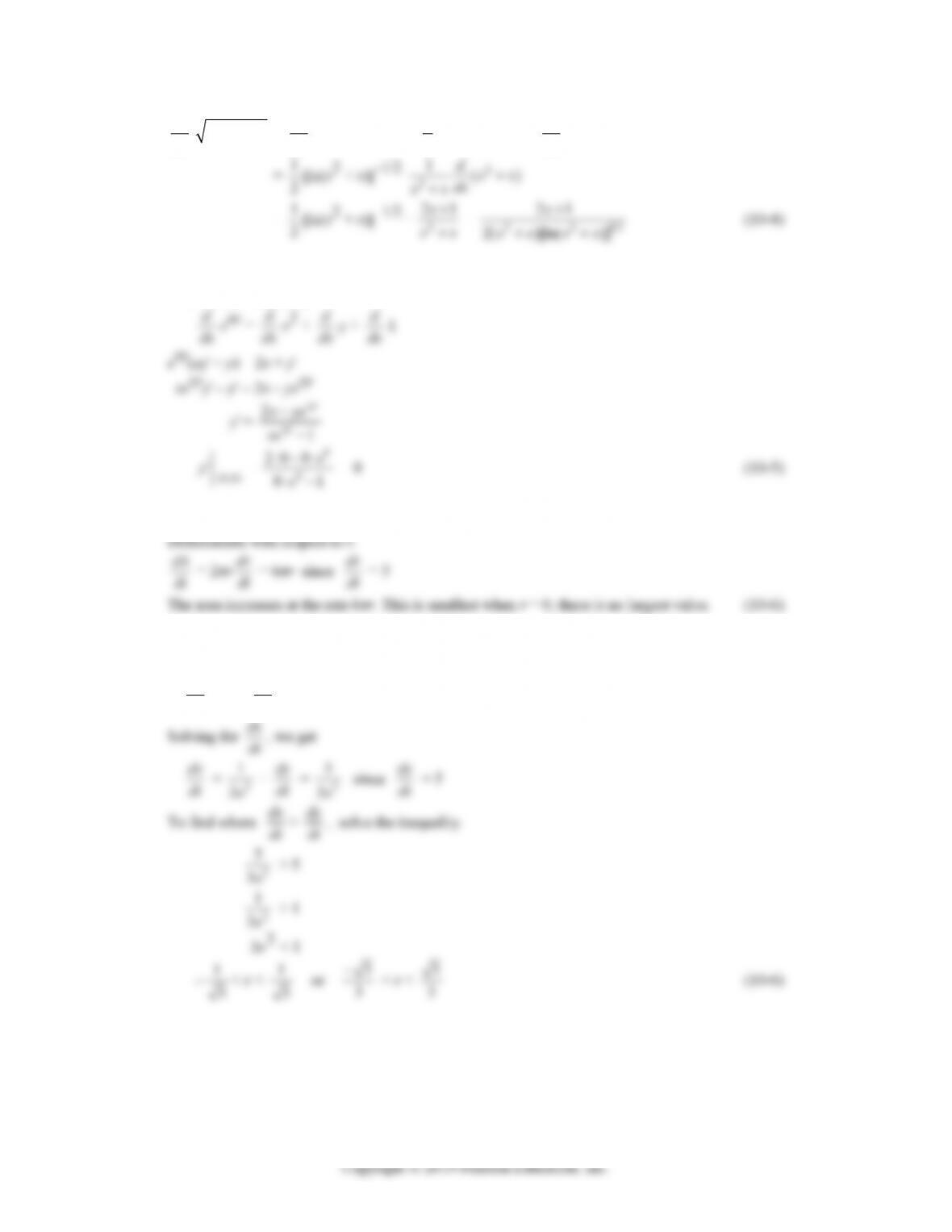
50 0.10(50)
EXERCISE 10-7 10-39
52. p + 0.04x = 32, 032p
800 25
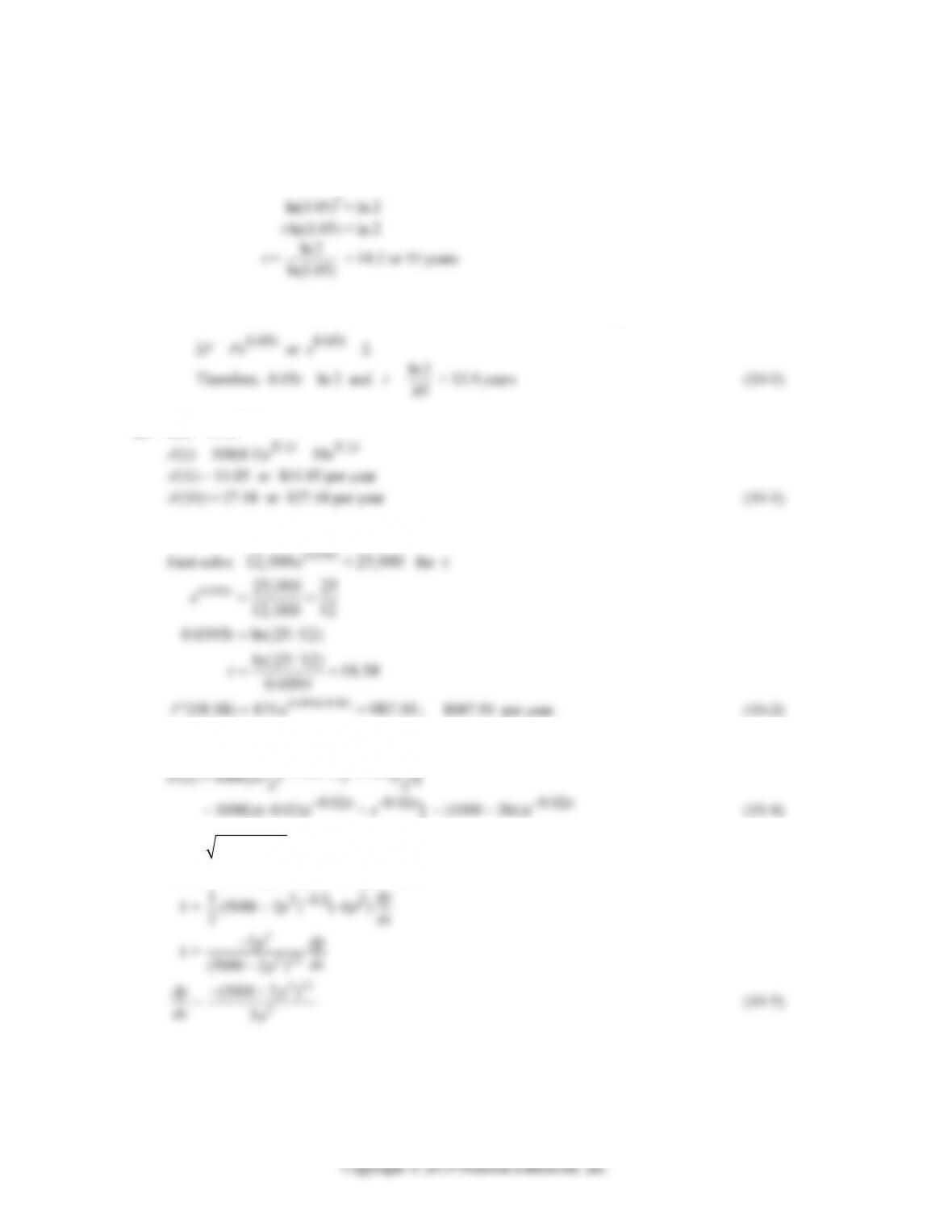
p
p; 28
4
54. From Problem 52, 16
() ; (16) 1;
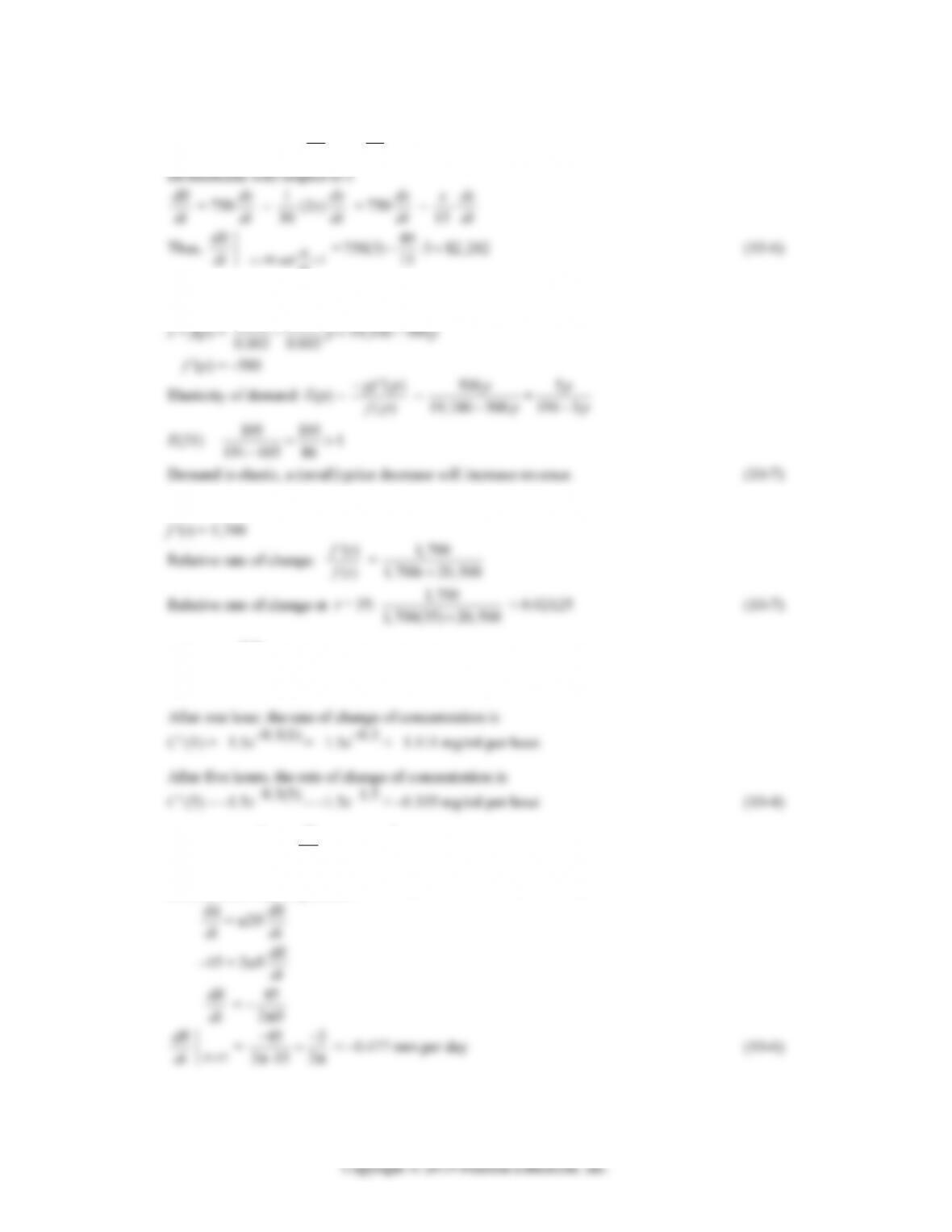
p
Ep E
56. Demand is inelastic if () 1;Ep 1 implies 32 which gives 16.
32
p
60.
480 8 , 480 8 0, so 0 60.xfp p p p
8
‘( )
p
pf p p
62.
22
2,400 6 , 2,400 6 0, so 0 20.xfp p p p
22
12
‘( ) 12 2
pp
pf p p p
2
400
p
3. Thus, Elastic on 20 ,20
3
64. x = f(p) = 324 2 p 324 – 2p ≥ 0 or 0 ≤ p ≤ 162
pf p
=
12
1(2)(324 2)
2
pp
p
66. x = f(p) = 2
3, 600 2 p, 3,600 – 2p2 ≥ 0, 0 ≤ p ≤ 30 2
212
1( 4 )(3, 600 2 )
10-40 CHAPTER 10: ADDITIONAL DERIVATIVE TOPICS
Copyright © 2019 Pearson Education, Inc.
E(p) =
2
2
p
68. x = f(p) = 10(16 – p), 0 ≤ p ≤ 16
R(p) = px = p[10(16 – p)] = 160p – 10p2.
70. x = f(p) = 10(p – 9)2, 0 ≤ p ≤ 9
72. x = f(p) = 30 – 5 p ≥ 0 implies 0 ≤ p ≤ 36
(30 – 5 p ≥ 0 or p ≤ 6 or p ≤ 36)
10-42 CHAPTER 10: ADDITIONAL DERIVATIVE TOPICS
88. x = 2,500 – 1,000p
E(p) = (1,000) 2
pp
21.29 2.58 1
90. From Problem 83, we have
R(p) = p(2,500 – 1,000p) = 2,500p – 1,000p2
92.
1.49 38.8ft t
1.49
ft
94.
1.1
5.9 1.1ln , ‘( )at t a t t
,
1.1
CHAPTER 10 REVIEW
1. A(t) = 2000e0.09t
dx (2 ln x + 3ex) = 2 d
dx ln x + 3 d
dx ex = 2
x
3. d
CHAPTER 10 REVIEW 10-43
4. y = ln(2x + 7)
5. () ln(3 )
x
f
xe
x
e
6. d
dx 2y2 – d
dx 3x3 – d
dx 5 = d
dx (0)
4yy‘ – 9x2 – 0 = 0
2
7. y = 3x2 – 5
dy
2
(3 ) (5)dx d
8. 2 0.01 50, ( ) 5, 000 200px xfp p (10-7)
9. From Exercise 8, ( ) 5,000 200 , ( ) 200xfp pfp
pf p p p p
f
pppp
10. From Exercise 9, elasticity of demand is () 25
p
Ep p
.
11. From Exercise 9, elasticity of demand is () .
25
p
Ep p
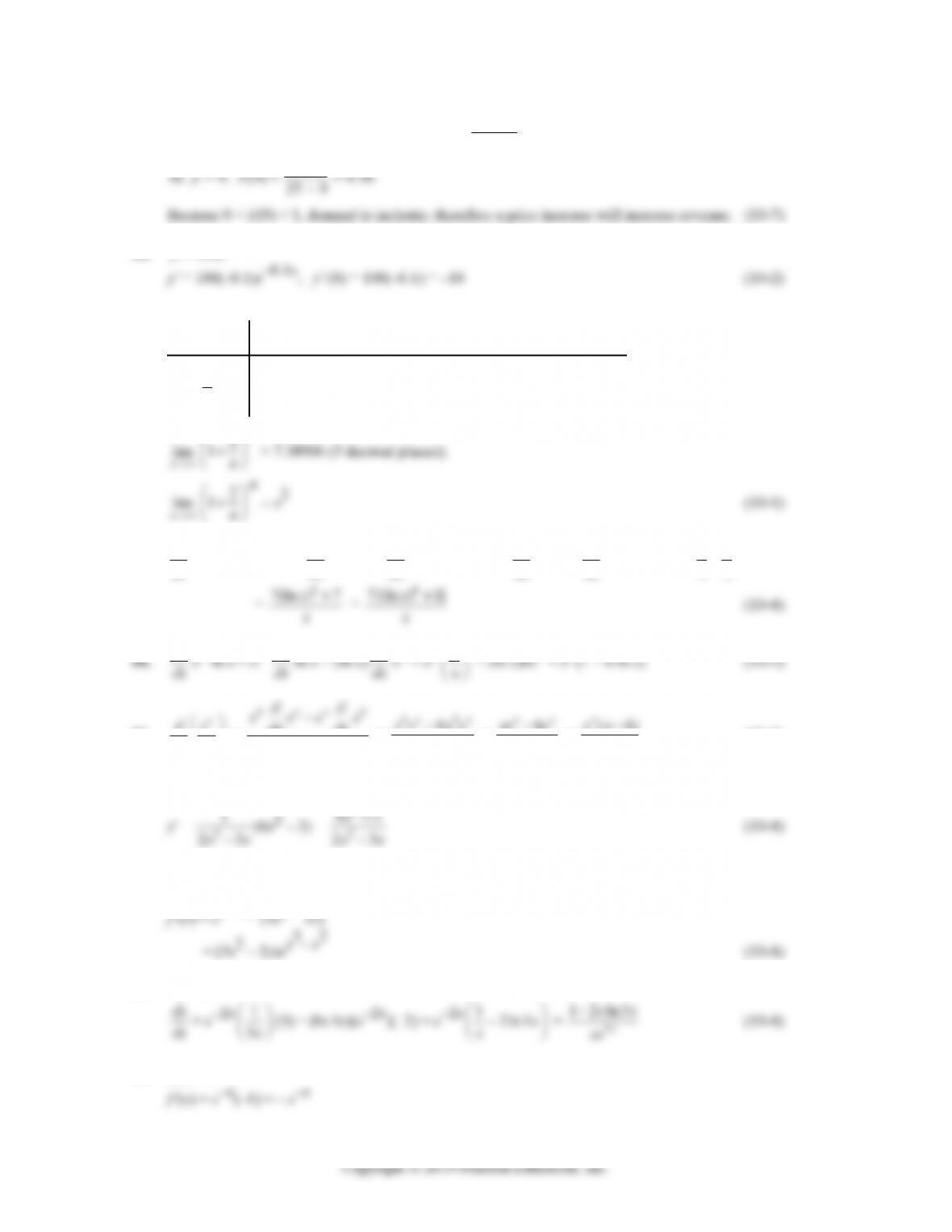
Demand is elastic when E(p) > 1:
10-44 CHAPTER 10: ADDITIONAL DERIVATIVE TOPICS
12. From Exercise 9, elasticity of demand is () .
25
p
Ep p
13. y = 100e–0.1x
14.
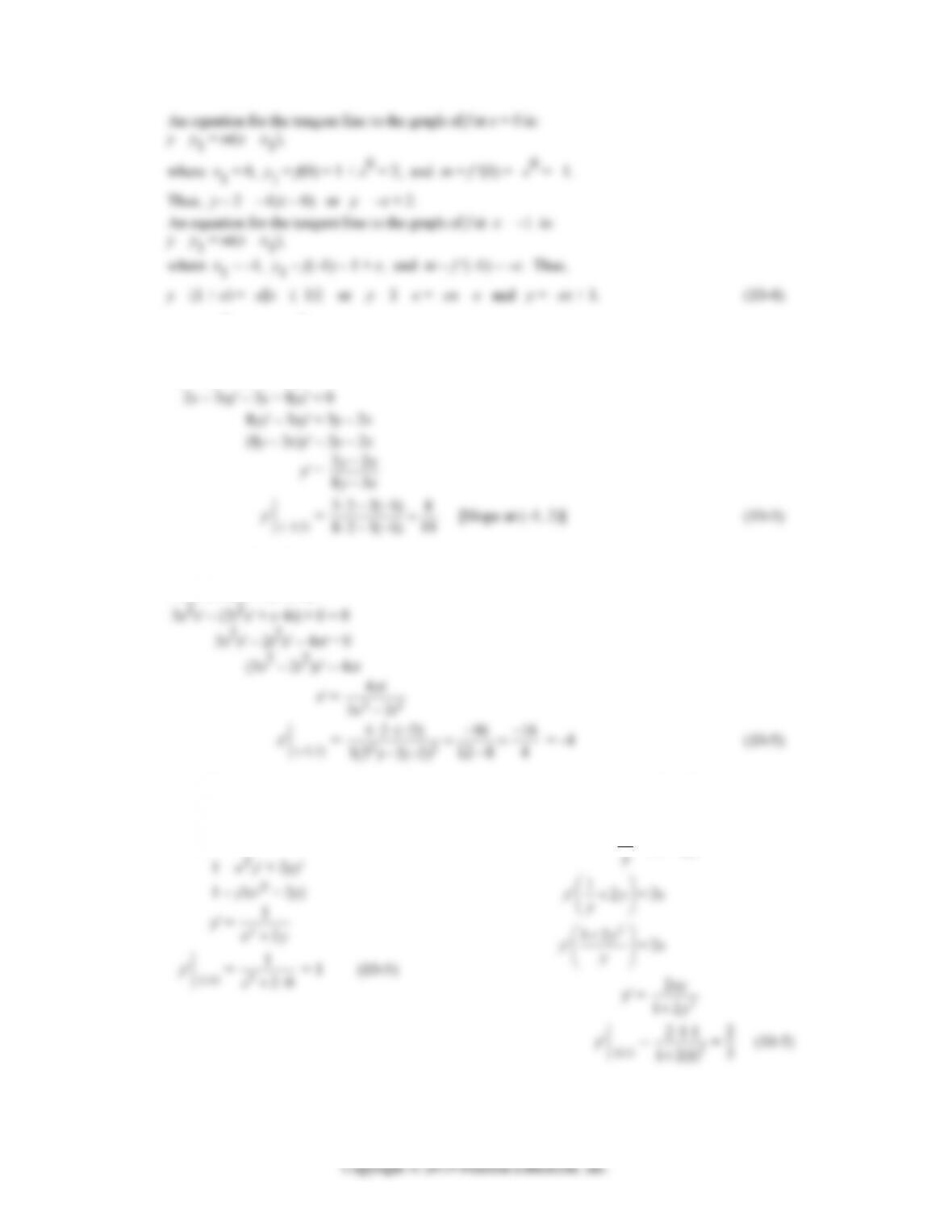
n 1000 100,000 10,000,000 100,000,000
2
2
1n
7.374312 7.388908 7.389055 7.389056
2
n
CHAPTER 10 REVIEW 10-45
Copyright © 2019 Pearson Education, Inc.
An equation for the tangent line to the graph of f at x = 0 is:
y – y1 = m(x – x1),
where x1 = 0, y1 = f(0) = 1 + e0 = 2, and m = f ʹ(0) = –e0 = –1.
Thus, y – 2 = –1(x – 0) or y = –x + 2.
An equation for the tangent line to the graph of f at x = –1 is:
y – y1 = m(x – x1),
where x1 = –1, y1 = f(–1) = 1 + e, and m = f ʹ(–1) = –e. Thus,
y – (1 + e) = –e[x – (–1)] or y – 1 – e = –ex – e and y = –ex + 1. (10-4)
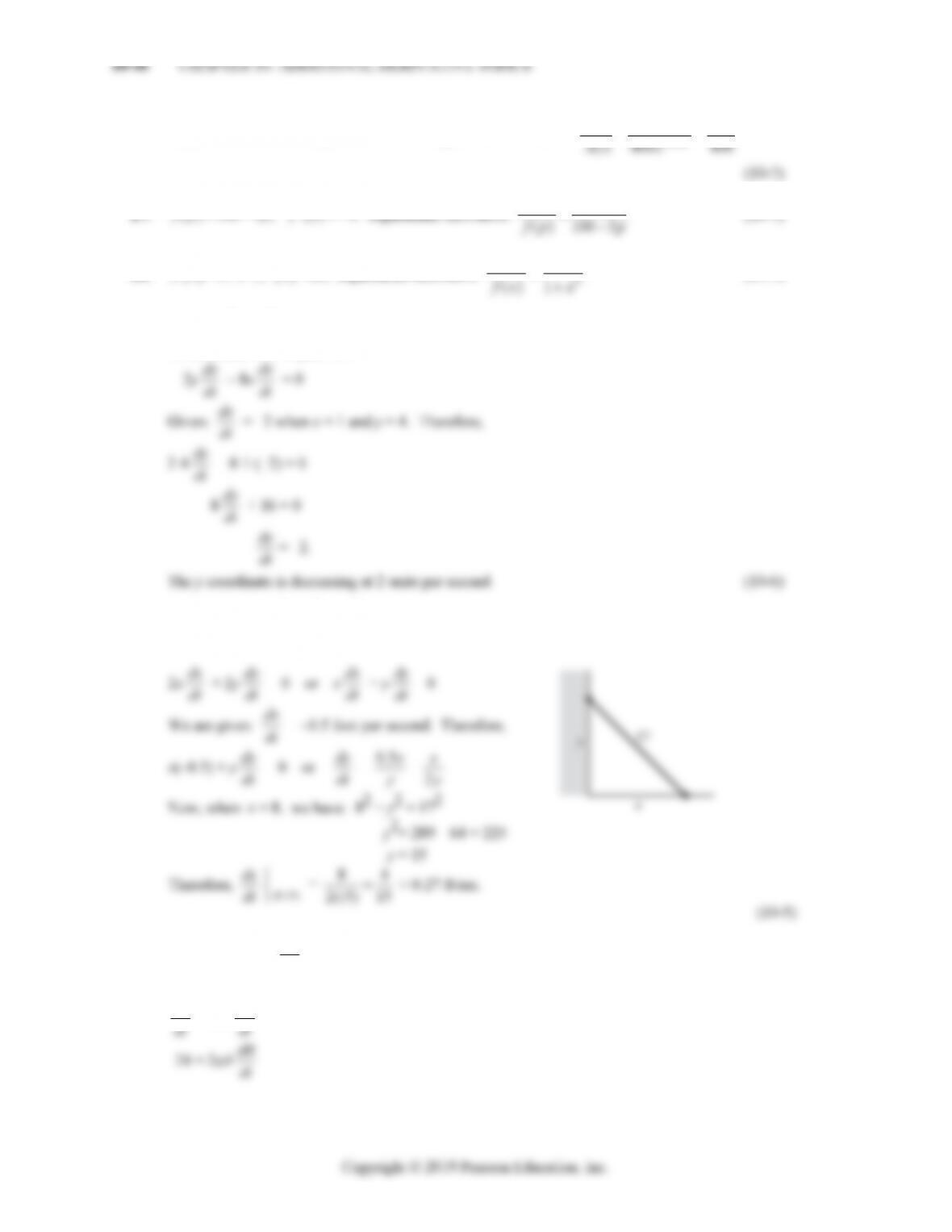
22. x2 – 3xy + 4y2 = 23
Differentiate implicitly:
2x – 3(xy‘ + y·1) + 8yy‘ = 0
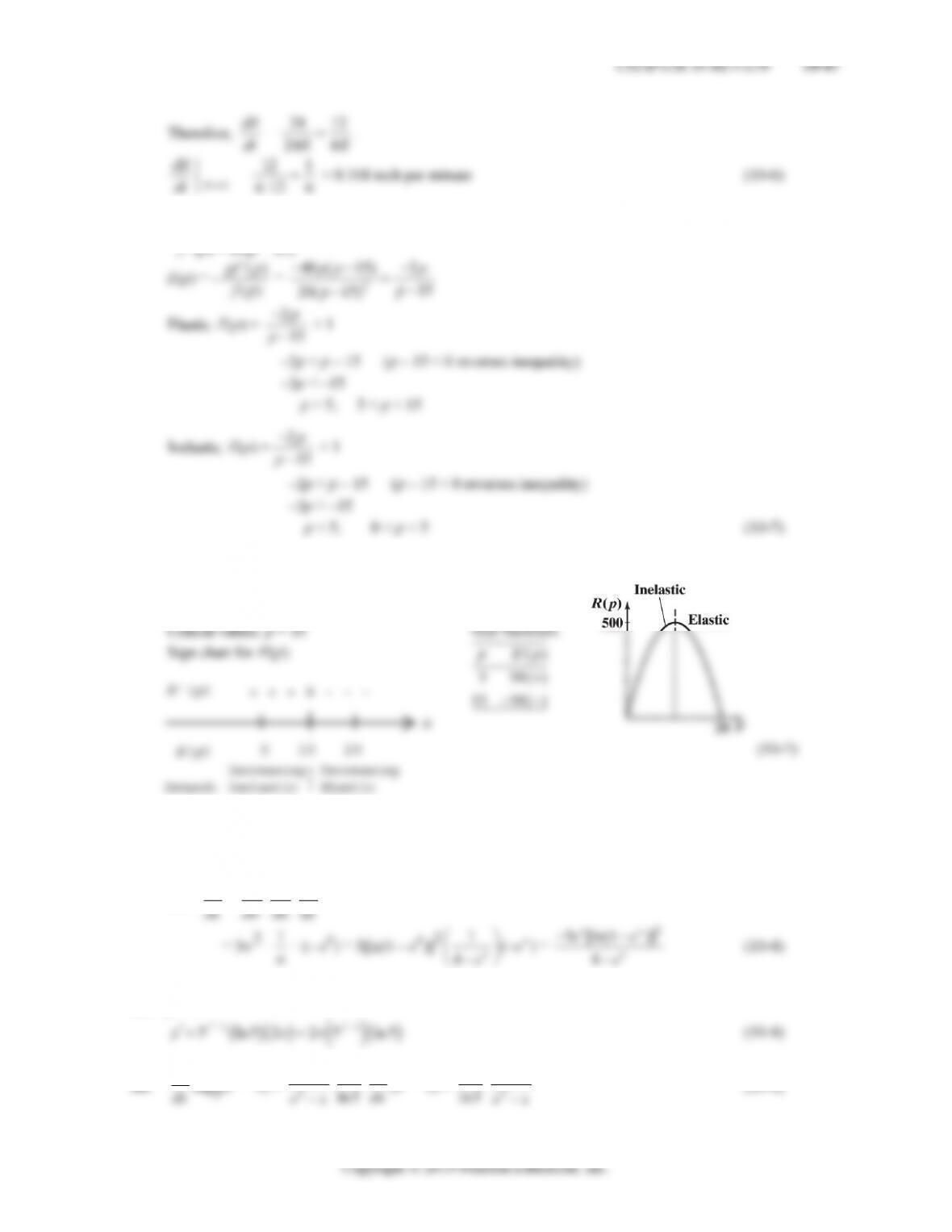
23. x3 – 2t2x + 8 = 0
Differentiate implicitly:
24. x – y2 = ey
Differentiate implicitly:
1 – 2yy‘ = eyy‘
25. ln y = x2 – y2
Differentiate implicitly:
‘
y
y
= 2x – 2yy‘
y
y
Copyright © 2019 Pearson Education, Inc.
32. x = f(p) = 20(p – 15)2 0 ≤ p ≤ 15
33. x = f(p) = 5(20 – p) 0 ≤ p ≤ 20
R(p) = pf(p) = 5p(20 – p) = 100p – 5p2
R‘(p) = 100 – 10p = 10(10 – p)
Increasing Decreasing
Demand: Inelastic Elastic
34. y = w3, w = ln u, u = 4 – ex
(A) y = [ln(4 – ex)]3
(B) dy
x
2
3[ln(4 )]
xx
ee
35. y = 5x2–1
22
–1 –1
xx
36. d
11
d
121
x
(10-4)
10-48 CHAPTER 10: ADDITIONAL DERIVATIVE TOPICS
37. d
dx
2
ln( )
x
x = d
dx [ln(x2 + x)]1/2 = 1
2[ln(x2 + x)]–1/2 d
dx ln(x2 + x)
x
1()
d
2[ln(x2 + x)]–1/2 · 2
x
x
= 2212
2( )[ln( )]
xx xx
38. exy = x2 + y + 1
Differentiate implicitly:
x
39. A = πr2, r ≥ 0
40. y = x3
Differentiate with respect to t:
dy
dt = 3x2dx
dt
x
x
x
x
CHAPTER 10 REVIEW 10-49
41. (A) The compound interest formula is: A = P(1 + r)t. Thus, the time for P to double when r = 0.05
and interest is compounded annually can be found by solving
2P = P(1 + 0.05)t or 2 = (1.05)t for t.
(B) The continuous compound interest formula is: A = Pert. Proceeding as above, we have
42. A(t) = 100e0.1t
43. 0.0395
() 12,000 .
t
Pt e
t
44. R(x) = xp(x) = 1000xe–0.02x
45. x = 3
5000 2 p = (5000 – 2p3)1/2
Differentiate implicitly with respect to x:
dx =
2
3
p
10-50 CHAPTER 10: ADDITIONAL DERIVATIVE TOPICS
46. Given: R(x) = 750x –
2
30
x
and dx
dt = 3 when x = 40.
dt 40 and 3
xdt
15
47. p = 38.2 – 0.002x
48. f(t) = 1,700t + 20,500
49. C(t) = 5e–0.3t
C’ (t) = 5e–0.3t(–0.3) = –1.5e–0.3t
50. Given: A = πR2 and dA
dt = –45 mm2 per day (negative because the area is decreasing).
Differentiate with respect to t: