EXERCISE 10-4 10-21
92. C(x) = 6 + 44x = 6 + (4x + 4)1/2, 0 ≤ x ≤ 30
2
(B) C‘(15) = 1/2
2
94. x = 1,000 – 60 25p = 1,000 – 60(p + 25)1/2, 20 ≤ p ≤ 100.
30
96. C(t) = 250(1 – e-t), t ≥ 0
(A) Cꞌ (t) = 250e-t
(B) Cꞌ (t) = 250e-t > 0 on (0, 5)
()
00
tCt
98. T(t) = 30e–0.58t + 38, t ≥ 0
EXERCISE 10-5 10-23
18. 5x3 – y – 1 = 0
20. y2 + x3 + 4 = 0
22. y2 – y – 4x = 0
24. 3xy – 2x – 2 = 0
d
26. 2y + xy – 1 = 0
10-24 CHAPTER 10: ADDITIONAL DERIVATIVE TOPICS
Copyright © 2019 Pearson Education, Inc.
6x2y + 2x3y‘ – 3x2 + 0 = 0
2x3y‘ = 3x2 – 6x2y
y‘ =
22
3
36
2
x
xy
x
= 3(1 2 )
2
y
x
y‘ at (–1, 3) = 3(1 2(3))
2( 1)
= 15
2
= 15
2
30. x2 – y = 4ey
32. ln y = 2y2 – x
34. xey – y = x2 – 2
d
dx (xey) – d
dx (y) = d
dx (x2) – d
dx (2)
x
36. x3 – tx2 – 4 = 0
d
dt (x3) – d
dt (tx2) – d
dt (4) = d
dt (0)
x
x
x‘ at (–3, –2) = 2
3( 2) 2( 3)
= 2
0
x
EXERCISE 10-5 10-25
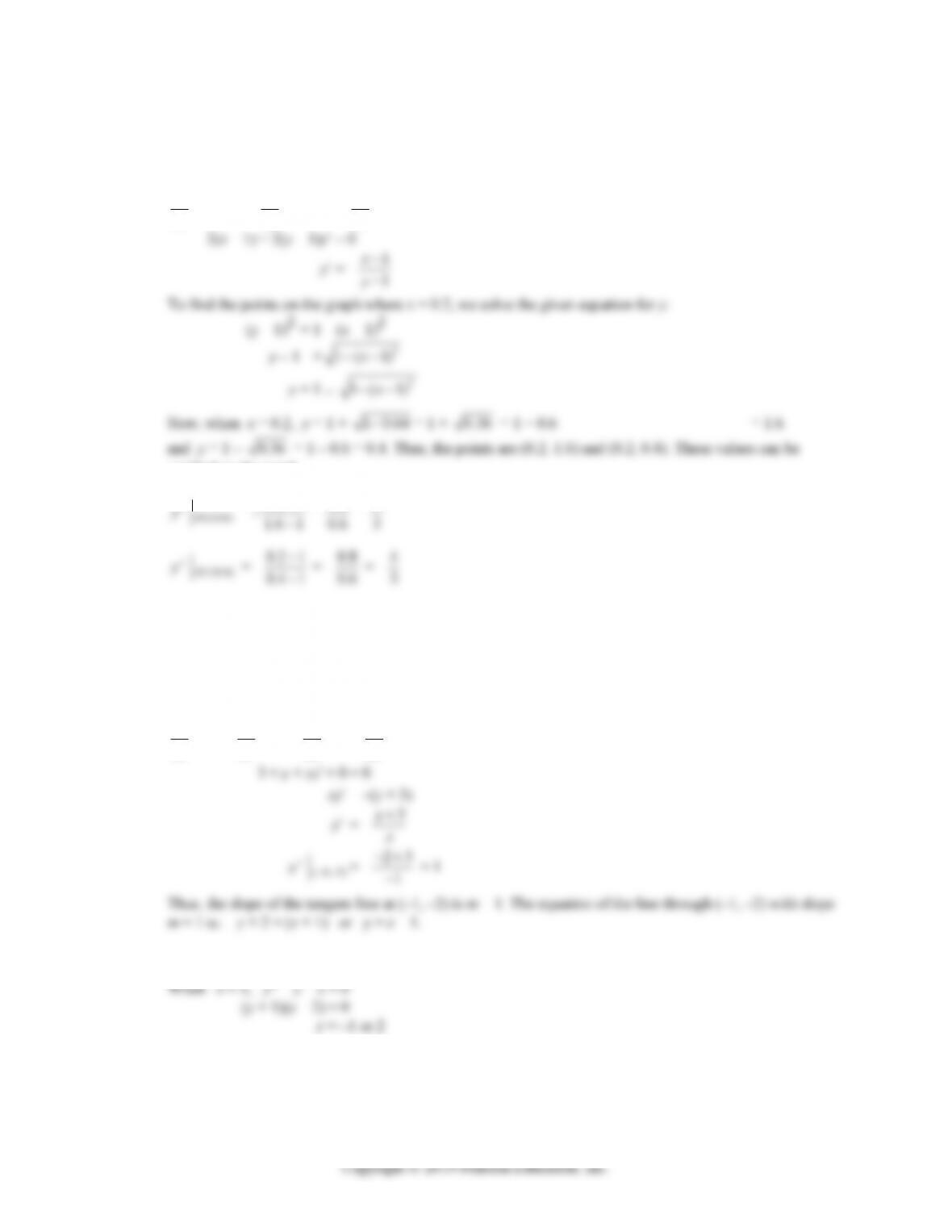
38. (x – 1)2 + (y – 1)2 = 1.
Differentiating implicitly, we have:
d
dx (x – 1)2 + d
dx (y – 1)2 = d
dx (1)
verified on the graph.
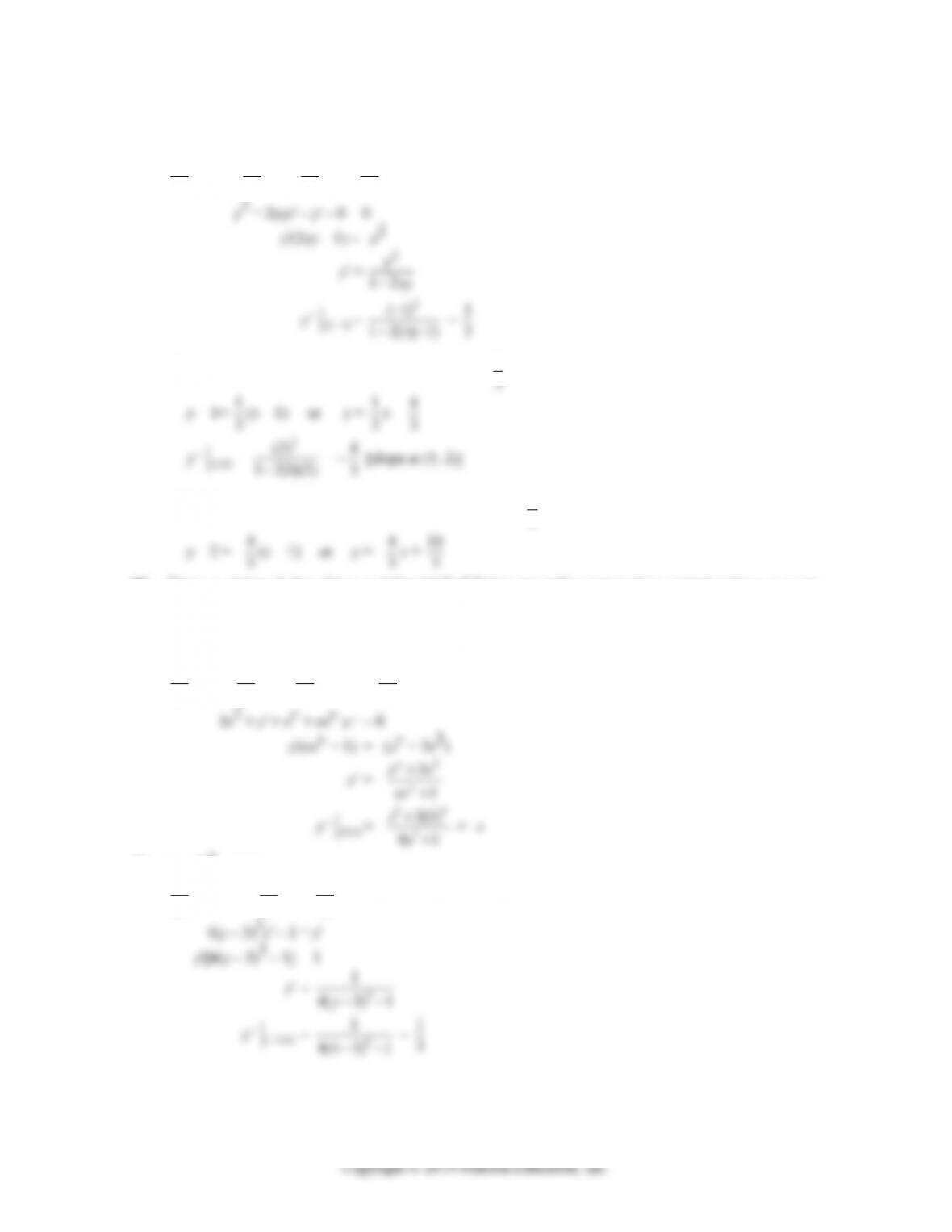
40. 3x + xy + 1 = 0
When x = –1, 3(–1) + (–1)y + 1 = 0, so y = –2. Thus, we want to find the equation of the tangent line at
(–1, –2).
First, find y‘.
d
dx (3x) + d
dx (xy) + d
dx (1) = d
dx (0)
42. xy2 – y – 2 = 0
10-26 CHAPTER 10: ADDITIONAL DERIVATIVE TOPICS
Thus, we have to find the equations of the tangent lines at (1, –1) and (1, 2). First find y‘:
d
dx (xy2) – d
dx (y) – d
dx (0) = d
dx (0)
The equation of the tangent line at (1, –1) with m = 1
Thus, the equation of the tangent line at (1, 2) with m = –4
3 is:
44. Since y appears in two places as polynomial of degree one and as exponent we cannot express y as an
explicit function of x. We need to use implicit differentiation to find the slope of the tangent line to the
graph of the equation at the point (0, 1).
x3 + y + xey = 1
d
dx (x3) + d
dx (y) + d
dx (xey) = d
dx (1)
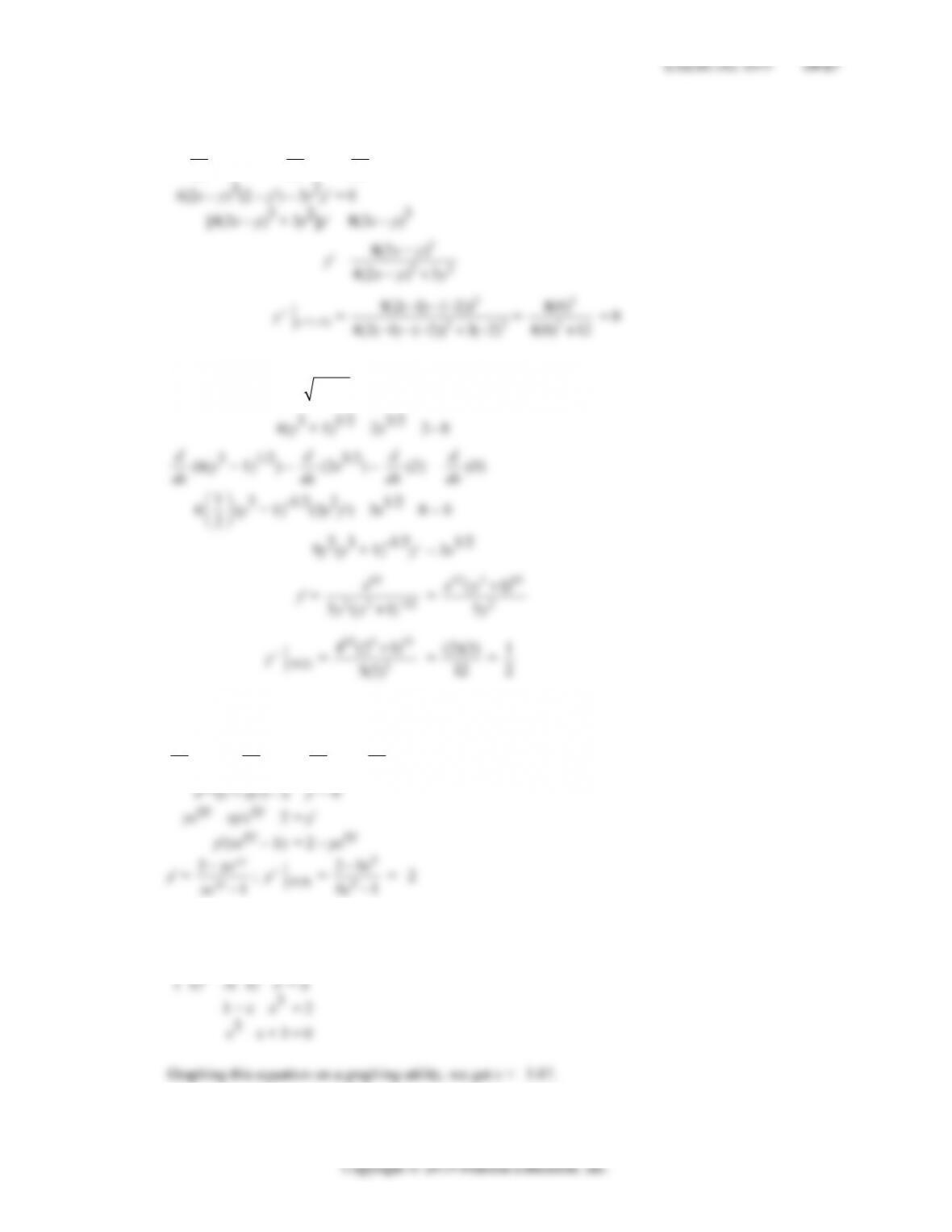
46. (y – 3)4 – x = y
d
dx (y – 3)4 – d
dx (x) = d
dx (y)
10-28 CHAPTER 10: ADDITIONAL DERIVATIVE TOPICS
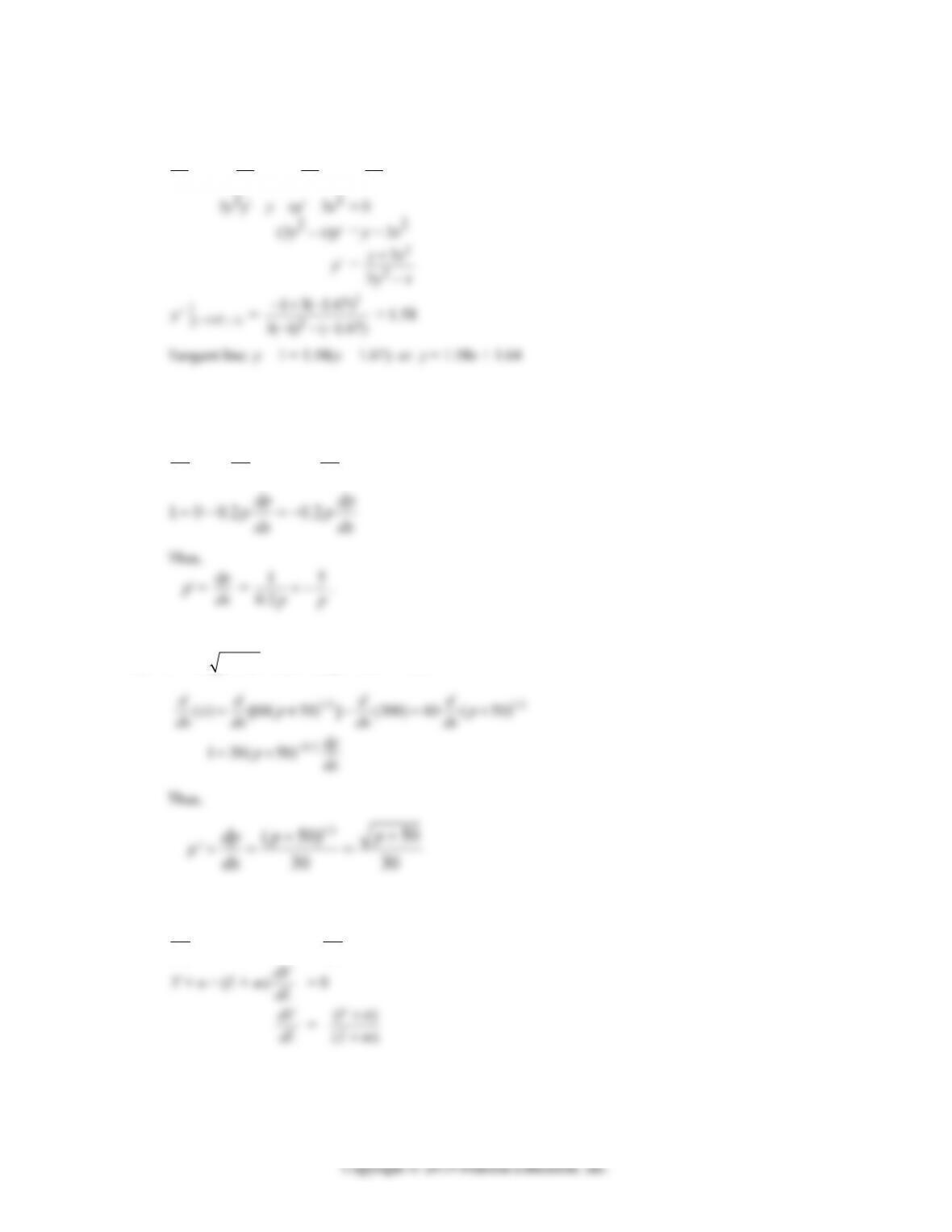
Now, differentiate implicitly to find the slope of the tangent line at the point (–1.67, –1):
d
dx (y3) – d
dx (xy) – d
dx (x3) = d
dx (2)
56. 2
5, 000 0.1
x
p
2
( ) (5, 000) (0.1 )
dd d
x
p
dx dx dx
dx = 15
0.2 pp
58. x = 1/2
60 50 300 60( 50) 300pp
1/ 2 1/ 2
( ) [60( 50) ] (300) 60 ( 50)
dd d d
xp p
dx dx dx dx
30 30
dx
60. (L + m)(V + n) = k
d
dL ((L + m)(V + n)) = d
dL (k)
EXERCISE 10-6 10-29
62. 12
2
mm
FG
r
12
mm
dd
FG
2
dd
12
2
dF Gm m
64. 12
2
mm
FG
r
12
2
mm
dd
FG
dr dr r
2
dd
3
dr r
EXERCISE 10-6
2. 22 2
(400) 160,000 502,655 mAr
6. 33 3
44
(3) 36 113.1 m
Vr
1,000 1,000
22
10. y = x3 – 3
Differentiating with respect to t:
dy
10-30 CHAPTER 10: ADDITIONAL DERIVATIVE TOPICS
12. x2 + y2 = 4
Differentiating with respect to t:
2xdx
14. x2 – 2xy – y2 = 7
Differentiating with respect to t:
2xdx
16. 4x2 + 9y2 = 36
Differentiate with respect to t:
EXERCISE 10-6 10-31
18.
z = rope From the triangle,
x2 + y2 = z2
20. Circumference: C = 2πR
dC
dt = 2π dR
dt
22. Surface area: S = 4πR2
dS
dt = 8πRdR
dt
24. VP = k
Differentiating with respect to t:
dV
dt P + VdP
dt = 0
26. By the Pythagorean theorem,
z2 = (300)2 + y2 (
1)
y
z
10-32 CHAPTER 10: ADDITIONAL DERIVATIVE TOPICS
Therefore, dz
dy
(400,500)
28. y = length of shadow
x = distance of man from light
z = distance of tip of shadow from light
20
ft
A
C
5 ft
dt = 5. Thus, dy
dt = 5
3ft/sec.
30. Observe that
z2 = x2 + 1
Differentiating with respect to t:
zdz
dt = xdx
dt
z
(0,1)
EXERCISE 10-6 10-33
Copyright © 2019 Pearson Education, Inc.
From (1), for dz
dt = 5, we have x = 21x which is impossible.
Therefore, the distance from (0, 1) is never increasing at ≥ 5 units per second.
32. x3 + y2 = 1; dy
dt = 2, dx
dt = 1
Differentiating with respect to t:
x
x
x
34. C = 72,000 + 60x (1)
R = 200x –
2
x
(2)
Costs are increasing at $30,000 per week at this production level.
(B) Differentiating (2) with respect to t:
dR
dt = 200 dx
dt – 1
15 xdx
dt
x
dx
x
10-34 CHAPTER 10: ADDITIONAL DERIVATIVE TOPICS
(C) Differentiating (3) with respect to t:
dP
36. S = 50,000 – 20,000e–0.0004x
Differentiating implicitly with respect to t, we have
dS
38. 1/2
800 36 20 800 36( 20)xp p
Differentiating implicitly with respect to t, we have
18
dx d d dp dp
40.
() 800 36 20Rp p p
18 800 36 20
dR dp dp
EXERCISE 10-6 10-35
42. 2
3 2 500, (6 2)
dx dp
xp p p
dt dt
dx
44. 4
25 4 ln , .
dy dx
yx
dt x dt
dy
46. Price p and demand x are related by the equation
x2 + 2xp + 25p2 = 74,500 (1)
Differentiating implicitly with respect to t, we have
2xdx
dt + 2 dx
dt p + 2xdp
dt + 50pdp
dt = 0 (2)
(A) From (2), dx
dt =
(25)
dp
xp
dt
xp
(B) From (2), dp
dt =
()
25
dx
xp
dt
x
p
10-36 CHAPTER 10: ADDITIONAL DERIVATIVE TOPICS
Copyright © 2019 Pearson Education, Inc.
Now, for x = 150, p = 40 and dx
dt = –6, we have
dp
dt = (150 40)( 6)
150 25(40)
≈ 0.99
Thus, the price is increasing at the rate of $0.99 per month.
48. T = 6 1
1
x
= 6(1 + x–1/2)
Differentiating with respect to t:
dT
dt = 6 1
2
x–3/2 dx
dt
= –3x–3/2 dx
dt
EXERCISE 10–7
0.02
p
4. 22
180
180 0.8 , 0 15; 225 1.25 ,
0.8
p
p
xx x p
6. /4 /4
45 , 0 12; 45 , ln (45 ), 4 ln (45 p)
4
xx
x
pe xe p px
8. 500
ln (500 5 ), 0 90; 500 5 , 100 0.2
5
p
pp
e
p
xx e xx e
p
10.
2
60 1.2
f
xxx
x
x
2
60 1.2
fx
x
x
12.
0.5
15 3
x
fx e
0.5
0.5
15 3
x
x
fx e