Chapter 10 – Organizational Change & Innovation: Lifelong Challenges for the Exceptional Manager
10-1
10
Chapter
Organizational Change &
Innovation:
Lifelong Challenges for the Exceptional Manager
Major Questions the Student Should Be Able to Answer 2
Mapping the Class: Chapter Outline 3
Overview of the Chapter 4
CHAPTER CONTENTS
Chapter 10 – Organizational Change & Innovation: Lifelong Challenges for the Exceptional Manager
10-2
10.1 The Nature of Change in Organizations
MAJOR QUESTION: Since change is always with us, what should I understand about
it?
10.4 Promoting Innovation within the Organization
MAJOR QUESTION: What do I need to know to encourage innovation?
MAJOR QUESTIONS THE STUDENT SHOULD BE ABLE TO ANSWER
Chapter 10 – Organizational Change & Innovation: Lifelong Challenges for the Exceptional Manager
10-3
10.1 The Nature of Change in Organizations
• Planning Fundamental Change: What Will You Be Called on to Deal With?
10.2 Types & Models of Change
10.3 Organizational Development: What It Is, What It Can Do
• What Can OD Be Used For?
10.4 Promoting Innovation within the Organization
• How Does Failure Impede Innovation?
10.5 The Threat of Change: Managing Employee Fear & Resistance
MAPPING THE CLASS: CHAPTER OUTLINE
Chapter 10 – Organizational Change & Innovation: Lifelong Challenges for the Exceptional Manager
10-4
10.1 The Nature of Change in Organizations
There are two types of change, reactive and proactive. Forces for change may
10.2 Types & Models of Change
There are three types of change, adaptive, innovative, and radically
10.3 Organizational Development: What It Is, What It Can Do
Organizational development (OD) is a set of techniques for implementing
10.4 Promoting Innovation within the Organization
Innovation may be a product innovation or a process innovation, a core
10.5 The Threat of Change: Managing Employee Fear & Resistance
Resistance to change is an emotional/behavioral response to real or imagined
threats to an established work routine. Resistance can be considered to be the
OVERVIEW OF THE CHAPTER
Chapter 10 – Organizational Change & Innovation: Lifelong Challenges for the Exceptional Manager
10-5
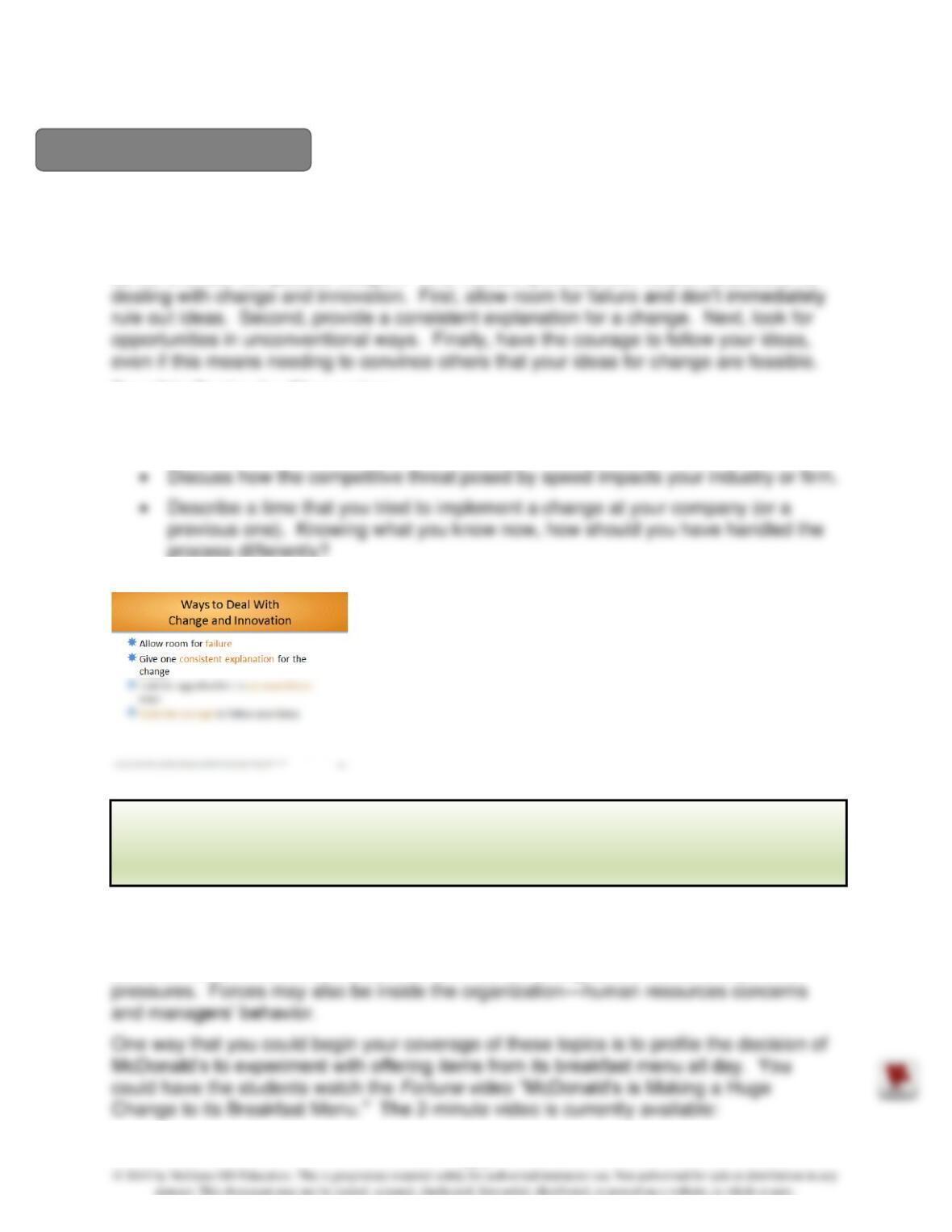
The Manager’s Toolbox: Managing for Innovation & Change Takes a Careful Hand
Dealing with change is an ongoing challenge for every manager and speed is emerging
as the ultimate competitive weapon. This Toolbox provides four recommendations for
Possible Topics for Discussion:
• If you were going to instill a culture of innovation in a company you worked for,
what kinds of things would you do?
Section 10.1 discusses reactive and proactive change. Forces for change may consist
of forces outside the organization—demographic characteristics; technological
advancements; shareholder, customer and market changes; and social and political
CLASSROOM OUTLINE
10.1 The Nature of Change in Organizations (pp. 306-312)
Since change is always with us, what should I understand about it?
Chapter 10 – Organizational Change & Innovation: Lifelong Challenges for the Exceptional Manager
10-6
Article Citation:
Brat, I. (2015, March 30). McDonald’s to test expanded breakfast hours. Wall Street
Journal Online.
Possible Topics for Discussion:
• Discuss the forces for change that are likely to impact your academic institution
over the next 5-10 years.
Major Idea Outline:
A. People are generally uncomfortable about change, in both small and large
matters.
B. Fundamental Change: What Will You Be Called On to Deal With?
1. It is possible to identify and prepare for the future that has already
2. Beyond trends such as declining population in developed countries,
more diversity, etc. are some supertrends shaping the future of
business.
a. The marketplace is becoming more segmented and moving
toward more niche products.
(1) We have “demassification,” with consumer groups becoming
segmented into smaller and more specialized groups that
Chapter 10 – Organizational Change & Innovation: Lifelong Challenges for the Exceptional Manager
10-7
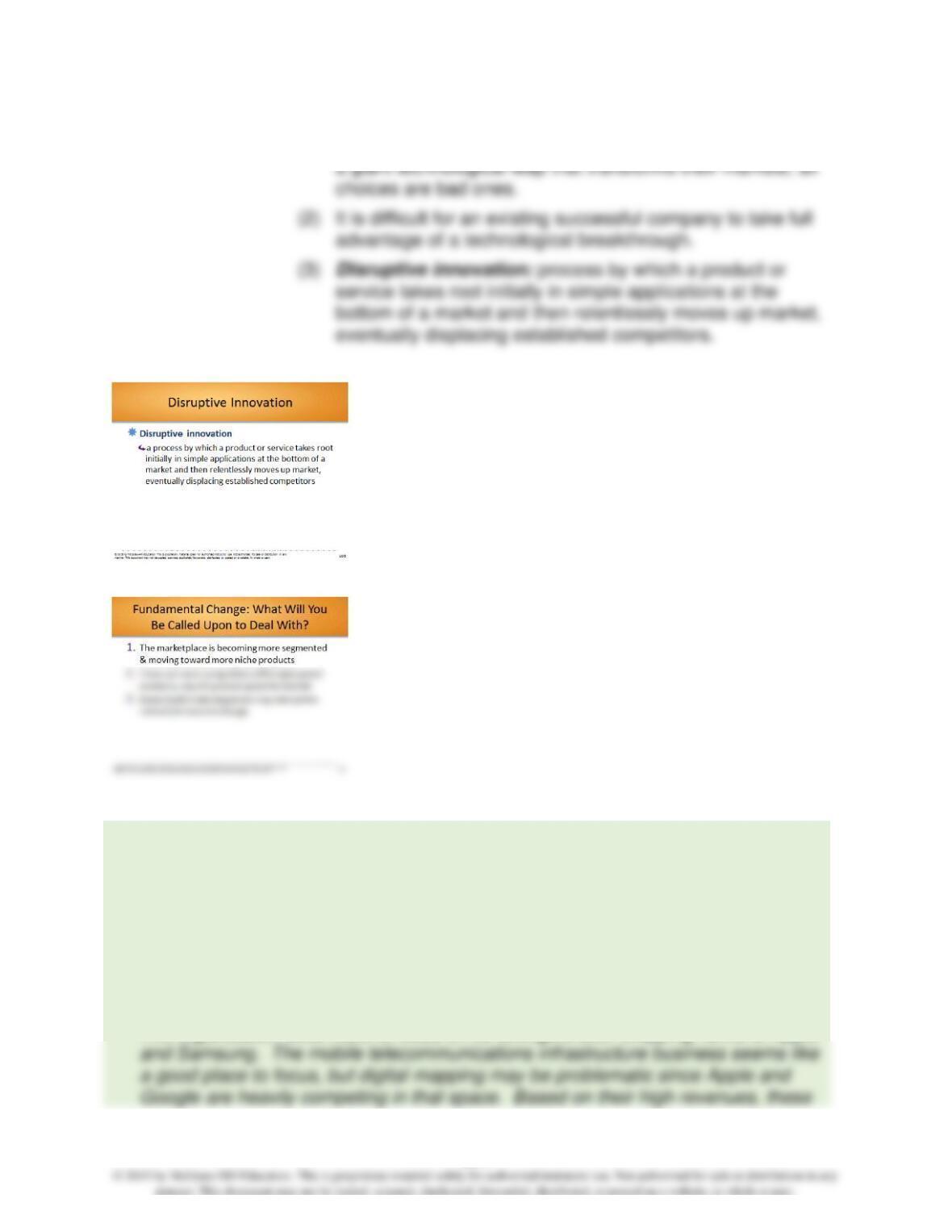
(1) Harvard Business School professor Clayton Christensen
argues that, when successful companies are confronted with
Interactive Classroom Material:
EXAMPLE: Radical Change: The Fall of the BlackBerry (p. 307)
In 2009, Finnish phone maker Nokia’s BlackBerry held first place in world market
share for cell phones—so popular it was nicknamed the CrackBerry. Four years later,
it had gone from dominance to also-ran, falling far behind Apple and Samsung.
YOUR CALL
Do you think the new strategy will work?
The organization does need to focus on its strengths after dropping ranks to Apple
Chapter 10 – Organizational Change & Innovation: Lifelong Challenges for the Exceptional Manager
10-8
Additional Activities:
One way to build on this Example is to have the students watch the video “BlackBerry
Passport: The Design Story.” This 2-minute video was developed by BlackBerry and
it discusses the process used to create the design of the BlackBerry Passport.
Consider using the following discussion questions:
Many people believe that BlackBerry should exit the device market completely.
Do you think BlackBerry has a chance to succeed with this new product?
d. China, India and other offshore suppliers are changing the way
we work.
(1) Globalization and outsourcing are transforming whole
industries and changing the way we work.
e. Knowledge, not information, is becoming the new competitive
advantage.
(1) As information technology does more of the work formerly
done by humans, many lower-level employees previously
thought of as knowledge workers are now being recognized
Chapter 10 – Organizational Change & Innovation: Lifelong Challenges for the Exceptional Manager
10-9
C. Two Types of Change: Reactive versus Proactive
1. Reactive change: responding to unanticipated problems and opportunities
Interactive Classroom Material:
EXAMPLE: Reactive Change: The BP Gulf of Mexico Blowout (p. 309)
Some crises happen quickly like the April 2010 explosion on the BP drilling platform in
the Gulf of Mexico which led to the sinking of the rig, the loss of 11 lives, and one of
the largest oil spills ever to happen in U.S. waters.
YOUR CALL
Wasn’t that enough time for oil companies to plan for major accidents? What
should BP have done?
Proper planning may have saved BP a lot of money and resources. Though a
backup shutoff was not mandated by regulators, it would have ethically been wise.
Remember the ethical decision making tree? Many organizations, such as Shell,
Chapter 10 – Organizational Change & Innovation: Lifelong Challenges for the Exceptional Manager
10–10
Additional Activities:
For a more in-depth profile of the decisions leading up to the Deepwater Horizon
disaster, consider having the students watch the 60 Minutes segment “Blowout: The
Deepwater Horizon Disaster.” The segment aired in 2-parts in 2010 and it provides
first-hand accounts of what happened.
Consider using the following discussion questions:
Discuss forces for change that will likely impact BP over the next 10 years.
2. Proactive change: managing anticipated problems and opportunities
a. Proactive change, or planned change, involves making carefully
thought-out changes in anticipation of possible or expected problems
or opportunities.
Interactive Classroom Material:
EXAMPLE: Proactive Change: Disney World Gets Out Front with Its MagicBand
(pp. 309-310)
The Walt Disney Company is taking a giant proactive stride: investing $1 billion into a
YOUR CALL
Chapter 10 – Organizational Change & Innovation: Lifelong Challenges for the Exceptional Manager
10–11
Do you think Disney is on to something? Could the technology be applied to
zoos, Las Vegas resorts, and other venues, as the company hopes? How?
Disney is on to something in regards to making life easier for visitors to its parks,
Additional Activities:
One way to build on this Example is to have the students watch the Business Insider
video “Forget Apple and Google, Disney has Already Mastered Wearable Tech.” This
2-minute video provides students a visual way to see how the bands operate.
Consider using the following discussion questions:
If you were planning to travel to a Disney resort, which would be most important to
SELF-ASSESSMENT 10.1 (p. 310)
Assessing Your Attitudes toward Change at Work
Go to connect.mheducation.com and take Self-Assessment 10.1.
Student Questions:
1. Where do you stand when it comes to your attitude toward change? Are you
surprised by the results?
2. Based on your three lowest scoring survey items, how might you foster a more
positive attitude toward change? Be specific.
Generally, students can foster a more positive attitude towards change by
Chapter 10 – Organizational Change & Innovation: Lifelong Challenges for the Exceptional Manager
10–12
3. What type of questions might a recruiter ask you during an interview to assess
your attitude toward change? What would be your response to these
questions?
Additional Activities:
You can also consult the Connect Instructors Manual for the post-assessment activity
and corresponding PowerPoint slides used for this Self-Assessment in Connect. In
D. The Forces for Change: Outside & Inside the Organization
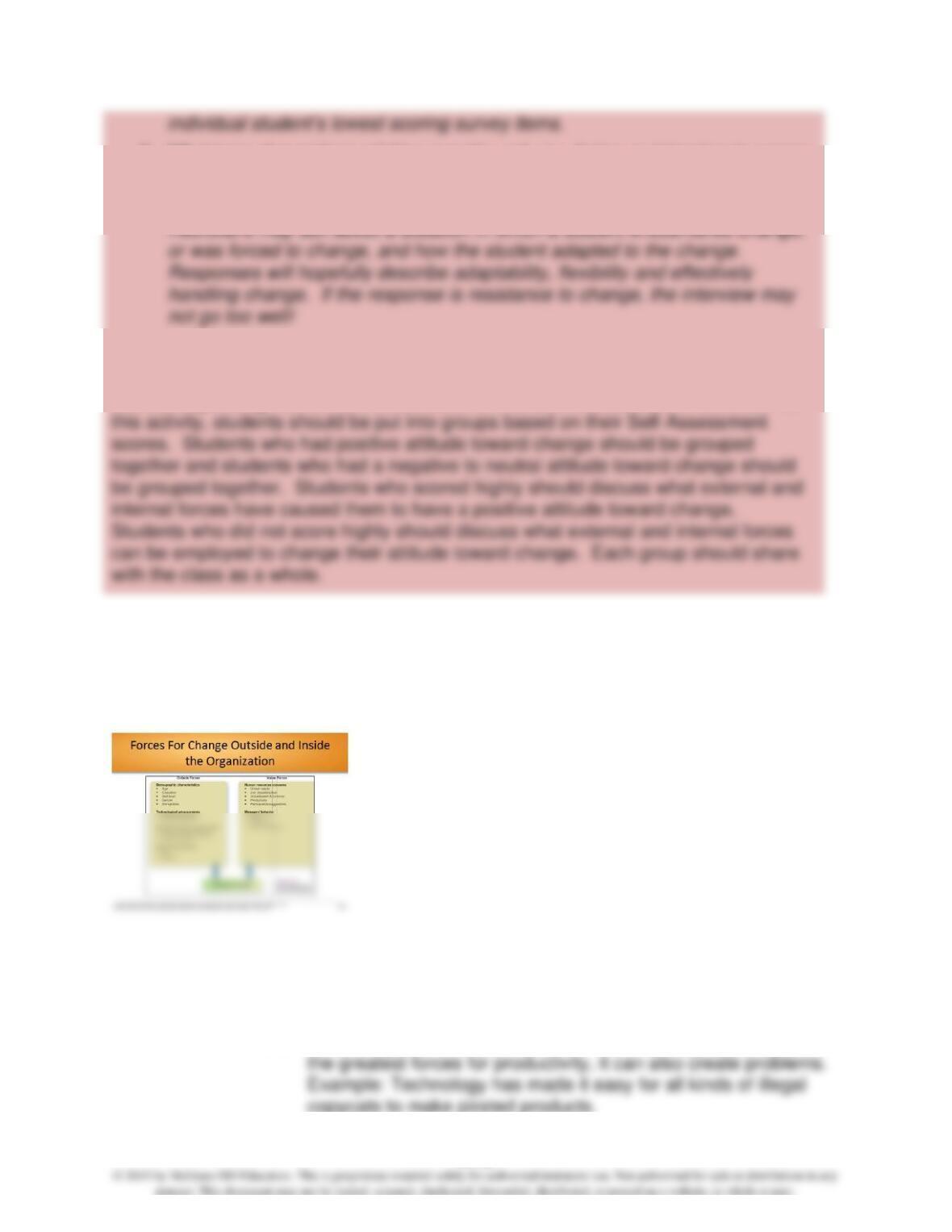
1. Managers can get clues as to when change is needed by monitoring the
forces for change – both outside and inside the organization.
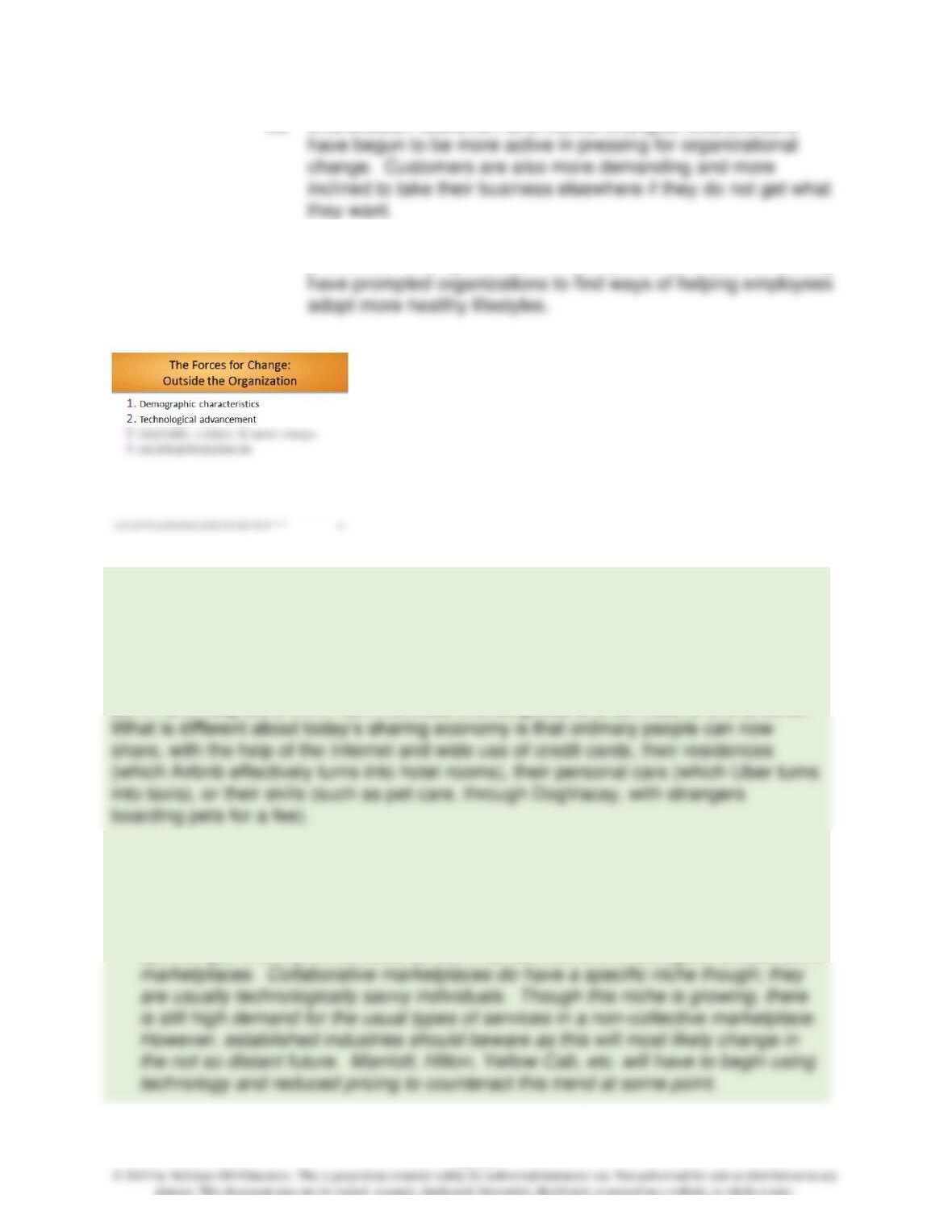
a. External forces consist of six types:
(1) Demographic characteristics, such as those occurring in the
U.S. workforce, with the workforce becoming more diverse.
(2) Technological advancements. While technology may be one of
Chapter 10 – Organizational Change & Innovation: Lifelong Challenges for the Exceptional Manager
10–13
(3) Shareholder, customer, and market changes. Shareholders
(4) Social and political pressures. Social events can create great
pressures. Example: Health-related problems related to obesity
Interactive Classroom Material:
EXAMPLE: Technology Creates the Sharing Economy: Airbnb, Uber, & . . .
DogVacay? (p. 311)
The sharing economy, also known as collaborative or peer-to-peer marketplaces, is a
technological variation on past behavior in which people who knew each other, such
as kin and neighbors within communities, offered goods and services to one another.
YOUR CALL
What do you think will be the effect of these collaborative marketplaces on
established industries?
Established industries, such as major hotel chains, taxi vendors, etc. will have to
up their game and provide better prices if consumers are to disregard collaborative
Chapter 10 – Organizational Change & Innovation: Lifelong Challenges for the Exceptional Manager
Additional Activities:
One way to build on this Example is to have the students watch the Wall Street
Journal video “DogVacay: Crowd-Sourced Care for Your Pet – Digits.” The video at
the link below goes on to profile other companies, but the first 2:47 minutes of the
video focuses on DogVacay. Consider using the following discussion questions:
Discuss the outside forces that likely have contributed to the success of
(Correct answer is B)
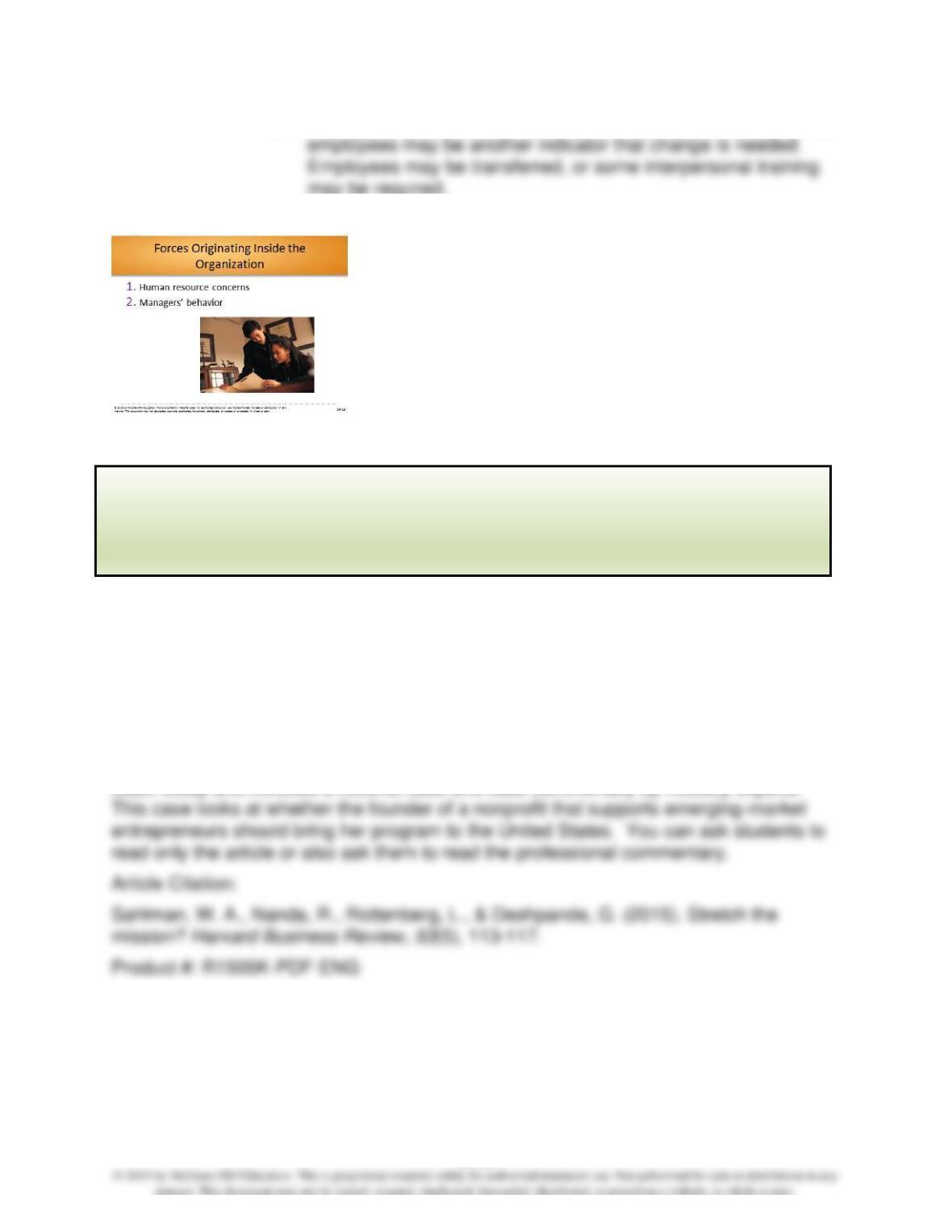
b. Internal forces affecting organizations may be of two types:
(1) Human resources concerns. Job dissatisfaction can be a major
Chapter 10 – Organizational Change & Innovation: Lifelong Challenges for the Exceptional Manager
10–15
(2) Managers’ behavior. Excessive conflict between managers and
Section 10.2 discusses the three types of change, from least threatening to most
threatening: adaptive, innovative, and radically innovative. It also describes Lewin’s
three-stage change model: unfreezing, changing, and refreezing. Finally, it describes
Kotter’s eight steps for leading organizational change, which can be linked to Lewin’s
three stages.
One way that you could begin your coverage of these topics is to have the students
read the Harvard Business Review article “Stretch the Mission?” This article is a HBR
Possible Topics for Discussion:
• Describe examples of adaptive, innovative and radically innovative changes that
have been implemented in your company (or a previous one).
• Compare and contrast Lewin’s change model and Kotter’s eight steps for leading
change.
10.2 Types & Models of Change (pp. 313-316)
What are three types of change, and how are Lewin’s and Kotter’s
approaches designed to handle change?
Chapter 10 – Organizational Change & Innovation: Lifelong Challenges for the Exceptional Manager
10–16
Major Idea Outline:
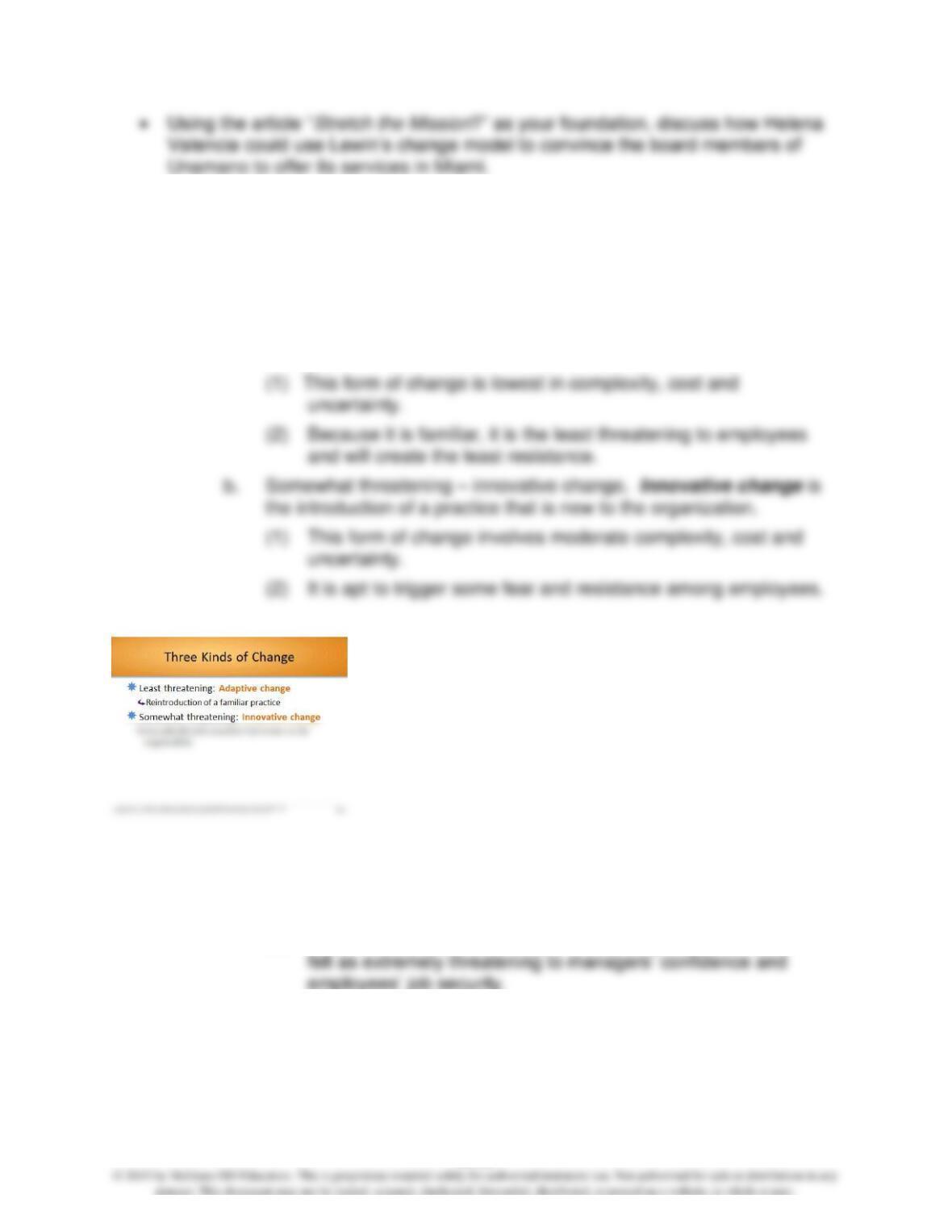
A. Three Kinds of Change: From Least Threatening to Most Threatening
1. The degree to which employees feel threatened by it in general depends
on whether the change is adaptive, innovative or radically innovative.
a. Least threatening – adaptive change. Adaptive change is
reintroduction of a familiar practice, the implementation of a kind of
change that has already been experienced within the organization.
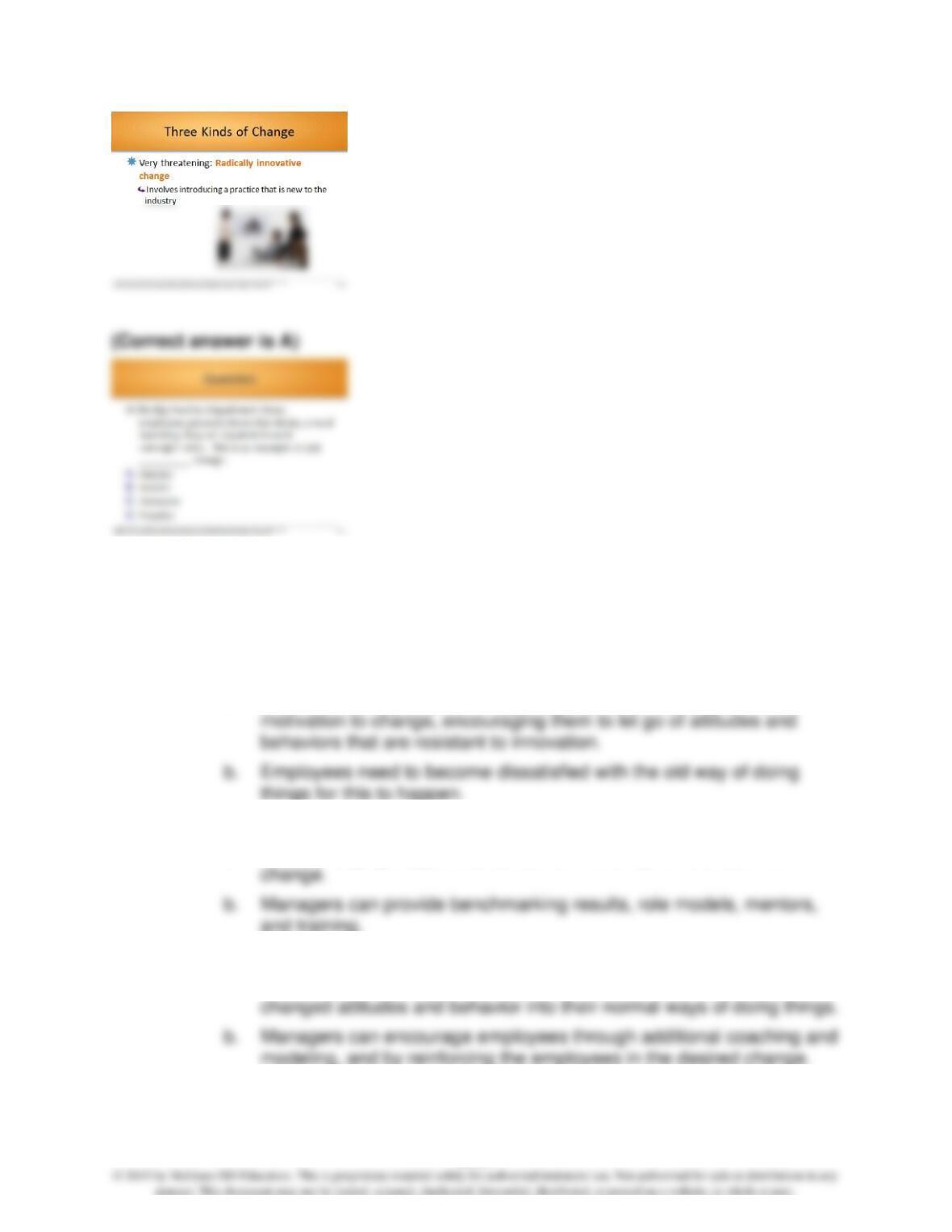
c. Very threatening – radically innovative change. Radically
innovative change involves introducing a practice that is new to the
industry.
(1) Because it is the most complex, costly and uncertain, it will be
Chapter 10 – Organizational Change & Innovation: Lifelong Challenges for the Exceptional Manager
10–17
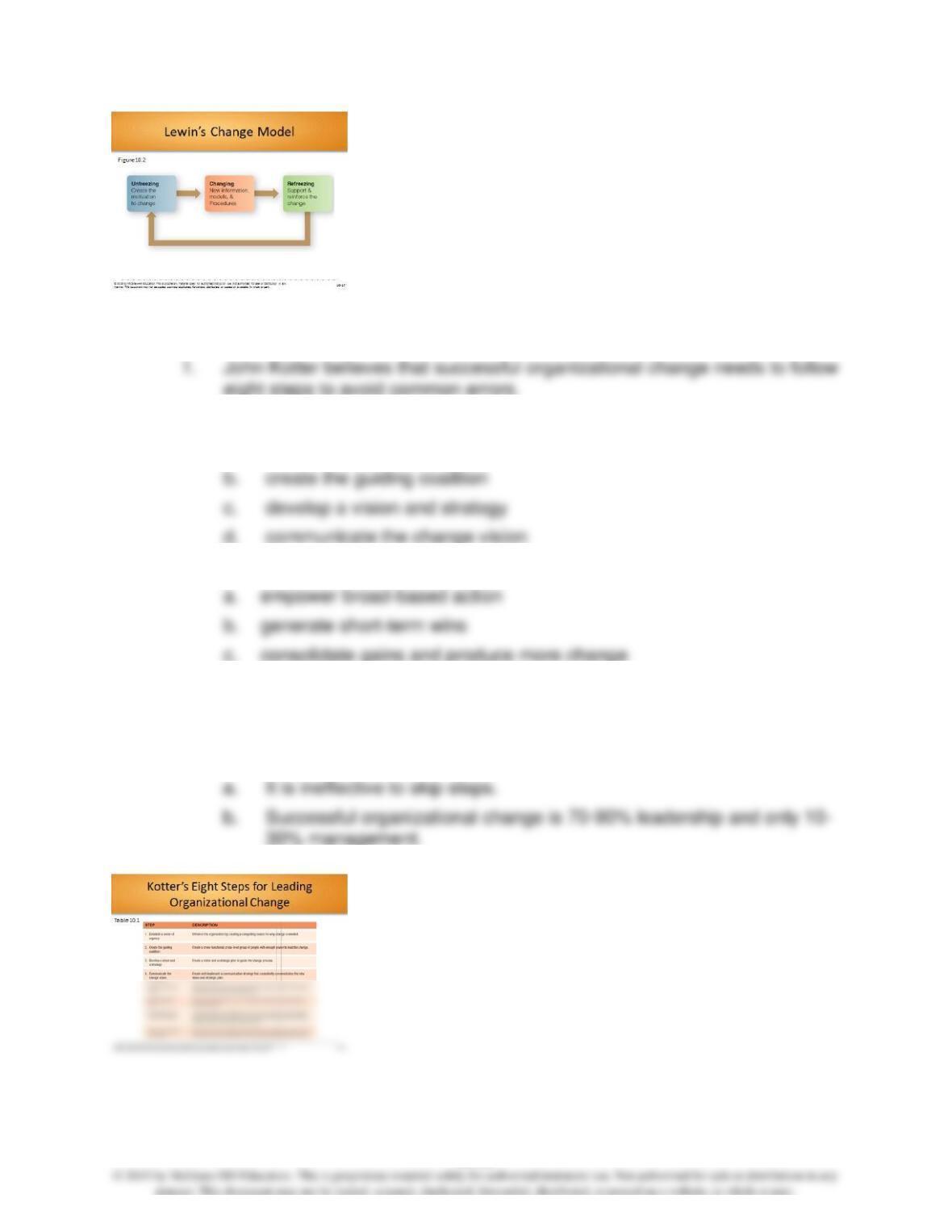
B. Lewin’s Change Model: Unfreezing, Changing, and Refreezing
1. Social psychologist Kurt Lewin developed a three-stage model to explain
how to initiate, manage, and stabilize planned change.
2. “Unfreezing”: creating the motivation to change
a. In the unfreezing stage, managers try to instill in employees the
3. “Changing”: learning new ways of doing things
a. In the changing stage, employees need to be given the tools for
4. “Refreezing”: making the new ways normal
a. In the refreezing stage, employees need to be helped to integrate the
Chapter 10 – Organizational Change & Innovation: Lifelong Challenges for the Exceptional Manager
10–18
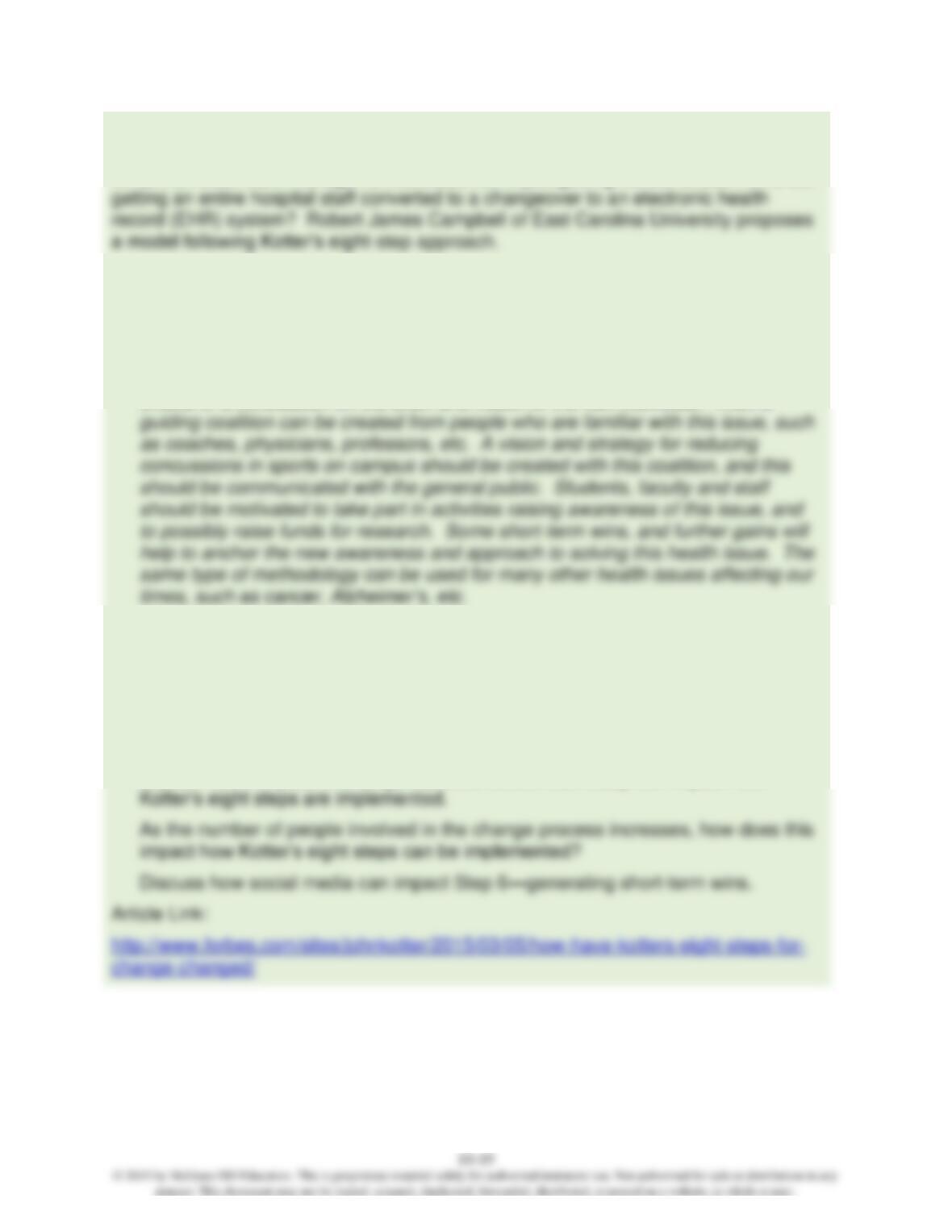
D. Kotter’s Eight Steps for Leading Organizational Change
2. Steps 1-4 represent unfreezing:
a. establish a sense of urgency
3. Steps 5-7 represent the changing stage:
4. Step 8, corresponding to refreezing, anchors new approaches in the
organization’s culture.
5. Kotter’s steps identify specific behaviors that managers need to exhibit to
successfully lead organizational change.
Chapter 10 – Organizational Change & Innovation: Lifelong Challenges for the Exceptional Manager
Interactive Classroom Material: Kotter’s Steps in Organizational Change:
Implementing an Electronic Health Record System (p. 316)
What if a health care manager is interested not in just getting nurses to use PDAs but
YOUR CALL
If you were to start a campaign to reduce them in a particular sport on your
campus, how would you apply Kotter’s methodology?
First, you would need to develop a sense of urgency, which exists when it comes
to health issues such as concussions. A video can be created that shows the
effects of a concussion on the brain and health of the hurt individual. Then a
Additional Activities:
One way to build on this Example is to have the students read the Forbes online
article “How Have Kotter’s Eight Steps for Change Changed?” This article discusses
how elements of Kotter’s model should be adapted for how the business environment
has changed in the 20 years since the model’s creation. Consider using the following
discussion questions:
Explain how the pace of change that businesses face today can impact how
Chapter 10 – Organizational Change & Innovation: Lifelong Challenges for the Exceptional Manager
Section 10.3 discusses organizational development, which is a set of techniques for
implementing change, such as managing conflict, revitalizing organizations, and
adapting to mergers. OD has three steps: diagnosis, intervention, and evaluation. Four
factors have been found to make OD programs effective: 1) Multiple interventions, 2)
Management support, 3) Goals geared to both short– and long-term results, and 4) OD
is affected by culture.
Possible Topics for Discussion:
• Thinking of your current employer (or a previous one), describe a specific
problem that the firm could use OD to solve and the steps that would be involved.
Major Idea Outline:
A. Organization development (OD) is a set of techniques for implementing
planned change to make people and organizations more effective.
1. OD focuses specifically on people in the change process.
10.3 Organizational Development: What It Is, What It Can Do
(pp. 317-319)
What are the uses of OD, and how effective is it?