College Mathematics: Learning Worksheets Chapter 10
286
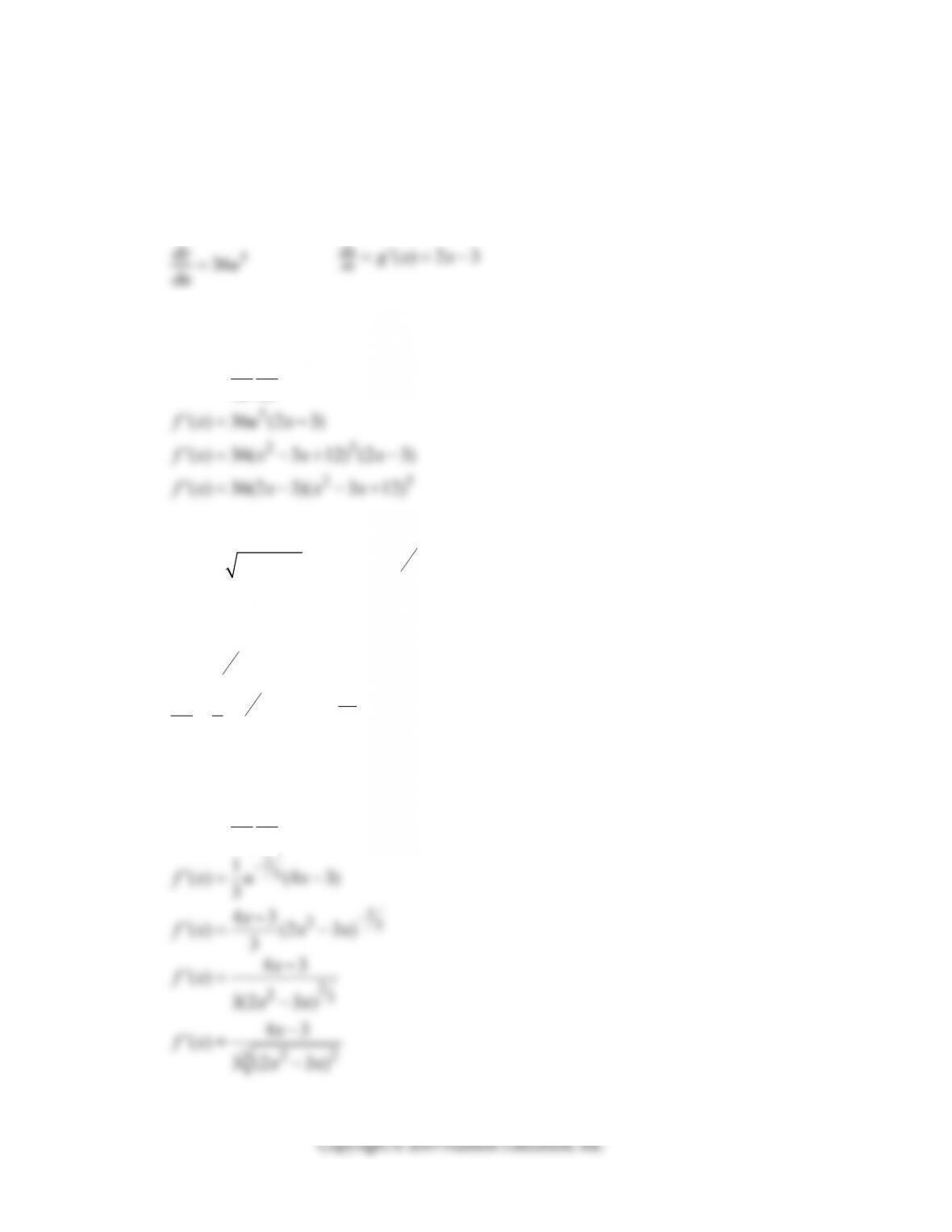
8. 26
6( 3 12)yxx
We must break the function into y and g(x) and then find each derivative.
6
6
yu
2
() 3 12
ugx x x
Now, use the chain rule.
()
dy du
fx du dx
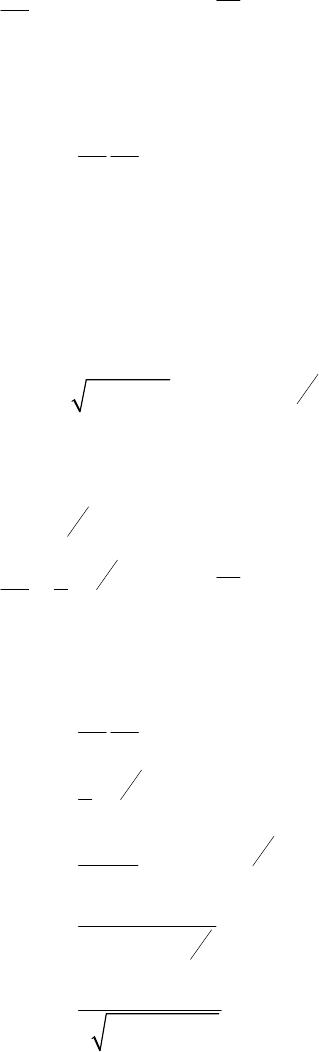
9. 32
() 2 3
f
xxx 1
23
(2 3 )
x
x
We must break the function into y and g(x) and then find each derivative.
13
23
1
3
yu
dy u
du
2
() 2 3
() 4 3
du
dx
ugx x x
gx x
Now, use the chain rule.
()
dy du
fx du dx
x
10. 3
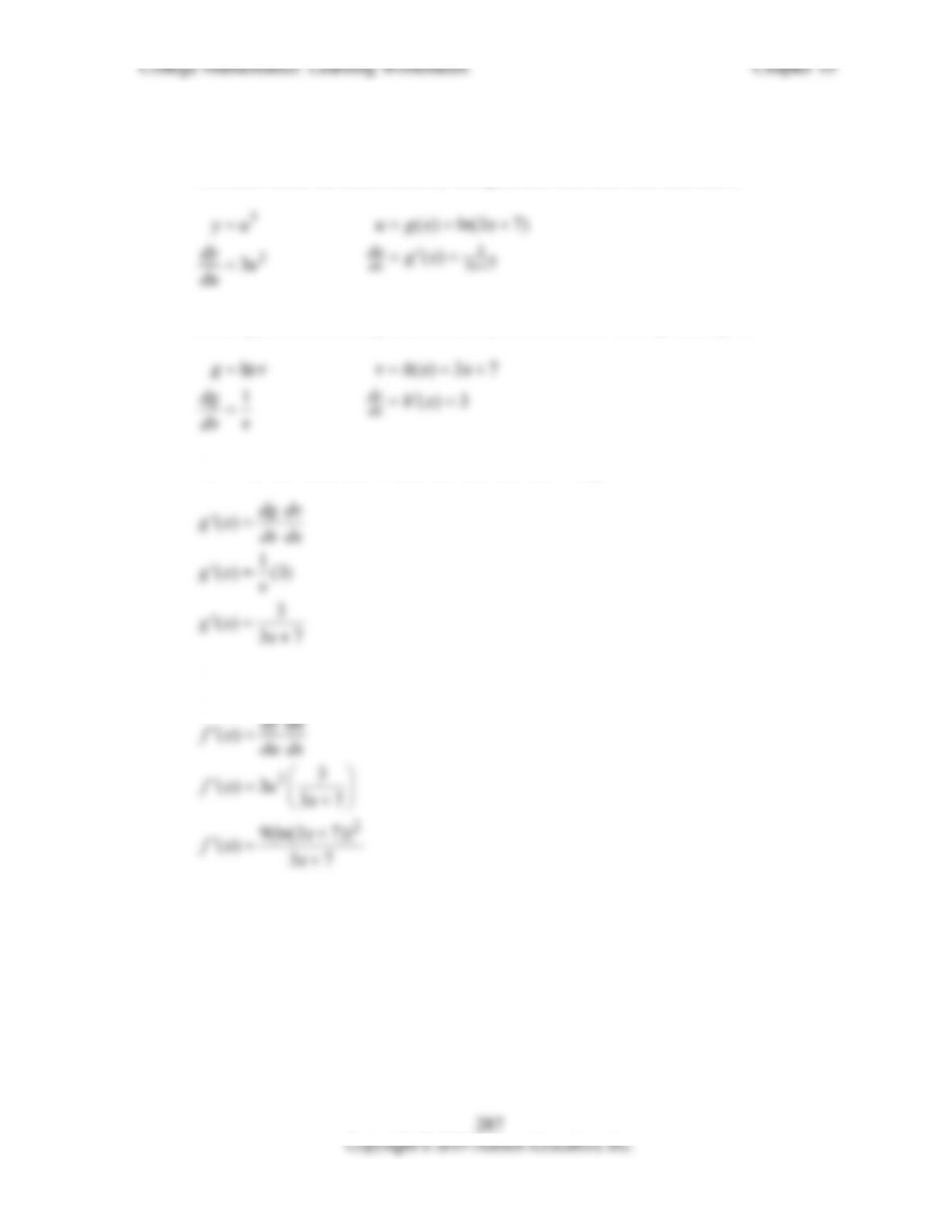
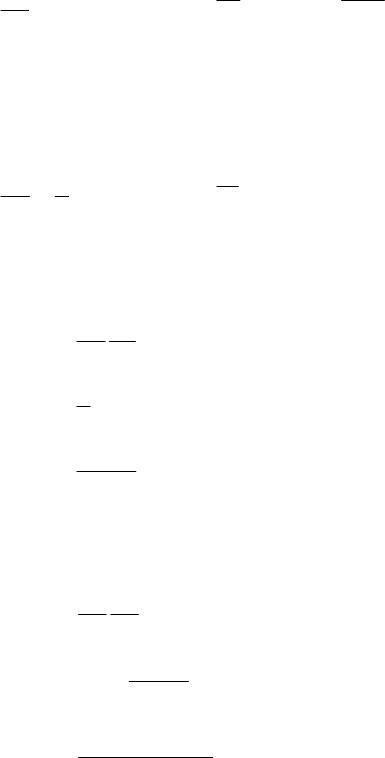
(ln(3 7))yx
We must break the function into y and g(x) and then find each derivative.
Since ( )gxis still a composite function, we must break it into pieces again.
Now, use the chain rule to find the first derivative of g.
Now, use the chain rule again.


College Mathematics: Learning Worksheets Chapter 10
288

College Mathematics: Learning Worksheets Chapter 10
289
Name ________________________________ Date ______________ Class ____________
Goal: To find the first derivative of functions that are not explicit in nature.
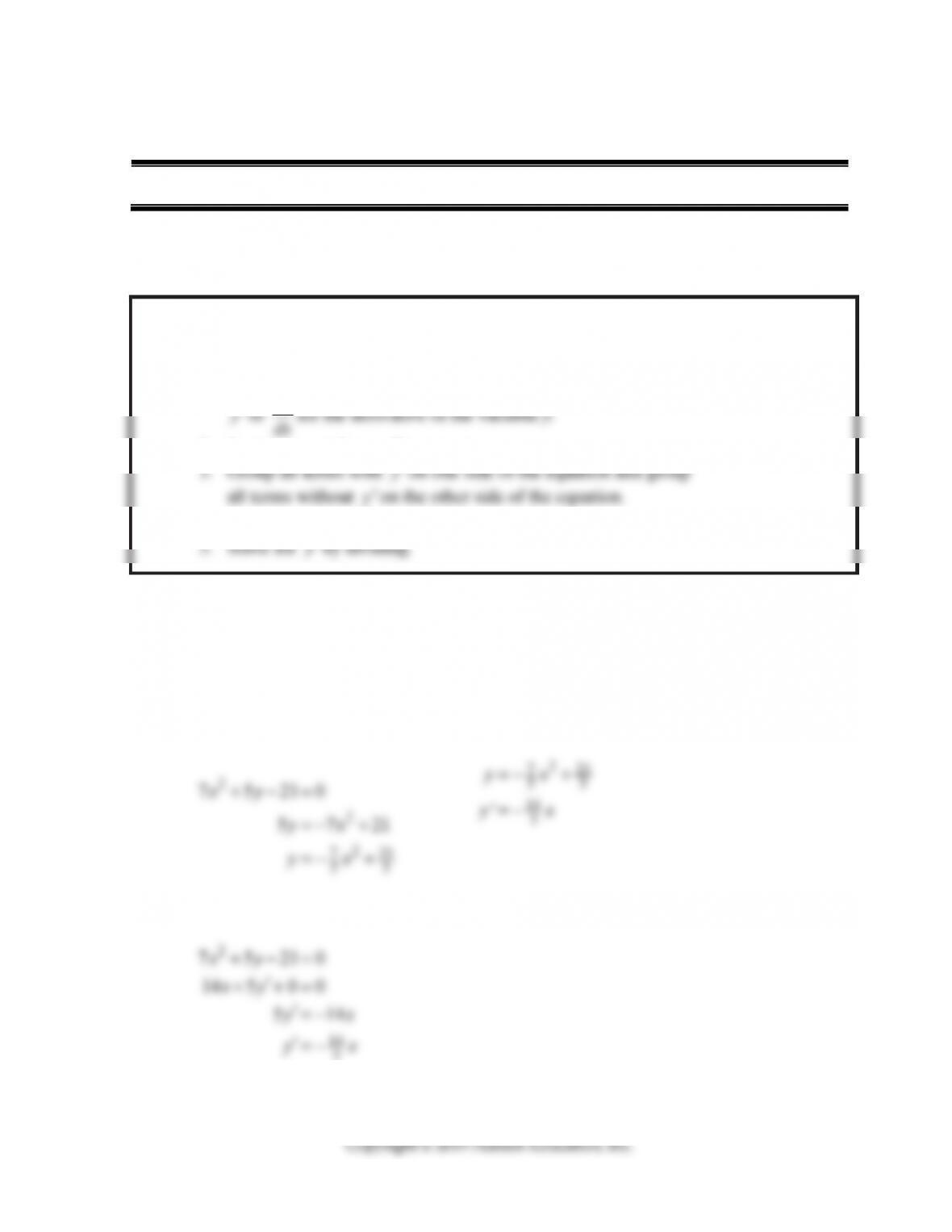
1. Consider the equation
2
75210xy+−=
a) Solve the equation for y and then find the first derivative.
b) Use implicit differentiation to find the first derivative.
5
Section 10-5 Implicit Differentiation
Procedure:
1. Find the derivative of the function using the basic derivative rules using
2. Remove parentheses, if necessary.
y
y
4. Factor out
y
for all terms that have a .
y
y
290
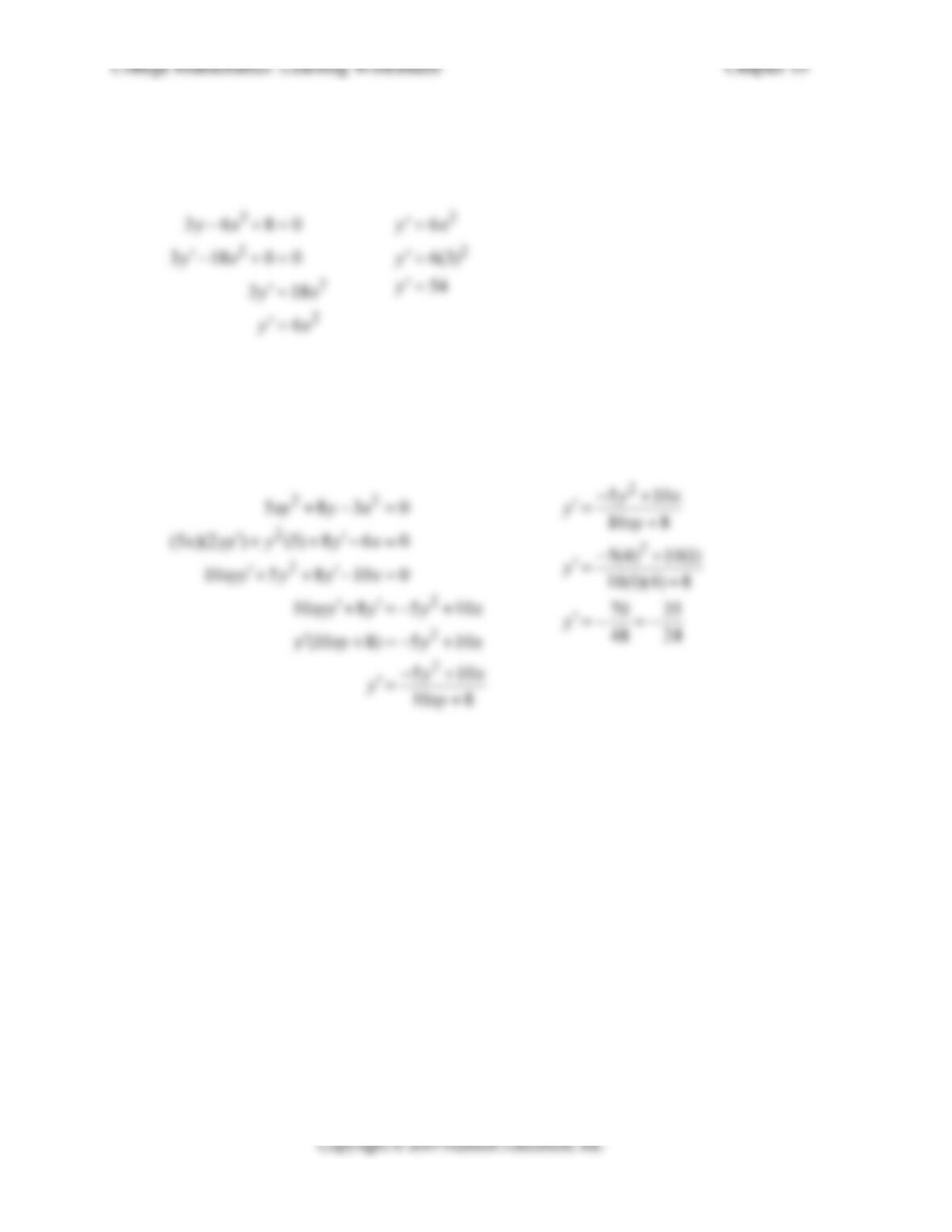
2. Use implicit differentiation to find the first derivative and evaluate it at
the given point.
3
36 80;(3,2)yx
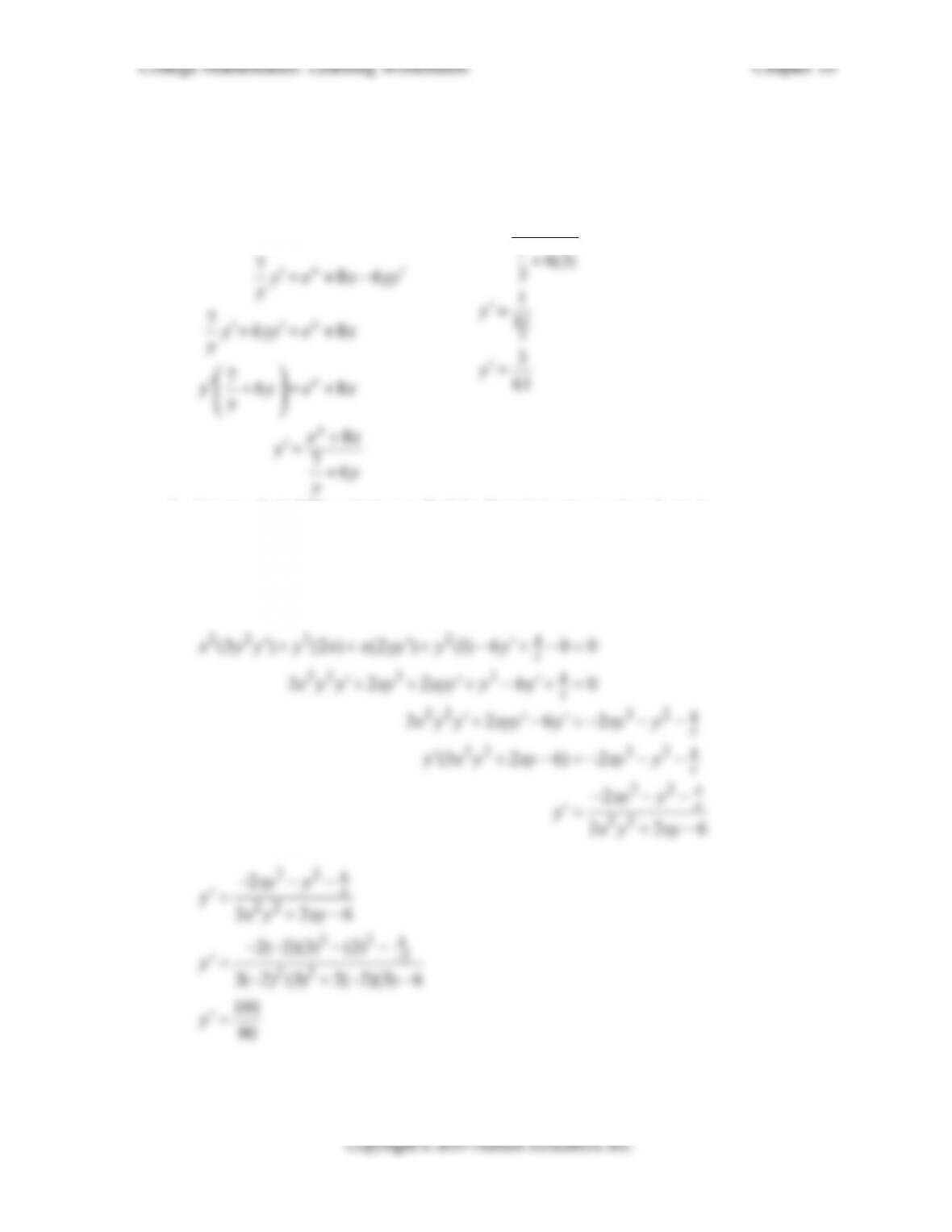
3. Use implicit differentiation to find the first derivative and evaluate it at
the given point.
22
5830;(1,4)xy y x+− =

291
4. Use implicit differentiation to find the first derivative and evaluate it
at the given point.
22
7ln 4 3 ; (0,3)
x
ye x y=+ −
22
7ln 4 3
x
y
exy
y
=+ −
0
8(0)
76(3)
e
y
+
′=
5. Use implicit differentiation to find the first derivative and evaluate it
at the given point.
23 2 64ln60;(2,3)xy xy y x
23 2
64ln60
xy xy y x
292
6. Use implicit differentiation to find the first derivative and evaluate it
at the given point.
32
2165130;(3,2)yx
7. Use implicit differentiation to find the first derivative and evaluate it
at the given point.
43
(4 ) 6 2 7; (1,0)yyxx
College Mathematics: Learning Worksheets Chapter 10
293
Name ________________________________ Date ______________ Class ____________
Goal: To solve problems that involve related rates
1. Assume that ()
x
xtand ().yyt
Find dy
dt given 23
39215, 4, 2, 1.
dx
xxyy x y
dt
Find the first derivative using implicit differentiation:
Now substitute all known values into the first derivative and solve for .
dy
dt
2
69 (9)6 0
dx dy dx dy
xxy y
dt dt dt dt
Section 10-6 Related Rates
Procedure: Solving Related Rates Problems
1. Sketch a figure, if possible.
3. Express all given rates and rates to be found as derivatives.
5. Implicitly differentiate the equation found in step 4, using the chain rule where
appropriate, and substitute in all given values.
294
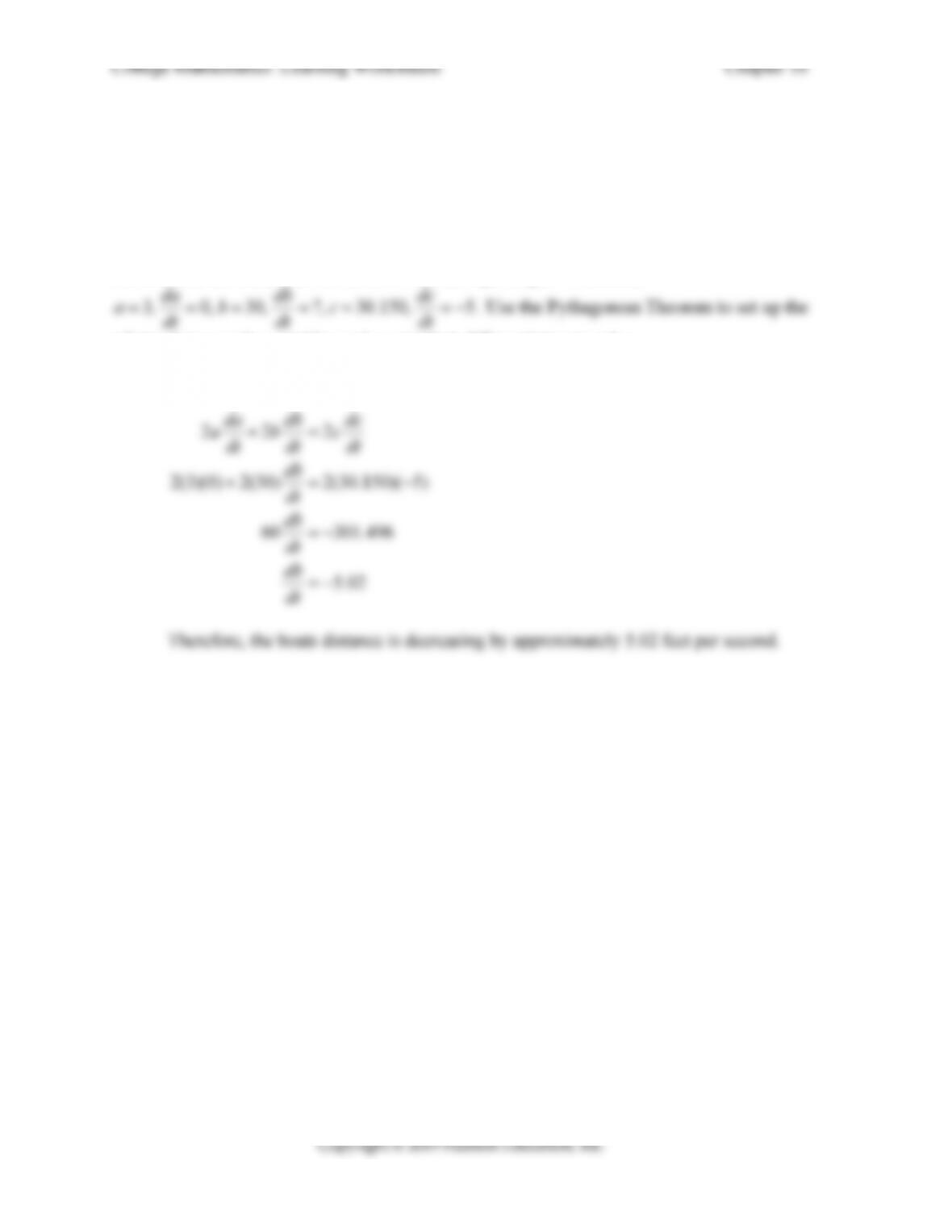
2. A boat is being pulled toward a dock by a rope. If the rope is being pulled in at 5 feet
per second and the rope is 3 feet above the dock, how fast is the distance between the
dock and the boat decreasing when it is 30 feet from the dock?
Based on the information, sketching the rope, the dock, and the boat gives a right
triangle. We have 3 variables that we will call a, b, and c (typical sides of a right triangle).
Let the variable a be the rope height from the dock, the variable b be the distance between
the boat and the dock, and the variable c be the rope length. Therefore,
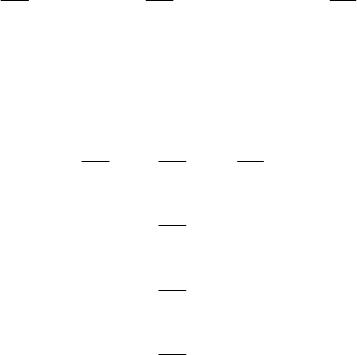
relation between the variables and use implicit differentiation to solve.
222
abc
+=
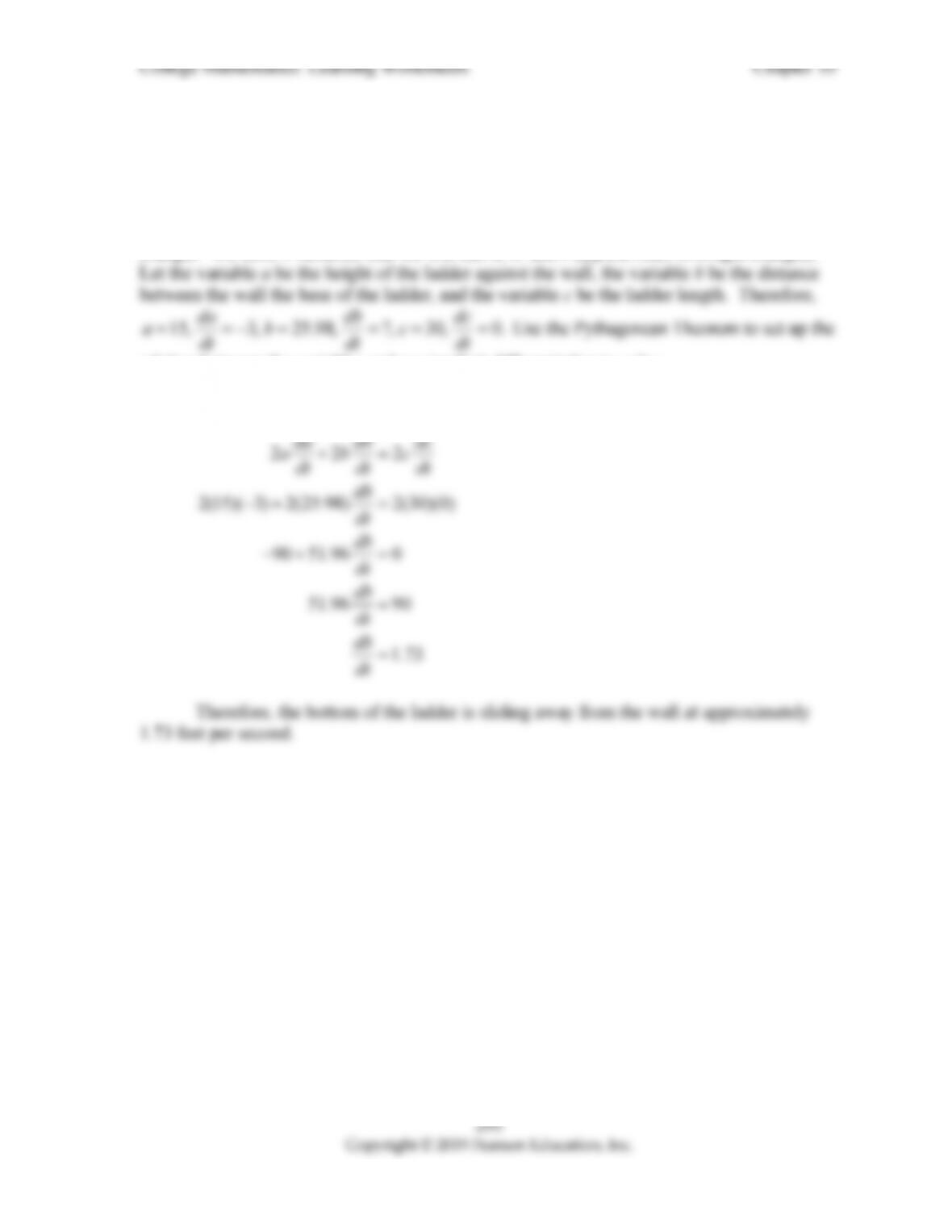
3. A 30-foot ladder is placed against a vertical wall. Suppose that the top of the ladder
slides down the wall at a constant rate of 3 feet per second. How fast is the bottom of
the ladder sliding away from the wall when the top of the ladder is 15 feet above the
ground?
Based on the information, sketching the ladder, the wall, and the ground gives a right
triangle. We have 3 variables that we will call a, b, and c (typical sides of a right triangle).
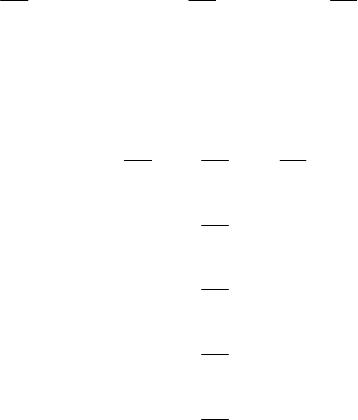
relation between the variables and use implicit differentiation to solve.
222
ab c
+=
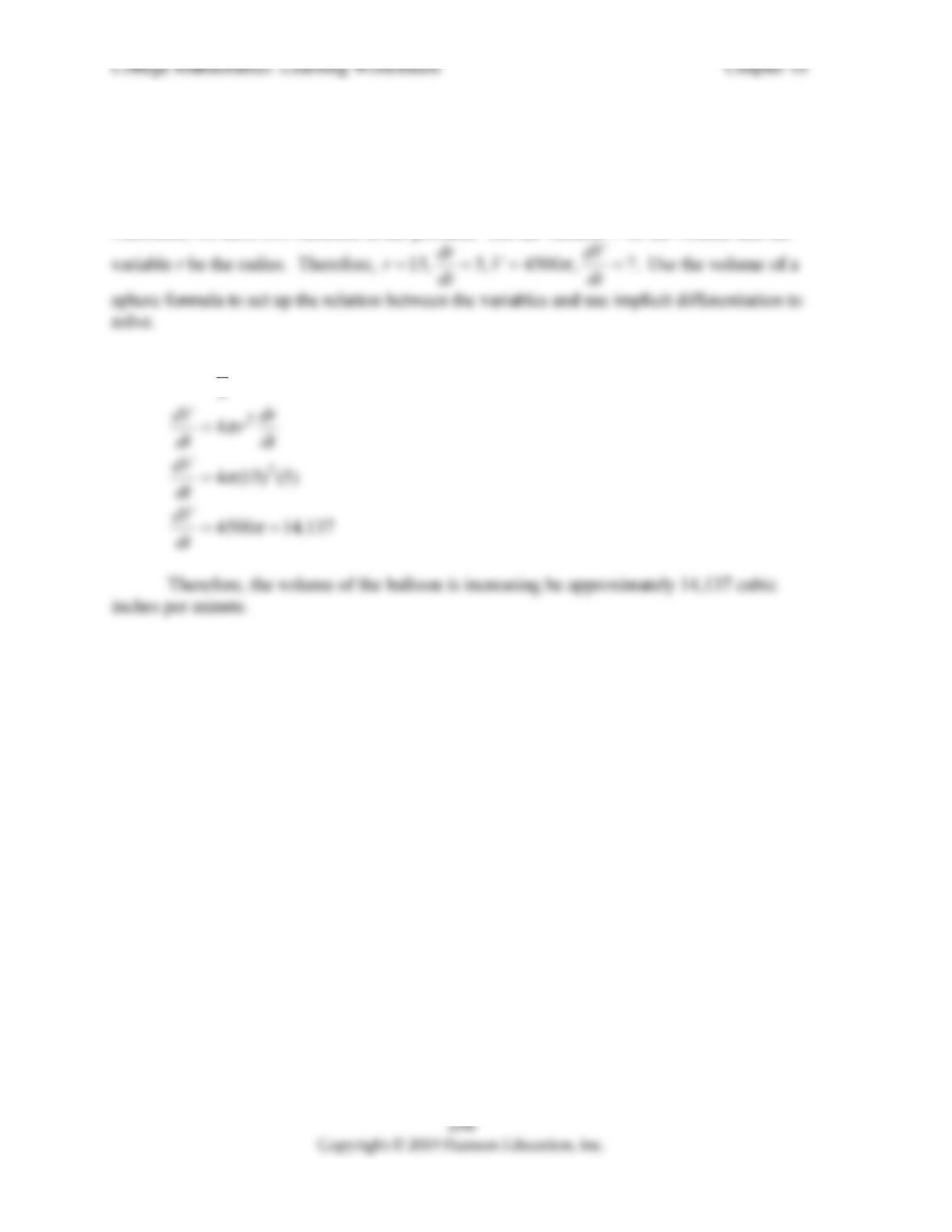

4. The radius of a spherical balloon is increasing at a constant rate of 5 inches per
minute. How fast is the volume changing when the radius is 15 inches?
As helium is pumped into a balloon, the radius and the volume of the balloon change.
Therefore, we have two variables in the problem. Let the variable V be the volume and the
3
4
Vr
π
College Mathematics: Learning Worksheets Chapter 10
297
Name ________________________________ Date ______________ Class ____________
Goal: To determine the elasticity of demand for functions
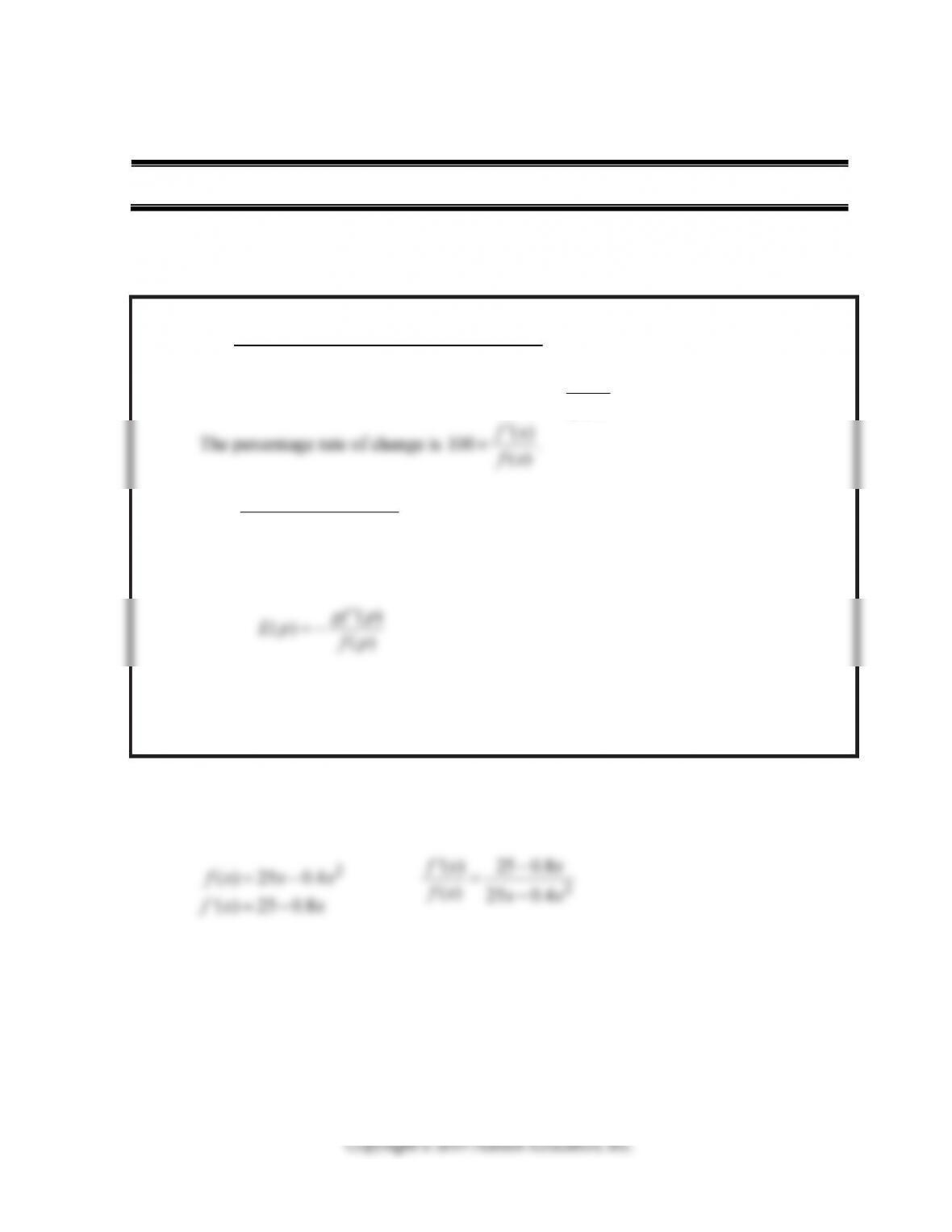
1. Given 2
( ) 25 0.4 ,
f
xxx=− find the relative rate of change.
f
f
f
Section 10-7 Elasticity of Demand
Definition: Relative and Percentage Rates of Change
The relative rate of change of a function ()
f
xis ()
.
()
f
x
f
x
f
f
Theorem 1: Elasticity of Demand
If price and demand are related by (),
x
fpthen the elasticity of
demand is given by
f
a) If 0()1,Epthen demand is inelastic.
b) If () 1,Epthen demand is unit.
c) If () 1,Epthen demand is elastic.

2. Given 2
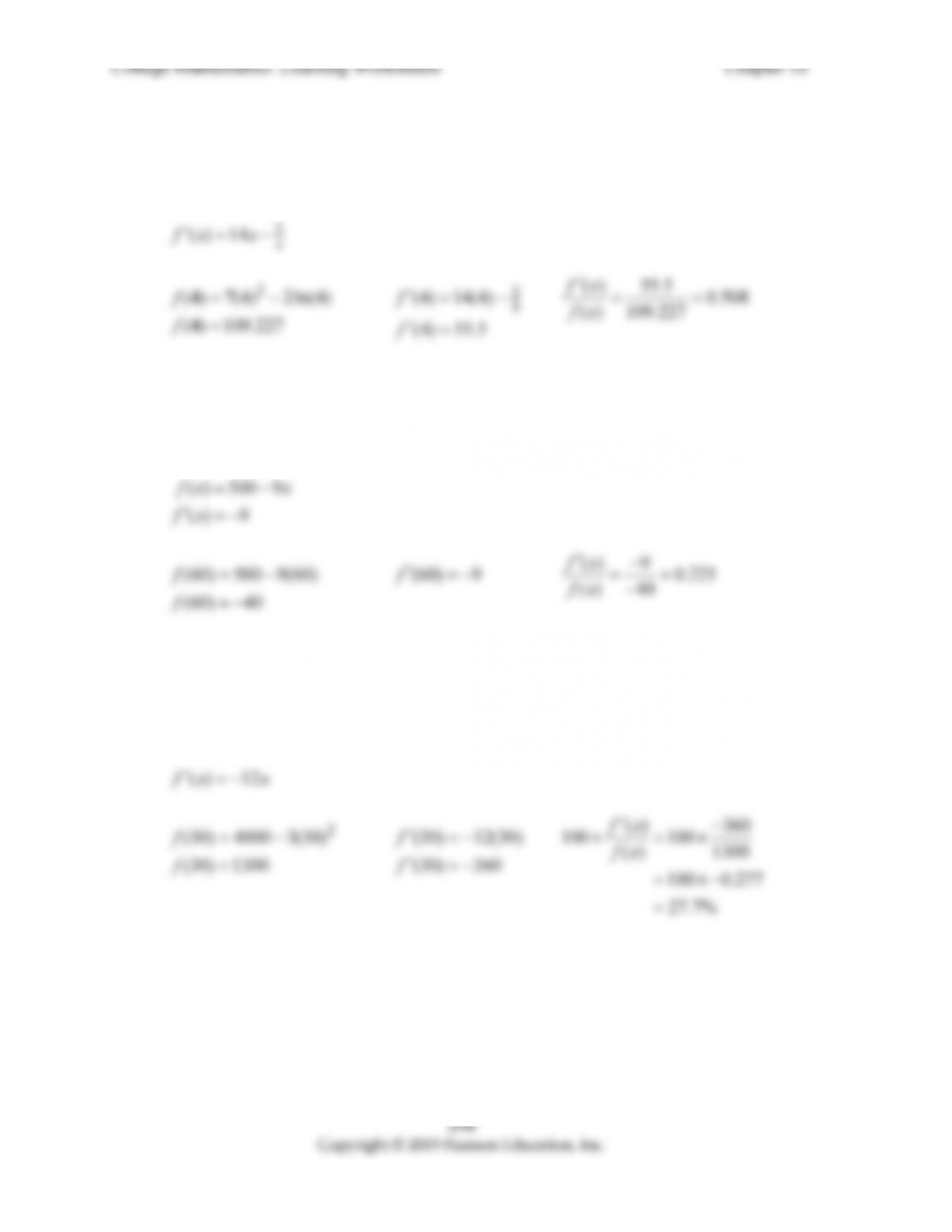
() 7 2ln ,
f
xx x find the relative rate of change when 4.x
(Round to three decimals, if necessary.)
2
() 7 2ln
f
xx x
3. Given ( ) 500 9 ,
f
xx=−
find the relative rate of change when 60.x
(Round to three decimals, if necessary.)
4. Given 2
( ) 4000 6 ,
f
xxfind the percentage rate of change when 30.x
(Round to the nearest tenth, if necessary.)
2
( ) 4000 6
f
xx

299
5. Given ( ) 10,000 350 ,
x
fp p== −use the price–demand equation to find ( ),Ep the
elasticity of demand.
( ) 10,000 350
( ) 350
f
pp
fp
=−
′=−
()
() ()
pf p
Ep fp
′
=−
6. Given 2
( ) 850 3 0.04 ,
x
fp p p use the price–demand equation to find (),
E
pthe
elasticity of demand to determine whether the demand is elastic, inelastic, or has unit
elasticity at the indicated values of p.
a. 15p
b. 35p
c. 55p
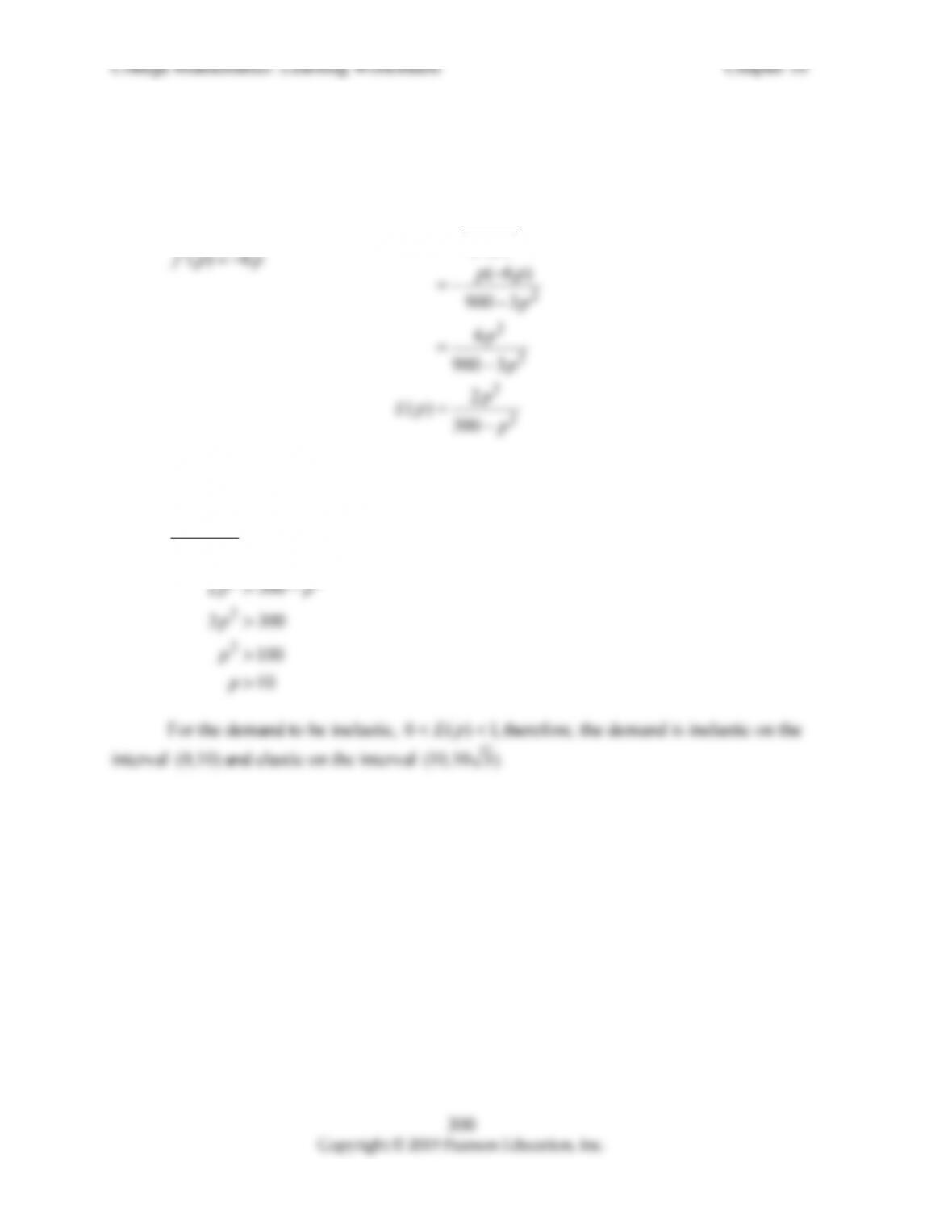
2
( ) 850 3 0.04
f
ppp
()
() ()
pf p
Ep fp
2
2
3(15) 0.08(15) 63
(15) 0.079;
796
850 3(15) 0.04(15)
E
demand is inelastic.
7. Given 2
( ) 900 3 ,
x
fp p==−use the price–demand equation to find the values of p
for which demand is elastic and the values for which demand is inelastic. Assume
that price and demand are both positive.
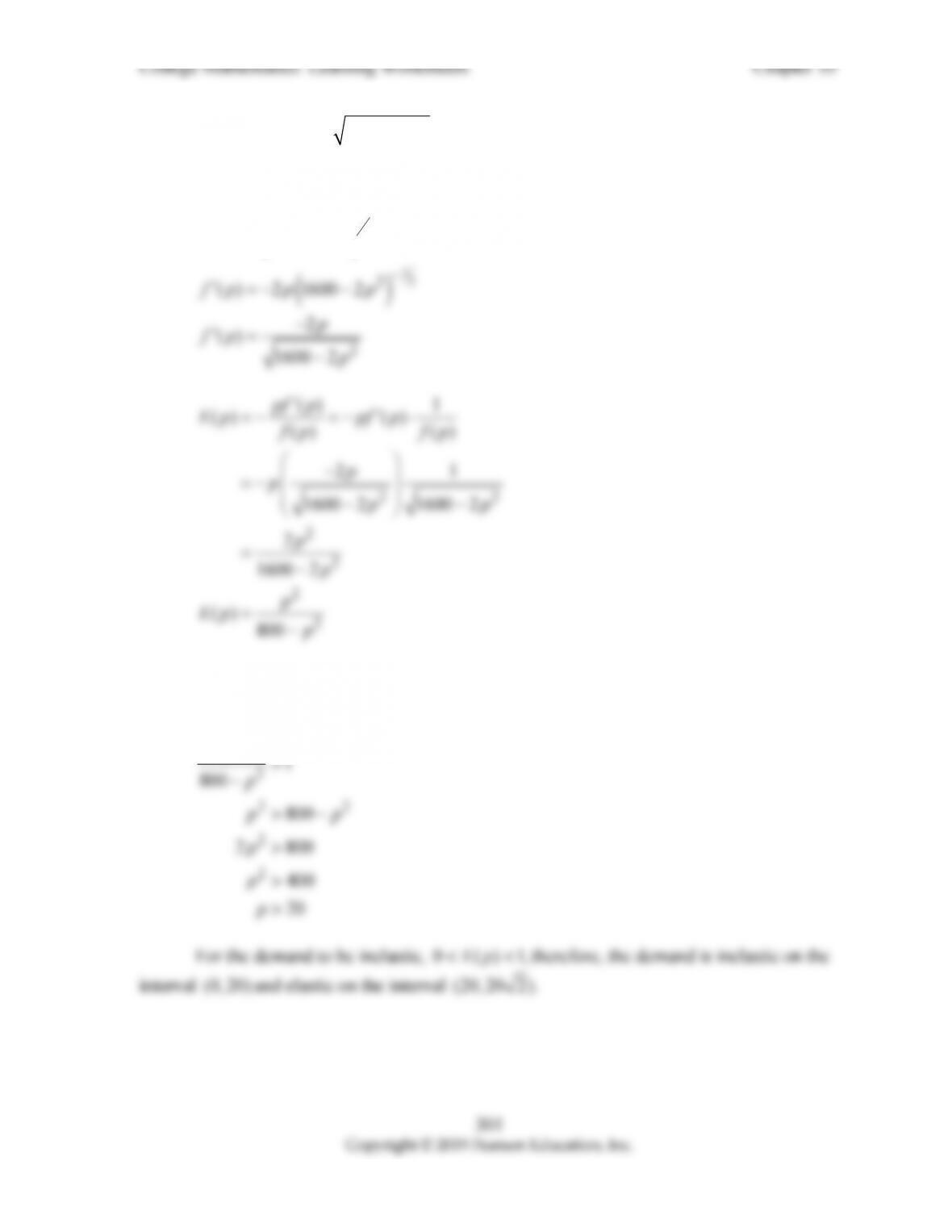
2
( ) 900 3
f
pp
=−
()
() ()
pf p
Ep fp
′
=−
For the demand to be elastic, ( ) 1.Ep
2
2
22
21
300
p
p
>
−
8. Given 2
( ) 1600 2 ,
x
fp p use the price–demand equation to find the values of
p for which demand is elastic and the values for which demand is inelastic. Assume
that price and demand are both positive.
12
2
( ) 1600 2
fp p
For the demand to be elastic, ( ) 1.Ep
2
p


College Mathematics: Learning Worksheets Chapter 10
302