
Instructor Resource
Rowe, Cases in Leadership 5e
SAGE Publications, Inc., 2019
Case Note
Case 10.1: Schneider Electric India: Leadership Challenges
Abinash Panda, Anshul Jain, and Samir Mishra wrote this teaching note as an aid to instructors
in the classroom use of the case Schneider Electric India: Leadership Challenges, No.
9B17C011. This teaching note should not be used in any way that would prejudice the future use
of the case.
Teaching Note
Synopsis
Samir Mishra was the newly appointed plant director of the Schneider Electric plant in Rudrapur,
India. The plant was plagued with problems concerning low employee engagement and quality

Instructor Resource
Rowe, Cases in Leadership 5e
SAGE Publications, Inc., 2019
Learning Objectives
After discussing the case, participants will appreciate the following aspects of adaptive
leadership and will understand how to do the following:
Position in course
This comprehensive case is suitable for an MBA or postgraduate course on plant-level leadership
or change management. For executive education participants, it provides material for an in-depth
Relevant Readings
• Black, J. S. (2014). It starts with one: Changing individuals changes organizations (3rd
ed., pp. 1–27). Upper Saddle River, NJ: Pearson Education.
• Burns, J. M. (1978). Leadership (pp. 49–80). New York, NY: Harper & Row.
Assignment Questions
1. With Mishra deciding to accept the new production target of 27,000 units, what kind
of mindset and leadership would he require to successfully meet this challenge?
2. Evaluate the interventions that Mishra introduced. What could have been done
differently?
Teaching Plan
Based on the assignment questions, we suggest that students should do four hours of pre-class
reading and analysis. They are also expected to read the case prior to class discussion.
The following time plan is suitable for a 90-minute class:
Analysis
1. With Mishra deciding to accept the new production target of 27,000 units, what kind of
mindset and leadership would he require to successfully meet this challenge?
In Mishra’s situation, there were two options: refuse the order or take up the challenge of ramping up
production. The latter choice would call for a complete re–engineering of the production line, which

2. Evaluate the interventions that Mishra introduced. What could have been done
differently?
As the plant director, Mishra focused on both work and people processes at Rudrapur. In the
domain of work processes, Mishra introduced production techniques that were based on a lean
production concept. An action study was introduced to identify the clogs in the production line,
which were then quickly smoothed out. Such work process interventions improved the

3. How would you assess Mishra’s leadership style? Would you have adopted a different
approach to deal with the challenges?
Mishra’s leadership style can be understood from the way he dealt with four key senior leaders: the
quality manager (Rao), the HR manager (Singh), the production manager (Razdan), and the
Flexible
Mishra was flexible in his leadership style and approach. He did not hesitate to use his positional
power and authority to deal with the quality head. When Mishra realized that Rao was unwilling
2
Ibid.
Authoritative
Mishra used power and authority to exercise leadership in each situation. Exercising leadership is
about mobilizing people to achieve socially or organizationally useful outcomes. Adaptive
leadership is the practice of mobilizing people to tackle tough challenges and to thrive in the
process.
3
Heifetz makes a distinction among leadership, power, and influence. Power is understood as
the leader’s capacity to get followers do what the leader wants, irrespective of the followers’
Transformational
Mishra’s leadership style can also be labelled as transformational. Burns (see Relevant Readings
section of the teaching note) defines transforming leadership as a process in which leaders and
followers help each other to advance to higher levels of morale and motivation. According to

Collaborative
Mishra’s MBWA style of leading and managing helped to bridge the psychological distance
between workers and managers; it also fostered collaboration between the two groups. Mishra
frequently spent time on the shop floor to guide the workers and managers, as needed, and he
empowered the workers to propose improvements to the production line. By involving the
4. Compare and contrast plant leadership and corporate leadership.
Corporate leadership is significantly different in character from plant leadership. Plant leadership
is directly involved in most of the activities at the plant level. The plant leader is ultimately
In this case, in his role as plant director, Mishra demonstrated excellent problem-solving
skills, and he was able to engage workers and engineers through his equally strong relational
skills. His years of acquired technical expertise helped Mishra to guide others to solve technical
Instructor Resource
Rowe, Cases in Leadership 5e
SAGE Publications, Inc., 2019
5. Are Mishra’s actions likely to succeed? Are they likely to create any future issues?
Mishra involved all of his functional managers in the change process at Rudrapur so they could
each gain an understanding of and appreciation for the challenges of their workplace. This
approach was different from simply forcing the staff to implement a solution that Mishra had
identified unilaterally. By involving his functional managers and listening to them, Mishra was
successful in eliciting commitment from each of them. Through various other interventions,
What Happened
The Schneider Electric plant at Rudrapur met the increased targets to a large extent. The
Luminous order fell just 10 per cent short of its mark, and the plant made up the difference in

Instructor Resource
Rowe, Cases in Leadership 5e
SAGE Publications, Inc., 2019
July’s production. Quality issues at Rudrapur subsided as well, with the plant rejection rate
falling to just 32,000 parts per million, an improvement of more than 60 per cent. The entire
management team and the workers were overjoyed at being able to meet the target.
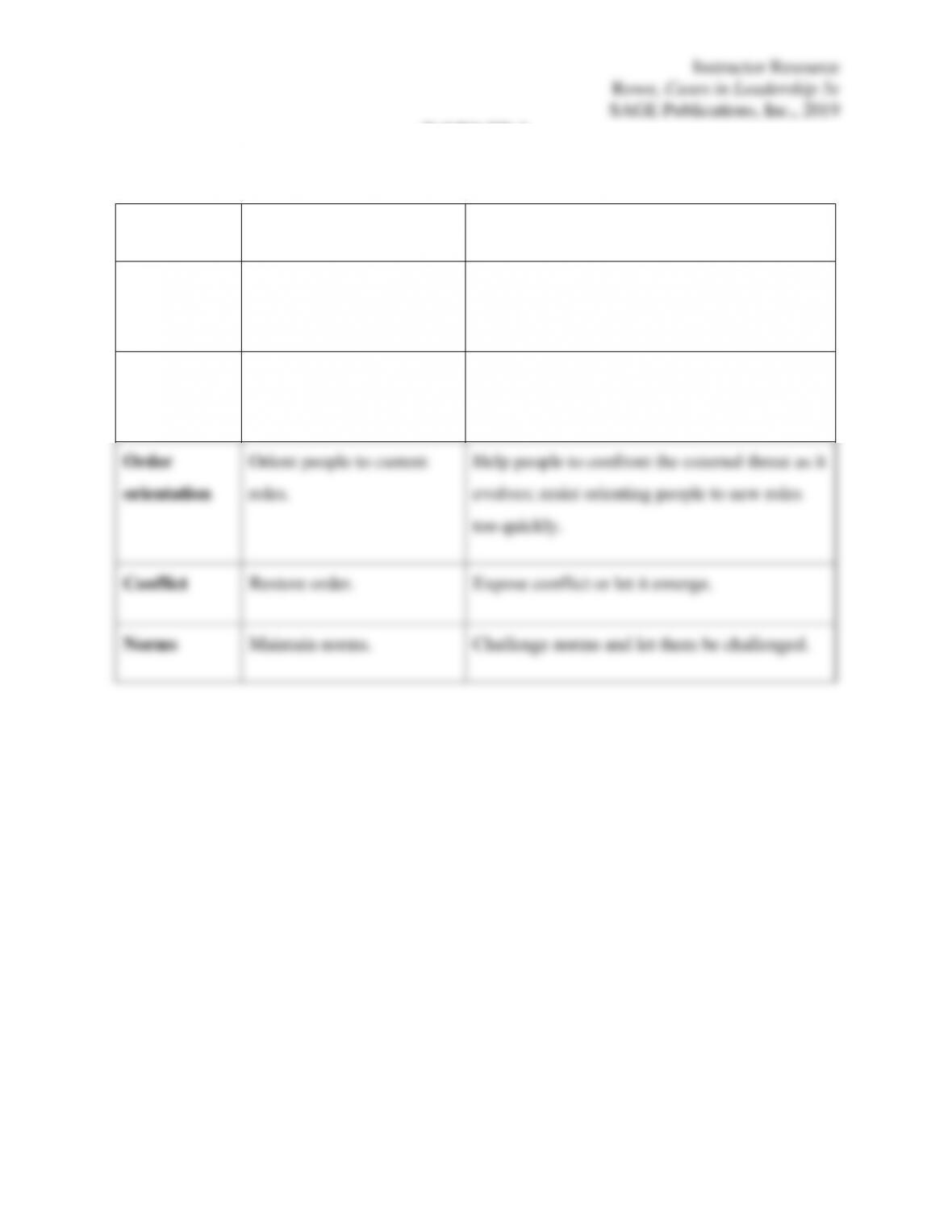
Exhibit TN-1
A Comparison of Technical and Adaptive Leaders
Task
Technical Leader
Adaptive Leader
Direction
Provide problem definition
and solution.
Identify adaptive challenges; frame key
questions and issues.
Protection
Protect from external
threat.
Disclose external threat.
Order
orientation
Orient people to current
roles.
Help people to confront the external threat as it
evolves; resist orienting people to new roles
too quickly.
Conflict
Restore order.
Expose conflict or let it emerge.
Norms
Maintain norms.
Challenge norms and let them be challenged.

Instructor Resource
Rowe, Cases in Leadership 5e
SAGE Publications, Inc., 2019
Exhibit TN-2
Board Plan
Situation (context)
• 450 workers (80 per cent temporary and 20 per cent permanent)
• Low morale and poor motivation
• Untrained workers
Interventions
• Lean and agile production techniques
• Debottlenecking
Leadership style/approach
• Adaptive leadership (with flexibility)
Overcoming resistance

Instructor Resource
Rowe, Cases in Leadership 5e
SAGE Publications, Inc., 2019
• Confronting the managers
Unique leadership approach
• Adaptive leadership with a tinge of transformational leadership
• Blend of “individual-out” and “organization-in” approaches to change management
Key takeaways
• Exercising leadership is key.
• Involve and engage all stakeholders.