Chapter 01 – Foundations of Information Systems in Business
1-1
1 Foundations of Information Systems in Business
CHAPTER OVERVIEW
Chapter 1: Foundations of Information Systems in Business presents an overview of the five basic areas of
LEARNING OBJECTIVES
After reading and studying this chapter, you should be able to:
1. Understand the concept of a system and how it relates to information systems.
2. Explain why knowledge of information systems is important for business professionals, and identify five areas
of information systems knowledge that they need.
5. Identify several challenges that a business manager might face in managing the successful and ethical
development and use of information technology in a business.
6. Provide examples of the components of real world information systems. Illustrate that in an information system,
Chapter 01 – Foundations of Information Systems in Business
1-2
SUMMARY
• IS Framework for Business Professionals. The IS knowledge that a business manager or professional needs to
know is illustrated in Figure 1.2 and covered in this chapter and text. This knowledge includes (1) foundation
concepts: fundamental behavioral, technical, business, and managerial concepts like system components and
• Business Roles of Information Systems. Information systems perform three vital roles in business firms.
Business applications of IS support an organization’s business processes and operations, business decision making,
and strategic competitive advantage. Major application categories of information systems include operations support
• System Concepts. A system is a group of interrelated components, with a clearly defined boundary, working
toward the attainment of a common goal by accepting inputs and producing outputs in an organized transformation
• Information System Model. An information system uses the resources of people, hardware, software, data, and
networks to perform input, processing, output, storage, and control activities that convert data resources into
• IS Resources and Products. Hardware resources include machines and media used in information processing.
Software resources include computerized instructions (programs) and instructions for people (procedures). People
resources include information systems specialists and users. Data resources include alphanumeric, text, image,
Chapter 01 – Foundations of Information Systems in Business
KEY TERMS AND CONCEPTS
1. Computer-Based Information System (8):
An information system that uses computer hardware and software to perform its information processing
activities.
2. Control (29):
The systems component that evaluates feedback to determine whether the system is moving toward the
5. Data Resources (33):
Data is now thought of as a valuable raw material that should be used, maintained, and secured as such. Data
resources include not only structured information typically found in databases, but also the unstructured
information found in e-mail or other collaborative systems, audio, and video.
6. Developing successful information system solutions (18):
Business professionals are responsible for proposing new or improved systems to support their business
8. E-business applications (12):
Businesses today are using the Internet, corporate intranets, and inter–organizational extranets to support
business activities with suppliers, partners, customers, accounting, finance, research and development,
manufacturing, marketing, sales, and customer service.
9. E-commerce (12):
The buying and selling, marketing and servicing, and delivery and payment of products, services, and
Chapter 01 – Foundations of Information Systems in Business
1-4
11. Extranet (12):
A network that links selected resources of a company with its customers, suppliers, and other business partners
using internet technologies.
12. Feedback (29):
Data or information concerning an information system’s performance.
13. Hardware Resources (32):
All physical devices and materials used in information processing. This includes not only machines, but storage
media such as disks, tape, and paper.
14. Information (34):
Data that have been converted into a meaningful and useful context for specific end users.
15. Information System (4):
16. Information system activities (35):
All information systems (manual or automated) share the same characteristics.
a. Input ( 35):
Data entry.
17. Information System Model (31):
The conceptual view of an information system.
18. Intranet (12):
Internet-like networks and websites developed for use within an organization.
Chapter 01 – Foundations of Information Systems in Business
19. Knowledge Workers (32):
People whose primary work activities include creating, using, and distributing information.
20. Management information systems (15):
These systems provide information to managers and business professionals.
21. Network resources (34)
22. People Resources (32):
People are an essential component of an information system. Broadly, this resource includes IS specialists and
end users.
a. IS specialists (32):
23. Roles of IS in Business (8):
Information systems perform three vital roles in any type of organization.
a. Support of business processes and operations (8):
24. Software Resources (33):
Software resources comprise all sets of information processing instructions. This includes not only software but
the human procedures associated with managing information systems as well.
a. Programs (33):
Set of instructions used by people to complete a task.
25. System (26):
A system is a group of interrelated components working together toward a common goal by accepting inputs
Chapter 01 – Foundations of Information Systems in Business
1-6
26. Types of Information Systems (13):
Information systems are classified in order to spotlight the major roles each plays in the operations and
management of a business.
a. Cross-functional information systems (15)
Information systems that cross the boundaries of functional business areas and management levels in order
to support business processes throughout the organization.
d. Functional business systems (15):
Systems that focus on basic business functions such as accounting, marketing, sales, finance, and human
resource management.
e. Transaction processing systems (14):
Transaction processing systems (or TPS) are a type of operations support system. A TPS processes routine
business transactions such as sales or purchases.
Chapter 01 – Foundations of Information Systems in Business
1-7
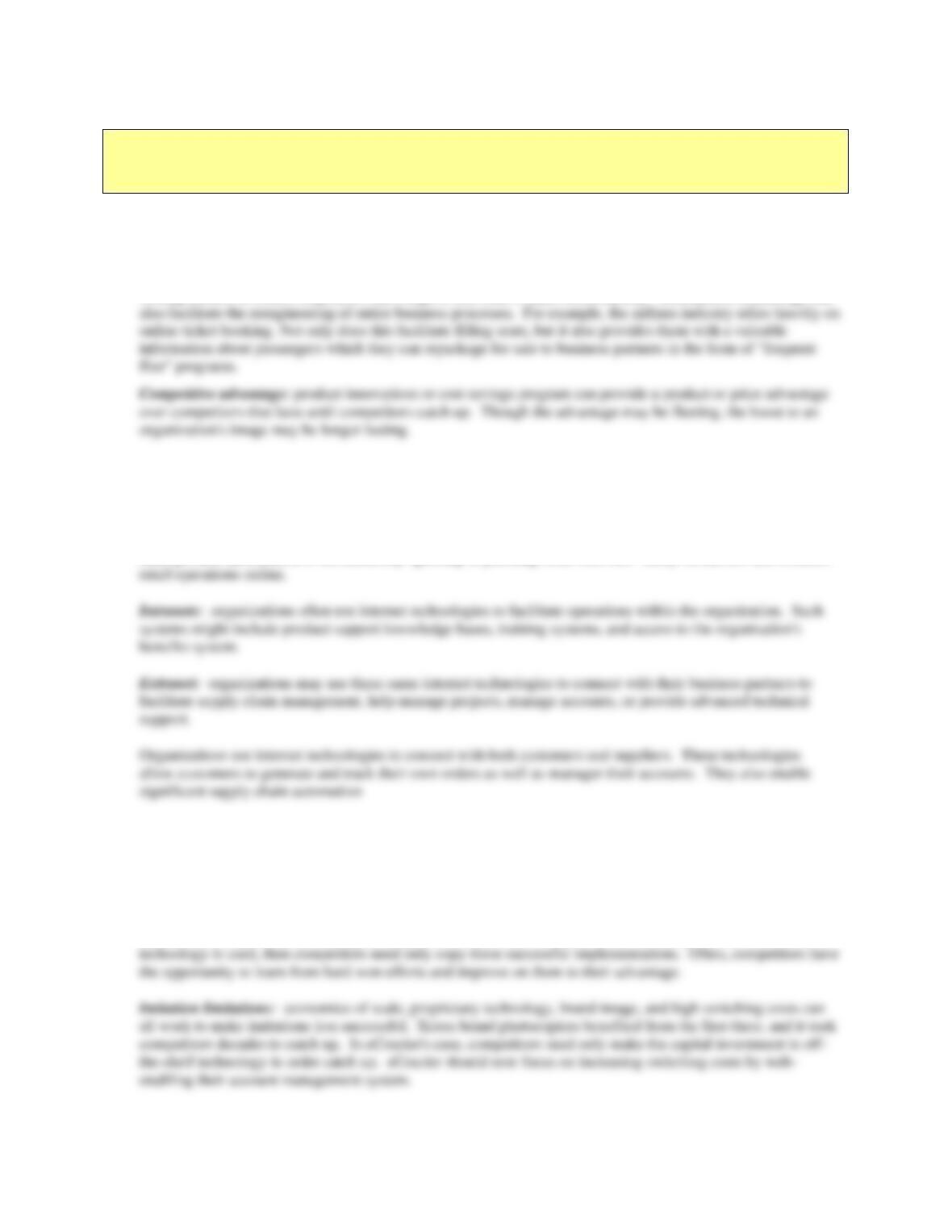
ANSWERS TO REVIEW QUIZ
Q.
A.
Key Term
Q.
A.
Key Term
1
19
Knowledge workers
25
22
People resources
2
23
Roles of IS in business
26
16a
Input
11
10
Enterprise collaboration systems
35
18
Intranet
12
25
System
36
11
Extranet
13
12
Feedback
37
7
E-business
14
2
Control
38
26d
Functional business systems
15
3
Data
39
5
Data resources
16
14
Information
40
6
17
16
Information system activities
41
14a
Information products
18
17
Information system model
42
21
Network resources
19
13
Hardware resources
43
22a
IS specialists
20
13a
Machines
44
4
Data or information processing
21
13b
Media
45
Process control systems
22
24
Software resources
46
20
Management information systems
23
24a
Programs
47
26e
Transaction processing systems
24
24b
Procedures
48
26g
Enterprise collaborative systems
3
23a
Support of business processes and operations
27
16b
Processing
4
23b
Support of business decision making
28
16c
Output
5
23c
Support of strategies for competitive advantage
29
16d
Storage
6
15
Information system
30
16e
Control
7
1
Computer-based information system
31
26
Types of information systems
8
22b
End users
32
26c
Operations support systems
9
8
E-business applications
33
26b
Management support systems
10
9
Electronic commerce
34
26a
Chapter 01 – Foundations of Information Systems in Business
1-8
ANSWERS TO DISCUSSION QUESTIONS
1. How can information technology support a company’s business processes and decision making and give it
a competitive advantage? Give examples to illustrate your answer.
Support: Information technology can automate manual process such as document transmission. Instead of
writing memos or letters, employees can compose and send e-mails electronically. Information technology can
2. How does the use of the Internet, intranets, and extranets by companies today support their business
processes and activities?
Internet: organization can connect directly with the general public. Opportunities range from giving away
basic product information to automatically updating or patching retail software. Many businesses also conduct
3. Refer to the Real Word Case on eCourier, Cablecom, and Bryan Cave in the chapter. Jay Bregman, CTO
and cofounder of eCourier, notes that the company hopes their innovative use of technology will become a
differentiator in their competitive market. More generally, to what extent do specific technologies help
companies gain an edge over their competitors? How easy or difficult would it be to imitate such advantages?
Advantage: at best, most technology innovations provide only a temporary edge over competitors. Even in the
unusual case of patented technologies, the patent runs out after 17 years. If the advantage comes from how a
Chapter 01 – Foundations of Information Systems in Business
1-9
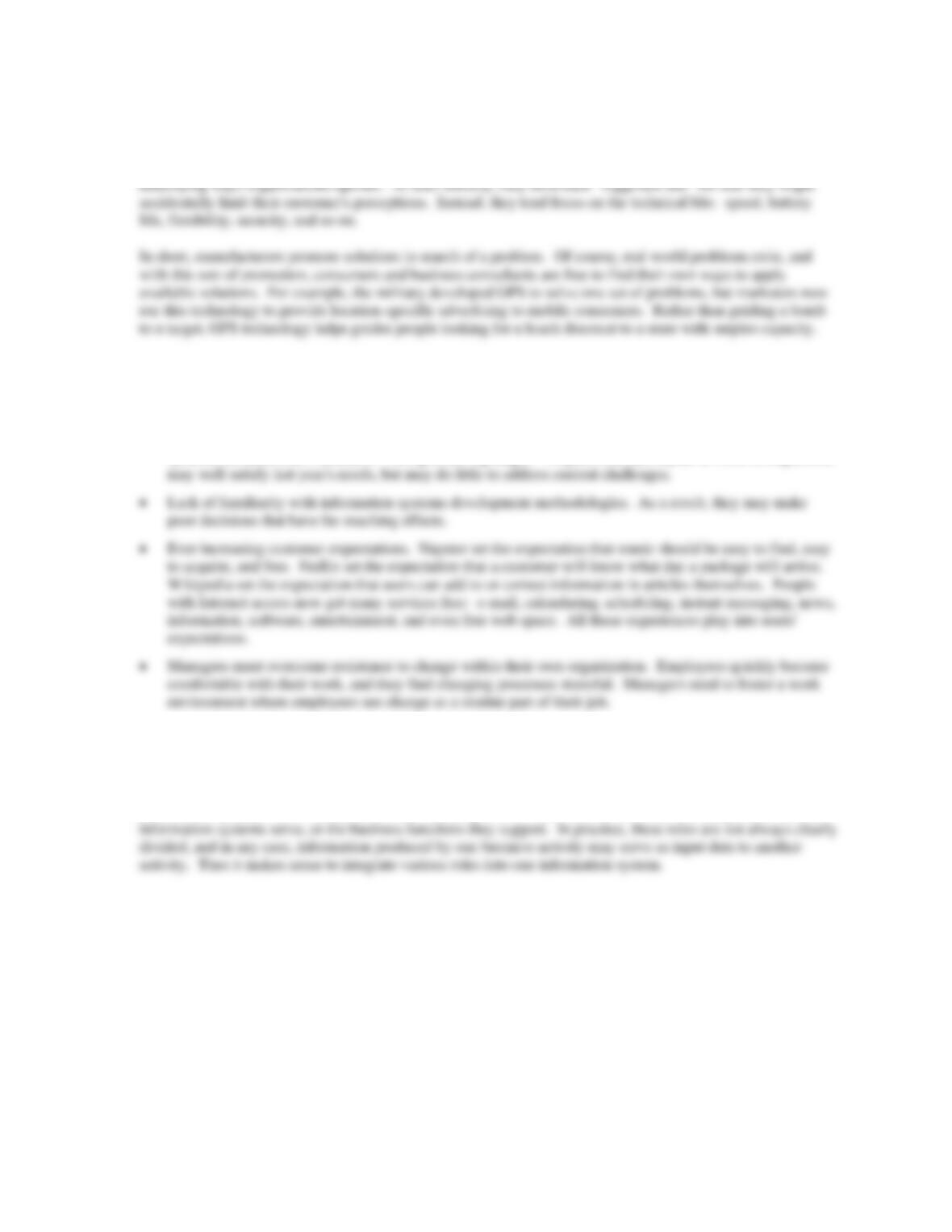
4. Why do big companies still fail in their use of information technology? What should they be doing
differently?
Top Five Reasons for Success
Top Five Reasons for Failure
User involvement
Lack of user input
5. How can a manager demonstrate that he or she is a responsible end user of information systems? Give
several examples.
There are two sides to this answer. First, managers must make good use of information resources placed at their
disposal. Second, managers must not use their information systems irresponsibly. Student’s answers may vary
depending on how they interpret this question.
Responsible use: Managers should demonstrate that they are using their information systems as intended. In
the case of e-mail, calendar, scheduling, and collaborative systems, other users would notice a manager’s lack of
6. Refer to the Real World Case on the New York Times and Boston Scientific in the chapter, and think
about any technology-enabled innovations that you have read about or come across recently. To what extent
is innovation about the technology itself, and to what extent is it about changing the underlying ways that
companies do business?
Innovations:
• iPad
Executive management support
Incomplete requirements and specifications
Clear statement of requirements
Changing requirements and specifications
Proper planning
Lack of executive support
Realistic expectations
Technological incompetence
Chapter 01 – Foundations of Information Systems in Business
1-10
Motivation:
Manufacturers appear to be uncertain about the extent to which an innovative product may change the
7. What are some of the toughest management challenges in developing IT solutions to solve business
problems and meet new business opportunities?
Challenges:
• Increased competitive pressures resulting from a rapidly changing business environment. Developing large
systems has been often likened to “hitting a moving target.” Projects that take a year or more to implement
8. Why are there so many conceptual classifications of information systems? Why are they typically
integrated in the information systems found in the real world?
Conceptual classifications of information systems are designed to emphasize the many different roles of
information systems. This can be done from various points of view, such as the level of management that the
9. In what major ways have information systems in business changed during the last 40 years? What is one
major change you think will happen in the next 10 years? Refer to Figure 1.4 to help you answer.
Chapter 01 – Foundations of Information Systems in Business
1-11
History:
• Tabulation (pre 1950s)
• Data processing (1950s-1960s)
10. Refer to the real world example about responsibility and accountability for project failures in the
chapter. Are these IT projects, or business projects with a significant IT component? Who should be
responsible for ensuring their success? Explain.
(the work below has some application to the answer: re-work)
IT Projects
A few projects might be considered solely IT projects. For example, a server upgrade involves only IT people.
Any resulting failure will almost always trace back to IT. Here’s another way of looking at this – if I take my
car in to a garage for repairs, is it my fault if the mechanic reassembles the transmission incorrectly? My