
Chapter 01-What Do We Mean by Leadership?
1-16
Exercise 1-2
Exercise Title: Getting Acquainted
Purpose: To allow students to get to know each other and introduce different views of leadership.
Summary: Have students respond to one or more (but probably not all) of the following tasks:
1) Describe the best leader you have personally known.
If there are too many in the class for everyone to participate, instructors may choose to break them into
manageable groups. If space and materials permit, it is helpful for students to “publish” their responses, or
a least a summary phrase of them, on a blackboard or poster paper. This is critical, of course, for the
visual symbol. By the way, it is quite helpful for instructors to participate in this activity; they may even
go first to “break the ice.”

Chapter 01-What Do We Mean by Leadership?
1-17
Exercise 1-3
Exercise Title: Getting to Know You
Purpose: To introduce participants to many leadership concepts and to each other.
Summary: This is an ice-breaking exercise which serves as a nice introduction to leadership, norms,
communication, planning, problem solving, etc. Break the class into 10−12 person groups, and give them
10 minutes to learn everyone else’s name in the group. At the end of the ten minute period, instructors

Chapter 01-What Do We Mean by Leadership?
1-18
Exercise 1-4
Exercise Title: Point North
Purpose: To demonstrate how people differ in their definitions of leadership.
Summary: Ask everyone in the room to stand up and close their eyes. Once they have done this, the
instructor should then ask students to point north. Then have them open their eyes and note where
Discussion questions include:
– Why do people disagree?
– How do we know what the truth is?
– Are we surprised that even “experts” disagree to some degree?
– What does this have to do with the study of leadership?

Chapter 01-What Do We Mean by Leadership?
1-19
Exercise 1-5
Exercise Title: Leadership is Leadership (or Is It?)
Purpose: To introduce the context of leadership, as well as implicit theories of leadership.
Summary: Divide the class into groups. Assign each group one of the following categories (or any
others): (1) government; (2) sports; (3) private industry; (4) the military; (5) the ministry. Have each

Chapter 01-What Do We Mean by Leadership?
1-20
Exercise 1-6
Exercise Title: The Lineup
Purpose: A physical icebreaker that raises issues of group leadership, communication, and teamwork.
Summary: This is an effective icebreaker if the group has 15−30 people. Instructors will need to create a
“balance beam” that consists of a set of boards about 8−12 inches in width and long enough for everyone
in the group to stand on in single file. The “beam” can sit on cement blocks and be no more than one foot
above the ground.
Alternative setup: Instead of having a balance beam, instructors might want to just place two strips of
masking tape on the floor. The strips should be about 12 inches apart, and students are not to step outside
the tape while doing the exercise.

Chapter 01-What Do We Mean by Leadership?
1-21
Exercise 1-7
Exercise Title: Chernobyl
Purpose: To demonstrate leadership, management, followership, trust, visioning, communication,
delegation, and the situational factors affecting leadership behaviors.
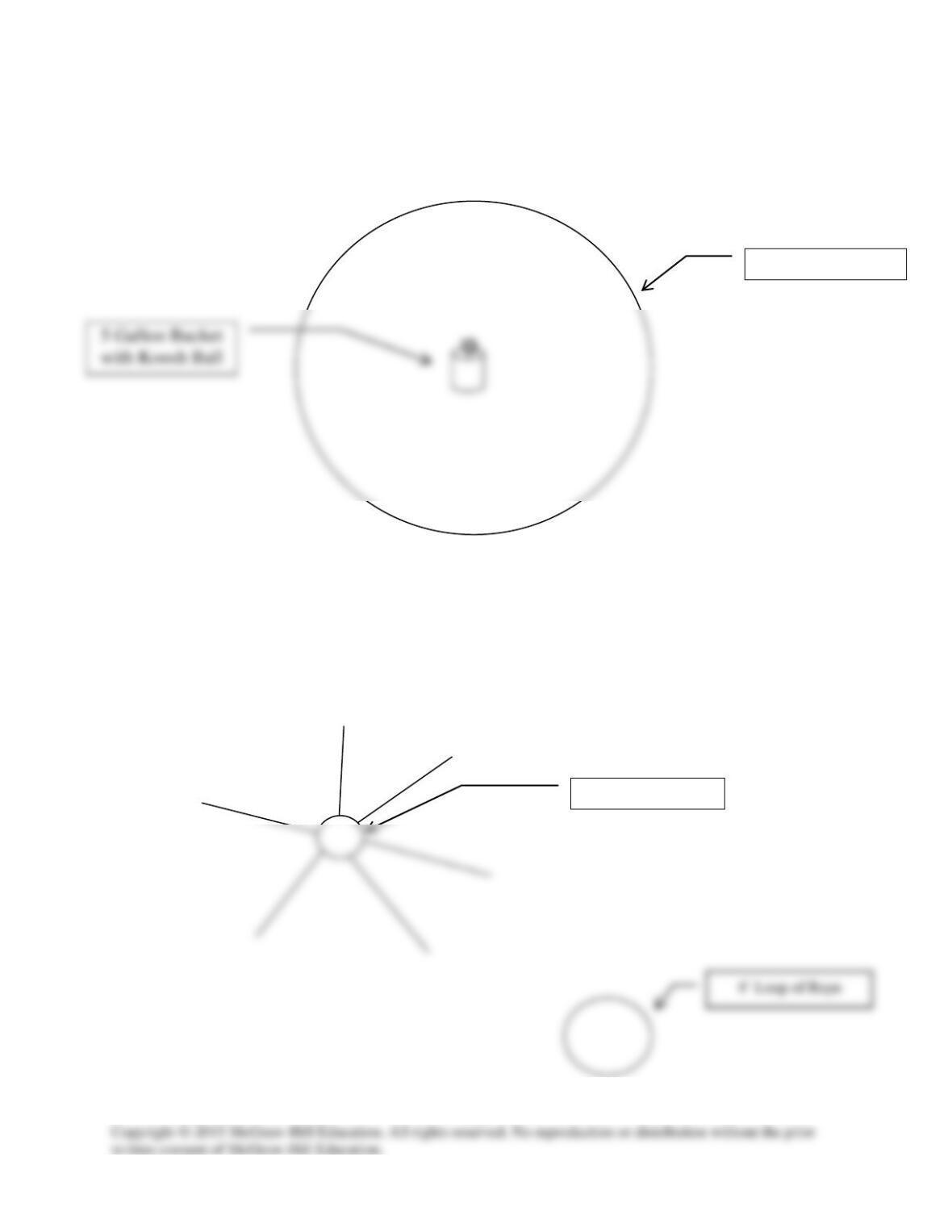
Summary: You will need a 5 gallon plastic bucket, a koosh ball, a transportation device made of surgical
rubber tubing and rope, a loop of rope 15 feet in diameter, a loop of rope 4 feet in diameter, and 5−7
blindfolds (this varies depending upon the number of people in the exercise). Place the koosh ball on top
The transportation team is made up of three hierarchical levels. Appoint one or two leaders to oversee
the overall project, 5−7 first-line supervisors, and 5−7 workers (the number of supervisors, workers,
blindfolds, and tails on the transportation device must match). The workers are blindfolded before they
see the exercise, and they are the only ones who can touch the transportation device. Thus, blindfold the
workers at least 50 yards from the containment area, and assign a supervisor to help each worker get to
the containment area and work on the problem.
Give the leaders and supervisors 25−30 minutes to plan and implement a solution. To successfully
solve the problem, the leaders must communicate an overall plan, the supervisors must constantly
The instructor should comment on how the team came up with and implemented solutions, how the
situation and the followers affected the leadership process, how supervisors and workers communicated
with and listened to each other, what role teamwork and trust played in the process, how real

Chapter 01-What Do We Mean by Leadership?
1-22
Chapter 01-What Do We Mean by Leadership?
1-23
Chernobyl Diagram
15’ Diameter Rope
Surgical Tubing
Transportation Device

Chapter 01-What Do We Mean by Leadership?
1-24

Chapter 01-What Do We Mean by Leadership?
1-25
Exercise 1-8
Exercise Title: The Blind Men and the Elephant
Purpose: To demonstrate 1) leadership is a complex process and 2) the value of multiple perspectives to
the study of leadership (and other important issues related to the leadership process).
Summary: You will need a copy of the poem on the following page—individual copies can be
distributed to students or the poem can be displayed on an overhead (or through a similar multimedia
outlet).
This exercise can be completed in small groups or as a classroom discussion.
After reading the poem, students should focus their discussions on two specific issues: 1) what does this
poem mean and 2) what does it have to do with the study of leadership. Simply stated, the poem strikes at
the heart of something that is crucial to the study of just about anything—in our case, leadership. The
This exercise takes 25–30 minutes to complete.

Chapter 01-What Do We Mean by Leadership?
1-26
THE BLIND MEN AND THE ELEPHANT
American poet John Godfrey Saxe (1816-1887) based the following poem
on a fable which was told in India many years ago.
It was six men of Indostan / To learning much inclined,
Who went to see the elephant / (Though all of them were blind),
That each by observation / Might satisfy his mind.
The Third approached the animal, / And happening to take
The squirming trunk within his hands, / Thus boldly up and spake;
“I see,” quoth he, “the elephant / Is very like a snake!”
The Sixth no sooner had begun / About the beast to grope,
Than, seizing on the swinging tail / That fell within his scope,
“I see,” quoth he, “the elephant / Is very like a rope!”
And so these men of Indostan /
Disputed loud and long,

Chapter 01-What Do We Mean by Leadership?
1-27
So, oft in theologic wars /
The disputants, I ween

Chapter 01-What Do We Mean by Leadership?
1-28
Exercise 1-9
Exercise Title: Leaders, Followers, and Managers
Purpose: To identify (as well as compare and contrast) the attributes of leaders, followers, and managers.
Summary: Divide students into small groups (4−5 students per group) and provide each group with a
flipchart or white/chalk board space to construct their lists.
Part I: Student groups should be instructed to identify individual attributes for each of the following
Part II: Ask one student from each group to report on their key findings. After all of the groups have
reported their individual findings, a class-wide summary discussion (with an emphasis on what was
generated by the groups) can be pursued. Potential points to consider:
– Was any one group described by more emotional or rational terms—are they mutually

Chapter 01-What Do We Mean by Leadership?
1-29
Additional References/Resources
Badaracco, J.L. (1997). Defining moments: When managers must choose between right and
wrong. Boston, MA: Harvard Business School Press.
Hogan, R., Curphy, G.J., & Hogan, J. (1994). What we know about leadership: Effectiveness and
personality. American Psychologist, 49, 493−504.
Hogan, R. & Kaiser, R. B. (2005). What we know about leadership. Review of General
Psychology, 9, 169−180.
Newstrom, J. & Scannell, E. (1998). The big book of team building games: Trust-building
activities, team spirit exercises, and other fun things to do. New York, NY: McGraw-Hill.
Useem, M. (1998). The leadership moment. New York, NY: Times Business, Random House.
Websites

Chapter 01-What Do We Mean by Leadership?