
Chapter 01 – The Exceptional Manager: What You Do, How You Do It
1-21
C. Three Levels of Management
1. Top Managers: Determining Overall Direction
a. Top managers have titles like “chief executive officer (CEO),” “chief
operating officer (COO),” and “president.”
b. Top managers make long-term decisions about the overall direction of
the organization and establish the objectives, policies, and strategies
for it.
c. These executives must be future oriented, dealing with uncertain,
highly competitive conditions.
d. These managers are at the summit of the management pyramid.
2. Middle Managers: Implementing Policies and Plans
a. Middle managers implement the policies and plans of the top
managers above them and supervise and coordinate the activities of
the first-line managers below them.
b. Titles may be “clinic director,” “dean of students,” “division head,” or
“plant manager.”
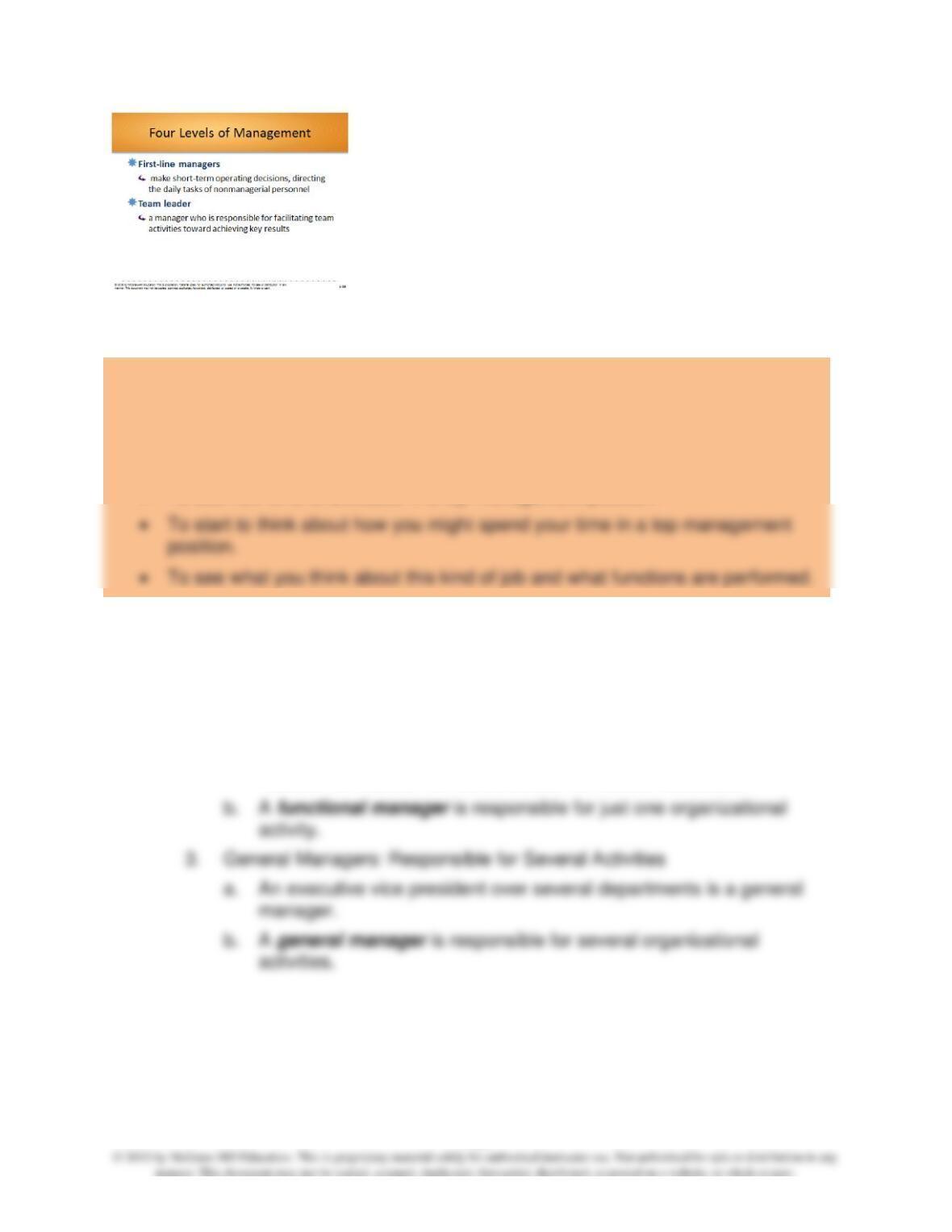
3. First-Line Managers: Directing Daily Tasks
a. Examples of job titles at the bottom of the pyramid: “departmental
head,” “foreman,” “team leader,” or “supervisor.”
b. Supervisor is the name often given to first-line managers as a whole.
c. First-line managers make short-term operating decisions, directing
the daily tasks of nonmanagerial personnel.
Chapter 01 – The Exceptional Manager: What You Do, How You Do It
1-22
Group Exercise: How Well Do Managers Manage Their Time?
There is a group exercise available at the end of this manual that allows students to
apply top management level time management.
Exercise Objectives
• To see how time is allocated in a top management position.
D. Areas of Management: Functional Managers versus General Managers
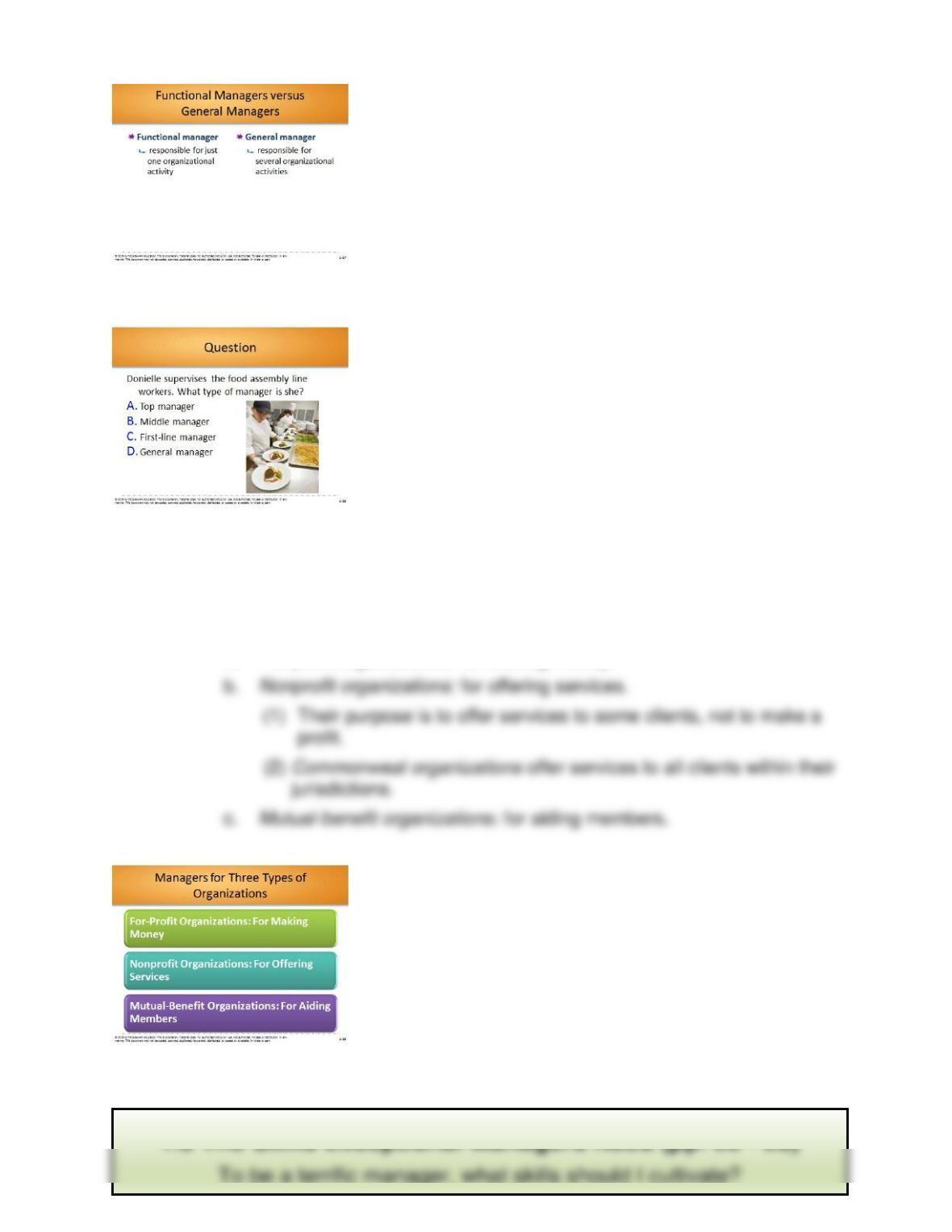
1. The organization is run by 2 types of managers—functional and general.
2. Functional Managers: Responsible for One Activity
a. Titles of functional managers may be “vice president of production,”
“director of finance,” or “administrator for human resources.”
Chapter 01 – The Exceptional Manager: What You Do, How You Do It
1-23
(Correct answer is C)
E. Managers for Three Types of Organizations: For-Profit, Nonprofit, Mutual-
Benefit
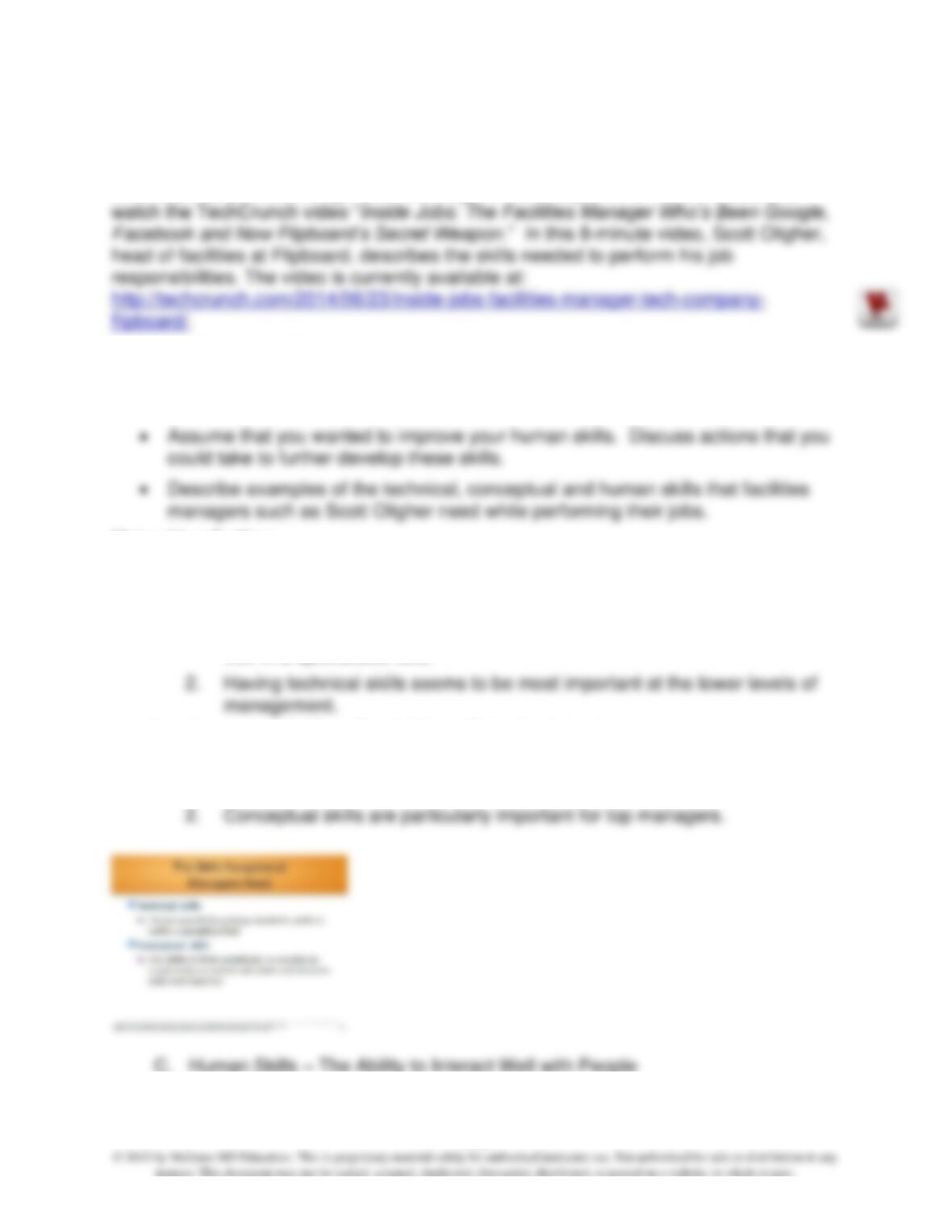
1. Organizations are classified according to the purposes for which they are
formed.
a. For-profit organizations: for making money.
Chapter 01 – The Exceptional Manager: What You Do, How You Do It
1-24
Section 1.5 highlights three principal skills good managers need. The first is technical,
the ability to perform a specific job. The second is conceptual, the ability to think
analytically. The third is human, the ability to interact well with people.
One way that you could begin your coverage of these topics is to have the students
Possible Topics for Discussion:
• Provide examples of how you have been able to enhance the skills needed to be
an exceptional manager through your coursework.
Major Idea Outline:
Researcher Robert Katz found that managers acquire three principal skills:
A. Technical Skills – The Ability to Perform a Specific Job
1. Technical skills consist of the job-specific knowledge needed to perform
well in a specialized field.
B. Conceptual Skills – The Ability to Think Analytically
1. Conceptual skills consist of the ability to think analytically, to visualize an
organization as a whole, and understand how the parts work together.
Chapter 01 – The Exceptional Manager: What You Do, How You Do It
1-25
1. Human skills consist of the ability to work well in cooperation with other
people in order to get things done.
D. The Most Valued Traits in Managers – Among the chief skills companies seek
in top managers are the following:
1. The ability to motivate and engage others.
Section 1.6 discusses the three roles manager play: interpersonal, informational and
read the Forbes article “Twinkie’s Miracle Comeback.” This article can be used to
1.6 Roles Managers Must Play Successfully (pp. 24 – 27)
To be an exceptional manager, what roles must I play successfully?
Chapter 01 – The Exceptional Manager: What You Do, How You Do It
1-26
Possible Topics for Discussion:
• Describe ways that technology and social media have changed the roles of
managers since Mintzberg’s classic study in the 1960s.
Twinkies.
Major Idea Outline:
A. The Manager’s Roles: Mintzberg’s Useful Findings
1. Scholar Henry Mintzberg shadowed managers in the 1960s to see what
they do; he noted three findings.
a. A manager relies more on verbal than on written communication.
b. A manager works long hours at an intense pace.
(1) Long hours at work, typically 50 hours per week, are standard.
c. A manager’s work is characterized by fragmentation, brevity, and
variety.
(1) Only about 1/10th of managerial activity took more than an hour.

Chapter 01 – The Exceptional Manager: What You Do, How You Do It
1-27
Chapter 01 – The Exceptional Manager: What You Do, How You Do It
1-28
Interactive Classroom Material:
PRACTICAL ACTION: Executive Functioning: How Good Are You at Focusing
Your Thoughts, Controlling Your Impulses, & Avoiding Distractions? (pp. 25–26)
This Example focuses on managing yourself and your resources in the workplace.
YOUR CALL
Is this a problem for you? What can you do to improve your “executive
functioning”?
This Example demonstrates why it is important for students to direct their attention
Additional Activities:
One way that you could build on this Practical Action is to have the students watch
the video “Are Smartphones Making Us Stupid?” This 2-minute video profiles the
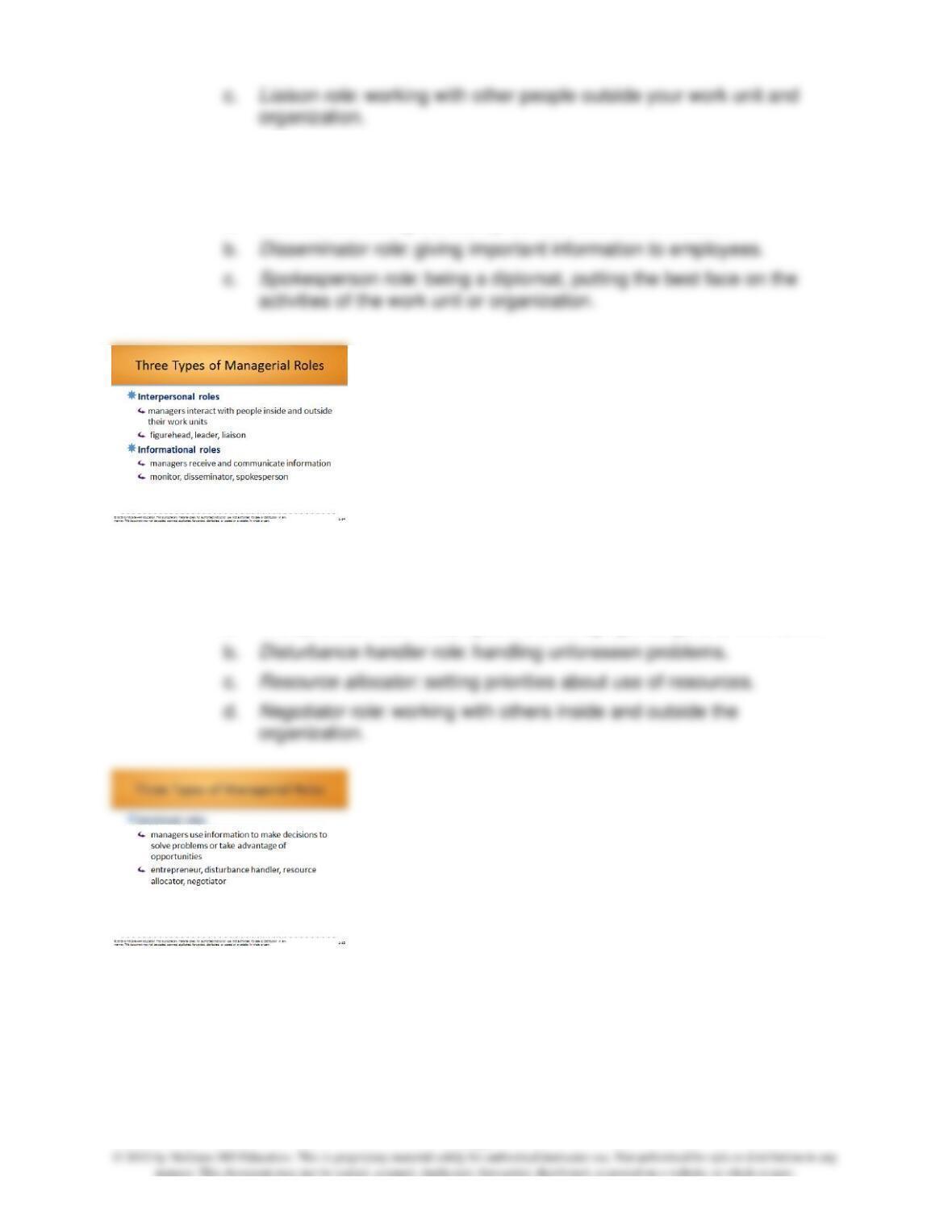
B. Three Types of Managerial Roles – Mintzberg concluded that managers play
three broad types of roles or “organized sets of behavior.”
1. In their interpersonal roles, managers interact with people inside and
outside of their work units.
Chapter 01 – The Exceptional Manager: What You Do, How You Do It
1-29
2. In their three informational roles – as monitor, disseminator, and
spokesperson – managers receive and communicate information with
other people inside and outside of the organization.
a. Monitor role: being constantly alert for useful information.
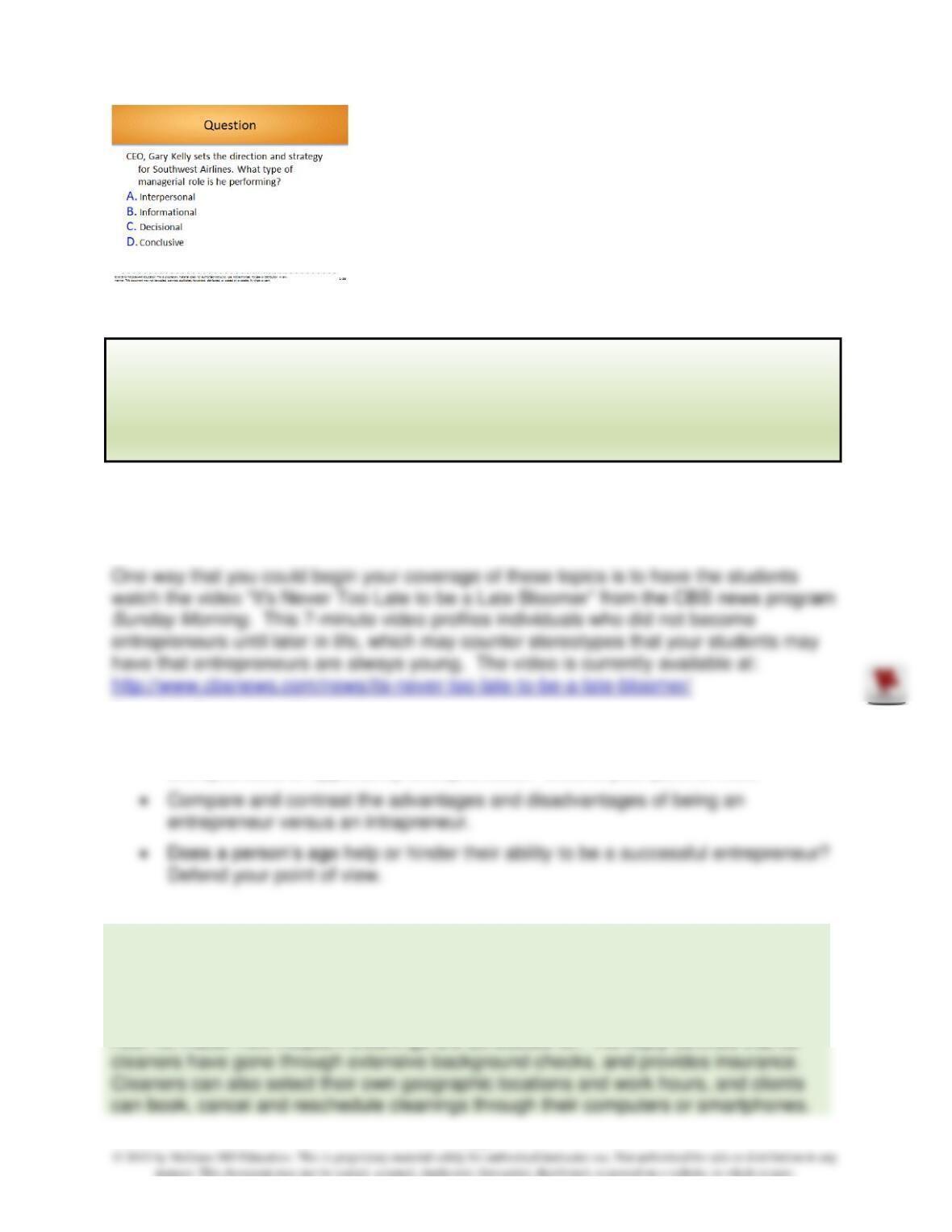
3. In their decisional roles, managers use information to make decisions to
solve problems or take advantage of opportunities.
a. Entrepreneur role: initiating and encouraging change and innovation.
Chapter 01 – The Exceptional Manager: What You Do, How You Do It
1-30
(Correct answer is A)
Section 1.7 defines entrepreneurship and its subparts: the entrepreneur and the
intrapreneur. Entrepreneurs and managers differ in many ways, and may have different
characteristics.
Possible Topics for Discussion:
• Who do you think makes the best entrepreneurs, so-called necessity
entrepreneurs or opportunity entrepreneurs? Defend your point of view.
Interactive Classroom Material:
EXAMPLE: A Hot Start-Up Cleans Up: Homejoy Transforms an Old Business
(pp. 28-29)
This Example discusses Homejoy, a home cleaning service that charges a flat $20 an
hour no matter how frequent cleanings are scheduled for. Homejoy certifies that its
1.7 The Link between Entrepreneurship & Management
(pp. 28 – 32)
Do I have what it takes to be an entrepreneur?

Chapter 01 – The Exceptional Manager: What You Do, How You Do It
1-31
YOUR CALL
Do you think you have the stomach for the risks involved in establishing and
growing a start-up? What are some risks associated with owning your own
business?
Owning your own business has tremendous risks and is not for the faint of heart.
Additional Activities:
One way to build on this Example is to have the students watch the video “How
Homejoy Swept the Competition.” In this video, Homejoy co-founder Adora Cheung
discusses some of the steps taken to launch the firm. The entire video is 30 minutes,
Major Idea Outline:
A. Entrepreneurship Defined: Taking Risks in Pursuit of Opportunity
1. What entrepreneurship is—Entrepreneurship is the process of taking
risks to try to create a new empire.
Chapter 01 – The Exceptional Manager: What You Do, How You Do It
Interactive Classroom Material:
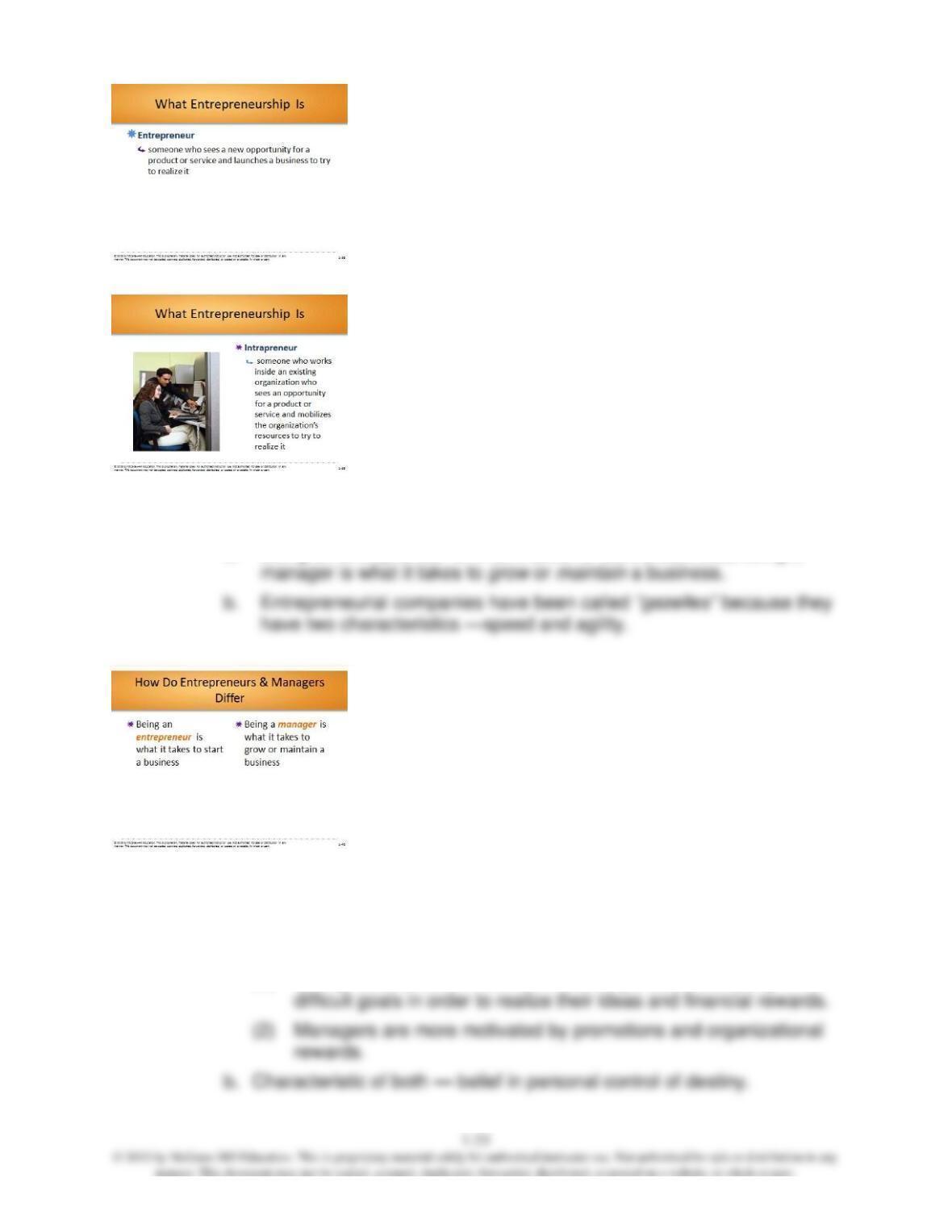
EXAMPLE: Example of an Intrapreneur: Intel’s Anthropologist Genevieve Bell
Explores Possible Innovations for Automakers (p. 30)
This Example discusses how Intel hired an anthropologist to lead 100 social scientists
YOUR CALL
Do you think most companies truly support intrapreneurship? Why would they
not?
Students should provide examples of companies that support intrapreneurship,
and how they do that. Many companies have specific programs set up for this, but
Additional Activities:
One way to build on this Example is to have the students watch Bhavna Mathur’s
TED Talk “Unleashing Social Intrapreneur.” In this 7-minute video, Bhavna profiles
key differences between entrepreneurs and intrapreneurs. Consider using the
following discussion questions:
Discuss how the challenges facing an intrapreneur working for a company like 3M
or Google would be different than those facing a start-up entrepreneur.
Chapter 01 – The Exceptional Manager: What You Do, How You Do It
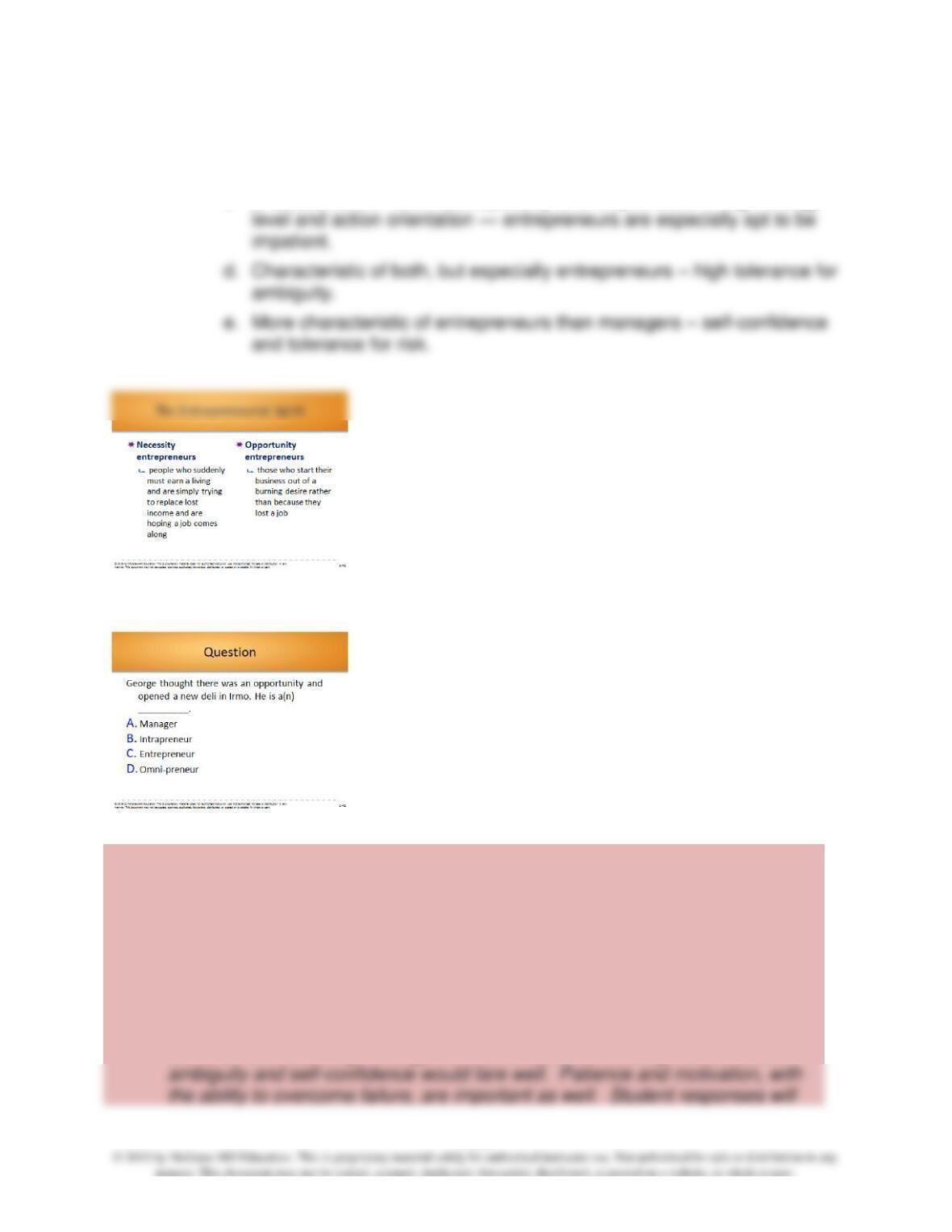
2. How do entrepreneurs and managers differ?
a. Being an entrepreneur is what it takes to start a business; being a
3. Entrepreneurs have psychological characteristics that are different from
managers.
a. Characteristic of both — high need for achievement
(1) Entrepreneurs seem to be motivated to pursue moderately
Chapter 01 – The Exceptional Manager: What You Do, How You Do It
1-34
(1) An internal locus of control is the belief that you control your
own destiny.
(2) Both entrepreneurs and managers like to think they have
personal control over their lives.
c. Characteristic of both, but especially of entrepreneurs — high energy
(Correct answer is C)
SELF-ASSESSMENT 1.2 (p. 32)
To What Extent Do You Possess an Entrepreneurial Spirit?
Go to connect.mheducation.com and take Self-Assessment 1.2.
Student Questions:
1. To what extent are your motives, aptitudes, and attitudes similar to
entrepreneurs? Explain.
Students who have high energy, internal locus of control, high tolerance for
Chapter 01 – The Exceptional Manager: What You Do, How You Do It
1-35
2. Based on your results, where do you have the biggest gaps with
entrepreneurs in terms of the individual motives, aptitudes, and attitudes?
3. What do these gaps suggest about your entrepreneurial spirit? Discuss.
4. Do these results encourage or discourage you from thinking about starting
your own business? Explain.
Additional Activities:
You can also consult the Connect Instructors Manual for the post-assessment activity
and corresponding PowerPoint slides used for this Self-Assessment in Connect. In
this activity, students should be assigned to groups based on their Self-Assessment
1.1 What are the rewards of being an exceptional manager?
1.2 What would I actually do—that is, what would be my four principal
functions—as a manager?
1.3 Challenges can make one feel alive. What are seven challenges I could look
forward to as a manager?
1.4 What are the levels and areas of management I need to know to move up,
down, and sideways?