Chapter 01 – The Management Process Today
1-16
In addition to diversity, managers must now learn to compete on an increasingly global scale. The
breakdown of barriers between formerly distinct economies has forced companies to improve
performance in order to compete successfully with companies around the world. Managers can learn to
ACTION
6. Choose an organization such as a school or a bank; visit it; then list the different kinds of
organizational resources it uses. How do managers use these resources to maintain and improve its
performance?
7. Visit an organization and talk to first-line, middle, and top managers about their respective
management roles in the organization and what they do to help the organization be efficient and effective.
Chapter 01 – The Management Process Today
1-17
(Note to instructor: Due to the nature of this question, individual answers may differ widely, though
students should address the following points in their answers.)
Managers at various levels within an organization have different but related types of responsibilities for
8. Ask a middle or top manager, perhaps someone you already know to give examples of how he or she
performs the management functions of planning, organizing, leading and controlling. How much time
does he or she spend in performing each task?
9. Try to find a cooperative manager who will allow you to follow him or her around for a day. List the
roles the manager plays and how much time he or she spends performing them.
Chapter 01 – The Management Process Today
1-18
Copyright © 2017 McGraw-Hill Education. All rights reserved. No reproduction or distribution without the prior written consent of McGraw-Hill
Education.
Peter Johnson is a manager of a real-estate office. Performing this job requires Peter to perform many of
Mintzberg’s roles that encompass the managerial functions of planning, organizing, leading and
controlling organizational resources. Peter acts as a figurehead; a person who symbolizes an organization
and what it is seeking to achieve. He establishes for his field agents the appropriate ways to behave in an
organization with his professional manner and enthusiasm. This role requires constant attention, and is
exhibited in his personality and mannerisms. Much of Peter’s time is devoted to acting as a leader for his
employees, motivating his employees to perform at a higher level by training, counseling, and mentoring
them. Another main part of Peter’s job is in the liaison role, linking and coordinating activities of people
and groups both inside and outside the organization.
Disseminating information is also an integral part of Peter’s job. By acting as a monitor, Peter analyzes
information to effectively organize and control resources, while his role as a disseminator involves
sharing this information with his employees to influence their work and behavior. Finally, Peter does play
some decisional roles within his organization, working as a resource allocator who decides how to
allocate people and other resources, and a negotiator, who manages solutions between groups with
competing interests.
AACSB: Analytic
AACSB: Reflective Thinking
Thinking About Managers and Management
(Note to instructor: Due to the nature of these questions, student responses may vary. The following are
examples.)
1. Think of your direct supervisor. Of what department is he or she a member and at what level of
management is this person?
2. How would you characterize your supervisor’s approach to management? For example, which
particular management tasks and roles does this person perform most often? What kinds of management
skills does the manager have?
BUILDING MANAGEMENT SKILLS
Chapter 01 – The Management Process Today
1-19
Copyright © 2017 McGraw-Hill Education. All rights reserved. No reproduction or distribution without the prior written consent of McGraw-Hill
Education.
He continues to control the project by holding weekly meeting with his team to assess the
progress and provide the necessary feedback. He reviews the work that they have completed and
makes recommendations for any necessary changes. At this point he determines whether his
team is on schedule with the budget and if necessary how they can better manage their time.
Jonathon performs many of the interpersonal, informational and decisional roles coined by Mintzberg.
Within the interpersonal roles he is required to act as a figurehead, leader and liaison among and
between his team members. He performs informational roles by monitoring technical and client specific
information, disseminating the necessary information to his clients and staff, and acts as a spokesperson
when he represents the firm at many meetings, presentations and recruiting events. While performing
decisional roles he must act as an entrepreneur in determining what lines of business are best to solicit, a
disturbance handler when any unforeseen events effect the progress of his team, a resource allocator in
determining which employee should work on which project and a negotiator when he must negotiate with
other managers when there is a scheduling conflict involving his team members.
Jonathon possesses tremendous technical and human skills. His technical skills include his ever
increasing accounting expertise as well as his up to date knowledge of the issues facing his clients and
their industry. He exercises his human skills every time he interacts with supervisors, staff associates,
partners, support staff and clients.
3. Do you think the tasks, roles, and skills of your supervisor are appropriate for the particular job he or
she performs? How could this manager improve his or her task performance? How can IT affect this?
4. How did your supervisor’s approach to management affect your attitudes and behavior? For example,
how well did you perform as a subordinate and how motivated were you?
5. Think about the organization and its resources. Do its managers utilize organizational resources
effectively? Which resources contribute most to the organization’s performance?
Chapter 01 – The Management Process Today
1-20
6. Describe the way the organization treats its human resources. How does this treatment affect the
attitudes and behaviors of the workforce?
7. If you could give your manager one piece of advice or change one management practice in the
organization, what would it be?
8. How attuned are the organization to the need to increase efficiency, quality, innovation, or
responsiveness to customers? How well do you think the organization performs its prime goals of
providing the goods or services that customers want or need the most?
Chapter 01 – The Management Process Today
1-21
1. Either by yourself or in a group, give three reasons why you think the behavior was unethical. For
example, what rules or norms were broken? Who benefited or was harmed by what took place? What was
the outcome for the people involved?
2. What steps might a manager take to prevent such unethical behavior and encourage people to behave
in an ethical way?
Opening a New Restaurant
1. Decide what each partner’s managerial role in the restaurant will be. For example, who will be
responsible for the necessary departments and specific activities? Describe your management hierarchy.
MANAGING ETHICALLY
SMALL GROUP BREAKOUT EXERCISE
Chapter 01 – The Management Process Today
1-22
Copyright © 2017 McGraw-Hill Education. All rights reserved. No reproduction or distribution without the prior written consent of McGraw-Hill
Education.
The primary investors should serve as top managers who are responsible for the performance the
restaurant and its staff. Top management will make decisions about menu decisions, price setting,
marketing, and how the different employees and supervisors should cooperate and help one another to
achieve the restaurant’s goals.
2. Which building blocks of competitive advantage do you need to establish to help your restaurant
succeed? What criteria will you use to evaluate how successful you are managing the restaurant?
3. Discuss the most important issues that must be made about (a) planning, (b) organizing, (c) leading,
and (d) controlling to allow you or your partners to utilize organizational resources effectively and build
a competitive advantage.
Management must plan, which involves deciding which goals an organization should pursue, what
1-23
Copyright © 2017 McGraw-Hill Education. All rights reserved. No reproduction or distribution without the prior written consent of McGraw-Hill
Education.
In controlling, management must decide how they will evaluate how well the organization is achieving its
goals. Sales and customer satisfaction would seem to be adequate measures of this aspect of managing.
4. For each managerial task, list the issues to solve, and those roles which will contribute the most to
your restaurant’s success.
(Note to instructor: Due to the nature of this question, student responses may vary. The following are
examples.)
Questions:
1. What kinds of organizing and controlling problems is Achieva suffering from?
2. What kinds of management changes need to be made to solve them?
BE THE MANAGER
THE WALL STREET JOURNAL CASE IN THE NEWS
Chapter 01 – The Management Process Today
1-24
Case Synopsis: The Algorithm That Tells the Boss Who Might Quit
Employers want to know who is likely to leave their companies. As turnover becomes a bigger
worry—and expense—in a tightening labor market, some companies, including Wal-Mart Stores
Questions
1. How does the managerial task of leading affect employee performance?
2. As the economy continues to improve, workers will be looking to change jobs (and
companies) at a faster pace. What can managers do to plan for and fill job openings
quickly?
3. How else can managers use “big data” to help plan for human resources?
Chapter 01 – The Management Process Today
1-25
Copyright © 2017 McGraw-Hill Education. All rights reserved. No reproduction or distribution without the prior written consent of McGraw-Hill
Education.
company. Wal-Mart is trying to determine in advance which employees are likely to get promoted so that
it can line up replacements more quickly.
AACSB: Analytic
AACSB: Reflective Thinking
There is no recommended MHS for Chapter 1.
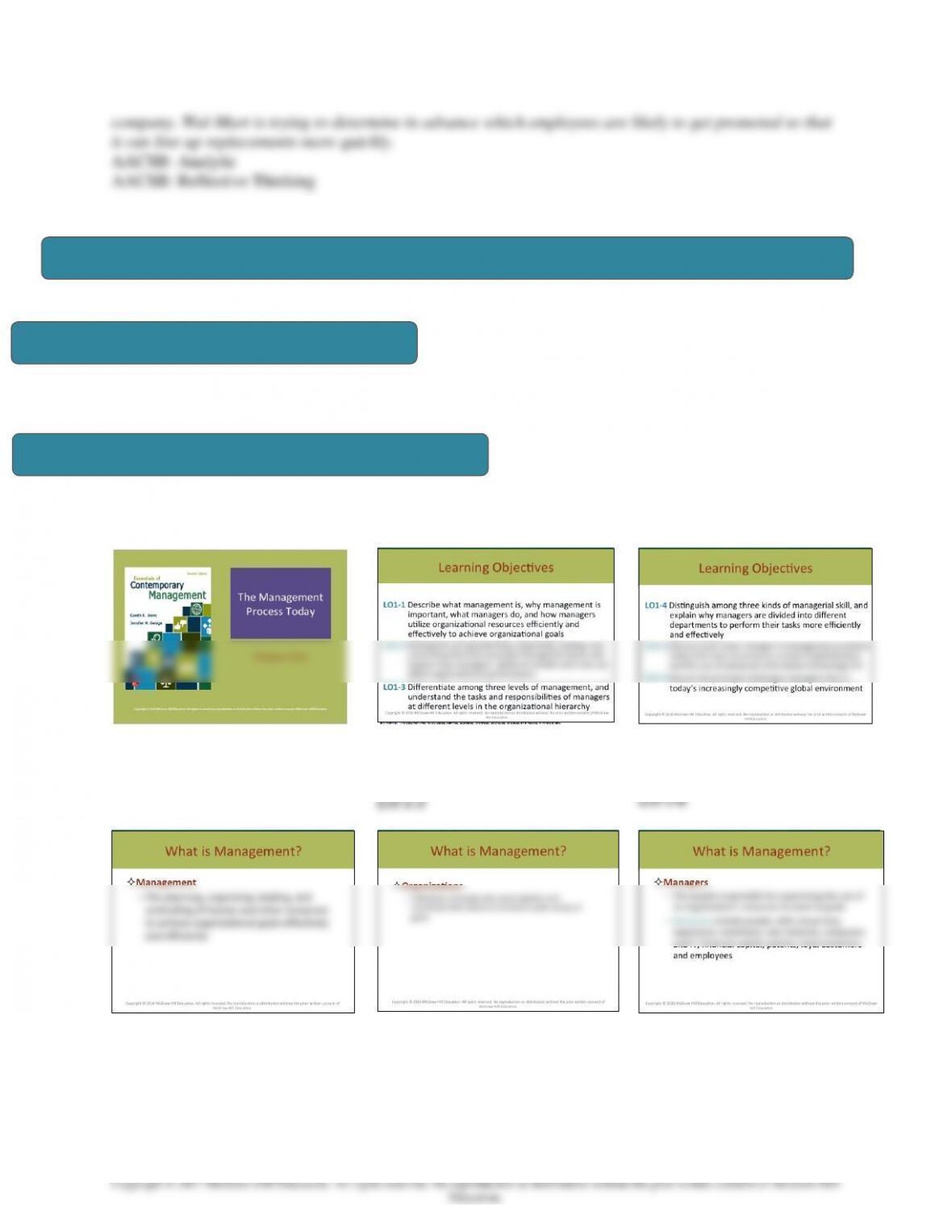
These Instructor’s PowerPoint slides can be used to supplement the lecture material.
INSTRUCTOR’S POWERPOINT
SLIDE 1
Chapter Title
INSTRUCTOR’S POWERPOINT
SLIDE 2
Learning Objectives: LO 1-1 –
LO 1-3
INSTRUCTOR’S POWERPOINT
SLIDE 3
Learning Objectives: LO 1-4 –
LO 1-6
INSTRUCTOR’S POWERPOINT
SLIDE 4
What is Management?
INSTRUCTOR’S POWERPOINT
SLIDE 5
What is Management?
INSTRUCTOR’S POWERPOINT
SLIDE 6
What is Management?
SUPPLEMENTAL FEATURES
MANAGER’S HOT SEAT (MHS)
INSTRUCTOR’S POWERPOINT SLIDES
Chapter 01 – The Management Process Today
1-26
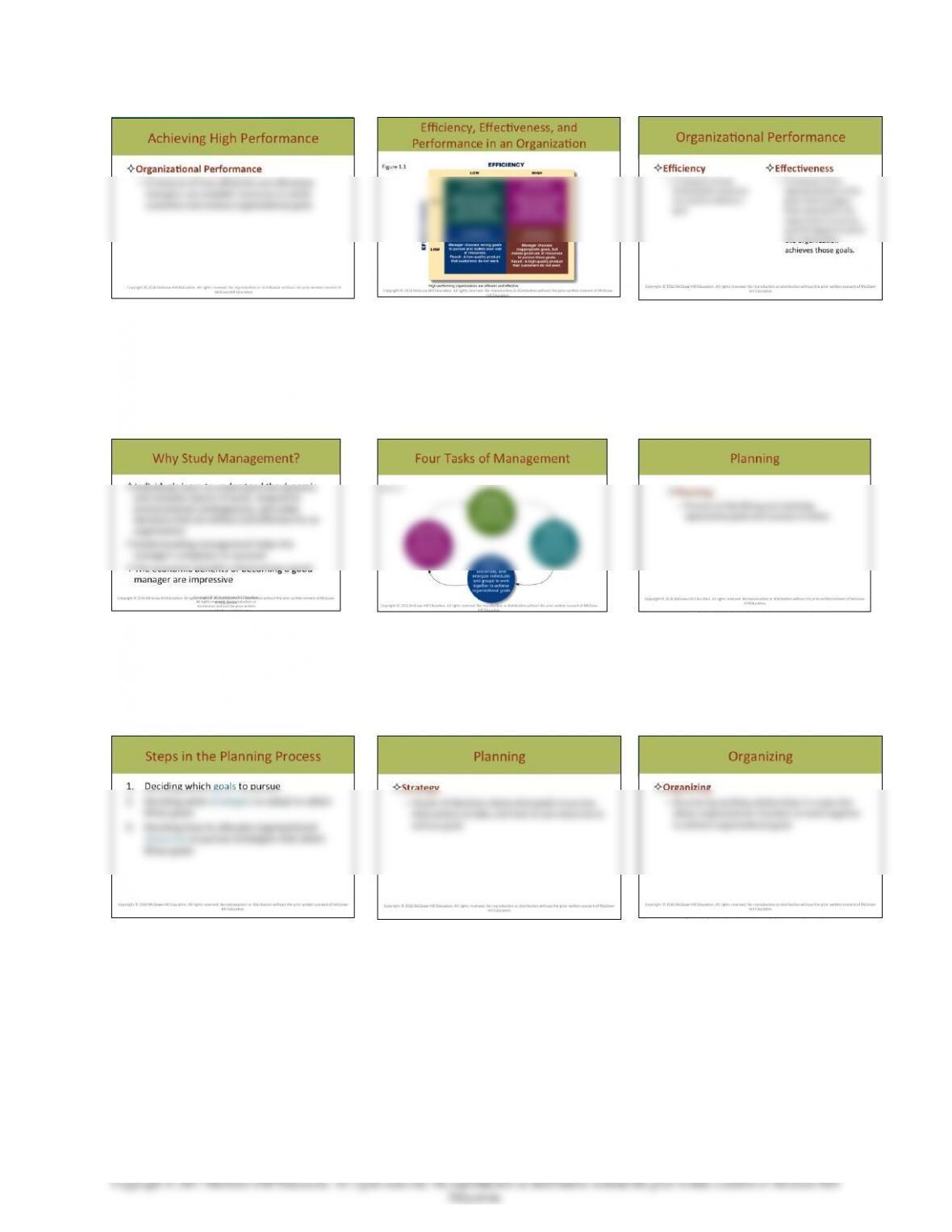
INSTRUCTOR’S POWERPOINT
SLIDE 7
Achieving High Performance
INSTRUCTOR’S POWERPOINT
SLIDE 8
Figure 1.1: Efficiency, Effectiveness,
and Performance in an
Organization
INSTRUCTOR’S POWERPOINT
SLIDE 9
Organizational Performance
INSTRUCTOR’S POWERPOINT
SLIDE 10
Why Study Management?
INSTRUCTOR’S POWERPOINT
SLIDE 11
Figure 1.2 – Four Tasks of
Management
INSTRUCTOR’S POWERPOINT
SLIDE 12
Planning
INSTRUCTOR’S POWERPOINT
SLIDE 13
Steps in the Planning Process
INSTRUCTOR’S POWERPOINT
SLIDE 14
Planning
INSTRUCTOR’S POWERPOINT
SLIDE 15
Organizing
Chapter 01 – The Management Process Today
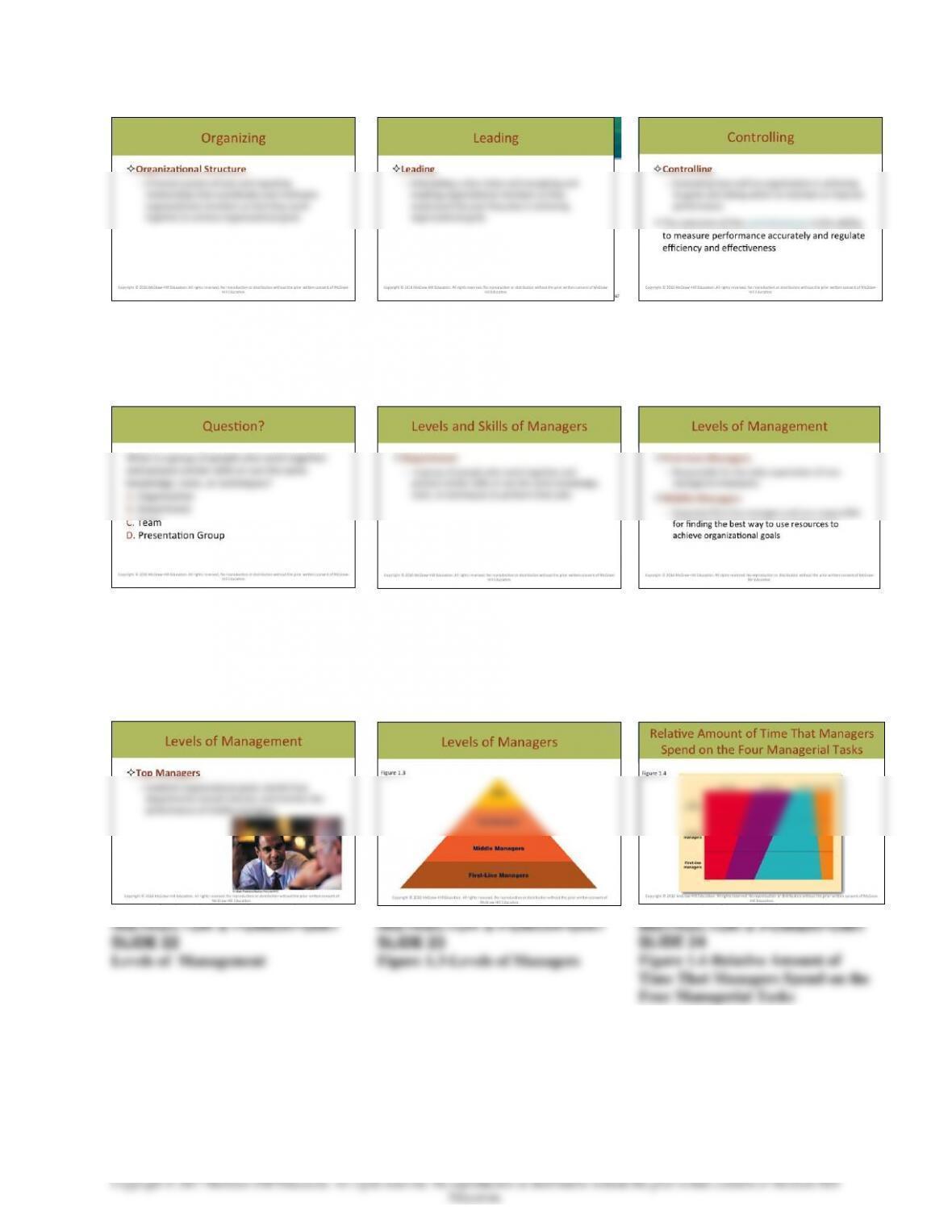
INSTRUCTOR’S POWERPOINT
SLIDE 16
Organizing
INSTRUCTOR’S POWERPOINT
SLIDE 17
Leading
INSTRUCTOR’S POWERPOINT
SLIDE 18
Controlling
INSTRUCTOR’S POWERPOINT
SLIDE 19
Question?
INSTRUCTOR’S POWERPOINT
SLIDE 20
Levels and Skills of Managers
INSTRUCTOR’S POWERPOINT
SLIDE 21
Levels of Management
INSTRUCTOR’S POWERPOINT
SLIDE 22
Levels of Management
INSTRUCTOR’S POWERPOINT
SLIDE 23
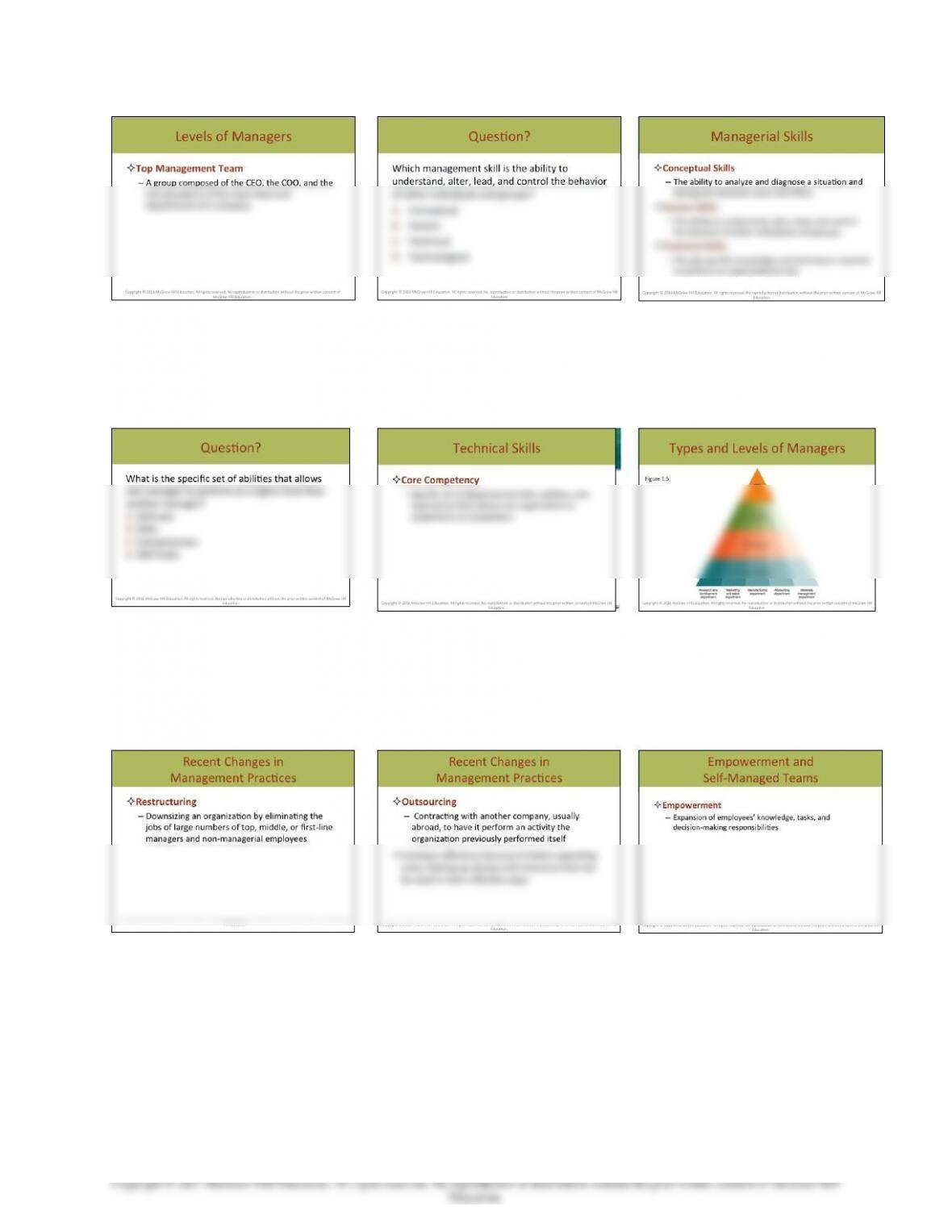
Figure 1.3-Levels of Managers
INSTRUCTOR’S POWERPOINT
SLIDE 24
Figure 1.4-Relative Amount of
Time That Managers Spend on the
Four Managerial Tasks
Chapter 01 – The Management Process Today
1-28
INSTRUCTOR’S POWERPOINT
SLIDE 25
Levels of Managers
INSTRUCTOR’S POWERPOINT
SLIDE 26
Question?
INSTRUCTOR’S POWERPOINT
SLIDE 27
Managerial Skills
INSTRUCTOR’S POWERPOINT
SLIDE 28
Question?
INSTRUCTOR’S POWERPOINT
SLIDE 29
Technical Skills
INSTRUCTOR’S POWERPOINT
SLIDE 30
Figure 1.5-Types and Levels of
Managers
INSTRUCTOR’S POWERPOINT
SLIDE 31
Recent Changes in Management
Practices
INSTRUCTOR’S POWERPOINT
SLIDE 32
Recent Changes in Management
Practices
INSTRUCTOR’S POWERPOINT
SLIDE 33
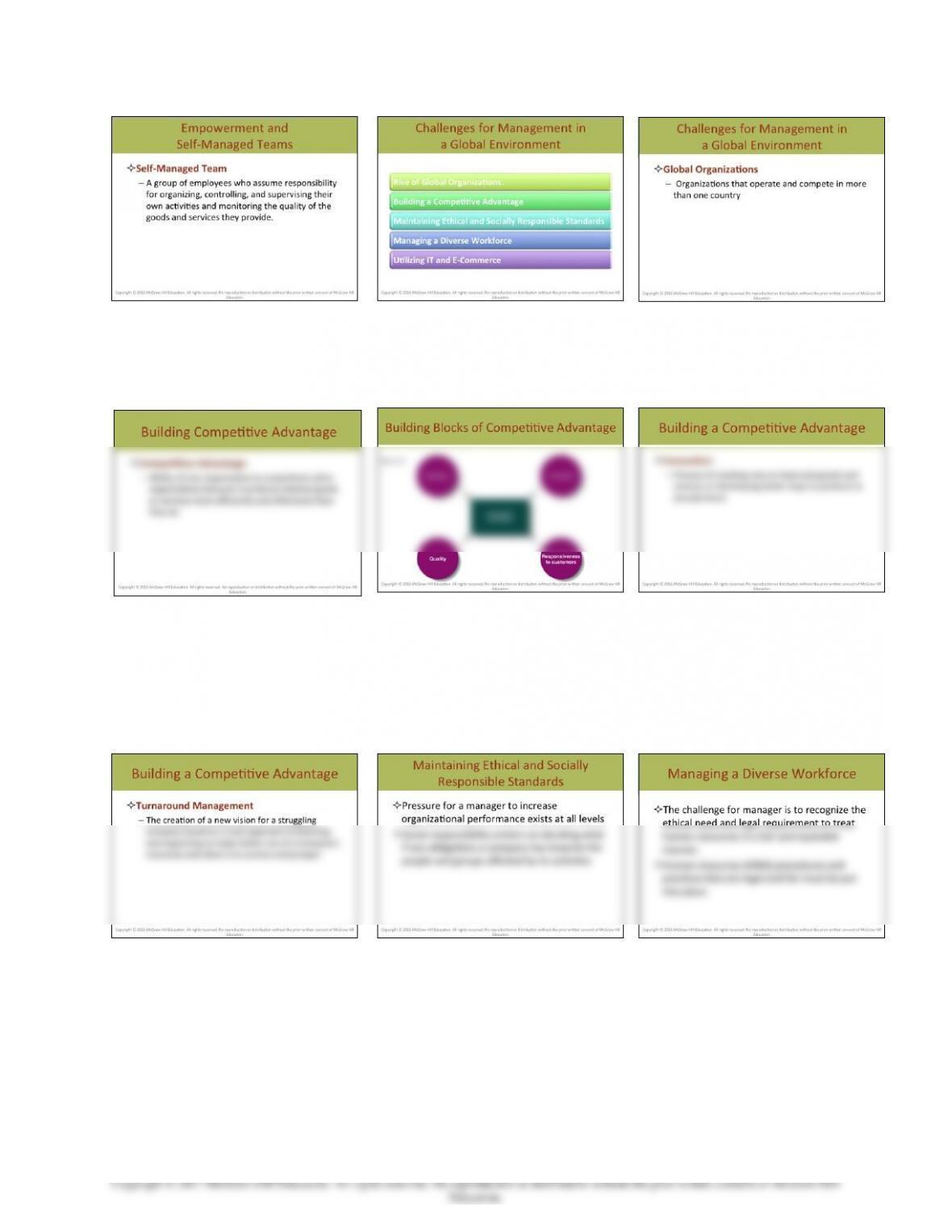
Empowerment and Self-Managed
Teams
Chapter 01 – The Management Process Today
1-29
INSTRUCTOR’S POWERPOINT
SLIDE 34
Empowerment and Self-Managed
Teams
INSTRUCTOR’S POWERPOINT
SLIDE 35
Challenges for Management …
INSTRUCTOR’S POWERPOINT
SLIDE 36
Challenges for Management …
INSTRUCTOR’S POWERPOINT
SLIDE 37
Building Competitive Advantage
INSTRUCTOR’S POWERPOINT
SLIDE 38
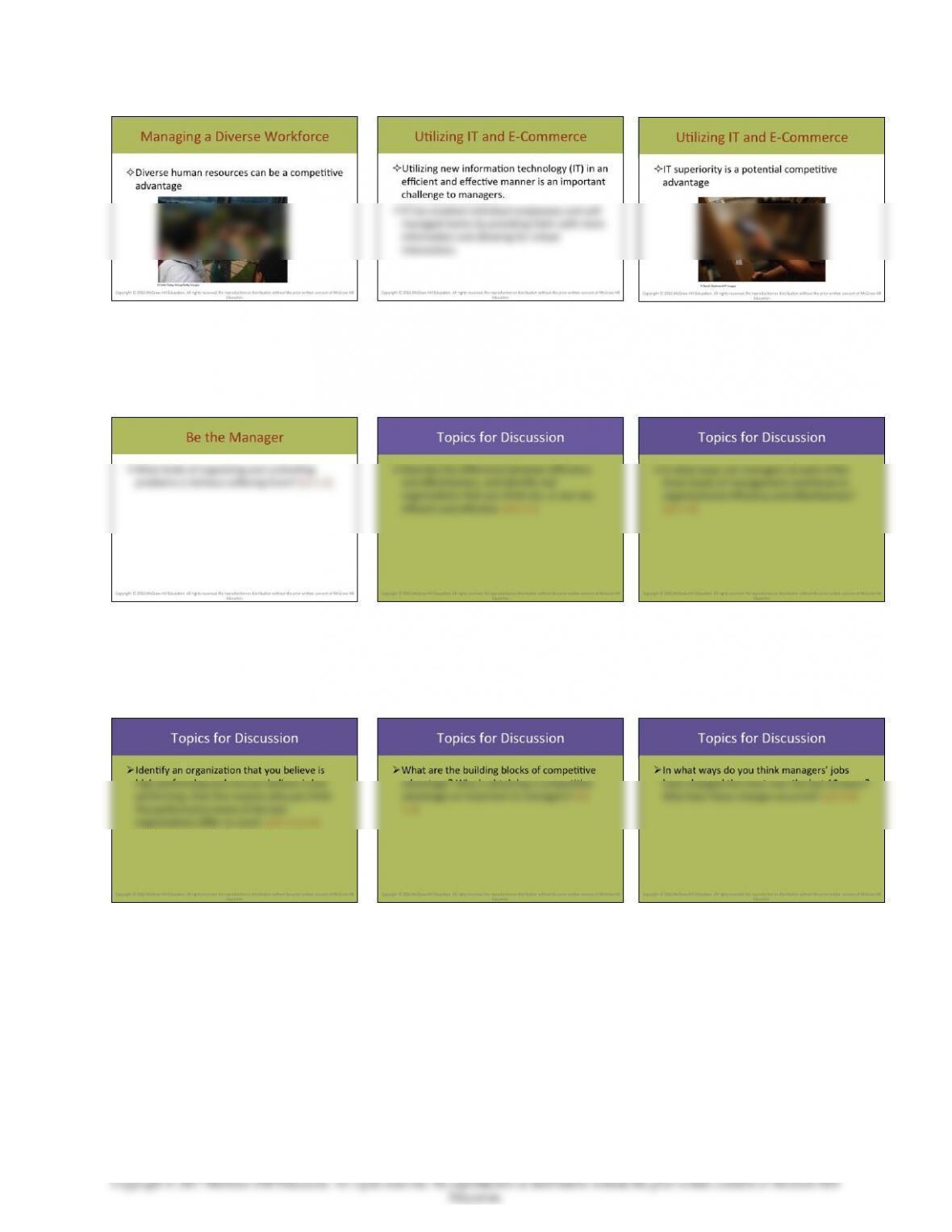
Building Blocks of Competitive
Advantage
INSTRUCTOR’S POWERPOINT
SLIDE 39
Building a Competitive Advantage
INSTRUCTOR’S POWERPOINT
SLIDE 40
Building Competitive Advantage
INSTRUCTOR’S POWERPOINT
SLIDE 41
Maintaining Ethical and
Responsible Standards
INSTRUCTOR’S POWERPOINT
SLIDE 42
Managing a Diverse Workforce
Chapter 01 – The Management Process Today
1-30
INSTRUCTOR’S POWERPOINT
SLIDE 43
Managing a Diverse Workforce
INSTRUCTOR’S POWERPOINT
SLIDE 44
Utilizing IT and E-Commerce
INSTRUCTOR’S POWERPOINT
SLIDE 45
Utilizing IT and E-Commerce
INSTRUCTOR’S POWERPOINT
SLIDE 46
Be the Manager
INSTRUCTOR’S POWERPOINT
SLIDE 47
Topics for Discussion
INSTRUCTOR’S POWERPOINT
SLIDE 48
Topics for Discussion
INSTRUCTOR’S POWERPOINT
SLIDE 49
Topics for Discussion
INSTRUCTOR’S POWERPOINT
SLIDE 50
Topics for Discussion
INSTRUCTOR’S POWERPOINT
SLIDE 51
Topics for Discussion