Chapter 01-What Do We Mean by Leadership?
1-1
Part 1: Leadership Is a Process, Not a Position
Chapter 1: What Do We Mean by Leadership?
Leader

Chapter 01-What Do We Mean by Leadership?
1-2
Chapter 1 Outline
What Do We Mean by Leadership?
Introduction
What is Leadership?
Leadership is both a science and an art
Leadership Myths
Myth: Good leadership is all common sense
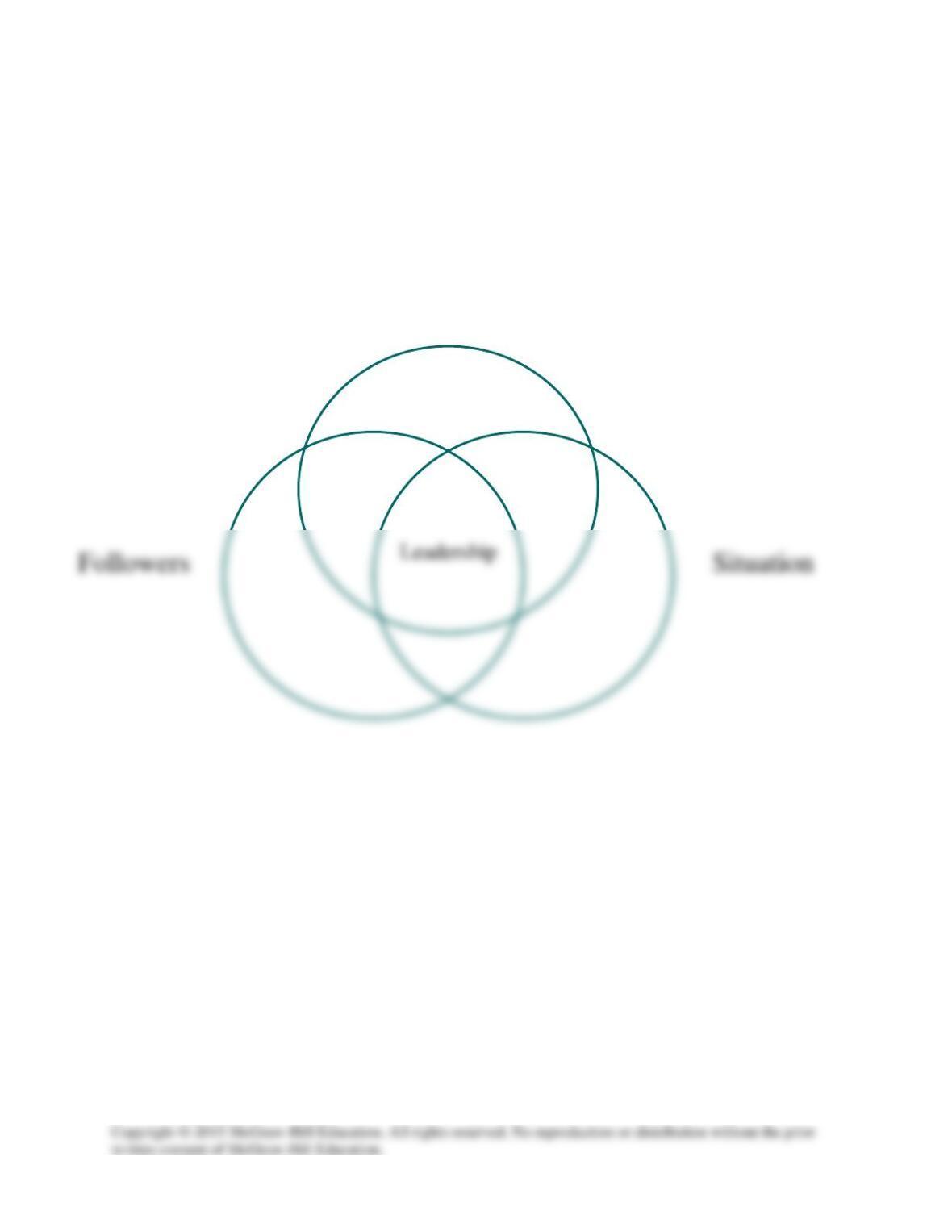
The Interactional Framework for Analyzing Leadership
The Leader
Illustrating the Interactional Framework: Women in Leadership Roles
There Is No Simple Recipe for Effective Leadership
Summary

Chapter 01-What Do We Mean by Leadership?
1-3
Key Learning Points
Introduction
The text opens with a story of leadership issues faced by a Uruguayan rugby team that was involved
in a plane crash in the Andes mountains en route to a game in Chile. It is a tale of survival and
What is Leadership?
Leadership is a complex phenomenon involving the leader, the followers, and the situation. Some
leadership researchers have focused on the personality, physical traits, or behaviors of the leader;
others have studied the relationships between leaders and followers; still others have studied how
experience. It is distinct from both management and followership.
Leadership Myths
In general, these myths can be classified into three broad categories of beliefs that hinder the
development of leadership: 1) “good leadership is all common sense;” 2) “leaders are born, not
made;” and 3) “the only school you can learn leadership from is the school of hard knocks.” In the
first case, the implicit (or explicit) notion is that there is a body of commonly accepted knowledge that
The Interactional Framework for Analyzing Leadership
Leadership scholars have spent a great deal of time focusing their studies on specific leaders as the
means for improving our understanding of leadership. However, focusing exclusively on the leader
ignores the followers and the situation in the leadership process. Using all three lenses of the

Chapter 01-What Do We Mean by Leadership?
1-4
The Leader
What does the leader bring to the table as an individual? This component contains personal history,
interests, character, personality, intelligence, and motivation. How leaders achieve leadership status
The Followers
Although researchers have not paid a great deal of attention to the role of followers, this is beginning
to change. In fact, research shows that followers’ expectations, personality traits, maturity levels,
their own abilities and attempt to function at the same operational level with fewer resources.
The Situation
This aspect of the model is possibly the most ambiguous and complex of all. This is the case because it
Illustrating the Interactional Framework: Women in Leadership Roles
Research shows that increasing numbers of women are occupying leadership positions in
organizations. A 2010 study indicated that women comprised an estimated 40 percent of U.S.
managers. While this is encouraging, several obstacles still exist that constrain opportunities for
capable women to rise to the highest levels of organizations. For example, although more female than

Chapter 01-What Do We Mean by Leadership?
1-5
There Is No Simple Recipe for Effective Leadership
It is simply impossible to offer a recipe for successful leadership—a specific behavior (and its
effectiveness) occurs within a specific context and with a specific set of followers—these areas need

Chapter 01-What Do We Mean by Leadership?
1-6
An Overview of This Book
Leadership is best viewed as a process that involves the interaction between the leader, the followers,
and the situation (the basis of the LFS Interactional Framework used in the text). In line with this
framework, the book is organized into four parts. Part 1 focuses on the notion that leadership is a
process, not a position. Part 2 focuses on the “L,” or leader, portion of the model and considers

Chapter 01-What Do We Mean by Leadership?
1-7
Brief Definitions of the Key Terms for Chapter 1
Leadership: A complex phenomenon involving the leader, the followers, and the situation. Also,
the definition, as used in the text, is “the process of influencing an organized group toward
accomplishing its goal” (Roach & Behling, 1983 cited in Hughes, Ginnett, & Curphy, 2005 p. 8).
Academic tradition: Research-based literature that uses data and statistical techniques to make
inferences about effective leadership.
position, and expertise.
Followers: The second element of the interactional framework—includes concepts like values,
norms, and cohesiveness.
Situation: The third element of the interactional framework—includes concepts like the task, the
environment, and stress/crisis.
Interactions: The important distinction that leadership is not just about individuals and their
characteristics but rather how these individuals leverage their characteristics within a particular
environment or context—leadership is not context (or setting) free.
Passive followers: Endpoint of Kelly’s broad followership dimension indicating followers who
do not engage, dodge responsibility, and need constant supervision.
Heroic Theory: The assumption that leadership is a general personal trait expressed
independently of the situation in which the leadership was manifested

Chapter 01-What Do We Mean by Leadership?
1-8
Interactive Leadership: Leadership style that enhances others’ self-worth and believes that the
best performance occurs when people are excited about their work and feel good about
themselves.

Chapter 01-What Do We Mean by Leadership?
1-9
Overview of the Learning Resources for Chapter 1
Exercise 1-2: Getting Acquainted. In this 20−40-minute exercise, students get into small groups
Exercise 1-3: Getting to Know You. This 20-minute ice-breaking exercise is designed to help
Exercise 1-4: Point North. This 5-minute exercise demonstrates that even experts disagree on
what constitutes good leadership.
Exercise 1-5: Leadership is Leadership (or Is It?). In this 25-minute exercise, small groups are
Exercise 1-7: Chernobyl. This 50-minute experiential exercise does an excellent job introducing
students to the concepts of leadership, management, followership, and the myths of leadership.
Exercise 1-8: The Blind Men and the Elephant. This 25-minute exercise uses a poem by John
Exercise 1-9: Leaders, Followers, and Managers. This 25-minute exercise is an effective way to
identify and discuss the differences between leaders, followers, and managers.

Chapter 01-What Do We Mean by Leadership?
1-10

Chapter 01-What Do We Mean by Leadership?
1-11
Sample Lesson Plans for Chapter 1
Lesson 1: 60 minutes.
Pre-work: A combination of Exercise 1-9: Leaders, Followers, and Managers and Exercise 1-8: The Blind
Men and the Elephant.
Lesson Plan:
Both portions of this exercise should be completed in small groups with a final, composite discussion
Part I:
• Each small group will generate the lists of attributes from Part I of Exercise 1-8 (15 minutes)
• Have the groups report their finding to the class paying particular attention to the discussion
points listed in Part II of Exercise 1-8 (10 minutes).
Part II:
• Read or present the poem, The Blind Men and the Elephant to the class (5 minutes).
Lesson 2: 60 minutes
Pre-work: Exercise 1-7, Chernobyl. This exercise should be completed with the entire class (or
in groups of 15−20 students; students not participating in the exercise can be used as observers).
No outside work is required prior to using this exercise in the classroom.
Lesson Plan:
• Assign students to the required positions, including observers, and overview the exercise in
very general terms (5 minutes).

Chapter 01-What Do We Mean by Leadership?
1-12
• After the observers’ debriefing, instructors highlight their significant observations during the
Chapter 01-What Do We Mean by Leadership?
1-13
Minicase, “Richard Branson Shoots for the Moon,” Sample Answers
Question 1: Would you classify Richard Branson as a manager or a leader? What qualities
distinguish him as one over the other?
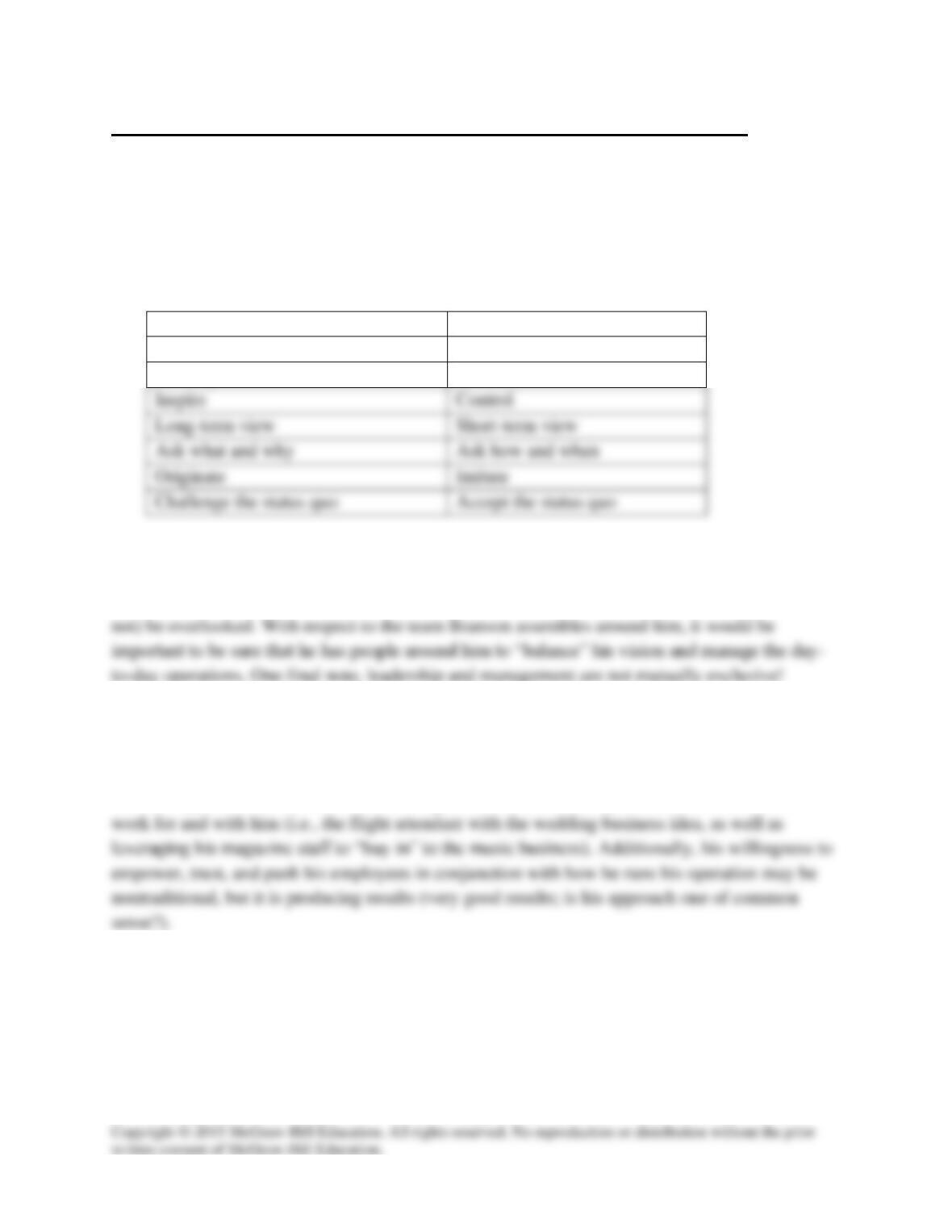
Perhaps it would be useful to think about the distinctions made by Bennis (1989) and others as a
place to frame this discussion. For example:
Leaders
Managers
Innovate
Administer
Develop
Maintain
Long-term view
Short-term view
Ask what and why
Ask how and when
Originate
Imitate
Challenge the status quo
Accept the status quo
Generally, it is quite evident that Branson exhibits qualities listed in the left-hand column of the
table above—he is innovative, inspiring, and original, and he challenges the status quo (“Got a
Big Idea?”). However, it is important to note that the management functions cannot (and should
Question 2: As mentioned earlier in this chapter, followers are part of the leadership
process. Describe the relationship between Branson and his followers.
Branson appears to have a knack for sharing his vision and creating excitement in those who
Question 3: Identify the myths of leadership development that Richard Branson’s success
helps disprove.
Foremost in this minicase, Branson’s history helps disprove the notion that leadership is all
common sense—prior to reading (or knowing) the results of his actions, it is unlikely many

Chapter 01-What Do We Mean by Leadership?
1-14

Chapter 01-What Do We Mean by Leadership?
1-15
Chapter 1 Exercises & Instructions
Exercise 1-1
Exercise Title: Truth or Lies
Purpose: To introduce classmates to each other.
Summary: Instructors should pass out two large Post-it notes to each student, and then ask students to
write something true and something false about themselves on each note. The students should then attach
the two notes to themselves. Students should then be asked to go around the room and determine the true
This exercise takes about 25 minutes to complete.