19
• sourcing decisions (Procter & Gamble, Nike, Victoria Secrets)
39. Select one of the OM challenges and investigate it in more detail. Prepare a 5–10-minute
presentation on what you found.
Students should choose one of the following and identify emerging issues that will more
depth and understanding.
• Customers.
• Workforce.
40. Geoff Colvin of Fortune magazine discussed the concept of a “”friction-free economy” in
which labor, information, and money move cheaply and quickly through the firm’s global
supply chains (ENDNOTE: Geoff Colvin, “Every Aspect of Your Business is About to
Change,” Fortune.com, November 1, 2015, pp. 103-112). (The term was actually coined
by Bill Gates in 1997 and is now becoming a reality). Research this concept, and write a
two-page paper that describes the impacts and challenges that a friction-free economy
would have on operations management.
20
Since information (bits) is basically an unlimited resource, supply can always exceed
demand, and challenge traditional economic theory such as Adam Smith. With more
distributed “knowledge” in the marketplace, markets for goods could clear faster and
inventory build-ups could be avoided, thus smoothing out the “boom-and-bust” cycles
that are typical of market economies. Also, consider publishing paper books and how that
might change including OM textbooks.
One story is as follows: Say you want to buy a new refrigerator. Instead of driving to
nearby stores and looking at the various models and prices or scouring newspaper ads for
sales, you’ll just whip up a special little software program (web crawler) and send it off to
scour the global Net for refrigerators that match your needs, dimensions, warranty, color,
and price range. When it finds sources that match your requirements, it’ll let you know
where they are. You might wind up buying a refrigerator directly from a manufacturer in
northwest China.
Teaching Note: Mickey Mouse: To Talk or Not?
This is a short case intended to focus attention on services, what do operations managers do,
how goods differ from services, and what creates value? The objective is to get students talking
21
Case Questions for Discussion:
1. Using the “What Do Operations Managers Do? box in the chapter, what key activities
most directly relate to the case situation?
Process design: select the right equipment, information, and work methods to produce
high-quality goods and services.
2. Provide one good and bad example “moment of truth” if Mickey Mouse talks to
customers?
• A good example is using the person’s name to personalize service.
• A good example is telling a kid he loves them.
• A good example is telling a kid he or she is cute.
3. What are some advantages and disadvantages of talking Disney characters from a service
perspective?
Advantages of Disney Characters Talking to Customers
• Build customer relationships and loyalty
22
Disadvantages of Disney Characters Talking to Customers
• Customers may not like what Disney character says, their tone of voice, local dialects,
faint or weak voice, etc.
Teaching Note: Zappos, A Subsidiary of Amazon
The objective of this case is to introduce students to a web-based firm where the motto is
“Deliver WOW through service” and the student can begin to understand issues such as:
(1) How goods and services are bundled together (i.e., the customer benefit package) to create
value.
You might also want to put up the Zappos web page (www.zappos.com) during the classroom
discussion and browse through it pointing out OM related issues and topics. Zappos is now
owned by Amazon but Zappos maintains its own brand, website, and operations and logistics
23
Sometime during the class point out that the CEO, Jeffrey Bezos, wants to “establish an
emotional connection” will all Zappos customers.
Case Questions for Discussion:
1. Draw and describe the customer benefit package that Zappos provides. Goods? Services?
Digital Content? Who manufactures the physical goods? Who is responsible for the
quality and delivery of the physical goods?
Students may draw something like below but expect them to not be clear on what is a good
versus a service so if you grade this assignment be open-minded. Go over the definitions of
goods and services in Chapter 1 as you discuss the case. Remember information of any type
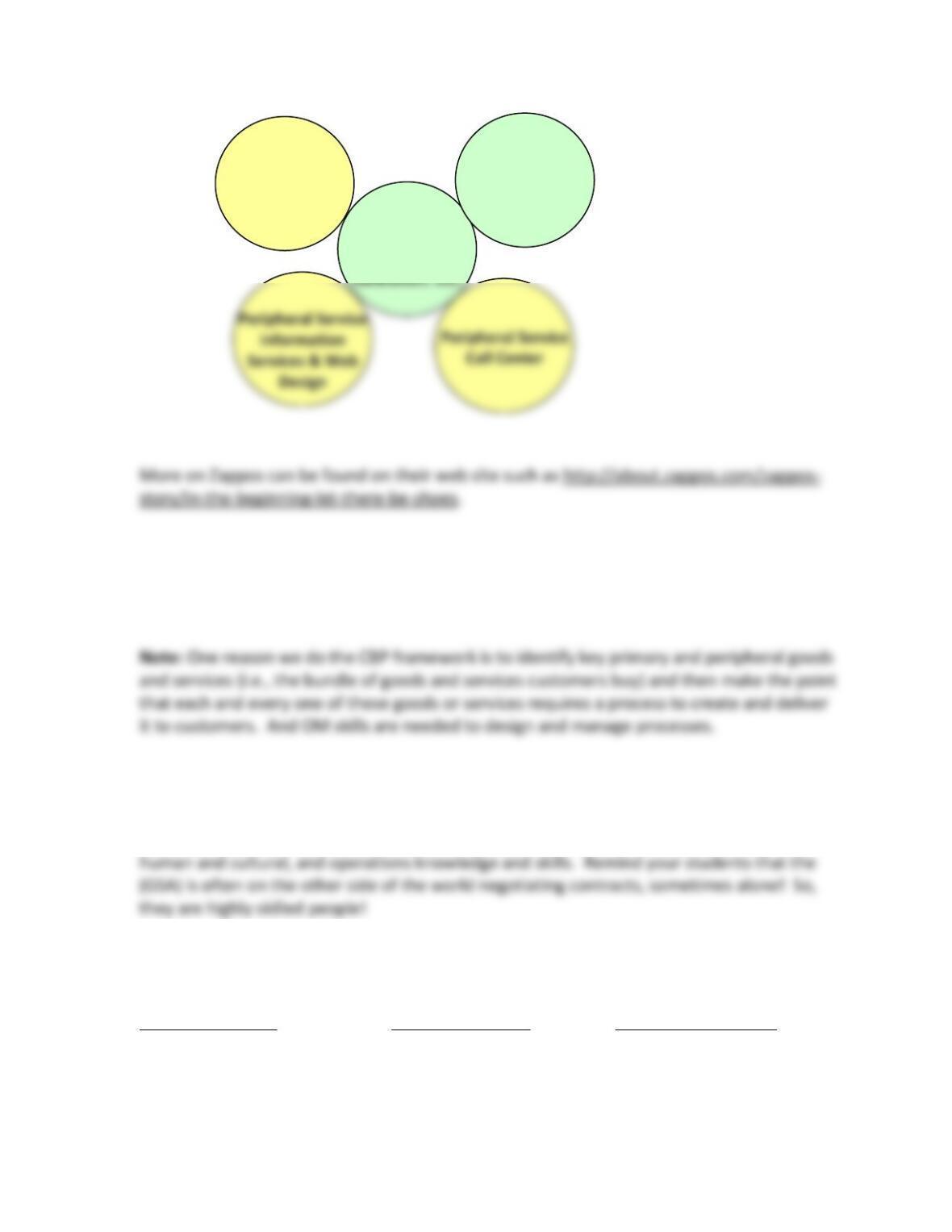
24
Some students may want to draw a “dual CBP with primary goods and primary services” like
the McDonald’s CBP drawn in Chapter 3 and Exhibit 3.5. This is fine and brings goods and
services more in balance. The key for OM is what processes and supply chains create and
deliver each good and/or service?
Who manufactures the physical goods? Contract manufacturers mostly in Asia!
Who is responsible for the quality and delivery of the physical goods? Zappo Global
Sourcing Agents (GSA) who have accounting, negotiation, quality management, logistic,
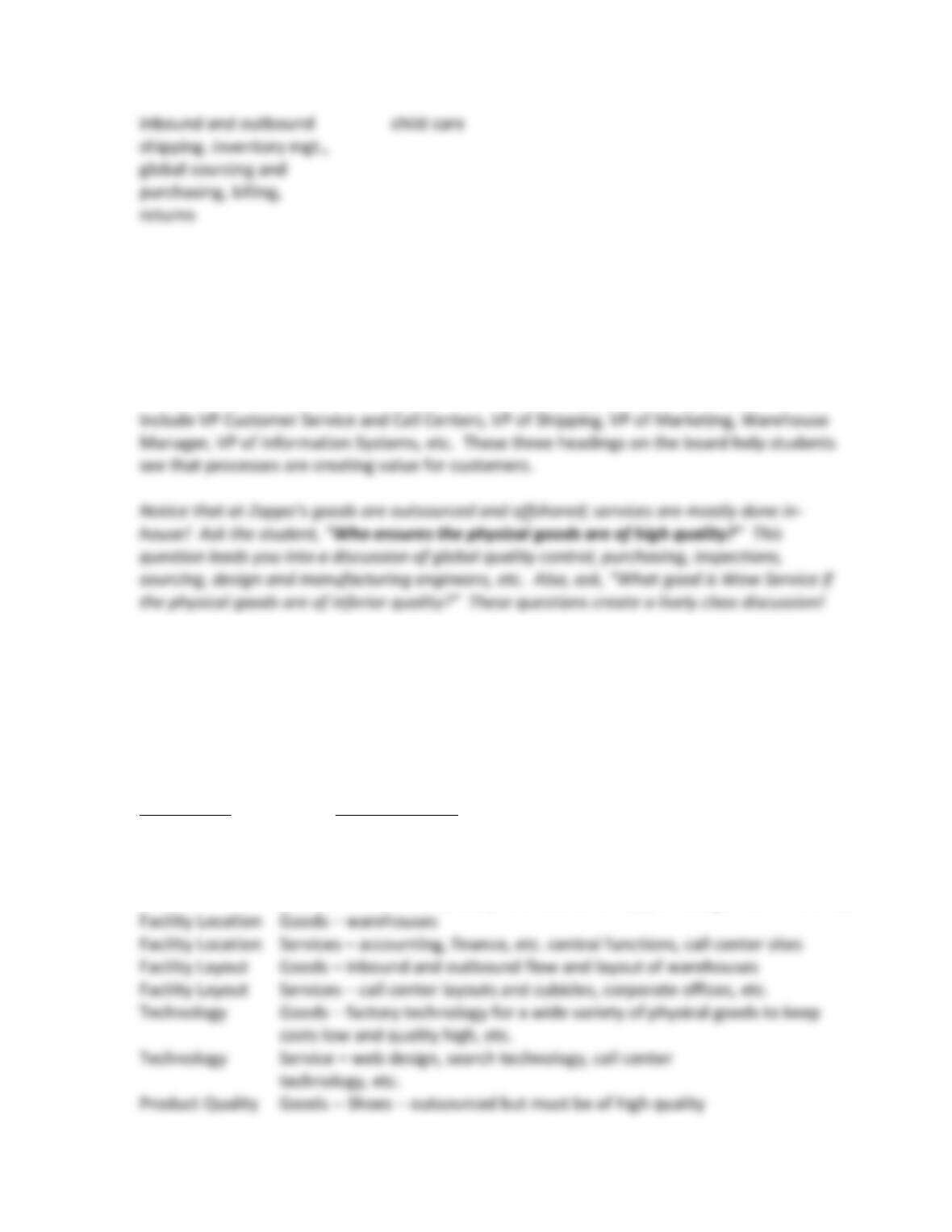
2. Identify and describe the primary, support, and general management processes needed to
execute a customer order at Zappos. (We recommend you always do this question.)
Primary processes Support Processes General Mgt. Process
Call center, order Training, hire, VPs of OPNS, IT, Mktg,
entry, fulfilment, picking, medical, salary, HRM, Finance,
Primary Goods
Shoes, handbags,
Peripheral Goods
Packaging
Peripheral Service
Free shipping in
both directions
25
Also, you will have to help them with issues such as what processes create the OM
capability to provide free shipping in both directions. For example, primary processes
might be order entry, warehousing and order picking, outbound shipping, purchasing, and
return shipping and receiving. Support processes might include salary payments, dental
insurance, job training, and day care services for employees provided by other functional
areas. General management processes might be the VP of Human Resource management
who oversees all HRM functions and processes. Other integrative management processes
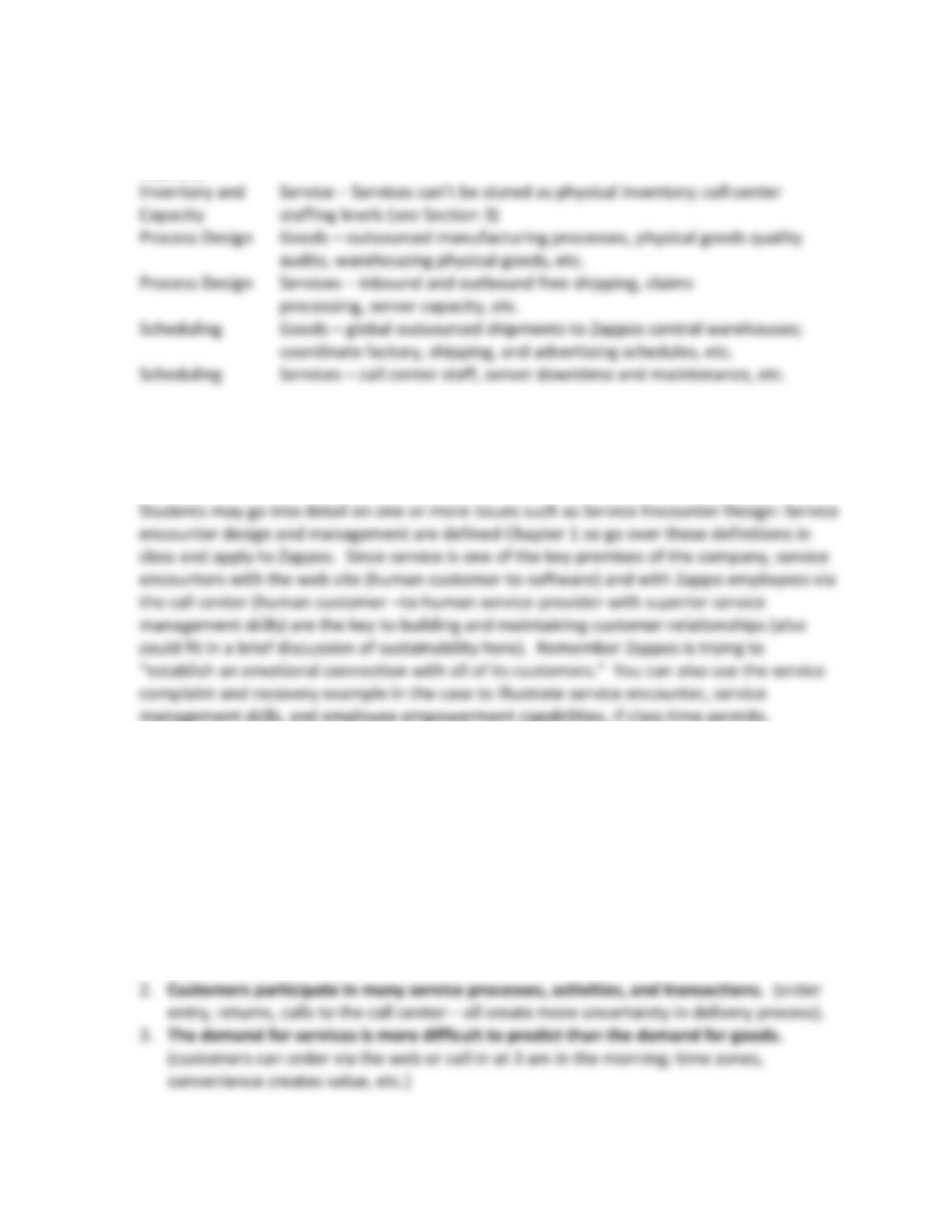
3. Describe how any three of the OM activities in the box “What do Operations Managers
Do?” impacts the management of both the goods that Zappos sells and the services that it
provides.
Students might build a table somewhat as below but at this early point in the course it will
not be too detail. Below are some ideas for the table.
OM Activity Good or Service
Forecasting Goods – demand for a multitude of physical goods, many of which are
fashion items
Forecasting Services – call center volume by hour of the day
(illustrates customer participation and difficulty predicting service demand)
26
Service Quality Service — Call center processes, service encounters, etc.
Inventory and Goods – Genghis system to manage warehouses, inventory, etc.
Capacity
You can also query the students on whether Zappo’s has initiatives on sustainability such as
reducing their carbon footprint, green supply chains, remanufacturing, global sourcing, and
so on. What is their sustainability responsibility if they outsource?
4. Explain how this case illustrates each of the seven major differences between good–s
producing and service providing businesses.
Differences Between Goods and Services
1. Goods are tangible while services are intangible. (Does Zappo’s manufacture shoes?
No. The CEO says “Deliver WOW through service.” And “They may only call once in
their life, but that is our chance to wow them.” Zappo’s has a dual CBP with goods and
services of roughly equal importance. That is, what does the customer buy? A bundle
of goods and services.)
27
4. Services cannot be stored as physical inventory (web and server capacity, call center
staff and equipment capacity; capacity is the substitute for physical inventory in a
service business).
5. Service management skills are paramount to a successful service encounter (face-to–
face call center staff (humans) and the customer (humans); go over the three
Teaching Strategy
One suggestion is to begin class by asking the class “Have any of you bought something on-line
from Zappos?” If so, let them tell their story pointing out key OM issues/capabilities. Then go
You might also note that the CEO’s vision includes
• One, day 30% of all retail transactions in the U.S. will be on-line.
• People will buy from the company with the best service and best election.
You can end by saying something like (i.e., lessons from the case):
(a) OM provides the core capabilities for this on-line retailer that provides both goods and
28
(c) Zappos is a virtual platform that manufacturers no physical goods.
Teaching Note: Hudson Jewelers
A complete teaching note for all chapters is available in the Instructor Resources online.
Instructors should read the entire case and most of the case assignments at the end of each
chapter. Then decide if you want to assign all or part of the case questions.
Students are challenged to define the customer benefit package augmented with this new CAD
technology, define the strategy and rank order of competitive priorities, draw a pre- and post-
service view of the value chain, consider the advantages and disadvantages of the “design your
own ring” service experience, understand the role of the servicescape and service encounter
design in creating the total customer experience, what are the core (key) processes at the retail
(store) level, and in the global diamond value chain.
The instructor can scatter the case assignments out throughout the semester or take the last
week or two of a semester to focus on the case. Or the case can be used as a course project
where the instructor assigns case questions that he/she wants to focus on.
29
Teaching Strategy
THE CHALLENGE IS TO APPLY OM CONCEPTS AND METHODS TO THE GLOBAL DIAMOND
INDUSTRY. For many students, this case is interesting but not easy.
You may decide to use parts or none of the 34 Hudson Jewelers case study questions. We use
different questions in different semesters and we use HJ case questions on topics we want to
emphasize during the semester. We have never used more than 6 to10 questions during a
semester and those were divided among case teams.
Example course syllabus explanation
*Odd numbered teams hand in and answer certain questions from the Hudson Jewelers case
posted on CANVAS. Even numbered teams hand in and answer different questions about this
Example class assignment
7 Tues/Jan 27 Team Prepare Hudson Jewelers Case Hand-in. Answer Questions #X,
#Y, and #Z. A maximum of six-page write-up by answering the case
questions in a Q and A format. Even numbered teams hand in this
assignment.
30
Chapter 1 Case Questions for Discussion:
1. Use one of the three value chain frameworks discussed in this chapter to characterize the
diamond value chain. How does this value chain gain a customer? How does it create
value? How does it keep a customer?
For example, the pre- and post-production value chain model is depicted in Exhibit 1.8. The
Pre-Production Services
• Global supplier and purchasing negotiation (price of diamonds and rings)
• Employee service management and technology (CAD) training (family business)
Global Value Chain Processes
• Forecasting demand at store and industry level
• Store job design and training (technology and service management skills)
• Retail jewelry store layouts and process flow integration
• Global purchasing (order raw materials, grade diamonds, negotiate)
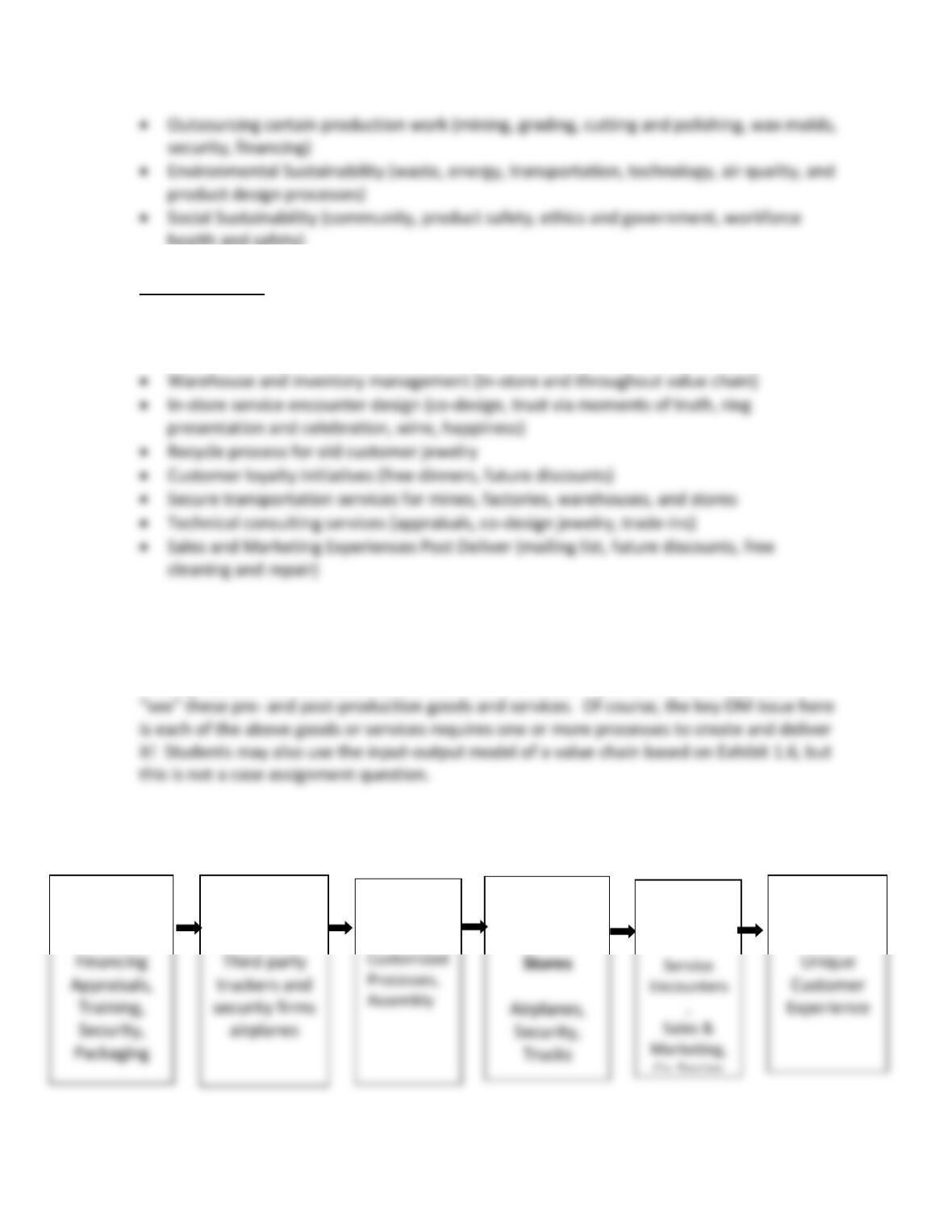
31
health and safety)
Post-Production
• Warranty and claims processing
• Jewelry appraisal services and documents
• In-store and on-line billing and payment
The diamond supply chain described in the make-to-order Hudson Jewelry case s study is a
“pull” type of supply chain.
Undergraduate students will only point out a few of these – you will have to help them
Suppliers
Mining,
Insurance,
Factories
Fabrication,
Standard,
Outbound
Shipping
To Retail
Input-output Value Chain View of Hudson Jewelers
Retail
Stores
Inbound
Shipping and
Transport
Customers
Great &
32
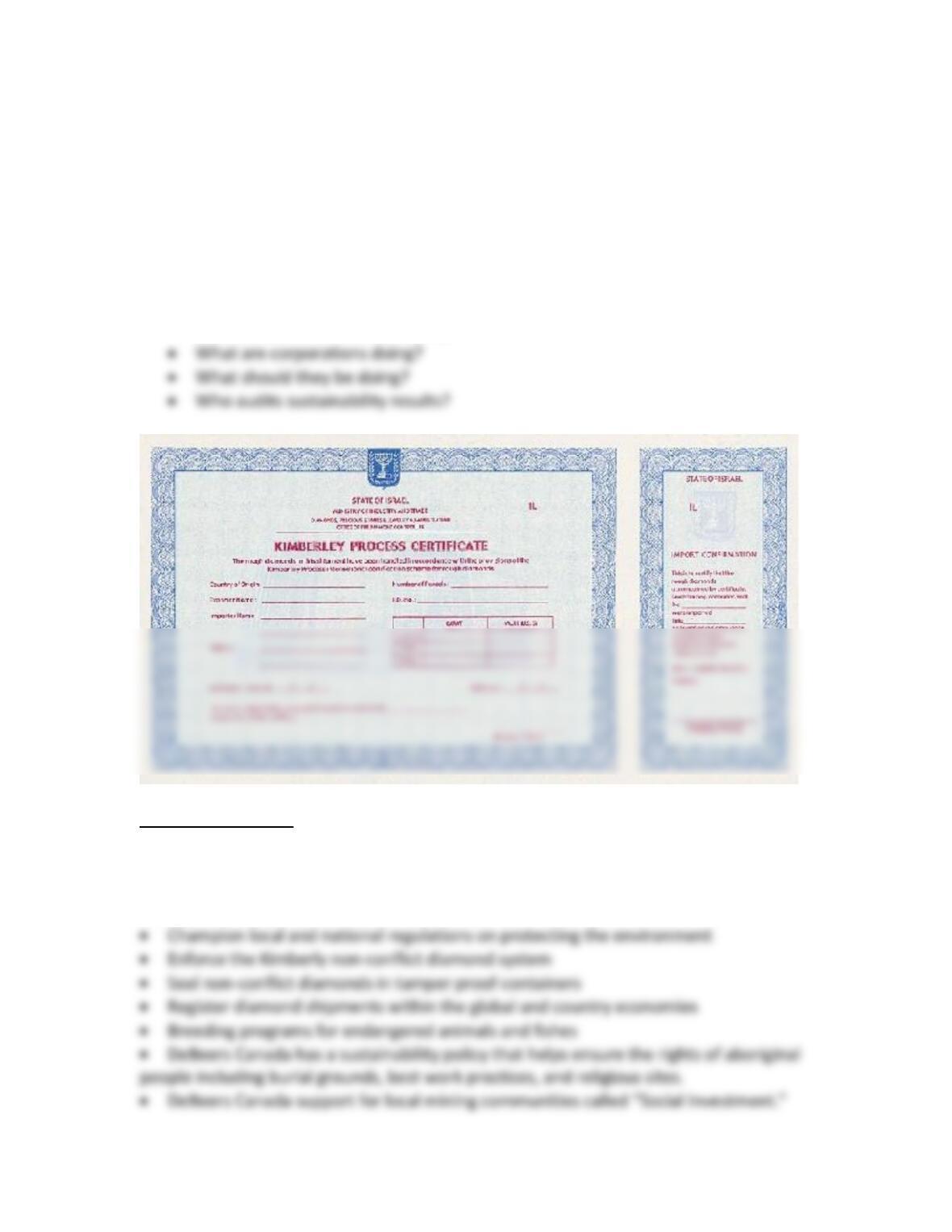
2. Research what major diamond producers are doing regarding social, environment, and
financial sustainability practices. Visit corporate annual reports, for example. Provide two
or three examples.
Corporate annual reports in the jewelry diamond industry are good places to research this
question. In 2019, for example, Rio Tinto stock price has been soaring. This is an open-
ended question so expect a wide variety of student or team responses. Ask your class:
• What should corporations in this industry be doing to promote environmental,
social, and financial sustainability?
Social Sustainability
• Petra Diamonds has a complete sustainability program including helping local
communities where they have operations (i.e., mine closure plans, water management,
energy use, provide employment to remote locations, mining rights, social compliance
matrix, and so on.
33
Environmental Sustainability
• Reduce mining footprint (square area) on surface
• Minimize waste alluvial and storage
Financial (Economic) Sustainability
• Long-term land – use planning around mines
• Champion protected areas
3. Write a short two-page paper on “blood diamonds” and/or “ethical diamonds.” Define
each and explain the positives and negatives for this social sustainability issue. What
should be the role of diamond producers? What is the role of operations managers in this
industry?
See the answer to Question #2 above.
Blood diamonds finance armed conflicts and civil wars. Worst cases include the conflicts in
34
pollution, worker exploitation, regulated work environments and labor laws, meet legal and
regulatory requirements, poor working conditions, and so on, including financing
revolution, civil wars, and armed conflicts.
Brilliant Earth built their reputation on trying to guarantee ethical gems. (See answer to
Case Question # 6 on reverse logistics and Brilliant Earth).
Other issues students will discuss may include:
• Child labor
OM managers have a responsibility to champion ethical jewelry and diamonds throughout
the supply chain. Ask your class, Do OM managers have responsibility for environmental
sustainability? Social sustainability? The answer is yes in everyday operating decisions and
for top management in terms of defining corporate and operational strategy and policy on
sustainability.
Students can apply the concepts in Exhibit 1.13 to a jewelry store and its supply chain. They
35
Environment Sustainability (waste management, energy optimization, transportation
optimization, technology upgrades, air quality, sustainable product design)
• Black Diamonds Vendor Code defines standards for working conditions, safety, and
production process that must be environmentally responsible.
• Some companies along the diamond supply chain use the Higgs Index to measure the
environmental impact of their brands, facilities, and products.
• Diamonds are a sustainable product design in the sense they are reusable.
• The carbon footprint for global stone and jewelry transport is unknowable but value
chain corporations could do more to reduce it.
Social Sustainability (product safety, workforce health and safety, ethics and governance,
community)
• Petra Diamonds supports funding for the prevention, treatment, and education of
villages surrounding their mines for diseases such as HIV, tuberculosis, and malaria.
36
Economic Sustainability (performance excellence, financial management, resource
management, emergency preparedness)
• Performance excellence, financial management, resource management, and emergency
preparedness are the four sub perspectives.