1-1
1 LINEAR EQUATIONS AND GRAPHS
EXERCISE 1-1
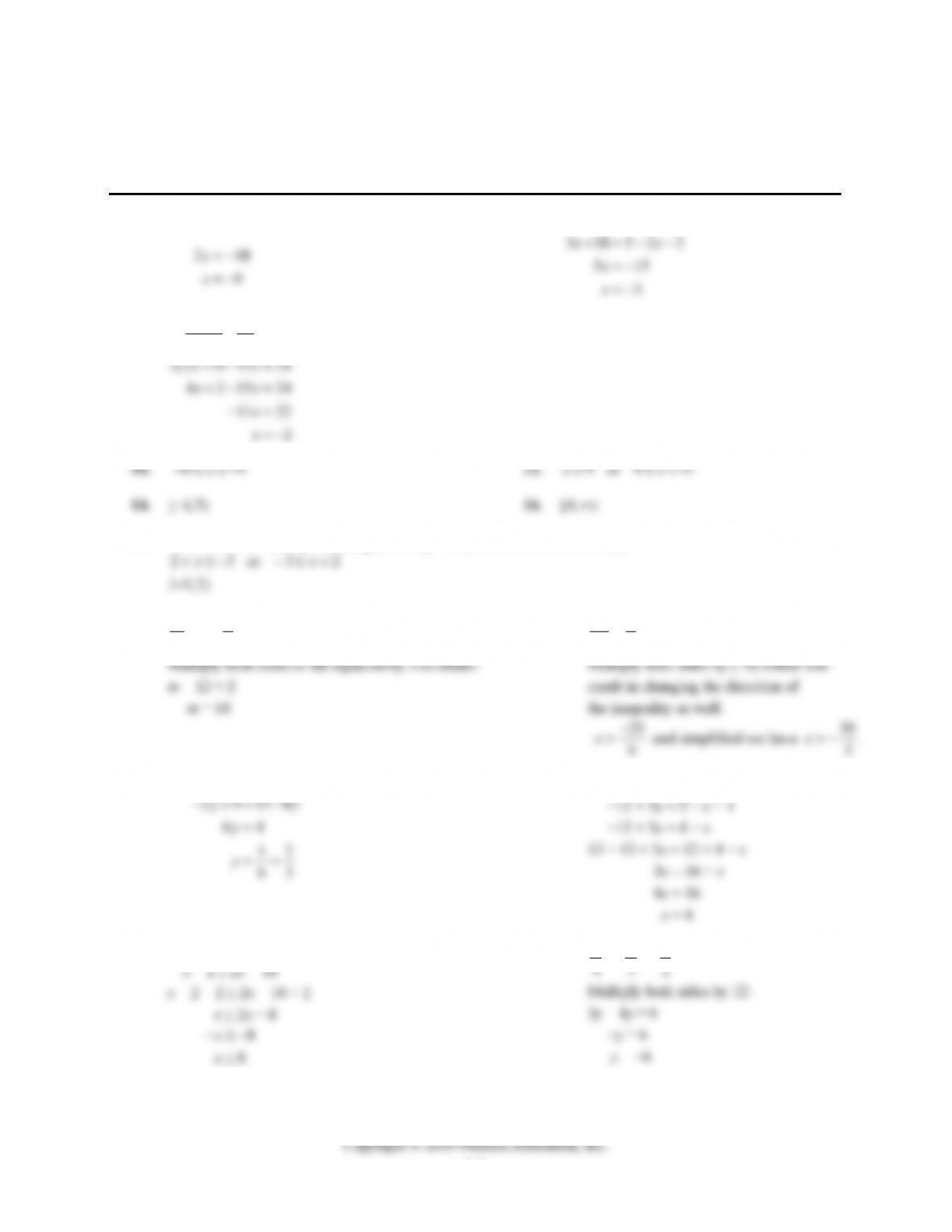
2. 76524xx 4. 3( 6) 5 2( 1)xx
9
x
x
31852 2
3
xx
x
6. 215 4
32
xx (multiply both sides by 6) 8. 35x
18. 8412x (divide the inequalities by – 4 and reverse the directions)
20. 2
4
33
m
22. 5
46
x
6
3
24. 39 138
yy y
26. −3(4 − x) = 5 − (x + 1)
28. x − 2 ≥ 2(x − 5)
30. 4
y − 3
y = 1
1-2 CHAPTER 1: LINEAR EQUATIONS AND GRAPHS
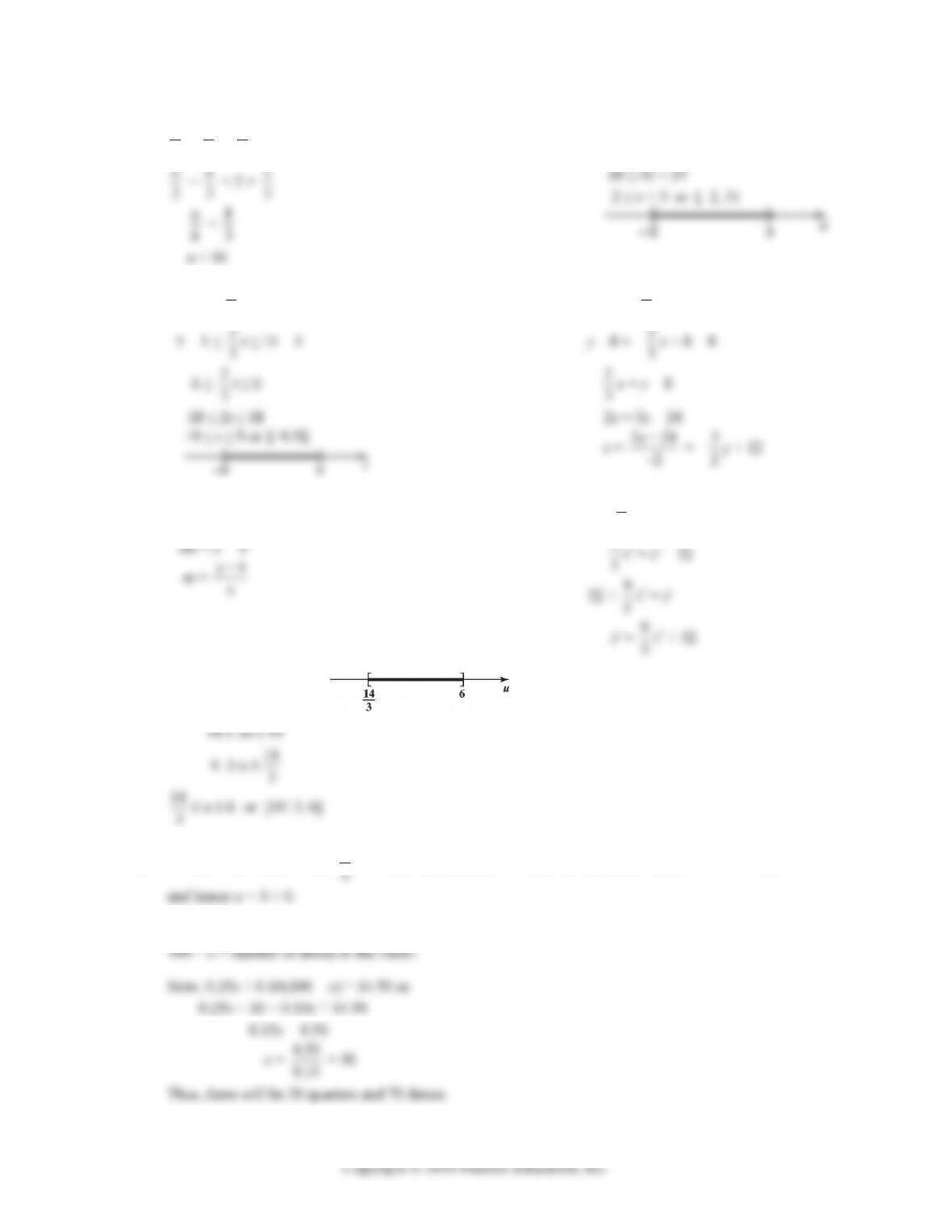
32. 2
u − 2
3 < 3
u + 2
34. −4 ≤ 5x + 6 < 21
−6 − 4 ≤ 5x < 21 − 6
36. −1 ≤ 2
3t + 5 ≤ 11
38. y = − 2
3x + 8
40. y = mx + b
y − b = mx + b − b
42. C = 5( 32)
9F
44. 10 8 3 6
18 3 14
u
u
46. If a and b are negative and b
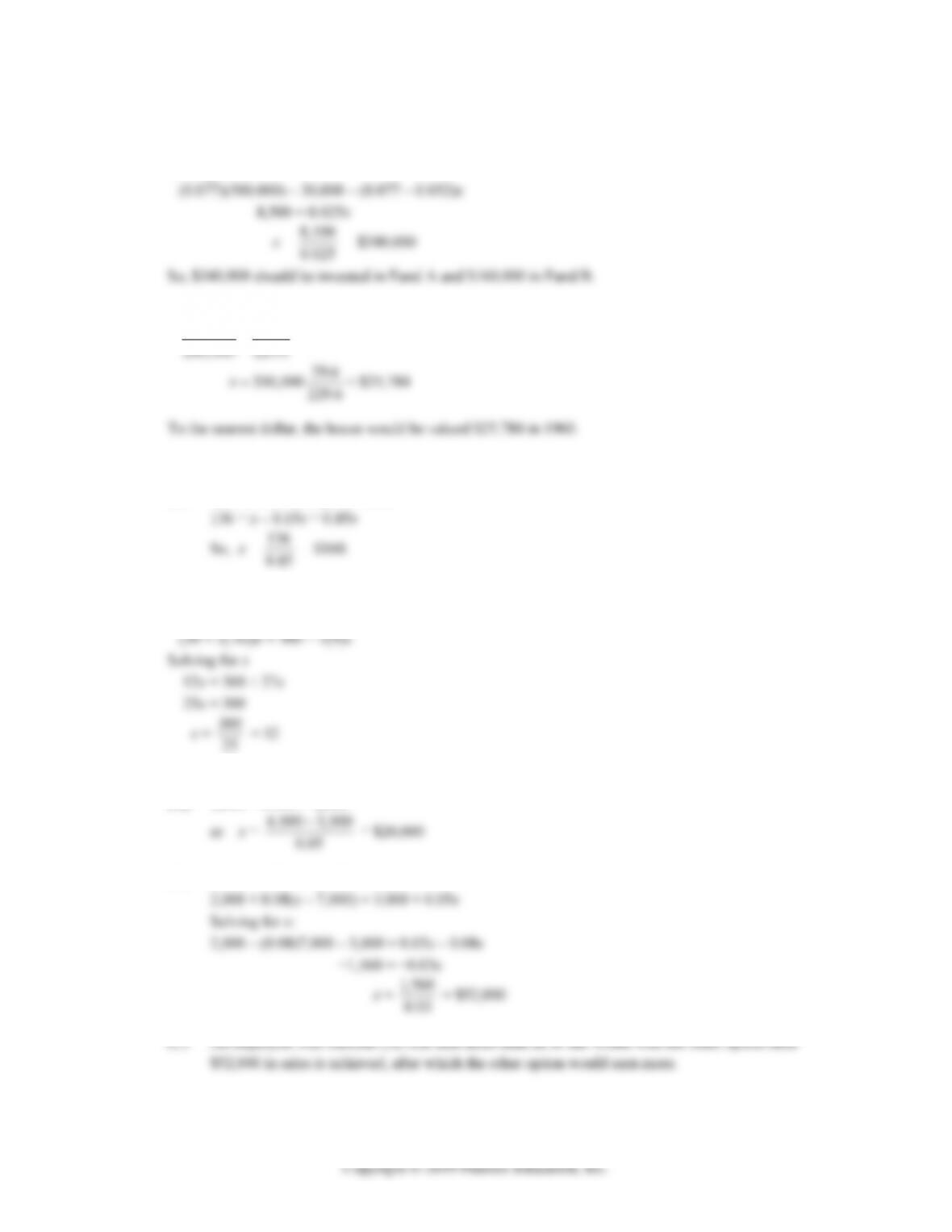
48. Let x = number of quarters in the meter. Then
EXERCISE 1-1 1-3
50. Let x be the amount invested in “Fund A” and (500,000 – x) the amount invested in “Fund B”. Then 0.052x
+ 0.077(500,000 – x) = 30,000.
Solving for x:
52. Let x be the price of the house in 1960. Then
29.6
x (refer to Table 2, Example 10)
54. (A) It is 60 – 0.15(60) = $51
(B) Let x be the retail price. Then
56. Let x be the number of times you must clean the living room carpet to make buying cheaper than renting.
Then
58. Let x be the amount of the second employee’s sales during the month. Then
(A) 3,000 + 0.05x = 4,000
or x = 4,000 3, 000
0.05
= $20,000
(B) In view of Problem 57 we have:
(C) An employee who chooses (A) will earn more than he or she would with the other option until
1-4 CHAPTER 1: LINEAR EQUATIONS AND GRAPHS
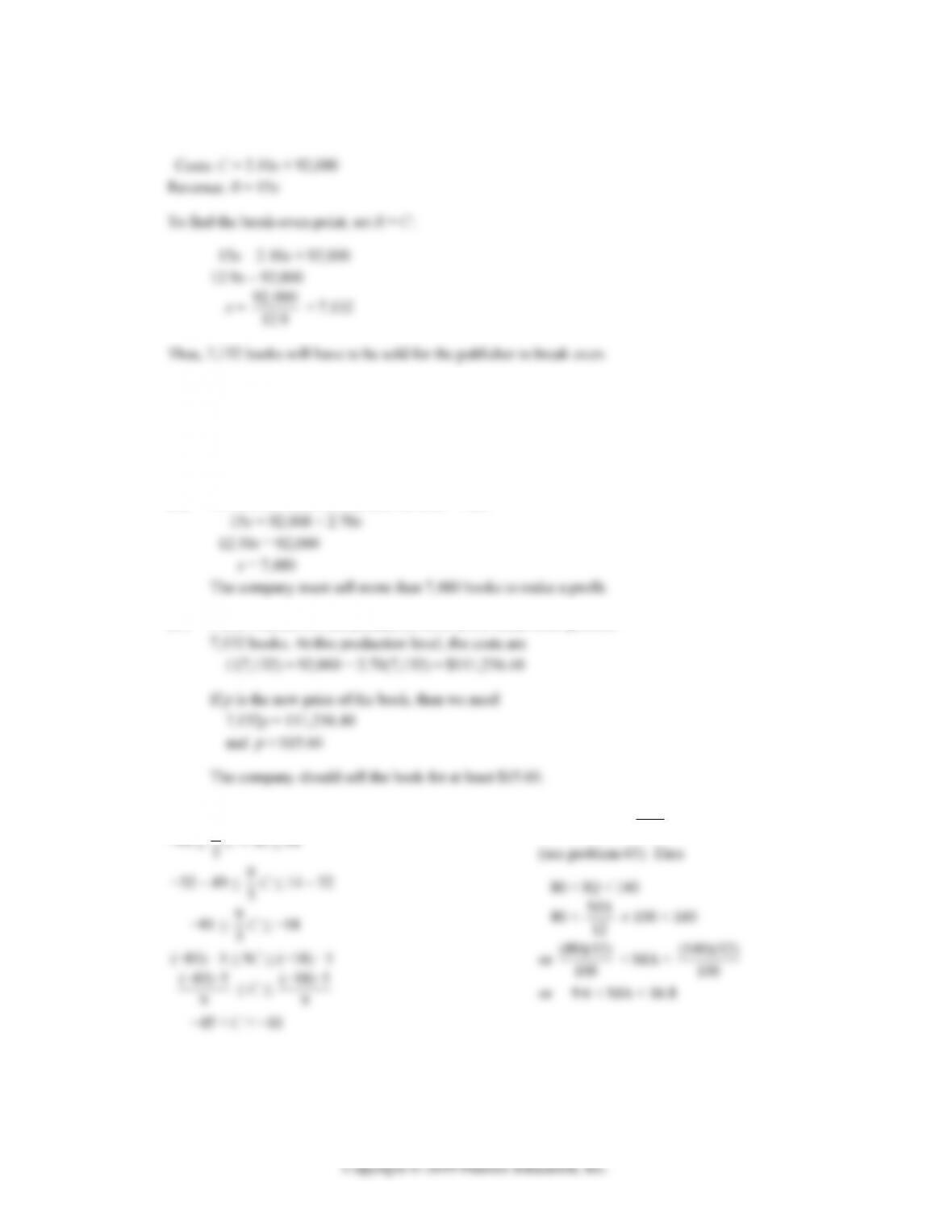
60. Let x = number of books produced. Then
62. Let x = number of books produced.
Costs: C(x) = 92,000 + 2.70x
Revenue: R(x) = 15x
(A) The obvious strategy is to raise the price of the book.
(B) To find the break-even point, set R(x) = C(x):
(C) From Problem 60, the production level at the break-even point is:
64. −49 ≤ F ≤ 14
66. Note that IQ = MA
CA 100
EXERCISE 1-2 1-7
Copyright © 2019 Pearson Education, Inc.
48. The equation of the vertical line is x = −5 and the equation of the horizontal line is y = 6.
50. The equation of the vertical line is x = 2.6 and the equation of the horizontal line is y = 3.8.
52. Slope: 4m; point: (0,6). Using the point-slope form:
64( 0)
yx
54. Slope: 10m ; point: (2, 5). Using the point-slope form:
(5) 10( 2)
10 15
yx
yx
56. Slope: 2/7m; point: (7,1). Using the point-slope form:
2
1(7)
yx
58. Slope: 0.9m; point: (2.3, 6.7). Using the point-slope form:
6.7 0.9( 2.3)
0.9 4.63
yx
yx
60. (A) m = 52 3
31 2
22
62. (A) m = 73
32
= − 4
5
55
EXERCISE 1-2 1-9
(B) For R = $240 we have
or C = 240 3
1.5
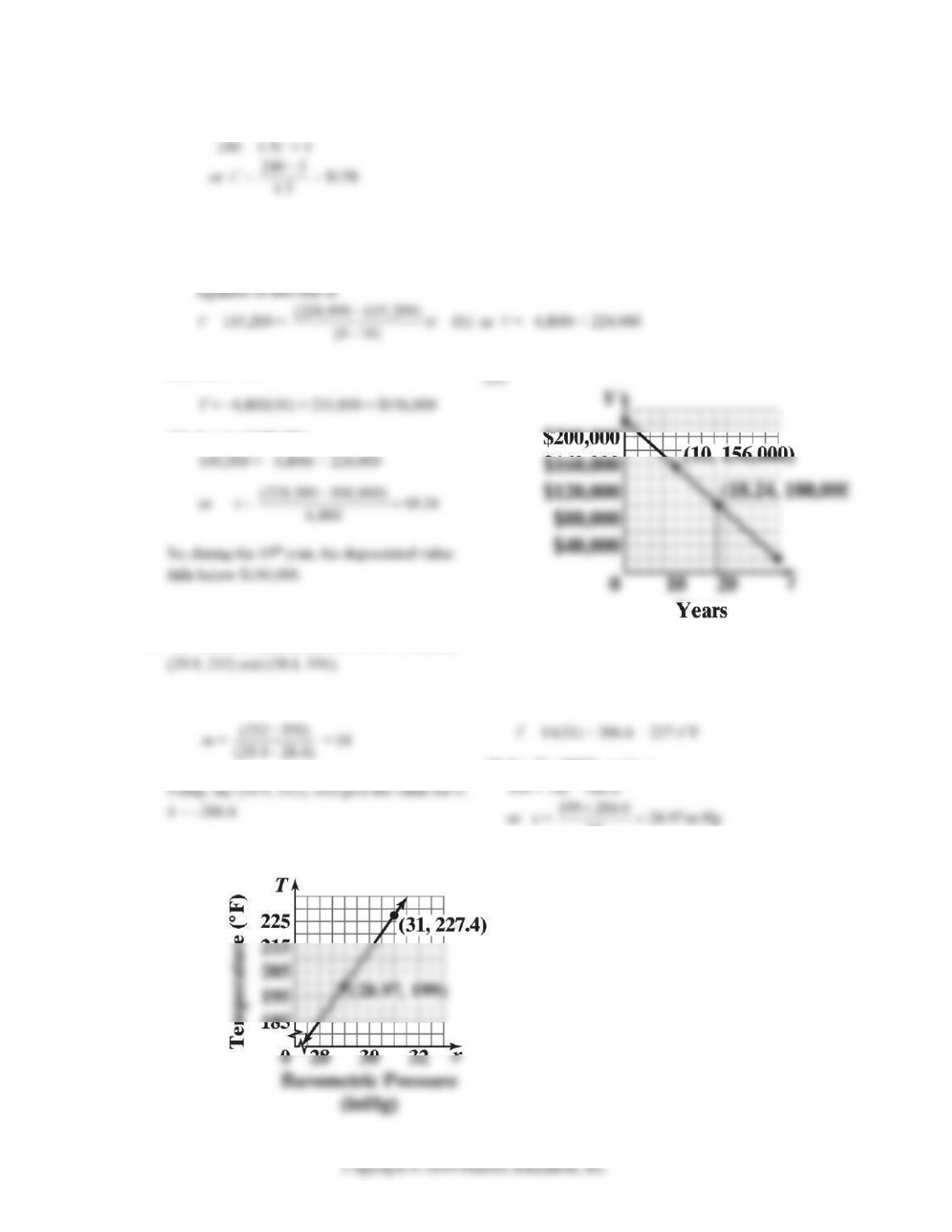
76. We observe that for (t, V) two points are given: (0, 224,000) and (16, 115,200)
(A) A linear model will be a line passing through the two points (0, 224,0000) and (16, 115,200). The
(B) For t = 10
(C) For V = $100,000
100,000 = −6,800t + 224,000
or t = (224,000 100,000)
6,800 18.24
So, during the 19th year, the depreciated value
falls below $100,000.
(D)
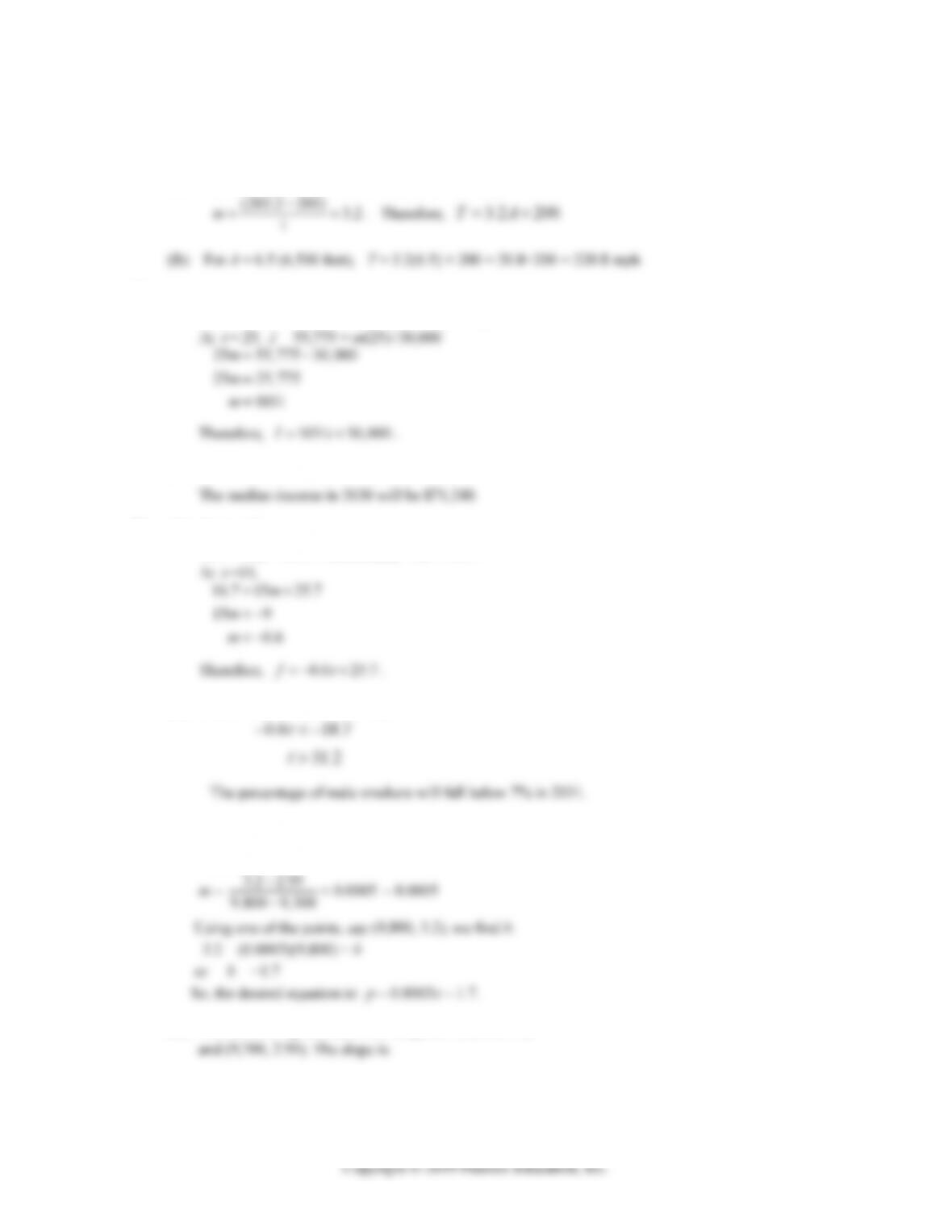
78. We have two representations for (x, T) namely:
(A) The line of the form T = mx + b has slope:
m = (212 191)
(29.9 28.4)
= 14
(B) For x = 31, we have
(C) For T = 199˚F, we have
14 8.97
(D)
1-10 CHAPTER 1: LINEAR EQUATIONS AND GRAPHS
80. Let T be the true airspeed at the altitude A (thousands of feet). Since T increases 1.6% ,
(1000) 200(1.016) 203.2.T
(A) A linear relationship between A and T has slope
82. (A) I = mt + b
At t = 0, I = 30,000. Therefore, I = mt + 30,000.
(B) At t = 40, 1031(40) 30,000 71, 240I
84. (A) f = mt + b
At t = 0, f = 25.7. Therefore, f = mt + 25.7.
(B) Solve 0.6 25.7 7t for t
t
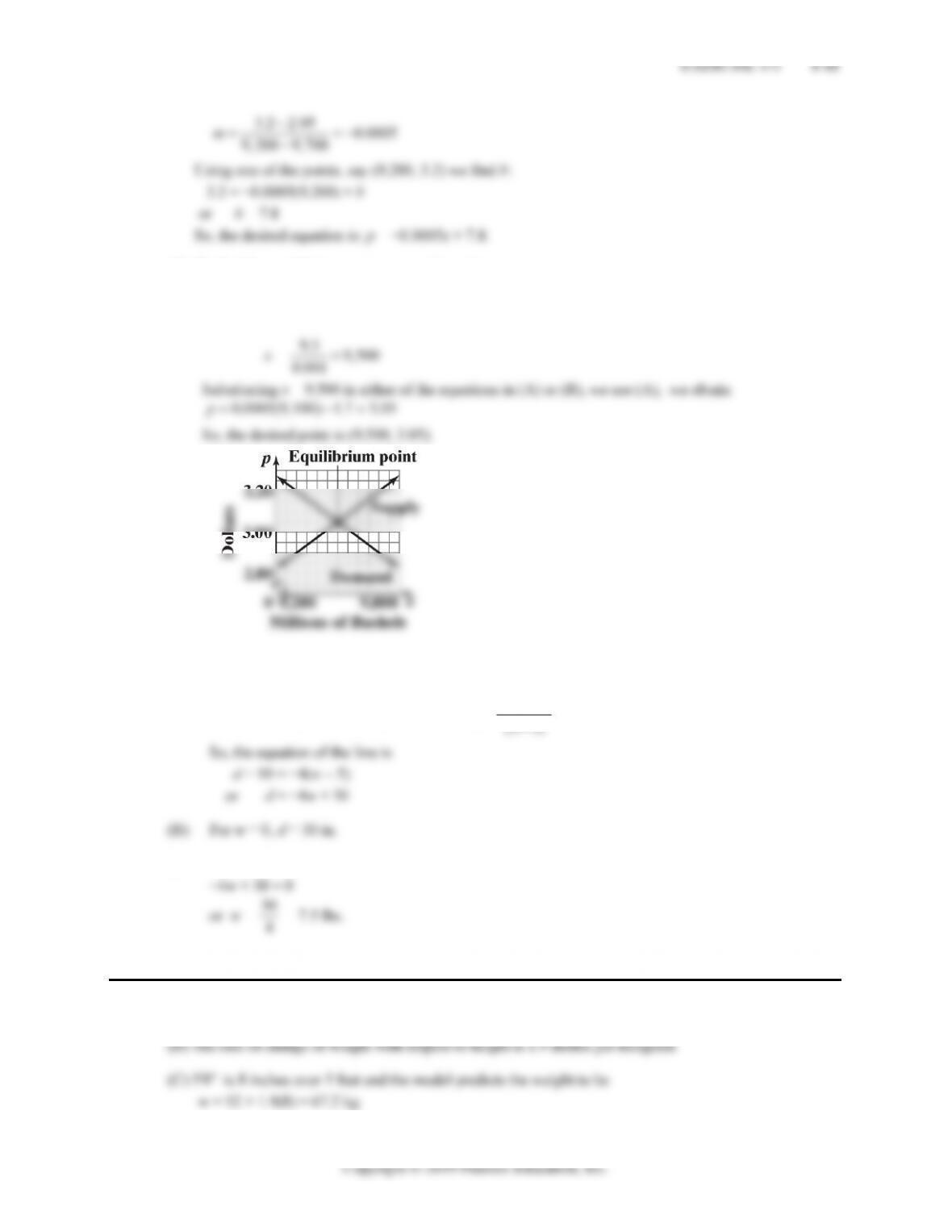
86. (A) For (x, p) we have two representations: (9,800, 3.2) and (9,300, 2.95).
The slope is
(B) Here the two representations of (x, p) are: (9,200, 3.2)
Copyright © 2019 Pearson Education, Inc.
(C) To find the equilibrium point, we need to solve
0.0005x – 1.7 = −0.0005x + 7.8 for x. This gives
0.001x = 9.5 or
(D)
88. We have two representations of (w, d): (3, 18) and (5, 10).
(A) The line through these two points has a slope (18 10)
(C) For d = 0,
EXERCISE 1-3
2. (A) w = 52 + 1.9h