Chapter 01 – The Information Age in Which You Live: Changing the Face of Business
1-1
CHAPTER 1
THE INFORMATION AGE IN WHICH YOU LIVE:
CHANGING THE FACE OF BUSINESS
JUMP TO THE SUPPORT YOU WANT
STUDENT LEARNING OUTCOMES
2. Describe how to use break-even analysis to assess the financial impact of information
technology.
4. Compare and contrast Porter’s three generic strategies and the run-grow-transform
CHAPTER SUMMARY
This chapter serves two primary purposes. First the chapter introduces your students to the
broad notion of management information systems within an organization and the three key
resources on which MIS focuses – people, information, and information technology.
Second, the chapter jumps right into the process of appropriately selecting which technologies
to use based on the industry in which your organization operates, the identified business
strategies for competing in that industry, and how to assess the impact of technology.
The primary sections of this chapter include:
1. MIS Resource #1: Information
3. MIS Resource #3: Information Technology
5. Industry Impact of IT: Porter’s Five Forces Model
Chapter 01 – The Information Age in Which You Live: Changing the Face of Business
1-2
LECTURE OUTLINE
INTRODUCTION (p. 4)
MIS RESOURCE #1: INFORMATION (p. 5)
1. Defining Information Quality
MIS RESOURCE #2: PEOPLE (p. 10)
1. Technology Literacy
3. Your Ethical Responsibilities
MIS RESOURCE #3: INFORMATION TECHNOLOGY (p. 13)
FINANCIAL IMPACT OF IT: BREAK-EVEN ANALYSIS (p. 15)
1. Reducing Fixed Costs
3. Increasing Revenue
INDUSTRY IMPACT OF IT: PORTER’S FIVE FORCES MODEL (p. 19)
2. Supplier Power
4. Threat of New Entrants
STRATEGY IMPACT OF IT: PORTER (AGAIN) AND RGT (p. 23)
1. Overall Cost Leadership
3. Focus
END OF CHAPTER (p. 26)
1. Summary: Student Learning Outcomes Revisited
3. Closing Case Study Two
5. Short-Answer Questions
7. Discussion Questions
Back to Jump List
Chapter 01 – The Information Age in Which You Live: Changing the Face of Business
1-3
MODULES, PROJECTS, AND DATA FILES
Supporting Modules
XLM/A Computer Hardware and Software – comprehensive tour of technology terminology
focusing on personal technologies including application software, system software, input
devices, output devices, storage devices, CPU and RAM, and connecting devices such as cables
and ports.
XLM/K Careers in Business – Extended Learning Module K provides an overview of jobs titles
and descriptions in the fields of accounting, finance, hospitality and tourism management,
information technology, management, marketing, productions and operations management,
and real estate and construction management including what IT skills you should acquire to be
successful in each field.
Group Projects
• Assessing the Value of Customer Relationship Management: Trevor Toy Auto Mechanics
Electronic Commerce Projects
• Searching job databases
Data Files
There are no data files associated with this chapter. There may be data files for the Group
Projects you choose.
Back to Jump List
Chapter 01 – The Information Age in Which You Live: Changing the Face of Business
1-4
• These are the Student Learning Outcomes for the chapter.
• Use them as a road map to inform your students of what you will be
covering.
• With this edition, we’ve changed the focus of the opening case
studies.
• This slide provides the narrative for the previous slide.
• Hotels are also suffering from less in-room pay-per-view movie
• These are great questions for starting class.
• Some of your students may have never used a pay phone.
• This slide reinforces the fact that we live and work in a digital world,
where technology and information are important, pervasive, and
often invasive.
Chapter 01 – The Information Age in Which You Live: Changing the Face of Business
1-5
• This slide starts the section on management information systems
(Student Learning Outcome #1).
• It defines MIS.
• This slide lists the 3 important organizational resources within MIS.
• Obviously, people are the most important resource.
• This slide presents Figure 1.1 on page 5.
• It illustrates the synergistic effect MIS can have if people, technology,
and information are coordinated and managed together.
• This slide provides an overview of the chapter, including the major
sections and which addresses each learning outcome.
• This slide begins the discussion of information as a key resource.
• It defines data and information.
• Later, we morph information into business intelligence.
Chapter 01 – The Information Age in Which You Live: Changing the Face of Business
1-6
• This slide presents Figure 1.2 on page 6.
• It illustrates the difference between data and information.
• This slide continues the discussion of information by focusing on
business intelligence and its definition.
• This slide presents figure 1.3 on page 7.
• It illustrates business intelligence.
• BI is information on steroids.
• This slide focuses on the fact that information is valuable only if it
exhibits quality.
• Quality is often nebulous and difficult to define but we can describe it
• This slide presents Figure 1.4 on page 9.
• It provides a graphical illustration of the various organizational
Chapter 01 – The Information Age in Which You Live: Changing the Face of Business
1-7
• This slide discusses the flow perspective of information.
• Within an organization information can flow up, down, horizontally,
and outward/inward.
• This slide discusses the perspective of information with respect to
what it describes.
• This slide begins the discussion of people as a key resource within MIS.
• People are the single most important resource in any organization.
• Today, people must focus on being:
o Technology literate
o Information literate
• This slide presents Figure 1.5 on page 13
• It illustrates the relationship between acting legally and ethically
• The goal, obviously, is to remain in Quadrant I with all your actions
Chapter 01 – The Information Age in Which You Live: Changing the Face of Business
1-8
• This slide begins the discussion of information technology as a key
resource within MIS.
• It defines information technology and its two primary components –
hardware and software.
• This slide presents Figure 1.6 on page 14.
• It provides a graphical depiction of the categories of IT and, within IT,
• This slide (and the next) defines and describes the 6 major categories
of hardware.
• This slide (and the previous) defines and describes the 6 major
categories of hardware.
• This slide defines the two major types of software – application and
system.
• Again, work through XLM/A with your students for a thorough review
of software.
Chapter 01 – The Information Age in Which You Live: Changing the Face of Business
1-9
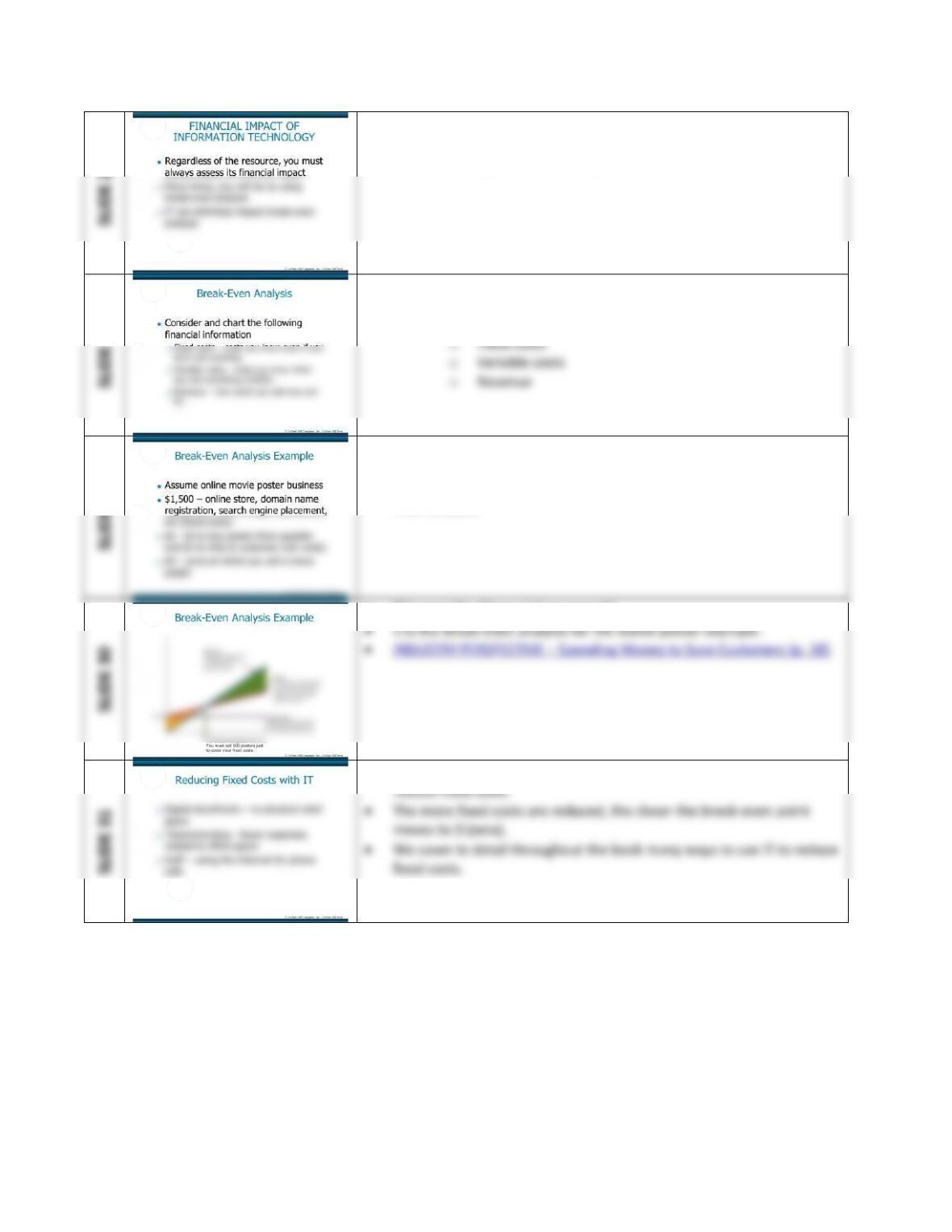
• This slide begins the discussion of how to assess the financial impact
of IT (Student Learning Outcome #3).
• It does so using break-even analysis.
• This slide provides a description of the three financial aspects of
break-even analysis.
• They are:
• This slide sets up the break-even analysis example provided in the
book.
• You may want to consider creating a workbook to illustrate break-
even analysis.
• This provides Figure 1.7 on page 15.
reduce fixed costs.
• The more fixed costs are reduced, the closer the break-even point
• This slide lists just a few of the many ways in which IT can be used to
Chapter 01 – The Information Age in Which You Live: Changing the Face of Business
1-10
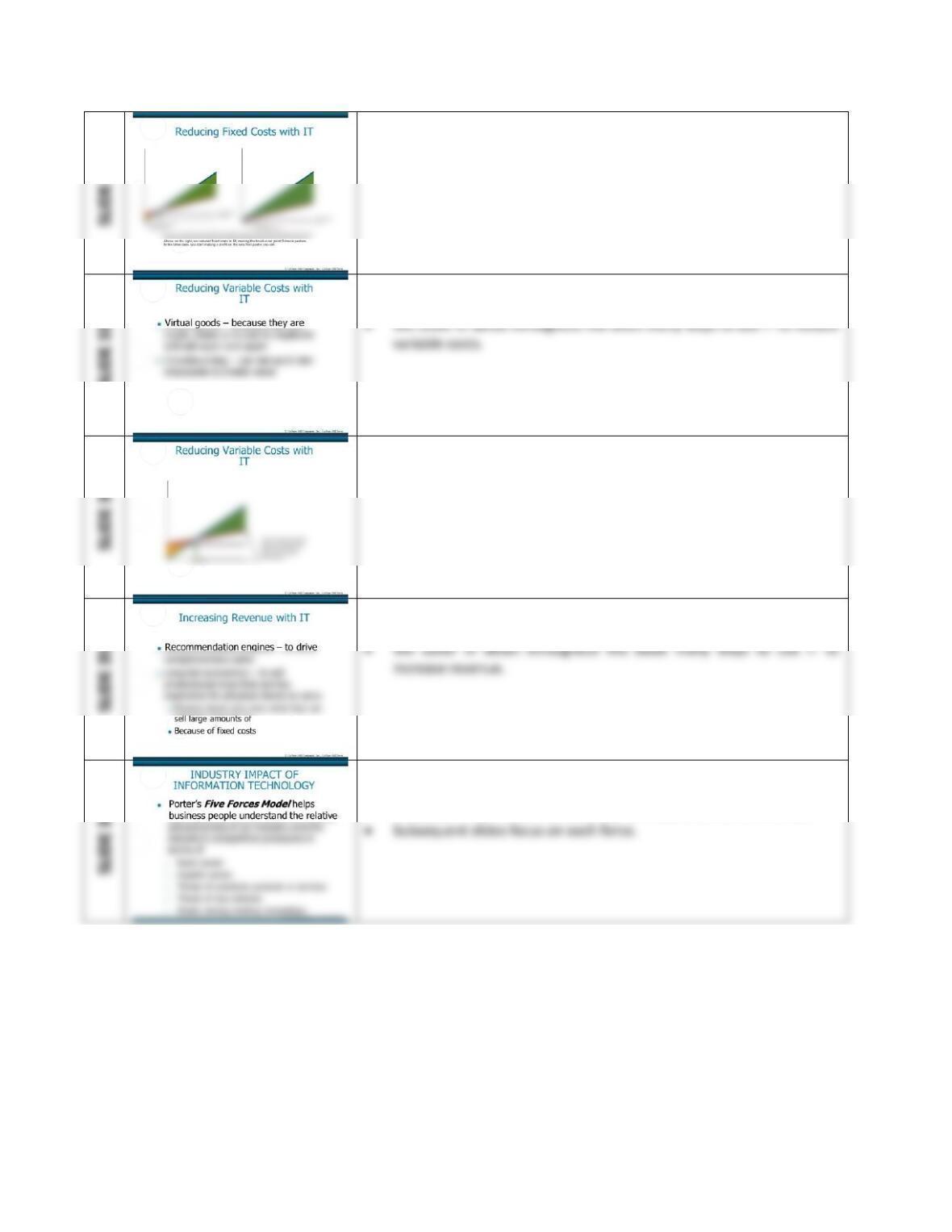
• This slide presents Figure 1.8 on page 16.
• It illustrates the effect on break-even of lowering fixed costs.
SLIDE 33
• We cover in detail throughout the book many ways to use IT to reduce
• This slide lists just a few of the many ways in which IT can be used to
reduce variable costs.
SLIDE 34
• This slide presents Figure 1.9 on page 17.
• It illustrates the effect on break-even of lowering variable costs.
SLIDE 35
• This slide lists just a few of the many ways in which IT can be used to
increase revenue.
• This slide begins the section on Porter’s Five Forces Model (Student
Learning Outcome #3).
• It defines Porter’s Five Forces Model and identifies the five forces.
SLIDE 32
Chapter 01 – The Information Age in Which You Live: Changing the Face of Business
1-11
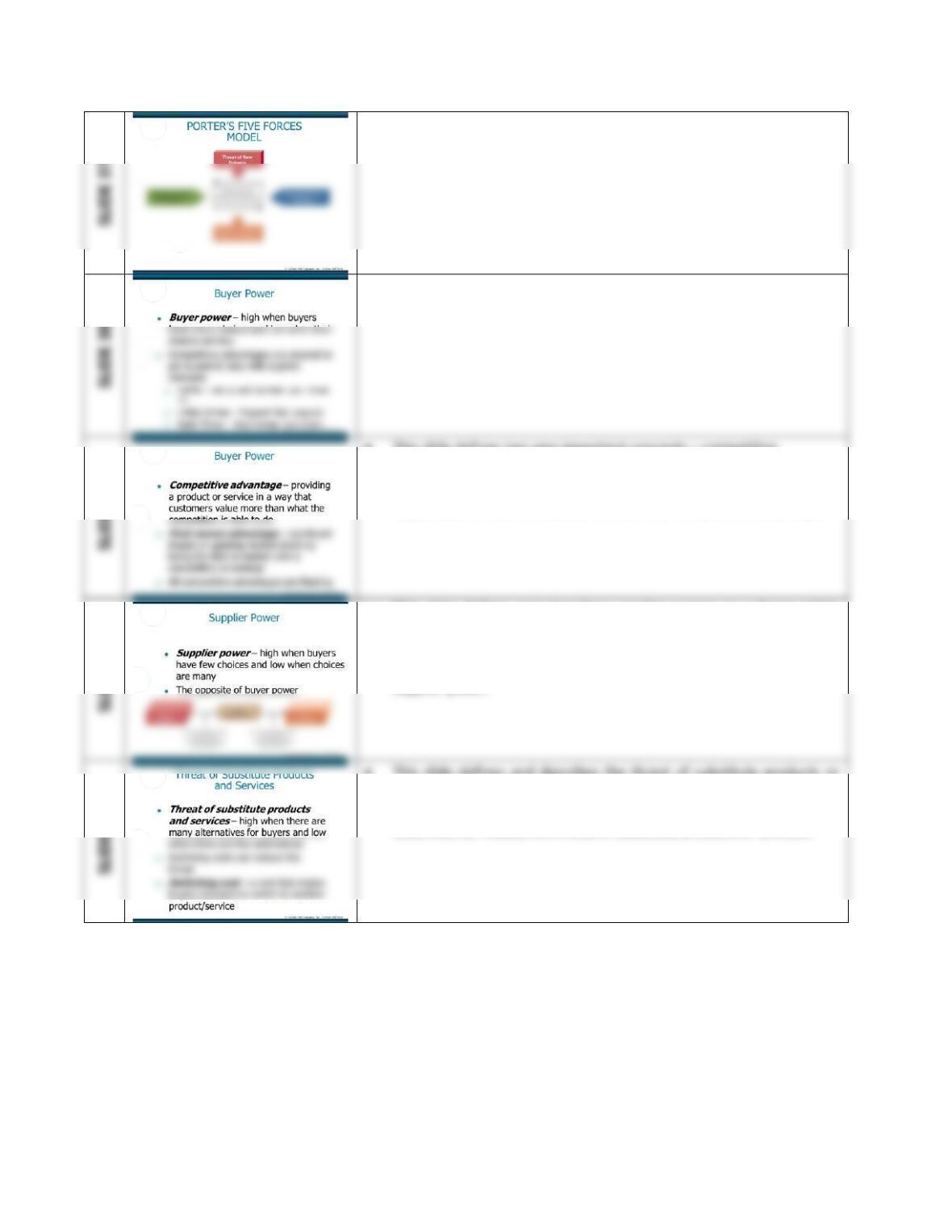
• This slide presents Figure 1.10 on page 19.
• It graphically depicts the five forces model.
• This slide defines and describes buyer power as one of the five forces
within Porter’s Five Forces Model.
• This slide defines two very important concepts – competitive
advantage and first-mover advantage.
• The point here is that no competitive advantage is ever permanent.
• Organizations must constantly seek out new competitive advantages.
• This slide defines and describes supplier power as a force within
Porter’s Five Forces Model.
• It also includes Figure 1.11 on page 21 which illustrates how
organizations have to deal in opposite ways with both buyer and
supplier power.
• This slide defines and describes the threat of substitute products or
services as a force within Porter’s Five Forces Model.
• It also defines switching costs and provides examples of switching
costs that can reduce the threat of substitute products or services.
Chapter 01 – The Information Age in Which You Live: Changing the Face of Business
1-12
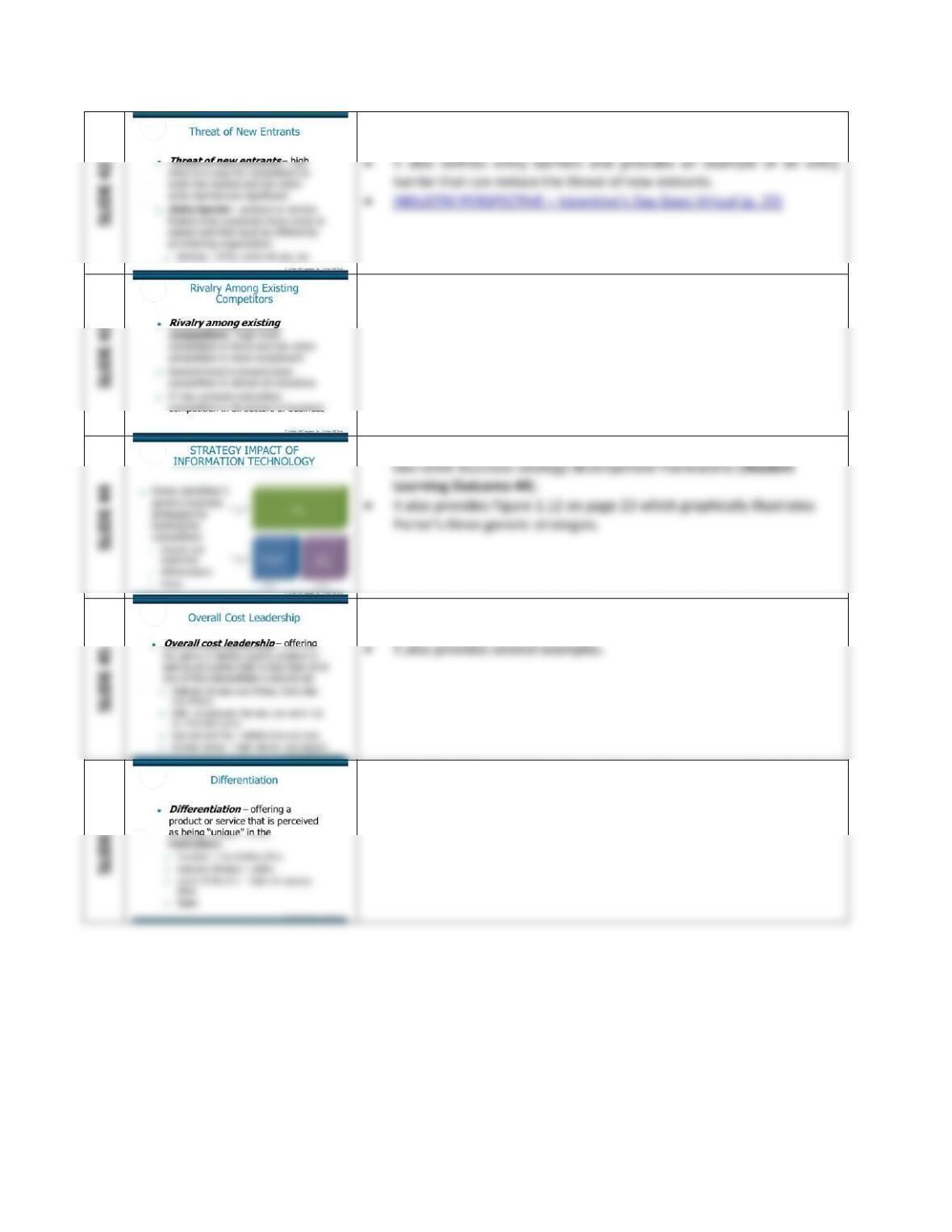
• This slide defines and describes the threat of new entrants as a force
within Porter’s Five Forces Model.
• This slide defines and describes the rivalry among existing competitors
as a force within Porter’s Five Forces Model.
• This slide begins the discussion of Porter’s three generic strategies and
• This slide defines and describes overall cost leadership as one of
Porter’s three generic strategies.
• This slide defines and describes differentiation as one of Porter’s three
generic strategies.
• It also provides several examples.
Chapter 01 – The Information Age in Which You Live: Changing the Face of Business
• This slide defines and describes focus as one of Porter’s three generic
strategies.
• It also provides several examples.
• This slide introduces and defines the RGT framework.
• It is a good tool because it requires organizations to think about how
• This slide discusses the RGT framework in more detail.
• This slide presents Figure 1.13 on page 26.
SLIDE 51
• This slide illustrates how Porter’s three generic strategies and the RGT