
Page 1 of 13
Chapter 1: Differing Perspectives on Quality
Chapter Outline
• Differing Perspectives on Quality
▪ What is Quality?
▪ Recognizing both Product and Service Dimensions of Quality
▪ Differing Functional Perspectives on Quality
▪ Three Spheres of Quality
▪ Other Perspectives on Quality
▪ Arriving at a Common Understanding of Quality Using a Contingency
Perspective of Quality
Overview
The entire concept of quality is what one of my professors once called an “arm–
waiver.” We all intuitively know what it means, yet when we are asked to explain it, we
just sort of wave our arms.
Chapter 1 defines the terms. The author references various definitions of quality.
He makes the distinction between service and manufacturing from a quality perspective
and delves into “The Supply Chain.” Consideration of quality as it applies to the modern
supply chain expands our understanding of its application. Professor Foster has taken the
concept of the supply chain and made it integral to the subject of quality. Any book on
quality must discuss Deming. The author makes reference to Deming throughout the
book.
The focal point of the chapter is the question “What is Quality?” Professor Foster
supplies a list of topics product and service quality that can be ideally used in a class
discussion:
• Performance
• Features
• Reliability
• Conformance
• Durability
• Tangibles

Page 2 of 13
The author looks at quality from different perspectives. This list is also an excellent
starting point for class discussion:
• Supply chain
• Engineering
• Operations
• Strategic management
• Marketing
• Financial
• Human resources
Chapter 1 will ideally fit into a standard 100-minute class period.
Page 3 of 13
Discussion Questions
1. Why is quality a difficult term to define? How can we improve our understanding
of quality?
2. Briefly discuss Garvin’s eight dimensions of quality. Is Garvin’s multidimensional
approach a step forward in improving our understanding of quality? Why or why
not?
Garvin lists the following:
• Performance
• Features
• Reliability
• Conformance
3. Is there a difference between service quality and product quality? If so, what are
the implications of these differences for a manager of a service business, such as a
restaurant or a retail store?
Service quality suggests an achievement in a level of customer service and is more
4. Define the concept of empathy.
On page 6, the concept of empathy is discussed: Finally, consumers of services desire
empathy from the service provider. In other words, the customer desires caring,
5. Why is communication within an organization an important part of the quality
improvement process?
On page 6, the author says: It is difficult to devise a coherent strategic plan relating to
quality when communication is imprecise.
Think about the people involved. Do the marketer, engineer, order processor, and
manager all speak the “same language?” Communication enables planning. In a
6. Compare and contrast the engineering perspective and marketing perspective of
quality? How could an overemphasis on the engineering perspective work to the
disadvantage of a business organization?
The textbook (page 13) says: The marketer focuses on the perceived quality of products
and services as opposed to the engineering based conformance definition of quality. The
question then asks whether the engineering approach could be self-defeating.
7. Describe the “systems view” that underlies modern quality management thinking.
Which of the perspectives of quality discussed in Chapter 1 is most closely aligned
with the systems view?
Some discussion questions might be:
A. What is the systems view?
B. What do the approaches have in common?
C. How are the approaches different?
D. How do the different approaches affect the ultimate consumer?
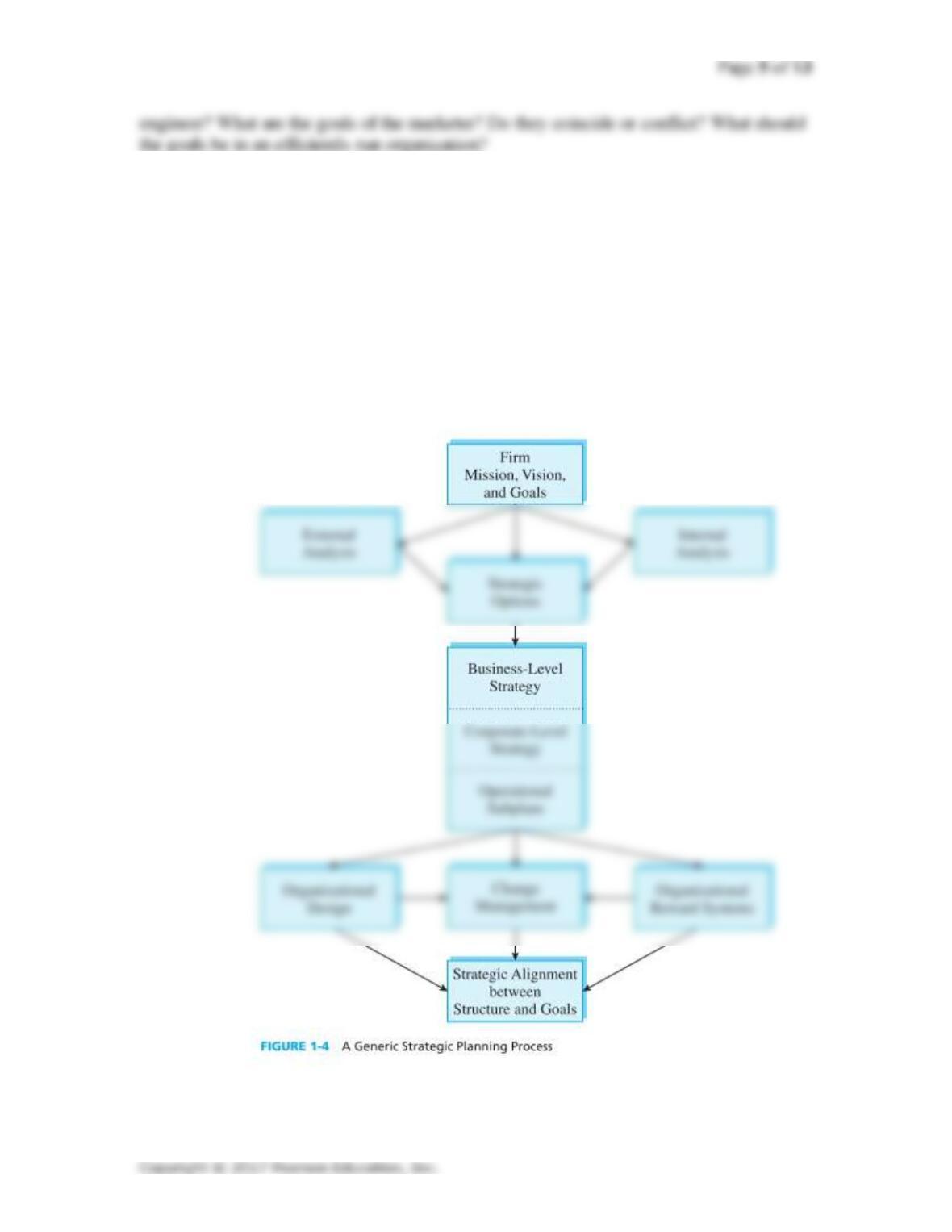
This diagram depicts the basic approach to planning.
8. Why is planning an important part of the quality process? How could a firm’s
quality management initiatives be adversely affected if planning was not a part of
the process?
Refer back to the question on communication (question 5). You might review Garvin’s
list:
• Performance
• Features
• Reliability
9. Research has shown that quality is still a major concern of the majority of CEOs
in American corporations. Is this level of concern about quality warranted? Please
explain your answer.
A discussion about the competition between American and foreign products would be
productive. How has the automotive industry been affected by the apparent quality or
10. What is meant by the phrase cost of quality? How can this phrase help a firm
address its quality concerns?
The article Quality Strategy at GE contains the following statement: GE denied that such
problems forced GE to adopt its new quality program. “We are not in trouble,” they said,
citing the robust profits. But they conceded that “the time wasted, the money wasted, in
field fixes, in quality problems, in working things out, across corporate America, across
the world, is enormous.”
Does this give you any insight into the attitudes at GE after Welch’s departure? What
11. What are the major differences between traditional human resource
management and total quality human resource management? How does total
quality human resource management transcend traditional human resource
management in regard to providing an environment that is supportive of quality
concerns?
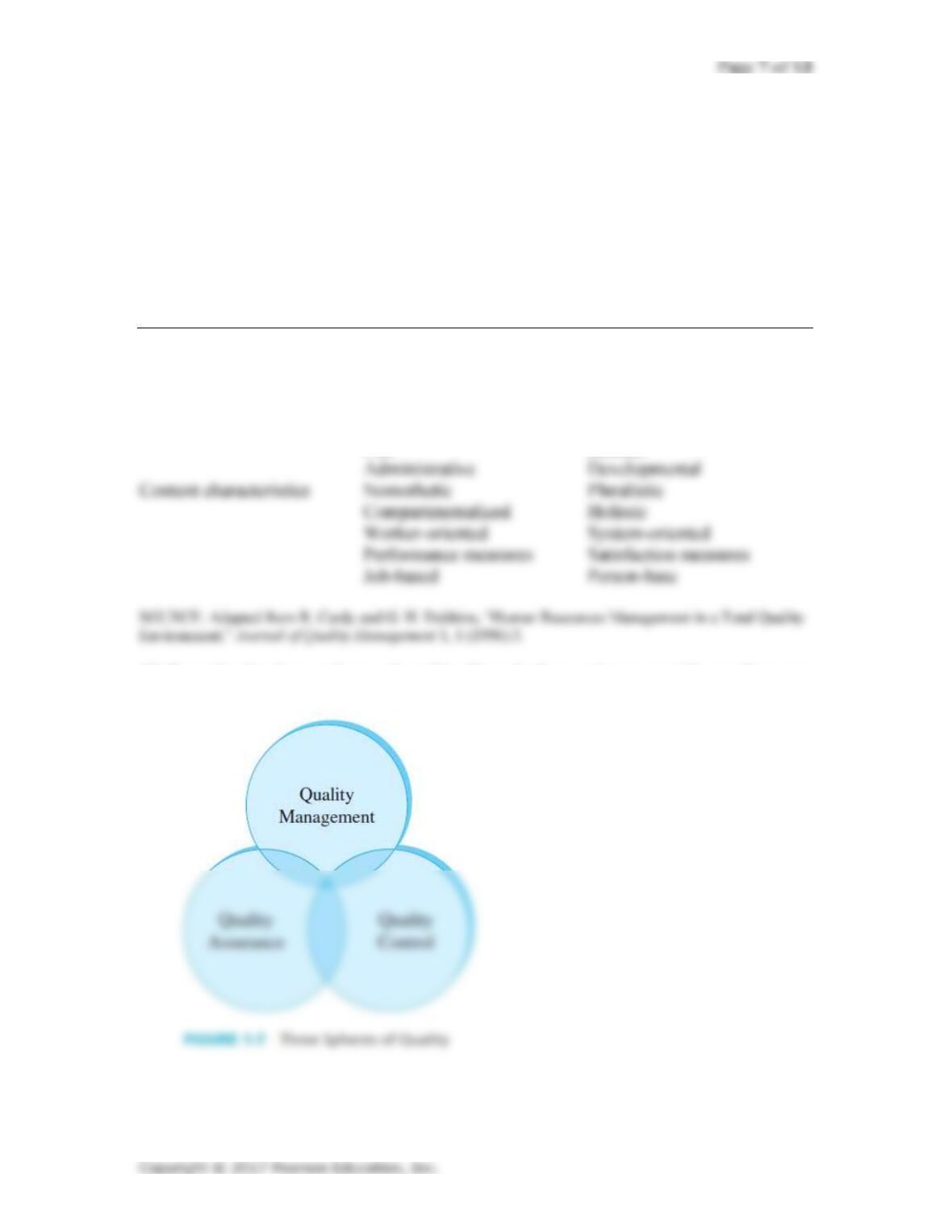
The table below lays out the question succinctly. This table should be an excellent
springboard for in-class discussion.
HRM versus TQHRM
Traditional HRM TQHRM
Process characteristics Unilateral role Consulting role
Centralization Decentralization
Pull Release
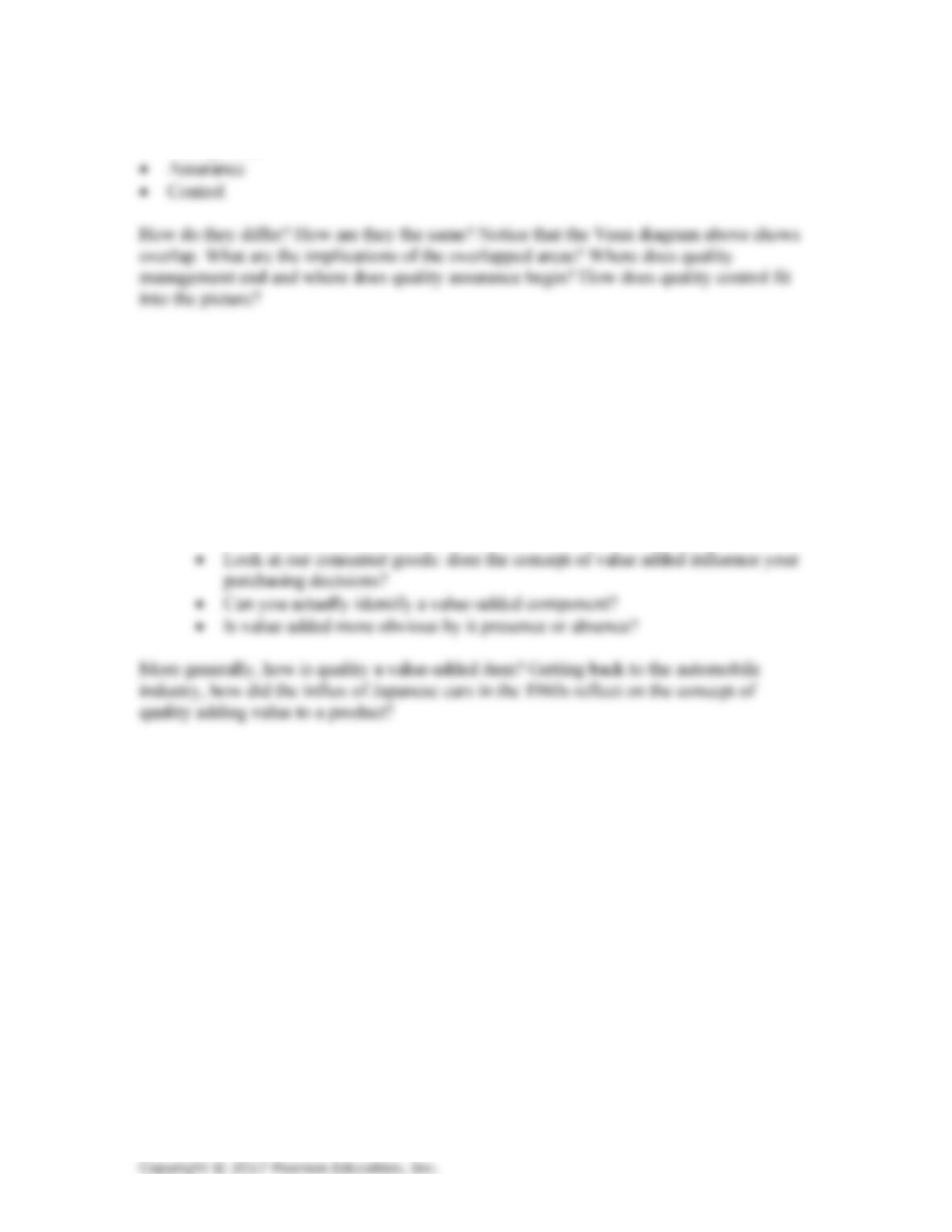
12. Describe the three spheres of quality. How do these spheres provide another way
to place the field of quality in perspective?
Page 8 of 13
Notice the three quality descriptors:
• Management
13. Discuss the value-added perspective on quality. What are the implications of this
perspective for the manager of a business organization?
A value-added activity can be pinpointed by asking, “Would this activity matter to the
customer?” In other words, in most cases, a value-added activity will have economic
value to the customer.
Looking back at the GE example that is discussed in question 10:
• How does value added enter into the discussion?
14. How does contingency theory inform decision making when implementing
improvement efforts?
Page 19 states: Contingency theory presupposes that there is no theory or method for
operating a business that can be applied in all instances
A company that defines part of its mission as “valuing and satisfying our customers
through personalized service” likely will pursue a different technological approach
toward its customers than a company with the mission of “applying technology to solve
customer problems.”
The contingency approach to quality also helps settle the different perceptions concerning
the definition of quality, for example:
• Do you as a consumer feel that quality is not as important in a lower priced
item?
• When a product has been on the market for an extended period of time, do you
Page 9 of 13
still observe quality?
• Do you have different expectations of quality for a high priced item than you
do for an inexpensive item? Why?
15. Should a firm consider the law of diminishing marginal returns when striving to
improve quality? Why or why not?
16. Are the perspectives of quality independent of one another? If not, describe ways
in which they are interrelated.
This chapter is named Differing Perspectives on Quality. Does the author make the point?
17. How can an understanding of the multiple dimensions of quality lead to
improved product and service designs?
As identified earlier, Garvin identified eight dimensions of quality:
• Performance
• Features
• Reliability
18. What is your concept of quality? Is it multidimensional, or does it focus on a
single dimension such as features, reliability, or conformance? Explain your answer.

Page 10 of 13
19. Describe an instance in which you and a coworker (or superior) perceived the
needs of a customer very differently. How did your differences in perception
influence how each of you wanted to meet your customer’s needs?
What aspects of quality made the most difference to you or your co-worker? Does your
Page 11 of 13
Case Study 1-1: FedEx: Managing Quality Day and Night
This cast study provides insight into the unique problems faced by a service-based
company. Central to this discussion are three questions that the company asks its
employees:
1. What do you need from me?
Case Questions:
1. What is FedEx’s “common language” of quality? Is it important for a company to
establish a “common language” of quality? If so, why?
2. There are several different perspectives of quality, including the operations
perspective, the strategic perspective, the marketing perspective, the financial
perspective, the HR perspective, and the systems perspective. Which of these
perspectives are being emphasized by FedEx? Why?
Does the “common language” allow personnel to cross boundaries? Does inclusion of
3. Is FedEx’s level of emphasis on quality appropriate? Why or why not?
Who is FedEx’s competition? Is quality a focal point in this industry? How does the
customer measure quality? What specific attributes do the customers use to judge
quality?
Page 12 of 13
Case Study 1-2: Granite Rock Company: Achieving Quality through
Employees
This case presents quality through the management perspective. A strategy for using this
case might be to ask the students to list the specific steps taken by Management to
Case Questions:
1. Rather than focusing on human resource management (HRM) as a means of
supporting its quality initiatives, Granite Rock could have chosen another area as its
focal point (i.e., marketing, operations, information systems, and so on). How does a
focus on HRM support a company’s quality initiatives?
This statement might be the key: The managers at Granite Rock knew that a resulting
decline in customer satisfaction was inevitable and responded to this self-assessment by
2. Discuss the different components of Granite Rock’s HRM initiatives. How can
each of these components support the company’s quality efforts?
The list of initiatives might include:
• Employee training
3. Discuss CEO Woolpert’s feelings about communication with the customers
(paragraph 2). What happens when others in the company don’t know what has
been promised to the customer? How can quality management help to overcome this
situation?
The key sentence in this paragraph is: As explained by CEO Bruce Woolpert, you can’t
have employees out telling customers “yes” unless everyone else in the company knows
how to follow up on “yes.”

Page 13 of 13
Websites of Interest
http://www.nist.gov/baldrige/ — The home site for the Baldridge National Quality