1 –
1
Chapter 1
Introduction
Learning Objectives
1. Develop a general understanding of the management science/operations research approach to decision
making.
2. Realize that quantitative applications begin with a problem situation.
6. Identify the step-by-step procedure that is used in most quantitative approaches to decision making.
7. Learn about basic models of cost, revenue, and profit and be able to compute the breakeven point.
8. Obtain an introduction to the use of computer software packages such as Microsoft Excel in applying
quantitative methods to decision making.
Chapter 1
Solutions:
1. Management science and operations research, terms used almost interchangeably, are broad
disciplines that employ scientific methodology in managerial decision making or problem
2. Define the problem
Identify the alternatives
4. A quantitative approach should be considered because the problem is large, complex, important,
new and repetitive.
5. Models usually have time, cost, and risk advantages over experimenting with actual situations.
6. Model (a) may be quicker to formulate, easier to solve, and/or more easily understood.
7. Let d = distance
m = miles per gallon
c = cost per gallon,
Therefore Total Cost =
2dc
m
We must be willing to treat m and c as known and not subject to variation.
Introduction
c.
d. x = 0, y = 20 Profit = $100
(Solution by trial-and-error)
9. If a = 3, x = 13 1/3 and profit = 133
If a = 4, x = 10 and profit = 100
If a = 5, x = 8 and profit = 80
If a = 6, x = 6 2/3 and profit = 67
Since a is unknown, the actual values of x and profit are not known with certainty.
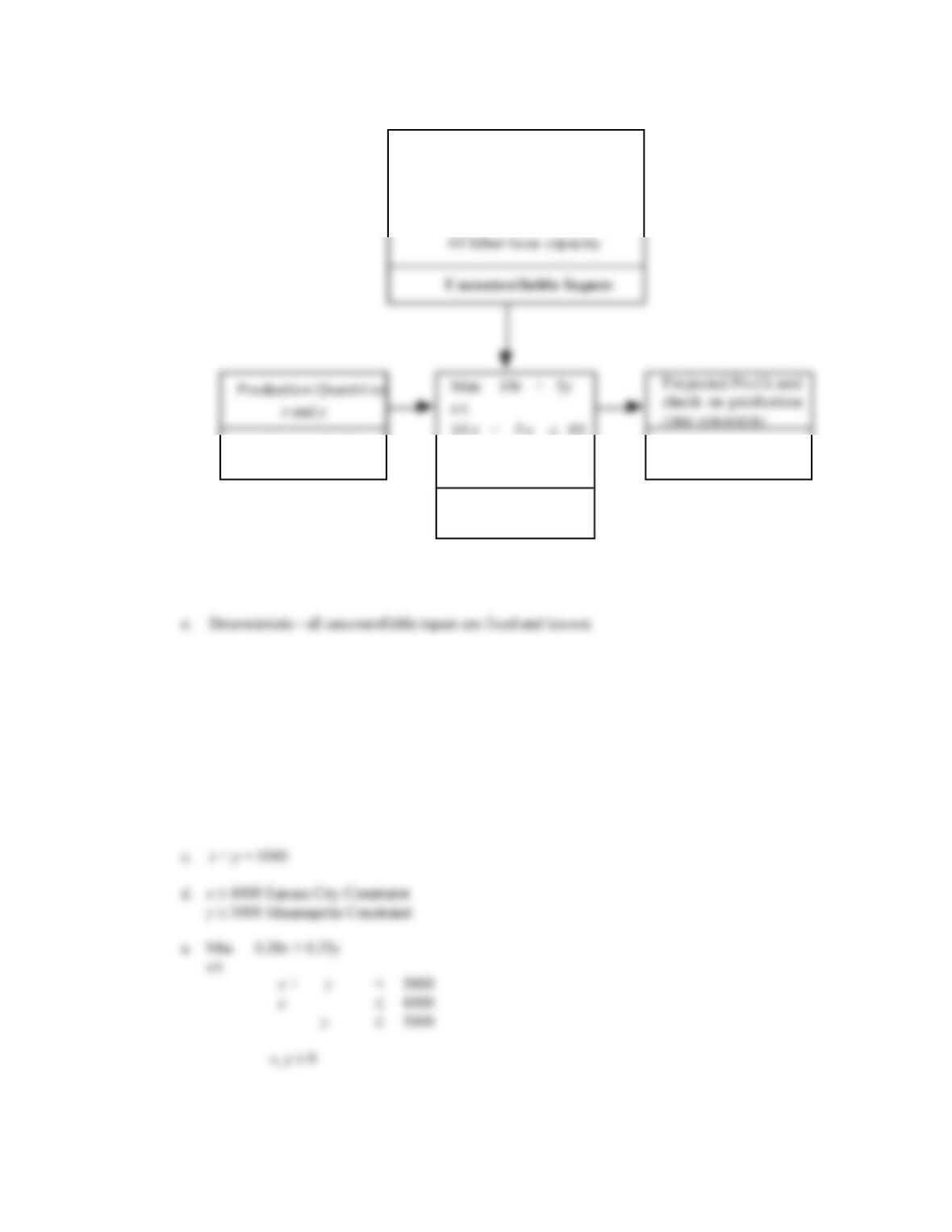
10. a. Total Units Received = x + y
b. Total Cost = 0.20x +0.25y
P rofit :
Labor Hours: 5/unit for x
2/ unit for y
$10/unit for x
$ 5/ unit for y
C on trol l a bl e
Inpu t
O utput
x
y
0
0
Math em a ti cal
Mode l
Chapter 1
11. a. At the $20 per-unit price, the firm can sell 800 – 10(20) = 600 units. At the $70 per-unit price, the firm can
sell 800 – 10(70) = 100 units.
c. Since total revenue (TR) is the product of demand (d) and price (p), we have that TR = dp = (800 –
10p)p = 800p – 10p2.
d. At $30, TR = 800(30) – 10(30)2 = 24,000 – 10(900) = 15,000.
At $40, TR = 800(40) – 10(40)2 = 32,000 – 10(1600) = 16,000.
At $50, TR = 800(50) – 10(50)2 = 40,000 – 10(2500) = 15,000.
When considering price alternatives of $30, $40, and $50, total revenue is maximized at the $40
price (i.e., p = 40).
12. a. If x represents the number of pairs of shoes produced, a mathematical model for the total cost of producing
x pairs of shoes is TC = 2000 + 60x. The two components of total cost in this model are fixed cost ($2,000)
and variable cost (60x).
b. If P represents the total profit, the total revenue (TR) is 80x and a mathematical model for the total
profit realized from an order for x pairs of shoes is P = TR – TC = 80x – (2000+60x) = 20x – 2000.
c. The breakeven point is the number of shoes produced (x) at the point of no profit (P = 0).
Thus the breakeven point is the value of x when P = 20x – 2000 = 0. This occurs when 20x = 2000 or
x = 100, i.e., the breakeven point is 100 pairs of shoes.
13. a. If x represents the number of students who enroll in the seminar, a model for the total cost to put on the
seminar is 9600 + 60(2x) = 9600 + 120x (note that the variable cost per student is $60 per day, and the
seminar is scheduled to last for two days, so total variable cost per student will be $120).
14. a. If x represents the number of copies of the book that are sold, total revenue (TR) = 46x and total cost (TC)
= 160,000 + 6x, so Profit = TR – TC = 46x – (160,000 + 6x) = 40x – 160,000. The breakeven point is the
number of books produced (x) at the point of no profit (P = 0). Thus the breakeven point is the value of x
when P = 40x – 160,000 = 0. This occurs when 40x = 160,000 or x = 4000, i.e., the breakeven point is 4000
copies of the book.
b. At a demand of 3800 copies, the publisher can expect a profit of 40(3800) – 160,000 = 152,000 – 160,000
= -8000, i.e., a loss of $8,000.
Introduction
c. Here we know demand (d = 3800) and want to determine the price p at which we will breakeven (the
point at which profit is 0). The minimum price per copy that the publisher must charge to break even
is Profit = p(3800) – (160,000 + 6(3800)) = 3800p – 182,800. This occurs whre 3800p = 182,800 or
p = 48.10526316 or a price of approximately $48.
15. a. If x represents the number of luxury boxes that are constructed, total revenue (TR) = 300,000x and total
cost (TC) = 4,500,000 + 150,000x, so Profit = TR – TC = 300,000x – (4,500,000 + 150,000x) = 150,000x –
4,500,000. The breakeven point is the number of luxury boxes produced (x) at the point of no profit (P = 0).
Thus the breakeven point is the value of x when P = 150,000x – 4,500,000 = 0. This occurs when 150,000x
= 4,500,000 or x = 30, i.e., the breakeven point is 30 luxury boxes.
16. a. The annual return per share of Oil Alaska is $6.00 and the annual return per share of Southwest Petroleum
is $4.00, so the objective function that maximizes the total annual return is Max 6x + 4y.
b. The price per share of Oil Alaska is $50.00 and the price per share of Southwest Petroleum is $30.00,
17. a. sj = sj – 1 + xj – dj
or sj – sj-1 – xj + dj = 0
b. xj cj
c. sj Ij