
Chapter 01 – The Exceptional Manager: What You Do, How You Do It
1-1
1
Chapter
The Exceptional Manager:
What You Do, How You Do It
Major Questions the Student Should Be Able to Answer 2
Mapping the Class: Chapter Outline 3
Overview of the Chapter 5
CHAPTER CONTENTS
Chapter 01 – The Exceptional Manager: What You Do, How You Do It
1-2
1.1 Management: What It Is, What Its Benefits Are
MAJOR QUESTION: What are the rewards of being an exceptional manager?
1.2 What Managers Do: The Four Principal Functions
1.4 Pyramid Power: Levels and Areas of Management
MAJOR QUESTION: What are the levels and areas of management I need to know to
move up, down, and sideways?
1.5 The Skills Exceptional Managers Need
MAJOR QUESTION: To be an exceptional manager, what roles must I play successfully?
MAJOR QUESTIONS THE STUDENT SHOULD BE ABLE TO ANSWER
Chapter 01 – The Exceptional Manager: What You Do, How You Do It
1.1 Management: What It Is, What Its Benefits Are
• The Rise of the Die Maker’s Daughter
• Key to Career Growth: “Doing Things I’ve Never Done Before”
1.2 What Managers Do: The Four Principal Functions
• Planning
1.3 Seven Challenges to Being an Exceptional Manager
• Managing for Competitive Advantage—Staying Ahead of Rivals
• Managing for Diversity—The Future Won’t Resemble the Past
1.4 Seven Challenges to Being an Exceptional Manager
• The Traditional Management Pyramid: Levels & Areas
1.5 The Skills Exceptional Managers Need
• Technical Skills—The Ability to Perform a Specific Job

Chapter 01 – The Exceptional Manager: What You Do, How You Do It
1-4
1.6 Roles Managers Must Play Successfully
1.7 The Link between Entrepreneurship & Management
• Starting Up a Start-up: From Hats to Hamburgers
• Entrepreneurship Defined: Taking Risks in Pursuit of Opportunity
Chapter 01 – The Exceptional Manager: What You Do, How You Do It
1-5
1.1 Management: What It Is, What Its Benefits Are
An organization is a group of people who work together to achieve some specific
1.2 What Managers Do: The Four Principal Functions
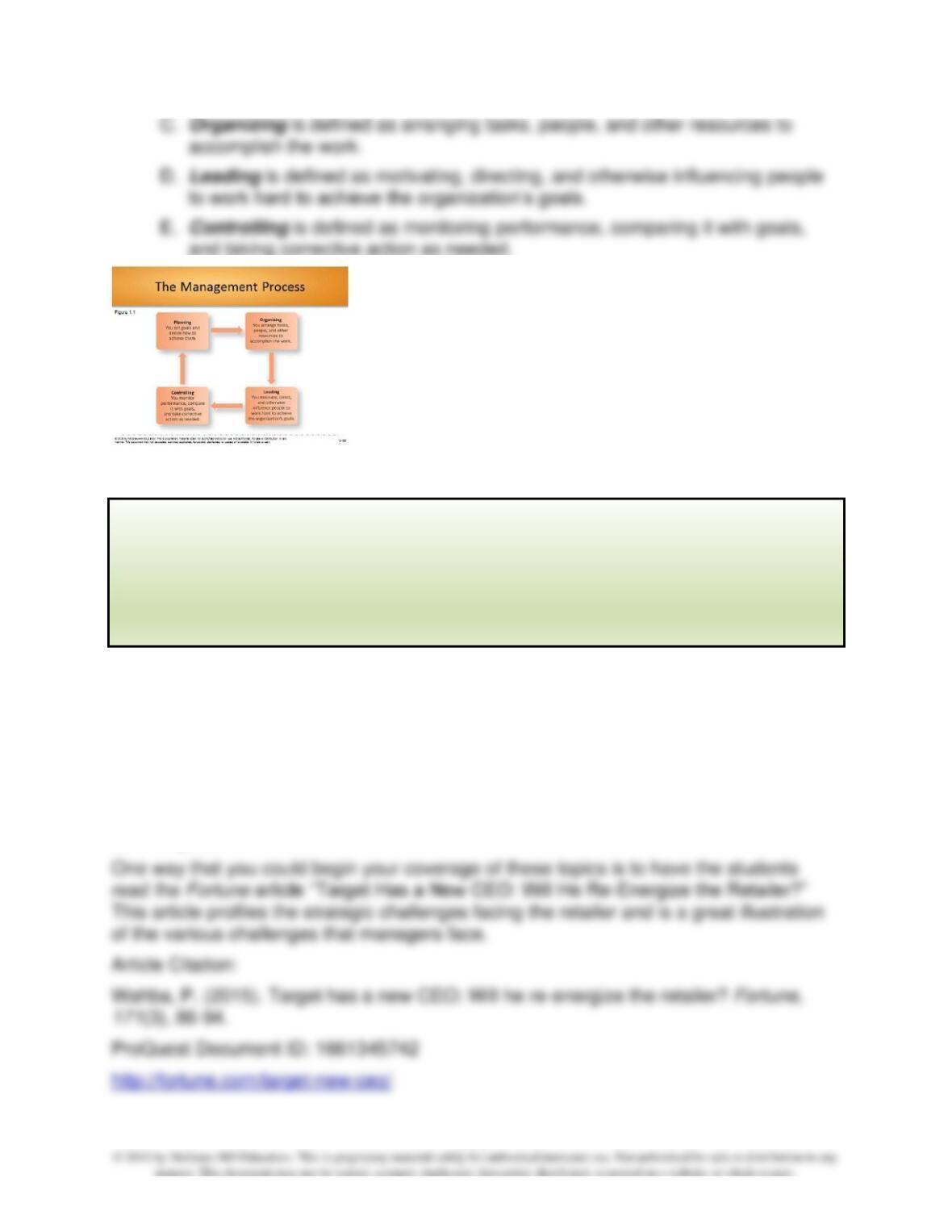
The four management functions are planning, organizing, leading, and controlling.
Planning (further discussed in Chapter 5) is defined as setting goals and deciding how
1.3 Seven Challenges to Being an Exceptional Manager
Competitive advantage is the ability of an organization to produce goods or services
more effectively than competitors do, thereby outperforming them. An organization
must stay ahead in four areas: (1) being responsive to customers, (2) innovation, (3)
1.4 Pyramid Power: Levels & Areas of Management
There are four levels of management. Top managers make long-term decisions about
the overall direction of the organization and establish the objectives, policies, and
OVERVIEW OF THE CHAPTER
Chapter 01 – The Exceptional Manager: What You Do, How You Do It
1-6
1.5 The Skills Exceptional Managers Need
Managers need exceptional skills. Technical skills consist of the job-specific
1.6 Roles Managers Must Play Successfully
There are three types of managerial roles. In their interpersonal roles, managers
1.7 The Link between Entrepreneurship & Management
A start-up is defined as a newly created company designed to grow fast.
Chapter 01 – The Exceptional Manager: What You Do, How You Do It
1-7
The Manager’s Toolbox: A One-Minute Guide to Success in This Class
There are four rules that go a long way to ensuring student success in a class.
Students should attend every class, they should not cram or postpone studying, they
should read and review the course materials more than once, and they should
Possible Topics for Discussion:
• Do you sometimes (often?) postpone keeping up with coursework, then pull an
“all–nighter” of studying to catch up before an exam? What do you think happens
to people in business who do this?
• What could your professor do as the “manager” of this class to ensure that you
and your fellow classmates avoid cramming for exams?
Section 1.1 defines management and organizations. Good managers have an influence
on the organization far beyond the results that can be achieved by one person acting
alone. Managers are also generally well paid.
CLASSROOM OUTLINE
1.1 Management: What It Is, What Its Benefits Are (pp. 4 – 8)
What are the rewards of being an exceptional manager?
Chapter 01 – The Exceptional Manager: What You Do, How You Do It
1-8
Possible Topics for Discussion:
• Describe the biggest challenges that you think that managers at your employer
(or a previous one) face.
Major Idea Outline:
1) Management may be defined as “the art of getting things done through people.”
Managers operate within an organization, a group of people who work
together to achieve some specific purpose.

Chapter 01 – The Exceptional Manager: What You Do, How You Do It
1-9
Interactive Classroom Material:
EXAMPLE: Efficiency versus Effectiveness: “Don’t Tell Me You’re Sorry, Just
Fix the Problem!” (p. 5–6)
This Example describes customer service, or lack of it, in the airline industry. Many
airlines favor efficiency over effectiveness, but this costs airlines’ bottom line as they
cannot retain customers. Apologies do not help either when deemed half-hearted or
insincere as customers want their problems fixed, not just talk.
YOUR CALL
What recent unpleasant customer experience would you want to post on this
website?
Students should share unpleasant travel experiences with different airlines. Are
Chapter 01 – The Exceptional Manager: What You Do, How You Do It
1-10
Students can also discuss common responses, or excuses, they have heard from
customer service agents at the airline. Did they feel as if these responses were
half-hearted or insincere?
Additional Activities:
One way to build on this Example is to have the students watch the video segment
“Airfare Sale Crashes Southwest Airlines’ Website.” This 3-minute video profiles how
Critique Southwest’s handling of this situation.
Given that the firm’s website has previously crashed when the company
announced fare sales, does that influence your perceptions of how the company
addressed the situation?
What other recommendations would you make to the airline for responding to
customer complaints about not being able to buy a sale ticket and/or use the
online check-in feature when the website was down?
2) What Are the Rewards of Studying and Practicing Management?
The payoffs of studying management as a discipline include:
a. You will understand how to deal with organizations from the
outside, and how people on the inside make decisions.
Chapter 01 – The Exceptional Manager: What You Do, How You Do It
1-11
Section 1.2 defines the four functions of management: planning, organizing, leading and
controlling. All these functions affect one another, are ongoing, and are performed
simultaneously.
One way that you could begin your coverage of these topics is to have the students
speech-27376638.
Possible Topics for Discussion:
• Have the students arrange a time to interview their manager or someone who
works in a managerial role. Have them ask the manager to describe how he or
Major Idea Outline:
A. To achieve the goals of organization you perform the management process.
1. Managers perform the management process, also known as the four
management functions: planning, organizing, leading, and controlling.
1.2 What Managers Do: The Four Principal Functions Are
(pp. 9 – 10)
What would I actually do—that is, what would be my four principal
functions—as a manager?
Chapter 01 – The Exceptional Manager: What You Do, How You Do It
1-12
B. Planning is defined as setting goals and deciding how to achieve them.
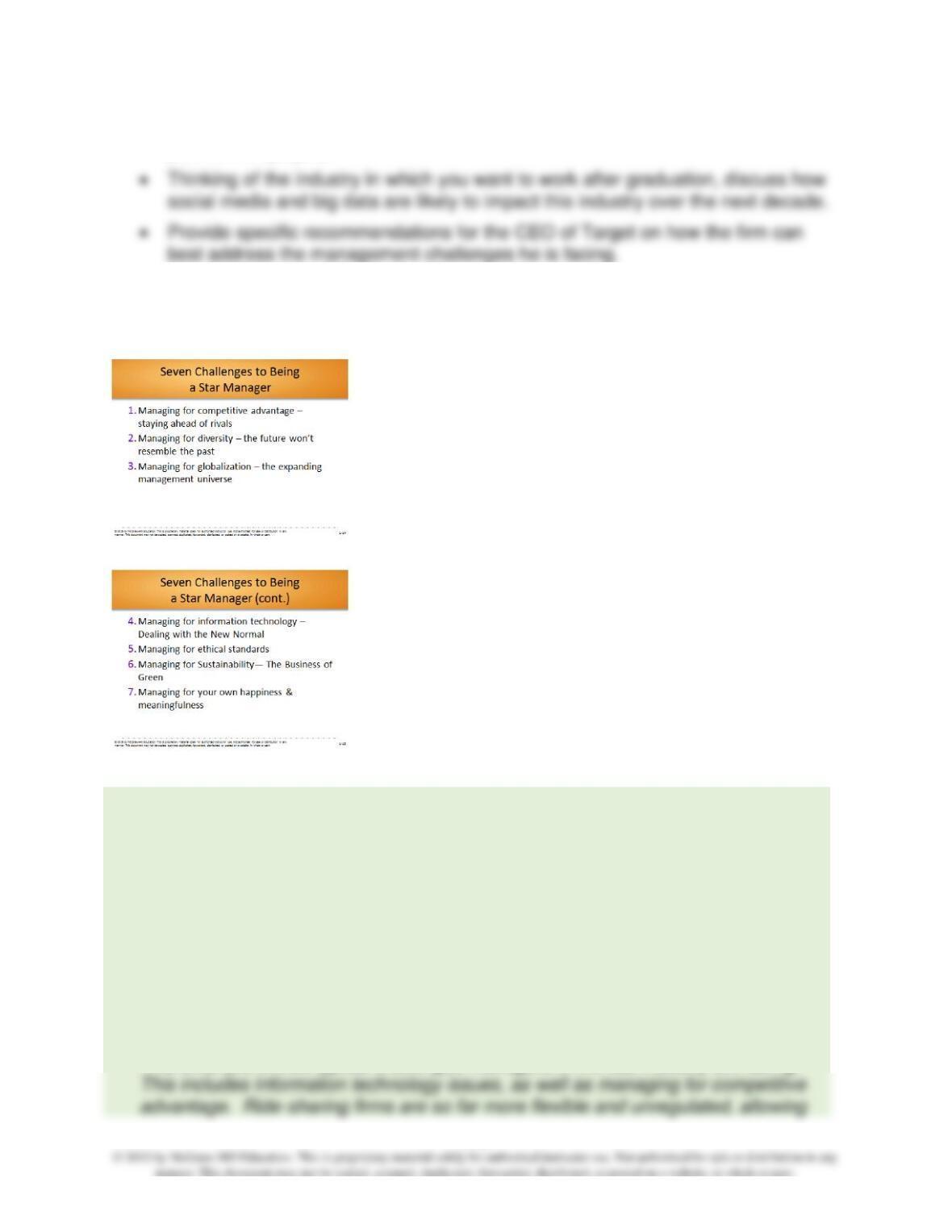
Section 1.3 highlights the seven challenges facing any manager. Managers need to
manage for competitive advantage—to stay ahead of rivals. They need to manage for
diversity in race, ethnicity, gender, and so on, because the future won’t resemble the
past. Managers also need to manage for the effects of globalization and of information
technology, as well as always needing to manage to maintain ethical standards.
Moreover, they need to manage for sustainability—to practice sound environmental
policies. Finally, managers need to manage for the achievement of their own happiness
and life goals.
1.3 Seven Challenges to Being an Exceptional Manager
(pp. 11 – 17)
Challenges can make one feel alive. What are seven challenges I could
look forward to as a manager?
Chapter 01 – The Exceptional Manager: What You Do, How You Do It
1-13
Possible Topics for Discussion:
• Describe the most important challenges facing managers at your company (or a
previous employer).
Major Idea Outline:
A. Managers face several challenges.
Interactive Classroom Material:
EXAMPLE: The Struggle for Competitive Advantage: App-Based Ride-Share
Services Leave the Taxi Industry Reeling (p. 11-12)
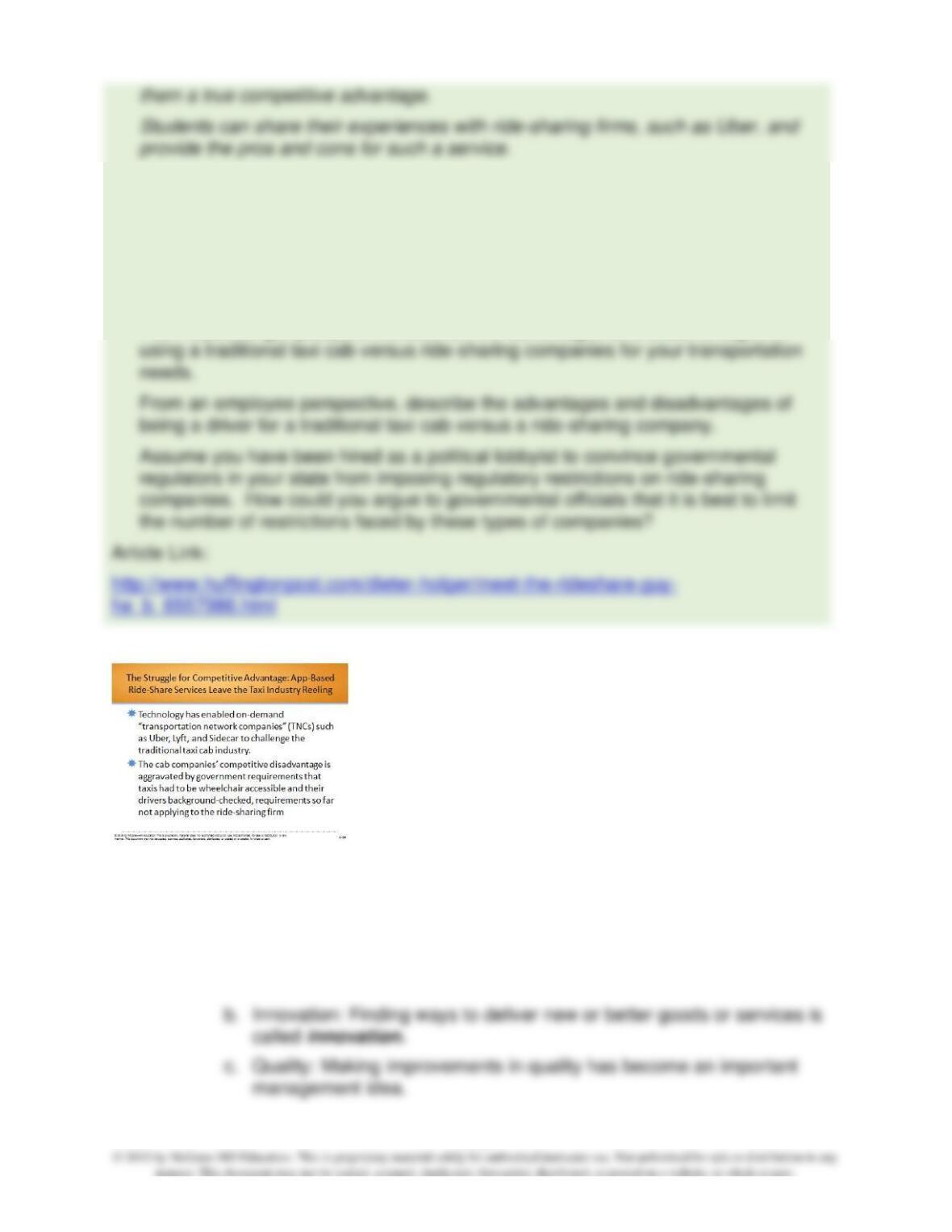
Smartphones and apps have led to the rise of ride-sharing companies like Uber, Lyft
and Sidecar, challenging the traditional taxi cab industry. Cab companies are having
trouble filling shifts, and many disabled riders are having trouble finding cabs with
accommodations since ride-sharing companies do not have to follow government
regulations mandating them like cabs do.
YOUR CALL
Which sector do you think will prevail?
This Example shows typical challenges managers in the cab industry are facing.
Chapter 01 – The Exceptional Manager: What You Do, How You Do It
1-14
Additional Activities:
One way to build on this Example is to have the students read the Huffington Post
article “Meet ‘The Rideshare Guy’ (He Works for Uber, Lyft and Sidecar).” This article
provides insights into what it might be like for students considering supplementing
their income by working for a ride-sharing company. Consider using the following
discussion questions:
From a passenger perspective, describe the advantages and disadvantages of
B. Challenge #1: Managing for Competitive Advantage—Staying Ahead of Rivals
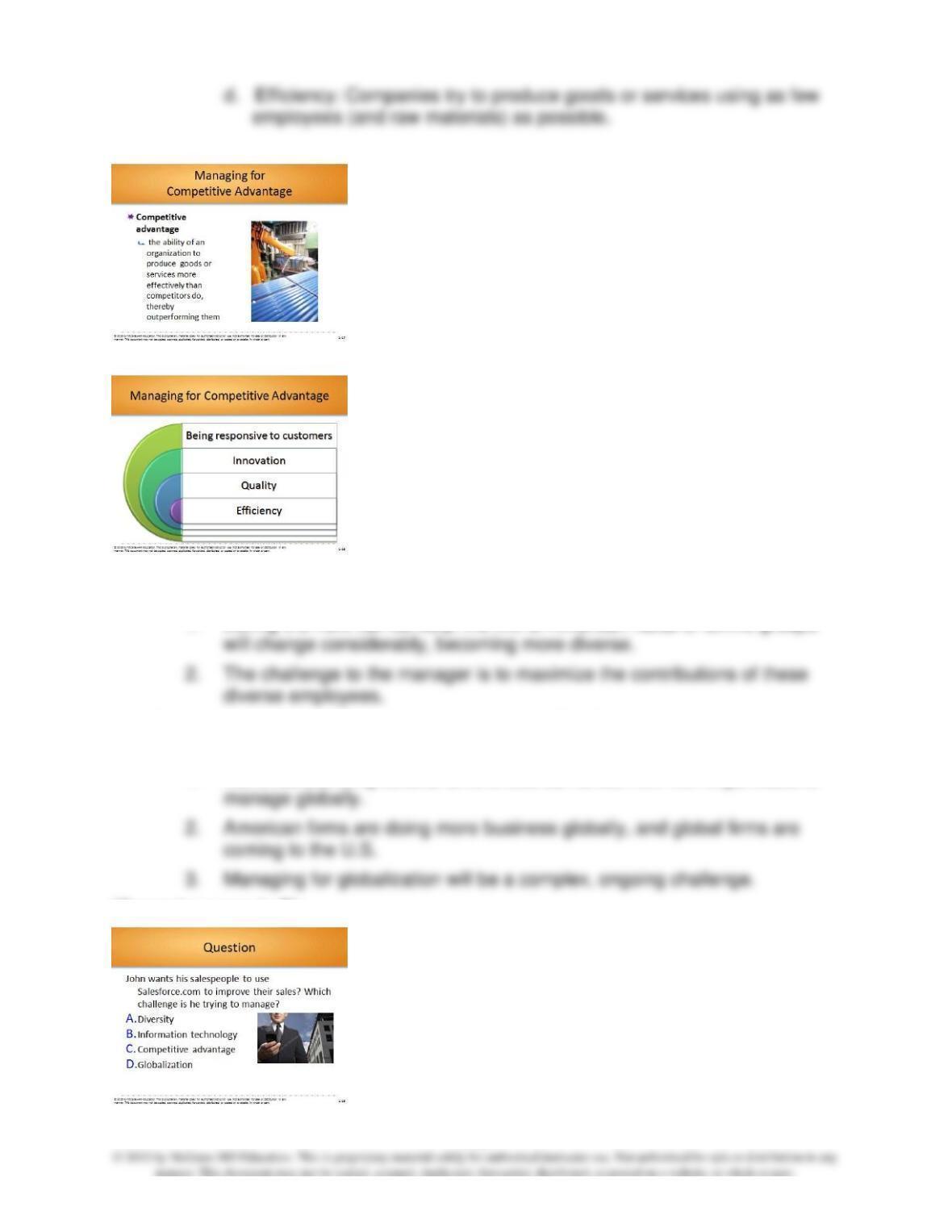
1. Competitive advantage is the ability of an organization to produce goods
or services more effectively than its competitors do, thereby outperforming
them in four areas:
a. Being responsive to customers: The first law of business is, take care
of the customer.
Chapter 01 – The Exceptional Manager: What You Do, How You Do It
1-15
C. Challenge #2: Managing for Diversity —The Future Won’t Resemble the Past
1. During the next half-century, the mix of American racial or ethnic groups
D. Challenge #3: Managing for Globalization — The Expanding Management
Universe
1. Not understanding cultural differences can affect how well organizations
(Correct answer is B)
Chapter 01 – The Exceptional Manager: What You Do, How You Do It
E. Challenge #4: Managing for Information Technology
1. The Internet is the global network of independently operating but
interconnected computers, linking hundreds of thousands of smaller
4. Implications of e-business: 21st-century managers need to understand
and use:
a. Far-ranging e-management and e-communication, including:
(1) E-mail, or text messages and documents transmitted over a
b. Accelerated decision making, conflict, and stress
(1) The Internet connects us to huge, interconnected databases—
c. Changes in organizational structure, jobs, goal setting, and knowledge
management
(1) Organizations and teams have become “virtual”; they are no
longer bound by time zones and locations.
Chapter 01 – The Exceptional Manager: What You Do, How You Do It
1-17
(4) Collaborative computing, using state-of-the-art computer
software and hardware, will help people work better together.
F. Challenge #5: Managing for Ethical Standards
1. With the pressure to meet sales targets, managers can face ethical
dilemmas.
Interactive Classroom Material:
PRACTICAL ACTION: Preparing Yourself to Behave Right When You’re
Tempted to Cheat (p. 16)
This Example shows that there are all kinds of reasons why people cheat. How we
think we may act when put in the position to cheat, and how we actually act, may be
YOUR CALL
Can you tell yourself how you should—and must—behave the next time you’re
tempted to cheat or see someone cheating?
When it comes to seeing others cheating, it begins with knowing when you
probably will not speak up. Once you figure this out, you need to be courageous
Additional Activities:
One way that you could build on this Practical Action is to have the students read the
Chapter 01 – The Exceptional Manager: What You Do, How You Do It
1-18
Wall Street Journal article “Cheating Concerns in Asia Cloud SAT Testing.” The
article discusses how it is becoming easier than ever for students to game the system
when taking the SAT college-entrance exam. Consider using the following discussion
questions:
What actions should academic institutions take to deal with the fact that cheating
occurs in the SAT testing process?
If you knew that you could have cheated on the SAT exam to dramatically
G. Challenge #6: Managing for Sustainability – The Business of Green
1. Sustainability is defined as economic development that meets the needs of
the present without compromising the ability of future generations to meet
their own needs.
H. Challenge #7: Managing for Your Own Happiness and Life Goals
Chapter 01 – The Exceptional Manager: What You Do, How You Do It
1-19
SELF-ASSESSMENT 1.1 (p. 17)
How Strong Is My Motivation to Be a Manager?
Go to connect.mheducation.com and take Self-Assessment 1.1.
Student Questions:
1. Does this instrument accurately assess your potential as a manager?
2. Which of the seven dimensions do you think is likely the best predictor of
managerial success? Which is the least? Explain.
Student responses will differ here. Some will respond with information
3. The instrument emphasizes competition with others in a win–lose mentality.
Describe the pros and cons of this approach to management.
Students will hopefully point out pros as being success as a byproduct of
Additional Activities:
You can also consult the Connect Instructors Manual for the post-assessment activity
and corresponding PowerPoint slides used for this Self-Assessment in Connect. In
1.4 Pyramid Power: Levels & Areas of Management
(pp. 18 – 21)
What are the levels and areas of management I need to know to move
up, down, and sideways?
Chapter 01 – The Exceptional Manager: What You Do, How You Do It
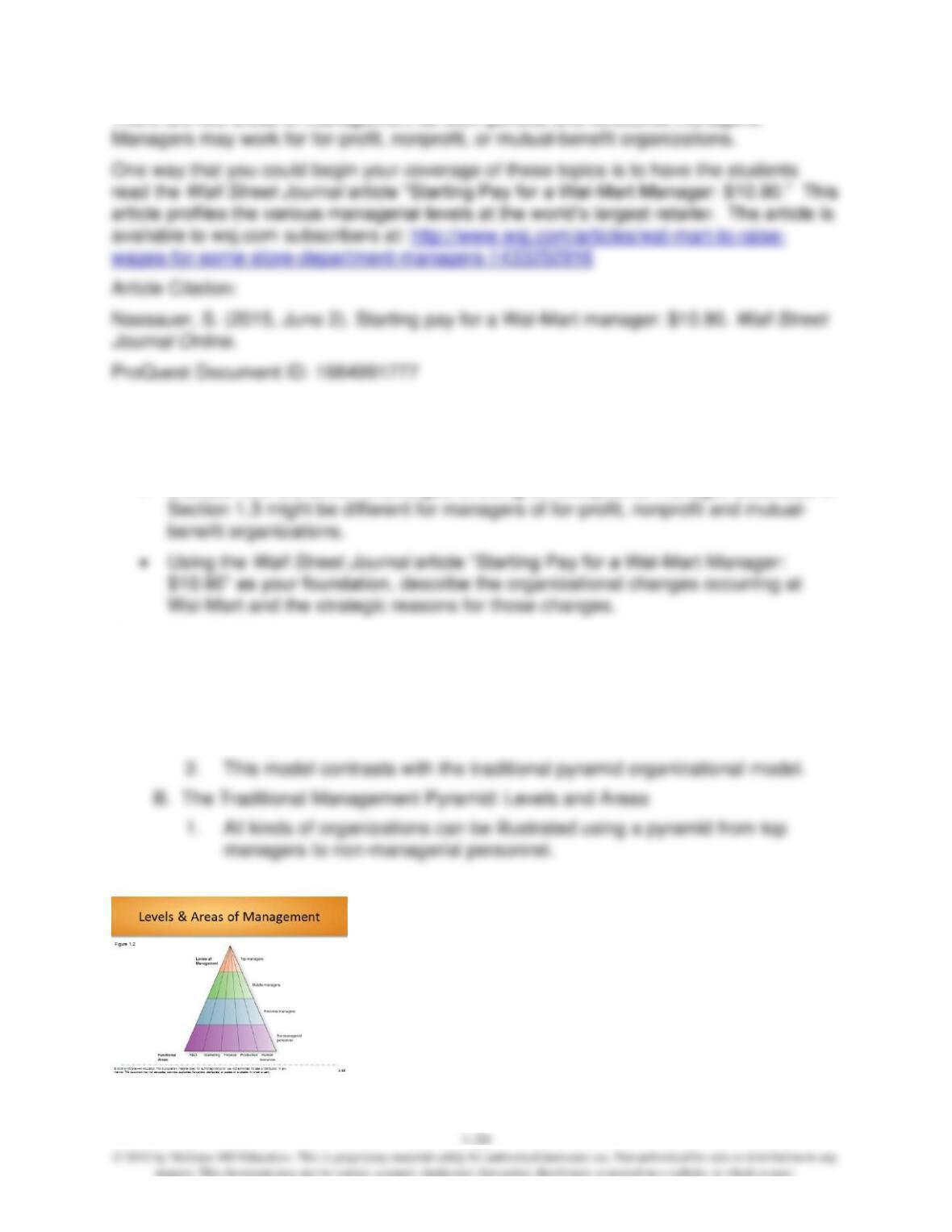
Section 1.4 defines the four levels of managers: top, middle, first line and team leaders.
There are two areas of management as well: general and functional managers.
Possible Topics for Discussion:
• Describe the typical duties of the top managers, the middle managers, the first-
line managers and the team leaders at your employer (or a previous one).
• Discuss how the seven challenges to being an exceptional manager described in
Major Idea Outline:
A. Role of Management
1. Peter Drucker’s organization model sees the manager as a conductor
whose role is not to play each instrument but to lead all the musicians
through the most effective performance.