
CHAPTER 1
THE INVESTMENT SETTING
I. Rationale for Investment
A. Income streams and spending needs usually do not coincide
1. If income is greater than spending – people tend to invest the surplus
2. If spending is greater than income – people tend to borrow to cover the deficit
B. People would be willing to forgo current consumption only if they are confident of
II. Measures of Return and Risk
A. Measures of Historical Rates of Return
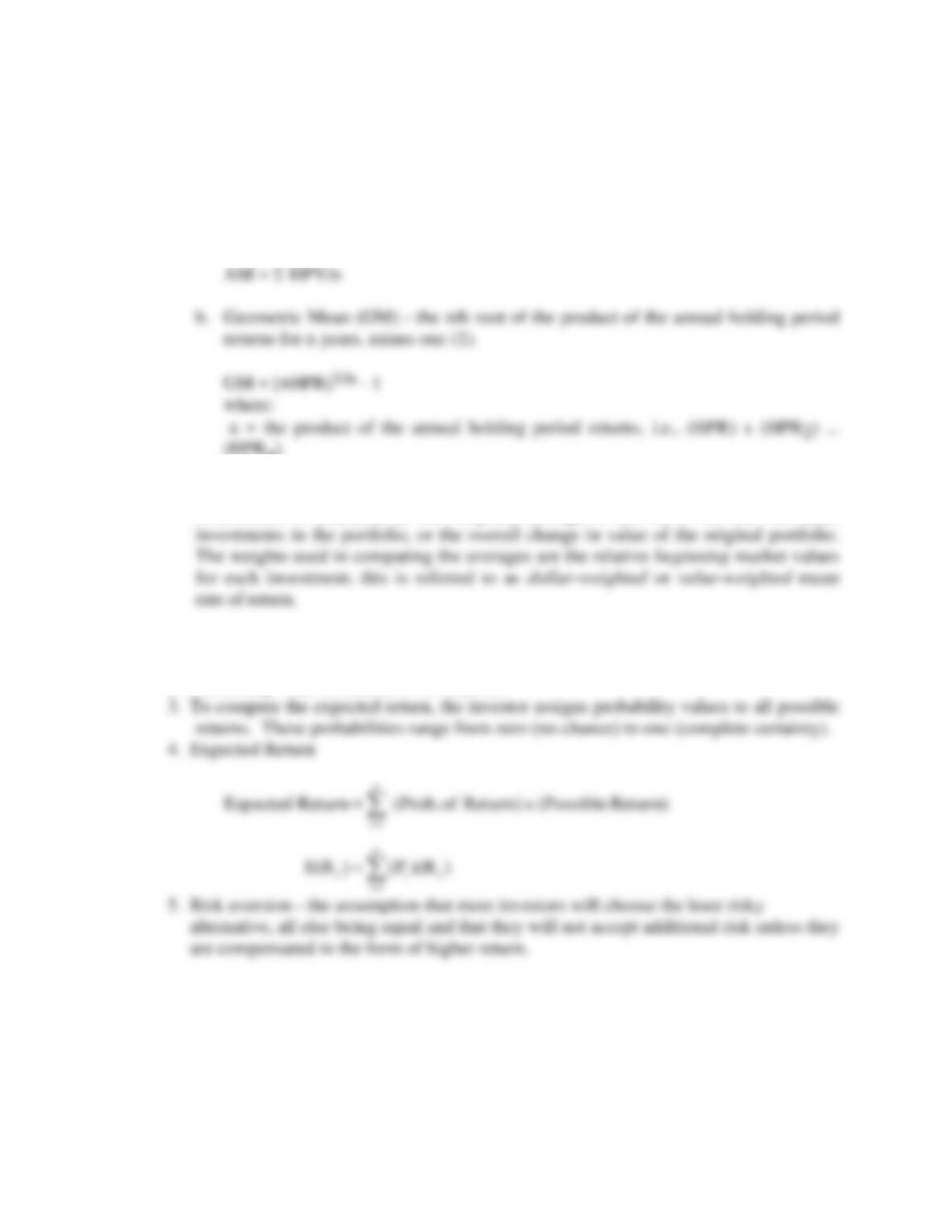
1. Holding Period Return (HPR) – the total return from an investment, including all
sources of income, for a given period of time. A value of 1.0 indicates no gain or
2. Holding Period Yield (HPY) – the total return from an investment for a given
period of time stated as a percentage.
1 – 2
B. Computing Mean Historical Returns
1. Mean rate of return – the average of an investment’s returns over time.
2. Single Investment
a. Arithmetic Mean (AM) – a measure of mean return equal to the sum of annual
HPYs divided by the number of years.
3. A Portfolio of Investments – The mean historical rate of return for a portfolio of
investments is measured as the weighted average of the HPYs for the individual
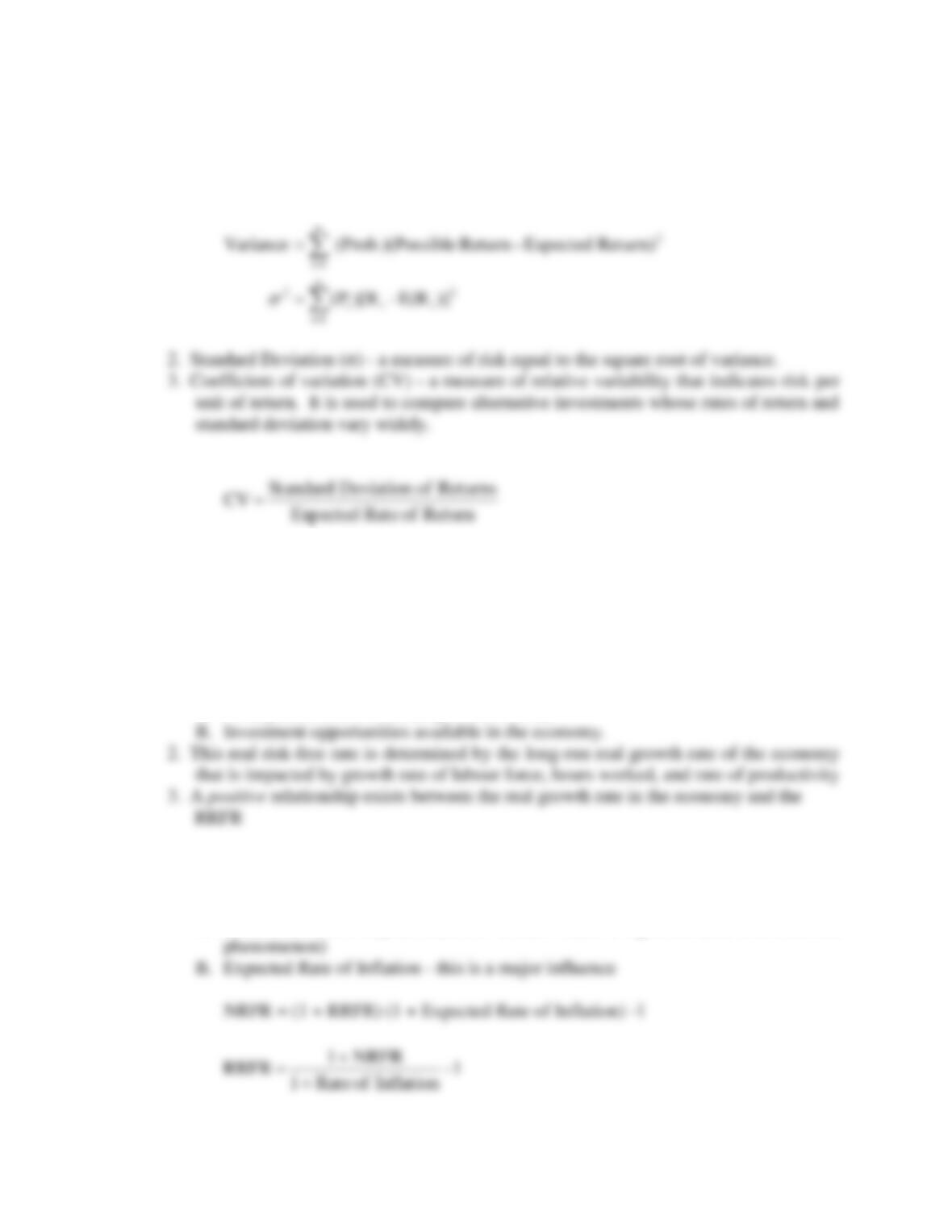
C. Calculating Expected Rates of Return
1. Risk – the uncertainty that an investment will earn its expected return.
2. Probability – the likelihood of an outcome
1 – 3
D. Measuring the Risk of Expected Returns
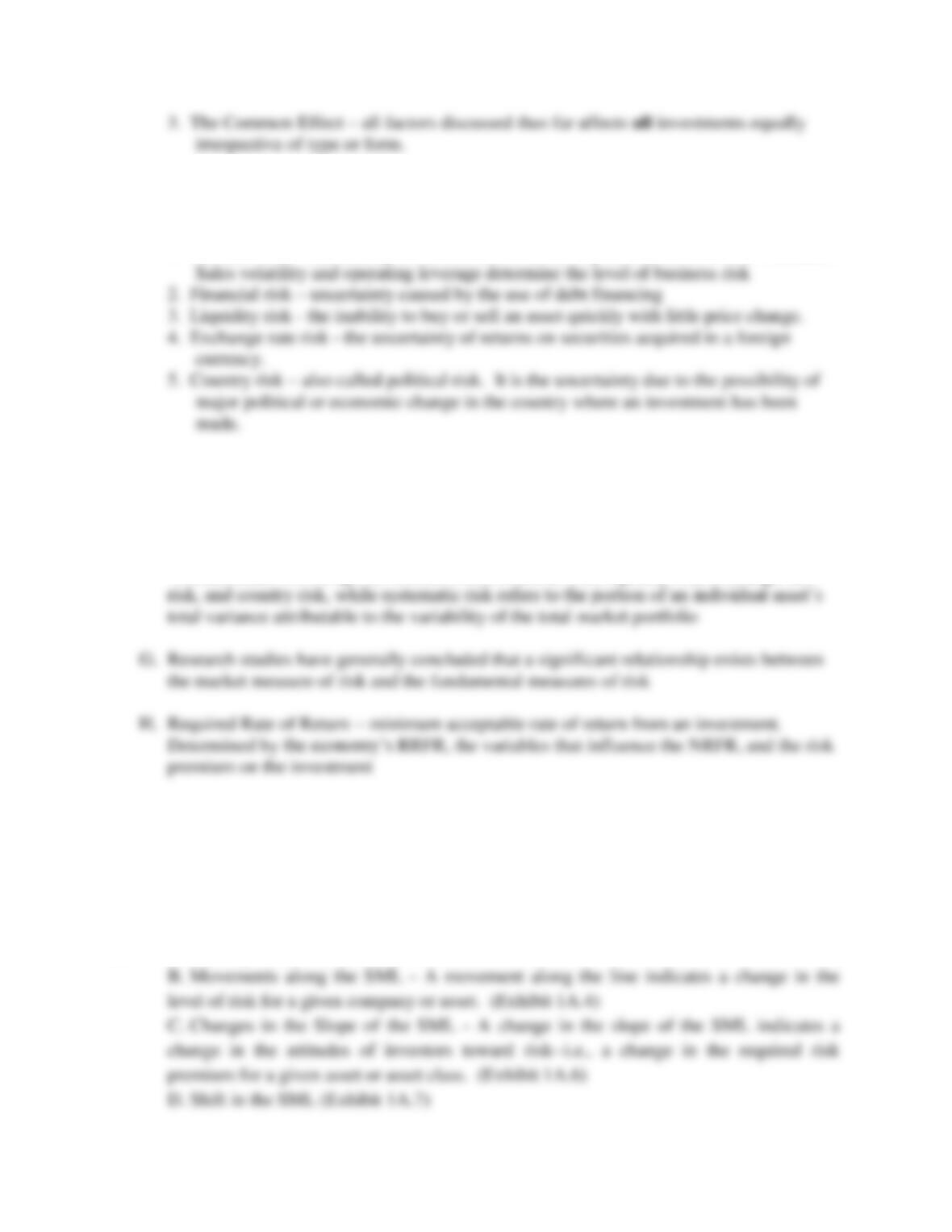
1. Variance – a measure of risk equal to the sum of the probability of return times the
squares of a return’s deviation from the mean.
III. Determinants of Required Returns
A. Rates of Return – vary over time and across investments (Exhibit 1.2).
B. The Real Risk-Free Rate (RRFR) – the basic interest rate assuming no inflation or
uncertainty about future flows.
1. Factors that influence this rate
A. Time preference for consumption of income
C. The Nominal Risk-Free Rate (NRFR) – incorporates inflation
1. Note the substantial variation in government T-bill rates over time (Exhibit 1.2)
2. Factors that influence NRFR
A. Conditions in the Capital Markets – Relative ease or tightness (this is a short-run
1 – 4
D. Risk Premium – varies from asset to asset and is responsible for differences in rates of
return between assets at a certain point in time. The major determinants of the risk
premium are:
1. Business risk – uncertainty of income flows caused by the nature of a firm’s business.
E. Risk Premium and Portfolio Theory
– The relevant risk measure for an individual asset is its comovement with the market
portfolio
F. Fundamental Risk versus Systematic Risk
– Fundamental risk comprises business risk, financial risk, liquidity risk, exchange rate
Appendix 1 – A Review of Statistics and the Security Market Line
I. Computing Variance and Standard Deviation
Coefficient of Variation
II. Covariance
Correlation
III. A. Security Market Line (Exhibit 1A.3)

1 – 5
Can be caused by a change in any of the following:
E. Summary of Changes in the Required Rate of Return
1. A movement along the SML