Hitt 13e Case Teaching Notes
Case 1: Alphabet Inc.: Reorganizing Google
Case Synopsis
Co-founded by Larry Page and Sergey Brin in 1998, Google’s original mission was “to organize
the world’s information and make it universally accessible and useful.” Over the years, Google
has come to dominate that space, but the company has also diversified in numerous ways.
In response to increasing pressure from investors and in the face of stagnant share prices,
Google announced an unusual restructuring plan in October 2015. It created a new firm—
Alphabet, Inc.—to act as a holding company for Google and quite a few other independent
subsidiaries under the Alphabet umbrella. The businesses within Alphabet were organized into
two reporting segments—Google (and related core businesses) and Other Bets—and each
subsidiary was set up to run independently under the leadership of individual CEOs. Executive-
level leadership and the board of directors remained largely unchanged, and investors’ shares
of the former Google simply became shares in Alphabet, Inc.
Under the new structure, subsidiaries have been pushed toward greater accountability. The
intended benefits of the new structure were to: enable each subsidiary to focus on its own
mission, limit each subsidiary’s liability for the others’ debts, enhance greater transparency
Learning Objectives
• Describe different levels of diversification achieved using different corporate-level
strategies. (Chapter 6)
• Describe how firms can create value by using a related diversification strategy. (Chapter
6)
• Discuss the incentives and resources that encourage diversification. (Chapter 6)
• Describe how corporate governance fosters ethical decisions by a firm’s top–level managers.
(Chapter 10)
• Define organizational structure and controls and discuss the difference between
strategic and financial controls. (Chapter 11)
• Describe the relationship between strategy and structure. (Chapter 11)
Strategic Issues and Suggested Discussion Questions & Answers
1. How would you characterize Alphabet’s current level of diversification, and how did
the organization achieve this? Do you think the firm is over diversified?
Given Alphabet’s many businesses in a number of industries, it might be easy to assume that
the firm is a highly diversified company pursuing an unrelated diversification strategy. However,
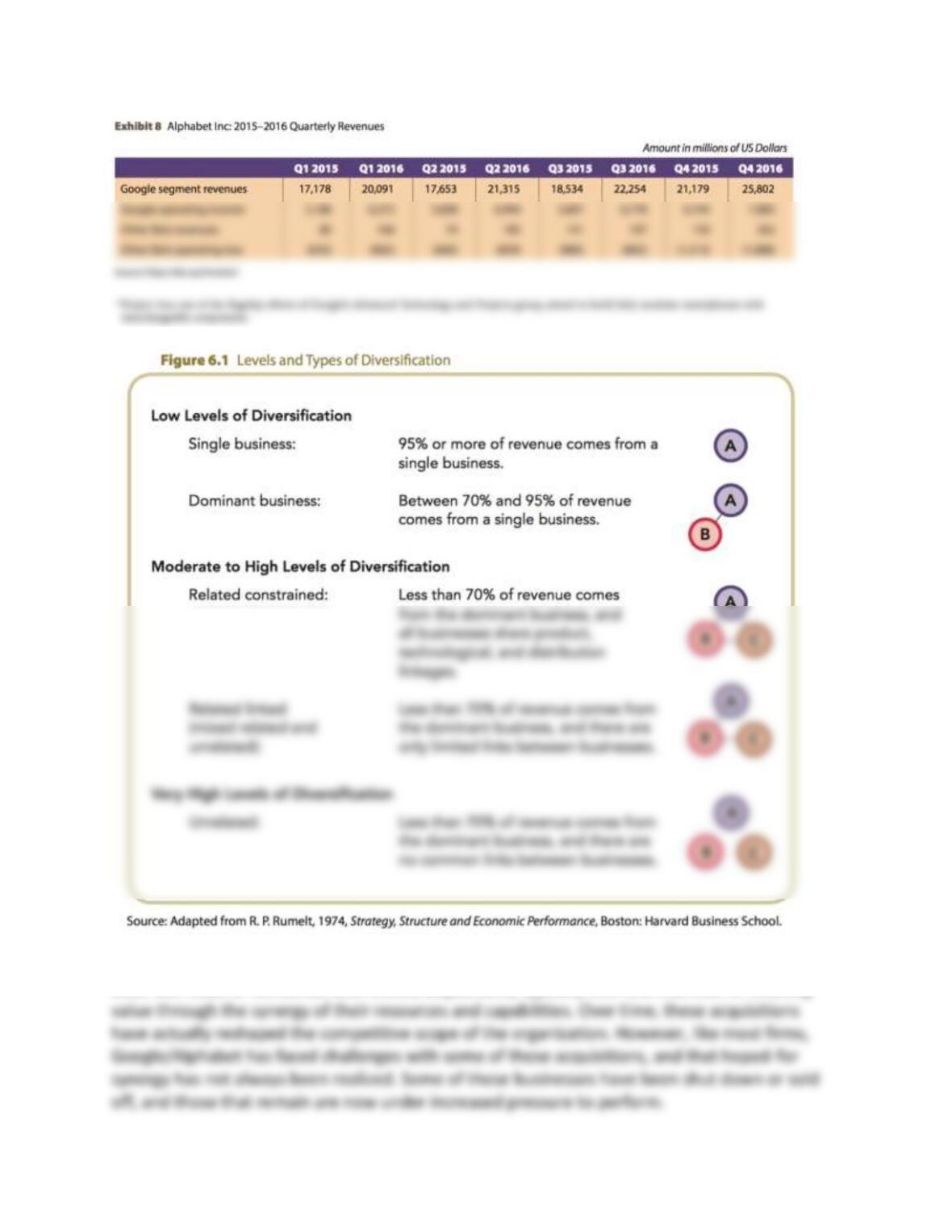
While some of Google/Alphabet’s new businesses have been developed internally, many have
been the result of horizontal and related acquisitions, typically with the intention of creating
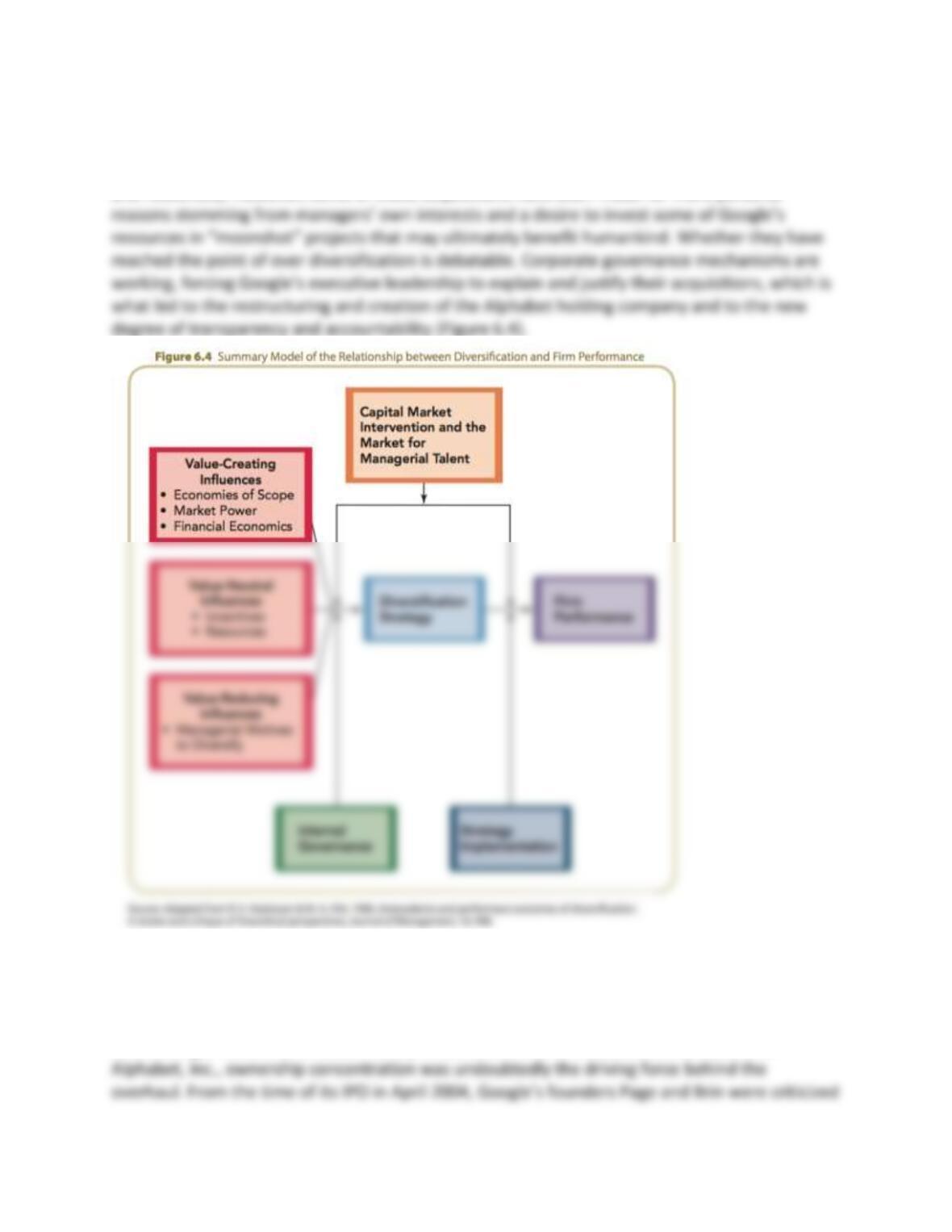
Larry Page and other top-level managers have pursued diversification for a variety of both
value-creating motives (market power and financial gain) and value-neutral motives (incentives
and resources). However, some of these acquisitions have been made for more personal
2. In the years leading up to 2015, which internal governance mechanism most heavily
influenced Google’s top-level managers to restructure the company and create a new
parent holding company, Alphabet?
While Google’s board of directors surely influenced the firm’s decision to restructure as
3. Briefly explain what type of structure the new Alphabet, Inc. is using, and describe four
of the six specific outcomes top-level managers and analysts expected from this
restructuring.
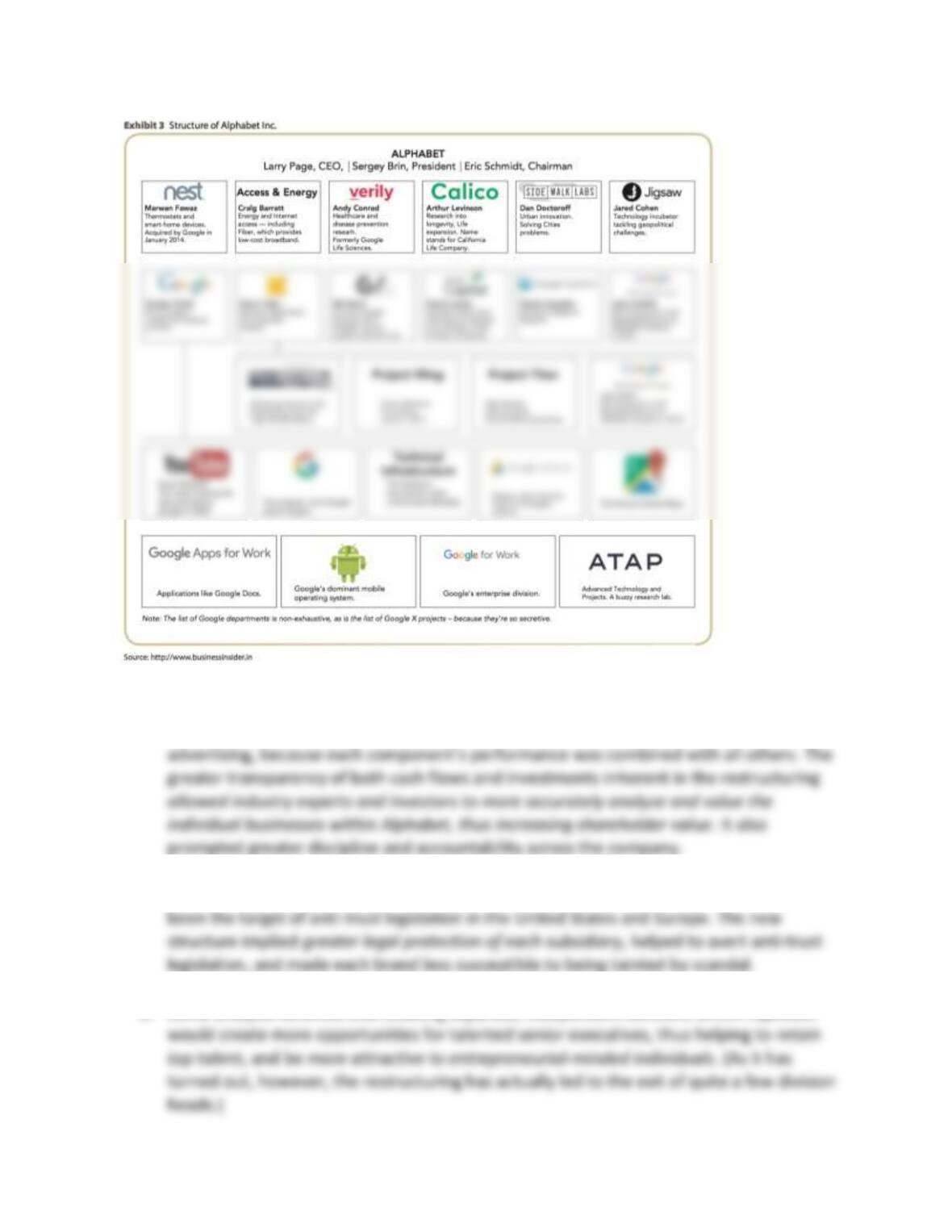
Alphabet, Inc. consists of a corporate office and operating divisions, each representing a
separate business or profit center in which responsibilities for day-to-day operations and
Google insiders as well as industry analysts identified six specific outcomes that could be
expected from this new structure:
1. The multidivisional (M-form) structure gave each division within Alphabet greater
autonomy and decision-making power, which made the businesses more nimble and
3. Prior to the restructuring, Google did not have to disclose specific information regarding
individual components of its business, such as YouTube, mobile search, and online
4. Over the years, Google as a single entity had come under intense legal scrutiny and had
5. Some analysts believed that creating separate, independent divisions within Alphabet
4. How has the relationship between structure and corporate-level strategy at Google
changed over time? How have these transitions affected the organization, and how do
you think Alphabet will respond to the new structure in the future?
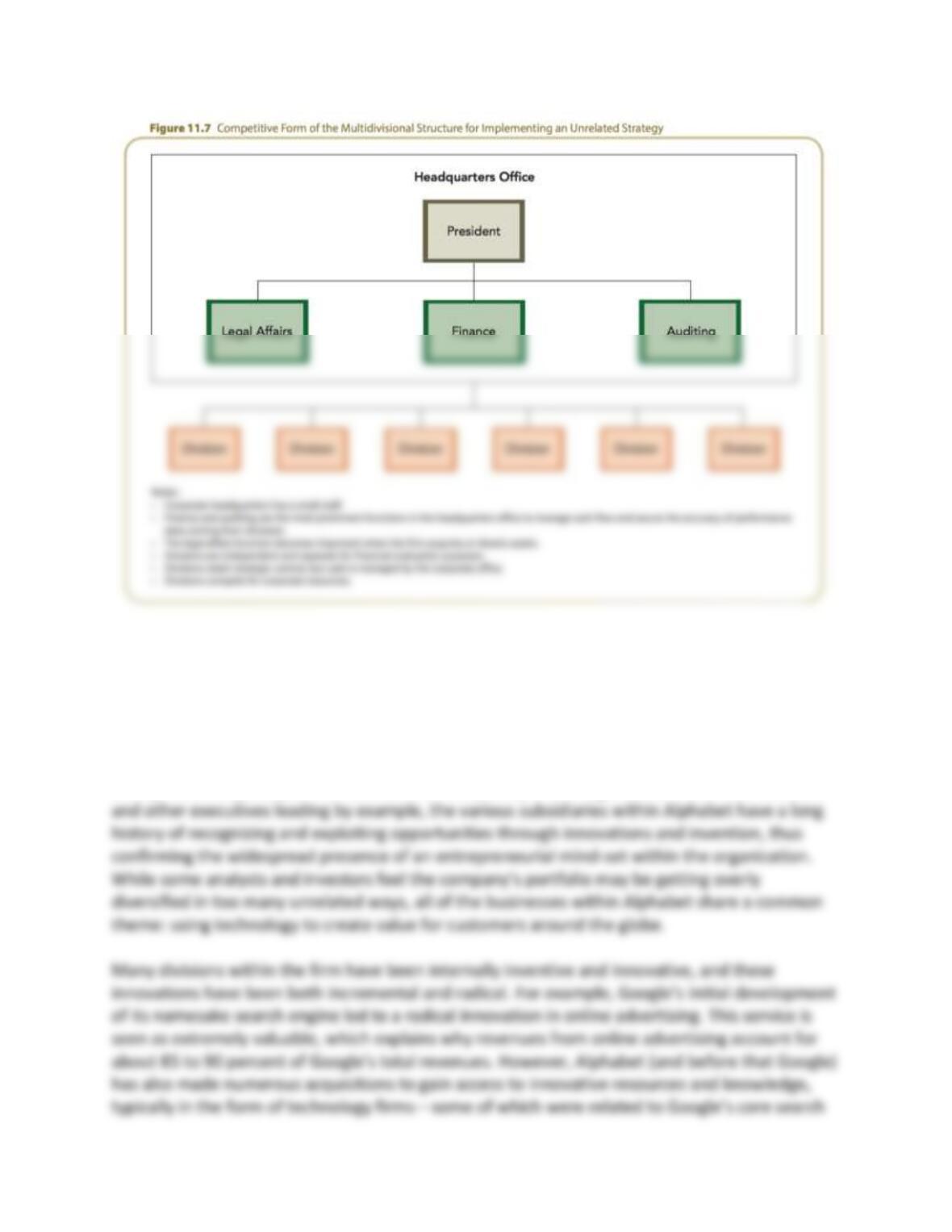
For many years, Google used a functional structure, but as the company grew and diversified,
its structure no longer matched its strategy, causing a breakdown. It was inevitable that the
Eventually, however, Alphabet’s new structure can be expected to result in an efficient internal
capital market. Alphabet can expect to enjoy three benefits: First, it will be more flexible, with
various divisions creating, bringing in, and working on different projects while corporate
headquarters determines which of those have the greatest potential and deserve more capital.
5. How would you characterize the level of corporate entrepreneurship within Alphabet?
Name several examples of how the firm exhibits an entrepreneurial mind-set and
creates value for customers.
Founded by entrepreneurs Larry Page and Sergei Brin in 1998, Google, now a subsidiary of its
parent holding company called Alphabet, Inc., still exhibits a high level of corporate
entrepreneurship, despite the vast size and complexity of the organization. With the founders
6. Google, now Alphabet, is known for sponsoring quite a few “moonshot” projects,
which are bold, risky, and typically expensive explorations into innovations that will
hopefully generate value-adding products and services but that may or may not pay
out in the long run. Should investors support this type of project? Why or why not?
Students’ answers will vary, but they need to support their opinion with logical reasoning. Some
of Alphabet’s moonshot projects include Project Loon (delivering Internet service to developing
Additional Resources
Reuters’s company profile gives in-depth background on Alphabet’s current financials,
leadership, valuation, news, and more: