Solutions for Chapter 1: Questions and Problems
CHAPTER 1
THE INVESTMENT SETTING
Answers to Questions
1. When an individual’s current money income exceeds his current consumption desires, he
saves the excess. Rather than keep these savings in his possession, the individual may
consider it worthwhile to forego immediate possession of the money for a larger future
2. Students in general tend to be borrowers because they are typically not employed so have
no income, but obviously consume and have expenses. The usual intent is to invest the
3. In the 20-30 year segment an individual would tend to be a net borrower since he is in a
relatively low-income bracket and has several expenditures – automobile, durable goods,
etc. In the 30-40 segment again the individual would likely borrow since his expenditures
4. The saving-borrowing pattern would vary by profession to the extent that compensation
patterns vary by profession. For most white-collar professions (e.g., lawyers) income
would tend to increase with age. Thus, lawyers would tend to be borrowers in the early
Solutions for Chapter 1: Questions and Problems
5. The difference is because of the definition and measurement of return. In the case of the
Globe and Mail, they are only referring to the current dividend yield on common stocks
6. The variance of expected returns represents a measure of the dispersion of actual returns
around the expected value. The larger the variance is, everything else remaining constant,
7. An investor’s required return is a function of the economy’s risk free rate (RFR), an
inflation premium that compensates the investor for loss of purchasing power, and a risk
premium that compensates the investor for taking the risk. The RFR is the pure time
8. Three factors that influence the nominal RFR are the real growth rate of the economy,
liquidity (i.e., supply and demand for capital in the economy) and the expected rate of
inflation. Obviously, the influence of liquidity on the RFR is an inverse relationship,
while the real growth rate and inflationary expectations have positive relationships with
Solutions for Chapter 1: Questions and Problems
9. The five factors that influence the risk premium on an investment are business risk,
financial risk, liquidity risk, exchange rate risk, and country risk.
Business risk is a function of sales volatility and operating leverage and the combined
effect of the two variables can be quantified in terms of the coefficient of variation of
operating earnings. Financial risk is a function of the uncertainty introduced by the
10. The increased use of debt increases the fixed interest payment. Since this fixed
11. According to the Capital Asset Pricing Model, all securities are located on the Security
Market Line with securities’ risk on the horizontal axis and securities’ expected return on
its vertical axis. As to the locations of the five types of investments on the line, the U.S.
government bonds should be located to the left of the other four, followed by U.K.
government bonds, low-grade corporate bonds, common stock of large firms, and

Solutions for Chapter 1: Questions and Problems
12. If a market’s real RFR is, say, 3%, the investor will require a 3% return on an investment
since this will compensate him for deferring consumption. However, if the inflation rate
13. Both changes cause an increase in the required return on all investments. Specifically, an
increase in the real growth rate will cause an increase in the economy’s RFR because of a
higher level of investment opportunities. In addition, the increase in the rate of inflation will
result in an increase in the nominal RFR. Because both changes affect the nominal RFR,
Common Stock of Large Firms
NRFR
Canadian Government Bonds
U.K. Government Bonds
Low Grade Corporate Bonds
Expected
Return
Expected Risk
Common Stock of Japanese Firms
Security Market Line

Solutions for Chapter 1: Questions and Problems
14. Such a change in the yield spread would imply a change in the market risk premium
15. The ability to buy or sell an investment quickly without a substantial price concession is
known as liquidity. An example of a liquid investment asset would be a T-bill. A T-bill
can be bought or sold in minutes at a price almost identical to the quoted price. In
contrast, an example of an illiquid asset would be a specialized machine or a parcel of
Expected

Solutions for Chapter 1: Questions and Problems
– 6 –
CHAPTER 1
Answers to Problems
For Problem #1: HPR = 1.191
19.1% .191 1 – 1.191 1 – HPR HPY
191.1
34
50.40
34
1.50 39
Investment of Value Beginning
Flows)Cash (including Investment of Value Ending
HPR .1
====
==
+
=
=
1
Inflation of Rate1
Return Period Holding
Return of Rate Real““ 4. −
+
=

Solutions for Chapter 1: Questions and Problems
– 7 –
Stock T is more desirable because the arithmetic mean annual rate of return is higher.
016.
5
.08
5
)04(.)02(.)09.()03(.)08(.
AM
054.
5
.27
5
)15(.)03.()12.()08(.)19(.
AM
n
HPY
(AM)Mean cArithemeti a).(5
B
T
i
n
1i
==
++−++
=
==
+−+−++
=
=
=
Solutions for Chapter 1: Questions and Problems
By this measure, B would be preferable
5(d). Geometric Mean (GM) = 1/n – 1
where = Product of the HRs
GMT = [(1.19) (1.08) (.88) (.97) (1.15)]1/5 -1
= [1.26160] 1/5 –1 = 1.04757 –1 = .04757
GMB = [(1.08) (1.03) (.91) (1.02) (1.04)]1/5 -1
= [1.07383] 1/5 –1 = 1.01435 – 1 = .01435
05681.00323.
00323.5/01614.
01614.
00058.00002.01124.00020.00410.
)016.04(.)016.02(.)016.09.()016.03(.)016.08(.
B
2
22222
B
==
==
=
++++=
−+−+−−+−+−=
Solutions for Chapter 1: Questions and Problems
– 9 –
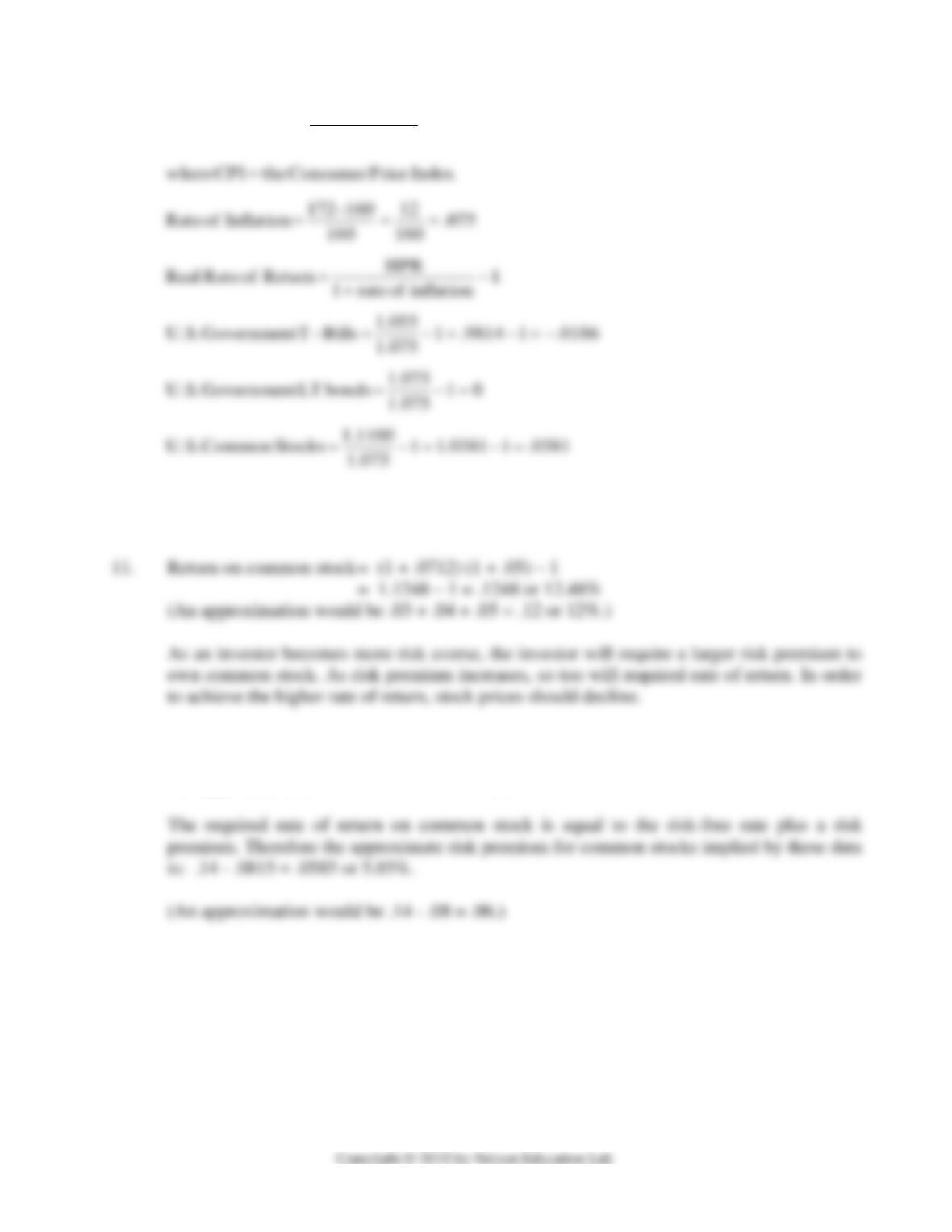
10. NRFR = (1 + .03) (1 + .04) – 1 = 1.0712 – 1 = .0712
(An approximation would be growth rate plus inflation rate or .03 + .04 = .07.)
12. Nominal rate on T-bills (or risk-free rate) = (1 + .03) (1 + .05) – 1
= 1.0815 – 1 = .0815 or 8.15%
(An approximation would be .03 + .05 = .08.)
CPI
CPI CPI
Inflation of Rate .9
n
n1n
−
=+